Benchmarking vs Competitive Analysis for AI Visibility
Compare benchmarking vs competitive analysis: definitions, metrics, methods, and when to use each for AI assistant visibility.
You can outrank a rival in search, publish stronger documentation, and still watch an AI assistant recommend that rival first. That happens because assistants often draw on third-party evidence you don't control, including reviews, comparison pages, and partner sites that describe the rival more often than they describe you. A rank table shows the loss. It doesn't prove the cause, and fixing the wrong cause wastes a quarter. That's the central distinction in Benchmarking vs Competitive Analysis for AI visibility, and it's why the two methods have to be paired in the right order.
Table of Contents
- Benchmarking vs Competitive Analysis Side by Side
- How Each Method Works in Practice
- Metrics Each Approach Relies On
- Choosing the Right Approach for AI Visibility
- Real Decisions Each Approach Informs
- Set Up Your First AI Visibility Benchmark
Benchmarking vs Competitive Analysis Side by Side
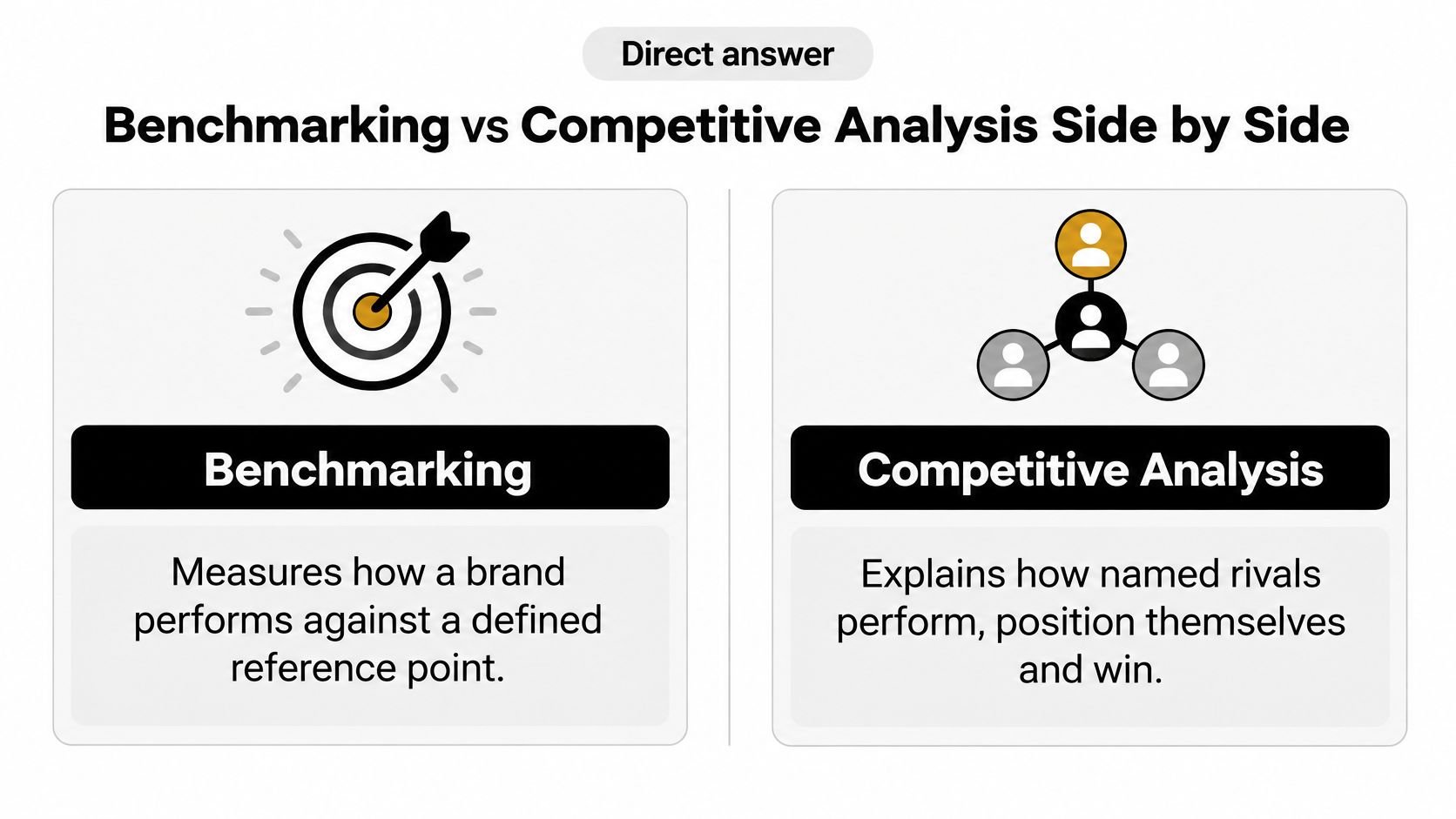
Benchmarking measures how a brand performs against a defined reference point. Competitive analysis explains how named rivals perform, position themselves, and win. Both can use the same prompts and AI providers, but their outputs differ. A benchmark yields a reference number and a measured gap. Competitive analysis yields an explanation and testable hypotheses about why that gap exists.
The distinction isn't new. According to Robert Camp's history of the Xerox benchmarking program, Xerox formalized modern benchmarking in 1979 after finding Japanese rivals, including Fuji Xerox, could sell high-quality copiers below Xerox's production cost, with their manufacturing costs estimated at 40-50% of Xerox's. The exercise began as competitive benchmarking, then widened to best practices across industries. By 1981 it was standard operating procedure, and by 1983 about 230 processes had been benchmarked.
Benchmarking vs Competitive Analysis at a Glance
| Dimension | Benchmarking | Competitive analysis |
|---|---|---|
| Core question | How do we compare on a defined metric? | How do named rivals win, position and sell? |
| Typical output | A measured gap against a reference target | A strategic explanation and testable hypotheses |
| Unit of analysis | Metrics such as share of voice, average rank and citation overlap | Positioning, messaging, pricing, citations and strengths |
| Reference point | Category leader, competitor median, industry average or own history | Specific named competitors |
| Review cadence | Recurring, on a fixed schedule | Triggered by events or reviewed quarterly |
| AI visibility example | Share of mentions trails the competitor median on the same prompt cohort | A rival is recommended after three independent review sites describe it and the brand is absent |
Read the table as a division of labour, not a contest. Benchmarking is accountable for comparability. If the prompts, providers, or period change between measurements, the gap isn't trustworthy. Competitive analysis is accountable for causality. If it can't point to the pages, wording, or pricing that plausibly produced the gap, it's commentary, not analysis.
Two Confusions to Drop
The first confusion is treating a rank table as a strategy. Knowing you're third on buyer prompts doesn't tell you whether to rewrite a landing page, earn reviews, or fix help content. The second is treating a review of a rival's messaging as a measurement. A sharp teardown of a competitor's homepage can't tell you whether the gap is widening, narrowing, or confined to one provider.
Pairing rule: Benchmarking shows where the gap is. Competitive analysis explains why it exists and whether it deserves action.
Teams that want to turn competitor insights into SaaS strategy usually need both moves in sequence, because insight without a baseline can't be prioritized and a baseline without insight can't be acted on.
Neither method outranks the other. Competitive analysis asks what the rival is doing, while benchmarking asks how far behind you are and what closes the gap.
How Each Method Works in Practice
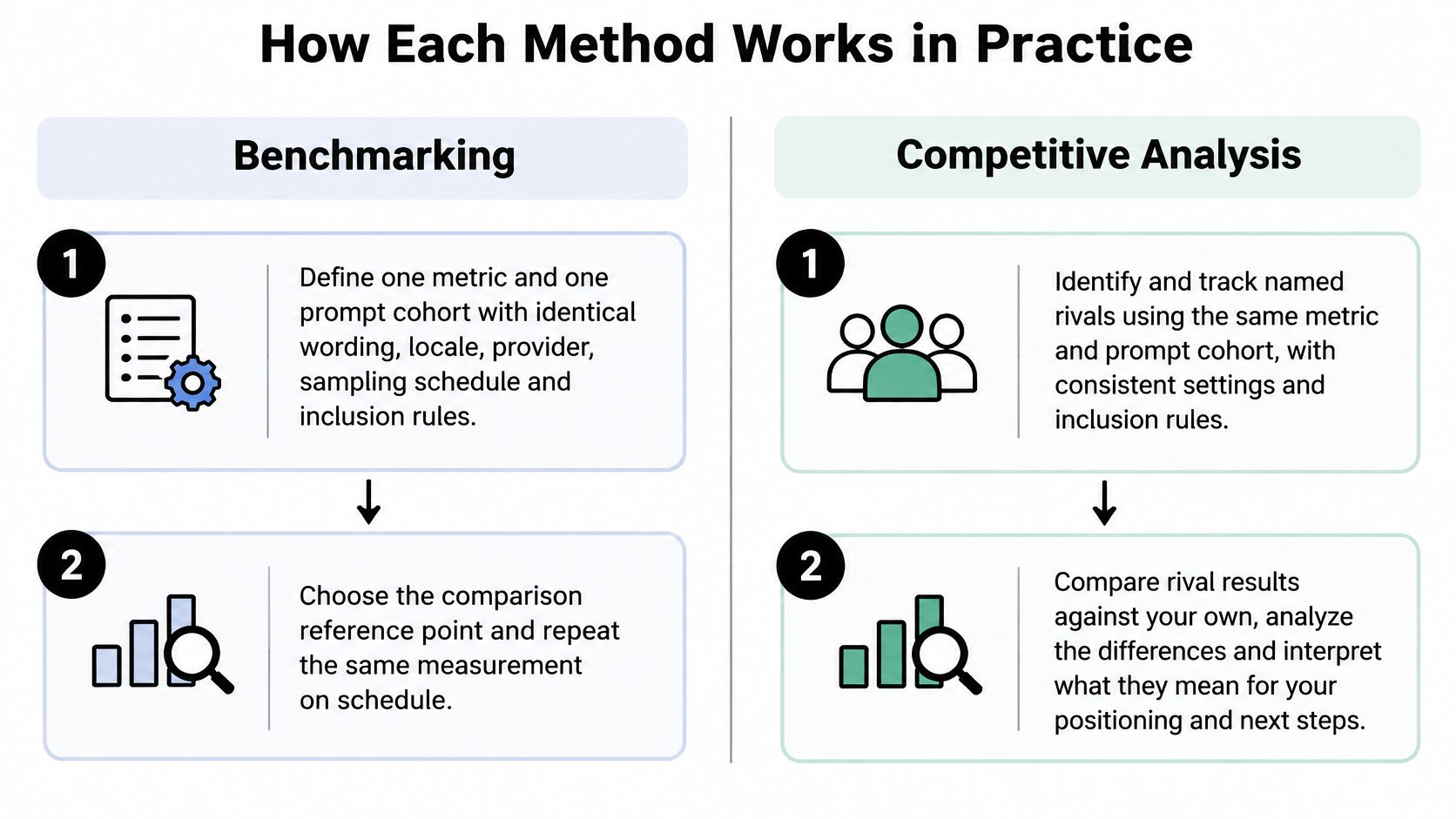
Run the two procedures in parallel but keep their jobs separate. One produces numbers you can defend. The other produces reasons you can test. Mixing them midstream, such as changing prompts because a rival launched a feature, corrupts the trend line you're trying to read.
Benchmarking Procedure
- Define one metric and one prompt cohort with identical wording, locale, provider, sampling schedule, and inclusion rules for every brand.
- Choose the reference set, whether that's named competitors, the competitor median, the category leader, or your own history.
- Collect over a fixed window long enough to smooth one-off model variance, not a single day's snapshot.
- Calculate normalized gaps, such as your share of mentions minus the competitor median, and the average rank difference on the same prompts.
- Set the target the gap should close toward, with a date and an owner.
This discipline matters because, as a Springer chapter on benchmarking practice describes it, benchmarking converts selected attributes into comparable measurements against defined competitors, industry averages, historical performance, or best-in-class organizations. Without identical conditions, apparent gaps may reflect query mix or model variance rather than actual visibility.
Competitive Analysis Procedure
- List the rivals that own your buyer-intent prompts, not every company in the category.
- Map how they're positioned, messaged, and priced where the AI answer describes them.
- Read the source URLs the answers cite for their favourable descriptions.
- Turn each observation into a testable hypothesis, such as a missing review profile or an unclear pricing page.
- Test one hypothesis at a time with a content, documentation, or review change, then re-measure.
For a worked method for the qualitative side, Contesimal's competitive analysis playbook is a useful companion, and our guide to structuring a competitive intelligence analysis covers how to organize the findings.
State your coverage in every report. Our provider checks are provider API checks and don't reproduce every consumer app experience, nor do they track Google AI Overviews, Google AI Mode, or Microsoft Copilot. A benchmark that hides its coverage invites readers to overgeneralize from it.
Metrics Each Approach Relies On
The same number does different work in each method. Benchmarking treats a metric as a comparison against a reference. Competitive analysis treats it as a clue to investigate. Confusing those roles is how teams end up optimizing a score instead of fixing a cause.
AI Visibility Metrics by Approach
| Metric | Benchmarking use | Competitive analysis use |
|---|---|---|
| Visibility (share of tracked answers where the brand appears) | Compare your share with the competitor median on identical prompts | Ask which prompts rivals own and why |
| Average position when recommended | Track rank difference on the same prompt cohort | Examine why the rival is placed first |
| Sentiment | Measure the distribution against a fixed baseline | Read the descriptive language and the sources behind it |
| Citation domain overlap | Count how many source domains you share with each rival | Identify the third-party pages that drive rival citations |
| Visibility over time | Track change across fixed reporting windows | Explain spikes after launches, reviews or pricing changes |
| AI-driven visits | Compare traffic and conversions by prompt segment | Judge whether a rival's gain changes real demand |
Two metrics get misread most often. Visibility is the share of tracked answers where the brand appears, and a visibility score describes only the responses collected for the chosen prompts, providers, and period, not every AI search. Position is the average rank when the brand is recommended, so it says nothing about prompts where you're absent entirely. A brand can hold a strong average position while appearing in very few answers. Our overview of LLM visibility tracking defines each metric in full.
From Checklists to Weighted Scores
Feature comparisons need the same rigour. As SI Labs' benchmarking guidance notes in distinguishing metric-driven comparison from broader competitive analysis, a yes or no checklist hides quality differences. Score each capability on an explicit scale instead.
- 0 means absent and 1 means basic or manual support.
- 2 means partial or limited-provider support.
- 3 means automated and multi-provider.
- 4 means advanced workflow or attribution.
Weight each score by buyer importance and business impact, and date-stamp the evidence behind it. Then place the weighted score beside performance metrics such as capability coverage, median time from detected visibility loss to alert, percentage of recommendations implemented, and attribution confidence.
A weighted feature score tells you what a product claims to do. Performance metrics tell you whether it works.
The output that reaches a roadmap meeting should be a prioritized gap register, scored as gap magnitude multiplied by customer importance multiplied by business impact, divided by implementation effort, with a confidence modifier for evidence quality. That formula stops teams copying a rival's feature list and surfaces the gaps that affect discovery, conversion, retention, or trust.
Choosing the Right Approach for AI Visibility
Pick the method after you name the decision. Three questions cover most AI visibility choices, and each points to a different method. Benchmarking answers how visible the brand is relative to a baseline. Competitive analysis answers why a competitor appears more often or more favourably. Deciding which intervention is most likely to improve business outcomes needs both methods plus evidence of downstream results.
Which Approach to Start With by Situation
| Situation | Start with | Why |
|---|---|---|
| Tracking whether AI visibility is improving quarter to quarter | Benchmarking | Fixed prompts produce comparable trend lines |
| A rival suddenly appears in buyer comparison prompts | Competitive analysis | You need the sources and wording behind the change |
| Setting a target for share of mentions | Benchmarking | It needs a competitor median or leader as the reference |
| Deciding whether to publish a comparison page | Competitive analysis, then benchmarking | Explain the gap first, then measure the impact |
| Reporting AI channel health to executives | Benchmarking | The same definitions produce repeatable figures |
| Choosing which competitor to target first | Competitive analysis | It needs qualitative overlap of buyer prompts |
Conventional SEO rankings can mislead this choice. Authority does not guarantee inclusion in AI answers. A brand can beat rivals on domain strength and still lose AI visibility when independent reviews and comparison pages describe the rival more often. That gap is often built from third-party evidence the brand does not control and the rival benefits from. A rank table shows the size of the gap. Causal competitive analysis shows which sources produced it and whether your own pages can fix it.
That distinction changes the first move. If the benchmark gap is driven by third-party mentions, rewriting your own pages is the wrong first intervention. Customers can add competitor brands in MyMentions and compare share of voice and sentiment against them, which makes the first question cheap to answer before you invest in the second. Benchmarking and competitive analysis also sit inside a wider set of research methods; SurveySparrow's overview of market research methods shows where each fits.
Use benchmarking when the question concerns trend or target. Use competitive analysis when it concerns a sudden change or a named rival. For the boundary between these methods and broader market research, see our comparison of competitive intelligence vs market research.
Real Decisions Each Approach Informs
The pairing earns its keep when it changes a decision. Three typical scenarios show where the benchmark ends and the investigation begins.
The first scenario shows a benchmark gap traced to sources the brand doesn't own.
Scenario One The Missing Reviews
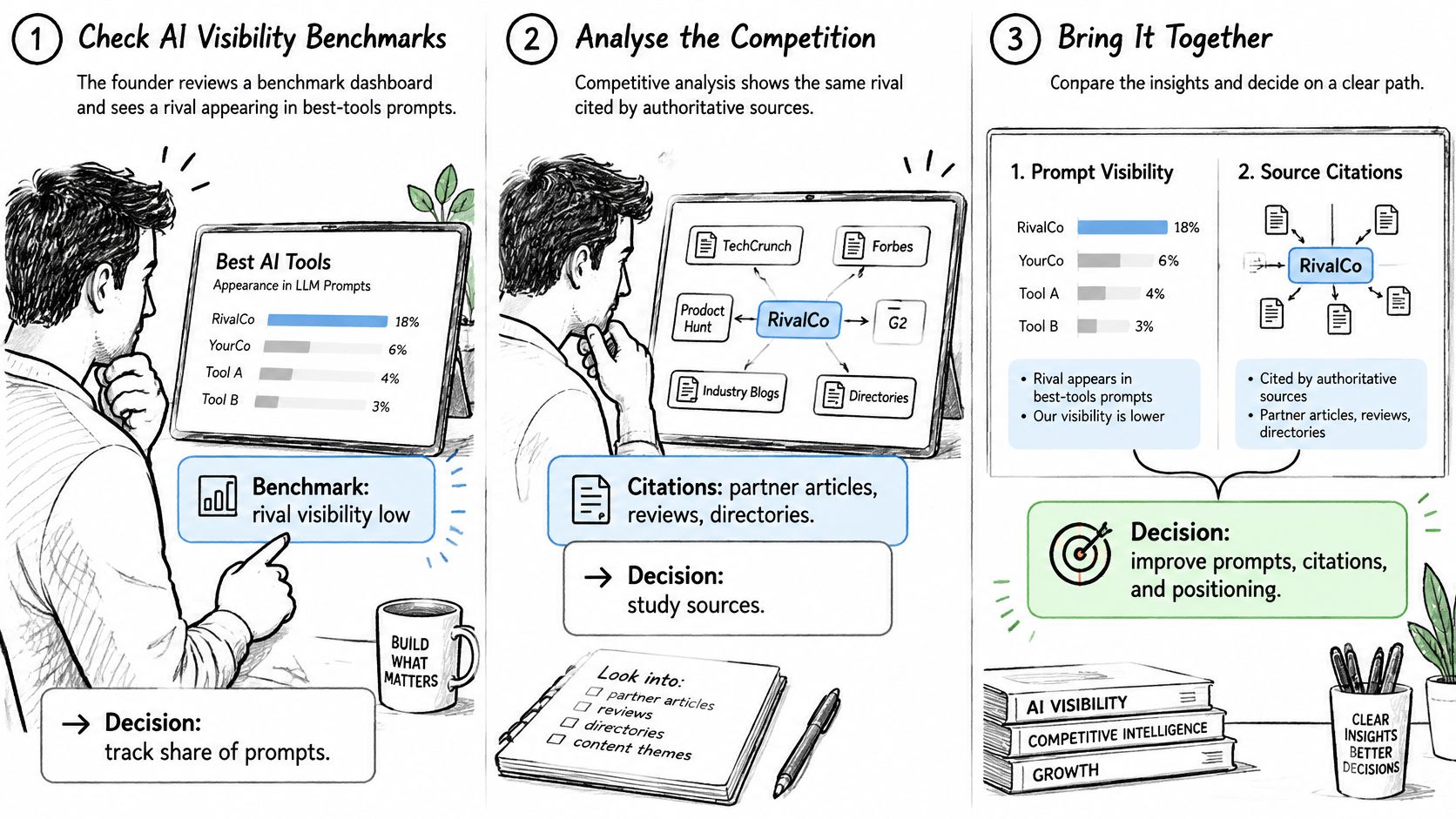
Say a SaaS founder's benchmark shows a rival recommended in best-tools prompts while the founder's product is absent. Competitive analysis reveals the rival is cited from three independent review pages the founder lacks entirely. The decision is to pursue third-party reviews before rewriting documentation, because the evidence assistants rely on lives on sites the founder doesn't control. Pro and Enterprise plans include citation source analysis, which reviews the source URLs returned with AI answers alongside brand mentions, so this check doesn't require manual sampling.
Scenario Two The Narrow Gap
Say a growth marketer finds the visibility gap only on high-intent comparison prompts in a single provider, while informational prompts look healthy. Averaging all prompts together would bury the problem. The decision is to rebuild the comparison pages and re-benchmark that cohort alone, so the next measurement isolates whether the change worked. Our guide to competitive analysis and strategies covers how to sequence moves like this.
The short walkthrough below shows how a team moves from a measured gap to a specific page-level change.
Scenario Three The Stale Documentation
Say a product team sees citation sources pointing to outdated help content that describes retired features. The decision is to update the docs and correct the descriptions assistants repeat. Pro and Enterprise plans include customized site, content, and UX recommendations, but those are suggestions to investigate and don't guarantee a change will increase mentions.
Conversion check: An AI traffic visit is separate from a mention, signup, or purchase, and completed conversions must be measured in your analytics or billing system.
Treat small traffic movements cautiously. Missing referrers, blocked scripts, and source classification can affect tracking coverage, so a modest change in AI visits may reflect measurement limits rather than demand. Confirm any claimed win against signups or revenue before scaling the intervention.
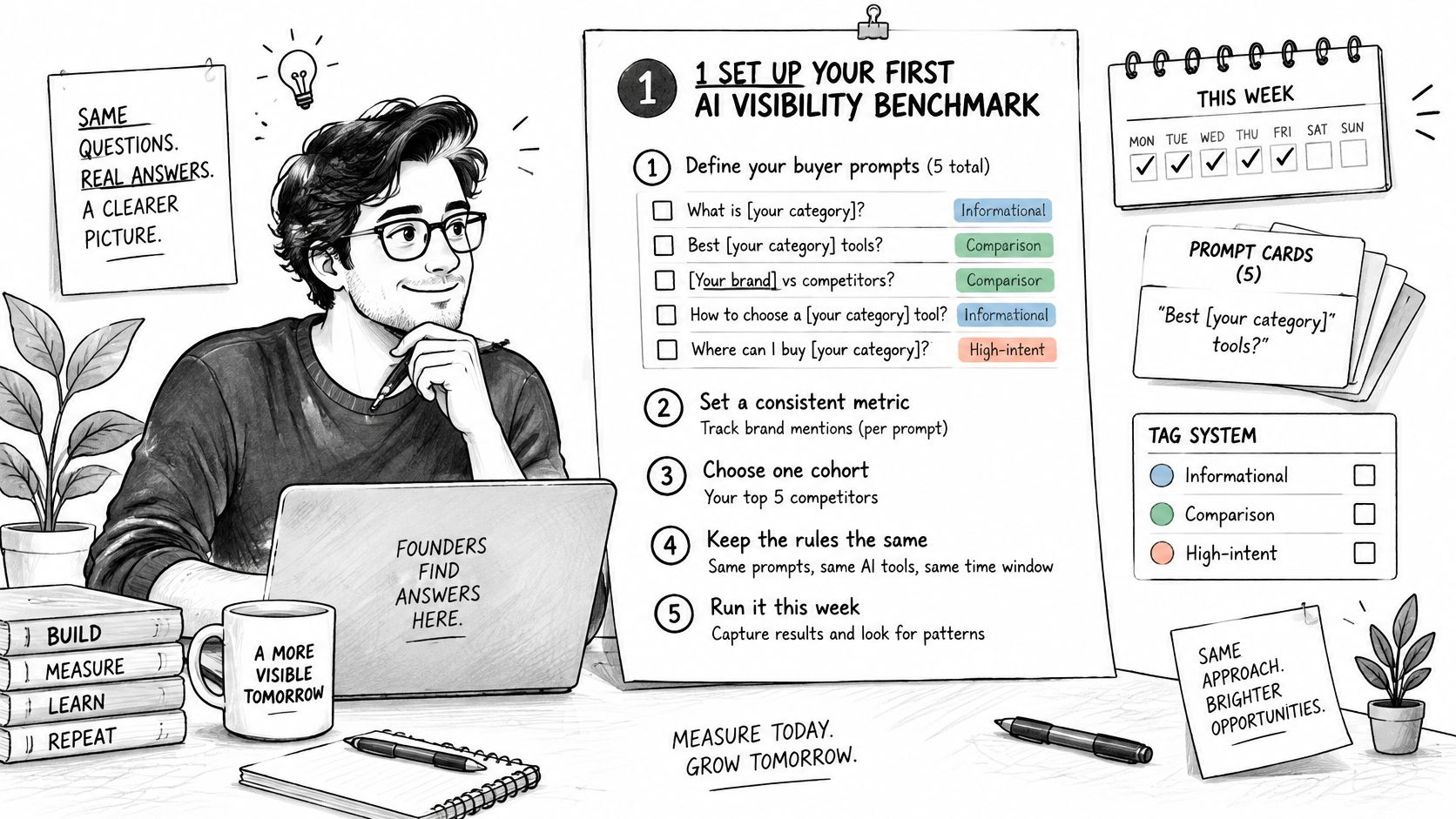
Set Up Your First AI Visibility Benchmark
A first benchmark should be small, fixed, and boring. Excitement belongs in the decisions it supports, not in a methodology that changes every week.
The setup below moves from prompt selection through to a monthly decision habit.
Seven Setup Steps
- Choose a starting set of buyer prompts, for example five, and tag each as informational, comparison, or high-intent, because a segmented benchmark reveals what an average hides. Our library of prompt examples helps with wording.
- Add three to five named competitors that appear in answers to those prompts.
- Select the providers you care about, knowing one prompt checked against one provider uses one daily check, so five prompts across three providers use 15 daily checks, within the Starter plan's 25.
- Run a four-week baseline with identical wording, locale, and schedule before changing anything.
- Set investigation thresholds, such as a sustained change in share of voice or average position on one cohort, so noise doesn't trigger work.
- Connect the tracking script and measure whether AI visits lead to signups or purchases in analytics or billing.
- Review the gap register monthly and choose one intervention per gap, then re-measure that cohort.
To get started, you create a product, choose a plan, and then see how AI assistants mention, rank, and describe your brand. Every paid plan starts with a 7-day free trial, so you can test the setup before committing. Teams coming from social reporting may also find a benchmarking playbook for social teams a helpful parallel for setting review cadences.
End the setup by naming the decision it supports. For your top-priority gap, will you fix it now, or investigate its cause first? If you can't name the cause with evidence, investigate. The baseline exists to make that call.
Set up your first benchmark in MyMentions by adding your buyer prompts and three to five competitors, then compare visibility, average position, sentiment, and citation sources across providers on a fixed schedule. When a gap appears, you'll have both the measured reference point and the source evidence needed to decide whether the fix belongs in your docs, your comparison pages, or third-party coverage. Start your trial today and turn your first four-week baseline into a prioritized gap register your team can act on.