
Pew Research Center found that 58% of U.S. respondents searched at least once for a result that included an AI-generated summary, while 65% saw an AI reference somewhere on a results page. LLM visibility tracking is the ongoing measurement of how often, where, and how accurately AI assistants surface, recommend, and cite a brand across prompts. The clearest way to measure it is to separate six signals: retrieval, mention, rank, sentiment, citation, and referral.
That distinction matters because an AI answer can shape a buyer's view before they click anything. A brand might be retrieved but left out of the response, mentioned without a recommendation, or recommended with a citation to someone else's page. Each outcome points to a different problem, and a single visibility score can hide the difference.
Table of Contents
- Why LLM Visibility Tracking Is the New Search Ranking
- The Six Core Metrics of LLM Visibility Tracking
- How Visibility Actually Happens Inside an AI Pipeline
- Three Measurement Approaches and When to Use Each
- Connecting Visibility Data to Analytics and SEO Workflows
- Why Confidence Intervals Matter More Than Rankings
- Two Real Use Cases and the Backlogs They Produce
- A Practical Checklist for Getting Started This Quarter
Why LLM Visibility Tracking Is the New Search Ranking
AI answers now appear within familiar search journeys, not just in chatbot tabs. Pew's browsing study found that 58% of U.S. respondents conducted at least one search-engine query that produced an AI summary alongside traditional results, and 65% encountered an AI reference somewhere on a results page. Only 13% visited an AI chatbot website at least once during the month, rising to 20% among adults aged 18–29, which helps explain why chatbot traffic alone can't represent AI discovery. Pew Research Center's analysis of web browsing
Commercial referrals reinforce the shift. Adobe reported that U.S. web traffic from AI-driven referrals increased more than tenfold between July 2024 and February 2025, while referrals to U.S. retail websites rose 12 times during that period. Adobe also reported that 36% of generative-AI users said they had replaced traditional search with AI assistants. Adobe's analysis of AI-driven referral traffic
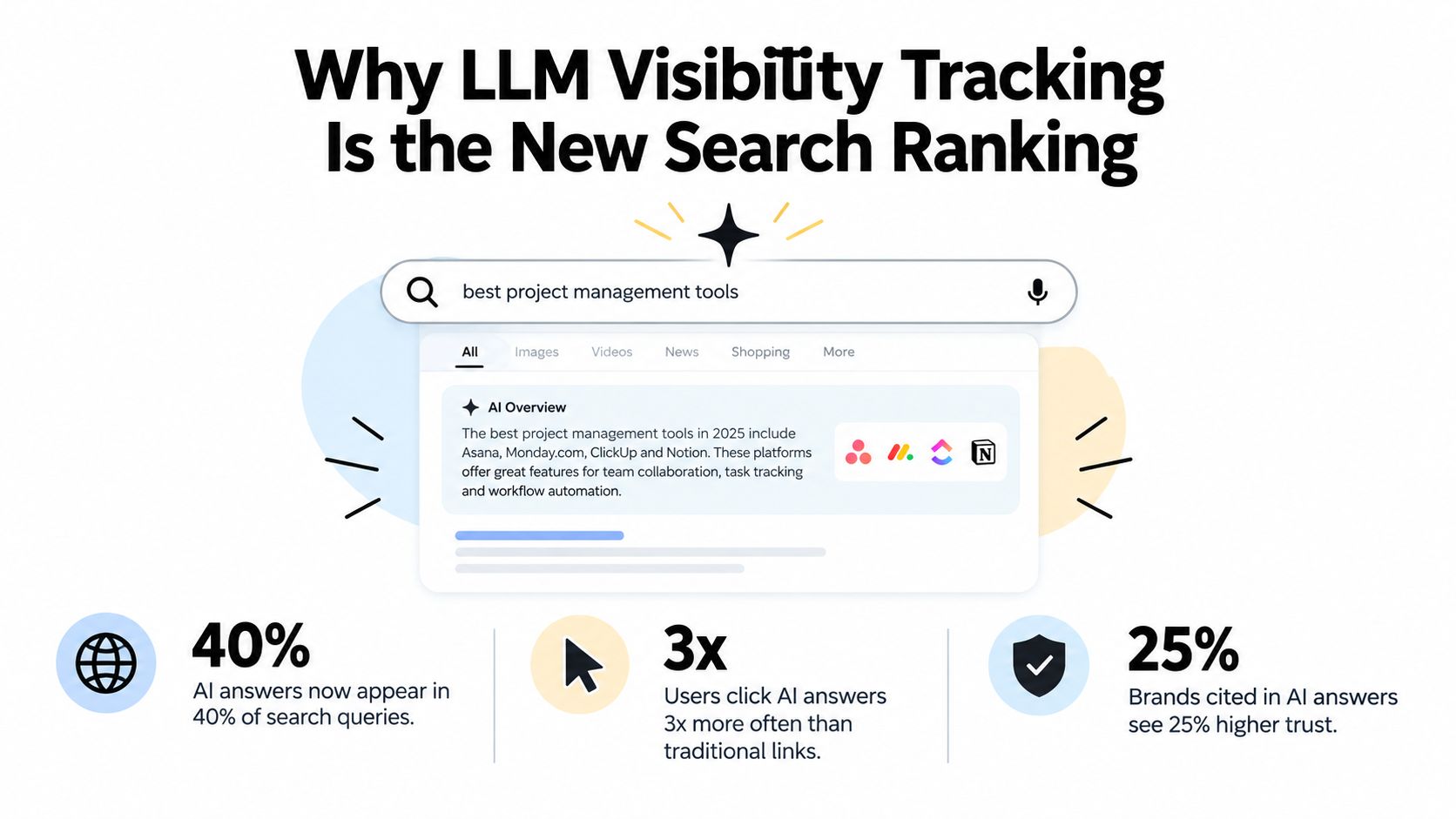
Traditional rank tracking is therefore an incomplete proxy. A brand can appear in an AI summary, influence a recommendation, or earn a referral without holding a conventional organic-search position. And a high-ranking page doesn't guarantee that an assistant retrieves or uses it.
Treat organic rank as one part of a broader discovery picture. LLM visibility tracking adds a way to measure what happens when systems select sources, compose answers, describe brands, and send visitors onward. By tracking these outcomes together, teams can distinguish visibility from influence, and influence from measurable site activity.
The Six Core Metrics of LLM Visibility Tracking
Think of AI visibility as a chain of events, not a single score. A system has to find relevant information, include a brand in its answer, place that brand within the response, describe it in a particular way, credit sources, and sometimes send users to a website.
Retrieval presence records whether a brand's content or a relevant source is found for a prompt. For example, a product guide may be retrieved for a question about project-management software but never appear in the final response.
Answer inclusion, or mention rate, measures whether the brand appears in the generated answer. A platform that's named in a comparison has earned inclusion, even if it isn't recommended.
Rank or position captures where the brand appears in the response. If the answer lists several tools, a brand named first is positioned differently from one placed near the end.
Sentiment describes the tone and framing around the brand. An assistant might call a product easy to configure, or mention it with reservations about its fit for larger teams.
Citation ownership tracks which sources receive credit for claims about the brand. An answer can recommend a company while citing a review site or competitor's comparison page instead of the company's own documentation.
Referral measures visits that arrive from AI-driven sources. For example, an analytics team might see an AI referral session after an assistant links to a product page.
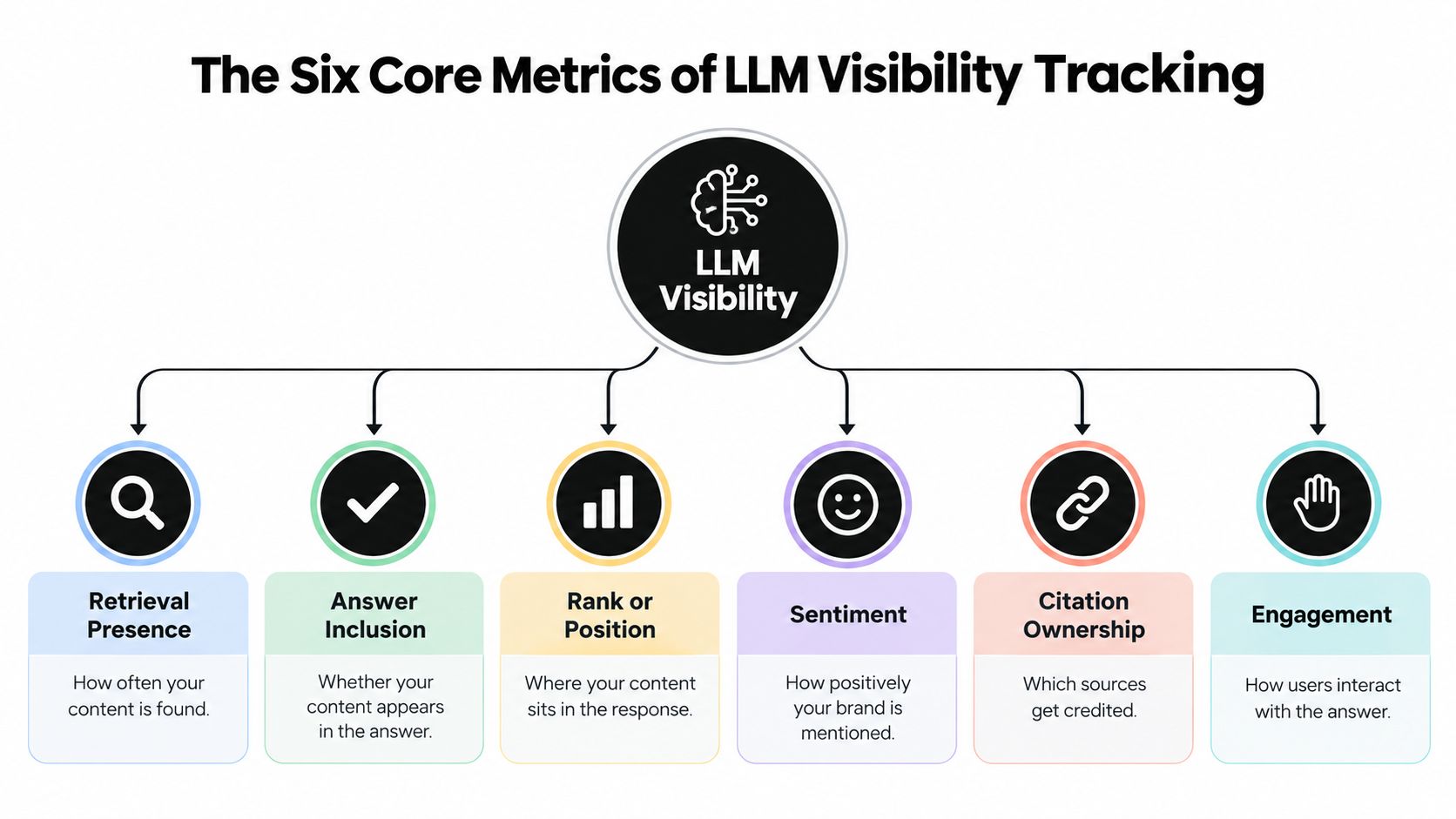
A brand can win a mention and lose citation ownership. Another can earn a citation without becoming a recommendation. One composite score can't show which outcome needs fixing.
For a useful dashboard, keep the six signals separate and connect each to an owner. Teams building broader reporting can use GTM dashboard examples from The Social Search as a reference for organizing measures around decisions, rather than collecting charts for their own sake. For competitor comparisons, a dedicated AI share-of-voice framework can help teams distinguish their brand's presence from the wider category conversation.
Some metrics will feel familiar. Position echoes rank tracking, sentiment resembles the quality of a search snippet, and citations offer a partial analogue to backlinks. Retrieval and answer inclusion are different questions: whether a source is available to the system and whether the answer uses the brand.
How Visibility Actually Happens Inside an AI Pipeline
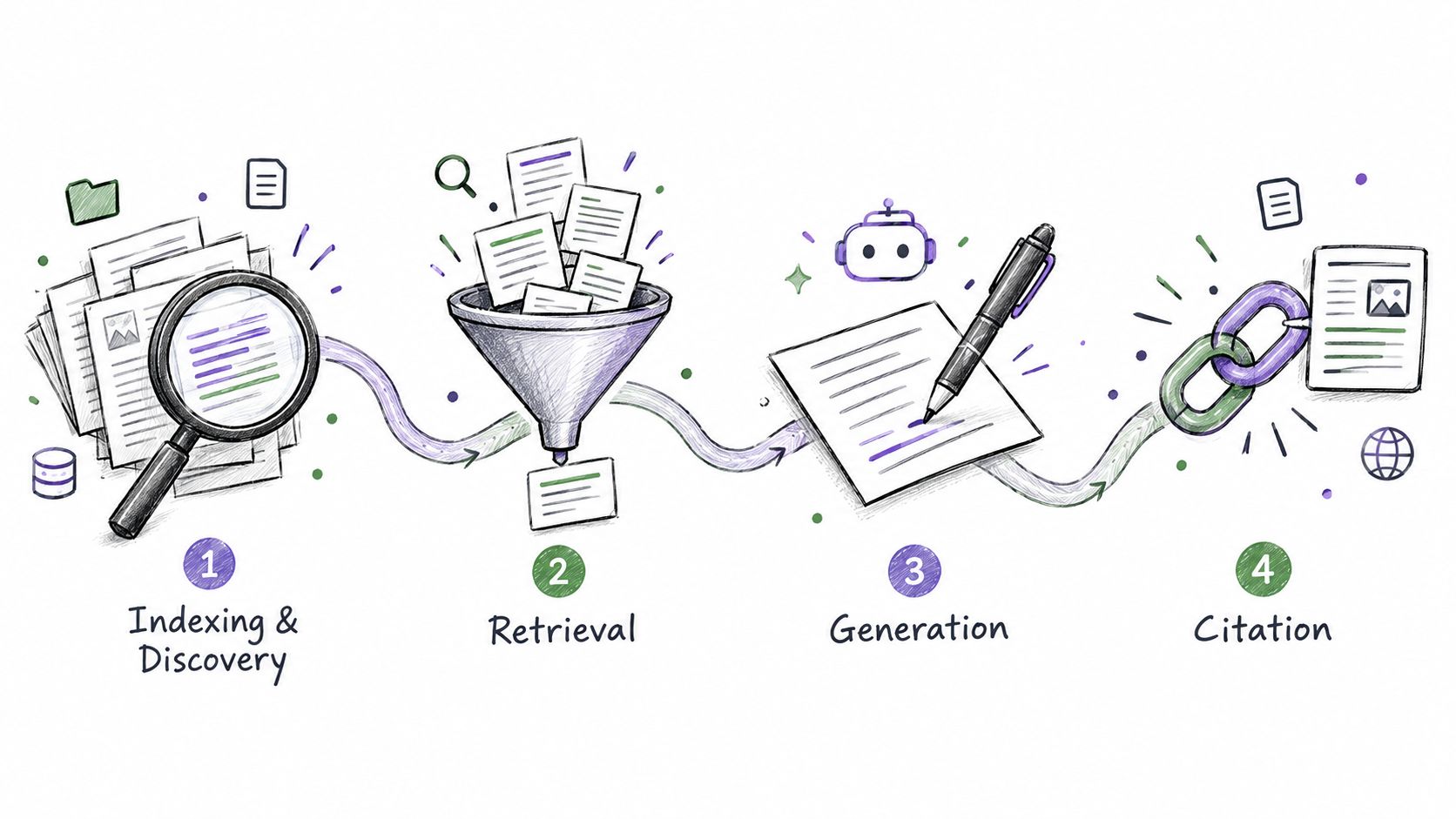
A missing signal is more useful when you can connect it to the stage that produced it. In a retrieval-augmented answer, an AI system typically needs to find sources, select relevant material, generate a response, and format any citations. The exact process differs across products, but the stages offer a practical way to diagnose a visibility drop.
Discovery and retrieval
Before an assistant can use a page, the page has to be findable and eligible for retrieval. If the brand's documentation never appears among retrieved sources, investigate indexing, accessibility, content structure, and whether authoritative pages clearly answer the prompt. A page that's difficult to crawl or vague about what the product does may not make the candidate set.
Prompt wording also matters. A buyer asking for a tool “for a small product team” may trigger different source discovery from someone asking for “an enterprise workflow platform.” A guide to query fan-out can help teams think through the related questions and subtopics a system may use to answer a buyer's initial prompt.
Selection and generation
Retrieval doesn't guarantee inclusion. The model still has to decide which evidence is relevant and turn it into an answer. If a source is retrieved but the brand isn't mentioned, check whether the page states the product's use cases, differentiators, and supporting evidence plainly enough to be selected.
A systematic review of retrieval-augmented generation evaluation treats context relevance, answer relevance, faithfulness, correctness, and citation quality as distinct dimensions. That distinction helps narrow the diagnosis: if the brand appears but the description is inaccurate, the issue may be how evidence is interpreted or how clearly the source supports the claim. Review of retrieval-augmented generation evaluation
Citation formatting
The system may use information without citing the page it came from. Save the retrieved URLs, the final citations, and the claim each citation is supposed to support. If the page appears in retrieval but not in the citations, investigate the clarity and directness of its evidence, then compare it with the third-party sources that received credit.
This pipeline turns a vague instruction to “improve AI visibility” into a more precise question: At what stage did the brand disappear, and what evidence would help it advance?
Three Measurement Approaches and When to Use Each
Teams don't need to build a complete measurement system from scratch. They can combine prompt testing, citation review, and analytics attribution, then choose the right method for the question at hand.
Prompt-level sampling tests a curated set of buyer-intent questions across AI providers. It's useful for measuring whether a brand appears, where it appears, how it's described, and how competitors compare. Its main trade-off is that results can vary between runs, so teams need consistent prompts and enough repeated observations to tell patterns from fluctuations.
Source-citation analysis focuses on the URLs and domains cited in responses. It helps content, SEO, and PR teams see which sources earn credit and whether citations support the answer. A benchmark covering more than 20,000 evidence-based question-answer pairs found accuracy varied by source type, with the highest accuracy for structured guidelines at about 90%, lower accuracy for narrative sources at about 70%, and the lowest for systematic reviews at roughly 50–60%. The same benchmark found that providing the top three retrieved articles increased accuracy by 23%. Benchmark on evidence sources and model accuracy
Referral and conversion analysis connects AI-sourced visits to on-site behavior and business outcomes. Adobe reported that AI-driven referrals to U.S. websites increased more than tenfold over the period described earlier, but referral volume alone doesn't establish qualified traffic or revenue impact. That's why analytics teams should track engaged visits and conversion assistance where their analytics setup supports it.
| Approach | Primary signals covered | Time to first insight | Relative cost | Best fit team |
|---|---|---|---|---|
| Prompt-level sampling | Retrieval, mention, position, sentiment | Quick once prompts are set | Moderate, depending on coverage and tooling | SEO, growth, and product marketing |
| Source-citation analysis | Citation ownership and source quality | Quick for a targeted prompt set | Moderate | Content, PR, and SEO |
| Referral and conversion attribution | Referral visits and conversion assistance | Depends on traffic and analytics setup | Low to moderate if analytics is already in place | Analytics and growth |
These are complementary approaches, not competing ones. Prompt results suggest where to investigate, citation reviews point to evidence gaps, and referral analysis tests whether visibility is leading to meaningful site activity. MyMentions can be one option for organizing prompt-level results, provider comparisons, cited sources, and traffic attribution within a shared workflow.
Connecting Visibility Data to Analytics and SEO Workflows
LLM visibility data becomes useful when it reaches the teams that can act on it. Start by defining a shared record for each prompt run: the prompt text, provider, timestamp, answer, brand mention, position, sentiment, retrieved or cited URLs, and any referral data you can connect. Keep raw answers alongside structured fields so analysts can check whether a score reflects what the assistant said.
A practical rollout has three steps:
- Send prompt-level events to a warehouse. Keep provider, prompt cohort, answer, and measurement fields together so analysts can compare like with like.
- Connect cited URLs to SEO workflows. Review whether those pages are crawlable, current, and supported by relevant sources. Share fixes with the content owner rather than leaving the citation report in a standalone dashboard.
- Put the measures beside existing performance data. In Looker or Looker Studio, show visibility changes alongside organic traffic and referral visits. The goal is to compare signals, not to collapse them into one metric.
For a typical operating rhythm, a morning alert can flag an unexpected change on a high-intent prompt. A weekly review with content and SEO can examine prompt cohorts and decide which pages need attention. A monthly leadership review can compare competitor positioning and assess whether referral activity supports the visibility story.
The video below can be used as a practical complement to that measurement workflow.
Alerts should identify what changed, where it changed, and who owns the next action. For a local-service example of how search work can connect to a defined industry, see this overview of SEO services for contractors. To evaluate visits alongside AI visibility measures, teams can also use an AI traffic analytics workflow that keeps referral behavior distinct from prompt-level exposure.
Why Confidence Intervals Matter More Than Rankings
A position estimate from one prompt run is an observation, not a stable truth. Identical questions can produce different answers and citations across time and providers, and apparent gaps between domains may fall within normal variation. Recent research examining repeated samples across Perplexity, OpenAI SearchGPT, and Google Gemini describes citation variability and unstable rankings among frequently cited domains. Study of citation and ranking variability across AI search
That makes run-to-run confidence an important part of the KPI. If a team sees a brand move up in average position, it should ask whether the change persists across repeated runs and comparable prompts. If the movement is no larger than the normal variation in those answers, rewriting a page or changing the PR plan may be premature.
Read the movement before acting
Track identical prompt cohorts over time and report the number of runs, provider, observed variance, and an interval around the estimate. Define a minimum detectable change before launching a project, so the team knows what kind of movement would justify action. These practices make it easier to separate a structural shift, such as a source entering retrieval, from an answer that changed wording on one run.
Teams that need a refresher on the reasoning can consult this practical guide to significance testing. The same discipline applies when people ask whether ChatGPT gives the same answers to everyone: the answer can vary, so a single output shouldn't carry the weight of a campaign verdict.
Decision rule: If the observed movement is smaller than ordinary run-to-run variation, report it as inconclusive and keep monitoring.
Confidence-aware reporting protects teams from overclaiming gains and prevents reactive changes based on noise. Sometimes the soundest recommendation from a visibility dashboard is to wait for more evidence.
Two Real Use Cases and the Backlogs They Produce
Consider a SaaS founder selling to developers. Their team finds that assistants cite the company's documentation in roundup answers but rarely recommend the product directly. That pattern suggests the documentation may be useful as evidence, while the company's category positioning or product fit isn't clear enough to turn a citation into a recommendation.
The resulting backlog would focus on explaining who the product serves and how it compares with alternatives. The team might improve comparison pages, clarify product use cases, and create developer-focused content that connects technical capabilities to buyer needs. The next prompt review can test whether the brand moves from source material to direct inclusion.
A consumer brand can face the opposite issue. Its products appear frequently in answers, but assistants cite competitor pages or third-party reviews instead of the brand's own product information. The brand is visible, yet it has limited ownership of the evidence supporting the recommendation.
That team's backlog might prioritize accurate product pages, useful partner content, and independent reviews that give assistants clearer evidence to cite. The team should check whether citations support the product claims, not just whether the brand appears more often.
The difference between these situations is why a diagnostic dashboard is more useful than a vanity score. One team needs stronger category association; the other needs better supporting sources. For a next step after diagnosis, teams can turn observations into a prioritized SEO recommendations backlog, assigning each fix to the people responsible for content, technical SEO, product marketing, or partnerships.
A Practical Checklist for Getting Started This Quarter
Use this checklist to connect each signal to an action and an owner:
- Retrieval: Check indexing, accessibility, and source discovery. Owner: SEO and technical teams.
- Mention: Clarify category fit and product use cases. Owner: product marketing.
- Rank: Strengthen relevant evidence and comparisons. Owner: content and SEO.
- Sentiment: Correct outdated or unclear brand information. Owner: brand and communications.
- Citation: Improve the clarity, currency, and support behind important claims. Owner: content, PR, and partnerships.
- Referral: Track AI-origin visits and how they behave on site. Owner: analytics and growth.
Create a prompt set around the questions buyers ask when comparing options, exploring a category, or looking for a recommendation. Keep the wording consistent between runs, and choose providers based on where your audience encounters AI answers and where your team can measure results. Start with a repeatable testing cadence, then add providers as the team can compare results consistently.
Make sample size and confidence part of the KPI, not an appendix. Record how many runs support each result, keep prompt cohorts consistent, and avoid calling a small movement a win until it stands apart from normal variation.
LLM visibility tracking treats AI assistants as a real discovery channel, with the same seriousness as organic search, paid media, and lifecycle marketing. Start by assigning an owner to each signal, then review the first prompt cohort with your SEO, content, and analytics teams.
MyMentions helps teams track AI visibility, position, sentiment, cited sources, and provider-level results, then organize findings into a prioritized backlog. Visit MyMentions to explore how its prompt tracking and reporting can fit into your measurement workflow.