Competitive analysis advice often stops at “know your rivals.” That's a useful starting point, but knowing what competitors offer won't improve your position unless the findings change a decision. A team needs to know which customer gap to address, what market position to defend, and which competitor move deserves a response.
The strongest competitive analysis and strategies connect structured diagnosis with customer evidence and execution. That means looking beyond features and conventional search rankings to understand how buyers compare options, what evidence supports each brand's claims, and how AI assistants describe the category. The approaches below pair classic frameworks with practical next steps, from SWOT analysis to prompt-level monitoring. For a broader process, see how to analyze competitors effectively.
Table of Contents
- 1. SWOT Analysis
- 2. Porter's Five Forces
- 3. Porter's Generic Competitive Strategies
- 4. Blue Ocean Strategy
- 5. Competitive Benchmarking
- 6. Competitive Battlecards
- 7. Win/Loss Analysis
- 8. Positioning Map
- 9. Share of Voice and Share of Model Analysis
- 10. Competitor Monitoring and Early-Warning Alerts
- 10 Competitive Analysis & Strategy Frameworks Compared
- Turn Insight Into a Competitive Action Plan
1. SWOT Analysis
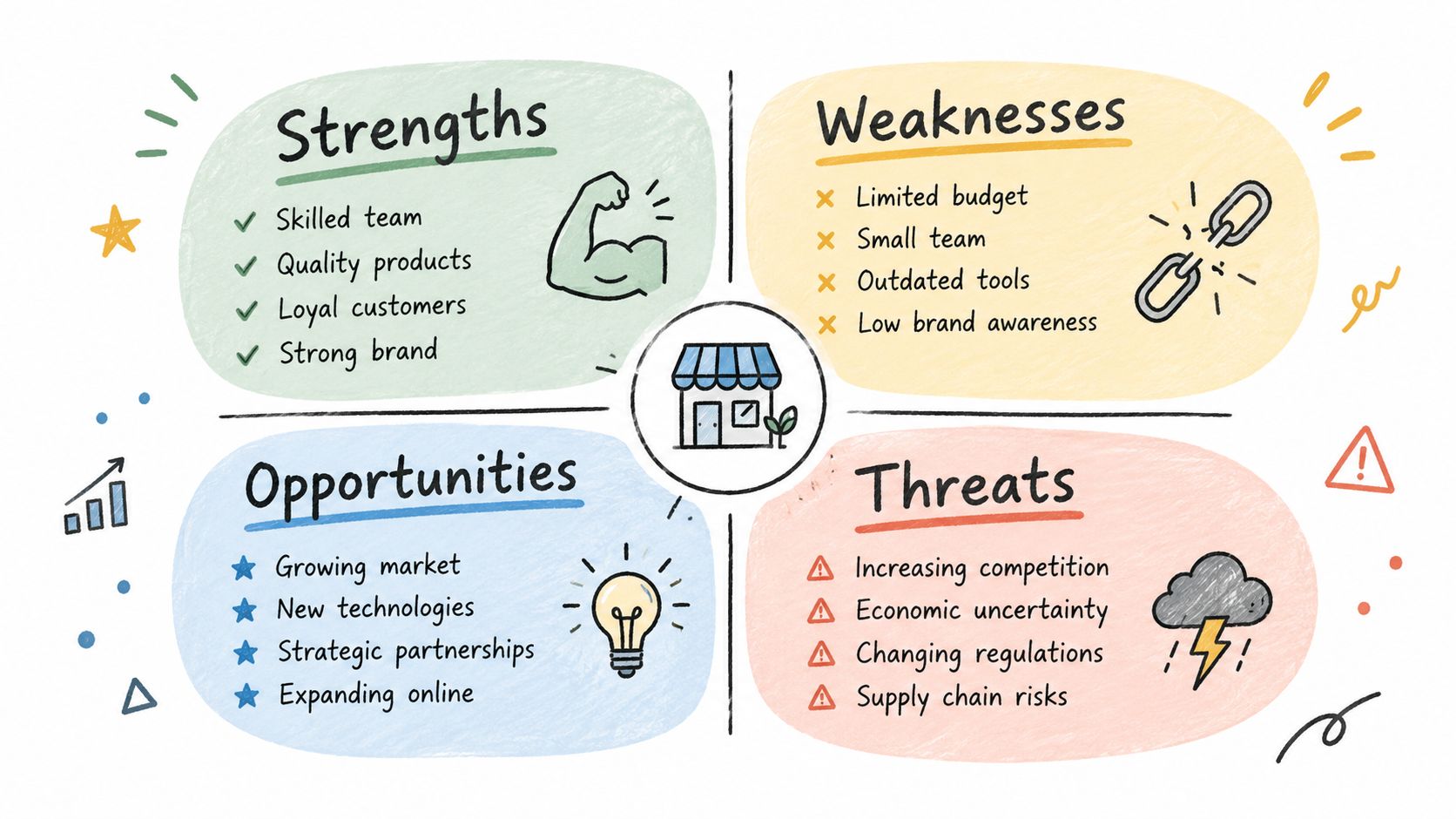
A SWOT analysis separates internal strengths and weaknesses from external opportunities and threats. That distinction matters: a strong product team can address a documentation gap, but it can't directly control a competitor's launch or a shift in buyer demand. Used well, SWOT gives a team a shared diagnosis before it commits to tactics.
For example, a SaaS company might find that its product is frequently recommended for agency project management prompts but rarely appears when buyers ask about enterprise workflow automation. The first finding could point to an existing strength; the second could reveal a visibility weakness or a mismatch between the company's offer and the enterprise buyer's needs. Treat that as a hypothesis to test, not proof that content alone will solve the problem.
Turn observations into choices
Keep the analysis selective. A crowded quadrant full of loosely supported opinions makes it difficult to see what deserves action. Limit each quadrant to the most consequential findings, and record the evidence behind each one, such as customer feedback, product documentation, or repeated AI-answer observations.
A useful next step is to connect the quadrants through a TOWS analysis. Use strengths to pursue opportunities, then decide how to reduce weaknesses that make threats more serious. Teams can also compare competitive intelligence with broader market research using this guide to competitive intelligence and market research.
Practical rule: If a SWOT finding doesn't lead to a decision, owner, or follow-up question, it may not belong on the page.
2. Porter's Five Forces
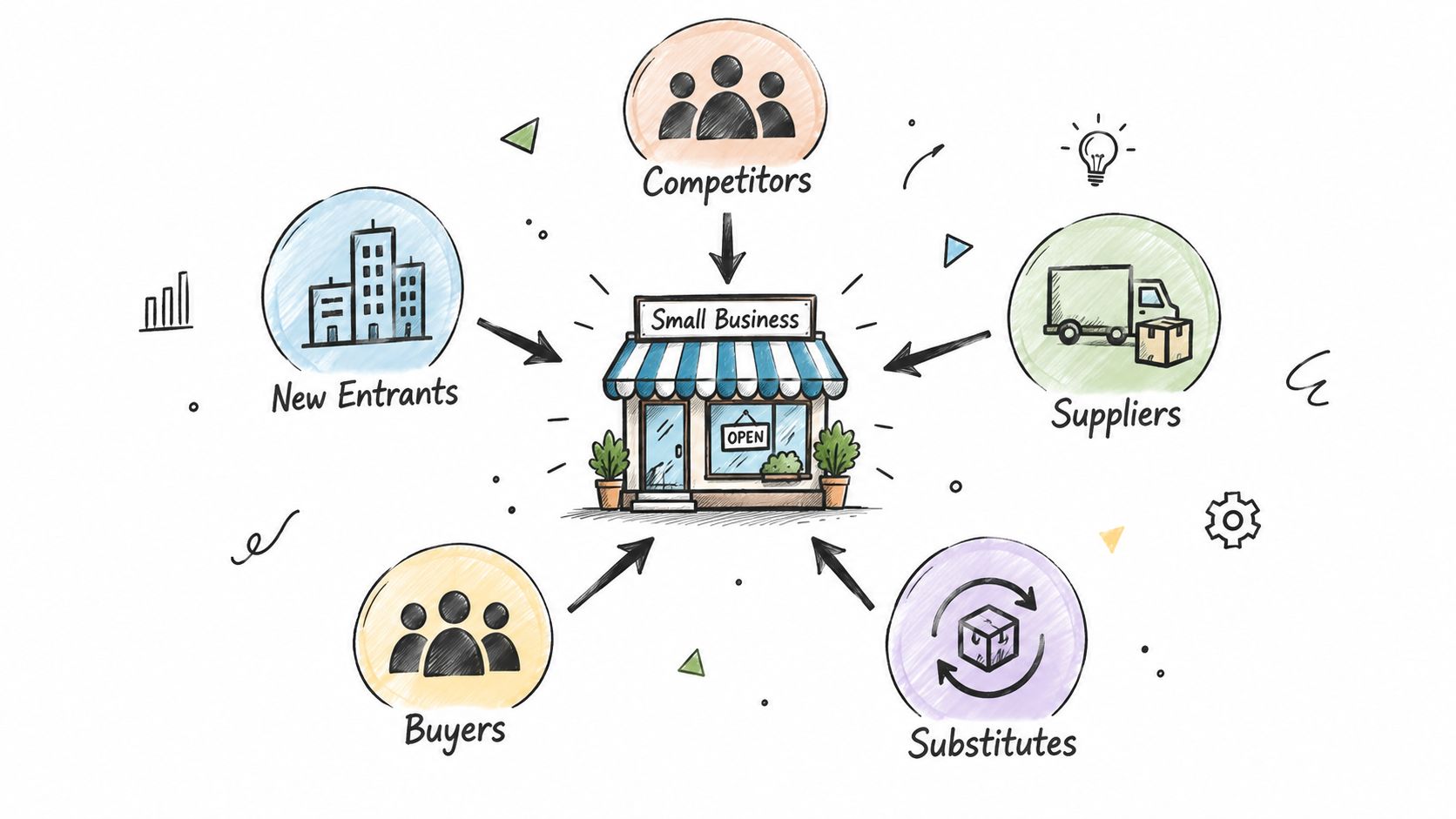
A company can have few obvious direct rivals and still face intense competitive pressure. Michael Porter's Five Forces framework helps teams examine rivalry among existing firms, the threat of new entrants, buyer power, supplier power, and the threat of substitutes. Porter introduced this approach in a Harvard Business Review article published in March–April 1979, then expanded it in his 1980 book Competitive Strategy (Harvard Business Review's overview of the five forces).
The framework shifts the question from “Who are our competitors?” to “What structural pressures limit our ability to earn and defend value?” A software business might assess whether customers can switch easily, whether a small number of platforms control distribution, or whether a new entrant can reproduce the product without facing significant technical barriers.
Add the intermediary to the analysis
AI assistants can shape which vendors buyers consider, even when those assistants aren't substitutes for the software itself. Treat them as a potential intermediary: examine which brands they recommend, what sources they cite, and whether their summaries influence buyers' comparisons.
Rate each force as high, medium, or low only after recording the reasoning and evidence behind the rating. A score without an explanation can create false certainty. Then use the diagnosis to choose a response, such as improving differentiation, reducing dependence on a supplier, or strengthening customer retention.
3. Porter's Generic Competitive Strategies
When a rival changes pricing or adds features, copying the move can feel like the quickest response. Porter's generic strategies offer a more deliberate choice: compete through cost leadership, differentiation, or focus. Cost leadership means designing the business to deliver at lower cost, differentiation means offering distinct value buyers care about, and focus means serving a narrower segment through either approach.
A mid-market software company built around legal workflows illustrates focus. It can serve a specific customer context more thoroughly than a broad platform, but that choice also limits its addressable market and makes it important to understand the segment's needs. By contrast, a company that claims to be the simplest, most powerful, and cheapest option may leave buyers unclear about why they should choose it.
Match the measure to the strategy
The right metric depends on the position you choose. A differentiated product might track whether buyers recognize and value its distinctive capabilities; a focused product might examine conversion and retention among its target segment. In AI answers, teams can also inspect which buyer prompts produce accurate descriptions of their strengths and where competitors are more consistently recommended.
If a rival owns price-led comparisons, matching every discount can undermine a more defensible position. Instead, test whether customers value another advantage, such as trust, workflow fit, support, or integration quality. Revisit the strategy when buyer evidence or competitor behavior changes, not merely because a rival announced a new feature.
4. Blue Ocean Strategy
Blue Ocean Strategy asks a company to look beyond direct competition and search for customer value that existing offers don't address well. Its Strategy Canvas compares the factors competitors emphasize, while the Four Actions Framework asks what to eliminate, reduce, raise, or create. The work is not about relabeling a crowded product category. It's about making a different value proposition meaningful to buyers.
Cirque du Soleil is a familiar illustration: it combined theatrical elements with live entertainment while moving away from some conventions associated with traditional circuses. For a software company, a similar exercise might uncover a neglected buyer need, such as a simpler implementation path for a specific team type. That opportunity needs validation through customer conversations and actual buying behavior.

Look for gaps in how buyers compare options
Prompt-level AI analysis can help reveal use cases where current answers provide weak comparisons or fail to address a particular customer problem. But an empty spot in an AI answer isn't automatically an open market. It may reflect weak evidence, low buyer demand, or an unfamiliar category label.
A Strategy Canvas can include factors buyers and assistants use to describe the category, such as setup effort, integrations, transparency, or depth of functionality. Use the Four Actions questions to challenge those factors, then test the proposed positioning with customers and public content. A video introduction to the framework can provide another way to think through the exercise:
5. Competitive Benchmarking
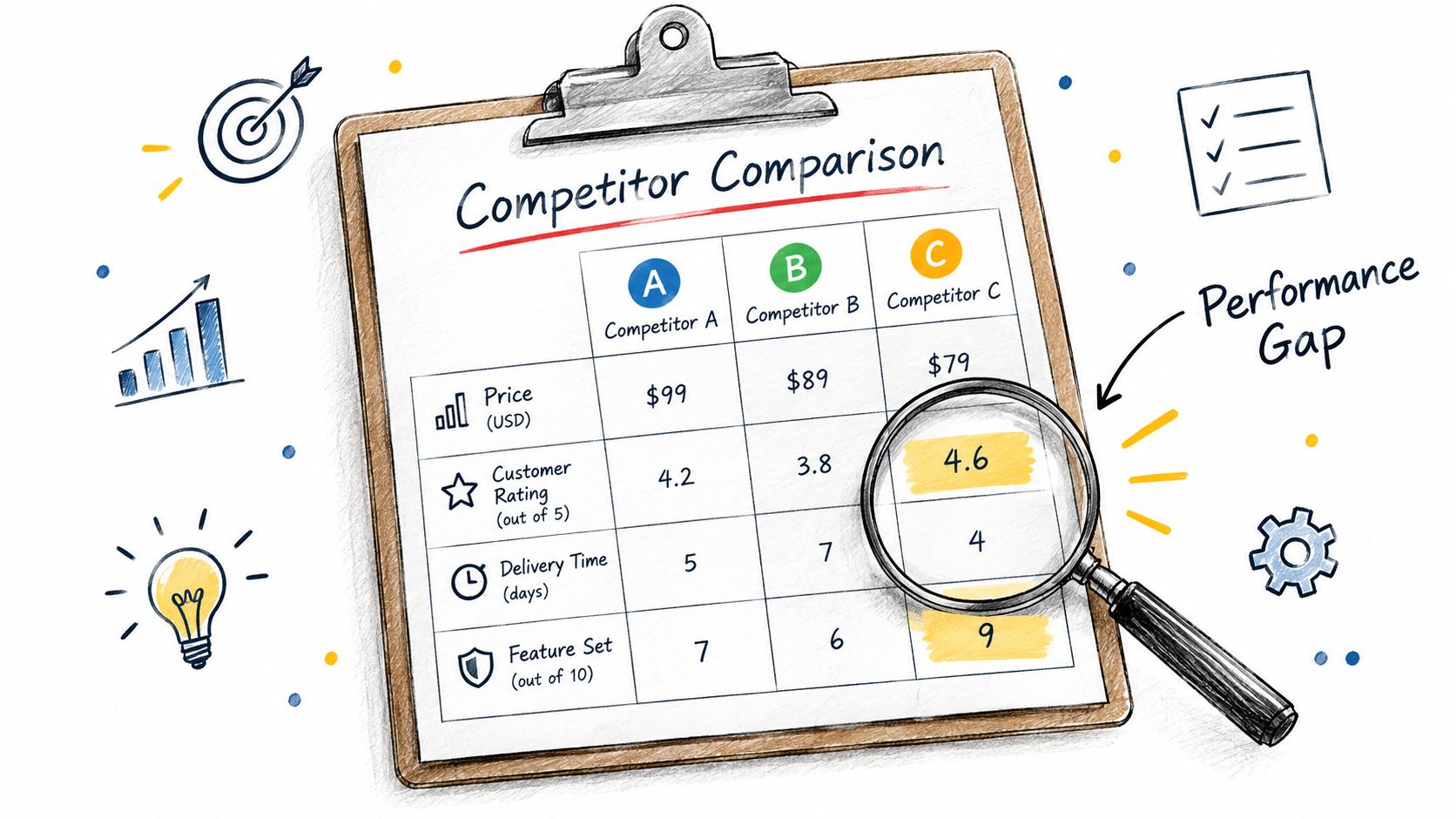
Benchmarking is useful when it compares relevant businesses on consistent measures, not when it turns every competitor into a target to imitate. McKinsey's SaaS pricing research, for example, uses a peer database of private and public B2B SaaS companies with approximately $10 million to $500 million in annual revenue. The underlying lesson is to compare companies in a suitable cohort rather than treating a general market average as a universal standard (McKinsey's research on B2B SaaS pricing).
For an AI visibility benchmark, define a stable set of direct competitors and a consistent prompt library. Compare mention frequency, answer position, sentiment, citation quality, and relevant downstream outcomes. Keep the measurement method steady so a change in prompt wording or provider mix doesn't masquerade as business progress.
Make the benchmark decision-ready
Choose measures that relate to a strategic question. If the team wants to improve discovery, track whether the brand appears for relevant buyer prompts. If the question is conversion, examine whether visibility is associated with qualified visits or sales conversations. Competitor prices can inform a decision, but they don't establish what customers are willing to pay for your offer.
Document definitions, data sources, and exceptions so colleagues can interpret changes consistently. For a practical guide to setting up a comparison, use competitor benchmarking methods. If paid-search agency selection is relevant to your market, a comparison of Google Ads agencies can serve as an example of a buyer-facing comparison page.
6. Competitive Battlecards
A battlecard translates competitive research into guidance a sales or marketing team can use during a real buyer conversation. It should describe a specific competitor's strengths, likely objections, relevant proof, and the situations where your product is a better fit. A battlecard that only lists feature differences won't help a seller respond when a prospect raises concerns about risk, migration, or trust.
Consider a buyer who says an AI assistant recommended a competing product for a particular use case. The response should not dismiss the recommendation. The seller should understand which prompt produced it, what sources the assistant relied on, and whether the competitor has an advantage for that buyer.
Keep claims provable
For every comparison, link the talk track to evidence that sales can share and marketing can publish. If a competitor is described as easier to implement, check product documentation, customer feedback, and the actual onboarding experience before repeating that claim. Where evidence is uncertain, qualify the point rather than turning an impression into a fact.
Keep the document concise enough to use in a live conversation, and assign a clear owner to update it after meaningful changes. Add AI-visibility context where it helps: the prompts on which a rival appears, the sources behind its descriptions, and the proof your team can provide in response. Product marketing can use those findings to improve public pages, making accurate information easier for both buyers and AI systems to find.
7. Win/Loss Analysis
Sales teams often hear why a deal was won or lost, but the explanation recorded in a CRM may reflect a quick summary rather than the buyer's full reasoning. Win/loss analysis adds direct customer evidence through structured conversations with buyers who chose your product, chose another option, or made no decision. It can reveal whether the deciding factors were pricing, integrations, trust, perceived risk, or fit with a team's workflow.
For example, a prospect might say that a competitor appeared more credible because its documentation answered a technical question the buyer couldn't resolve on your site. That finding points to a specific improvement opportunity. It doesn't prove that documentation caused the loss on its own, so check whether the same concern appears in other interviews and sales feedback.
Connect buyer memory to observed evidence
Ask how the buyer first discovered the category and which sources shaped the shortlist. Include AI assistants alongside search, review platforms, peers, and sales outreach. Then compare what buyers recall with prompt-level results and the sources assistants cite. The comparison can help teams distinguish a genuine product disadvantage from missing or unclear public evidence.
Interview a mix of wins, losses, and no-decisions, and share themes with product, sales, and marketing. Competitive intelligence is most useful when it informs decisions across teams; this guide to competitive intelligence in marketing provides additional context. Don't treat a single interview as a market-wide conclusion. Use it to form a question, then look for corroboration in customer behavior, product data, and subsequent conversations.
8. Positioning Map
A positioning map makes competing brand perceptions easier to discuss. Choose two dimensions that matter to buyers, such as ease of setup and enterprise depth, then place your brand and competitors according to customer evidence. The map is a thinking tool, not a measurement instrument that can make subjective judgments objective by putting them on axes.
A SaaS company might discover that customers describe its product as easy to use but limited in advanced controls, while a rival is perceived as more configurable and harder to learn. That insight could support a positioning decision, a product investment, or a clearer explanation of which customers the product serves best.
Choose axes buyers recognize
Start with sales interviews, customer reviews, and product evaluations to find language customers actually use. AI-generated descriptions can provide another perspective, especially when buyers use assistants to compare vendors. Keep those observations separate from direct customer evidence, and note when a description is repeated or appears only once.
Use the map to decide which attribute you want buyers to associate with your product. Trying to own several conflicting positions can make messaging vague. Revisit the map when the product, target customer, or competitive set changes, and check whether your intended position matches what buyers and assistants say.
9. Share of Voice and Share of Model Analysis
Traditional share of voice tracks a brand's presence in relevant conversations; share of model applies a similar idea to AI-generated answers. For a defined prompt set, teams can track whether their brand appears, where it appears, how it's described, and which sources support the answer. That makes the analysis more actionable than counting mentions without knowing their context.
The need for operational discipline is clear in the marketing workflow data: a 2025 survey of 1,200 B2B and B2C marketers found that 35% used data to inform marketing strategy, 31% had begun using data to demonstrate marketing ROI, and 54% felt overwhelmed by implementing AI into workflows (the survey's marketing-report findings). For competitive teams, the implication is straightforward: collecting observations isn't enough. Someone must decide what to change and measure the result.
Inspect the sources behind the answer
Build prompts from buyer language, sales conversations, and support questions. Track results by provider rather than relying on a blended score, and inspect the cited pages when a competitor is repeatedly recommended. If the assistant cites a competitor's product documentation or a third-party comparison, ask whether your own equivalent evidence exists and whether it answers the same buyer question.
Separate repeated findings from one-off responses. MyMentions' guide to AI share of voice analysis can help teams structure this work. For a broader view of generative engine optimization, see this answer engine optimization agency guide.
10. Competitor Monitoring and Early-Warning Alerts
A competitive analysis becomes stale when teams treat it as a one-time report. Ongoing monitoring helps identify relevant changes in pricing, integrations, product documentation, customer reviews, and AI visibility. The point isn't to watch every competitor action. It's to notice changes that could affect a buyer decision or require a strategic response.
An alert that a rival has appeared in AI answers for an important use case deserves investigation, not an automatic counter-campaign. Review the answer, inspect its sources, and check whether the change persists across prompts and providers. The cause could be a new product capability, better public documentation, a shift in the available evidence, or variation in model output.
Set a response path before the alert arrives
Choose a small set of meaningful signals and route each to a named owner. A product manager might review a newly announced integration; product marketing might check a changed competitor claim; SEO or content teams might investigate a citation gap. If nobody owns the alert, the system creates noise rather than action.
Use competitive intelligence analysis practices to connect monitoring with decisions. Log what changed, what the team did, and whether the signal proved useful. Refine thresholds when alerts repeatedly trigger without producing a relevant response, and preserve findings that reveal an important shift in buyer expectations.
10 Competitive Analysis & Strategy Frameworks Compared
| Competitive Analysis Method | 🔄 Complexity & Resources | ⚡ Speed & Efficiency | 📊 Expected Outcomes | ⭐ Ideal Use & Key Advantage |
|---|---|---|---|---|
| SWOT Analysis | Low; workshop, evidence, and limited data | Fast to create; refresh quarterly | Prioritized internal strengths and weaknesses, plus external opportunities and threats | Early-stage strategic review; 💡 simple, flexible, and easy to communicate |
| Porter's Five Forces | Medium–high; requires market data and judgment | Moderate; assess each force and document evidence | View of industry pressure, profitability, and structural risks | Industry or market-entry strategy; ⭐ explains the sources of competitive pressure |
| Porter's Generic Competitive Strategies | Medium; needs customer, competitor, and operational data | Moderate; focus on choosing a clear position | Defined cost leadership, differentiation, or focus strategy with aligned priorities | Competitive positioning and resource allocation; 💡 helps avoid unfocused investment |
| Blue Ocean Strategy | High; requires customer research and market validation | Slow; new-market concepts need testing | Potential new market space, value innovation, and differentiated offerings | Escaping crowded markets or feature and price competition; ⭐ encourages category innovation |
| Competitive Benchmarking | Medium; requires competitor data and consistent metrics | Moderate; efficient when dashboards and baselines exist | Measurable performance gaps and progress against targets | Tracking performance against named competitors; 📊 makes gaps concrete and comparable |
| Competitive Battlecards | Medium; requires competitor research, proof points, and an owner | Fast to use; updates needed after major changes | Consistent sales responses, objection handling, and competitor-specific messaging | Sales enablement and rapid deal support; ⚡ gives teams field-ready guidance |
| Win/Loss Analysis | Medium–high; requires interviews and careful synthesis | Slow; depends on response rates and analysis | Evidence-based insight into buyer decisions, objections, and discovery channels | Improving product, pricing, and messaging; 💡 captures buyers' reasons behind outcomes |
| Positioning Map (Perceptual Map) | Medium; requires buyer-relevant dimensions and perception data | Moderate; visual map is straightforward to share | View of competitor overlap, perceived differences, and possible market gaps | Aligning brand and product positioning; ⭐ makes competitive perceptions easy to interpret |
| Share of Voice / Share of Model Analysis | Medium–high; needs a defined prompt set, repeated sampling, and analytics | Ongoing; comparisons require consistent measurement | AI mention rates, rankings, sentiment, citation sources, and visibility gaps | Measuring AI discovery performance; 📊 identifies prompt and content opportunities |
| Competitor Monitoring and Early-Warning Alerts | Medium; needs monitoring tools, thresholds, and ownership | ⚡ Continuous detection; response depends on alert routing | Timely awareness of competitor changes and emerging risks | Ongoing competitive intelligence; ⚡ supports faster responses to launches and market shifts |
Turn Insight Into a Competitive Action Plan
No single framework answers every strategic question. SWOT can organize an internal and external diagnosis; Five Forces can surface structural pressure; win/loss interviews can clarify buyer reasoning; and ongoing monitoring can reveal whether a competitor's move changes the market. Choose one framework for diagnosis, one method for customer or market evidence, and one execution mechanism. A larger collection of frameworks won't help if the team can't turn findings into decisions.
Start by naming the decision you need to make. It might be whether to defend a product position, improve documentation for a buyer use case, adjust how sales explains a competitive difference, or invest in a segment competitors serve poorly. State what evidence would change the decision, and record what you know, what you suspect, and what still needs validation.
For AI visibility work, separate presence from performance. A brand mention is descriptive evidence; relative position against named competitors is comparative evidence; qualified visits, sales conversations, and pipeline are closer to business outcomes. AI answers can vary by provider and prompt, so repeated observations are more useful than treating one response as a stable market verdict. When an answer favors a competitor, inspect the citations and check whether the claim is accurate before assigning a content fix.
Turn the chosen priority into a focused 30-day plan. Establish a baseline using a consistent prompt set or customer-research method, assign an owner, ship one meaningful change, and schedule a review. The change might be clearer product documentation, stronger third-party proof, a sales talk track grounded in customer evidence, or a better fit between the product and a target segment. Keep the scope small enough that the team can learn whether the action helped.
MyMentions can support the AI-visibility part of this workflow by organizing buyer-intent prompts, comparing brand and competitor visibility across supported providers, surfacing citation sources, and tracking changes as a prioritized backlog. Pair that data with customer interviews, sales feedback, and product evidence rather than treating any one dashboard as the final answer. Competitive analysis earns its place when teams use it to make a decision, ship a response, and learn from what happens next.
Use MyMentions to organize buyer-intent prompts, compare your brand's AI visibility with competitors, and investigate the sources shaping AI answers. Visit MyMentions to turn competitive findings into a trackable improvement plan.