A Series B SaaS founder approves a large research project to size a new vertical. The interviews are well designed, the segmentation is thoughtful, and the final market model looks credible. Six weeks later, a competitor launches the same wedge and starts appearing in AI assistant recommendations, review comparisons, and partner content. The team funded the right research process for the wrong decision.
That confusion is common. Competitive intelligence protects your position against named rivals and fast-moving market signals. Market research protects your roadmap from assumptions about buyers, demand, and willingness to pay. In AI-mediated discovery, the distinction matters even more because customers may encounter your category through assistant answers, review pages, partner sites, and help documentation before they reach your website.
Table of Contents
- Why This Choice Matters for SaaS Teams
- Defining Each Discipline Without the Jargon
- Comparing Goals, Methods, Outputs, and KPIs
- The Market Context Behind Each Discipline
- When SaaS and Product Teams Should Use Each Approach
- Decision Rules for Choosing the Right Approach
- Tool Stacks and Workflows That Actually Ship
- Moving From Either-Or to an Always-On Blend
Why This Choice Matters for SaaS Teams
The founder in that scenario didn't waste money because market research lacks value. The mistake was asking a buyer-validation function to answer a competitor-monitoring question. A research project can tell the team whether the new vertical has a real problem, which segments care most, and what language buyers use. It won't reliably tell them that a rival changed its packaging last week or that third-party pages now frame the rival as the default choice.
That mismatch creates three practical costs:
- Wasted spend: The company pays for a deep answer after the relevant strategic window has narrowed.
- Slow reaction to AI discovery: Marketing and product teams miss changes in how assistants, reviews, and partner pages describe the category.
- Missed pricing signals: A team can model willingness to pay while overlooking a competitor's packaging change, new entry tier, or feature-based price anchor.
A useful brand monitoring framework helps clarify the first layer of the problem, but SaaS teams need to connect monitoring to decisions. The question isn't whether you should collect more information. It's whether the information will help marketing respond to a rival, help product validate a roadmap bet, or help leadership decide where to allocate resources before quarter close.
Practical rule: If a named competitor can change the decision before your research project finishes, start with competitive intelligence.
You should leave this choice with a simple operating view. CI protects share and response speed. Market research protects customer truth and roadmap quality. The strongest teams don't treat them as competing budgets. They assign each discipline the question it can answer fastest, then combine the findings when a market move and a buyer need intersect.
Defining Each Discipline Without the Jargon
Start with the observer.
Competitive intelligence watches competitors. It tracks named rivals, substitutes, emerging entrants, and the external signals that influence buyer perception. Those signals include product releases, pricing pages, positioning changes, review language, partner pages, job postings, sales objections, and AI assistant answers. The work is continuous and event-driven because the useful output often needs to reach sales, product marketing, or leadership within days.
Market research watches the buyer. It studies demand, segment fit, unmet needs, purchase criteria, willingness to pay, and the reasons customers choose or reject a solution. Its methods usually include surveys, interviews, focus groups, structured customer studies, segmentation work, and market sizing. The work is often project-based because the team is trying to answer a defined question at a particular point in time.
The competitor benchmarking process makes the CI side easier to operationalize, especially when teams need consistent comparisons rather than scattered updates. But benchmarking is only useful when someone knows what decision the comparison should support.
| Discipline | Who it watches | Core question | Typical cadence | Main users |
|---|---|---|---|---|
| Competitive intelligence | Named competitors and market-facing sources | What changed, and how should we respond? | Continuous or event-driven | Marketing, sales, product marketing, strategy |
| Market research | Buyers, users, and target segments | What do customers need, value, and pay for? | Project-based or periodic | Product, strategy, marketing, leadership |
The overlap is real. Both functions can read review sites, interview customers, analyze sales conversations, and influence product strategy. They diverge on cadence, ownership, and the cost of delay. CI asks for a current signal tied to a rival or market event. Research asks for a defensible explanation of buyer behavior.
Apply this test on Monday: “What is happening to us right now?” points to CI. “Why is the market behaving this way?” points to market research.
Comparing Goals, Methods, Outputs, and KPIs
A competitor changes its pricing overnight, while your team is still validating whether buyers value the category. Those situations require different operating systems. Competitive intelligence tracks movement and supports a fast response. Market research tests demand and explains buyer behavior well enough to guide investment.
| Dimension | Competitive Intelligence | Market Research |
|---|---|---|
| Primary goal | Detect and interpret competitor or market moves | Validate demand, needs, segments, and purchase behavior |
| Core methods | Competitor monitoring, web scraping, review analysis, battlecard updates, win/loss analysis | Surveys, interviews, focus groups, TAM modeling, segmentation, structured studies |
| Primary data sources | Competitor sites, pricing pages, product documentation, reviews, partner pages, sales calls, AI assistant outputs | Buyers, users, prospects, survey respondents, customer records, industry data |
| Typical outputs | Battlecards, competitor profiles, pricing deltas, feature-parity maps, alerts, weekly briefs | Demand studies, segment profiles, willingness-to-pay findings, market models, research reports |
| Time horizon | Immediate response and ongoing monitoring | A defined decision window, often tied to a launch, market, or roadmap question |
| KPIs | Share of voice, pricing changes, feature coverage, win/loss themes, mention quality, response time | NPS, willingness to pay, segment penetration, demand strength, research completion, confidence in a decision |
CI uses monitoring, structured extraction, and a crawl website API to compare competitor pages at scale. For AI-mediated discovery, the watchlist must also include assistant outputs, review sites, and partner pages. These sources shape how buyers encounter and describe your product, even when you do not control the wording. KPIs such as share of voice, mention quality, feature coverage, and response time show whether that visibility is improving and whether the team can act quickly.
Market research uses surveys, interviews, focus groups, customer records, and market models to test whether demand exists beneath those signals. It can determine which buyers have the problem, how they evaluate options, what they value, and what they may pay. CI can show that rivals are gaining attention. Research establishes whether the underlying need is large and durable enough to justify a product or go-to-market decision.
The outputs arrive on different schedules. CI produces a pricing alert, weekly win/loss report, revised battlecard, or assistant-visibility review. Research produces a demand study, segment analysis, or willingness-to-pay recommendation for planning.
The distinction that matters: CI optimizes for freshness and action. Market research optimizes for buyer understanding and decision confidence.
Both disciplines can use reviews, customer conversations, and sales data. Separate the trigger and the decision standard. A competitor announcement triggers CI. Uncertainty about unmet need triggers research. A roadmap decision involving both needs one shared hypothesis and coordinated evidence, rather than two disconnected reports.
The Market Context Behind Each Discipline
The scale of the surrounding industries tells SaaS buyers something useful about maturity. The global market research industry grew from about $71.5 billion in 2016 to $130 billion in 2023, with an estimated $140 billion in 2024, according to ESOMAR-based industry reporting. That history reflects a mature discipline built to quantify demand, customer behavior, and market size at global scale.
Competitive intelligence has become a substantial category too. A market summary estimates the global CI market at about $50.87 billion in 2024, with a projection of $122.77 billion by 2033 and a 9.1% CAGR, as reported in the competitive intelligence market summary. The direction matters more than the comparison alone. CI is moving from occasional competitor reports toward infrastructure for ongoing strategic decisions.
| Metric | Competitive Intelligence | Market Research |
|---|---|---|
| Reported market scale | About $50.87 billion in 2024 | About $140 billion estimated in 2024 |
| Reported growth direction | Projected to reach $122.77 billion by 2033, at a 9.1% CAGR | Expanded from $102 billion in 2021 to $140 billion in 2024, roughly 37.3% growth |
| Industry role | Monitoring, interpreting, and responding to competitive movement | Measuring demand, behavior, segmentation, and market size |
| SaaS buying signal | Investment in always-on monitoring and response | Investment in structured validation and decision confidence |
The broader insights industry is also shifting. In ESOMAR's 2023 to 2024 reporting, market research represented 36% of the industry while data analytics reached 39%, making analytics the larger segment. For SaaS teams, that shift explains why CI now includes machine-readable sources, review ecosystems, partner content, and AI answers rather than only competitor press releases.
| Discipline | Use it when the budget must answer |
|---|---|
| Market research | Whether demand is real, who has it, and what buyers value |
| Competitive intelligence | What rivals and influential sources are changing right now |
When SaaS and Product Teams Should Use Each Approach
A crowded feature launch needs both disciplines, but not at the same time or for the same reason.
A new feature in a crowded category
Marketing should begin with CI. Map rival positioning, packaging, feature claims, review language, partner pages, and AI-generated answers. The output should show where competitors appear strong, where their claims are unsupported, and which objections sales will encounter.
Product and strategy then use market research to test whether the target segment cares about the feature. Interviews and structured research can reveal whether the problem is urgent, whether current workarounds are acceptable, and whether the proposed benefit is distinct enough to change purchase behavior. CI tells you how to enter the conversation. Research tells you whether the conversation deserves product investment.
A pricing page overhaul
Market research anchors the customer side. Ask buyers how they evaluate packages, which outcomes justify budget, where they see risk, and what trade-offs they accept. A pricing study should inform packaging and willingness-to-pay decisions, not validate a preferred price.
CI handles the external response. Track competitor packaging, plan names, limits, feature gates, and language changes. After launch, monitor how assistants and third-party pages summarize your offer. The pricing page may be accurate while the market narrative remains stale, incomplete, or tilted toward a rival.
An AI visibility drop
This is a CI incident first. Check whether your product disappeared from assistant answers, whether a review snippet changed, whether a partner page stopped citing you, or whether competitor content became the dominant reference. The work requires fast source triage and a clear owner, not a long research brief.
Market research still has a role. Validate whether the lost audience represents an in-market segment, whether those buyers use the affected category language, and whether the perceived gap matters in active evaluations. The combination prevents an expensive reaction to a visibility change that has little commercial relevance.
Product teams can strengthen the buyer side with disciplined product discovery techniques. Marketing should own CI triggers and distribution. Product should own research-backed roadmap bets. Strategy should reconcile conflicts and force both outputs into one decision record.
Decision Rules for Choosing the Right Approach
Stop choosing between teams. Choose the question.
If the question is “What is happening to us right now?”, default to competitive intelligence. If the question is “Why is the market behaving this way?”, default to market research. If both questions matter, run the work in parallel under one shared hypothesis document so the teams don't produce incompatible answers.
Use this six-item checklist before commissioning anything:
- Urgency: Does a competitor, channel, or buyer signal require a response before the next planning cycle?
- Freshness: Will an answer become less useful if the underlying pages, prices, reviews, or assistant responses change?
- Decision owner: Is marketing deciding how to respond, or is product deciding what to build?
- Budget ceiling: Can the team support a structured study, or does the decision need a lightweight signal first?
- AI surface exposure: Do assistants, review sites, partner pages, or documentation influence how buyers discover the category?
- Action destination: Will the output feed sales enablement, product planning, brand work, or executive strategy?
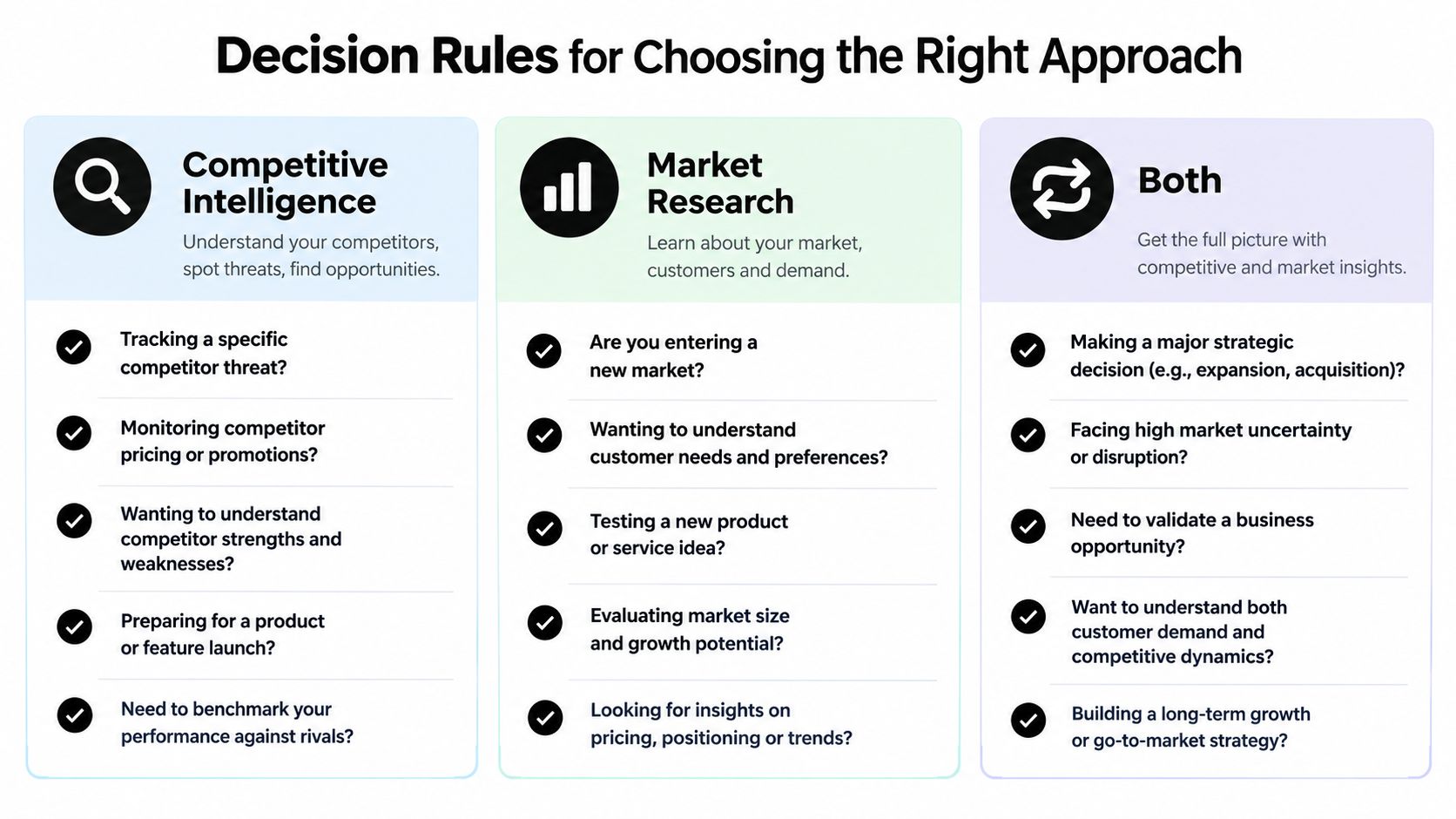
Choose CI when the trigger is external and immediate. Choose research when the uncertainty sits inside buyer motivation or market demand. Choose both when a competitor move may reflect a genuine shift in customer needs. In that case, CI identifies the movement, research tests its meaning, and the shared hypothesis keeps the organization from confusing visibility with demand.
Tool Stacks and Workflows That Actually Ship
A small SaaS team doesn't need a glossy stack. It needs three connected layers and a named owner for every output.
The CI layer
Track competitor websites, pricing pages, product documentation, reviews, partner pages, sales-call notes, and AI visibility. A platform such as MyMentions can monitor how assistants describe your product and competitors, compare prompt-level results across providers, surface citation sources, and turn visibility gaps into a prioritized backlog. For broader monitoring principles, the SponsorRadar competitor monitoring guide is a useful reference.
Use lightweight sales-call capture alongside external monitoring. Sales hears objections before dashboards do, while review and assistant sources show how those objections spread beyond individual deals. Marketing or product marketing should own the weekly CI brief.
The research layer
Use survey tooling for directional questions, an interview panel of 8 to 12 customers or prospects for recurring qualitative input, and a shared insight repository in Notion, a research repository, or an equivalent workspace. Product should own interview quality, tagging, and the connection between findings and roadmap decisions.
The AI competitor analysis tools category can support the CI side, but tools won't resolve unclear hypotheses. Keep the research layer focused on buyer language, unmet needs, segment fit, and willingness to pay.
The action layer
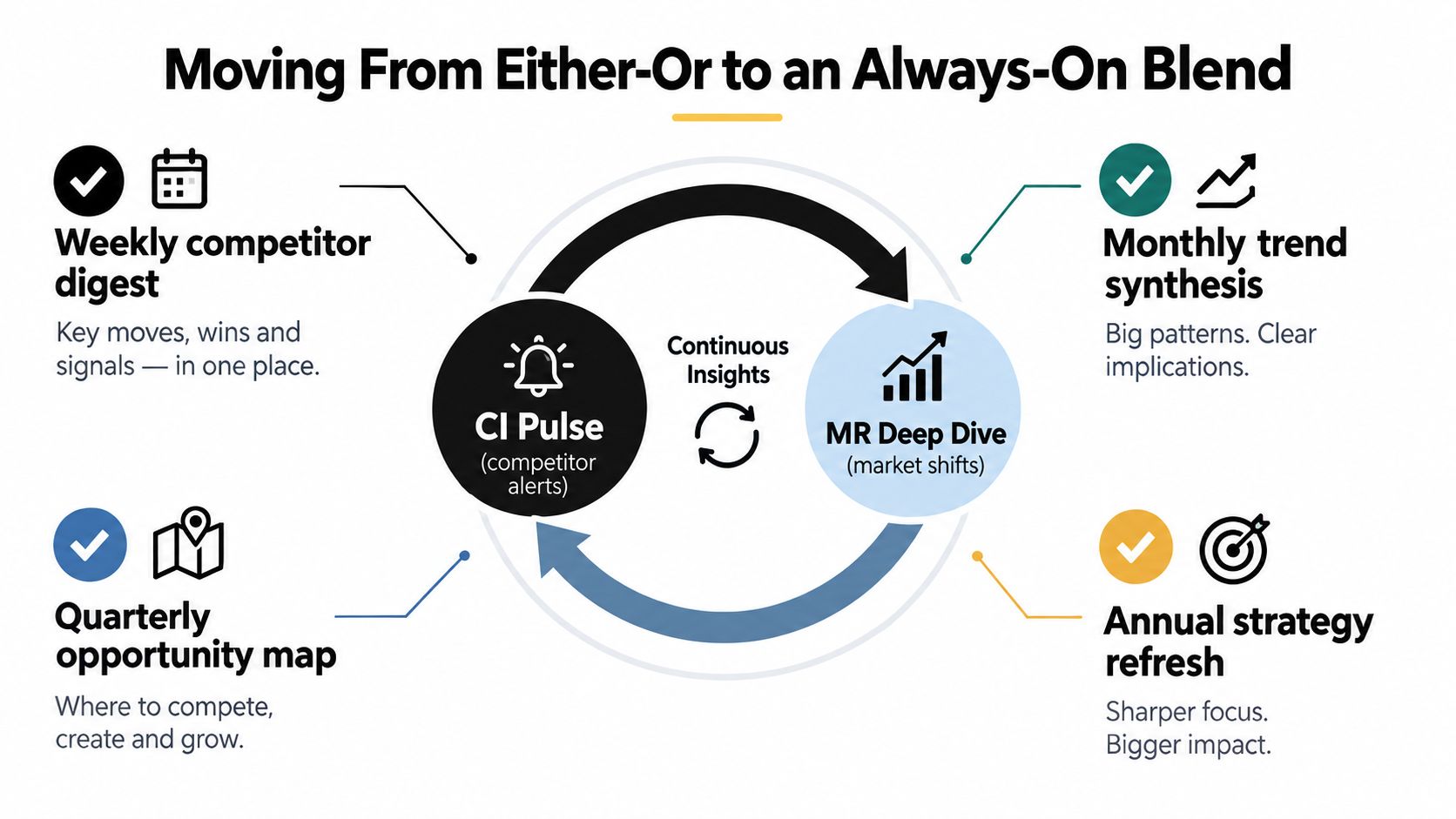
Run a Monday scan, a Friday brief, and a monthly deep dive. The Monday scan flags changes and assigns owners. The Friday brief records what changed, why it matters, and what someone will do next. The monthly session combines recurring CI signals with research findings and removes stale assumptions.
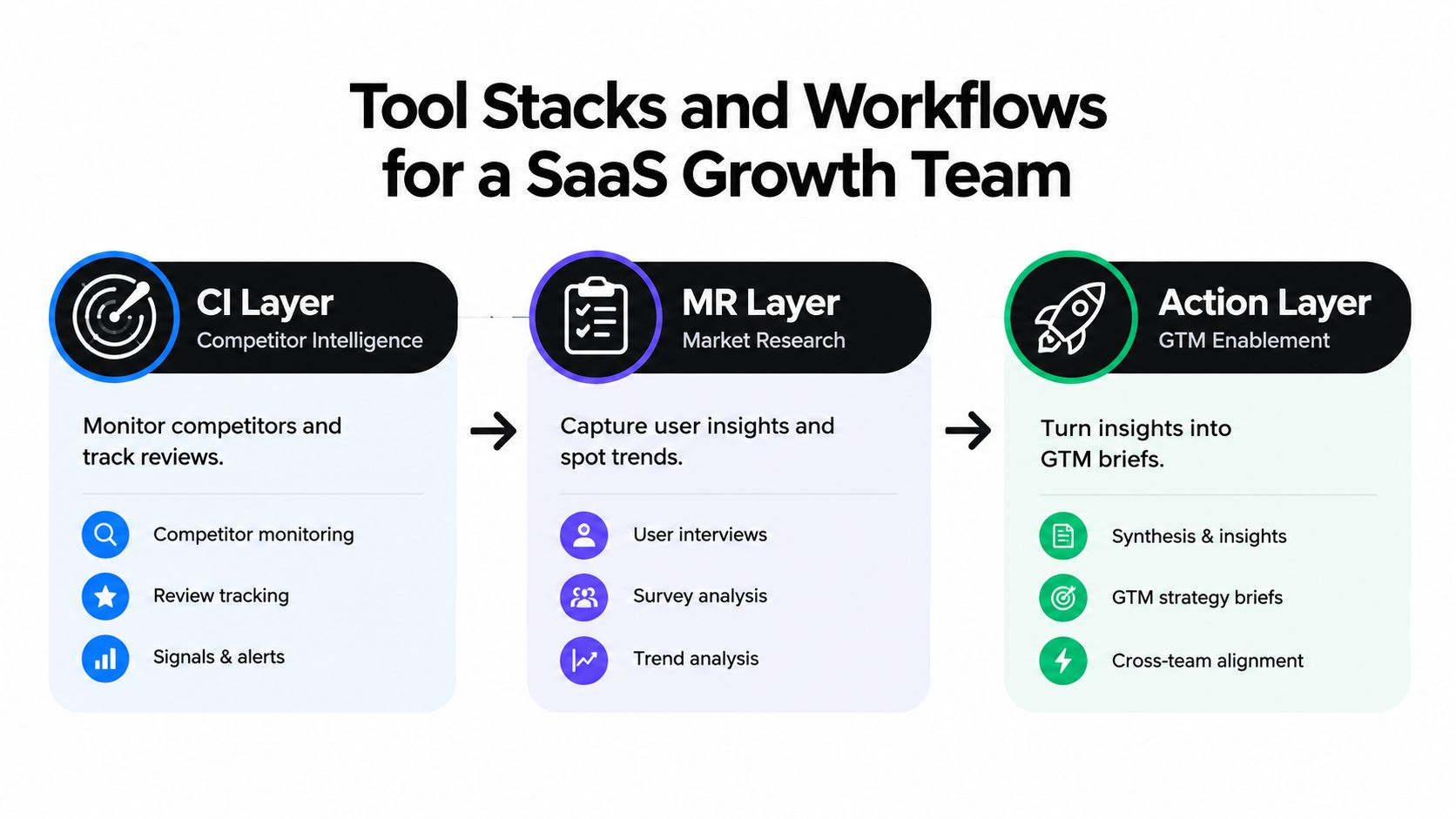
Put the workflow in a shared Slack or Notion channel. Marketing owns competitor alerts and battlecards. Product owns research synthesis and roadmap implications. The CI or strategy lead owns the meeting and the decision log. The most common failure isn't weak tooling. It's a dashboard with no person responsible for converting a finding into a shipped action.
Moving From Either-Or to an Always-On Blend
Competitive intelligence and market research aren't interchangeable, and a SaaS company shouldn't force one to replace the other. A rival's new positioning may appear across assistant answers, reviews, and partner pages. CI can identify that shift quickly, but only research can test whether buyers value the promise or whether the change reflects a narrow messaging tactic.
The durable operating model is a loop. CI flags movement. Market research validates demand underneath the movement. Product, marketing, and strategy then decide whether to change the roadmap, the message, the sales response, or nothing at all.
Three integration points make the blend work:
- Shared insight taxonomy: Use the same labels for segments, use cases, objections, competitors, pricing themes, and trust signals.
- Single source of truth: Store source links, findings, confidence, owner, and next action in one repository.
- Monday review ritual: Bring one CI finding and one research finding to the same cross-functional meeting, then assign a concrete response.
Ship four things this week:
- Pick one trigger event and assign an owner.
- Stand up a lightweight CI monitor for the competitors and sources that influence your buyers.
- Book the first three customer or prospect interviews.
- Block 30 minutes for the first cross-functional review.
The choice in competitive intelligence vs market research becomes straightforward once the question is explicit. Use CI to see the market move, use research to understand the buyer, and connect both to a decision someone can execute.
MyMentions helps SaaS teams track how AI assistants discover, rank, and describe their products and competitors, including the citation sources shaping those answers. Visit MyMentions to turn AI visibility findings into a prioritized competitive intelligence workflow your marketing and strategy teams can act on.