
Checking a competitor's homepage, pricing page, and changelog once a quarter isn't competitive intelligence analysis. It's a delayed news feed. A dashboard that shows average rank, share of voice, or competitor mentions can look rigorous while telling your team nothing about what to do next.
For a SaaS company with a small team, the standard advice is backwards. You don't need more monitoring. You need a system that distinguishes a meaningful competitive move from a random observation, then turns validated findings into product, content, sales, or trust work. In AI-driven discovery, that measurement discipline matters even more because the same prompt can produce different answers from one run to the next.
Table of Contents
- Why Most Competitive Intelligence Is Theater
- The Intelligence Cycle That Replaces Ad Hoc Monitoring
- Analytical Models That Actually Move Decisions
- Data Sources and Where Each One Lies to You
- Measurement Reliability and the Sampling Noise Problem
- A Framework That Turns Findings Into Shipped Work
- Putting It All Together and a 30 60 90 Rollout
Why Most Competitive Intelligence Is Theater
Most competitive intelligence programs fail before the first data point is collected. They start with the question, “What can we track?” instead of, “Which decision will change if we know this?”
That mistake produces the familiar quarterly slide deck. It contains pricing screenshots, feature comparisons, traffic estimates, new blog posts, and a few arrows pointing upward or downward. Leadership reviews it, sales asks for a battlecard, product adds nothing to the roadmap, and the document becomes obsolete as soon as a competitor changes its positioning.
Competitor monitoring is passive. It tells you that a rival launched a feature or changed a headline. Competitive intelligence analysis interprets that event in context. It asks whether the move changes the buying criteria for a target segment, threatens a high-intent category, exposes a product gap, or creates an opening for your positioning.
Operator's test: If a finding doesn't have an owner, a decision, and a next action, it isn't intelligence yet.
This discipline has never been merely a software category. Michael Porter's Competitive Strategy was published in 1980, the Society of Competitor Intelligence Professionals was founded in 1986, and 1994 marked a major transition in which competitive intelligence developed more visibly through publications, conferences, consultants, government programs, and university courses, as documented in this historical review of competitive intelligence.
That history gives founders a useful standard. CI combines strategic management, systematic scanning, evidence analysis, and decision support. A list of competitor updates meets none of those requirements by itself.
For an AI-first SaaS company, the difference is concrete. A passive report says a rival appears in answers for a category prompt. Intelligence analysis asks which prompts produce that appearance, which citation sources support it, whether the result persists across providers and runs, and whether the category affects qualified pipeline. It then recommends a specific intervention, such as improving documentation, strengthening independent reviews, or clarifying a comparison page.
Your current approach is real intelligence work only if you can complete this sentence: “We monitor these signals to answer this business question, so this owner will make this decision.” If you can't, stop refreshing the dashboard and define the question.
The Intelligence Cycle That Replaces Ad Hoc Monitoring
A useful CI program follows a cycle, not a pile of alerts. The Canadian government's competitive-intelligence guidance organizes the work around requirements, collection and organization, analysis, reporting, and informing decision-makers. That sequence creates a control point between seeing something and recommending a response.
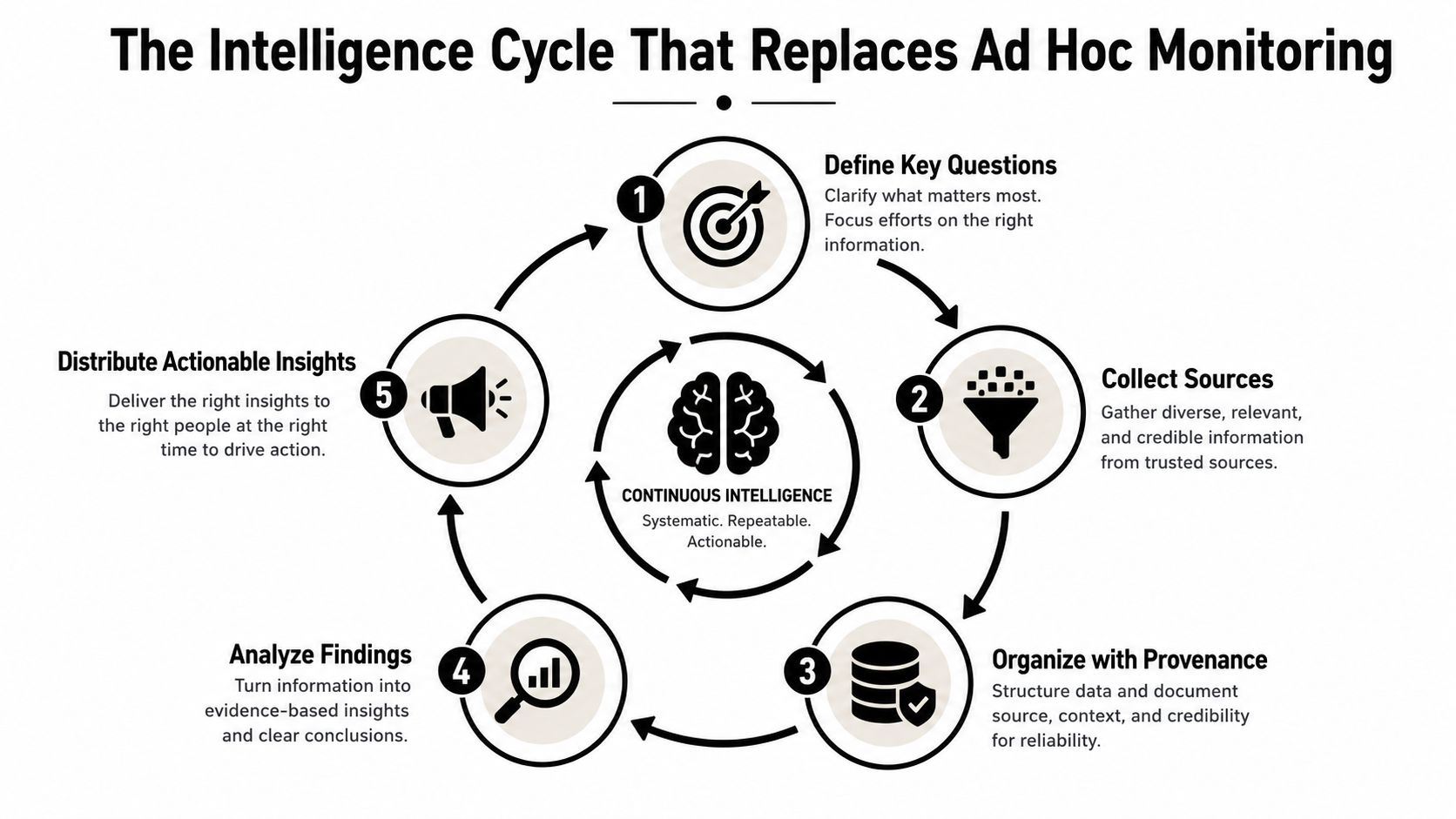
Define the question before collecting
Start with a decision, not a source list. For example: “Are we losing high-intent AI-assisted discovery to competitors in our core category?” That question is narrow enough to measure and important enough to justify recurring work.
Specify the segment, buyer intent, providers, competitors, and decision owner. A founder may own category strategy, while product marketing owns positioning and content owns citation gaps. The output of this stage is a question set and a definition of what would count as a meaningful movement.
Collect across sources
Run a controlled prompt set across relevant AI assistants, then combine those observations with product pages, documentation, reviews, comparison pages, partner content, customer interviews, sales notes, and win-loss evidence. Don't let one competitor announcement become the whole story.
Tools and workflows designed around competitor detection scenarios can help teams identify the kinds of events worth investigating, but detection is only collection. It becomes intelligence after you establish relevance, provenance, and business impact.
Organize with provenance
Record the prompt, provider, date, location where relevant, competitor, answer text, ranking position, sentiment, citation sources, and confidence. Preserve the original observation. A normalized row that cannot be traced back to its source is not reliable evidence.
A dashboard can summarize results, but it shouldn't replace the evidence ledger. The competitive intelligence dashboard guidance from MyMentions is useful here because it frames the dashboard as a decision surface rather than a storage bin for unclassified signals.
Analyze relationships and significance
Compare competitors against the same prompt mix and time window. Look for repeated changes across providers, source types, buyer intents, and answer language. Flag contradictions instead of averaging them away.
The key output is a finding with a hypothesis: “Competitor A appears more often for implementation prompts because independent comparison pages describe its onboarding process more clearly.” That is more valuable than “Competitor A gained visibility.”
Distribute a decision-ready brief
Send each stakeholder only what they can act on. Product receives a feature or trust gap. Content receives a source and topic opportunity. Sales receives changed buyer language and objections. Leadership receives a risk, opportunity, owner, and recommended decision.
The cycle then repeats after the intervention. New observations test whether the hypothesis held. That feedback loop gives you governance, auditability, and a reporting cadence that matches product and marketing decisions instead of a quarterly calendar.
Analytical Models That Actually Move Decisions
Small SaaS teams don't need a library of frameworks. They need a few analytical moves that expose a decision quickly.
One global study found that teams spent only 28% of intelligence time on analysis, even though 82% used an analytical model. The models reported most often were competitor analysis at 44%, SWOT at 38%, benchmarking at 36%, competitive-positioning analysis at 26%, and industry analysis at 25%, according to the study on competitive-intelligence practices.
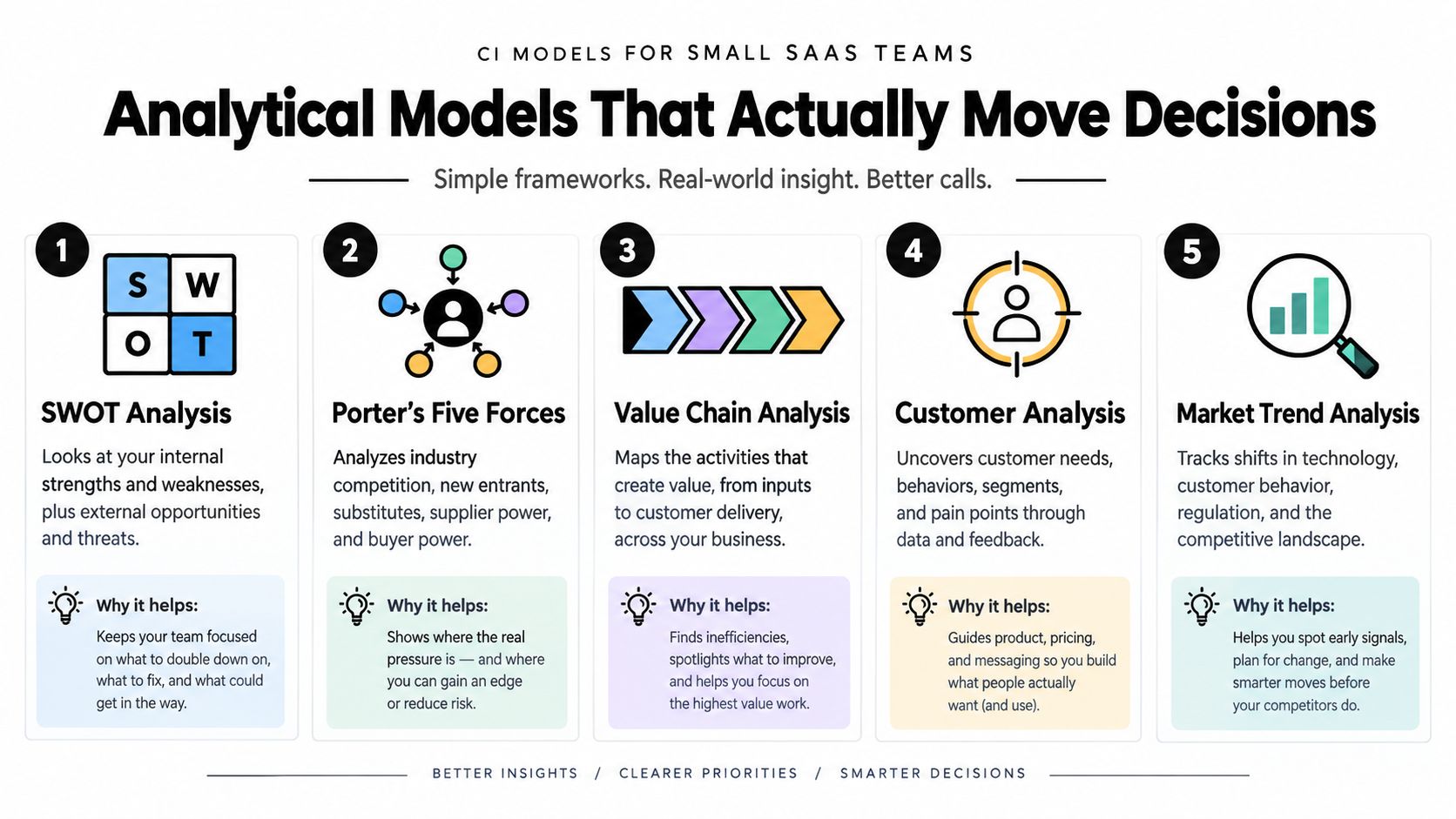
The numbers point to an uncomfortable pattern. Teams know models exist, but they still spend too much time collecting and too little time interpreting. Use the following models selectively.
Competitor analysis is the baseline
Map each important competitor against the same dimensions: target segment, job to be done, product capability, evidence quality, pricing logic, distribution, and AI-assistant presence. Don't create a feature matrix with every checkbox imaginable. Include only attributes that affect a buying decision or your roadmap.
The useful question isn't “Who has more features?” It's “Which competitor is easier for this buyer to understand and trust?” That reframes analysis around conversion and positioning.
Benchmarking needs controlled inputs
Benchmark your brand and competitors against identical prompts, providers, dates, and intent categories. Normalize the data before comparing it. Otherwise, a competitor with broader provider coverage or a different prompt mix can appear stronger for purely structural reasons.
A practical competitor benchmarking workflow should end with a gap, an explanation, and an intervention. A table that ends with colored cells is decoration.
Positioning analysis reveals the battle you're actually fighting
Plot competitors by two buyer-relevant dimensions, such as implementation complexity and governance depth, or self-serve speed and enterprise control. Then test whether AI assistants describe those distinctions accurately. If every provider describes the market using the same language, your differentiation may be invisible even if the product is clearly different.
SWOT is useful only with evidence
SWOT becomes ceremonial when teams fill it with adjectives. “Strong brand,” “weak awareness,” and “growing market” aren't findings. Tie every entry to observed customer language, product evidence, citation patterns, or competitive behavior. Use the model to choose a decision, not to complete a slide.
Industry analysis belongs in strategic reviews
Broader industry analysis matters when you're choosing a segment, entering a category, or deciding whether a threat changes the market structure. It's usually the wrong tool for deciding whether to rewrite one comparison page this week.
Reserve analysis time explicitly. If your team can't explain what changed, why it matters, and what should happen next, collecting another source won't solve the problem.
Data Sources and Where Each One Lies to You
Every source answers certain questions well and distorts others. Treat each one as a biased observation, then combine sources around the decision you need to make.
Competitor websites and pricing pages are useful for stated positioning, packaging, and feature claims. They cannot show actual adoption, customer satisfaction, or hidden commercial terms. Changelogs confirm shipped work, but silence does not prove that investment stopped. Job postings can indicate priorities, yet they describe intended hiring rather than completed capability.
AI-assistant answers and their citations show how products are discovered and described in buyer-like interactions. Use them to study visibility, language, and source influence. Do not treat one answer as market truth. Prompt wording, provider behavior, personalization, and source selection can change the result. Reviews and communities expose pain points that product pages omit, while vocal users can skew the apparent frequency of those problems.
Internal evidence usually connects more directly to commercial decisions. Win-loss notes, sales calls, support conversations, product usage, and customer interviews reveal what buyers do and where deals stall. They still carry selection bias, inconsistent tagging, incomplete recall, and the salesperson's interpretation of why a deal moved. Require consistent fields and review patterns across several deals before changing strategy.
Third-party reports provide category context and vocabulary, including the broader comparisons covered in this overview of competitive intelligence platforms. Their methods may not match your segment, and summaries can hide important definitions. Use them to frame questions, not to replace direct evidence.
The 2020 industry survey cited by SCIP's professional overview reported qualitative benefits among 95% of participating organizations and quantitative benefits among 89%. These figures describe respondents' experiences. They do not establish that CI alone caused the outcomes. Match source quality to decision risk, and record what each source cannot prove.
| Source type | Best for | Main bias | Typical cadence |
|---|---|---|---|
| Product, pricing, and changelog pages | Stated offer and release direction | Marketing claims and selective disclosure | On change |
| AI answers and citations | Discovery, language, visibility, and source influence | Sampling variation and provider behavior | Controlled recurring runs |
| Reviews and communities | Pain points and trust signals | Vocal-user bias and uneven detail | Weekly or monthly review |
| Sales and win-loss evidence | Buyer objections and decision drivers | Inconsistent notes and recall bias | Per deal, then periodic synthesis |
| Customer interviews and support | Actual friction and unmet needs | Small sample and relationship effects | Continuous, with scheduled analysis |
| Third-party reports | Market vocabulary and external context | Methodology mismatch and summarization | As relevant to a decision |
Audit the stack against the questions you must answer. To explain why a competitor wins deals, combine CRM evidence with sales conversations and customer research. To explain why AI assistants cite a rival, examine repeated answers alongside the cited pages. Use multiple sources when the decision carries risk, and label each source's limits before presenting a conclusion.
Measurement Reliability and the Sampling Noise Problem
The most dangerous CI dashboard is the one that looks precise. Average rank and share of voice can change because the underlying market moved, but they can also change because the assistant generated a different answer.
An industry dataset found that only 30% of brands remained visible from one AI answer to the next, while just 20% appeared across five consecutive runs, according to this analysis of AI-search brand visibility and citation volatility. Those findings should change how you design alerts. A single disappearance is an observation, not a crisis.
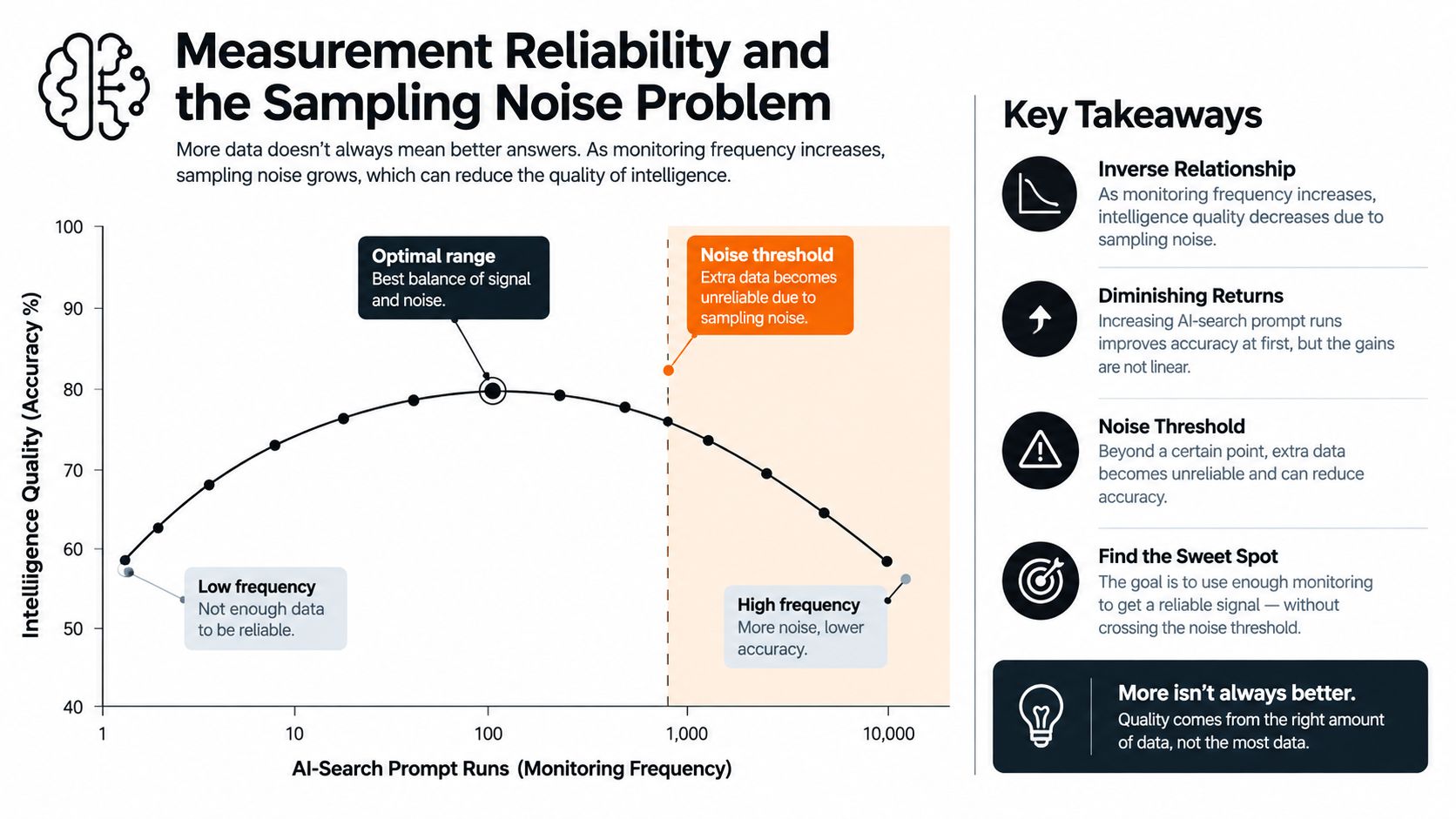
Treat every run as a sample
Prompt wording, provider updates, location, personalization, source availability, and model randomness can all affect an answer. Repeating a flawed measurement more often doesn't automatically make it more accurate. It can create a larger archive of noise and more opportunities for false alarms.
An academic study cited in the same research recommends at least seven runs per prompt per day for brand-visibility monitoring, eight when source-level coverage matters, and rolling aggregation over two to four weeks for statistically stable estimates. Use those recommendations as a measurement design, not as permission to spam prompts without standardization.
Report uncertainty beside the headline metric
Every AI-visibility report should include:
- Run count: How many observations support the result?
- Volatility: How often does the answer change across runs?
- Provider agreement: Do multiple assistants show the same direction?
- Confidence range: How much uncertainty surrounds the estimate?
- Source consistency: Are the same citation domains recurring?
- Intent coverage: Does the movement apply to one prompt or a buyer segment?
A competitor's apparent gain becomes more credible when it persists across controlled runs, providers, and related intents. It becomes less credible when it appears in one provider, one prompt, and one short window.
The guide to reliable citation analysis for AI search engines is relevant because source-level monitoring requires stricter sampling than a simple mention check. Track the observation quality before you interpret the movement.
Practical rule: Don't send an alert because a competitor moved. Send an alert when the movement survives your reliability test and points to a decision.
This approach prevents the most expensive kind of reaction: a team abandoning a sound strategy because a dashboard snapshot changed. Measurement reliability isn't a reporting detail. It determines whether your backlog responds to the market or to model randomness.
A Framework That Turns Findings Into Shipped Work
A CI program earns its budget when findings become shipped work. Use a four-part operating framework that forces every observation through ownership, explanation, and measurement.
Connect intelligence to the backlog
Start with a business outcome such as defending a high-intent category, improving qualified discovery, reducing a recurring sales objection, or clarifying a product boundary. Create backlog entries only when a finding connects to one of those outcomes.
A raw observation might say, “Competitor B appears in comparison answers.” A backlog-ready version says, “Independent comparison pages explain Competitor B's implementation path more clearly than our public documentation, which may be affecting recommendation language. Investigate and assign a content owner.”
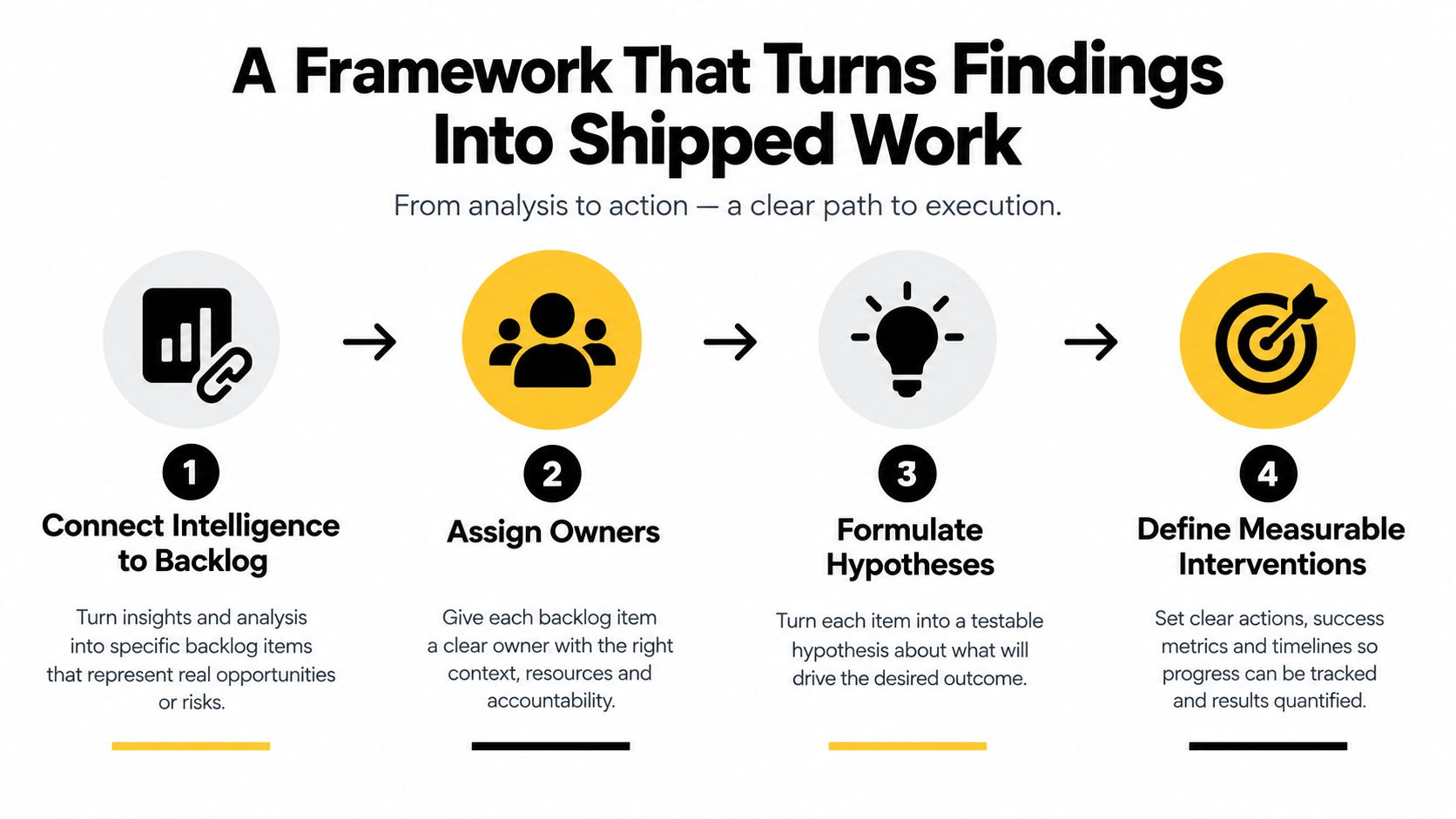
Assign an owner with authority
Give each action to the team that can change the underlying signal. Product owns capability gaps. Content owns explanation gaps. Product marketing owns positioning. Customer success owns recurring trust objections. Engineering owns technical access and rendering issues.
One person should be accountable for moving the item, even if several teams contribute evidence. Shared ownership usually means no ownership.
Form a testable hypothesis
Write the causal story before you build the fix. For example: “If we publish clearer implementation documentation and strengthen supporting evidence on relevant partner pages, assistants will cite our product more often for implementation prompts.”
Keep correlation separate from causation. A large-scale analysis found that branded web mentions correlated with AI Overview visibility at 0.664, while backlinks correlated at 0.218. YouTube mentions showed a correlation of roughly 0.737 across several AI systems, as reported in this analysis of brand mentions and AI visibility. Those are observational relationships. They don't prove that acquiring a mention causes an assistant to recommend a brand.
Define the intervention and measurement
Specify exactly what changes, where it changes, and what evidence will indicate progress. Measure the relevant prompt cluster with controlled runs, record citation sources, and watch downstream indicators such as qualified visits, demo intent, or sales language where available.
Don't optimize for a higher mention count if the mentions come from low-intent prompts. A smaller shift in high-intent recommendation language may matter more than broad awareness. Your intervention should target the evidence that appears to shape the answer, then test whether the answer and business outcome move together.
This framework also gives you a clean stopping rule. If the finding fails validation, close it as noise. If the intervention doesn't change the intended signal, revise the hypothesis instead of endlessly producing more reports.
Putting It All Together and a 30 60 90 Rollout
Run the program with five rules:
- Ask business questions first. Don't monitor a signal unless a decision depends on it.
- Standardize before scaling. Use fixed prompts, providers, intents, dates, and evidence fields.
- Reserve time for analysis. Collection is not the deliverable.
- Treat dashboards as samples. Report volatility and confidence, not just averages.
- Ship fixes, not reports. Every validated finding enters an owned backlog.
For the first 30 days, choose one high-intent category, a controlled prompt set, and the competitors that appear in real buyer conversations. Establish your source ledger, run baseline observations, and document the reliability rules you'll use.
By day 60, connect findings to product, content, sales, and trust owners. Validate recurring movements across providers and related prompts. Turn only validated findings into hypotheses and interventions. If you're formalizing objectives and ownership across a growing team, this OKR rollout guidance for scale-ups can help structure the operating rhythm.
By day 90, review which interventions shipped, which signals changed, and which business outcomes moved. Keep the prompt set that supports decisions, remove low-value monitoring, and expand only after the measurement process is stable. The AI visibility strategy guide can support the next stage as you connect competitive intelligence to broader discovery work.
MyMentions helps SaaS teams track how AI assistants mention, rank, and describe their products and competitors across controlled prompts, providers, citation sources, and confidence signals. Use MyMentions to turn validated AI-visibility findings into a prioritized backlog instead of another dashboard nobody acts on.