
79% of surveyed marketers worldwide said data analysis and interpretation would be an important team skill in 2025, according to Brandwatch's Marketer of 2025 report. The useful skill isn't collecting more competitor metrics. It's knowing which differences justify changing your message, moving budget, or fixing the path from discovery to purchase.
Table of Contents
- Why Competitor Analysis for Marketing Needs Outcomes
- An Outcome Weighted Competitor Scorecard
- How to Run the Analysis From Decision to Remeasure
- Fair Tests When Search and AI Answers Shift
- Evidence Sources Stronger Than Brand Claims
- From Catalog Trap to One Shipped Gap
Why Competitor Analysis for Marketing Needs Outcomes
Say a rival appears in more AI answers than your SaaS product. Your team wants to buy more awareness. Before approving that spend, ask whether those appearances lead to credible recommendations, qualified visits, or customers. A mention lead isn't automatically a commercial lead.
The scale of AI discovery makes that distinction worth examining. Similarweb data reported by TechCrunch shows that AI platforms generated 1.13 billion referrals to the world's top 1,000 websites in June 2025, up 357% year over year, while Google Search generated 191 billion referrals that month.
Separate exposure from business value
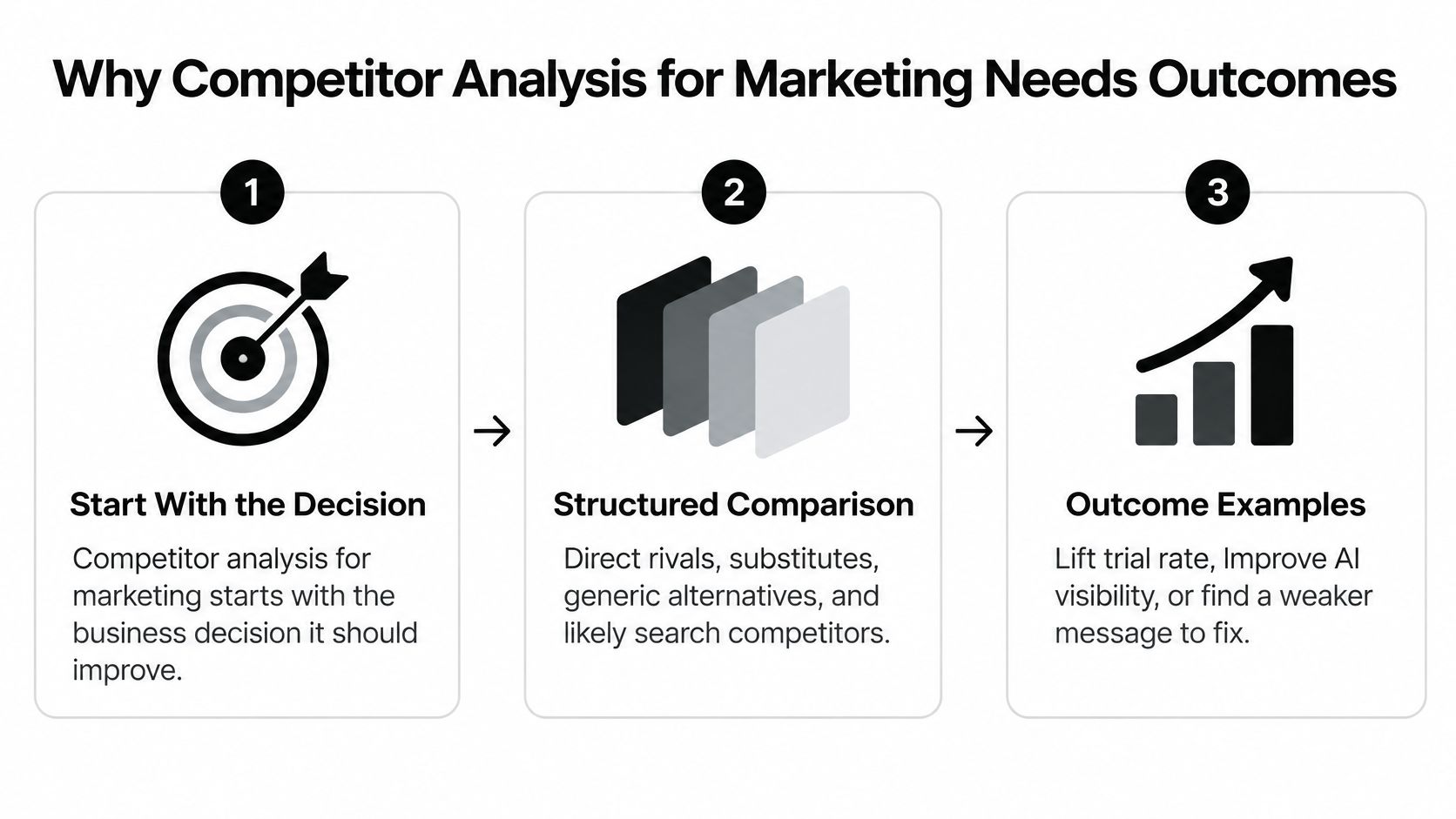
Competitor analysis for marketing is a structured comparison of the alternatives buyers can choose, including direct rivals, substitutes, generic solutions, and likely entrants. Compare their financial, technical, managerial, and marketing capabilities with yours, but only enough to inform a decision. The output should change segmentation, positioning, pricing, channel choice, or resource allocation.
Sign-up conversion by traffic source
Microsoft Clarity's analysis of more than 1,200 publisher and news websites, described in the same TechCrunch report, provides a useful distinction between traffic volume and conversion quality:
| Traffic source | Sign-up conversion rate |
|---|---|
| LLM referrals | 1.66% |
| Search | 0.15% |
| Direct | 0.13% |
| Social | 0.46% |
These are publisher sign-ups, not a forecast for your SaaS funnel. Use the comparison to challenge the assumption that every visit has equal value, then measure your own acquisition cohorts.
Choose the decision before the dashboard
For the fictional SaaS company, the immediate question might be whether weak acquisition comes from limited discovery or an unconvincing offer. Those problems require different spending decisions. More exposure won't repair a landing page that fails to explain implementation requirements.
Keep visibility, referral traffic, assisted conversions, and revenue separate. A buyer may encounter your brand in an answer, return through branded search, and convert later. Record that possible influence without claiming every subsequent sale as AI-generated revenue.
The distinction between competitive intelligence and market research also matters: observing rivals doesn't replace asking buyers why they choose an alternative.
Decision filter: If a finding wouldn't change an action, it doesn't belong in the executive scorecard.
Which single marketing move must this round of analysis improve?
An Outcome Weighted Competitor Scorecard
Outcome-weighted competitor scorecard
| Metric | What it measures | Decision weight | When it misleads |
|---|---|---|---|
| Share of voice | Mention frequency in search and AI answers | High for awareness | Many mentions, few citations or visits |
| Average position | Classic rank or order inside a generated answer | Medium | Top rank while an AI summary cuts clicks |
| Citation prominence | Relied-on source versus a passing name, and source quality | High for AI discovery | Cited only through weak third parties |
| Referral and assisted traffic | Clicks plus influenced visits | High for acquisition | Visibility with no attributable demand |
| Conversion quality | Sign-up or revenue per visit by source | Highest when budgets move | Tiny samples or a single short window |
| Sentiment | How answers describe the brand on buyer-intent prompts | Medium for positioning | Volume of chatter without purchase intent |
| Feature and message coverage | Gaps versus direct rivals and substitutes | Medium for product marketing | A feature checklist with unmatched audiences |
Don't turn these rows into an arbitrary composite score. Decision weight means priority, not permission to multiply incompatible measurements and call the result market leadership. An awareness campaign and an acquisition-efficiency review should produce different priorities.
For every competitor, add the observed result, the gap versus your brand, the evidence behind it, and an actionability judgement. Keep unavailable information visibly unavailable. You usually can't observe a private rival's revenue per visit, so don't present a traffic estimate as a substitute.
Make citation quality inspectable
Open the cited page rather than scoring the domain name alone. Check whether the page supports the actual recommendation, whether the information is current, and whether a buyer can verify the product claim. A detailed independent evaluation can be more useful than your own generic homepage.
Also distinguish a source used to justify an answer from a brand name in a list. Record the cited URL, the claim it supports, and its placement. That gives the content team something concrete to improve.
For retail-oriented teams, Online Brand Growth's Amazon product comparison strategies for brands offers a useful context for comparing alternatives at the point of choice. The same discipline applies to SaaS: compare the attributes buyers use to decide, not everything a product team can list.
Work through a rival without inventing its revenue
Consider a fictional rival called RelayDesk. It leads your brand on mentions, but its citations point to shallow roundups, while your implementation documentation receives substantive citations. Your own analytics also show that visitors arriving through implementation-related pages progress to qualified trials more reliably than visitors landing on broad category content.
That doesn't prove RelayDesk has a worse trial rate. It does suggest that trust-building content is a stronger immediate hypothesis than additional top-of-funnel ads.
Your filled scorecard could record:
- Observed rival advantage: Broader mention coverage on category prompts.
- Observed rival weakness: Limited supporting evidence behind recommendations.
- Your measurable opportunity: Extend implementation content into uncovered buyer questions.
- Budget implication: Fund the content and landing-path test before expanding awareness spend.
Use a consistent competitor benchmarking process to keep these judgements comparable. The scorecard should expose uncertainty, not hide it behind a polished total.
How to Run the Analysis From Decision to Remeasure
A defensible comparison depends on identical measurement, not an impressive competitor list. Sprig's competitive benchmarking guide supports a controlled approach with comparable respondents, consistent questions and scales, and an appropriate repeated-measures design.
Set the study boundaries
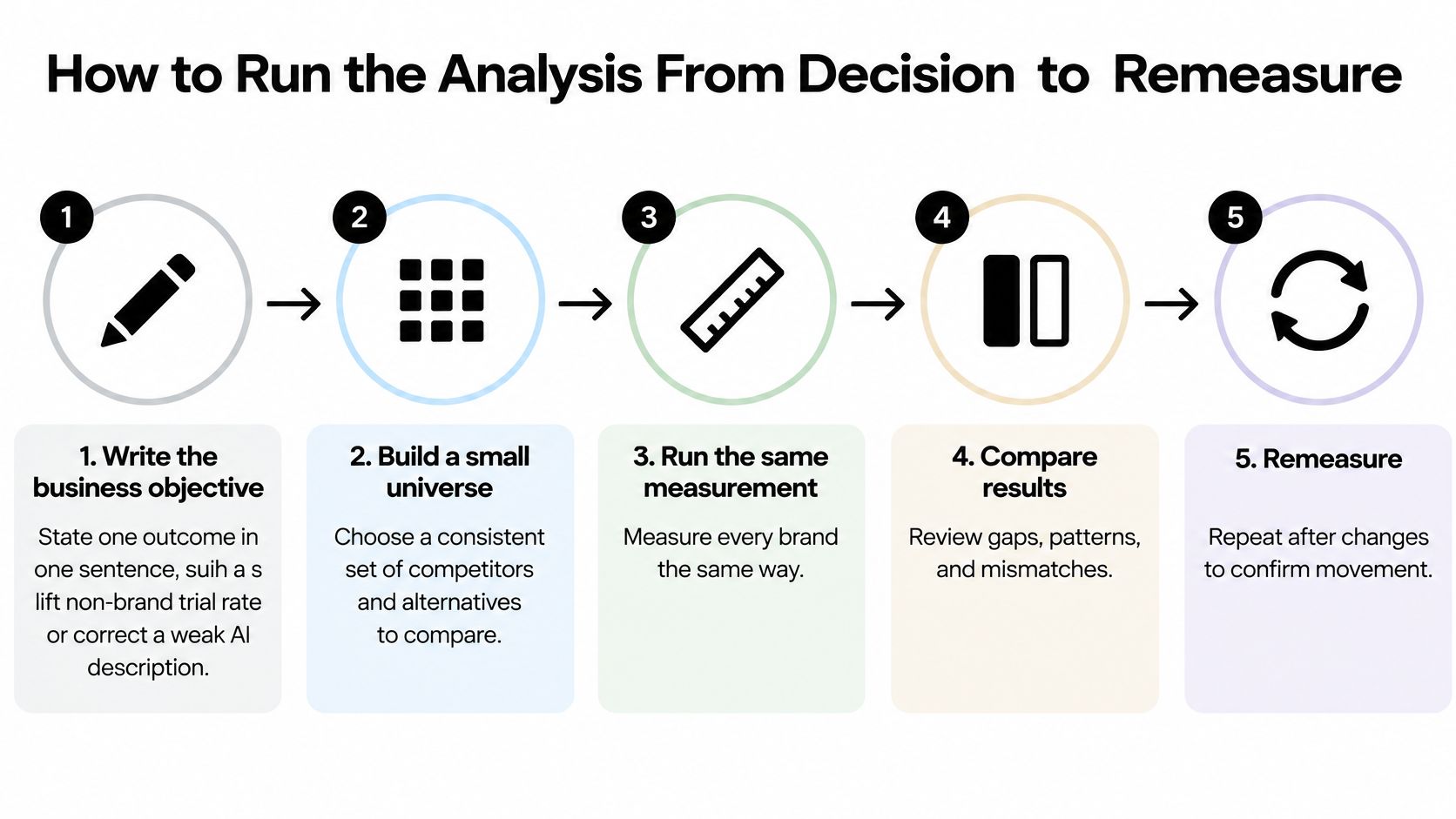
Write the business objective. State the outcome and audience in a sentence, such as improving qualified non-branded trial acquisition among operations teams. This prevents the project from drifting into a general review of the category.
Build a bounded competitor universe. Include direct alternatives and substitutes that solve the same job. An internal spreadsheet or manual workflow can belong; an admired enterprise brand serving unrelated buyers may not. Exclude brands for an explicit reason rather than because they're inconvenient to measure.
Choose the relevant scorecard rows. A positioning study needs buyer perceptions and message coverage. An acquisition review needs source-level traffic and conversion quality. Keeping only decision-relevant measures prevents analysts from selecting whichever metric makes their brand look strongest.
Freeze the collection protocol. Save exact buyer-intent prompts, collection conditions, provider or model versions, and survey wording before fieldwork. For buyer research, recruit from a common sampling frame and set brand quotas. Don't compare existing customers of your brand with loosely qualified prospects evaluating competitors.
Collect, interpret, and assign
Use a shared coding guide. Define inclusion, position, sentiment, and citation coverage before classifying answers. Explain how to handle an unranked list, an ambiguous product name, or an answer that mentions a brand negatively. Have another reviewer check ambiguous cases so subjective judgement doesn't become a hidden competitive advantage.
Segment before drawing conclusions. Separate buyer audiences, markets, channels, and branded versus non-branded intent. A surge in searches for a rival's name after a launch isn't evidence that it owns the category's purchase questions. Likewise, don't combine enterprise procurement prompts with self-service purchasing prompts.
Apply a predetermined noise rule. Check distributions, establish outlier handling before analysis, and use paired tests when the same respondents evaluate alternatives. Report confidence intervals for survey estimates and repeatability for prompt observations. Don't treat repeated outputs from an identical prompt as independent buyer opinions.
Assign the intervention and remeasurement. Name the accountable person, what they'll change, and when the same protocol will run again. Preserve the baseline so the team can distinguish an intervention's result from a change in measurement.
For marketplace businesses, Headline Marketing Agency's guidance to find gaps in competitors' Amazon listings provides a concrete application of bounded comparison. Examine the purchase obstacle, not merely whether a rival has filled every listing field.
A completed analysis contains a gap table with evidence, uncertainty, ownership, and a next action. A slide of competitor logos is only a starting list.
For company-size differences, show both the raw gap and any defensible size-adjusted comparison. If you can't support the adjustment, explain the limitation instead of manufacturing precision.
Fair Tests When Search and AI Answers Shift
An Ahrefs analysis of 300,000 keywords associated AI Overviews with a 34.5% lower average click-through rate for the top-ranking page, as reported by Digiday. That's an association, not proof that every query experiences the same loss. It is enough to reject rank alone as a reliable measure of available traffic.
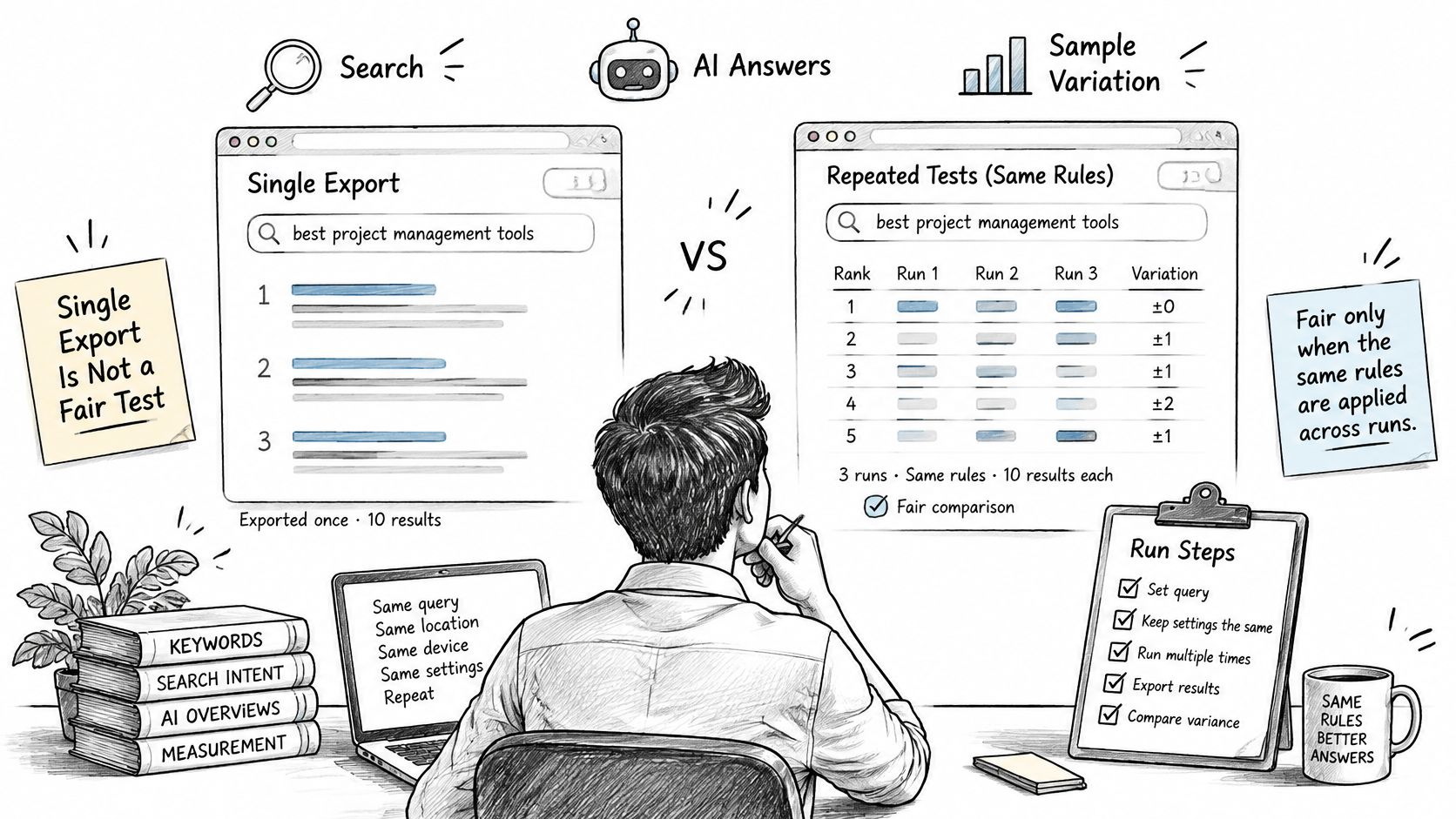
A conventional search export and an AI-answer snapshot capture different interfaces. Even within an assistant, wording, session context, location, and collection date can affect the comparison. Don't describe a rival as universally dominant when you've only tested a narrow slice of discovery.
Separate platform effects from competitive movement
Use conventional search and selected assistants within the same collection window. Record the search location, account state where relevant, available model identifier, and whether an AI summary appeared. Where a version isn't exposed, mark it as unknown.
Apply these comparison rules:
- Preserve the test conditions: Keep wording and buyer context fixed within the benchmark. Put newly discovered prompts into a separate exploratory cohort.
- Keep platform results separate: Compare each rival against your brand within each platform before calculating any combined view.
- Retain the answer evidence: Save text, cited URLs, timestamps, and coding decisions so an apparent change can be inspected.
- Require persistence: Repeat observations at a fixed interval before treating an isolated advantage as a durable trend.
Don't weight every platform equally by habit. If your buyers demonstrably use a particular discovery channel, explain that weighting. If you don't know their usage, report platform-specific results rather than implying a representative market average.
Diagnose a false win
Suppose a rival suddenly becomes prominent in an assistant after a platform update. The answer cites its documentation, and a quick review suggests copying its entire content architecture.
In a subsequent scheduled run, the advantage disappears without any competitor site change. The reasonable conclusion is platform sensitivity, not a proven content strategy. Hold the larger investment while inspecting which cited passages, prompt types, and answer formats changed.
A prompt regression testing approach makes those changes easier to investigate because the comparison retains a stable baseline. For the intervention itself, AdCrafty's guidance to set hypotheses for creative tests is useful: state what should change and what observation would contradict your explanation.
Don't move budget because a competitor won an answer. Move it when you understand the repeatable buyer opportunity behind that result.
Evidence Sources Stronger Than Brand Claims
Competitor evidence sources and what they can prove
| Source | Signal | Best for | Limit |
|---|---|---|---|
| SEC filings or annual reports | Geography, revenue mix, investment, stated goals | Public-company strategy | Missing for most private products |
| Product pages, pricing, and docs | Features, price, and positioning | Offer comparison | Promotional by design |
| Reviews and communities | Trust, complaints, reasons to switch | Weakness finding | Selected, vocal users |
| Partner pages and job posts | Ecosystem and capability bets | Future moves | Incomplete and lagging |
| Calls, interviews, press | Objectives in the company's words | Strategy inference | Spin and selective disclosure |
| Buyer research | Preference and willingness to switch | Positioning and pricing | Cost and sample design |
| Repeated AI prompt snapshots | Inclusion, rank, sentiment, citations | AI discovery | Changes by provider, prompt, and date |
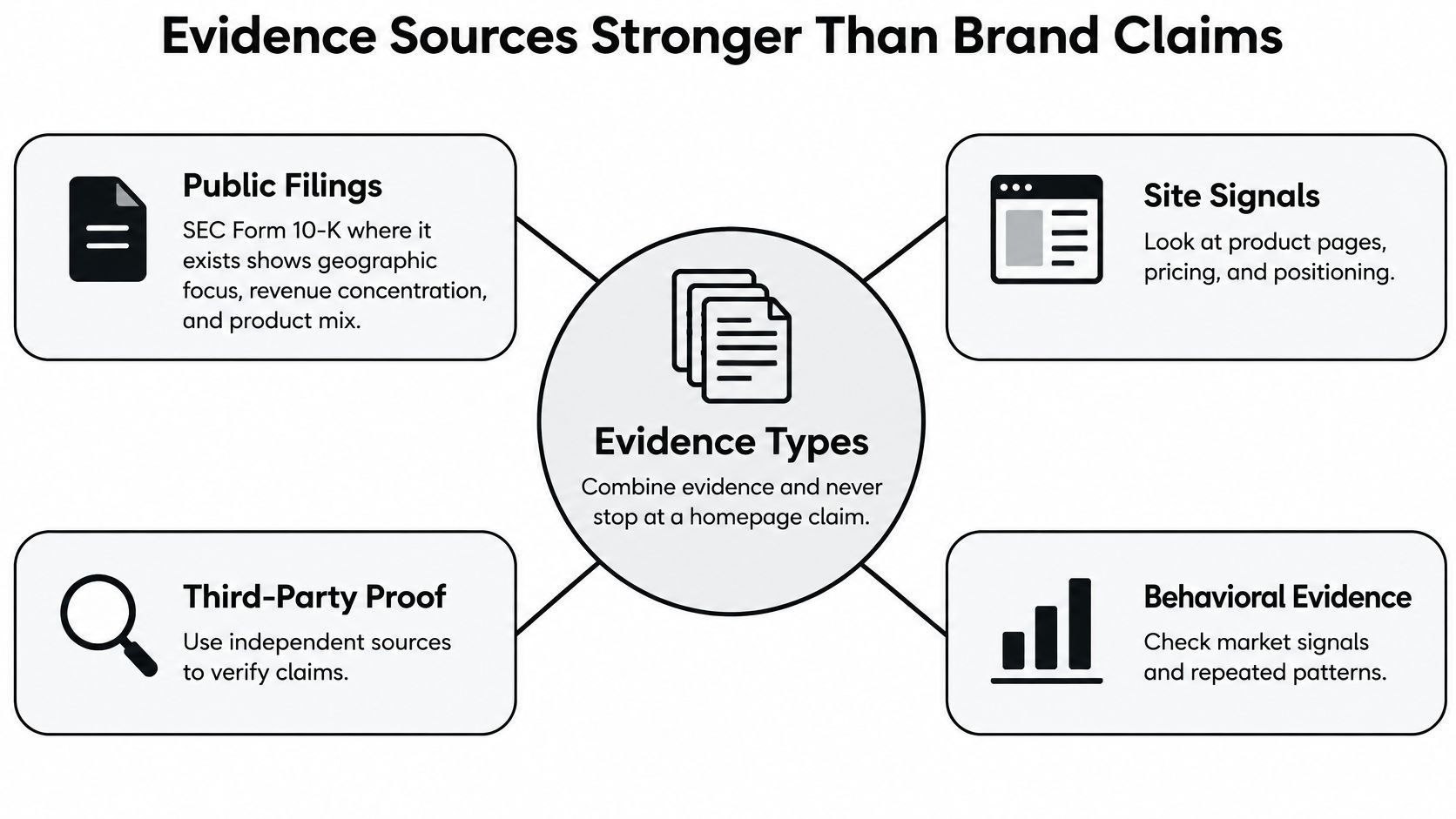
A homepage tells you what a competitor wants buyers to believe. It doesn't establish investment priorities, delivery quality, or customer preference. Saint Anselm College's competitor analysis guide identifies filings, annual reports, executive interviews, earnings calls, and press releases as useful inputs to a broader competitive assessment.
Public-company evidence versus private-product clues
Say a public software rival emphasizes expansion into a particular region. Compare that statement with its annual report's geographic revenue discussion and investment disclosures. Consistent evidence supports a strategy hypothesis; an isolated press announcement doesn't establish execution.
A private SaaS rival may publish no comparable financial filing. Substitute a dated evidence trail across pricing, documentation, release notes, partner announcements, and hiring pages. Label the conclusion as an inference, especially when a job posting is the main indication of a planned capability.
For offer comparisons, record plan restrictions, billing conditions, usage limits, and the date observed. A practical process to track competitor pricing helps distinguish an actual pricing move from a packaging change. Don't compare a promotional entry price with your fully configured plan.
Let the decision determine the source
Reviews help identify complaints worth investigating, but reviewers aren't a representative sample of all buyers. Look for repeated, specific accounts, then ask whether the issue applies to your target segment. A complaint about enterprise administration may be irrelevant to a solo founder.
Buyer research is more appropriate when the decision concerns preference, willingness to pay, or switching barriers. Ask buyers to evaluate comparable scenarios rather than inviting them to praise your product. Help content and implementation documentation can then verify whether a promised capability is usable in that scenario.
Build a comparative SWOT only after gathering evidence. The SWOT analysis overview describes the strengths, weaknesses, opportunities, and threats framework; its practical value here comes from comparison. Distribution reach isn't a meaningful strength unless it reaches relevant buyers more effectively than your alternatives.
Choose the evidence that resolves the decision. If the problem is buyer trust, another traffic estimate won't answer it.
From Catalog Trap to One Shipped Gap
The catalog trap starts with reasonable requests: add another rival, capture another feature, export another dashboard. It ends with a crowded spreadsheet and no committed change. Completeness is not the acceptance criterion; an evidence-backed intervention is.
Socialinsider's competitive analysis report guidance emphasizes turning comparisons into decisions, treating third-party benchmarks as directional, and tracking strategic trends at least quarterly. Use that discipline to constrain the work rather than expanding the report whenever someone asks a new question.
Replace collection with a decision backlog
A useful backlog entry contains the buyer problem, supporting evidence, proposed intervention, owner, success measure, and remeasurement conditions. Prioritize using expected impact, implementation effort, and confidence. Keep those judgements visible instead of hiding them in an unexplained formula.
Impact should connect to a funnel constraint. Effort should include engineering dependencies and review time, not just writing time. Confidence should reflect the evidence supporting the proposed cause, rather than how strongly the team prefers the idea.
Consider these before-and-after cases.
Before, a feature matrix. The team documents every rival's integration list and concludes that it needs more integrations. Nobody checks which missing connection prevents the target buyer from adopting the product.
After, a purchase obstacle. Buyer interviews and lost-deal notes repeatedly identify an existing integration that's difficult to discover and poorly explained. The product marketer owns a clearer integration page and onboarding explanation. The decision is a messaging and usability fix, not an immediate development commitment.
That distinction protects engineering capacity. Competitive parity can be expensive, especially when you copy capabilities designed for a different audience.
Match the fix to the observed failure
Before, a mention-count campaign. Your brand appears in category answers, but the recommendation lacks supporting evidence. The team proposes more broad articles because a competitor publishes frequently.
After, a citable answer. Inspect the relevant buyer question and publish the material needed to substantiate the claim: implementation steps, limitations, compatibility details, and verifiable product evidence. Assign a subject-matter reviewer and a content owner. Measure whether the intended page becomes a supporting citation on the relevant prompt cohort.
Don't treat citation acquisition as the final commercial result. Check whether visitors reaching that page understand the next step and whether the resulting trials fit your target customer.
For work that spans content and technical execution, translate findings into actionable SEO recommendations. Each recommendation should specify the affected page and required change, rather than just asking the team to improve authority.
Before, a traffic-volume response. Referral visits rise, but qualified trial progression doesn't. The acquisition team wants more of the same traffic because the channel chart looks healthy.
After, a landing-path test. Inspect message continuity between the answer, landing page, and sign-up flow. A visitor seeking migration guidance shouldn't arrive at a generic homepage with no migration detail. Give the growth owner responsibility for that path and evaluate qualified progression, not raw sessions.
Ship a bounded test
Separate delivery commitments from outcome commitments. A team can commit to publishing a reviewed migration guide and fixing its navigation; it can't guarantee that an assistant will cite it. Record both the controllable deliverable and the external result you'll observe.
Use a compact operating checklist:
- Evidence attached: Preserve the answer, cited page, buyer observation, or filing passage behind the gap.
- Owner named: Give a person responsibility for delivery and coordination.
- Success defined: Specify which scorecard measure should change and which downstream outcome matters.
- Guardrails retained: Watch for lower-quality trials, misleading claims, or a worse user experience.
- Retest scheduled: Reuse the original conditions and record any unavoidable changes.
I would start with the cheapest fix that addresses a credible purchase obstacle. That might be clearer documentation or a more relevant landing page, not a new campaign or feature. If the evidence is weak, fund a smaller diagnostic test before committing the production budget.
Your immediate action is to freeze a bounded set of buyer-intent prompts, compare the relevant alternatives, and assign the strongest supported gap. Leave unrelated observations in a parking lot. The analysis has done its job when someone ships a change and the team can evaluate what happened.
MyMentions offers competitor comparisons across AI assistants, including visibility, position, sentiment, and the citation sources behind answers. Visit MyMentions to organize buyer-intent prompts, inspect where rivals gain credible exposure, and turn those gaps into a prioritized backlog your team can measure after shipping.