A 2023 study found that 58.8% of tested prompt and model combinations lost accuracy after API updates, even when teams hadn't changed their prompts (arXiv research on prompt and model behavior). That finding changes the role of prompt regression testing. It isn't a final review before launch or a quick comparison between two outputs. It's release infrastructure for a system whose behavior can change when the prompt, model, retrieval layer, configuration, or provider changes.
LLM applications return valid responses even when they fail. A support assistant can sound helpful while omitting a required policy. A retrieval workflow can cite an irrelevant page while preserving a convincing tone. A structured response can contain plausible content that breaks a downstream parser. Conventional application monitoring may see a successful API request, but it won't necessarily see a behavioral regression.
The practical answer is to treat prompts as versioned software artifacts. Teams need representative test cases, behavioral assertions, pinned baselines, slice-level reporting, and a CI gate that blocks a release when evidence shows that an accepted behavior has degraded.
Table of Contents
- Why Prompt Regression Testing Matters Now
- Designing Your Golden Set and Baselines That Actually Catch Regressions
- Automating Prompt Regression Testing in Your CI Pipeline
- Measuring Real Regressions With Slice Analysis and Statistical Confidence
- From Alert to Fix With a Repeatable Remediation Workflow
- Proven Tips to Keep Your Prompt Tests Stable and Actionable
Why Prompt Regression Testing Matters Now
58.8% of prompt and model combinations dropped in accuracy across API updates, even without prompt edits, according to the study's findings. That result makes prompt regression testing release infrastructure, not a final review or a quick comparison of two outputs.
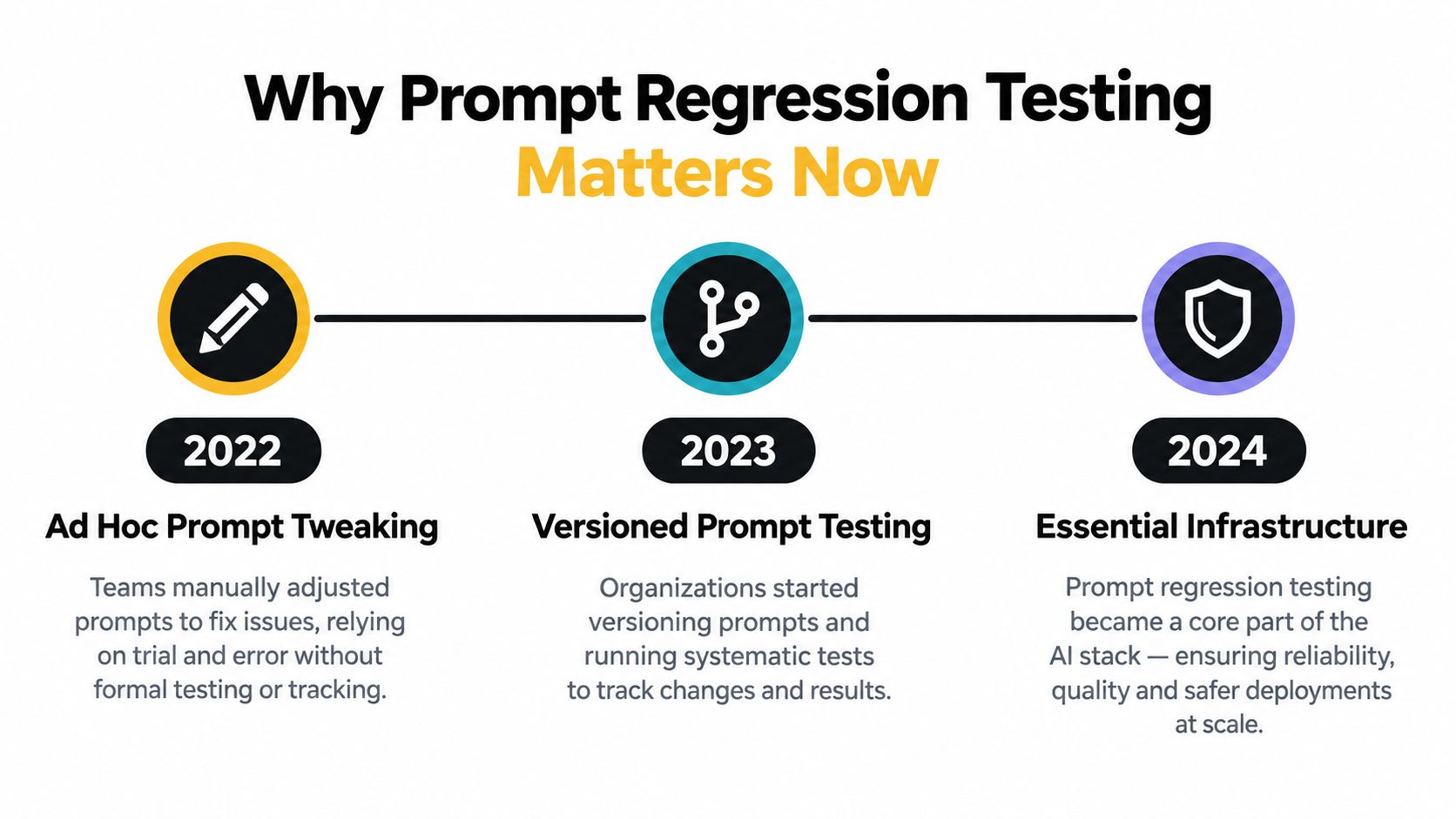
The practice became distinct after the 2022 wave of production chatbots and copilots, when teams saw that prompt changes could break behavior much like code changes (history of regression testing for prompts). By 2023, organizations shipping LLM products at scale were building internal regression frameworks. By 2024, open-source evaluation tools were treating regression testing as a first-class capability, according to the same engineering overview.
LLM behavior depends on more than the prompt. A provider can update an API model, retrieval changes can modify the context passed to generation, and configuration changes can alter output variability. Application code may remain untouched while the system's behavior shifts. Cross-provider tracking matters for the same reason: a prompt can satisfy its contract with one model and weaken it with another.
The research found that regressions occurred across API updates, not only after teams edited prompts. A manual review performed before release cannot protect a production feature from a dependency that changes later.
Why silent failures are expensive
The most costly failures often preserve fluent wording while losing a required property:
- Instruction adherence: The response follows the user's request but ignores a mandatory constraint.
- Structural validity: The content looks correct, yet the required JSON or field structure no longer parses.
- Safety behavior: A refusal or escalation rule weakens after a model update.
- Coverage: Common requests still work while edge cases or negative paths fail.
- Brand and commercial intent: The answer remains fluent but describes a product less accurately, ranks it differently, or omits the source supporting buyer confidence.
For founders and marketing teams, these changes can affect how AI assistants discover and describe a product. A prompt that once produced a favorable, well-cited answer may start surfacing competitors or weaker sources. The impact reaches beyond wording quality. It can affect trust, qualified visits, and the consistency of a product story across providers.
Teams that manage recurring operational failures can apply the same principle found in RETRO STRESS regression testing: repeated incidents indicate a need for durable controls, not another manual correction. LLM teams must adapt that approach to probabilistic outputs. The acceptance criterion is behavioral, not word-for-word identity.
Identical prompts can produce different answers. Why ChatGPT doesn't give the same answers to everyone provides useful context for designing assertions around meaning, structure, safety, and required content without requiring exact wording.
Practical rule: A prompt change is ready only when the accepted behavior is versioned, tested, and safe to release.
A mature implementation works like unit and integration testing with different assertions. The team keeps a frozen golden set, compares each run with a pinned baseline, examines slices such as intent, provider, and risk level, and uses statistical evidence before allowing deployment. CI should gate releases when the observed change exceeds the team's accepted tolerance. That turns prompt tweaking into repeatable AI software quality assurance.
Designing Your Golden Set and Baselines That Actually Catch Regressions
A golden set earns trust only when it mirrors the work real users send to the system. Convenient examples create false confidence. A release can pass while missing the intent, segment, content type, or provider variation behind production failures.
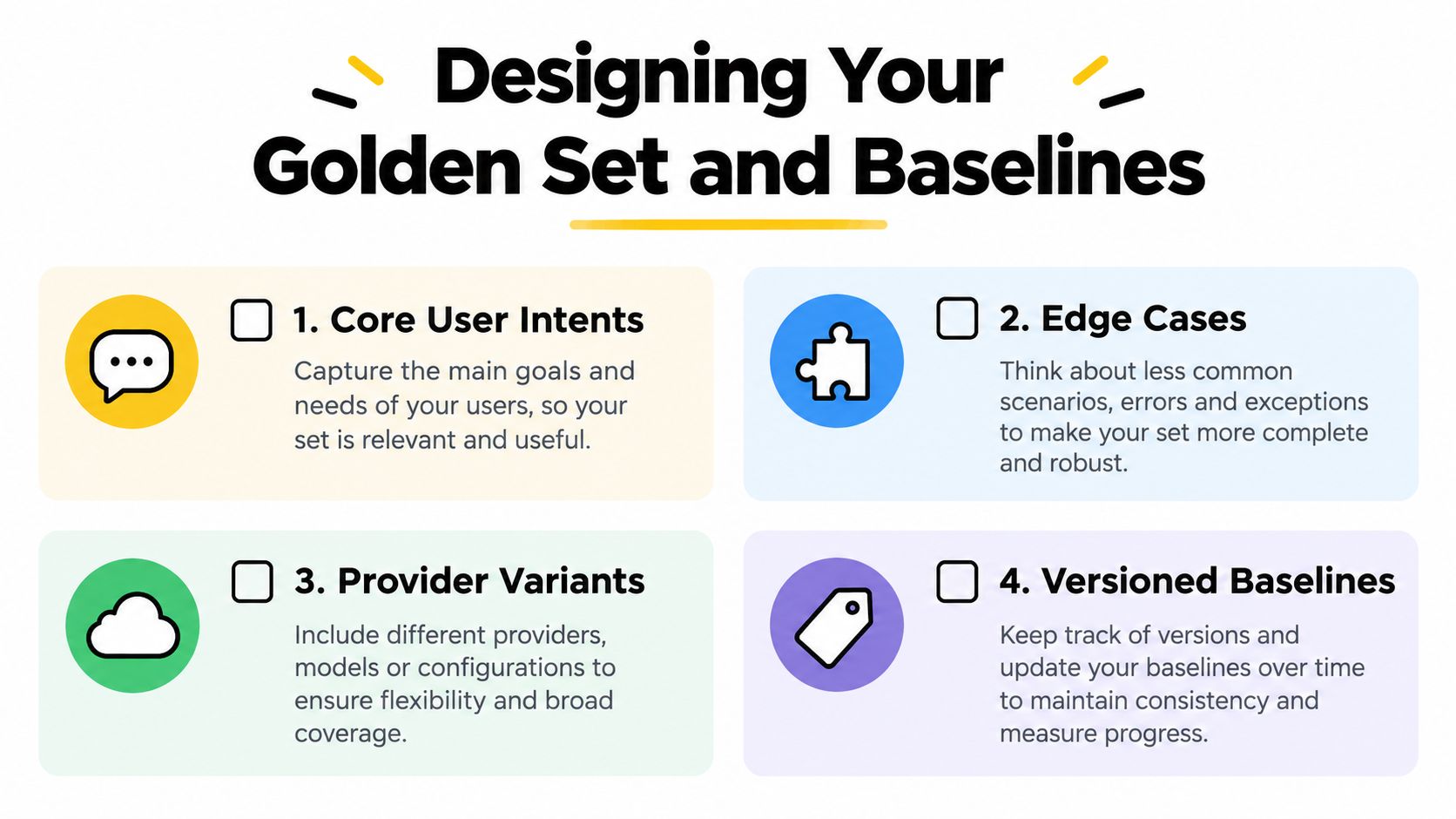
Define the route under test first. It may classify support tickets, summarize documents, answer product questions from retrieved context, or generate an AI visibility report. For each route, build a stratified set of roughly 100 to 300 paired cases, following the benchmark-style methodology described in Statsig's prompt regression testing guide. Distribute cases across core intents, difficult inputs, content categories, user segments, and provider paths. A random pile of examples will overrepresent easy traffic.
Build cases around behavior
Each case needs an executable expectation, not only an input and a target string. Record:
- Prompt input: The user request, system context, retrieved material, and relevant configuration.
- Expected behavior: What the model must do, omit, preserve, or refuse.
- Rubric: Criteria for correctness, completeness, structure, tone, citation quality, and safety.
- Slice tags: Intent, language, customer segment, content category, risk level, provider, and route.
- Baseline reference: The accepted prompt version, model identifier, parameters, and evaluation result.
A product-answer case might require the response to use only supplied documentation, identify uncertainty when evidence is missing, include a required product fact, and return a parseable structure. Wording can vary. These behavioral constraints must remain stable unless the contract changes.
The golden set should contain boundary cases as well as routine traffic. Include ambiguous requests, incomplete evidence, long retrieved context, malformed inputs, and cases where refusal is the correct result. Those examples expose regressions that an average score can hide.
Your baseline represents the last accepted state, not an ideal answer created after a failed run. Pin the prompt version, model configuration, retrieval inputs, and evaluator settings together. If the retrieval corpus changes, record it in the candidate environment. Otherwise, the comparison cannot distinguish a prompt regression from a data change.
Version the contract, not just the prompt
A behavior contract changes with product decisions. The team may permit a new output field, change the preferred tone, or revise how the assistant handles an edge case. Update the contract in the same pull request as the prompt, and explain each intentional expectation change. Editing the contract casually can erase a safety boundary that CI was meant to protect.
The PromptBench guidance recommends contract-based prompt regression testing and emphasizes slice-level analysis, since an aggregate score can hide failures concentrated in particular prompts, segments, or content categories (contract-based prompt regression testing). Use those slices as release controls, not just dashboard labels. A candidate that improves the blended score while failing a protected risk slice should not pass automatically.
Ask during review: which behavior is intentionally changing, and which behaviors must remain protected? The answer prevents a tone improvement from weakening format validation, or a retrieval improvement from reducing coverage for rare but important queries.
Teams can use prompt engineering best practices to refine instructions, examples, and constraints. Better prompt design does not replace regression coverage. The golden set records what the system is trusted to do, while the baseline makes that expectation comparable across model and provider updates.
Automating Prompt Regression Testing in Your CI Pipeline
The most reliable workflow treats prompt regression testing as a contract-based CI gate. Every pull request that changes a prompt, model, retrieval configuration, evaluator, or related infrastructure should trigger the same test suite against the candidate state and the pinned baseline.
The workflow can stay straightforward:
- Trigger the evaluation. Detect changes to prompt files, model identifiers, retrieval settings, evaluation code, or contract files. A manual release command can provide a second trigger for provider updates.
- Load the test contract. Fetch the versioned golden set, rubric definitions, slice tags, baseline metadata, and approved thresholds.
- Run the candidate and baseline. Execute both under controlled settings. Store prompts, model versions, parameters, retrieved context identifiers, outputs, evaluator results, and run metadata.
- Compare by rubric and slice. Report differences for each important behavior, not just one blended score.
- Apply the gate. Block the merge when a protected rubric regresses beyond the accepted decision rule. Allow an intentional change only when the contract update and justification are included in the same review.
- Publish an artifact. Preserve failed examples and comparison details so the owner can reproduce the issue without rerunning an entire production workflow manually.
Make provider differences visible
Cross-provider testing deserves its own dimension. The same route can behave differently across OpenAI, Google, Perplexity, Claude, or another provider because models vary in instruction following, retrieval behavior, formatting, and response style. A single baseline can hide that difference.
Store provider and model as explicit dimensions in the results. Compare each candidate to the appropriate pinned baseline, then inspect whether a change improves one provider while degrading another. For AI visibility work, preserve the answer, cited sources, position, sentiment, and prompt metadata so marketing and product teams can distinguish a model-specific shift from a broader content problem.
Monitoring tools can complement CI by tracking production behavior after deployment. A practical overview of LLM monitoring tools can help teams decide which traces, scores, alerts, and provider dimensions belong in the operational layer rather than the pull-request gate.
Release principle: CI should answer whether a proposed change is safe to merge. Production monitoring should answer whether accepted behavior remains healthy under live traffic.
The gate also needs ownership. Assign an owner for each route and rubric, define who can approve an intentional contract change, and retain the failed cases in the build output. Without clear ownership, teams eventually weaken thresholds or rerun tests until the failure disappears.
A short explainer can make the workflow easier to share with product and engineering stakeholders:
Automation doesn't remove judgment. It moves judgment to a controlled review point, where the team can see exactly what changed and decide whether the change is intended, acceptable, or unsafe.
Measuring Real Regressions With Slice Analysis and Statistical Confidence
A single aggregate score is an unsafe release signal. Common cases can improve while a smaller, higher-risk group deteriorates. Products serving multiple intents, segments, languages, or content categories need distribution-level analysis, not one average.
Slice analysis depends on consistent tags on every golden case. Compare baseline and candidate results by intent, risk level, content category, provider, and route. A support classifier may remain stable overall while mishandling escalation requests. An AI visibility test set may keep its average position while losing citations for one buyer-intent category.
Control output variance
LLM outputs are stochastic. A single run per case can turn random variation into a false release decision. Repeated runs, lower temperature settings where appropriate, and quarantine rules reduce that noise. Variance-control guidance for prompt regression testing (Statsig) recommends 3 to 5 runs per test case, majority voting, and classifying results as PASS at 70% or higher, FLAKY from 30% to 70%, and FAIL below 30%. The same guidance describes an approach using 5 to 10 samples while tracking standard deviation.
Treat those figures as operating choices, not universal laws. A deterministic extraction route may need fewer samples than a creative generation route. A safety boundary may require a stricter rule than a stylistic preference. Define the sampling policy before reviewing candidate results, or reviewers will unconsciously change the standard to fit the output.
Keep unstable cases visible. Mark them as flaky, investigate whether the input, evaluator, provider, or prompt causes the variance, and record the reason for quarantine. Do not exclude them from the gate without comment. A quarantined case still represents a product behavior that needs an owner and a plan.
Use confidence intervals for release decisions
Point estimates can overreact to random variation, especially in small slices. Compare paired baseline and candidate outcomes, calculate a confidence interval for the change, and write the release rule into the CI configuration. The benchmark methodology cited earlier recommends shipping only when the 95% confidence interval for the change doesn't sit entirely below zero on any rubric.
A practical decision matrix looks like this:
| Signal | What It Means | Action |
|---|---|---|
| Aggregate score stable, protected slice declines | The average hides a localized failure | Investigate the slice and block if the rubric is critical |
| Candidate point estimate declines, interval includes no clear negative change | Evidence is inconclusive | Repeat runs, inspect cases, and avoid an automatic rollback |
| Candidate interval sits entirely below zero on a protected rubric | Statistical evidence supports a regression | Block the merge or roll back |
| Results vary widely across repeated runs | The test case or evaluator is unstable | Quarantine, diagnose variance, and improve the test |
| One provider declines while others remain stable | The change may be provider-specific | Keep provider baselines separate and investigate that integration |
For outputs tied to market visibility, AI search analytics can inform the slice schema. Track provider, prompt intent, answer content, ranking, sentiment, and citations as separate dimensions. A visibility average can hide the prompt category where a product stopped appearing or where a competitor began receiving the supporting citation.
Provider-level tracking also prevents incorrect attribution. If one model changes while other providers remain stable, the prompt may be acceptable and the integration may require investigation. Keep provider, model, route, and contract version in the test record so CI can identify the boundary of the regression.
Evidence beats intuition: A response that looks worse in manual review deserves investigation. A slice-level decline supported by repeated runs and a confidence interval deserves a release decision.
LLM-as-a-judge can assess open-ended qualities, but it should not stand alone for critical behavior. Pair it with programmatic checks for required fields, forbidden content, citation presence, and structural validity. Use human review for disputed or high-impact cases, then store the adjudication so future tests become more precise.
From Alert to Fix With a Repeatable Remediation Workflow
Detection without remediation creates alert fatigue. A failed test needs a route, severity, owner, reproduction path, and decision deadline. Otherwise, the team learns to treat regression reports as background noise.
Start with an alert that includes the affected prompt or route, provider, model, contract version, failed rubric, slice, baseline result, candidate result, representative outputs, and links to the build artifact. Send operational notifications through Slack, Discord, or email according to the team's existing incident practice. For visibility changes, a dashboard should show share of voice, average rank, sentiment, and citation sources so the team can separate a response problem from a source or content problem.

Triage the failure before changing the prompt
Don't immediately rewrite the instruction. First classify the likely cause:
- Prompt defect: An instruction, example, priority, or constraint changed.
- Model or provider change: The prompt stayed pinned, but an upstream dependency changed.
- Retrieval defect: The candidate received different, incomplete, stale, or poorly ranked context.
- Evaluator defect: The rubric or judge misclassified an acceptable variation.
- Input shift: The golden case no longer represents the production distribution.
Reproduce the failure with the exact prompt version, model identifier, parameters, retrieved context, and test input. If the issue began after a model update, roll back to the last accepted configuration when the business risk justifies it. Then create a focused regression case that captures the failure before patching, so the fix has a durable test.
Close the loop
A complete remediation record should state what changed, why it changed, which slices were affected, and which tests confirmed the resolution. Assign separate owners when the fix crosses functions. Product may own the behavior contract, engineering may own the prompt or retrieval pipeline, and content or SEO may own the source material that AI systems rely on.
For AI visibility workflows, AI search monitoring can support the operational loop by keeping prompt-level changes and provider-level visibility signals connected. The team can use that evidence to prioritize a missing citation source, an inaccurate product description, a weak comparison page, or a technical issue that prevents important content from being discovered.
A realistic response to a model-update regression is controlled rather than dramatic. The team identifies the first failed slice, pins the failing configuration, rolls back if the impact is material, patches the prompt or context, adds a case for the defect, and reruns the full golden set. Shipping resumes only after the protected behavior passes across the relevant providers and the contract reflects any intentional change.
Proven Tips to Keep Your Prompt Tests Stable and Actionable
Stable suites protect teams from two common errors. An overly strict test fails on harmless wording changes. An overly loose test approves output that breaks the product contract.
Use these operating rules:
- Prefer behavioral assertions: Check required facts, structure, safety boundaries, intent, and citation behavior instead of exact strings.
- Repeat stochastic cases: Use 3 to 5 runs with majority voting when variance matters. Classify outcomes as PASS, FLAKY, or FAIL using the guidance described in the Statsig methodology.
- Quarantine, don't delete: Keep unstable cases visible while you investigate the test, evaluator, prompt, or provider behavior.
- Refresh from production: Add representative failures and newly important intents, then review each case so the suite does not overfit to one incident.
- Separate critical from cosmetic: Give safety, structure, and factuality regressions more release weight than a mild tone difference.
- Track providers independently: A passing result on one model does not show that another provider preserves the same behavior.
- Keep the contract in version control: An intentional output change needs a documented reason, updated expectations, and reviewer ownership.
- Combine automated and human review: Programmatic assertions catch structural failures consistently. Human adjudication resolves ambiguous semantic cases.
Run the suite on every prompt or model change, starting with one production route and its most important intents and edge cases. Pin the accepted configuration, and add slice tags before expanding the case count. Keep provider results separate so a change in one model does not hide a regression in another.
Quarantine cases rather than weakening assertions just to restore a green build. A flaky test may indicate unstable generation, an unclear contract, or an evaluator that needs revision. Record the reason for each exception, assign an owner, and set a condition for returning the case to the release gate.
Prompt regression testing becomes useful when it controls shipping decisions, rather than producing a report reviewed after deployment. Start with a narrow contract, measure it consistently, and require evidence before approving a prompt for production.
MyMentions helps teams track fixed prompts across AI providers, compare answers, rankings, sentiment, and citation sources, and turn visibility gaps into prioritized actions. Use MyMentions to connect prompt-level monitoring with a repeatable regression and remediation workflow for your product.