
The most popular SEO advice is usually the least useful: publish more content, add keywords, fix metadata, and wait. That approach produces activity, not necessarily progress. A recommendation only matters when someone can understand it, own it, ship it, and measure what changed.
Google's history makes the point. PageRank made external links important, while Florida, Panda, Penguin, Hummingbird, Page Experience, and the Helpful Content System successively changed how teams should think about quality, manipulation, relevance, technical performance, and usefulness. The durable lesson is simple: SEO recommendations have moved from keyword checklists toward authority, information quality, technical reliability, and experience. (Google algorithm update history)
Search visibility still has a sharp economic curve. A 2026 Google US desktop study measured average organic CTR at 20.02% for position one, 10.36% for position two, and 3.89% for position three, across SERP types. (Advanced Web Ranking CTR research) Your backlog shouldn't treat every ranking movement as equal. It should identify which fixes can move valuable pages into the top results, improve how answer engines extract your content, or remove technical barriers that prevent discovery.
Table of Contents
- Why Most SEO Recommendations Never Get Built
- A Five-Stage SEO Recommendations Workflow
- What Good Recommendations Actually Look Like
- Scoring and Prioritizing the Backlog
- Implementation, Measurement, and the AI Visibility Layer
- Common Pitfalls When Acting on SEO Recommendations
- Putting It All Together in Your First 30 Days
Why Most SEO Recommendations Never Get Built
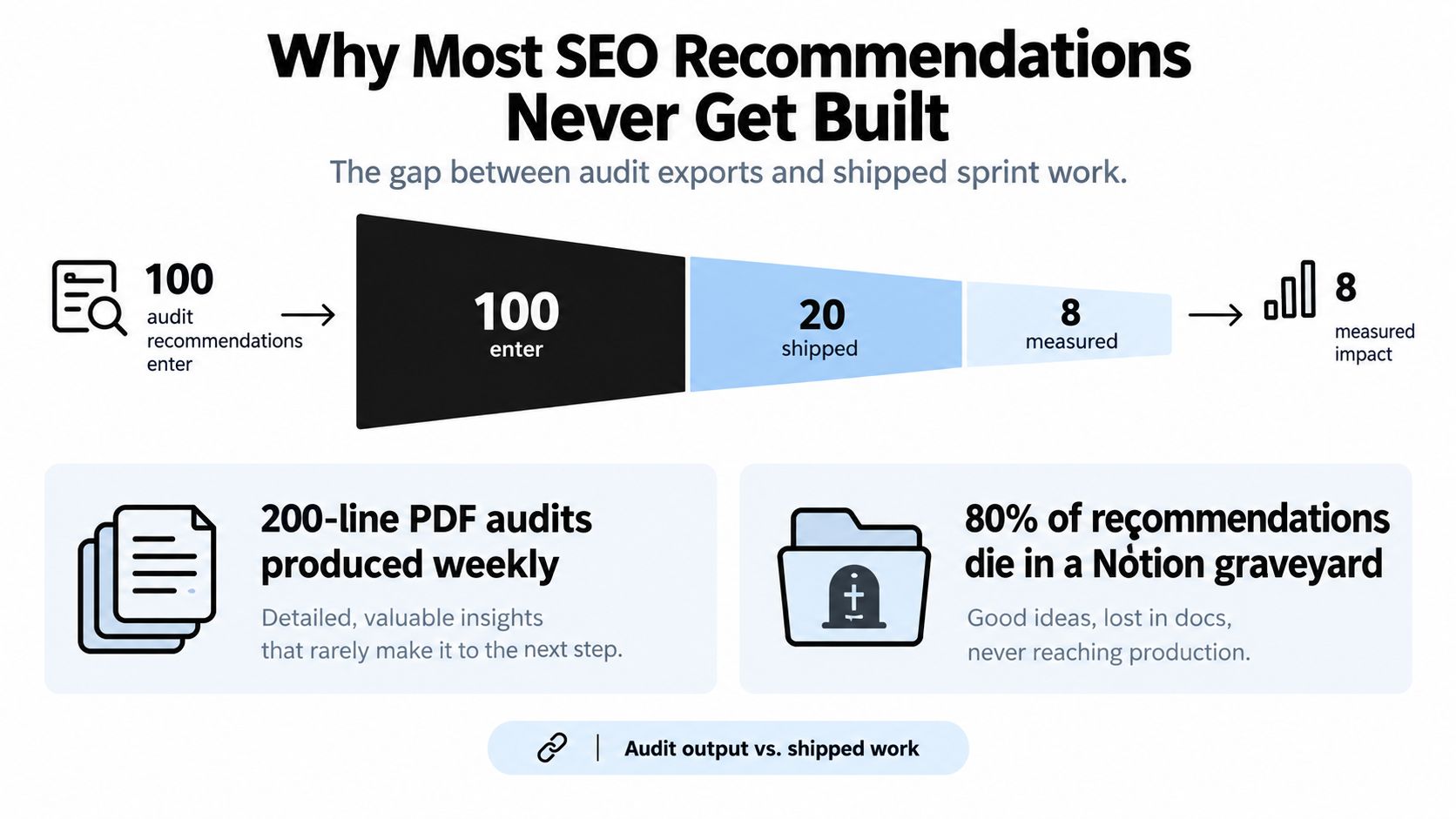
Most SEO programs don't fail because the team lacks a crawler. Screaming Frog, Ahrefs, Sitebulb, Search Console, and log analysis tools can all expose useful problems. They fail because an audit export isn't a delivery plan.
A long PDF can identify missing canonicals, weak internal links, duplicate titles, crawl errors, and thin pages. It doesn't tell an engineer which template to change, a content lead which URLs to rewrite, or a marketing director which fix deserves attention this sprint. The handoff turns a concrete issue into a vague request, then the vague request loses to product work with a clearer owner and deadline.
Practical rule: An SEO recommendation isn't finished when the audit detects it. It's finished when the team can ship and verify it.
The common response is to produce an even larger audit. That makes the backlog worse. Hundreds of rows with duplicate symptoms, false positives, and no effort estimate create a sorting problem that nobody has time to solve. A team staring at an unranked list will often choose easy metadata edits because they feel safe, while sitewide canonical or rendering issues continue to constrain the index.
Turn findings into accountable work
Treat every surviving finding like a product ticket. It needs an owner, an affected template or URL set, a defined change, acceptance criteria, an expected outcome, and a review date. The ticket should also record the evidence that produced it, so nobody has to repeat the original investigation during sprint planning.
A dashboard can help, but only if it supports decisions rather than decorating a report. A useful customizable SEO dashboard should let the team filter by issue type, owner, status, affected page group, and business value. The dashboard isn't the process. It gives the process a visible place to live.
The right target isn't “complete the audit.” The target is a smaller, ranked set of fixes that the team can deliver and learn from. A team that ships a focused batch of well-specified tickets will build more useful knowledge than a team that keeps exporting the same unresolved findings.
A Five-Stage SEO Recommendations Workflow
A workable workflow starts with raw evidence and ends with a logged outcome. Each stage should produce an artifact that the next stage can use. If a stage produces only a meeting or a slide, it isn't doing enough work.
Detect the actual issue
Pull findings from crawlers, Google Search Console, server logs, analytics, templates, and manual reviews. Deduplicate them before anyone starts arguing about priorities. Group repeated symptoms by template, directory, or page type, because fixing one template may resolve a larger class of URL-level findings.
The output is a deduplicated issue list. It should distinguish a sitewide implementation defect from an isolated page problem. A broken link on one obsolete page isn't the same backlog item as a navigation component that outputs the same broken destination across the site.
Triage signal from noise
Review whether each finding is valid, intentional, and valuable. A noindex page may be correctly excluded. A blocked resource may affect an important template, or it may belong to an abandoned asset. Triage should remove false positives and combine related findings before they consume engineering attention.
The output is a triage report with a decision for every cluster: ship, investigate, monitor, accept, or discard. Don't spend the meeting debating a minor error while a canonical configuration issue affects the site's primary page groups.
Specify the change
Rewrite the surviving finding as a ticket that a person outside SEO can execute. State the current behavior, the proposed behavior, affected URLs or templates, exclusions, implementation owner, and acceptance test. Include an evidence URL or export row so the ticket remains auditable.
The output is a ticket specification. Content tickets should include the intended searcher question, entities to cover, source requirements, and editorial boundaries. Engineering tickets should include the component, rendering context, test environment, and expected crawl behavior.
Prioritize before sprint planning
Score the ticket using impact, effort, and confidence. Add urgency when the issue blocks crawling, rendering, indexing, or a critical conversion path. Ranking the work before sprint planning prevents the loudest stakeholder or the easiest fix from setting the SEO roadmap.
The output is a scored backlog. It should show why an item is ahead of another, not merely display a priority label with no reasoning behind it.
Ship and measure
Assign the ticket, set a due date, record the release, and re-crawl the affected area. Then compare the intended outcome with actual changes in indexing, rankings, clicks, conversions, and answer-engine visibility where relevant. Use a fixed review cadence, because unlogged fixes become impossible to evaluate when other releases and algorithm changes arrive.
The output is a measurement log. Teams that need a practical operating model can pair this workflow with a guide to tracking SEO, provided the tracking system connects recommendations to releases and outcomes rather than storing metrics in isolation.
A useful external reference for local search teams is this guide to SEO strategies for Dorset businesses. Its value here isn't the location. It illustrates why recommendations need to reflect the business context, search intent, and page type instead of applying a universal checklist.
What Good Recommendations Actually Look Like
“Title tags are too long on 142 pages” describes a defect. It does not tell anyone what to ship. The implementer still has to find the responsible template, decide what the titles should communicate, identify exceptions, and define a validation method. That work belongs in the recommendation, not in the next person's head.
A ship-ready ticket states the change and its boundaries: update the product-category template to use “{Category} for {Audience} | {Brand}”; apply it only to the affected category template; preserve manually curated titles on editorial landing pages; validate rendered titles in staging; and review Search Console performance after release. The exact pattern depends on the site. The ticket must make the proposed change explicit enough for engineering, content, and SEO to act without another discovery meeting.
The four fields that prevent rework
Every recommendation needs four fields:
- Exact change: State what the team will alter, such as a template rule, component behavior, content addition, or internal-link revision.
- Affected scope: Name the URLs, template, component, query cluster, or content group in scope.
- Expected outcome: Identify the observable metric or search behavior that should change.
- Confidence level: Explain whether the evidence is direct, directional, or weak.
Define exclusions with the same care. List pages that must not change, including high-performing editorial titles, legal pages, language variants, and pages with deliberate noindex directives. A blanket fix can damage edge cases and erase useful page-level decisions.
A recommendation also needs provenance. Record the source, detection date, evidence URL, related tickets, and the audit row or query set behind the finding. Independent SEO content research based on 520,000 pieces of content and 50,000 SERPs warns that its statistics are medians and its findings describe correlations rather than causal relationships. (Semji SEO content study) Preserve enough context to test the hypothesis, rather than attributing every later movement to one release.
| Field | Vague Audit Line | Ship-Ready Ticket |
|---|---|---|
| Change | Titles are too long | Update the category template to use the approved title pattern |
| Scope | 142 pages | Affected category-template URLs, excluding editorial and legal templates |
| Measurement | Improve SEO | Validate rendered titles, monitor clicks and position for the mapped query group |
| Confidence | Not stated | Medium, based on repeated template output and query-page evidence |
| Ownership | Not stated | SEO lead specifies, engineering implements, content reviews exceptions |
| Metadata | Not included | Detection date, evidence URL, source, related tickets, audit reference |
Coverage beats mechanical placement
On-page work should answer the searcher's needs, not force an exact phrase into a title, heading, and paragraph. Recent analysis points toward topical coverage, entity depth, and related subtopics as stronger strategic targets than simple exact-match repetition. (Ranking factors study)
Write the ticket around the missing substance. Specify the unanswered questions, entities, comparisons, definitions, and evidence the page should cover. That improves the page's usefulness for traditional search and gives answer engines clearer material to interpret and cite.
For local-market teams, a practical guide for home service providers shows how intent and service context should shape the recommendation. A useful SEO strategy example should show the path from evidence to scoped action, ownership, and validation, rather than presenting an unranked list of tactics.
Scoring and Prioritizing the Backlog
A backlog doesn't become strategic because it has labels such as “high,” “medium,” and “low.” Those labels often reflect whoever reviewed the audit rather than the value of the work. Use a lightweight score that forces the team to compare opportunities on the same terms.
Score Impact, Effort, and Confidence on a 1-to-5 scale. Impact should account for business value, ranking opportunity, traffic exposure, and the potential for a page to become a cited source in an AI answer. Effort should include development, content production, QA, coordination, and release risk. Confidence should reflect the quality and directness of the evidence.
A simple ICE score is:
ICE = Impact × Confidence ÷ Effort
Use an urgency multiplier for issues that block crawling, rendering, indexing, or a critical page set. Don't use urgency as a way to label every preferred project urgent. Reserve it for defects where delay can prevent search systems from accessing or interpreting the intended content.
| Axis | What to Score (1–5) | Data Signal to Use | Weight |
|---|---|---|---|
| Impact | Potential business and visibility value | Search Console clicks, ranking opportunity, revenue page exposure, AI citation potential | High |
| Effort | Delivery cost and coordination required | Engineering estimate, content hours, QA complexity, release dependencies | Inverse |
| Confidence | Strength of the recommendation's evidence | Repeated template issue, crawl data, query-page match, controlled comparison | Medium |
| Urgency | Cost of waiting | Crawl, render, index, security, or launch blocker | Multiplier |
Consider two tickets. A title rewrite may take little time and have a plausible upside. A canonicalization fix may require more coordination, but it can affect how search engines identify the primary version of a page. If the second ticket has stronger evidence and broader technical impact, the score should put it first even though it is harder to ship.
Make scoring a decision, not a ceremony
Run triage with the people who can validate the inputs: SEO, engineering, content, analytics, and, where relevant, sales or product marketing. If the team can't agree on the score, record the uncertainty as a research ticket rather than pretending the estimate is precise.
Re-score when new evidence appears, after a release changes the affected page group, and during the regular backlog review. Keep the formula stable so scores remain comparable. Change the inputs when the business context or search opportunity changes.
Use a share of voice calculator when category visibility is part of the impact discussion. Share of voice is useful only when tied to a defined query set, competitor group, and time window. It shouldn't replace page-level evidence, but it can help a team compare strategic visibility work with isolated technical fixes.
Implementation, Measurement, and the AI Visibility Layer
An implementation ticket is a contract between the person who identifies the problem and the person who changes the site. It should name the owner, deadline, affected scope, proposed change, acceptance test, and metric. Without those fields, the ticket becomes a request for someone else to investigate.
Before publishing, run QA against the risk of the change. A content release needs editorial review, links, structured data where applicable, and rendered-page checks. A technical release may need a staging crawl, schema validation, redirect-map review, canonical checks, and confirmation that important content is available in the rendered HTML.
Measure the page and the passage
Traditional SEO metrics still matter. Track indexed pages, organic clicks, sessions, average position, query coverage, conversions, and landing-page engagement. Keep the baseline tied to the recommendation, because sitewide reporting can hide the result of a change on a specific template or query cluster.
AI answer engines add another layer. Track whether buyer-intent prompts mention the brand, where the brand appears, how it is described, which sources receive citations, and whether your pages are selected as source material. A generative-search benchmark tested 5,353 query-article pairs and 1,030 source articles and found that answer-first passages, question-style headings, structured data, and clean citable statements improved retrieval-stage visibility by about 22%. (Generative search benchmark)
That evidence changes the content ticket. Don't ask only whether the page includes the target phrase. Ask whether the answer is easy to extract, whether claims are clearly stated, whether entities are unambiguous, and whether the page offers evidence an answer engine can cite.
Measurement standard: Track the search result, the source passage, and the business action. Ranking without source visibility is incomplete, and citation without conversion context is also incomplete.
Keep one record of the experiment
Use a single sheet or system of record with the recommendation, hypothesis, source evidence, owner, release date, changed URLs, QA status, and outcome windows. Log both successful fixes and dead ends. A failed hypothesis is useful if the team knows what changed and avoids repeating the same assumption.
For teams extending SEO measurement into AI systems, measuring generative engine optimization provides a relevant framework for connecting prompt visibility, citations, and outcomes. The operating principle is the same as traditional SEO: define the unit of work, record the baseline, ship a controlled change where possible, and judge the result against the original hypothesis.
Common Pitfalls When Acting on SEO Recommendations
An audit creates options, not results. The backlog decides whether those options become growth or another unread deck.
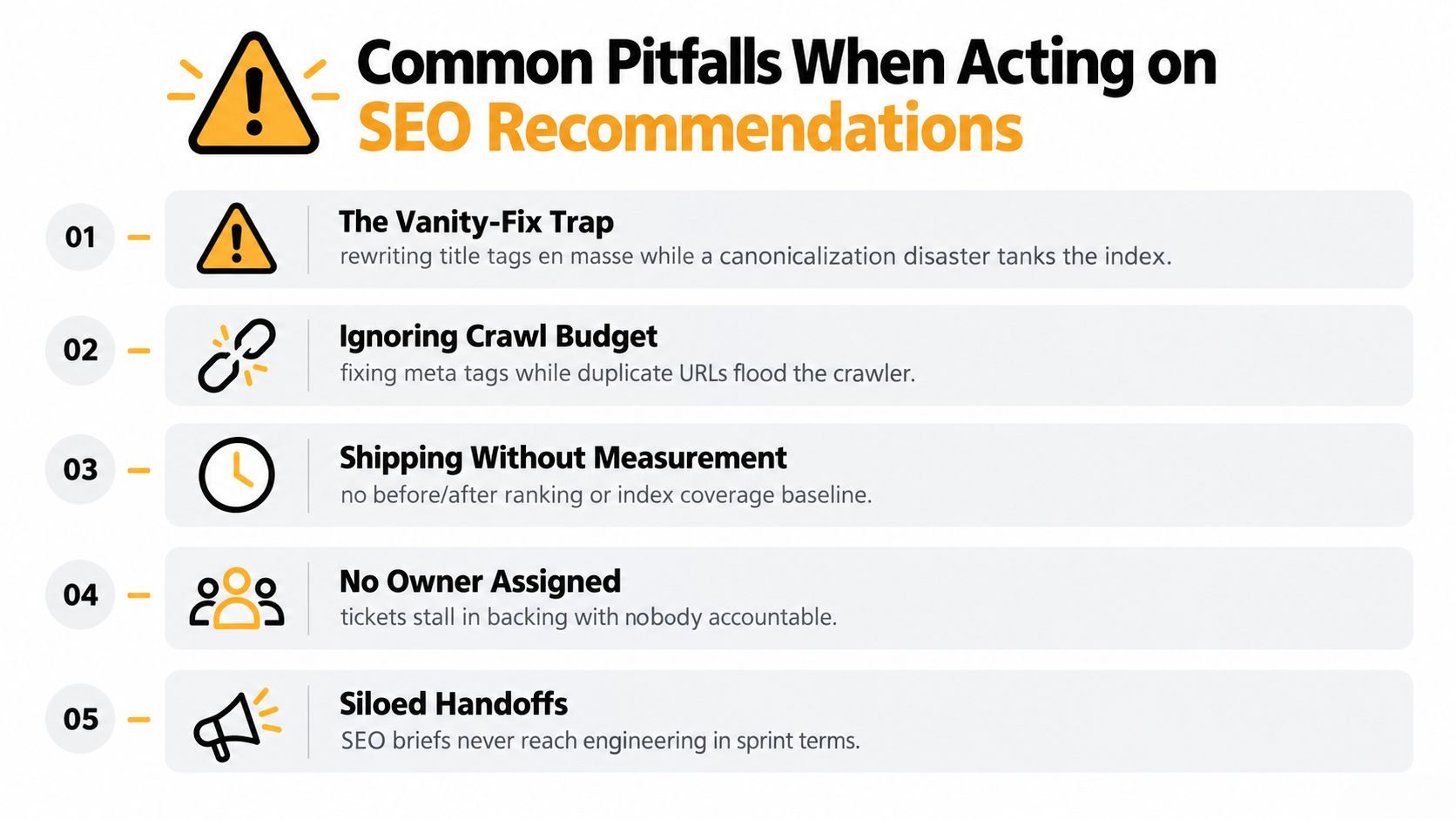
The vanity-fix trap pulls teams toward visible, low-risk work. They rewrite titles at scale because the task is easy to explain, while canonical, rendering, or indexing problems continue to affect how search engines process the site. Score recommendations by expected impact and delivery effort, then ship the highest-value constraint first. Easy work deserves a place only when it outranks harder work.
The correlation problem can also corrupt the backlog. Rankings rise after a content release, and the publishing cadence gets credit. Algorithm changes, seasonality, competitor movement, links, and technical releases may explain the same result. Correlation does not establish causation. Compare cohorts, record pre-release and post-release measurements, and treat one successful page as evidence for a hypothesis, not a universal rule.
Ownership creates a quieter failure. A recommendation in a document is not assigned work. Put the ticket in the product, engineering, or content backlog, name the person accountable for delivery, and define the review path. If no owner can accept the ticket, it is not ready for scoring.
Set the review date before release. A recommendation that depends on re-crawling, re-indexing, or wider query reassessment needs a meaningful observation period. Close or revise it against the expected mechanism, not an emotional reaction to an early dashboard snapshot.
Measure more than blue-link rankings. Search discovery now includes answer engines, zero-click results, social platforms, and chat interfaces, so a page may improve how a brand is cited or described before conventional rankings change. (SEO trends and AI discovery coverage) Track the query, cited passage, page, and business action together.
Use this release gate before work enters the sprint:
- Assign an owner: No ticket gets scored without someone accountable for delivery.
- Record the hypothesis: State what should change, why, and which signal will confirm it.
- Define the re-check: Choose the measurement window before release.
- Protect exclusions: List pages and templates that must remain untouched.
- Log negative results: A disproven hypothesis is still useful backlog evidence.
Putting It All Together in Your First 30 Days
Start with a small operating cycle that the team can repeat.
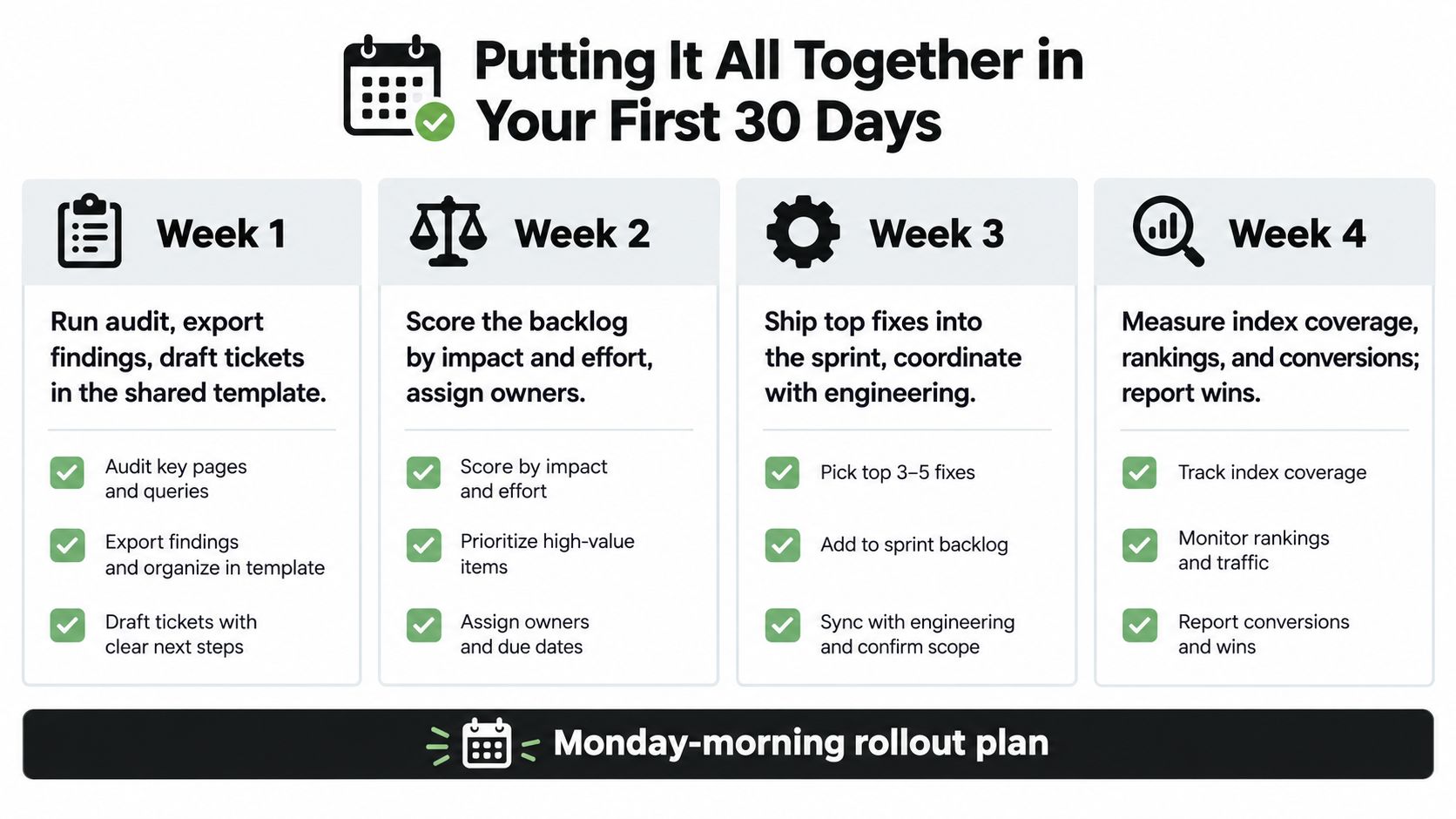
- Week 1, SEO lead: Run the crawl and data review, deduplicate findings, group issues by template, and draft tickets in the shared format.
- Week 2, SEO lead and delivery owners: Score Impact, Effort, Confidence, and Urgency. Assign owners, confirm estimates, and lock the sprint slate.
- Week 3, engineering and content: Ship the highest-value fixes, complete staging and production QA, and record every release.
- Week 4, analytics and SEO: Review index coverage, rankings, clicks, conversions, citations, and source visibility. Close disproven items, refine open hypotheses, and schedule the next cycle.
If velocity stalls, don't order another audit by default. Find the blocked handoff, clarify the owner, reduce the ticket scope, or fix the scoring inputs. SEO recommendations create growth only when they survive contact with the backlog.
MyMentions helps founders, marketers, and SEO teams turn AI search visibility into an actionable backlog by tracking buyer-intent prompts, brand position, sentiment, share of voice, and citation sources across supported AI providers. Visit MyMentions to connect search recommendations with the AI answers and sources shaping how buyers discover your product.