You already know the feeling. A buyer asks a simple question in an AI assistant, your competitor gets named first, and your product either disappears or comes back with a description that's outdated, incomplete, or just plain wrong. That's the moment AI optimization stops sounding abstract and starts looking like an operating problem your team has to own.
The confusing part is that people use the term to mean two different things. One team means tuning an AI system so it retrieves better evidence, answers faster, and stays within cost limits. Another team means tuning a brand's content and signals so AI assistants can discover it, trust it, and cite it. Both matter, but they solve different problems.
Table of Contents
- The Moment a Founder Realizes AI Is Answering About Them
- The Two Meanings of AI Optimization
- The Four Signal Families AI Assistants Read
- A Working Prompt and Source Workflow
- Why Mentions Alone Are a Vanity Metric
- Robustness Testing and Source Authority
- A 90-Day Operating Plan for Product and Marketing Teams
The Moment a Founder Realizes AI Is Answering About Them
A founder opens ChatGPT, types a prompt a buyer would use, and watches a competitor get recommended with confidence. Their own product might be missing entirely, or worse, summarized in a way that sounds close enough to pass in a casual meeting and wrong enough to lose the deal. That's not a branding problem in the old sense; it's a retrieval and attribution problem.
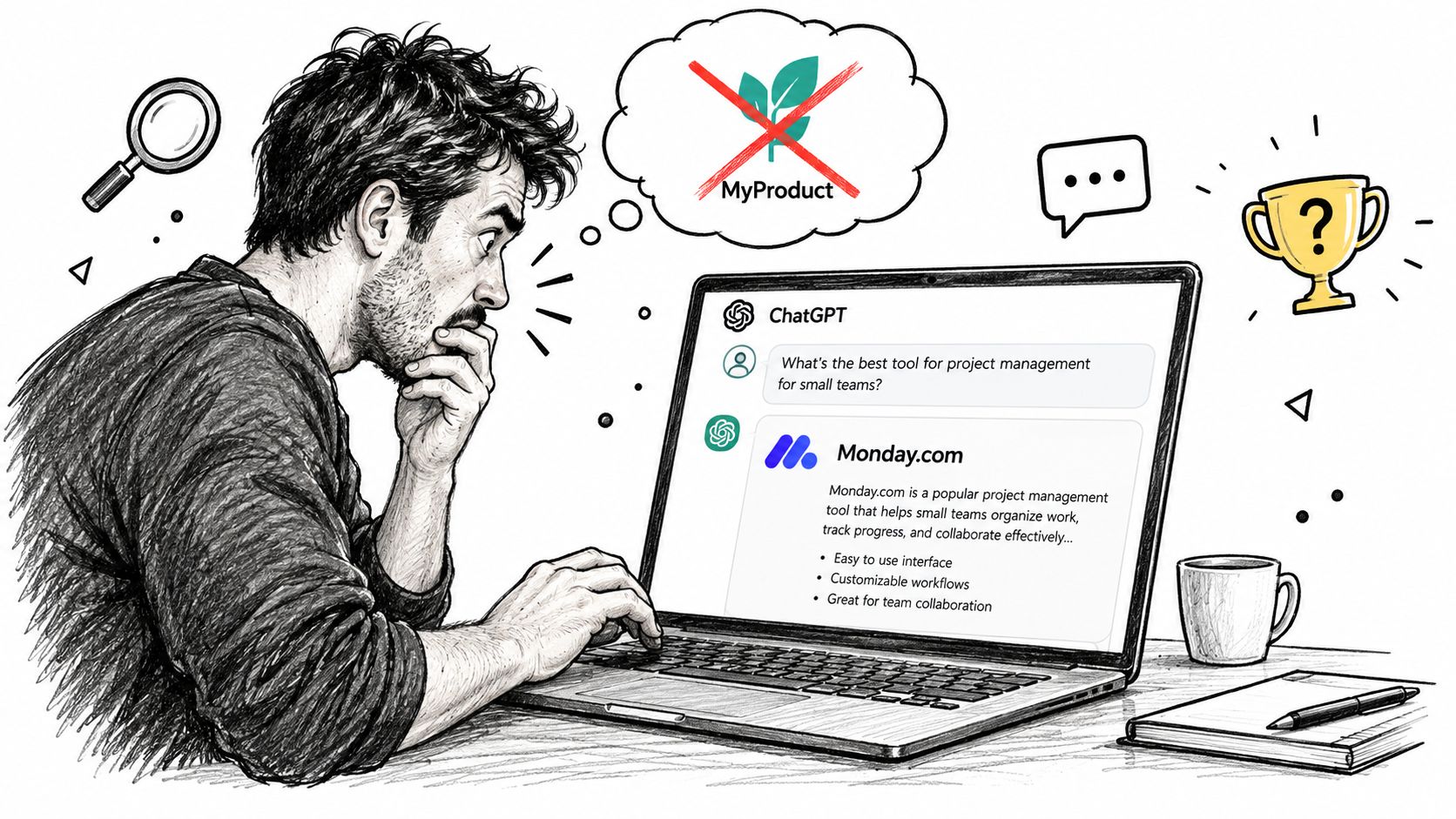
For a lot of SaaS teams, that is the first time AI discovery feels real. The assistant is no longer a demo toy, it's a surface where customers ask for shortlists, comparisons, and explanations before they ever visit a website. If that surface is naming competitors, the problem isn't just visibility, it's whether the system can reliably pull your strongest evidence into the answer.
Practical rule: if an AI assistant describes your product badly, treat it like a measurable product issue, not a vague reputation issue.
That shift changes the work. Traditional SEO thinking often stops at rankings and traffic, but AI answers are a different outcome. The question is no longer only, “Can people find us?” It's also, “Can the assistant retrieve the right page, summarize it correctly, and make it worth clicking through?”
A useful way to think about this is the difference between a page being indexed and a page being usable as evidence. When a buyer asks a high-intent question, the model needs a source it can trust, parse, and reuse. If your strongest proof lives in scattered copy, buried headings, or vague marketing language, the assistant may skip it even when the page technically exists.
The Two Meanings of AI Optimization
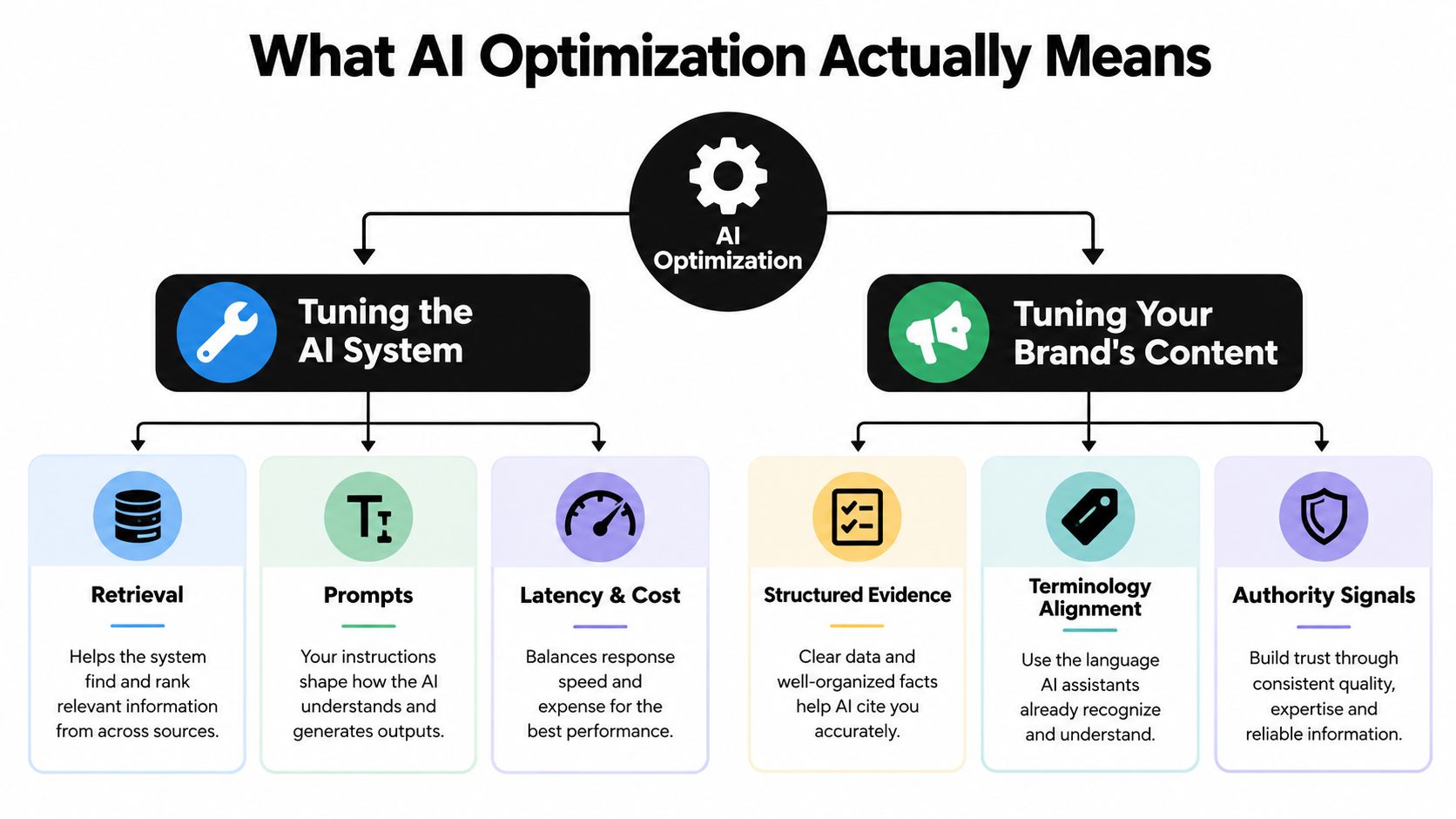
AI optimization is the work of improving an AI system, or improving the content signals that AI systems use. Those are two different jobs, and mixing them up is the fastest way for a team to spend months improving the wrong thing. One lives in the model pipeline. The other lives in discoverability and citation.
The two meanings people mix together
If you're optimizing an AI system, you're tuning retrieval, document chunking, context size, model choice, prompts, latency, and cost. Research on retrieval-augmented generation shows why this matters: retrieval quality and generation quality should be measured separately, not blended into one fuzzy score (Springer study). A pipeline can retrieve the right document and still summarize it badly, so each stage needs its own evaluation.
If you're optimizing a brand for AI discovery, you're making sure assistants can find, trust, and cite your pages. That means clearer terminology, stronger headings, better structured evidence, and authoritative pages that answer buyer-intent prompts cleanly. It's the same discipline you'd apply in an online presence optimization playbook, but aimed at how assistants read and reuse your material rather than how search engines rank it.
The three layers to name before you act
Optimization target: what are you trying to improve, the AI system or the brand's visibility in AI answers?
Data layer: are you tuning retrieval documents, prompts, product pages, reviews, or help content?
Success metric: are you looking at answer quality, retrieval recall, citations, visits, or conversions?
That framing keeps teams from talking past each other. A product team may care about MRR, Recall@1, and Recall@5, because those metrics show whether relevant evidence appears early in retrieval. A marketing team may care about whether the assistant cites the product docs, quotes the right feature, and sends qualified traffic. Neither view is wrong. They just sit at different layers of the stack, and each team needs its own numbers before anyone can agree on what "better" means.
Here's the shorthand: system optimization makes the model work better, visibility optimization makes your brand easier for the model to use. For teams comparing terminology across vendors and guides, the language around generative engine optimization often overlaps with this second meaning, so check which one a given guide is describing before you adopt its tactics.
The Four Signal Families AI Assistants Read
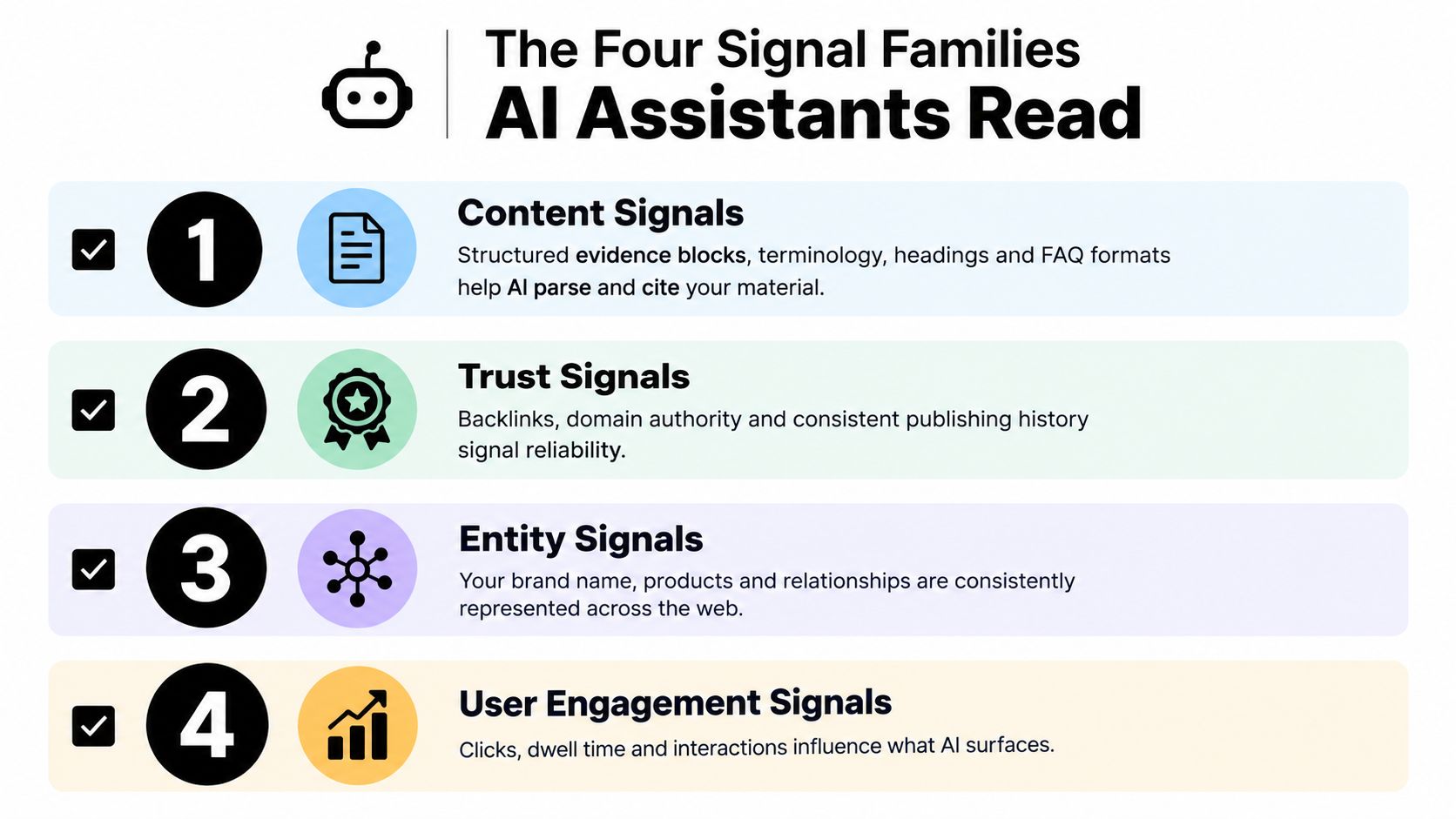
AI assistants don't read everything equally. They lean on a mix of signals, and the brands that show up consistently are usually the ones that make those signals obvious. If your product is being ignored or summarized badly, one of these four families is usually weak.
Content signals
Content signals are the clearest layer. Assistants parse headings, FAQ formats, terminology, feature lists, and evidence blocks to decide whether a page answers the prompt directly. If your product page says “smooth workflows” while buyers ask for “project intake automation,” the model has to work harder than it should.
A simple move is to build pages that mirror buyer language. If your audience compares tools, create comparison sections that spell out use cases, integrations, and limits in plain language. If your documentation buries the answer in long prose, rewrite one section into a short, structured block that the model can lift cleanly.
Trust signals
Trust signals tell the assistant whether your source deserves to be reused. Third-party reviews, consistent publishing history, author credibility, and citations all shape that judgment. If the only mentions of your brand live on low-quality syndicated pages, the assistant has less reason to treat your own page as authoritative.
External coverage and internal proof need to meet. A helpful starting point for teams that want to understand how broader search visibility works in practice is local SEO for tech companies, because the same basic idea applies, your strongest pages need to be visible, legible, and credible in the places buyers encounter them.
Entity signals
Entity signals are about consistency. The assistant needs to understand what your company is, what your product is called, and how those names relate to each other across the web. If your homepage, help docs, partner pages, and review profiles all use different labels, you make attribution harder.
The action here is boring but powerful. Audit your product names, category terms, and key differentiators across the pages that matter most. Then align them so the same entity shows up the same way in the places AI systems tend to read.
UX signals
UX signals help determine whether the page is easy to use as evidence. Clear navigation, readable layouts, comparison pages, and plain product explanations reduce friction for both humans and machines. The page doesn't need to be flashy, it needs to be interpretable.
For a quick cross-check on how AI search systems surface brands, teams often compare their own pages with guidance like AI search ranking. The right question is not “does this page look polished?”, it's “can an assistant extract a grounded answer from it without guessing?”
A Working Prompt and Source Workflow
A good AI optimization routine starts with prompts, not opinions. Build a small library of buyer-intent questions that match how people evaluate your category, then run those prompts across the assistants your audience uses. Log what gets cited, what gets ignored, and where the answer goes off track.
Build the prompt set by intent
Start with prompts that map to different buying moments. Early prompts ask what a category is, middle prompts ask how options compare, and late prompts ask for a shortlist or recommendation. You're not trying to be exhaustive, you're trying to cover the moments that influence pipeline.
| Buyer-Intent Prompt Category | Example Intent | Primary Signal to Watch |
|---|---|---|
| Problem aware | “What is the best way to handle X?” | Whether your category gets named at all |
| Solution aware | “Which tools help with X?” | Whether your product page or review pages get cited |
| Comparison | “X vs Y for small teams” | Whether the assistant uses accurate differentiators |
| Purchase ready | “Best option for [specific use case]” | Whether the answer includes your strongest proof |
Turn responses into a backlog
Capture more than the final answer. Save the cited sources, the phrasing the assistant used, and any confidence cues you can observe. Then sort the findings into three buckets, source fixes, content fixes, and trust fixes.
If you need a lightweight way to organize prompts and results, a tool like prompt examples can help teams keep the workflow consistent without turning it into a spreadsheet mess. The important part is repetition. A weekly prompt run surfaces drift early, before the wrong description becomes the default.
Operational rule: keep distinct, authoritative evidence blocks on pages you want retrieved. Long pages can work, but short structured sections are easier for assistants to reuse reliably.
That matters because AI systems don't just need information, they need information they can chunk and reassemble without losing the point. If your proof is spread across multiple paragraphs or mixed with marketing fluff, the assistant may retrieve the page and still miss the answer. A clean evidence block beats a bloated page when retrieval is the bottleneck.
Why Mentions Alone Are a Vanity Metric
Being named in an AI answer feels good. It's not enough. If the mention is wrong, unsupported, or attached to a bad citation, visibility can create more confusion than demand.

The credibility problem is real. A 2025 Tow Center evaluation found that generative-search tools often produced incorrect or speculative answers, fabricated links, or cited copied and syndicated versions of articles, and more than half of Gemini and Grok 3 responses in the tested news queries included fabricated or broken URLs (Tow Center evaluation). That means raw mention count can hide a quality problem.
Measure what the mention actually does
The better dashboard is built around citation correctness, source quality, sentiment, and downstream action. If an AI assistant mentions your product but sends no qualified visits, the mention is a weak win. If it cites a partner page instead of your documentation, that's a source hierarchy issue. If it describes your product accurately but still no one clicks through, then the answer may be good while the conversion path is broken.
A useful example from a broader user-behavior study is that AI-search users don't behave like classic search users. In a 2025 representative U.S. study of 1,526 participants, people using ChatGPT completed practical information tasks faster and were more likely to find the correct solution than Google users, but relied significantly less on primary web sources (WalkMe glossary summary). That makes downstream attribution harder, because the assistant may satisfy the user before your site ever gets a visit.
Use mentions as a diagnostic, not a finish line
If you only count mentions, you can't tell whether your content improved or just got noisier. You also can't tell whether the assistant is repeating outdated claims from a third-party page. The key question is whether the mention is grounded enough to support a buying decision.
For teams setting up reporting, the cleanest habit is to tie AI visibility to traffic, sign-ups, and qualified conversations. If those don't move together, the mention is informational, not commercial. That's the difference between vanity and value.
Robustness Testing and Source Authority
A brand can sound accurate in one AI answer and distorted in the next. That usually means the assistant is pulling from a shaky source base, not that your positioning suddenly changed. The job here is to test whether the same core facts survive small changes in prompt wording, context, and evidence order.
Stress-test the answer, not just the query
Start with one real buyer question. Then run close variants: shorter phrasing, more context, less context, and a different prompt format. After that, change the order of retrieved evidence, add a distracting source, and see whether the assistant still lands on the same product facts and cites the same pages. The benchmark on stability shows why this matters, because reordering or adding evidence can change answer quality even when the right information is available (evidence-order benchmark).
Consistency matters more than a single good result. If a slight prompt change produces a different feature description, pricing explanation, or citation set, your evidence layer is too easy to derail. In practice, that means the assistant has not learned which source should win when sources disagree.
Treat this like QA for a product surface. You are not asking, “Did we get mentioned?” You are asking, “Did the assistant name the right product, describe the right capability, and point to a source a buyer could trust?”
For teams that want a repeatable scoring method, SourceX's AI evaluation guides are useful because they turn review into a fixed rubric. Score each answer against the same checks, such as correct product, correct feature, correct pricing logic, and acceptable citation quality, so two reviewers can reach the same verdict on the same response.
Compare source profiles
Before you harden a page, compare how assistants attribute the answer. This guide on what source attribution means in AI answers is a useful reference if you need a clear way to judge whether the assistant is citing the page that should carry authority.
| Source Profile | Typical Strength | Typical Weakness |
|---|---|---|
| Strong first-party evidence | Clear ownership of product facts, pricing logic, and feature definitions | Can be ignored if it's vague, buried, or hard to parse |
| Heavy reliance on syndicated reviews | Broad surface area and easy third-party discovery | Can spread outdated claims or off-brand descriptions |
| Partner pages and integrations | Useful for credibility and context | Can dilute the primary source if the message drifts |
| User-generated discussions | Often candid and current | Hard to control for accuracy and attribution |
First-party evidence usually gives assistants a cleaner path to the answer. Brands that depend mainly on reviews or third-party summaries may appear often but still get described inconsistently. Fix the page that should be canonical first, then make its evidence easier to retrieve and harder to misread. That is how AI optimization becomes a quality-control loop around source trust, citation accuracy, and downstream conversion.
A 90-Day Operating Plan for Product and Marketing Teams
The best teams treat this like a recurring program, not a one-time audit. Start with a weekly prompt baseline, then improve the sources that most often shape the answer. Keep the scope small enough that someone can fully own it.
Weeks one and two are for setup. Build the prompt library, run it against the assistants that matter, and record the current state of visibility, citations, and accuracy. Use that baseline to decide what's broken, not what's merely inconvenient.
Weeks three through six are for source and trust fixes. Rewrite the pages that need clearer terminology, tighten evidence blocks, and clean up the pages that should be canonical but aren't. If your team wants a broader operating model for this work, AI visibility strategy is a helpful way to frame the effort around recurring measurement instead of one-off content tasks.
Weeks seven through ten are for expansion. Add more prompts, compare against close competitors, and set up alerts for drops in visibility or citation changes. In the final two weeks, package the findings into a stakeholder report that connects AI mentions to traffic, pipeline, and the quality of the source that produced the answer.
A simple recurring checklist keeps the work from drifting:
- Run buyer-intent prompts weekly and log answer quality, citations, and source changes.
- Review pages that should be canonical and make the evidence easier to retrieve.
- Track whether mentions lead to visits or conversations instead of stopping at visibility.
- Alert on source drift when the assistant starts preferring weaker pages.
That rhythm gives product, marketing, and SEO teams one operating loop. It's enough to move the answer quality without requiring a giant program or a new budget line.
If you want to see how your brand shows up across AI assistants, MyMentions tracks visibility, citations, position, and sentiment across buyer-intent prompts. It helps teams turn those results into source fixes and content priorities, so you can improve what AI assistants say and whether those answers drive qualified traffic.