Source attribution is the practice of linking a claim to the specific source that supplied or shaped it. In AI answers, the visible citation isn't always the source that drove the sentence.
A founder can discover that gap in a single buyer search. They open ChatGPT and ask for the best invoicing tool for freelancers. The answer names Stripe, Square, and Bonsai. After a refresh, it names PayPal, Wave, and FreshBooks instead. No page from the founder's domain appears in the click trail, even though the product may have influenced the answer somewhere upstream.
The founder clicks the citation chips and lands on a competitor's comparison page. Their product appears in one sentence, surrounded by the competitor's analysis. The brand is present in the generated answer, but invisible in the path that explains why the answer was written.
That distinction defines what is source attribution in an AI setting. It isn't merely adding a link after a paragraph. It means identifying which source supplied the evidence, shaped the wording, or contributed to the conclusion. A citation can be visible while the underlying attribution remains uncertain.
For marketing teams, this creates a practical analytics problem. You need to know not only whether an assistant mentions your brand, but also which pages support that mention, which pages appear in the response, and whether those two groups match.
Table of Contents
- The Moment You Realize Your Brand Was Cited But Not Seen
- Where Source Attribution Comes From and Why AI Changed It
- Why Source Attribution Matters for Trust, Ranking, and Compliance
- How AI Providers Surface and Weight Sources
- Common Attribution Formats You Will See Across Providers
- Measuring Whether Your Brand Actually Drives AI Answers
- How to Claim and Improve Attribution for Your Product
- Your 30-Day Plan to Make Attribution a Measurable Signal
The Moment You Realize Your Brand Was Cited But Not Seen
The founder's next move is familiar. They copy the prompt into a spreadsheet, record the answer, save the cited URLs, and compare the result with a competitor's response. The spreadsheet says the brand appeared. Analytics says nobody arrived from the assistant. Those facts aren't contradictory.
A generated answer can blend information from product documentation, reviews, partner pages, comparison articles, and other material. The interface may show only a small selection of links. One link might support a general statement, while another page supplied the wording or product detail that made the brand eligible for inclusion.
Practical rule: Treat a displayed citation as evidence to investigate, not automatic proof of causation.
The working definition helps separate three questions:
- Mention: Did the answer name the brand?
- Citation: Which URL did the interface display?
- Attribution: Which source supplied or shaped the claim?
Those questions often produce different answers. A competitor's roundup might receive the visible citation because it summarizes several vendors clearly, while the model's product understanding came from a support article or partner page that isn't displayed.
The problem resembles analytics attribution, where a conversion can have several touchpoints and the last visible interaction may not explain the entire decision. A practical growth measurement framework offers a useful mental model for separating observed activity from the influence that preceded it.
For a marketing team, the first operational change is simple. Save the complete answer, every displayed source, the surrounding language, the provider, and the prompt that produced it. Don't record only whether your logo appeared. The wording around the mention tells you whether the system understood your product accurately, borrowed a competitor's framing, or attached a weak citation to a strong-sounding claim.
Where Source Attribution Comes From and Why AI Changed It
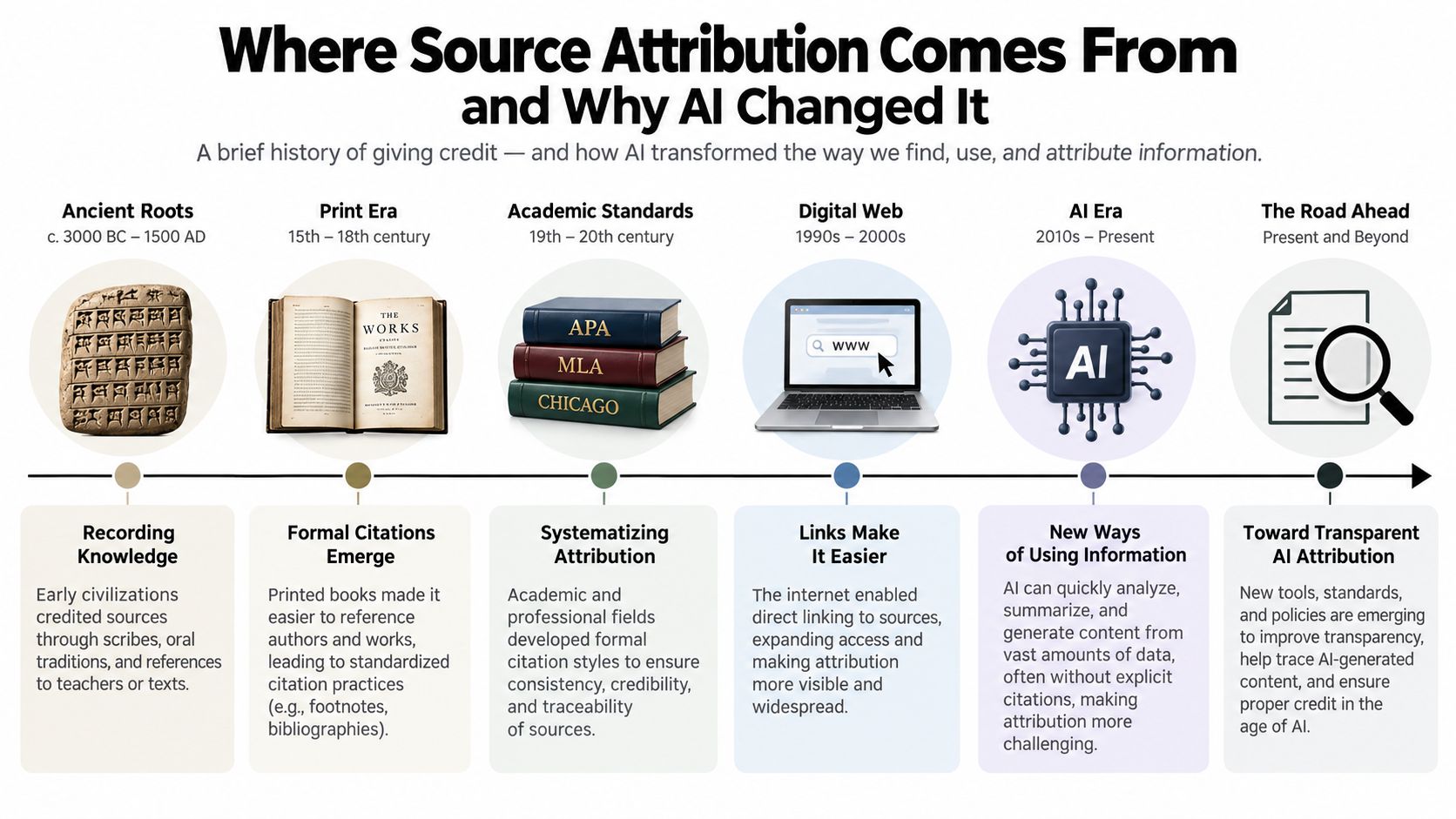
A reader follows a claim from an academic paper to its author and publication record. In journalism, phrases such as “said” and “according to” identify who supplied information. Hyperlinks extended that trail on the open web by taking readers from a statement to the page behind it.
The shared principle is provenance: people should be able to ask where an idea came from, inspect the supporting material, and judge whether the source fits the claim. Attribution theory also has roots beyond journalism, including social psychology. The NPR training discussion of source attribution describes attribution as part of clear reporting practice.
Provenance is more than a hyperlink
Data integration makes the distinction precise. Attribution can identify the relations, tuples, or supporting material behind a result. A query may be correct while depending on several sources. Provenance exposes those dependencies, allowing users to assess whether the result is complete, selective, or biased, as explained in attribution principles for data integration.
AI systems add another layer. They synthesize fluent answers from retrieved passages or learned associations, then providers choose what to retrieve, how to rank it, how to generate the response, and which URLs to display. The visible citation is therefore more like a window than a full production log. It can show supporting evidence without revealing every source that shaped the answer.
For teams working on generative engine optimization, that distinction creates a practical workflow. Each week, record the prompt, complete answer, provider, displayed URLs, and wording around the brand mention. Compare the visible link with likely source material, then mark whether the page supplied the claim, its framing, or only a supporting detail. A practical growth measurement framework helps separate observed citation from the broader influence that produced the answer.
Why Source Attribution Matters for Trust, Ranking, and Compliance
Attribution affects how users judge an answer and how teams improve the content behind it. A visible link can build confidence when it supports the exact claim. It can also create false reassurance when it points to a related page that did not provide the evidence.
Trust
A user can verify a statement when the cited page contains the relevant support. Trust weakens when the citation only appears authoritative. For example, an answer may describe pricing with wording from a company announcement while displaying a review page as its source. The publication looks credible, yet the page does not substantiate the specific pricing statement.
Clear attribution remains a core reporting practice because readers need to know where information came from, even when algorithmic systems control how audiences encounter and verify it. The NPR training guidance on attributing sources connects source visibility with trust.
Ranking and visibility
Repeated inclusion in AI answers can become a useful visibility signal for a brand. A citation does not automatically work like a backlink, however. The stronger question is whether a page repeatedly supplies relevant evidence for buyer prompts.
That distinction changes the weekly workflow. Record the prompt, complete answer, provider, displayed URLs, and wording around the brand mention. Then compare the displayed link with the pages that may have supplied the claim, framing, or supporting detail. A repeatedly cited page may be a canonical evidence asset. A displayed page may also be only a surface reference, while another source shaped the answer.
Compliance
Regulated teams need clear provenance controls. A health, finance, or legal answer becomes risky when the system relies on an outdated page, promotional summary, or source without suitable authority. Reviewers must be able to connect each material claim with the evidence used to support it, including its authority and currency.
| Pillar | What breaks without proper attribution | Concrete consequence |
|---|---|---|
| Trust | Users can't verify whether the source supports the claim | A buyer accepts a confident answer that rests on a mismatched page |
| Ranking and visibility | Teams can't tell which content earns or influences inclusion | Writers optimize the displayed URL while ignoring the actual evidence gap |
| Compliance | Reviewers can't establish source authority and currency | A professional relies on guidance that the cited page doesn't substantiate |
How AI Providers Surface and Weight Sources
AI answer engines generally expose sources in three interface locations. Inline links sit beside a sentence or phrase. Numbered references appear after a paragraph or answer block. A sources panel sits beside or below the response and lets the user inspect several URLs separately from the prose.
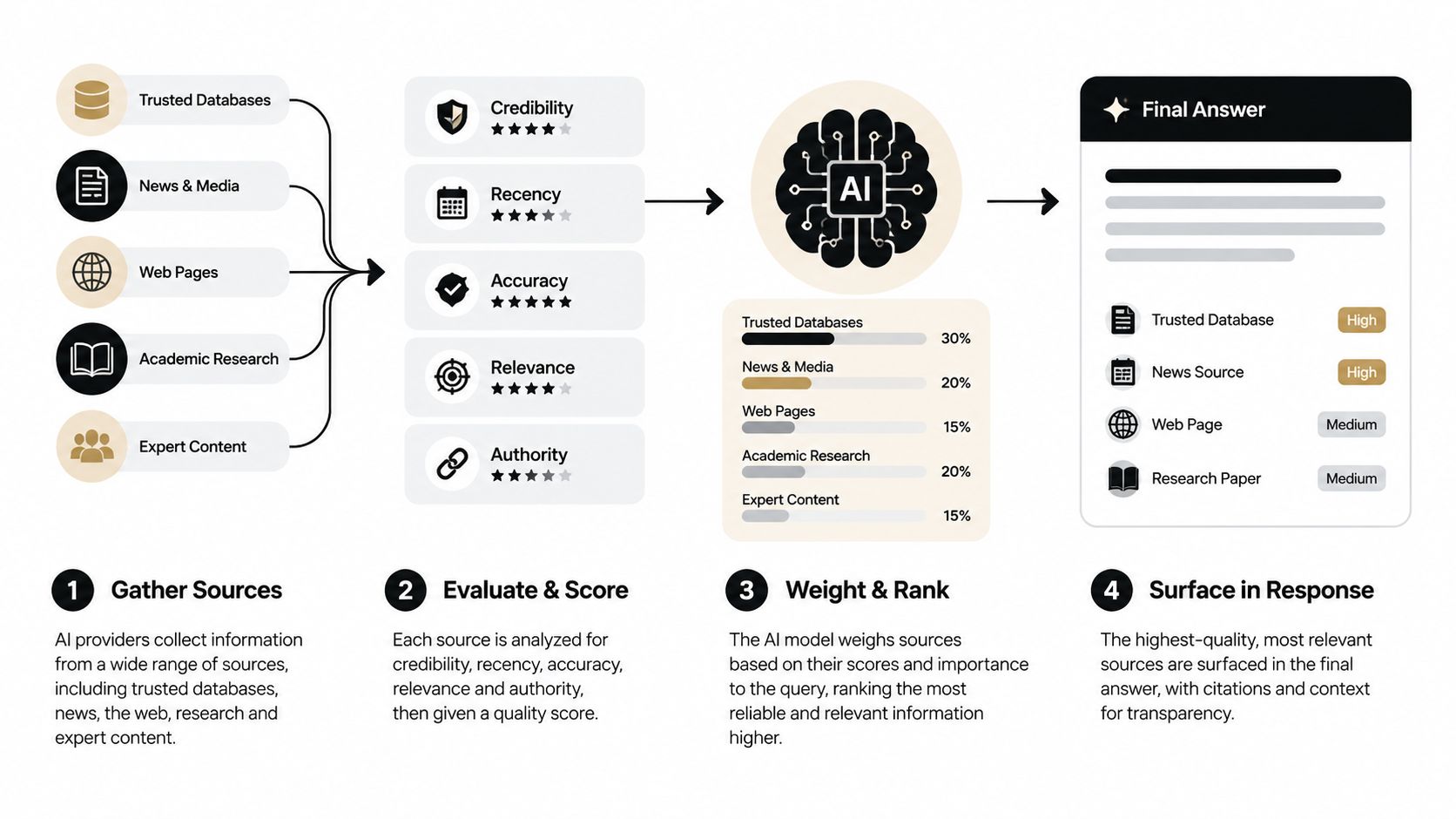
The interface is only the final layer. Underneath it, a provider may retrieve passages, score them for relevance, rerank candidates, generate an answer, and select citations that appear to support the output. The exact pipeline differs by product and can change over time, so marketers should avoid treating any provider's citation behavior as a fixed public formula.
What the retrieval layer evaluates
A retrieval system may favor a passage because it matches the prompt semantically, answers the question directly, appears current, comes from a source the system treats as reliable, or agrees with other retrieved passages. These are useful analytical categories, not a public guarantee that every provider uses the same signals or assigns them the same weight.
Consider a pricing question. ChatGPT might surface a support article because the page states the pricing rule plainly. Perplexity might show a review roundup because the prompt asks for comparisons and trade-offs. Google AI Overviews may draw from pages already visible in its search ecosystem, while still selecting a passage based on how directly it answers the query. A provider's AI search optimization overview offers additional context for teams studying how AI search surfaces information.
The visible source is therefore a product of retrieval, reranking, generation, and presentation. It isn't a neutral transcript of every document that influenced the answer. That distinction is central to AI ranking, because visibility analysis must separate a page's displayed position from its evidentiary role.
The citation chip tells you what the product chose to show. It doesn't necessarily tell you everything the system used.
For a visual walkthrough of how this process appears to users, review the following demonstration.
Common Attribution Formats You Will See Across Providers
Citation design affects what users notice and whether they click. A source woven into the sentence has a different practical value from a URL hidden in a collapsed panel, even when both technically provide attribution.
| Format | Where It Appears | Providers | Click-Through Expectation |
|---|---|---|---|
| Inline link | Beside the claim or within the answer text | ChatGPT, Perplexity, Google AI experiences | The source is highly visible and closely connected to the claim |
| Numbered reference | After a sentence, paragraph, or answer block | Perplexity and some research-oriented interfaces | Users click after reading the answer and matching the reference |
| Sidebar or sources panel | Beside or below the generated response | Microsoft Copilot, Google AI experiences, other answer interfaces | Users inspect the panel when they want verification or deeper research |
| Footnote block | Below the answer, sometimes collapsed | Interfaces that prioritize a clean reading surface | Discovery depends on the user expanding or scrolling to the citations |
These formats can also appear together. Microsoft Copilot, for example, may pair links in the answer with a separate list of references. That combination gives the user immediate context and a broader verification path, but it also makes measurement harder because the highly visible URL may not be the page that shaped the sentence.
What the format tells your analytics team
Record the format, not only the URL. An inline citation may create a direct visit opportunity. A sources panel may signal that the provider wants users to inspect evidence without interrupting the answer. A footnote block may carry attribution value even when it contributes little direct traffic.
The format also affects how users perceive authority. A link placed directly beside a claim appears tightly connected to that claim. A list of sources at the bottom may be interpreted as general background unless the interface maps each reference clearly.
Teams conducting citation analysis should add two fields to their review log: placement and claim relationship. Then compare whether your pages appear as direct support, general context, or an unconnected citation. That distinction gives content teams a better improvement brief than raw citation counts.
Measuring Whether Your Brand Actually Drives AI Answers
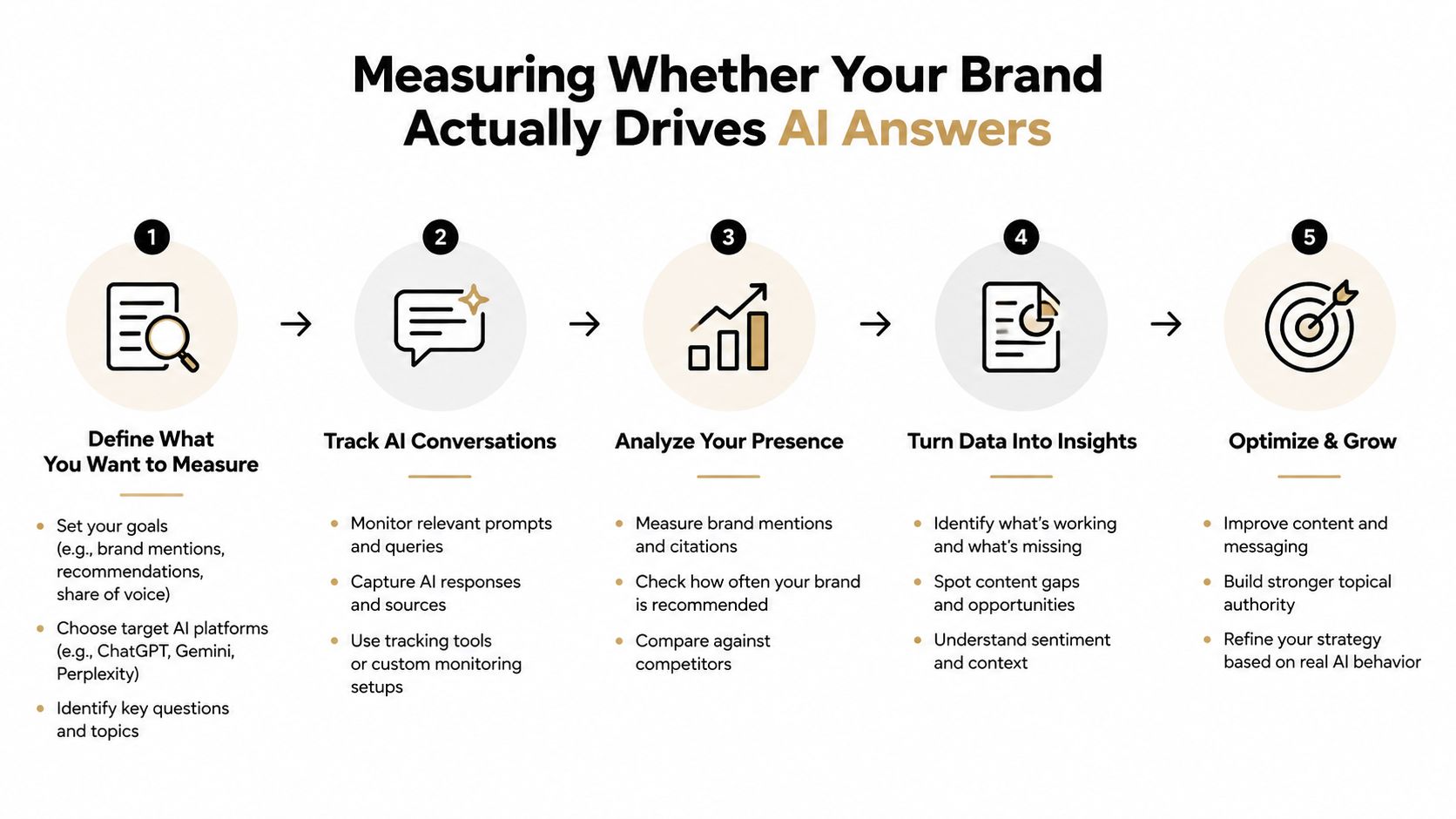
A useful measurement program starts with prompts, not impressions. Choose buyer questions that reflect real evaluation moments, then run the same wording across the providers your audience uses. Save the answer, cited URLs, mention position, surrounding sentiment, and any factual errors.
Start with prompt-level inspection
Create a stable prompt library. Include category questions, comparison questions, use-case questions, pricing questions, migration questions, and prompts that mention competitors. For every run, record:
- Prompt identity: Keep the wording and intent stable enough to compare results.
- Provider and date: Store where and when the answer appeared.
- Brand presence: Mark whether the answer mentions your product and how prominently.
- Cited sources: Capture every displayed URL, not just the first one.
- Claim quality: Note whether the description is accurate, incomplete, or misleading.
This manual baseline reveals the difference between a brand mention and a source relationship.
Track citation share
Citation share compares how often your domain appears in the answers against the domains of relevant competitors. It works as a leading visibility signal because it shows whose evidence providers repeatedly expose for a prompt set. It doesn't prove that a citation caused a visit or that the cited page caused the answer, so keep those questions separate.
Check sentiment and overlap
Sentiment-overlap checks compare the language around your mention with the position you want the market to understand. A product can appear frequently while the assistant describes the wrong audience, outdated pricing logic, or a capability it doesn't offer.
A workspace such as AI citation tracking can organize prompt runs, source capture, competitor comparisons, and change alerts in one workflow. The important operating principle is weekly consistency. Attribution changes when providers refresh retrieval indexes, alter ranking systems, or encounter new third-party content, so an occasional spot check won't show the direction of travel.
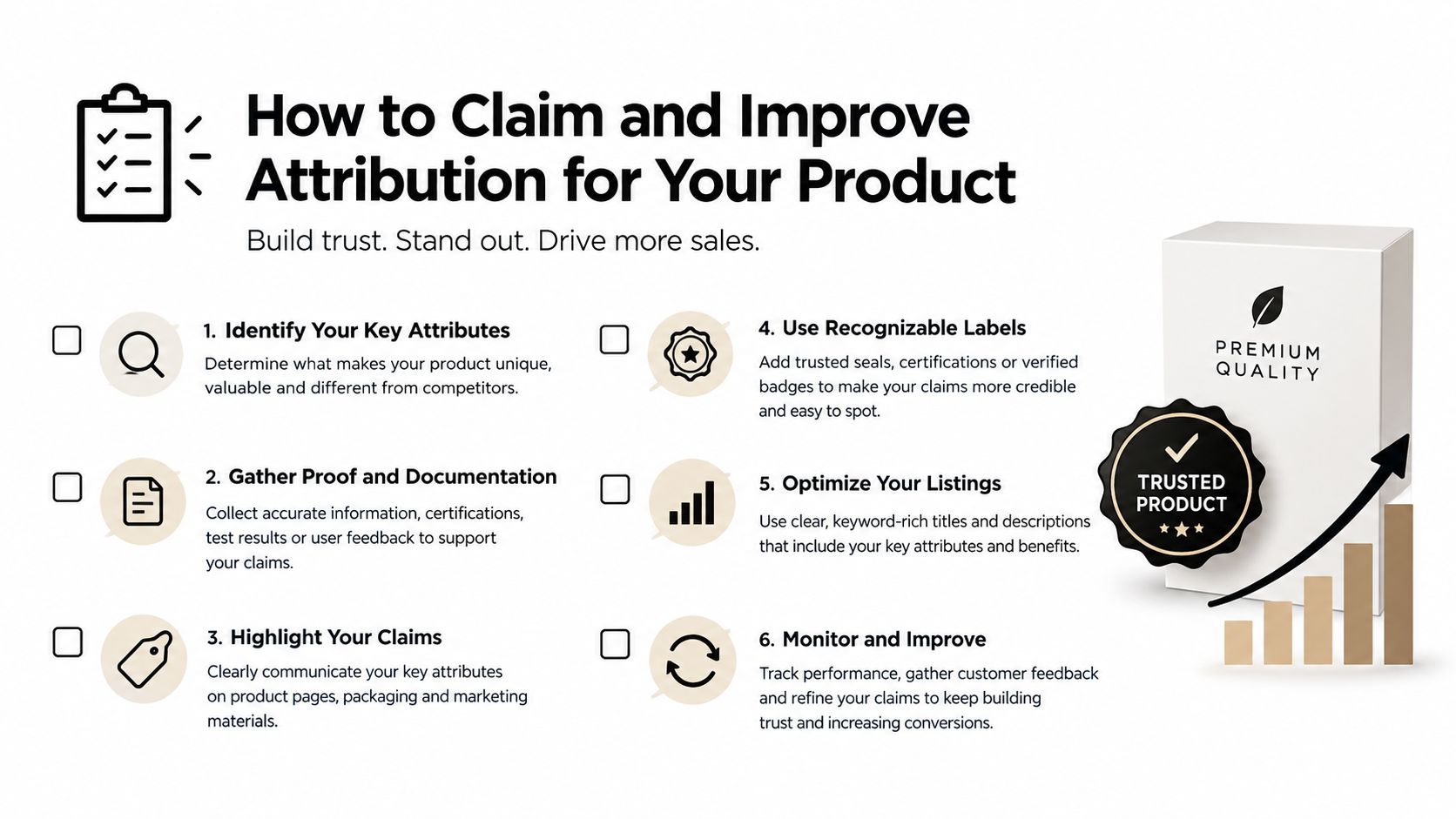
How to Claim and Improve Attribution for Your Product
The most important shift is to stop optimizing only the page that appears in the citation chip. That page may summarize your product, but a different document may have supplied the specific fact, phrasing, or category association behind the answer.
Turn documentation into evidence
Rewrite important product pages into answer-shaped evidence blocks. Use short, declarative sentences. State who the product serves, what it does, how an integration works, which plans include a capability, and where a limitation applies. Keep each statement close to the page topic, and make the page crawlable, indexable, and easy to interpret.
This format helps both human readers and retrieval systems locate a direct answer. It also gives reviewers a clean place to verify whether an assistant's wording remains accurate.
Build external corroboration
Brand-owned copy supplies necessary context, but independent pages often provide the comparison language buyers use. Pursue accurate reviews, marketplace profiles, editorial comparisons, and expert evaluations. Don't ask publishers to repeat promotional claims. Give them clear product facts, access to the product, and a way to distinguish your capabilities from adjacent tools.
Partner pages offer another route. Ask integration partners to describe the relationship consistently, including the use case, setup context, and boundaries of what the integration supports. Repeated, accurate language across independent sites can help systems connect your product with the right category and buyer problem.
Publish evidence others can reference
Original research, transparent methodology, and useful datasets give other publishers a reason to cite your work. The aim isn't to manufacture mentions. It's to create a source that contributes something distinct and can be checked by readers.
Evidence standard: If another site cites the page, a reviewer should be able to identify the exact claim, method, and limitation without guessing.
Use brand visibility in AI as a planning lens, then inspect whether the pages that appear publicly are also the pages that contain your strongest evidence. MyMentions is one option for reviewing cited URLs and identifying source patterns behind AI mentions, so teams can prioritize documentation, review, partner, or research work based on observed gaps.
Your 30-Day Plan to Make Attribution a Measurable Signal
Source attribution is best treated as evidentiary precision. A visible link matters, but the stronger measurement asks whether the source supports the claim, whether the system used your evidence, and whether the resulting description helps a buyer make a sound decision.
Use this four-week plan to establish a repeatable operating rhythm.
Week one
Build a prompt library around real buyer intent. Include questions about category fit, alternatives, pricing, integrations, workflows, and limitations. Run the prompts across selected providers and log every answer, mention, citation URL, citation format, and notable claim.
Week two
Classify the sources into owned, earned, partner, and unknown. Owned sources include documentation and product pages. Earned sources include reviews and editorial comparisons. Partner sources include integration and ecosystem pages. Unknown sources are pages whose relationship to the claim isn't yet clear.
Week three
Rewrite the three owned pages most closely connected to your priority prompts. Convert vague marketing copy into concise evidence blocks, clarify outdated details, and add the context a reviewer needs to verify each claim. Request one accurate third-party review or comparison that reflects the product's current positioning.
Week four
Rerun the prompt library and compare the citation mix with the baseline. Look for changes in source categories, claim accuracy, competitor presence, and the difference between displayed pages and likely driving pages. Keep the results in the same workspace so the team can distinguish a meaningful pattern from a single volatile answer.
The weekly question is straightforward: whose evidence did the assistant reach for, and was that evidence yours? Marketers already monitor rank, traffic, and share of voice. AI-era teams need the same discipline for source relationships, because a brand can be mentioned without controlling the evidence that defines it.
MyMentions helps teams monitor AI mentions, cited source URLs, visibility, position, sentiment, and competitor changes across supported providers. Visit MyMentions to build a prompt set, inspect the evidence behind generated answers, and turn attribution gaps into a weekly content and optimization workflow.