
Most advice about AI search ranking starts in the wrong place. It tells you to publish more answer-focused pages, add structured data, or optimize for conversational prompts. Those actions may improve eligibility, but they don't answer the question a growth team needs to resolve: did the assistant retrieve your evidence, represent it correctly, and influence a valuable business action?
AI visibility isn't a single ranking position. It's a chain of events. A page can enter the retrieval set and never appear in the answer. A brand can be cited while the assistant attaches the citation to an inaccurate claim. A favorable recommendation can appear without producing a visit, a qualified opportunity, or revenue. The practical discipline is to measure those outcomes separately.
Table of Contents
- Why AI Search Ranking Breaks the Old Playbook
- How a Retrieval Pipeline Actually Picks Your Page
- Where AI Overviews and Featured Snippets Diverge from the Top 10
- The Signals That Move You into a Generated Answer
- Citation Presence Is Not Citation Quality
- How Different AI Assistants Choose Different Sources
- Measuring AI Visibility Without Fooling Yourself
- A Prioritized Roadmap for AI Search Ranking
Why AI Search Ranking Breaks the Old Playbook
Traditional SEO offers a relatively stable measurement object. A query produces an ordered list, a rank tracker records your position, and users compare links before choosing which result to open. The workflow makes visibility look like a single, observable outcome.
AI-mediated search separates that visibility from the outcome. A system retrieves documents, selects passages, generates a response, and may attach citations to only some claims. Users receive a synthesized answer instead of ten clearly separated competitors. A page can enter retrieval and disappear from the answer, appear beside an unsupported statement, or earn a mention that changes no commercial behavior.
The attribution problem comes first. Optimization only becomes meaningful after retrieval, citation accuracy, answer placement, and business impact are measured as different events.
A June 2024 analysis of 100,013 U.S. keywords found AI Overviews for 8,718 queries, or 8.71% of the sample (SE Ranking's analysis). Conventional SEO remained a useful discovery signal, but it was not a complete gatekeeper.
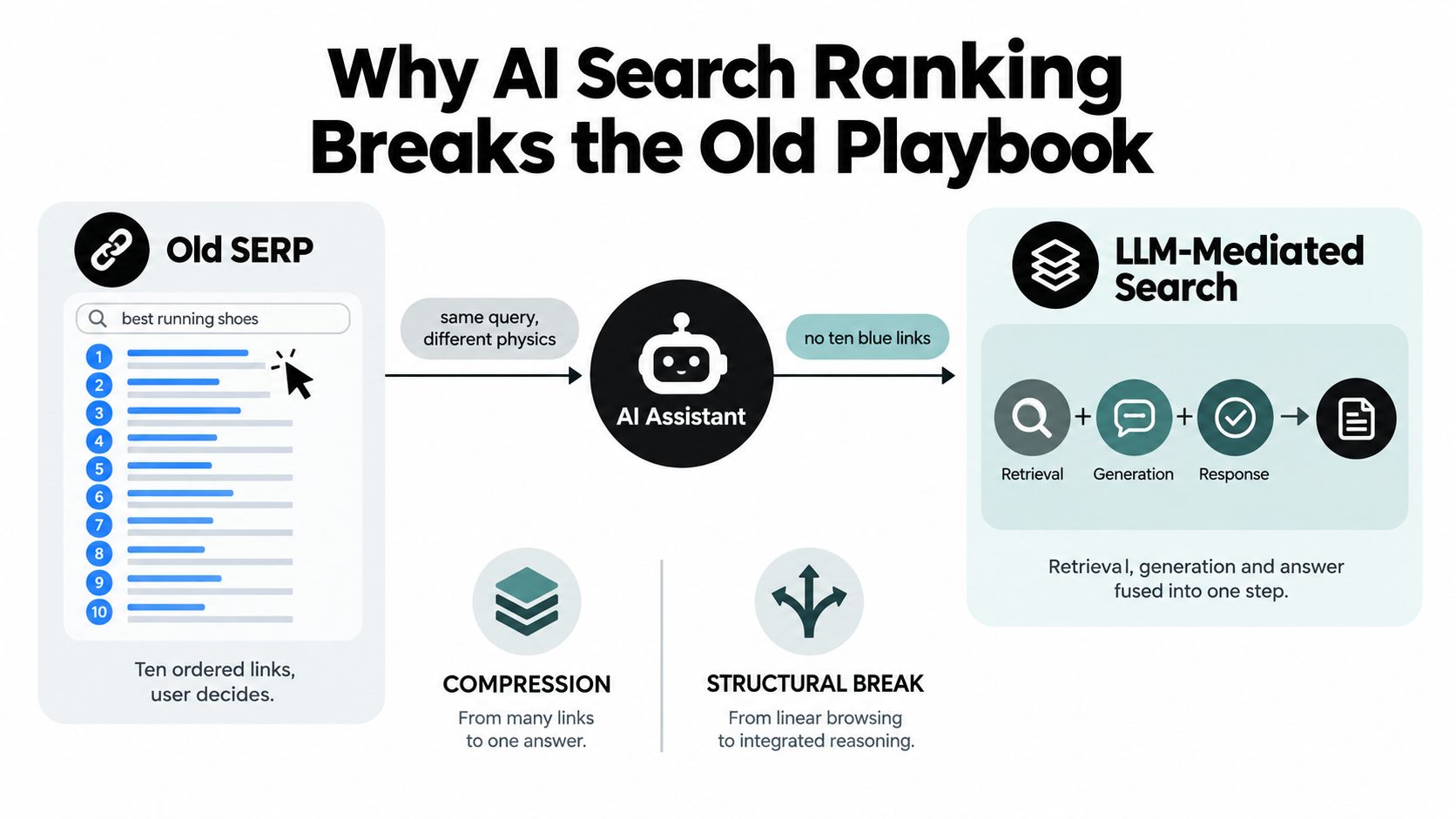
The four layers that dashboards collapse
A useful measurement stack separates four questions:
- Retrieval: Did the assistant select your domain or passage as a candidate?
- Citation correctness: Does the cited page support the specific claim beside it?
- Answer placement: How prominently did the assistant present your brand, product, or source?
- Business impact: Did the exposure contribute to qualified traffic, branded demand, conversions, or assisted revenue?
Position-based SEO tools answer only part of the first question. Mention trackers often report the third, even when they cannot verify whether the surrounding claim is accurate. Analytics platforms can measure the fourth, but usually cannot identify which prompt, citation, or statement created the outcome.
Practical rule: Treat an AI mention as an observation, not a success metric.
That distinction changes the work. Teams should identify which source entered the candidate set, verify the claim attached to the citation, measure how the answer framed the brand, and connect that exposure to buyer behavior. A visibility score that merges these stages can rise while citation quality or commercial value falls.
How a Retrieval Pipeline Actually Picks Your Page
An AI answer usually begins before generation. The system first retrieves candidate documents or passages, then reranks them, and only afterward gives surviving context to a language model for synthesis. An evaluation of nine retriever and reranker combinations found that LLM-based reranking improved downstream generation quality. The strongest tested configuration reached 0.8012 correctness and 0.9267 relevance, while also producing the only positive MRR gain in that experiment (the controlled evaluation).
The mechanics are easier to understand with a restaurant comparison. The retriever is a broad directory that finds kitchens matching the cuisine, location, and query terms. The reranker is a critic who filters that list using fit and quality. The generator writes the recommendation from the restaurants that survived. A restaurant that never enters the directory can't be recommended, no matter how elegantly the critic might describe it.
What happens at each stage
The retriever maximizes candidate reach. It may use keyword and vector signals to find pages whose language, entities, and concepts match the prompt. Crawlability, meaningful page structure, chunk boundaries, metadata, and clear terminology affect whether the system can find a useful passage.
The reranker improves precision. It orders candidates by their likely usefulness for the specific question. Topical fit, source credibility, freshness, and the clarity of the passage can matter here. A page may be broadly authoritative yet lose to a narrower page that answers the buyer's exact question more directly.
The generator synthesizes from surviving context. It doesn't normally inspect every page on the web while composing the response. It works from the selected context, which means upstream exclusion limits downstream influence. Polished prose aimed only at the model's writing style can't repair a retrieval failure.
The citation layer exposes selected evidence. A citation may point to a page the system used, but citation presence alone doesn't prove that the page supports every statement in the response. Teams need to record the answer, the cited URL, the relevant passage, and the claim attached to it.
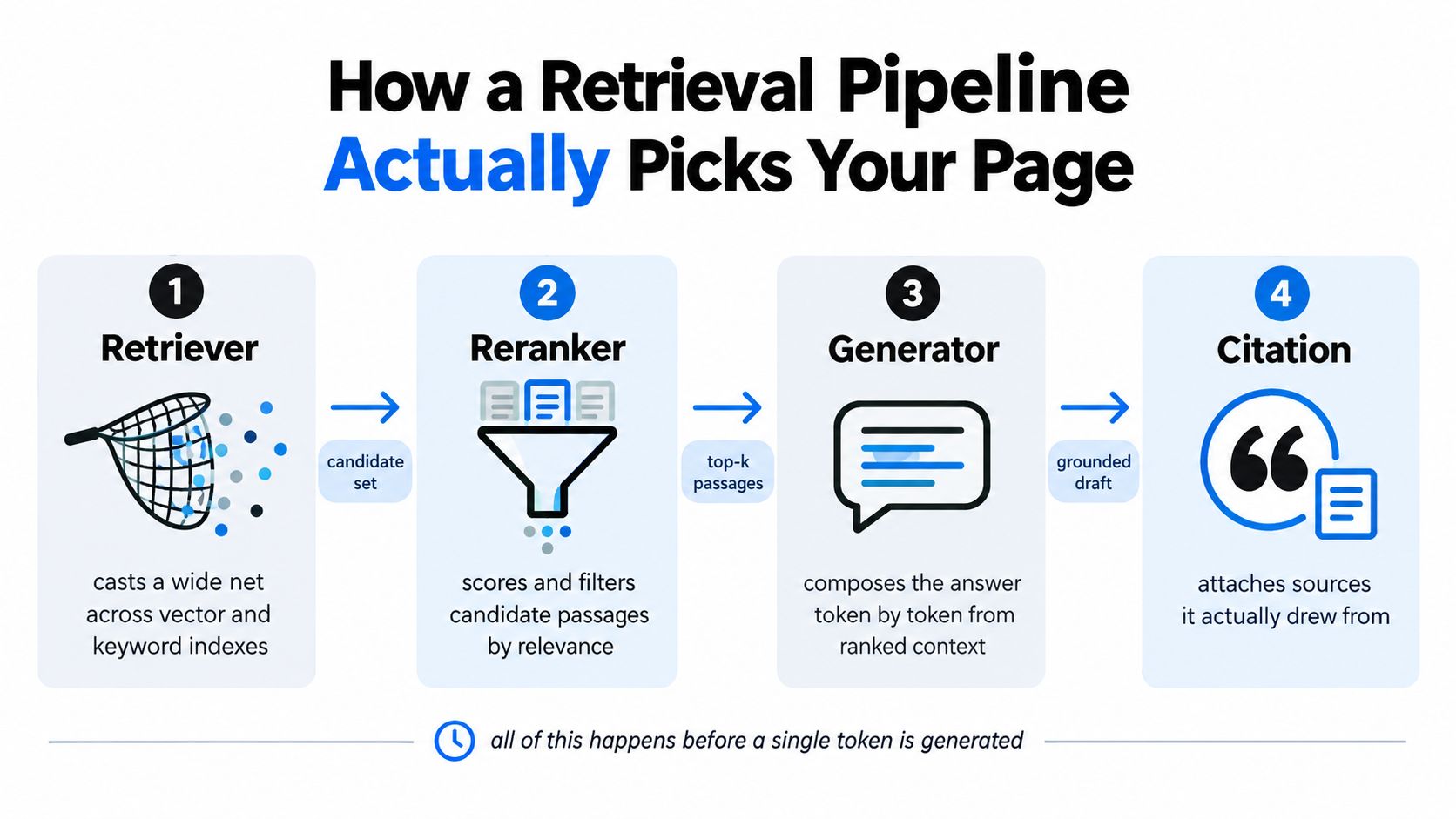
A query can also expand into related searches or subquestions, changing the candidate pool before the final response is written. This query fan-out explanation is useful for understanding why one user prompt can create several retrieval opportunities.
The operational implication is straightforward. Instrument candidate retrieval where possible, not just final mentions. Track which prompts surface the domain, which passages are selected, and whether the same page repeatedly survives reranking for the intended use case.
Where AI Overviews and Featured Snippets Diverge from the Top 10
AI search ranking is an attribution problem before it becomes an optimization problem. A page can rank below the first page, get cited in an AI Overview, and still generate no commercial value. Separate three outcomes: retrieval, citation correctness, and downstream action.
The Botify and DemandSphere analysis of more than 120,000 search queries shows why conventional rankings cannot stand in for AI visibility (Search Engine Land's coverage). AI Overviews appeared for 47.4% of studied queries, including 59% of informational searches and 19% of commercial searches. Those figures describe answer availability, not traffic, qualified visits, or revenue.
The study's clearest ranking finding is that approximately three-quarters of cited links came from pages outside the traditional top 10. It does not separate positions 1 to 3 from positions 4 to 10, so the result cannot support a more detailed concentration pattern. Organic rank still affects discovery, yet it is only one route into the evidence set used to construct an answer.
The same analysis found that AI Overviews and featured snippets together occupied 75.7% of mobile screen real estate and 67.1% on desktop. A page can hold its conventional position while the space and attention available to ordinary listings change materially. Visibility therefore requires two measurements: where the page ranks and whether an answer cites it.
Why the two answer formats behave differently
Featured snippets usually extract a compact passage from a page already performing strongly for the query. AI Overviews can combine passages from multiple sources and present a broader citation set. The cited research on AI Overviews found fewer visible links before expansion, followed by more links after users selected “Show More.” The expanded set could include substantially more sources than the initial view.
That difference changes the competitive surface. A position-seven page may contain the clearest definition, comparison, or qualification for one part of an answer, while a position-two page supplies broader context. The higher-ranked page wins the conventional listing. The lower-ranked page may still win a citation slot if its passage better matches the generated claim.
Citation presence also requires a correctness check. Record the prompt, cited URL, selected passage, and claim supported by that passage. Then connect the citation to downstream signals such as engaged visits, assisted conversions, or qualified enquiries. A mention that cannot be tied to a supported claim or a commercial outcome is an incomplete visibility result.
The relationship between topical depth and inclusion remains correlational. The dataset does not prove that adding words causes an Overview citation. It does support a narrower conclusion: rank trackers limited to the top 10 understate the pages that can influence an AI answer. Teams seeking to rank in AI Overviews should monitor source inclusion, citation correctness, and business impact separately from organic position.
The Signals That Move You into a Generated Answer
AI search ranking is an attribution problem before it becomes an optimization problem. A page must first be retrieved, then selected as evidence, then connected to a commercial outcome. Treating those stages as one visibility score hides where performance actually changes.
Retrieval relevance determines whether a page enters consideration. Explicit terminology helps systems connect a prompt with the document's subject, product category, and use case. A SaaS page that relies on branded feature names may be harder to retrieve for a generic buyer question than one that states the category and function plainly.
Authority and source ecosystem affect which candidates appear safe to cite. A Pew analysis of 68,879 Google searches found AI summaries for 12,593 searches. Wikipedia, YouTube, and Reddit together represented 15% of cited sources (the reported source ecosystem analysis). The finding does not establish a universal platform preference. It does show why owned-site work cannot account for citation share by itself.
Citation hygiene keeps claims tied to evidence. A product page making a precise comparison should point to material that supports that comparison directly. Contradictions across documentation, review pages, partner listings, and pricing explanations create uncertainty for reranking systems and buyers.
Clear structure gives retrieval systems separable passages to work with; design polish alone does not. Headings, self-contained answers, tables, lists, and crawlable facts make individual claims easier to identify. Schema can clarify page type and entities, but it cannot compensate for missing or ambiguous visible text.
Freshness reflects how quickly evidence loses relevance. A page with outdated product capabilities may remain discoverable while becoming a risky source for a current recommendation. Changing the publication date without updating the underlying evidence leaves that risk intact.
| Signal | Observed data point | What it implies for optimization |
|---|---|---|
| Conventional visibility | 84.72% of June 2024 AI Overviews with citations overlapped with at least one top-10 organic domain (SE Ranking) | Preserve technical SEO and organic discovery while improving answer-specific relevance |
| Long-tail source selection | Approximately three-quarters of cited links in the Botify and DemandSphere dataset came from outside the top 10 (Search Engine Land) | Audit strong, relevant pages beyond first-page rankings |
| Source ecosystem | Wikipedia, YouTube, and Reddit represented 15% of cited sources in the Pew analysis | Track third-party evidence and community visibility alongside owned pages |
| Query intent | Informational searches triggered Overviews at 59%, compared with 19% for commercial searches in the Botify and DemandSphere dataset | Segment prompt banks by intent before judging performance |
Teams explaining how pages can appear in AI-generated search answers should connect each content change to a prompt-level retrieval result, a supported citation, and a measurable business action. A mention alone cannot show which stage succeeded.
Citation Presence Is Not Citation Quality
A mention count can rise while the quality of attribution falls. In a 2025 evaluation covering 800 questions and 58,000 statement-source pairs, 50% to 90% of LLM responses were not fully supported by, or were sometimes contradicted by, the cited sources (the evaluation in PMC).
A 300-question subset makes the distinction sharper. GPT-4o with retrieval achieved 100% URL validity, but only 75.7% statement-level support and 38.4% response-level support. A valid URL can therefore lead to a page that doesn't adequately support the particular statement beside it.
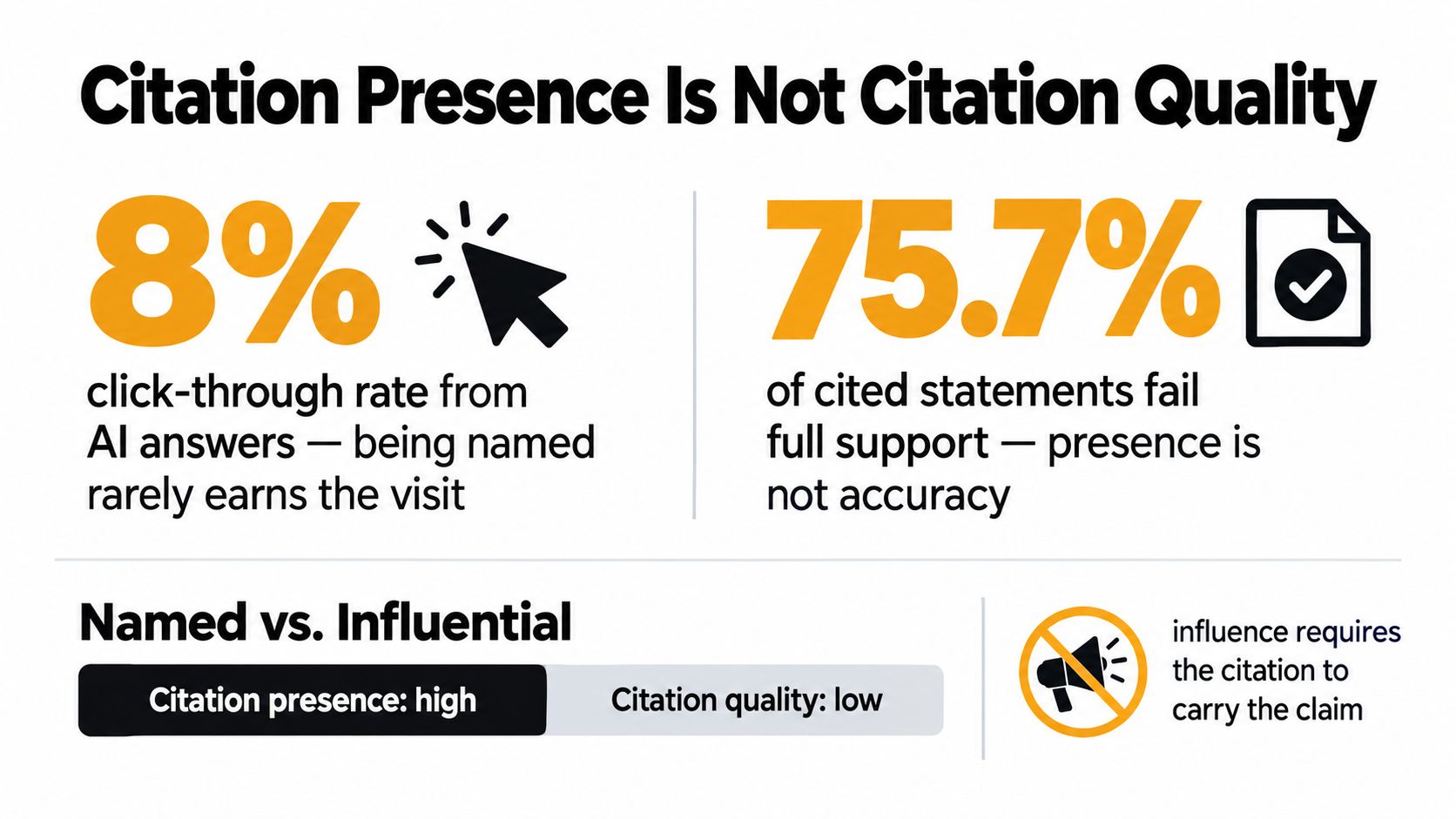
Three ways a visible mention can fail
- Entity mismatch: The assistant attributes a competitor's capability, review, or limitation to your product.
- Claim mismatch: The citation resolves correctly, but the page doesn't contain the fact or conclusion the answer assigns to it.
- Commercial mismatch: The answer describes your product positively, yet the user doesn't visit, request a demo, or enter a measurable buying path.
Behavioral data reinforces the final distinction. When Google AI Overviews appeared, users clicked a traditional result 8% of the time, compared with 15% without an Overview. Only 1% clicked a link inside the summary, and 26% ended the session without visiting a site, according to the behavioral reporting (CNET's coverage). Google disputes the broader traffic-loss interpretation and reports stable year-over-year organic click volume with higher average click quality. The disagreement is precisely why visibility shouldn't be treated as revenue.
A citation is evidence of selection. It isn't evidence of support, influence, or conversion.
A useful audit samples answers and scores each cited claim against the source passage. The audit should record whether the fact is present, current, attached to the correct entity, and consistent with product and documentation pages. This source-attribution perspective is developed further in what source attribution means for AI answers.
The reporting model should separate mention frequency, citation prominence, citation accuracy, branded search lift, qualified visits, conversions, and assisted revenue. A brand can lead on the first metric and lose on the rest.
How Different AI Assistants Choose Different Sources
A company does not compete in one universal AI index. It competes across retrieval environments with different access rules, freshness patterns, source displays, and citation conventions. The same prompt can produce different evidence sets in Google AI Overviews, ChatGPT, Perplexity, Claude, Gemini, and Copilot. AI search ranking therefore begins as an attribution problem: identify which system retrieved which evidence before treating visibility as an optimization result.
The Pew source-ecosystem data already cited shows why a single-provider view is incomplete: Wikipedia, YouTube, and Reddit collectively carry 15% of cited sources. Product documentation and marketing pages are only one part of the evidence set. Independent reviews, community discussions, video explanations, and partner references can influence what an assistant retrieves and cites.
| Assistant | Retrieval and source behavior | Observable citation behavior |
|---|---|---|
| Google AI Overviews | Combines conventional search discovery with answer-level retrieval and synthesis | Inline links can appear beside generated claims, while the visible set changes with the query and answer |
| Perplexity | Retrieval-led responses built around current web references | Inline numbered citations remain visible without expansion |
| ChatGPT | Uses browsing in supported experiences, with retrieval shaped by mode and query | With browsing, a source list can be disclosed, while citations may be absent by default |
| Claude | Uses connected retrieval or supplied documents when those are available | Source references depend on the connected context, so document-level testing is more informative than general assumptions |
| Gemini | Can combine generation with search-connected evidence | Search-linked references may appear with the response, but the selected URLs can change across prompts |
| Copilot | Search-connected answers can draw on indexed web documents | Sources are generally exposed alongside the answer, allowing reviewers to compare grounding pages with cited claims |
These differences change the investigation, not the publishing strategy. If a product appears in one assistant but not another, compare the missing evidence category first. The gap may come from weak documentation, absent third-party validation, unclear product terminology, or limited presence in the communities and platforms that another assistant retrieves.
Owned evidence and earned evidence
Owned pages give a SaaS company control over claims, dates, terminology, and structured explanations. Earned sources provide independent context, although the company controls them less directly. Platform evidence includes the documents and communities an assistant repeatedly retrieves for a category.
Measure these categories separately. Expanding an owned content library can improve the pages available for retrieval while leaving the brand absent from independent sources that shape comparative recommendations. That distinction also separates retrieval from citation correctness. A page may enter the candidate set, yet fail to support the claim attached to it.
Commercial value requires a third layer. A citation can be accurate and still produce no qualified visit, branded search lift, or conversion. Teams can use the AI provider comparison to choose which assistants and source behaviors to test, then report retrieval, citation accuracy, and downstream outcomes as separate measures.
Measuring AI Visibility Without Fooling Yourself
A defensible measurement system keeps retrieval, answer placement, citation quality, and business outcomes in separate layers. If one score combines all four, a rise in mentions can hide a fall in accuracy or qualified traffic.
Layer one measures candidate reach
Hit Rate@k is the share of prompts where a target source enters the first k retrieved candidates. It answers whether the domain is available to the answer system, not whether the final response cites it.
Mean Reciprocal Rank, or MRR, rewards higher positions by taking the reciprocal of the first relevant source's rank and averaging across prompts. It distinguishes a source that regularly appears first from one that appears only near the edge of the candidate set.
Layer two measures answer selection
Record whether the brand appears, where it appears in a recommendation list, how the assistant describes it, and which URLs support the response. Segment prompts by navigational, research, comparison, and transactional intent. Also separate brand queries from category queries, because a strong result on navigational prompts can conceal weak discovery among new buyers.
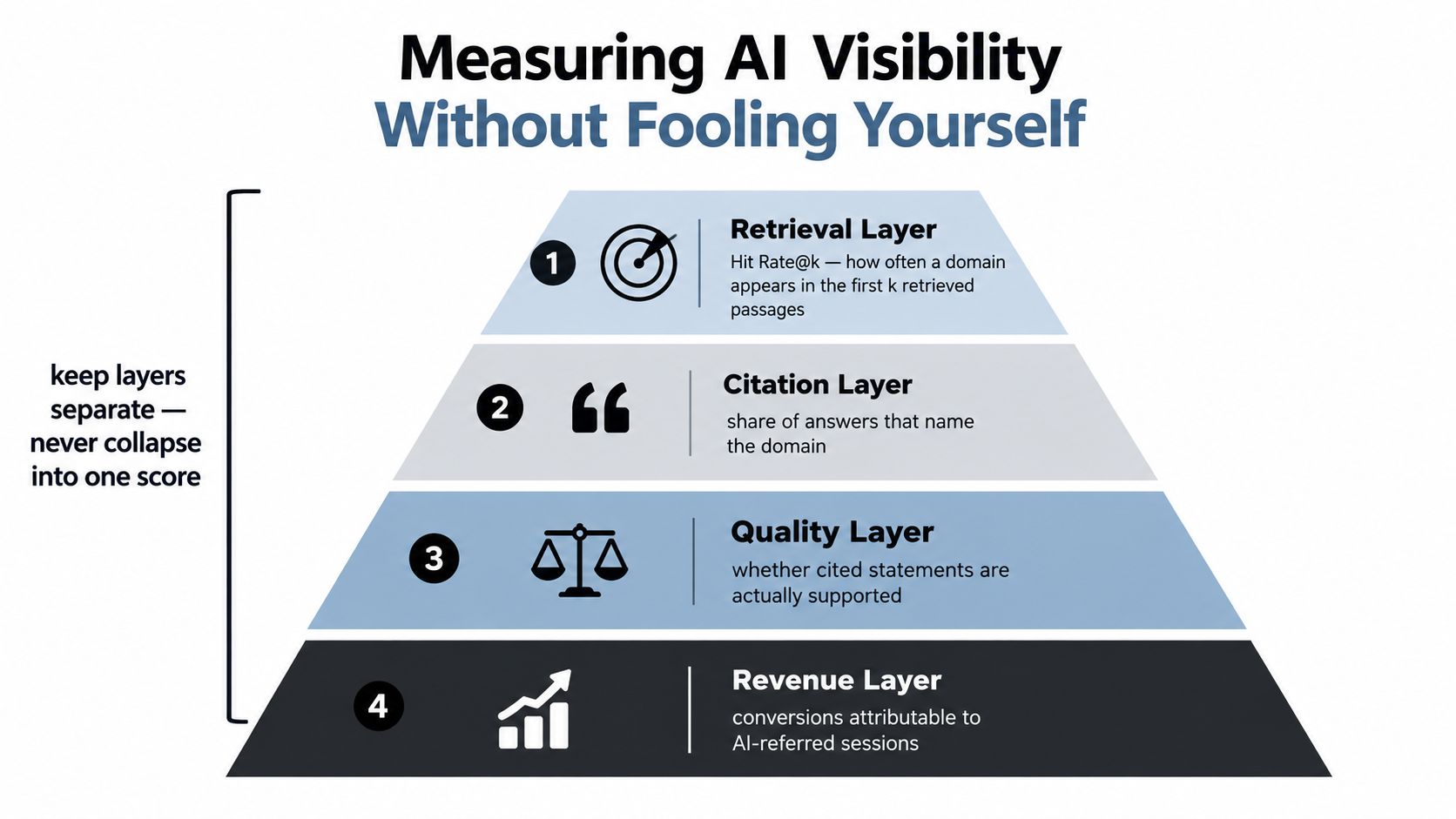
Layer three checks whether the citation carries the claim
Sample answers and calculate a citation-accuracy score based on claim-to-source alignment. Review whether the cited page contains the claim, whether the wording overstates the evidence, whether the source is current, and whether product pages agree with review and partner pages. This prevents a dashboard from rewarding a citation that actively misrepresents the product.
Layer four connects exposure to commercial outcomes
Use referrer data where available, branded search changes, qualified sessions, assisted conversions, and pipeline records. Don't assume an immediate click is the only path. A research prompt may influence consideration before a later direct visit, while a high-volume navigational prompt may produce little incremental value.
For statistical discipline, report confidence intervals around Hit Rate@k rather than presenting a single point estimate. The width depends on the observed rate and the size and composition of the prompt sample. A bank of 500 prompts can support a more stable estimate than a handful of synthetic queries, but it doesn't remove sampling bias. The prompts must represent the markets, intents, competitors, and product categories that matter.
Teams interested in exploring AI visibility for growth should connect the prompt bank to an analytics warehouse or reporting process. Re-test after changing one major variable, preserve the previous answer, and annotate provider or product changes. A quarterly comparison then becomes an experiment log rather than a collection of screenshots. A practical guide to measuring AI search visibility can help formalize those layers.
A Prioritized Roadmap for AI Search Ranking
Prioritize work by expected impact per engineering hour, not by how attractive the deliverable looks in a launch announcement.
First, repair retrieval fundamentals
Start with existing pages that already receive relevant organic attention or serve important buyer questions. Make product terminology explicit, expose canonical facts in crawlable HTML, improve heading structure, connect related pages with internal links, and remove contradictions across documentation, comparison, pricing, and partner content. Add structured data where it accurately describes the page. These changes improve the evidence base without requiring a new content factory.
Second, build answer-engine assets
Create comparison pages, definitions, implementation guides, and focused use-case pages where the company has genuine expertise. Each page should answer a clear question with self-contained passages and distinguish facts from opinion. Don't generate thin pages for every imaginable prompt. A larger URL inventory doesn't guarantee better retrieval, and unsupported claims can damage citation quality.
Third, instrument the system. Build a stratified prompt bank, capture provider-specific answers, record citations, and run claim-to-source audits. Track competitors and third-party sources, not only your own domain. If directory discovery is relevant to a startup's source portfolio, teams can evaluate services that help submit an AI startup to directories, while still validating whether those listings become trusted evidence.
The common 90-day failure is easy to recognize. A team publishes answer-focused pages, sees one assistant mention the brand, declares success, and never checks whether the citation was accurate or whether qualified demand changed.
Use a four-iteration loop instead:
- Instrument a defined prompt bank.
- Change one retrieval or evidence variable.
- Re-test across the same provider and intent segments.
- Attribute downstream movement without confusing correlation with causation.
MyMentions tracks prompt-level visibility, position, sentiment, competitors, and citation sources across supported AI assistants, then connects those observations with traffic attribution and prioritized recommendations. If your team needs to know not only whether assistants mention the product but also which sources shape those answers and whether exposure contributes to visits, visit MyMentions and build the measurement loop around evidence rather than mention volume.