Most advice about generative engine optimization starts with the wrong test: open ChatGPT, type a few prompts, and record whether your brand appears. That exercise can reveal obvious problems, but it isn't a measurement system. A single answer is a volatile observation, not a reliable estimate of visibility, citation quality, or commercial impact.
A serious GEO program treats AI search as an experimental environment. You need repeated samples, consistent prompts, multiple engines, source-level citation records, and an attribution path that connects visibility to business outcomes. The practical question isn't just whether an assistant mentioned you. It's whether the assistant mentions you consistently, places you prominently, describes you accurately, cites useful pages, and contributes to measurable customer activity.
Table of Contents
- Why Single-Run Prompt Checking Fails
- Defining Decision-Grade GEO Metrics
- Designing Repeated-Sampling Experiments
- Benchmarking Across AI Search Platforms
- Connecting AI Visibility to Business Attribution
- Building Your Optimization Backlog
Why Single-Run Prompt Checking Fails
Single-run prompt checking feels useful because it produces an immediate answer. A marketer types “What are the best tools for…” and sees a familiar competitor in the response, or notices that their own company is absent. The problem is that the result looks more precise than it is. You don't know whether the answer represents a stable pattern, a temporary retrieval choice, a changed context window, or ordinary output variation.
A foundational 2026 framework for measuring generative engine optimization treats visibility as a repeated-sampling problem rather than a one-time snapshot. In experiments across three generative search platforms, researchers collected consumer-product results under two regimes, daily collections across 9 days and high-frequency collections every 10 minutes, and found that citation distributions followed a power-law pattern with substantial variability across runs. The findings are discussed in research on generative engine optimization statistics.
That variability changes how you should interpret a “win.” If your domain appears in one answer and disappears in the next, the first observation isn't proof that a page optimization worked. Likewise, a competitor's absence in one answer isn't evidence that you overtook them. Bootstrap confidence intervals in the framework showed that many apparent domain differences fell within the measurement noise floor.
The snapshot creates false confidence
A manual check usually collapses several distinct questions into one binary result:
- Presence: Did the brand appear?
- Prominence: Where did it appear, and how much attention did it receive?
- Citation: Did the answer link to a source?
- Portrayal: Was the description accurate and favorable?
- Stability: Did the result recur across samples?
A yes-or-no spreadsheet can't preserve those distinctions. It encourages teams to optimize for mentions even when the mention is buried, unsupported, inaccurate, or irrelevant to the buyer's intent.
Practical rule: Never declare a GEO improvement from one prompt run. Treat it as a hypothesis that needs repeated observations.
The right replacement is prompt regression testing. Store the exact prompt, engine, date, session context, answer text, cited URLs, cited domains, brand position, and interpretation. A useful prompt regression testing workflow can then compare new samples with a stable baseline instead of relying on memory or screenshots.
Measure distributions, not anecdotes
A repeated sample doesn't eliminate uncertainty. It makes uncertainty visible. You can estimate how often your brand appears, how often it receives a citation, and how much those outcomes fluctuate by engine and prompt type. That lets you distinguish a likely content effect from normal model noise.
The operational shift is simple. Stop asking, “Did we show up today?” Ask, “Across comparable runs, what is our distribution of presence, citation, position, and portrayal, and how much confidence should we place in the change?” That is the foundation for decision-grade GEO.
Defining Decision-Grade GEO Metrics
Mention rate is a useful starting signal, but it isn't a sufficient KPI. A brand can appear frequently in generated answers and still be misrepresented, placed below stronger alternatives, or cited through weak sources. A measurement system should preserve those differences rather than compressing them into one visibility score.
The IAB framework for measuring visibility in the AI era organizes GEO measurement into Presence, Prominence, Portrayal, and Persuasion. This structure is practical because each dimension represents a different optimization decision.
Presence tells you whether the brand enters the answer
Track mention rate, citation rate, and share of voice separately. Mention rate answers whether the assistant names your brand. Citation rate answers whether a source associated with your brand supports the answer. Share of voice compares your presence with named competitors within the same prompt set.
Those metrics can diverge. Your brand might be mentioned from the model's internal knowledge while a competitor receives the visible citation. Or your site might be cited, but only for a minor detail while another domain supplies the answer's central recommendation. Record the exact cited URL and domain, not just the existence of a link.
Prominence measures the weight of the appearance
Position matters, but raw position isn't enough. An answer can list a brand near the top without explaining why it belongs there, while a later passage might provide detailed, persuasive information. Track placement, ranking order, answer-level influence, and the amount of substantive text connected to the brand.
The original GEO research addressed this problem through Position-Adjusted Word Count and Subjective Impression, metrics designed to distinguish a meaningful contribution from a token appearance. Teams that want to measure editorial content performance can apply the same discipline here, examining whether cited content contributes useful information rather than merely attracting a reference.
Portrayal and persuasion protect the business outcome
A citation can be visible and still damaging. Review whether the answer gets product capabilities, audience fit, pricing context, limitations, and category positioning right. Log sentiment, hallucination rate, and the specific factual errors that recur.
Persuasion captures the strength of the recommendation. Is the brand presented as a possible option, a credible shortlist candidate, or the preferred choice for a defined use case? Where measurement allows it, add recommendation strength and post-citation click-through rate as separate fields.
A useful metric schema might look like this:
| Layer | Core questions | Example fields |
|---|---|---|
| Presence | Are we included and cited? | Mention rate, citation rate, share of voice |
| Prominence | How much weight does the answer give us? | Placement, ranking order, substantive word count |
| Portrayal | Is the answer accurate and on-brand? | Sentiment, factual accuracy, hallucination rate |
| Persuasion | Does the answer influence action? | Recommendation strength, post-citation click-through rate |
Don't blend these fields too early. A composite score can help with executive reporting, but the underlying dimensions must remain available for diagnosis. If the score drops, your team needs to know whether the cause was absence, weaker placement, inaccurate portrayal, or declining downstream engagement.
For a broader view of brand presence across assistants, teams can also use an AI share of voice measurement approach that keeps competitive comparisons tied to prompt-level observations.
Designing Repeated-Sampling Experiments
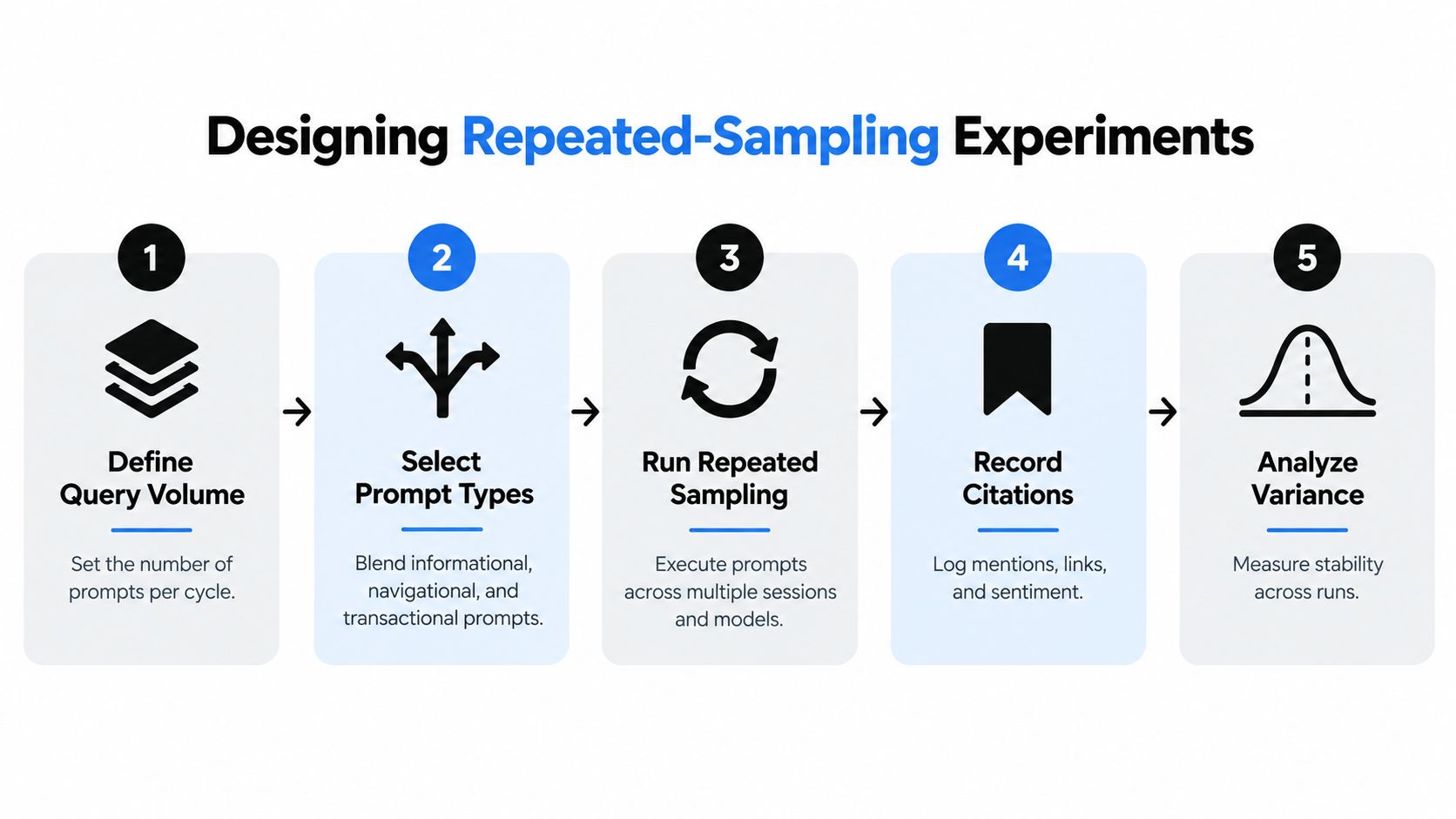
A reliable GEO measurement program starts with a test specification, not a dashboard. Before collecting answers, define the question set, engines, sampling cadence, fields, and decision rules. The IAB guidance recommends specifying query volume, sample size, prompt-type coverage, testing cadence, reproducibility, and platform coverage before making budget or strategy decisions.
Build the prompt set around intent
Start with prompts that represent the way buyers evaluate your category. A balanced set should include informational questions, navigational prompts, comparison requests, problem-solving queries, and transactional or recommendation-oriented prompts. Don't rely exclusively on existing SEO keywords. AI users often phrase tasks conversationally, ask for trade-offs, and combine several requirements in one request.
For each prompt, store:
- The exact wording, including punctuation and product names.
- The intent category, such as research, comparison, or purchase.
- The audience context, such as founder, technical buyer, or marketing leader.
- The expected competitor set, based on the category rather than personal assumptions.
- The relevant market and language, if the program spans regions.
- The success fields, including presence, citation, position, portrayal, and action.
Keep a fixed core set for trend analysis, then maintain a smaller exploratory set for new questions. If you change every prompt at once, you won't know whether a visibility change came from your content or from a new sample composition.
Repeat the same test under controlled conditions
Run the core prompts on a defined cadence across every selected engine. A daily schedule can reveal directional movement, while more frequent runs are useful when you need to understand short-term volatility. Use consistent settings wherever the platform exposes them, and record model or interface changes instead of treating them as ordinary observations.
Save the full answer, not just a screenshot or a brand flag. Extract every cited URL, normalize canonical variants, map URLs to domains, and label whether the source is owned, earned, partner, editorial, community, or user-generated. This source-level record tells you what information ecosystem is shaping the answer.
Quantify uncertainty before acting
For each metric, calculate a central estimate and an uncertainty interval. Bootstrap confidence intervals are practical because they let you resample observed runs without assuming that citation behavior follows a simple distribution. If two domains differ inside the confidence interval, treat the apparent gap cautiously. It may be measurement noise rather than a meaningful competitive difference.
The benchmark logic from the original GEO research is useful here. GEO-bench contains 10,000 queries drawn from diverse domains and sources, and it evaluates generated answers with Position-Adjusted Word Count and Subjective Impression. The important lesson isn't to copy the benchmark wholesale. It's to evaluate both frequency and substantive weight.
A practical dataset should include answer-level and source-level records:
- Answer record: Prompt, engine, run timestamp, answer text, brand presence, competitor presence, position, and portrayal.
- Citation record: Exact URL, domain, source type, linked passage, and whether the citation supports the claim.
- Stability record: Number of runs, appearance frequency, position variation, and confidence interval.
- Outcome record: Referral session, landing page, assisted conversion, and any known revenue or pipeline event.
A technical AI search audit can help identify crawlability, content, trust, and source gaps before you interpret a visibility baseline. But don't let an audit replace measurement. Technical eligibility is an input to the experiment, not proof that an engine will cite you.
Set rules for intervention
Decide in advance what counts as a meaningful change. For example, require the change to persist across multiple collection cycles, appear across comparable prompts, and remain visible after controlling for engine and intent. If only one prompt improves, create a content hypothesis. If several related prompts improve and the cited source changes in a consistent direction, prioritize validation and rollout.
This discipline prevents the common failure mode of editing content after every surprising answer. GEO optimization works better as a sequence of hypotheses, controlled changes, repeated samples, and documented decisions.
Benchmarking Across AI Search Platforms
An average GEO score across platforms can hide the behavior you need to understand. ChatGPT, Google, and Perplexity may answer the same commercial question with different citation depth, source mixes, answer structures, and retrieval patterns. A drop in aggregate visibility could reflect a platform-specific change rather than a broad decline in relevance.
A 2026 cross-platform measurement study recorded mean citations per prompt of 6.88 for ChatGPT, 12.06 for Google, and 16.35 for Perplexity. Those figures come from the cross-platform measurement study, and they show why citation depth must be tracked separately from mention rate and share of voice.
| Platform | Mean citations per prompt | Key behavioral trait |
|---|---|---|
| ChatGPT | 6.88 | Lower citation depth in the cited benchmark, so source presence may be more selective |
| 12.06 | More citation opportunities within an answer, with platform context affecting interpretation | |
| Perplexity | 16.35 | Higher citation depth, making source-level competition especially important |
The table isn't a universal performance target. It is a reminder that raw citation counts aren't comparable without platform context. A brand receiving a small number of citations in ChatGPT shouldn't be judged against a Perplexity count using the same threshold.
Normalize before comparing
Create platform-specific baselines by prompt type. Compare informational prompts with informational prompts, recommendation prompts with recommendation prompts, and the same market with the same market. Report both the platform result and the pooled result, but make the pooled result a secondary view.
A useful reporting layout includes:
- Within-platform visibility: How often the brand appears relative to competitors on one engine.
- Within-platform citation depth: How many citations appear and whether the brand's sources are among them.
- Cross-platform consistency: Whether the same prompts produce comparable brand treatment.
- Source overlap: Which domains recur across engines.
- Platform variance: How much position, sentiment, and citation selection change by engine.
Don't interpret source diversity as automatically positive. A broad mix of independent reviews, documentation, partner pages, and community discussions can provide resilience, but low-quality or contradictory sources can also create portrayal risk. Review the actual passages engines cite and classify whether they support the answer's main claim.
Separate model drift from content effects
Record engine updates, interface changes, retrieval settings, and prompt changes in the test log. If visibility moves after a model change, the timing is evidence of a possible platform effect, not proof that your content caused the movement.
For the same reason, avoid optimizing only for the engine with the most convenient reporting. Your buyers may use several assistants, and each can expose a different weakness. A platform comparison such as AI search market share analysis is useful for planning coverage, but your own audience and conversion data should determine where you invest.
The operational trade-off is clear. Wider platform coverage costs more to collect and analyze, yet narrow coverage can produce a confident answer about the wrong market. Start with the engines that influence your audience, then expand when the baseline shows material differences in citation behavior or portrayal.
Connecting AI Visibility to Business Attribution
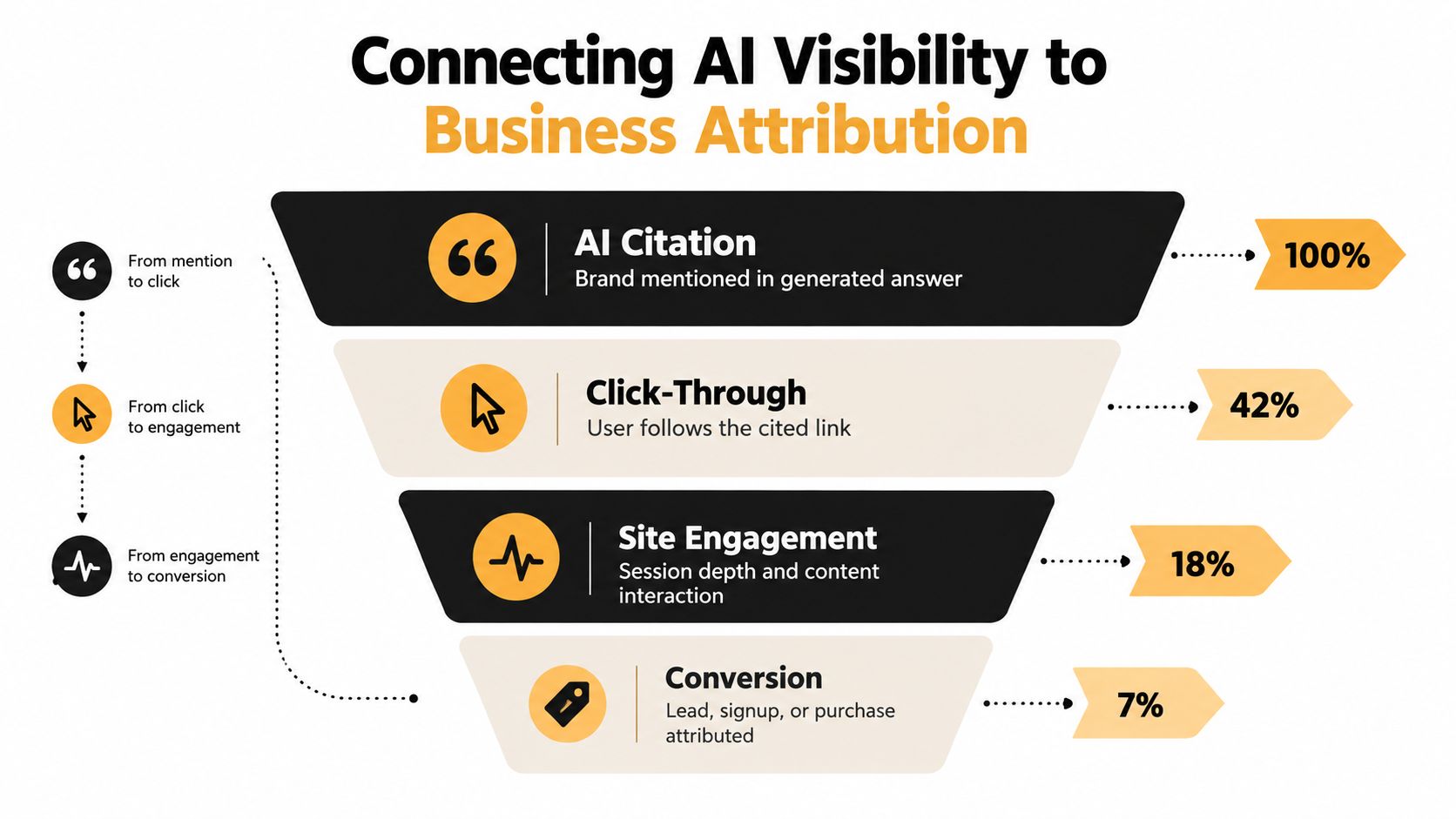
AI visibility is not revenue. A citation can indicate that an engine found your content relevant, yet it may produce no visit, lead, or sale. Treating mention counts as commercial proof creates a reporting system that rewards visibility even when buyer behavior does not change.
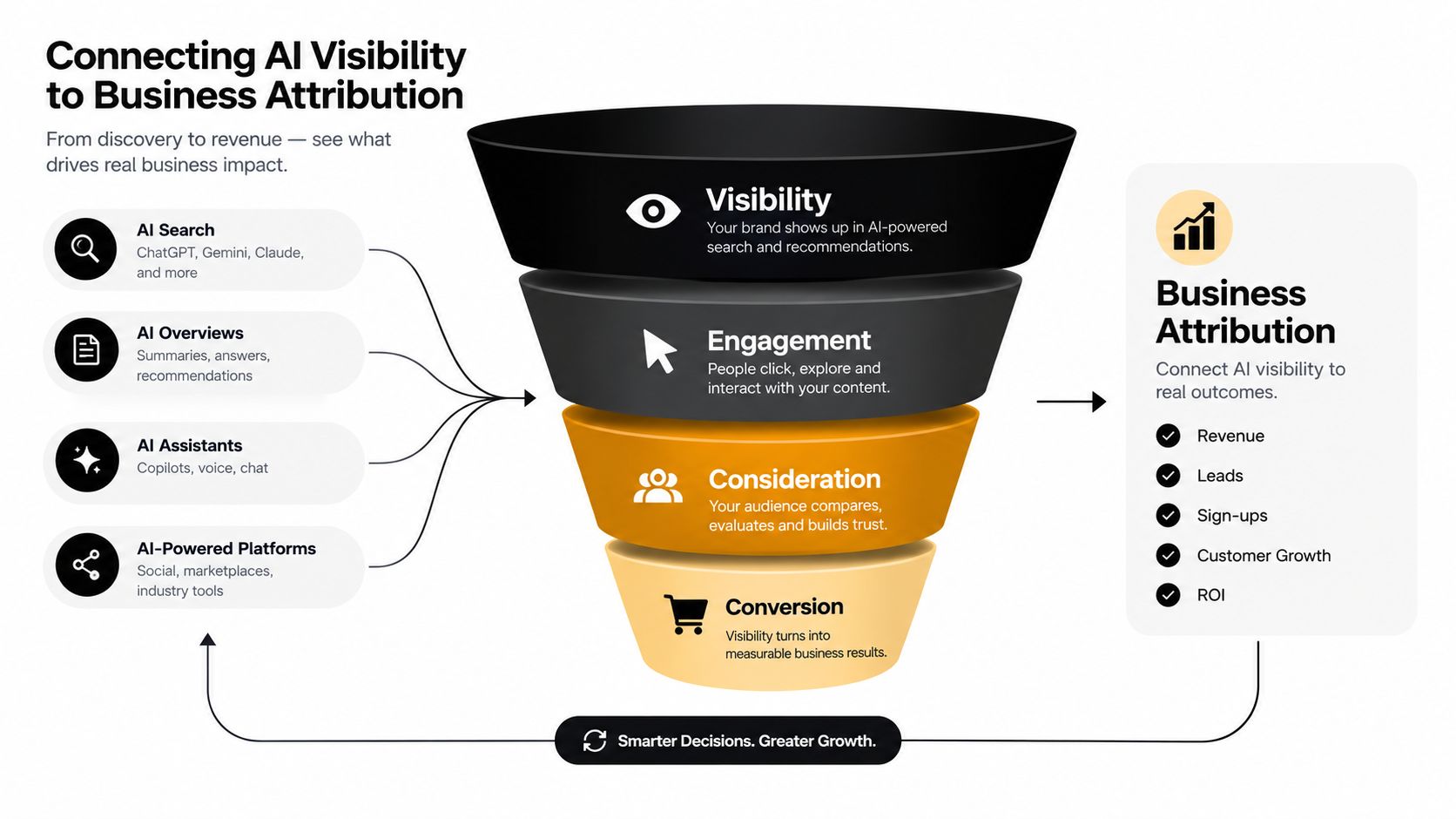
Build an outcome ladder from technical eligibility and source presence through mention quality, citation depth, referral behavior, engagement, assisted conversion, and revenue. Each stage answers a separate question. Technical access shows whether engines can retrieve a page. Citation depth shows whether they use it for a central claim or a minor detail. Downstream metrics show whether that exposure influenced a person or account.
Track the path without overstating causality
Use server logs, analytics referral data, tagged landing pages where possible, and CRM records to connect AI-referred sessions with later actions; an AI traffic analytics workflow shows how to keep those identifiers in one schema. Preserve the prompt, engine, cited URL, landing page, session, and conversion identifiers. If direct identification is unavailable, label the result as an assisted signal rather than claiming that the citation caused the conversion.
A practical performance attribution guide for 2026 can help teams select a model that fits their wider measurement setup. Apply the same reporting standard used for other channels: separate directly observed activity from modeled influence, and state what remains uncertain.
The path can break in several places:
- No click: The answer resolves the user's question before a site visit.
- Untracked referral: The assistant or browser removes useful referral context.
- Indirect conversion: Someone sees a citation, returns through another channel, and converts later.
- Assisted influence: AI exposure shapes consideration without producing the final session.
- Source substitution: An answer cites your content, while the user acts through a marketplace, partner, or sales conversation.
Treat zero-click behavior as a measurement change
Recent data suggests that Google zero-click searches rose from 56% to 69% in a single year after AI Overviews rollout, while AI-cited content was 25.7% fresher than traditional organic results, according to coverage of GEO campaign success measurement. Click-through rate can therefore understate visibility value, while visibility alone can overstate business value.
Measure both sides. Track AI-driven visits alongside branded search, direct traffic, assisted conversions, sales acceptance, and customer research signals where your systems support them. If citations increase while clicks decline, test whether the answer satisfies the query, the citation appears unattractive, or the platform changed its source presentation.
Freshness adds another confounder. A content update may coincide with a model refresh, seasonal demand, or greater brand awareness. Use holdout prompts, matched prompt groups, and predeclared observation windows where feasible. Compare changed pages with similar unchanged pages, then look for repeated movement across engines rather than treating one favorable reporting period as proof.
A decision-grade GEO business case combines visibility quality, source credibility, referral behavior, and assisted outcomes. It measures influence without forcing every AI interaction into a last-click framework the channel cannot support.
Building Your Optimization Backlog
Measurement becomes useful when every finding produces a clear owner, action, and validation test. A dashboard that reports declining citation share but doesn't identify the cited competitor sources leaves the team with anxiety rather than a work queue.
Start by grouping findings into four operational buckets:
- Content gaps: The answer lacks a clear explanation, comparison, use case, or proof point that buyers need.
- Trust gaps: Independent reviews, partner pages, documentation, or community references describe the category without supporting your brand.
- Portrayal risks: Assistants repeat outdated features, incorrect positioning, unsupported claims, or negative associations.
- Technical barriers: Important pages are difficult to discover, understand, or connect to the entities and claims engines use.
Prioritize each item by business relevance, evidence strength, implementation effort, and testability. A high-priority task might be a well-cited comparison page that addresses several buyer-intent prompts and has a clear owner. A low-priority task might be a cosmetic wording change supported only by one unstable answer.
Use source-level evidence in the ticket. Include the prompt cluster, affected engines, recurring cited domains, answer excerpts, current page, proposed change, and success metric. Assign one validation window and don't rewrite the success criteria after seeing the first result.
Create a recurring operating rhythm
Content and SEO teams should review new citation patterns on a fixed schedule. Product marketing can validate whether descriptions match current positioning. PR and partnerships can address third-party sources that repeatedly shape answers. Technical teams can resolve discoverability or structured-content issues.
Automated alerts help catch meaningful movement between reviews. Reports should distinguish a stable change from a single outlier and give stakeholders separate views for presence, prominence, portrayal, persuasion, and business outcomes. That makes the discussion more useful than presenting one unexplained visibility number.
Keep the backlog connected to experiments. Ship one coherent change, rerun the matched prompt group, inspect citation sources and answer wording, then record the result. Over time, this creates an internal evidence base about which content formats, trust signals, and technical fixes influence your category across each engine.
MyMentions offers prompt-level tracking for visibility, position, sentiment, citations, competitors, and traffic attribution across supported AI assistants, then turns those findings into a prioritized optimization backlog. Visit MyMentions to compare repeated GEO results, monitor source patterns, and give your team concrete fixes to test.