ChatGPT's share of generative AI chatbot traffic fell from 86.7% to 64.5% between January 2025 and January 2026, while Google Gemini rose from 5.4% to 21.5%. AI search market share is therefore shifting from near-monopoly conditions toward a competitive, multi-player arena.
That change matters for more than platform rankings. It changes how businesses should define visibility, evaluate citations, and allocate SEO resources. A platform can dominate raw traffic while contributing less measurable value to a company's website than a smaller competitor. The strategic question isn't only who has the most users. It's which assistants mention your brand, cite your content, and send commercially relevant visitors.
Table of Contents
- Introduction - The Changing Face of AI Search
- Defining AI Search Market Share and Scope
- Key Players in the AI Search Market
- Measuring Impact Beyond Raw Traffic Share
- Actionable Steps to Improve AI Visibility
- Conclusion - Navigating the Future of Discovery
Introduction - The Changing Face of AI Search
The sharpest signal of market change is the movement between ChatGPT and Gemini. An analysis of generative AI chatbot traffic reported that ChatGPT's share declined from 86.7% in January 2025 to 64.5% in January 2026, while Gemini increased from 5.4% to 21.5% during the same period. These figures indicate a substantial redistribution of attention, not the disappearance of a leader. ChatGPT remained ahead, but its position no longer represented the near-total concentration seen earlier. (Stackmatix analysis of AI search market share)
That distinction is important for marketing leaders. A dominant platform can make a single-channel strategy appear rational, especially when teams have limited budgets and want to prioritize the largest audience. Yet a falling share for the incumbent and a rising share for a major challenger show that platform concentration can change quickly. The content and technical signals that make a company discoverable in one assistant may not produce the same result in another.
The market's expansion adds another layer. The same analysis estimated roughly 45 billion AI platform sessions per month globally by March 2026, while reporting that ChatGPT still accounted for approximately 64.5% to 68% of web sessions. The combination suggests a category that's growing while becoming more competitive. More total activity doesn't remove the need to choose where to invest. It makes measurement more important because visibility can fragment across several discovery surfaces. (Stackmatix analysis of AI search market share)
The strategic implication for SEO teams
Search teams shouldn't replace traditional SEO with AI optimization. They should treat AI visibility as an additional layer in the discovery system. Buyers can still begin with Google, move to a conversational assistant, return to a product page, and then use another tool to compare vendors. Each step creates a different opportunity for a brand to be found or omitted.
Strategic rule: Track the platform that produces business impact, not only the platform that produces the largest audience.
That requires a broader operating model. Teams need content that search engines can index, pages that assistants can interpret, and third-party references that reinforce the company's credibility. A practical starting point is to map the providers and use cases relevant to your audience, then compare the results with a framework such as the best AI search engines. The objective isn't to chase every new assistant. It's to understand where your buyers ask questions and whether your brand appears in the resulting answers.
Defining AI Search Market Share and Scope
“AI search market share” can describe several different things, and each definition produces a different strategic conclusion. It might mean the percentage of chatbot web traffic captured by a platform, the share of AI referrals reaching publisher websites, the proportion of prompts handled by an assistant, or the percentage of tracked answers that mention a brand. These measures aren't interchangeable.
Traditional search remains the larger discovery layer. An industry summary estimated that Google handled approximately 89.6% of global search queries in May 2025, with Bing at about 4% and other engines accounting for the remainder. The same summary said AI-driven search had grown from under 10% of interactions in 2023 to about 30% by 2026. AI search is expanding rapidly, but it remains adjacent to classic search rather than replacing it outright. (Wix AI Search Lab research)
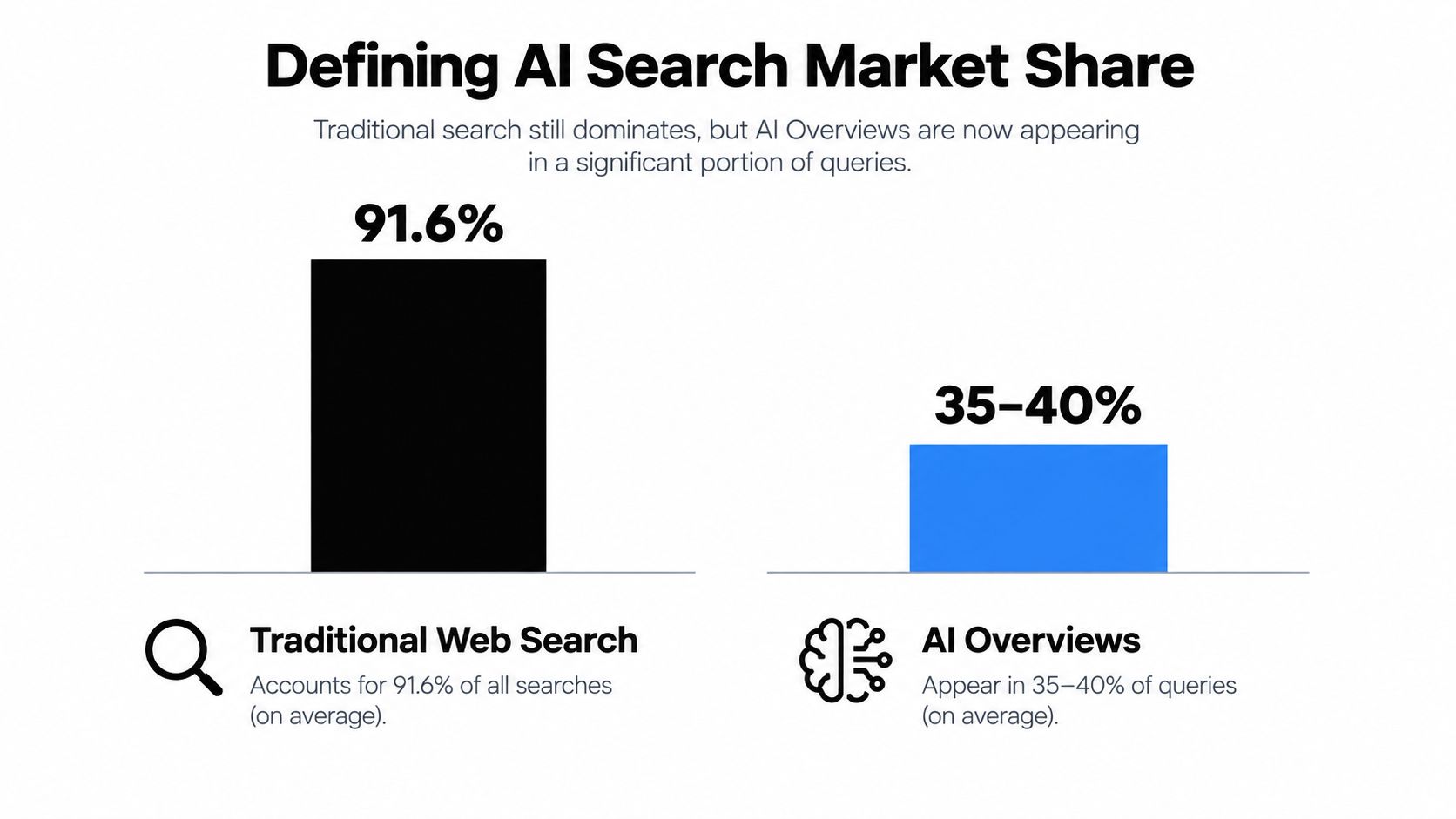
The distinction between market size and visibility share is central. Google's query share describes the scale of a search surface. A brand's share of voice describes how often it appears for a defined set of buyer prompts. A citation rate describes how frequently an assistant uses or references a source. A referral share describes the traffic that leaves the assistant and reaches a website. A company can perform well on one measure and poorly on another.
Two connected search systems
The practical model is a layered ecosystem:
- Traditional search: Search engines retrieve and rank pages, with Google remaining the dominant classic search surface in the available data.
- Conversational search: Assistants synthesize responses from retrieved or learned information and may cite, summarize, or recommend companies without generating a click.
- Brand visibility: A company's presence depends on whether its pages and external references are discoverable, understandable, and credible in both environments.
This is why teams should protect their organic foundations while building answer-engine readiness. Clear page structure, consistent product descriptions, useful comparison content, and credible third-party mentions can support both search inclusion and assistant citation. The work overlaps with SEO, but the reporting needs to distinguish rankings from appearances in generated answers. For a deeper treatment of how visibility differs from overall category size, see share of market versus share of voice.
The most useful definition depends on the decision being made. If leadership is deciding where users spend time, platform traffic share may help. If marketing is evaluating pipeline influence, referral share and assisted conversions matter more. If the content team is deciding what to improve, prompt-level citation and answer inclusion reveal the specific gaps.
The result is a simple operating principle. Never ask only, “Which AI search engine is largest?” Ask, “Largest by what measure, for which audience, and with what downstream consequence?”
Key Players in the AI Search Market
One 2026 aggregator analysis reported Google at approximately 90.39% worldwide in classic search, while placing ChatGPT at 79.08%, Perplexity at 7.67%, and Gemini at 7.03% in the AI chatbot category. These are secondary estimates from one analysis, not audited market data, and they describe different markets. Treating them as directly comparable would distort the competitive picture. (Perplexity AI Magazine market analysis)
Google therefore remains the dominant entry point for broad discovery. ChatGPT has greater influence over conversational research and recommendations within the reported chatbot figures. Perplexity's smaller share can still carry strategic value for users seeking answers with visible source context, while Gemini connects conversational discovery with Google's wider ecosystem. Raw usage identifies reach, but it does not show which provider creates citations, referrals, or commercial influence.
| Search layer | Leading platform in the available data | Reported share | Strategic role |
|---|---|---|---|
| Classic search | About 90.39% | Page discovery and ranked results | |
| AI chatbots | ChatGPT | 79.08% | Conversational research and recommendations |
| AI chatbots | Perplexity | 7.67% | Answer discovery with source context |
| AI chatbots | Gemini | 7.03% | Conversational discovery within Google's ecosystem |
Why platform roles matter more than rankings
A strong Google ranking does not guarantee inclusion in an assistant's response. A citation does not guarantee a visit either. Each outcome depends on a different retrieval and presentation system. Traditional SEO measures whether a page can rank for a query. AI visibility measures whether a provider includes the company, describes it accurately, and connects it with the relevant use case.
That distinction changes how teams interpret exposure. Resources examining the shift from ranked results to direct answers, including AI Frontiers' analysis of why Google ended the click, clarify why ranking position alone may not represent commercial value. An assistant can satisfy a question inside its interface, leaving a brand visible but receiving fewer source visits.
Provider-specific testing should reflect that reality. Run the same buyer-intent prompt across ChatGPT, Gemini, Perplexity, and the relevant Google search experience. Record brand inclusion, competitor visibility, cited sources, and factual accuracy. Compare these results with referral and conversion data rather than treating the largest platform as the automatic priority.
A consistent strategy keeps the factual foundation stable while adapting content to each provider's presentation format. An AI provider comparison can help structure that review. Final priorities should follow audience behavior, category intent, and the path from discovery to conversion.
Measuring Impact Beyond Raw Traffic Share
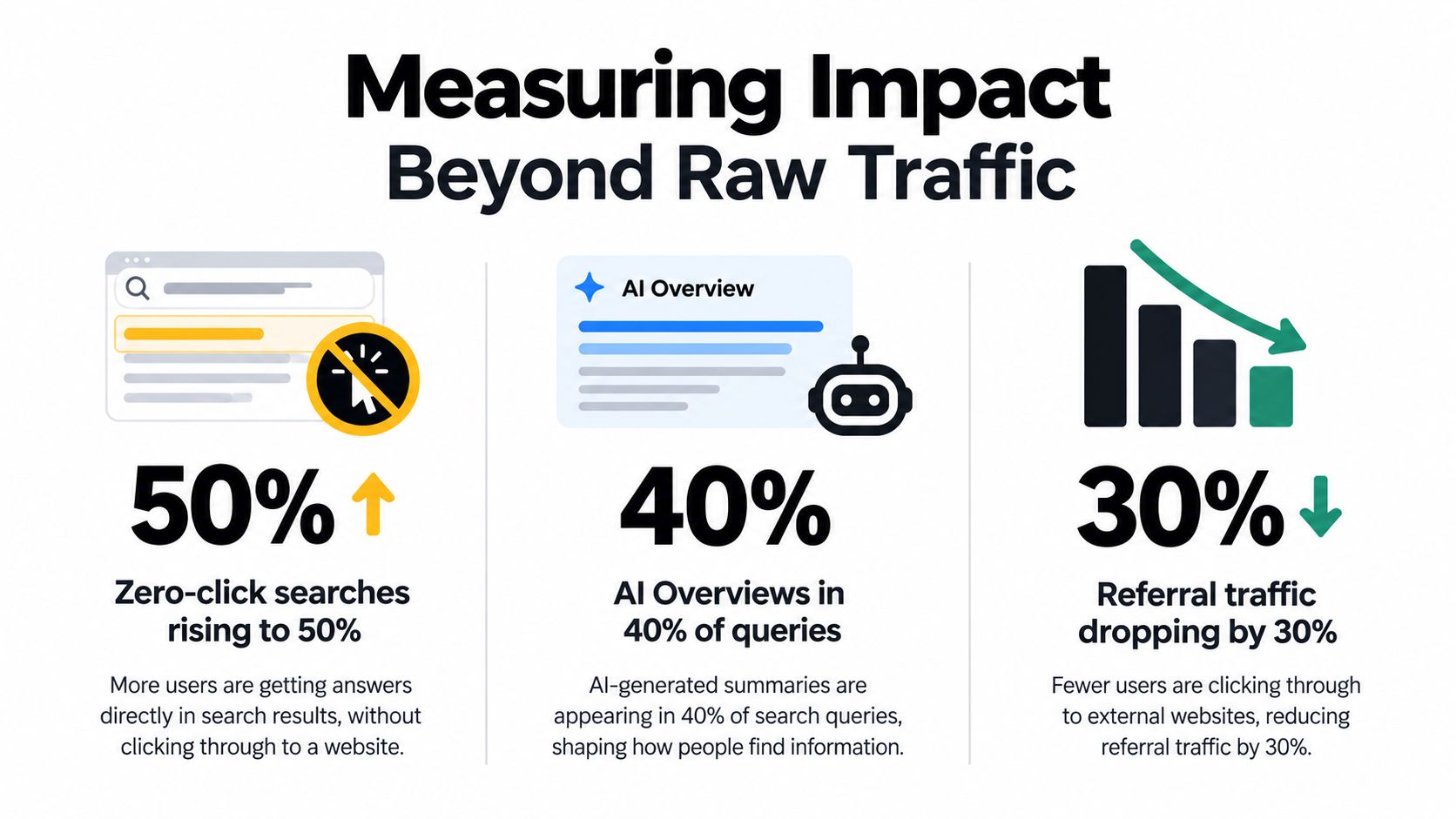
Raw traffic share answers a narrow question: where do users spend time? It doesn't answer whether those users leave the platform, cite your brand, or contribute to pipeline. That gap is one of the most important analytical problems in AI search.
An independent report estimated ChatGPT's AI search and chatbot share at roughly 59.7%. Yet a B2B referral analysis found that ChatGPT captured approximately 60.8% to 64.4% of measurable AI referrals, while Gemini represented 29.0% of visits but only 10.3% of normalized referral share. The divergence shows why platform traffic can overstate downstream influence. A large audience may remain inside the assistant, while a smaller or differently used platform may send a more meaningful portion of its activity to websites. (Omnius AI search and GEO report)
Three measures that shouldn't be combined
Treat these metrics as separate layers:
- Platform traffic share shows the relative size of an assistant's web audience.
- Citation or inclusion share shows how often your brand or content appears in generated answers for tracked prompts.
- Referral and conversion impact shows whether users reach your site and take meaningful action.
A dashboard that collapses all three into one “AI market share” number hides the decision you need to make. A traffic leader may deserve awareness investment, while a referral leader may deserve landing-page and conversion investment. A citation leader may deserve content and reputation investment even if it sends few immediate sessions.
The platform with the largest audience isn't automatically the platform with the greatest commercial influence.
This is especially relevant for research-heavy categories. Assistants can summarize a company's positioning, compare it with alternatives, and shape the shortlist before a buyer visits any website. In that scenario, referral analytics will undercount influence because the assistant has already affected the decision. Direct traffic and branded demand may rise without a clean source attribution. That doesn't justify abandoning measurement. It means teams should combine referral data with prompt-level visibility, brand search behavior, assisted conversions, and sales feedback.
Build an impact-weighted scorecard
A useful scorecard begins with the buyer prompt, not the provider. For each tracked question, record:
- Whether your brand was mentioned.
- Whether the answer positioned you correctly.
- Which competitor appeared instead.
- Which source supported the answer.
- Whether the response included a link.
- Whether the resulting visit showed engagement or conversion intent.
Then segment results by platform and intent. Product comparisons, implementation questions, pricing research, and problem-definition prompts may produce different visibility patterns. The important result is not a universal leaderboard. It's a map of where your company is visible at commercially meaningful moments.
A conventional technical review still matters because assistants need accessible, coherent sources. Teams can use a 2026 SEO audit guide to identify foundational weaknesses, then extend the review into answer inclusion and citation quality. The strategic improvement comes from connecting those findings to outcomes rather than treating rankings as the endpoint.
For a practical measurement framework, how to measure AI search visibility offers a way to organize provider, prompt, citation, and outcome data. The principle is straightforward: optimize for the visibility that influences decisions, not merely the traffic that looks largest in a market-share chart.
Actionable Steps to Improve AI Visibility
AI visibility improves through a repeatable process tied to buyer decisions. Start with the questions buyers ask, identify the sources assistants rely on, then assign each gap an editorial, technical, or reputation task. Raw traffic share can show where attention sits, but citation and referral impact determine where optimization may create business value.
1. Create a buyer-intent prompt set
Build prompts around real decisions rather than only high-volume keywords. Include category questions, vendor comparisons, implementation concerns, alternatives, objections, and fit. Conversational users often describe needs as complete questions, so keyword volume alone can miss commercially important demand.
Group prompts by stage:
- Problem discovery: What solutions address the buyer's situation?
- Evaluation: Which products compare well for a defined need?
- Validation: Is a vendor credible, secure, compatible, or suitable?
- Conversion: What does implementation involve, and what should the buyer do next?
Run each prompt across the providers relevant to your market. Save the complete answer, not just the appearance of your brand. Wording can expose inaccurate positioning, outdated product information, missing differentiators, or competitor claims that your content has not answered.
2. Strengthen the sources assistants can interpret
Make important facts easy to retrieve and verify. Use descriptive headings, concise definitions, comparison tables, consistent product terminology, and links between related pages. Check that capabilities align across documentation, pricing pages, partner profiles, review sites, and other public references.
Citation guidance from Outrank can help teams assess visibility beyond conventional backlink acquisition. Owned content and external references serve different roles. An assistant may discover your company through a review, partner page, documentation source, or comparison article instead of the homepage, and those sources may influence citations or referrals even when they contribute little raw traffic.
3. Turn observations into a prioritized backlog
A missing citation does not automatically deserve immediate work. Rank gaps by three criteria:
- Commercial importance: Does the prompt influence vendor selection or conversion?
- Competitive pressure: Does a competitor appear where your brand should?
- Fixability: Can your team improve the source, structure, or supporting evidence?
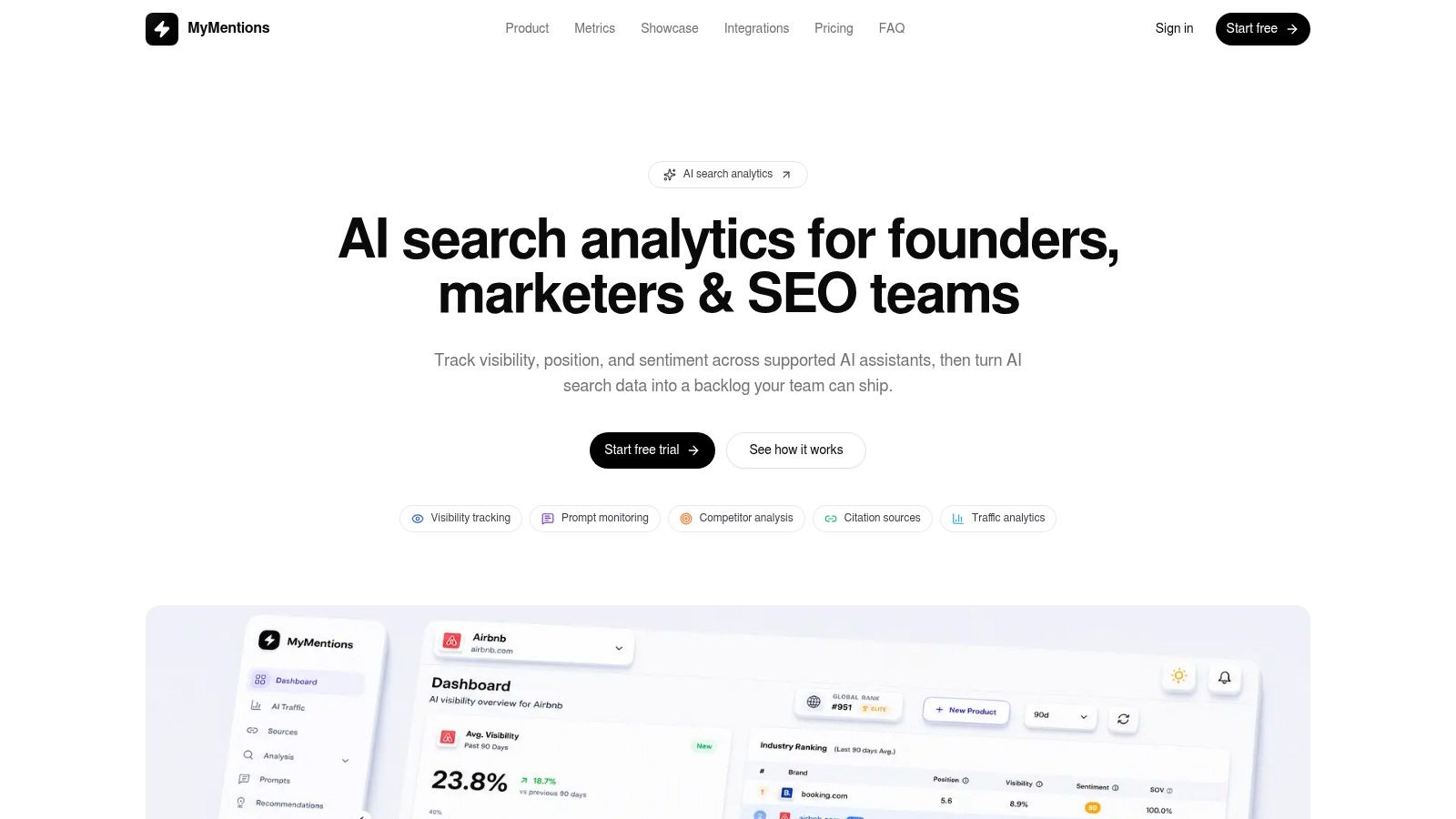
For a concrete framework on turning gaps into fixes, see how to improve product visibility. MyMentions can score each gap against commercial importance, competitive pressure, and fixability, turning prompt-level findings into a backlog of content, trust, UX, and technical improvements. Spreadsheets, analytics tools, or internal testing workflows can serve the same purpose if they preserve the connection between prompt, answer, source, and business outcome.
4. Recheck important prompts after changes
AI answers change as sources, products, and provider systems change. Re-run priority prompts after publishing a comparison page, updating product documentation, correcting a third-party listing, or launching a reputation campaign. Track inclusion, position, description, source selection, and referral behavior together, because a visibility gain without qualified action may have limited value.
The objective is accurate, consistent information that helps buyers decide. Different assistants may use different wording, but each should have enough reliable evidence to describe the product correctly and direct suitable users toward the next step.
Conclusion - Navigating the Future of Discovery
AI search is broadening while attention becomes less concentrated. As the introduction showed, an early leader can remain dominant while losing substantial relative ground as competing assistants gain adoption. That shift makes provider concentration a business risk, even when total AI search demand continues to grow.
A single-provider strategy may be efficient today, but it leaves a company exposed to changes in user behavior, integrations, ranking systems, and answer formats. A multi-platform strategy offers greater resilience when it is tied to outcomes rather than visibility alone. Appearing in more assistants has limited value if those systems describe the product inaccurately or fail to influence qualified buyers.
Volume is a starting point, not a verdict
Referral patterns reveal why raw market share is an incomplete measure. ChatGPT and Gemini showed meaningful differences between audience share, visits, and normalized referrals. Platform traffic can indicate reach, citations can indicate influence, and referrals or conversions can indicate measurable action. These signals answer different questions and should not be collapsed into one score.
The strongest measurement program connects them. It protects traditional search visibility because classic search remains a major discovery layer. It creates answer-ready content because assistants increasingly shape research. It monitors third-party sources because generated answers may draw on information beyond a company's website. Above all, it tests whether visibility changes what qualified buyers do next.
Build an adaptable visibility system
A useful measurement system exposes platform changes before they become revenue problems. Track a consistent set of buyer prompts, compare providers, monitor competitor appearances, inspect citation sources, and review referral quality. Assign each gap to the team best positioned to address it, whether that is SEO, content, product marketing, web development, customer education, or public relations.
The future of discovery will not have one permanent winner. It will reward companies that remain understandable and credible across the systems buyers use. Businesses focused only on raw volume may gain impressions without influence. Businesses that improve accurate inclusion, authoritative citations, and commercially relevant referrals can turn fragmented discovery into a durable advantage.
MyMentions helps founders, marketers, and SEO teams track whether AI assistants discover, rank, and describe their products across supported providers. Teams can create buyer-intent prompts, monitor visibility and sentiment, inspect citation sources, and turn provider-level gaps into practical fixes through MyMentions.