You're probably in one of two situations right now. Your company ranks well in Google, owns the obvious category terms, and still barely shows up when a buyer asks ChatGPT, Perplexity, Gemini, or Copilot for recommendations. Or you've started checking AI answers manually, and what you're seeing feels random enough that nobody on the team trusts the results.
That disconnect is why an AI search audit has become its own discipline. It isn't a lighter SEO audit with a new label. It's a sampling problem, a grounding problem, and a cross-engine comparison problem. If you treat it like rank tracking with chat screenshots, you'll miss the failure mode.
Teams also underestimate how weak baseline visibility still is. A large 2026 audit corpus reported that 63.8% of more than 1,000,000 scored website audits fell below 50/100 for AI search visibility, the average score was 43.2/100, and only 216 sites reached the “AI-Ready” threshold of 80 or above, according to SearchScore's 2026 AI search visibility data. Weak AI presence isn't an edge case. It's the default.
Table of Contents
- Why Your Brand Is Missing from AI Answers
- Building the Prompt Bank That Powers Your Audit
- Scoring Visibility Across Every Engine That Matters
- Citation Forensics and Source Quality Analysis
- Diagnosing the Four AI Visibility Failure Modes
- Turning Audit Findings into a Prioritized Fix Backlog
- Reporting Results and Setting Your Re-Audit Cadence
Why Your Brand Is Missing from AI Answers
A familiar scenario: a SaaS founder types “best customer onboarding platforms for mid-market SaaS” into ChatGPT and sees three competitors, none of them ranking above the founder's company in traditional search. Then they try Perplexity and get a different list. Then Google AI Overviews leaves them out again. At that point, the team usually assumes one of two things. Either the models are broken, or SEO no longer matters.
Neither is quite right.
Traditional SEO still matters, but it doesn't transfer cleanly into answer engines. Blue-link rankings reward one set of signals. AI assistants often work from a different chain of retrieval, chunking, citation selection, and answer assembly. A page can rank well in Google and still fail to become a trusted input for an AI-generated recommendation.
If you need a clean baseline on the discipline itself, MyMentions has a useful explainer on what AI visibility means in practice. It helps separate “we rank” from “the model mentions and cites us.”
The audit lens has to change
In a classic SEO review, you care about indexation, rankings, backlinks, internal links, and click paths. In an AI search audit, you're measuring whether the model includes your brand, how it describes you, which sources support that description, and whether the answer is even grounded well enough to trust.
That's why many service roundups now split AI visibility work from pure SEO consulting. If you're comparing operating models or want to see how specialists frame the category, AY Rank's list of AI visibility audit services is a useful reference point.
| Dimension | Classic SEO Audit | AI Search Audit |
|---|---|---|
| Primary output | Rankings and traffic opportunities | Mention, citation, and answer quality visibility |
| Unit of analysis | Page, keyword, SERP | Prompt, answer, citation set, engine |
| Success signal | Better rank position | Inclusion in answer with credible support |
| Competitor view | SERP overlap | Prompt-level co-mentions and source overlap |
| Trust assessment | Domain/page authority proxies | Grounding, freshness, authority, and source fit |
| Reporting cadence | Weekly or monthly rank changes | Repeated sampling across engines and prompt classes |
Why manual spot checks fail
One prompt tells you almost nothing. Prompt wording changes the answer shape. Engine choice changes the source set. Retrieval context changes whether your brand appears as a recommendation, a citation, both, or neither.
Practical rule: If your audit starts with “I asked ChatGPT once,” you don't have an audit yet. You have an anecdote.
A workable AI search audit tracks three layers separately:
- Presence: Does the brand appear at all?
- Placement: Where does it appear in the answer, if ordered?
- Proof: What source material supports that mention?
That structure turns a vague complaint, “AI ignores us,” into something diagnosable.
Building the Prompt Bank That Powers Your Audit
The prompt bank is where most audits fail. Teams either test the prompts they personally care about, or they test the easiest prompts to score. Neither reflects how buyers use AI assistants.
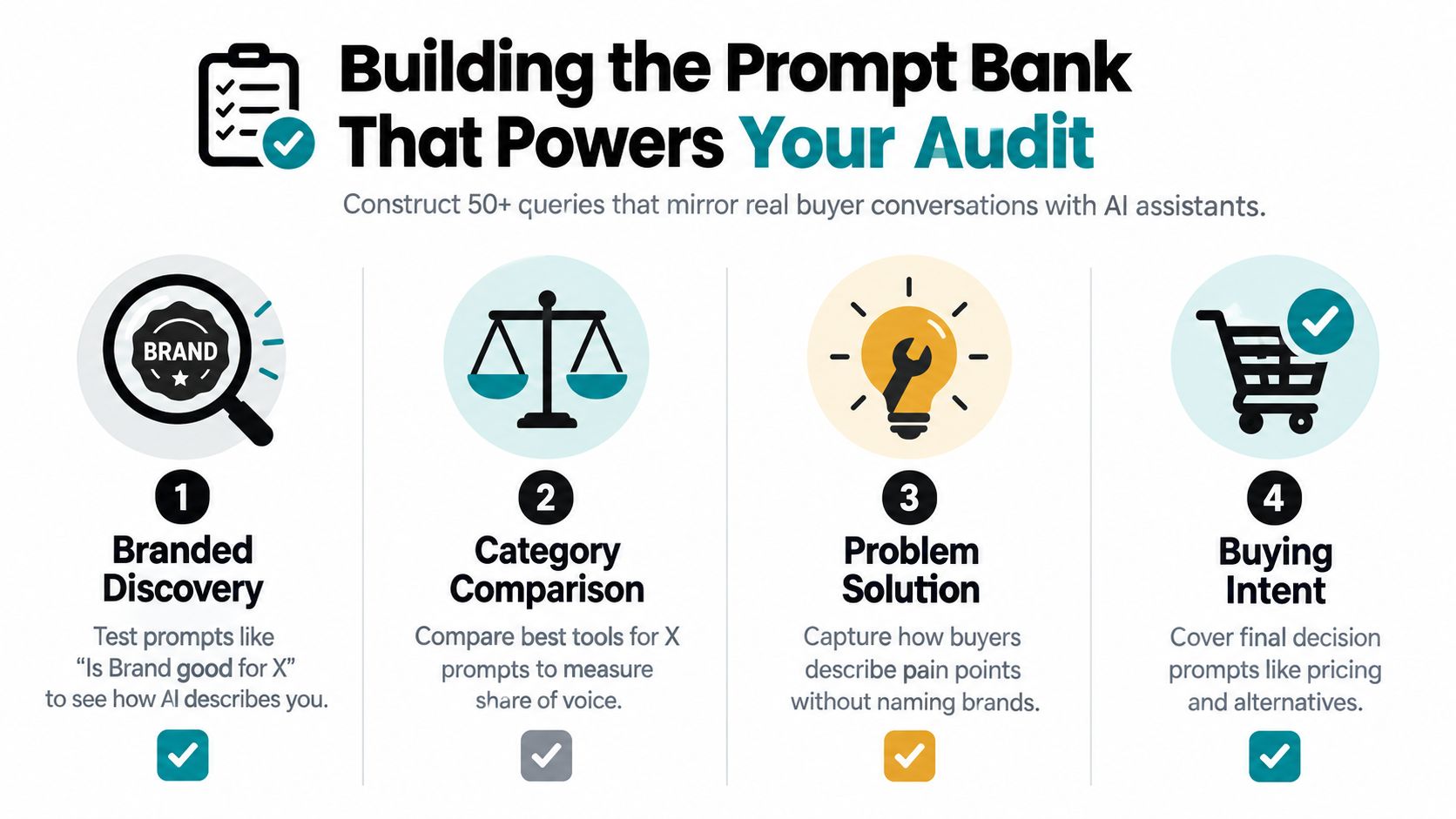
A better approach is to build a prompt set that mirrors real purchase conversations. The strongest benchmark in the research is methodological rather than tactical: one academic study audited Google's AI Overviews and featured snippets across 1,508 queries using browser agents from a fixed U.S. location, and a practical audit design should use 50+ queries spanning brand, category, comparison, and buyer-intent prompts across multiple assistants, according to the AI search audit methodology described in this academic study.
Start with a visual checklist so your team isn't improvising prompt classes.
The four prompt buckets that matter
Don't overcomplicate the first version. Build around four buckets:
Branded discovery
Prompts like “Is [Brand] good for enterprise SSO?” or “What does [Brand] do?” test how clearly the model understands your entity.Category selection
Think “best tools for SOC 2 automation” or “top employee onboarding software for distributed teams.” These prompts expose recommendation eligibility, not just brand awareness.Comparison prompts
“[Brand] vs [Competitor]” and “[Category tool A] alternatives” reveal where the model sees meaningful differentiation.Buyer-intent prompts
Use prompts such as “How do I choose a billing platform for usage-based pricing?” These often surface brands indirectly through problem framing.
The prompt writing itself matters. If your team defaults to short SEO-style phrases, you'll miss how buyers talk to LLMs. This guide on how to create effective AI prompts is a good companion for making those queries realistic and repeatable.
Control what you can
Most audit noise comes from uncontrolled variables, not from the model “being weird.” Set basic controls before you collect anything:
- Fix geography: Use a consistent location when the engine allows it.
- Track persona variants: A founder, RevOps lead, and security buyer won't ask the same question the same way.
- Document answer shape: Decide whether a pass means “mentioned anywhere,” “top three recommendation,” or “cited by name.”
- Log competitors expected: If a prompt should naturally surface three known vendors, record that expectation.
After the setup work, use a demonstration pass so the team sees what “good” capture looks like.
Single-prompt testing misleads teams because LLM output varies. A prompt bank gives you something much more useful: repeatable patterns. You stop arguing about screenshots and start seeing where your brand disappears by prompt class.
Scoring Visibility Across Every Engine That Matters
A common reporting mistake is collapsing all AI visibility into one score too early. That makes the slide cleaner, but it hides the actual operational issue. Cross-engine variance is often the story.
Recent guidance has started to reflect that reality. One 2026 checklist says the audit should cover at least four distinct engines with results tracked separately, and the same source notes a 2026 dataset claiming 71% of websites are not cited by AI systems, with only 0.12% labeled AI-ready, as summarized in G2's 2026 brand AI search audit checklist. Whether your own numbers are better or worse, the implication is clear: treating “AI search” as one channel blurs the problem.
Use a four-axis scoring rubric
For each prompt in each engine, score these four fields:
Rank position
If the answer lists options, where does your brand appear? First mention matters more than buried mention.Citation presence
Is your site cited? Are third-party sources cited? Is the model making claims without showing proof?Sentiment
Not just positive or negative. Note whether the framing is confident, cautious, dismissive, or generic.Confidence and hedge language
Phrases like “may be,” “often considered,” or “depending on use case” can signal weak support or ambiguous retrieval.
If you need tooling ideas for this layer, it's worth reviewing how different products handle tracking and exports. AutoSEO has a practical roundup to compare AI tracking tools, especially if you're deciding between spreadsheets, custom scripts, and dedicated platforms.
Worked example by engine
A prompt like “best project management tool for remote engineering teams” can produce very different outcomes across systems. That's why I prefer a per-engine sheet over a blended visibility number at the diagnostic stage. Teams using a dedicated tracker such as an LLM rank tracker workflow can automate part of this, but the rubric still needs human review.
| Engine | Rank Position | Citation Present | Sentiment | Confidence/Hedge |
|---|---|---|---|---|
| ChatGPT | Third mention | Yes, mixed owned and third-party | Positive but broad | Moderate hedge |
| Perplexity | First mention | Yes, source list visible | Positive and specific | Lower hedge |
| Google AI Overviews | Absent | Competitors cited instead | Neutral by omission | Not applicable |
| Claude | Mentioned without clear ordering | Limited citation clarity | Ambiguous | Higher hedge |
Treat each engine like a separate distribution channel. If your brand performs well in Perplexity and disappears in Google AI Overviews, averaging the result only makes the diagnosis worse.
Don't let one index hide the gap
Executives usually want one number. Give it to them later. During diagnosis, keep the engine-level split intact. Different assistants rely on different retrieval habits, source preferences, and answer styles. Your fix backlog should map to those patterns, not to an abstract blended score.
The output I want from this phase is simple: for each engine, which prompt classes are strong, unstable, or missing entirely.
Citation Forensics and Source Quality Analysis
Visibility alone can fool you. A brand mention with weak evidence is often worse than no mention, because the answer sounds authoritative while relying on thin support.
Citation forensics matters. In verifiability research on generative search, 51.5% of generated sentences were fully supported by citations on average, while 74.5% of citations correctly supported the sentence they were attached to. System-level recall ranged from 11.1% to 68.7% and precision from 63.6% to 89.5%, which is why citation presence by itself is not enough, as summarized in this overview of verifiability in generative search engines.
Read the answer like a ledger
For each answer, pull every cited URL and classify it across a few dimensions:
| Citation Attribute | Scoring Question | Pass Threshold |
|---|---|---|
| Grounding | Are the key claims tied to visible supporting sources? | Most material claims are supportable |
| Freshness | Are the cited sources current enough for the topic? | Sources are recent or still valid |
| Ownership mix | Is the answer relying only on your site, or also on earned mentions? | Includes credible third-party support |
| Topical fit | Do cited pages actually match the prompt context? | Sources align with the buyer question |
| Citation accuracy | Do the linked sources support the claim being made? | Claim and source materially match |
The mistake I see most often is overvaluing any citation from a prestigious domain, even when it doesn't support the exact claim in the answer. A review site mention about your pricing doesn't help much if the prompt is about implementation speed for healthcare teams.
What to flag immediately
Use a simple pass/fail lens first. Then go deeper.
- Competitor appears, your domain missing: The model knows the category but doesn't trust your pages enough to cite them.
- Your brand mentioned, no source shown: The answer may be pattern-matching from training or weak retrieval.
- Old comparison content dominates: The model is reaching stale pages because your current material isn't structurally clear or independently cited.
If you need a more systematic process for comparing source support and reliability, this breakdown of citation analysis for AI search engines is a practical reference.
A citation list is not a trust signal by itself. What matters is whether the cited source actually proves the sentence the model just wrote.
Forensics work is slower than visibility scoring, but it prevents the worst optimization mistake in this space: improving mention rate without improving answer quality.
Diagnosing the Four AI Visibility Failure Modes
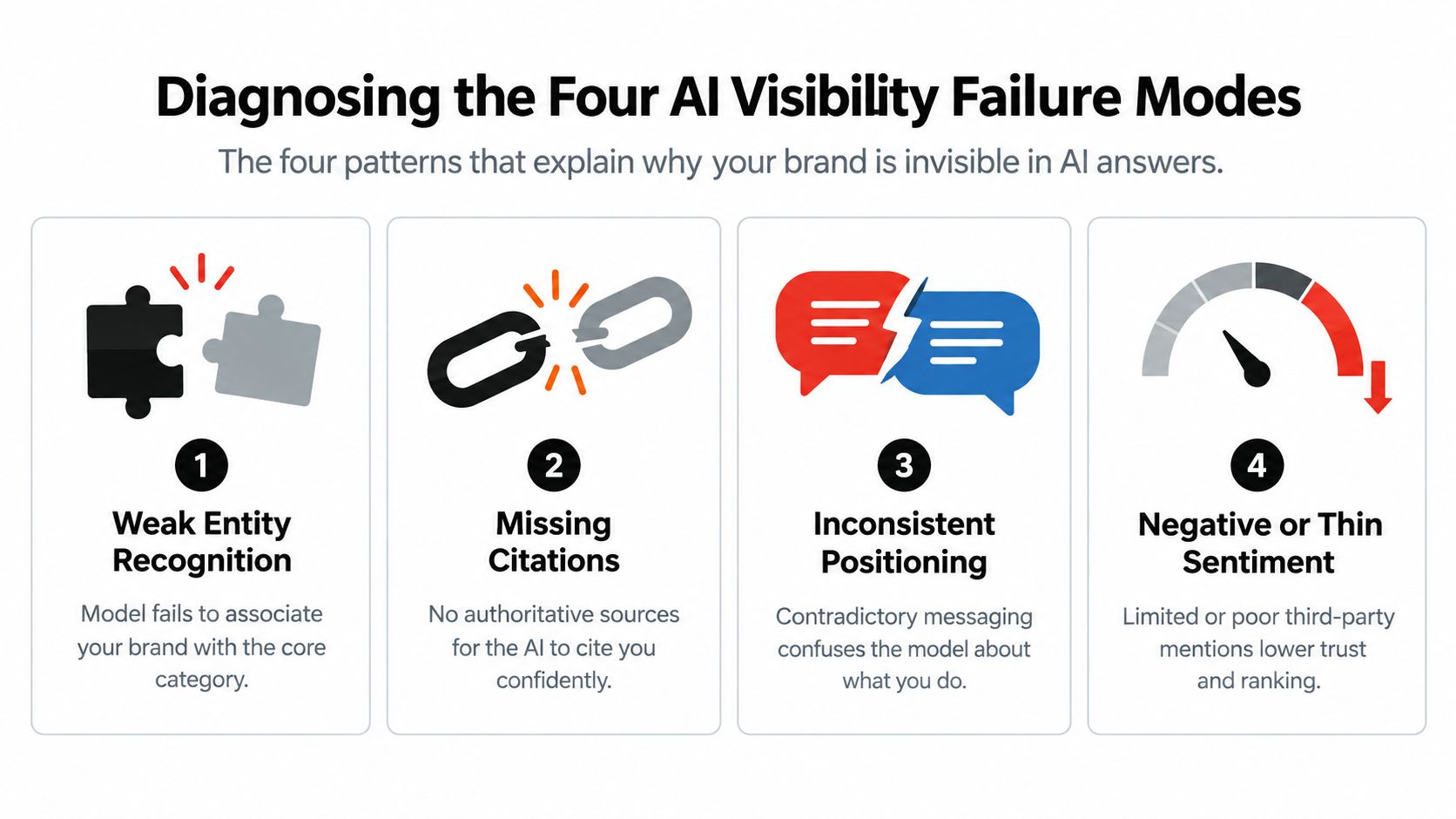
Most brands don't have a mysterious AI problem. They have one of four recurring failures, sometimes two at once.
Independent findings from 50+ AI visibility audits say the biggest failure modes are absent entity recognition, missing trusted third-party citations, inconsistent brand signals, and topical authority gaps, according to AI Search Engineers' published findings. Those patterns line up closely with what shows up in hands-on audits.
Weak entity recognition
This looks like an SEO relevance problem at first. It usually isn't.
The model knows your homepage exists, but it doesn't cleanly connect your brand to the category buyers ask about. That happens when product naming is inconsistent, category language shifts across the site, or your brand gets discussed online without a stable description.
A company says “revenue operations workspace” on one page, “sales planning platform” on another, and “forecasting software” in paid campaigns. A search engine can still rank those pages. A model deciding whether to recommend the brand gets less confident.
Missing third-party citations
This is one of the sharpest differences from classic SEO. You can rank with a strong site and modest external validation. AI answers often become much less willing to recommend you if nobody else appears to validate your claims.
Review platforms, partner pages, analyst mentions, implementation guides, and industry writeups often matter more here than teams expect. Not because every mention is magical, but because the assistant needs corroboration it can reuse.
Thin or inconsistent brand signals
This is the failure mode that product marketing usually owns, even if SEO discovers it first.
The model wants concrete signals. What do you do? Who are you for? What are the pricing boundaries, use cases, implementation constraints, proof points, leadership signals, trust markers, and alternatives? If those details are buried, contradictory, or missing, the assistant hedges or skips you.
Many “AI visibility” problems are really messaging problems that happened to become measurable through AI answers.
Inadequate topical authority
Some content programs still cover keywords without covering the surrounding decision context. They publish listicles and landing pages but skip the semantic neighborhood around integrations, security, migration, team fit, implementation patterns, and buyer objections.
That creates a shallow retrieval footprint. The brand may rank for a narrow term and still lose recommendation share on broader buyer-intent prompts.
The useful diagnostic move is to map each failure mode to its real cause, not to the nearest SEO analogy. Otherwise teams keep applying fixes that improve rankings while leaving AI answer visibility flat.
Turning Audit Findings into a Prioritized Fix Backlog
A good audit usually leaves teams with 20 to 40 possible fixes. Only a few of them change recommendation rate, citation quality, or answer accuracy in the next cycle. The job here is not to collect ideas. It is to choose the fixes that change how models retrieve, interpret, and trust your brand across engines that behave differently.
I group the backlog by owner, but I rank it by failure pattern. That distinction matters. If ChatGPT misses the brand because category language is inconsistent, and Perplexity cites competitors because third-party proof is thin, those are separate problems even if both show up as "low visibility" in the audit sheet.
Prioritize by failure mode, not by department
Use three working buckets so execution does not stall in one team:
- Technical: crawl access, rendering, schema, page structure, blocked assets, and pages that hide key facts below clutter
- Content: category pages, comparison pages, use-case pages, implementation docs, FAQs, and claim support
- Trust: reviews, analyst mentions, partner references, expert bylines, customer evidence, and other third-party citations assistants can reuse
That bucket system is for delivery. Prioritization comes from a simpler question: which fix increases eligibility across the largest share of your prompt bank?
Teams that want less manual prompt logging often use MyMentions to track prompt-level visibility, competitor mentions, citations, and sentiment in one workspace, then convert the findings into a working backlog.
Score fixes with enough rigor to make trade-offs
Keep the model simple. Fancy scoring creates false confidence and tends to reward whatever is easiest to quantify.
| Finding | Bucket | Impact (1-5) | Confidence (1-5) | Effort (1-5) | Priority | Owner |
|---|---|---|---|---|---|---|
| Brand category language is inconsistent across core pages | Content | 5 | 4 | 2 | High | Product marketing |
| Comparison prompts cite competitor reviews but not your domain | Trust | 4 | 4 | 3 | Medium-high | PR or brand |
| Key product pages lack answer-friendly structure and supporting FAQs | Technical | 4 | 3 | 3 | Medium | Content and SEO |
I usually score backlog items on three inputs:
Impact
Will this improve performance across multiple prompt types or only one narrow query set? Cross-engine wins deserve more weight than single-engine quirks.Confidence
Did the audit surface the issue repeatedly across runs, prompts, or engines? Repeated citation gaps and repeated grounding failures get high confidence. One odd answer does not.Effort
How much coordination does the fix require across product marketing, SEO, docs, PR, or engineering? Effort matters, but it should not dominate the list just because a title tag is easier to change than a weak proof layer.
That keeps teams out of a common trap. They clear ten low-effort tasks, report progress, and see no change in AI answer presence because none of those tasks improved grounding.
Sequence fixes in the order models need them
The shipping order is usually more important than the exact score.
Start with entity clarity and page structure. If your site does not state what the product is, who it serves, how it differs, and what claims can be supported, assistants have little stable material to extract.
Then fix decision-stage content gaps. Comparison pages, implementation guidance, buyer FAQs, and objections content give models answerable material for commercial prompts. For teams revising those assets, this guide to AI content optimization is a useful reference.
After that, invest in corroboration. Third-party reviews, partner references, independent mentions, and customer proof tend to matter more after the on-site story is coherent. If you chase mentions before tightening the source material, you often create citations that point back to a vague or contradictory brand narrative.
Build backlog items that can actually ship
Avoid backlog entries like "improve authority" or "optimize for AI." They create meetings, not output.
Write tasks at the page or asset level:
- Rewrite homepage and core product pages to align category language, ICP, and proof points
- Add comparison sections for named alternatives that repeatedly appear in audit prompts
- Expand implementation and security documentation for prompts where assistants hedge
- Create citation-ready proof blocks with customer evidence, pricing boundaries, and integration details
- Secure third-party mentions that validate the exact claims models are trying to answer
Good backlog items name the page, the missing evidence, the owner, and the prompt class they are meant to fix.
One more practical note. Traditional SEO habits can mislead teams here. A page can rank, get traffic, and still fail in AI answers because it does not provide extractable claims, clear product framing, or corroborated evidence. Prioritize the fixes that improve retrieval and grounding first. Those are the changes that tend to move visibility across engines instead of inside one reporting tool.
Reporting Results and Setting Your Re-Audit Cadence
The last mile is reporting. Most AI audit decks fail here because they either drown executives in prompt logs or oversimplify the findings into a vanity score.
Use a one-pager that ties visibility movement to shipped changes. Leadership doesn't need every screenshot. They need to know whether recommendation presence is improving, whether answer quality is getting safer, and which fixes changed the pattern.
A useful reality check comes from a 2026 independent analysis of 201 AI audits. 38 audits, or 18.9%, returned errors because the agent was likely blocked or couldn't reliably access the content. Among the 163 successfully processed audits, the average score was 61.6, the median was 66, 70.6% landed in “Inconsistent visibility,” only 4.9% reached “Strong foundation,” and 0% achieved “Exceptional.” Median subscores were 92 for structure, but 48 for authority and evidence and 45 for freshness, according to Search Engine Land's analysis of AI audit findings. That split is useful because it mirrors what many teams see internally: structure improves first, trust and freshness lag.
The metrics worth putting in front of leadership
| Metric | What It Shows | Reporting Frequency | Owner |
|---|---|---|---|
| Share of voice across prompt bank | How often the brand appears across tracked buyer prompts | Monthly | Growth or SEO |
| Grounding quality index | Whether mentions are supported by credible, relevant sources | Monthly | SEO and content |
| AI-attributed pipeline direction | Whether AI discovery is producing qualified visits and self-reported influence | Monthly or quarterly | Demand gen and ops |
| New gains, defended positions, losses | Which prompts improved, held, or declined after changes shipped | Monthly | Growth lead |
| Top citation sources | Which domains shape the model's view of the brand | Monthly | SEO, PR, product marketing |
Use a ninety-day loop
A tight re-audit cadence works better than continuous panic-checking.
- Weeks 1 and 2: refresh the prompt bank, re-run sampling, and capture outputs by engine
- Week 3: score answers, diff against the previous cycle, and isolate the biggest changes
- Week 4: ship the next fix set with clear owners
Then repeat.
Re-audit on a schedule, not on emotion. Engine behavior changes fast enough that ad hoc checking creates false alarms and wasted work.
Guardrails that keep reports honest
A few rules save teams from bad interpretation:
- Separate platform shifts from brand shifts: if multiple competitors move at once, the engine may have changed behavior.
- Don't over-credit one fix: if five things shipped between audits, report contribution carefully.
- Keep screenshots, but don't report from screenshots: the sheet is the source of truth, not the prettiest example.
The compounding value of an AI search audit comes from pattern recognition. Once the team sees which prompts, engines, and citation types consistently drive inclusion, the work stops feeling fuzzy. It starts looking like a real operating system for AI discovery.
MyMentions helps teams run this workflow without stitching together prompts, screenshots, citation logs, and reporting by hand. It tracks prompt-level visibility, position, sentiment, and cited sources across major AI assistants so you can spot cross-engine gaps and turn them into a fix backlog your team can ship. If you want to make your next AI search audit less manual, visit MyMentions.