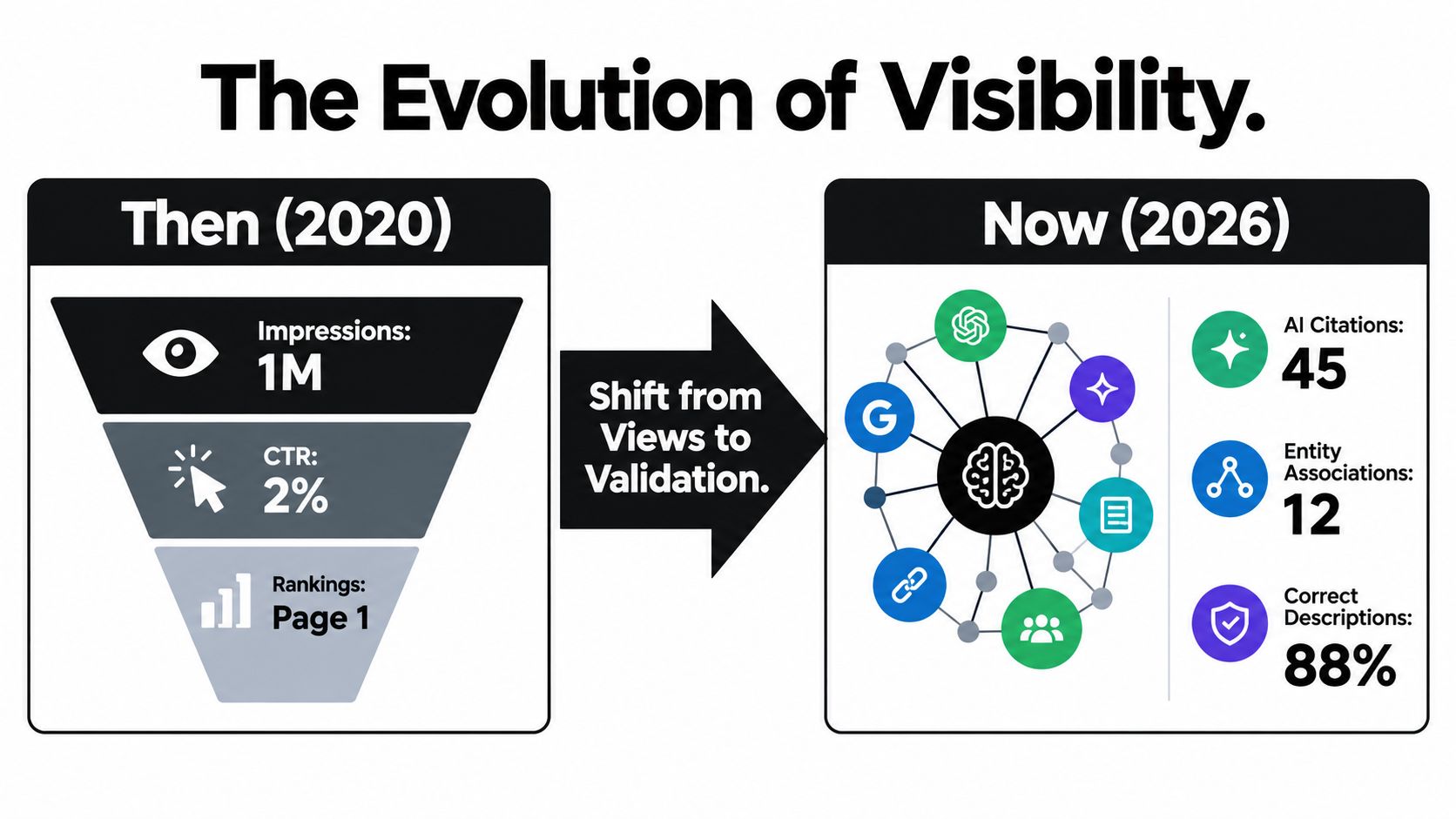
More impressions won't fix a brand that AI assistants can't identify, explain, or recommend. A founder can watch rankings hold steady while buyers increasingly ask ChatGPT, Gemini, Perplexity, or Google's AI Overviews to compare vendors without visiting a traditional result. The visibility question is no longer only, “How often do we appear?” It's “When a buyer asks for a recommendation, does the system name us, describe us accurately, and cite credible sources about us?”
That shift changes the work. Search still matters, social proof still matters, and consistent branding still matters. But they now feed a broader visibility system in which trust, entity clarity, citation frequency, and assisted conversions matter more than a dashboard full of impressions.
Table of Contents
- Why Brand Visibility Is Not What It Used to Be
- Run a Visibility Audit Before You Spend Another Dollar
- Prioritize the Buyer-Intent Prompts That Actually Matter
- Upgrade Content and Trust Signals So AI and Search Both Pick You Up
- Search Visibility vs AI Visibility and Where to Invest
- Measure What Changed and Iterate Without Drowning in Data
- Your 90-Day Brand Visibility Plan You Can Start Monday
Why Brand Visibility Is Not What It Used to Be
The popular definition of visibility is too narrow. It treats impressions, clicks, and blue-link rankings as the whole game. Those metrics describe exposure on a page, but they don't tell you whether an assistant has included your company in the shortlist a buyer receives.
Recent industry data reports that zero-click searches on Google increased from 56% to 69% between May 2024 and May 2025, meaning roughly seven in ten searches ended without a site visit. The same research reports that 50% of marketers saw organic traffic decline after AI Overviews launched, while 11% saw an increase. This analysis of AI search statistics captures the uncomfortable result: visibility and traffic can move in opposite directions.
The recommended entity matters more than the top result
Traditional search presents a ranked set of pages. An AI assistant synthesizes information, chooses which entities fit the request, and may cite only a subset of the sources it used. That means a page can rank well for a keyword yet fail to shape the answer a buyer receives.
AI visibility is therefore the frequency and prominence of accurate brand mentions inside generated answers, not just a ranking position. A useful introduction to AI visibility makes this distinction clear: the brand must be present in the answer layer, not just discoverable somewhere behind it.
Trust determines which brands survive that filtering. A Morning Consult benchmark covering 100 major brands found that the average brand was trusted by 59% of consumers and distrusted by 13%. The benchmark and its implications for brand visibility show why repeated exposure alone isn't enough. Buyers notice brands more readily when consistent messaging, proof points, third-party validation, and recognizable presentation support the name.
Operating premise: Visibility is no longer just being seen. It's being selected, described correctly, and supported by sources an assistant considers credible.
This premise changes every downstream decision. Your audit should log citations, not only rankings. Your content should answer prompts in extractable language, not merely target keywords. Your reporting should connect mentions to consideration and pipeline, even when no click occurs.
Run a Visibility Audit Before You Spend Another Dollar
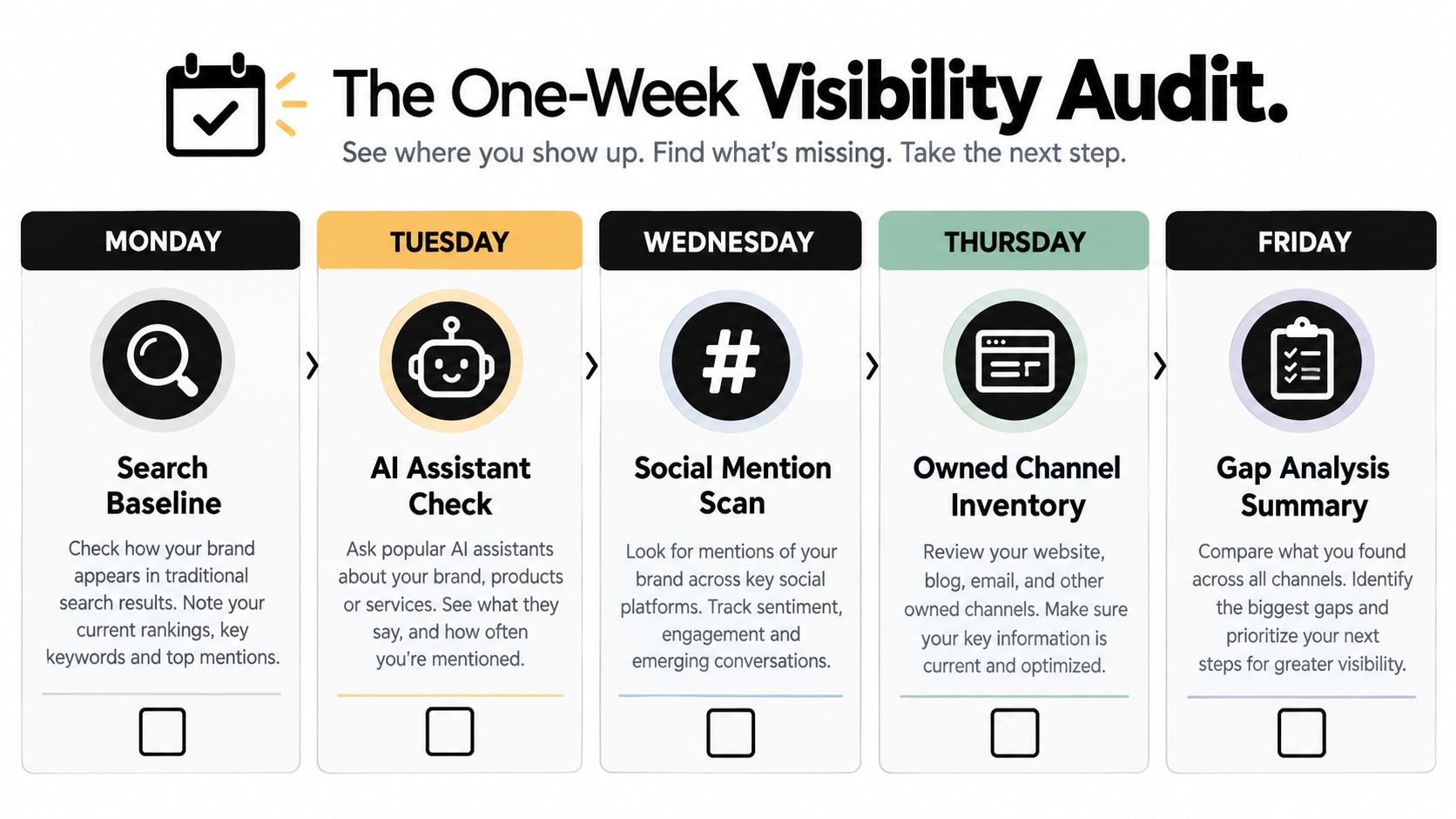
Don't commission another awareness campaign until you know where buyers encounter your brand and where the answer layer omits it. A focused work week is enough to create a useful baseline across search, assistants, social channels, and owned content.
Monday and Tuesday establish the baseline
Start with Google Search Console and your analytics platform. Export branded queries, clicks, impressions, branded landing pages, direct traffic, referral traffic, and conversions. Compare the current direction with your own previous periods, but avoid inventing a single blended visibility score. Search Console tells you how people find the site, while analytics helps you see whether brand demand reaches meaningful actions.
On Tuesday, create a fixed prompt set. Use 20 to 30 buyer-intent prompts across ChatGPT, Gemini, Perplexity, and Google AI Overviews, then run the same wording in each environment. Include queries such as:
- “What are the best [category] tools for a [specific company type]?”
- “Compare [your brand] with [competitor] for [use case].”
- “What should a [buyer role] look for when choosing [category] software?”
- “Which [category] platforms integrate with [relevant system]?”
- “What are the drawbacks of [your category or product type]?”
Record whether your brand appears, its position in the answer, the description used, sentiment, cited sources, competing brands, and whether the answer contains a factual error.
Wednesday through Friday expose the gaps
Wednesday is for entity and mention discovery. Check whether your company has a coherent presence on Wikidata, Google's business knowledge surfaces, Wikipedia where editorially appropriate, LinkedIn, Crunchbase, relevant directories, review platforms, Reddit discussions, and industry publications. Don't create entries that aren't justified. Instead, look for conflicting names, outdated descriptions, missing founder information, and unsupported claims.
Thursday is an owned-channel inventory. List your product pages, documentation, changelog, pricing page, comparison pages, customer stories, About page, Contact page, and help content. Mark each asset as crawlable, current, internally linked, authored, and easy to quote. AI systems need clear facts, not a maze of navigation and vague marketing language.
Use a spreadsheet with these columns:
- Prompt and funnel stage: Capture the exact query and whether it signals education, comparison, evaluation, or purchase.
- Assistant and date: Record the platform, location if relevant, and run date.
- Brand result: Note appearance, position, description, sentiment, and factual accuracy.
- Citation evidence: Log every cited URL and classify it as owned, earned, review, community, or partner content.
- Gap and owner: Assign the missing proof, page, mention, or technical fix to one person.
- Next action and status: Turn the finding into a shippable task, not a vague recommendation.
Friday is for prioritization. Your output shouldn't be a polished report that disappears into a shared drive. It should become the backlog for prompt selection, content rewrites, trust improvements, and measurement.
For a more detailed operating process, use this AI visibility audit guide as a reference while you run the checks.
Prioritize the Buyer-Intent Prompts That Actually Matter
Search volume is a poor reason to create content. A generic prompt can attract attention while contributing nothing to a buying decision. Prioritize questions that reveal a real commercial problem, distinguish between vendors, or ask for a recommendation with constraints.
Score each prompt against five criteria. Use a 1 to 5 scale for every criterion, then calculate a simple total. For competitive density, a high score should mean the prompt is difficult because many credible brands already appear. For current citation status, a high score should mean the prompt is strategically important but your brand is absent or poorly represented.
The five-part scoring model
Revenue proximity asks whether the prompt sits close to a demo, trial, purchase, or renewal decision. Specificity measures whether the question names a role, use case, integration, market, or constraint. Current citation status captures the urgency of your absence or inaccurate description. Competitive density shows how crowded the answer set is. Content gap measures whether you have a credible, structured source that directly answers the question.
A hypothetical CRM company could rank its prompts like this:
| Prompt | Revenue Proximity (1-5) | Prompt Specificity (1-5) | Current Citation Status (1-5) | Competitive Density (1-5) | Content Gap (1-5) | Priority Score |
|---|---|---|---|---|---|---|
| “What CRM is best for a sales team replacing spreadsheets and needing Slack integration?” | 5 | 5 | 5 | 4 | 5 | 24 |
| “Compare [CRM] with [competitor] for a small B2B sales team.” | 5 | 4 | 4 | 5 | 4 | 22 |
| “What is CRM software?” | 2 | 1 | 2 | 3 | 2 | 10 |
The first prompt wins because it combines purchase intent, a defined audience, a concrete pain point, and an integration requirement. The second is also valuable, but competitive density makes differentiation harder. The third may support education, yet its low specificity means it shouldn't displace the commercial prompts, regardless of potential search demand.
Map each high-priority prompt to the page that should influence it. A comparison prompt may need a transparent comparison page, an integration prompt may need a technical guide and product documentation, and a replacement prompt may need a migration page with proof. Then map each prompt to the assistant surfaces where buyers ask it and monitor the exact wording over time.
The practical method for creating effective AI prompts is to preserve the buyer's constraints rather than flattening them into a broad keyword.
Priority rule: If a prompt has low specificity, deprioritize it even when its apparent audience is large.
Upgrade Content and Trust Signals So AI and Search Both Pick You Up
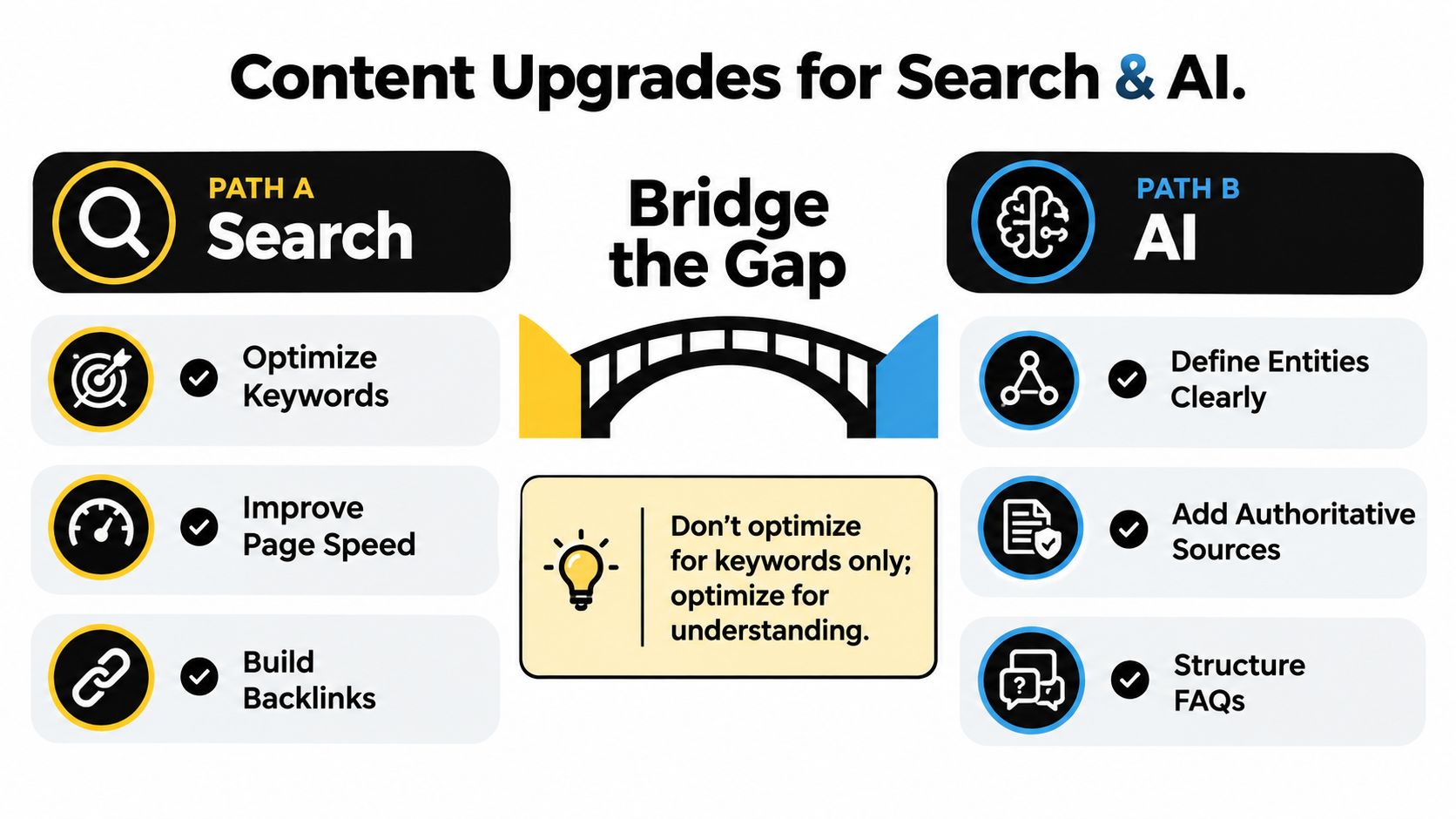
Many teams optimize a page around a keyword, publish it, and wait. That approach misses the evidence layer. Assistants need to understand who you are, what you sell, who it serves, and why an independent source should validate the claim.
Start with signals an early-stage company can ship without a major rebrand:
- Author identity: Put a real author name, role, relevant experience, and profile link on every substantive article.
- Operator transparency: Build an About page that names the people responsible for the product and explains the company's focus.
- Editorial accountability: Publish an editorial policy covering research, updates, corrections, and commercial relationships.
- Commercial clarity: Make pricing, packaging, eligibility, limitations, and contact paths easy to find.
- Independent proof: Earn accurate mentions on review platforms, comparison sites, relevant Reddit discussions, partner pages, and industry publications.
- Machine-readable identity: Use Organization, Article, Product, and FAQ schema where each type accurately describes the page.
Rewrite pages for extraction, not just optimization
Put the direct answer in the first 60 words of a pillar page. Then use descriptive headings, concise paragraphs, tables, definitions, examples, and clearly scoped FAQs. Each answer should stand on its own so an assistant can quote it without losing the subject or the conditions around the claim.
A thin product page might say:
“Our platform helps modern teams work smarter with powerful automation and flexible collaboration.”
That sentence describes almost nothing. A citable version names the entity, user, job, and boundary:
“[Product] is a workflow platform for operations teams that need to route requests, assign approvals, and monitor completion across recurring processes. It supports [named capabilities], integrates with [named systems], and is designed for [defined customer profile]. It isn't intended for [clear limitation].”
The second version gives search engines and assistants concrete relationships. It also gives buyers enough information to challenge or verify the claim.
Third-party validation deserves its own editorial calendar. Don't ask partners to repeat slogans. Give them useful facts, transparent comparisons, implementation lessons, and customer evidence they can discuss independently. A practical guide to scaling content creation for 2026 can help a small team produce this material without turning every page into generic AI copy.
Ship this trust-signal checklist this sprint
- Add named authors and credentials to priority pages.
- Rewrite the About page around people, product scope, and market served.
- Publish an editorial policy and update dates.
- Add accurate schema that matches visible page content.
- Review every claim on pricing, integrations, security, and customer outcomes.
- Identify external pages that describe the brand incorrectly or not at all.
- Create a request list for honest reviews, partner mentions, and customer stories.
- Improve internal links from high-authority pages to the priority prompt pages.
The deeper approach to optimizing for AI search is simple: make the page easy for a buyer to trust and easy for a retrieval system to interpret.
Search Visibility vs AI Visibility and Where to Invest
Search and AI visibility are related, but they aren't interchangeable budget lines. Search tends to reward pages that earn rankings and clicks for defined queries. AI visibility rewards coherent entities, extractable answers, and a credible source network that assistants can use when composing recommendations.
| Dimension | Search Visibility | AI Visibility |
|---|---|---|
| Primary surface | Traditional search results and features | ChatGPT, Gemini, Perplexity, and AI Overviews |
| What it rewards | Relevance, technical quality, links, usability, and authority | Entity clarity, citation-worthy answers, consistency, and trusted references |
| Core KPI | Qualified organic clicks and conversions | Mentions, position, accurate descriptions, citations, and assisted pipeline |
| Buyer behavior | The user often clicks to investigate | The user may shortlist without visiting a result |
| Time to impact | Usually requires sustained publishing and authority building | Can shift when source coverage, structure, or prompt relevance changes |
| Maintenance burden | Refresh pages, technical health, links, and rankings | Monitor prompts, citations, descriptions, source changes, and platform differences |
Search remains the heavier investment when buyers compare features on websites, click into demos, or need detailed documentation before committing. AI should receive more attention when your audience asks assistants to shortlist vendors, interpret a category, or compare options before visiting company sites.
Local context also matters. The 2025 Edelman Trust Barometer special report found that trust in domestically headquartered brands exceeds trust in foreign counterparts by an average of 15 points globally, with gaps of 30 points in Germany and 29 points in Canada. Edelman's report on trust and brands supports a practical conclusion for international SaaS teams: don't export one message unchanged. Build local references, market-specific proof, and regionally relevant pages.
Use this resource split for the quarter:
- Pre-PMF: Put most content and PR effort into learning which buyer prompts matter, while keeping a deliberate search foundation.
- Early traction: Divide effort between pages that capture high-intent clicks and external sources that shape AI recommendations.
- Scaled: Maintain both funnels, but assign separate owners and dashboards so AI citations don't disappear inside SEO reporting.
The market-share context for AI search can help teams decide which assistant surfaces deserve monitoring rather than assuming one provider represents the entire market.
Measure What Changed and Iterate Without Drowning in Data
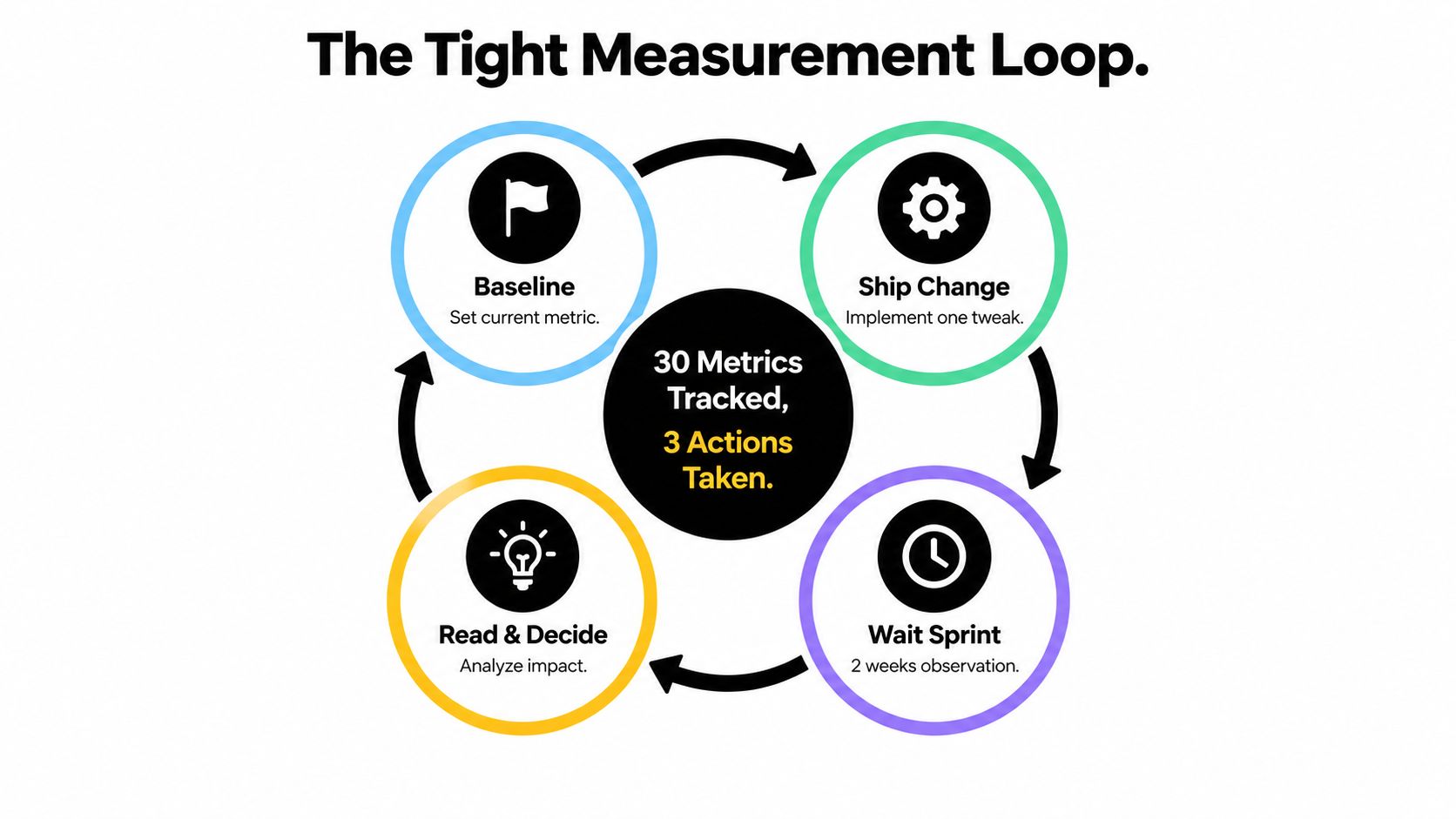
A visibility program fails when the team tracks everything and changes nothing. Use a tight loop: establish a baseline, ship one meaningful change, observe the next reporting cycle, then decide whether the change deserves more investment.
Track four numbers:
- Branded search volume: Use Search Console to monitor demand for your name, products, and distinctive features.
- AI share of voice: Run the 20 priority prompts across your selected assistants and record how often your brand appears relative to competitors.
- Cited-source referrals: Attribute visits from cited pages and assistant referrals where analytics can identify them.
- Assisted pipeline: Connect visibility pages and cited-source visits to opportunities, influenced accounts, and later conversions.
Keep the dashboard to one page in Looker Studio or Notion. The Monday review should show the baseline, current value, change, top winning prompts, missing citations, inaccurate descriptions, and the next action. If a metric doesn't alter a decision, remove it from the weekly view.
Use decision rules instead of dashboards for dashboards' sake
Keep working on a prompt when your description is accurate, citations are improving, and the prompt connects to a real buying stage. Change the target audience when a prompt attracts attention but produces no qualified conversations. Abandon a channel when repeated, credible activity fails to improve mentions, citations, referrals, or assisted deals.
A brand-health framework such as Crowbert's guide to key brand health metrics for teams can add context around perception and demand, but don't let broader measurement obscure this operating loop.
Measurement discipline: One shipped change and one clear decision beats a wall of charts.
If your answer share rises but direct traffic stays flat, don't automatically call the work a failure. Zero-click behavior means the assistant may have done part of the research before the buyer later returns through another path. Look for branded search, referral evidence, account engagement, and assisted pipeline before cutting a channel.
Your 90-Day Brand Visibility Plan You Can Start Monday
This plan turns the audit into a repeatable operating rhythm. Assign one owner for prompt monitoring, one for content and technical fixes, and one for external proof. A founder can own prioritization without personally performing every task.
Days 1 to 7
Run the audit across search, assistants, social, reviews, and owned content. Establish the initial state for branded demand, priority-prompt share of voice, citation frequency, description accuracy, and trust-signal gaps. Exit this phase when every important finding has an owner, a source, and a next action.
Days 8 to 30
Select the top 10 buyer-intent prompts from the scoring model. Publish or rewrite the matching pages, then add direct answers, structured headings, accurate schema, author information, pricing clarity, and internal links. Begin outreach for relevant reviews, comparison coverage, partner references, and community discussions where your buyers already evaluate products.
Exit when each priority prompt has a dedicated source or a documented reason not to create one. Don't measure success by publishing volume. Measure whether the pages answer the prompt better than the material currently being cited.
Days 31 to 60
Strengthen the evidence layer. Update the About and Contact pages, add customer stories, request honest reviews, correct inconsistent third-party descriptions, and improve documentation and changelog crawlability. Start a weekly review of branded search, assistant mentions, citation sources, referral sessions, and assisted conversions.
Exit when the team can identify which sources influence each priority prompt and which factual gaps still prevent accurate recommendations.
Days 61 to 90
Double down on the two or three changes that moved the useful metrics. Keep the pages and external relationships that improve accurate mentions, qualified referrals, or assisted opportunities. Cut campaigns that generate exposure without stronger consideration or commercial evidence.
Document the winning prompt set, source categories, content templates, review process, and reporting cadence. At the end of the period, you should have a quarterly loop that starts with prompt research, moves through trust and content work, and ends with a decision based on buyer outcomes.
Start Monday with the audit, not another campaign. MyMentions tracks brand visibility, position, sentiment, prompt-level results, competitor share of voice, and the citation sources shaping AI answers, so you can turn assistant findings into a prioritized backlog. Visit MyMentions to evaluate where your brand is being cited, how it's being described, and which fixes deserve attention first.