AI search prompts now represent 28% of the size of search worldwide, while monthly AI sessions have reached 56% of search's size, according to Position Digital's 2026 AI search statistics compilation. That changes the optimization brief. You're not only trying to rank a page in a list of blue links. You're trying to become one of the sources an assistant selects, summarizes, and cites inside an answer.
The practical shift is from page visibility to citation visibility. AI systems need content they can retrieve, understand, verify, and quote without forcing a reader or model to reconstruct the point. That means evidence-rich passages, explicit source attribution, clear structure, and a credible presence beyond your own domain.
Table of Contents
- Why AI Search Changes How Visibility Works
- Build Your Prompt Inventory and Map Intent to Content
- Author Content and Metadata That AI Assistants Want to Cite
- Make Pages Machine Readable With Structured Data and Trust Signals
- Earn Citations Beyond Your Site in Reviews and Partner Pages
- Monitor Visibility and Turn Insights Into a Shipping Backlog
Why AI Search Changes How Visibility Works
Traditional SEO gives you a ranking position. AI search gives you a place, or no place, inside a synthesized response. The assistant may combine your product documentation, an independent review, a partner page, and a forum discussion into one answer. If your page is difficult to interpret or your claims lack support, the model can use the underlying idea without citing you, or choose a clearer third-party source instead.
The foundational Generative Engine Optimization research published in 2024 tested how content changes affect visibility in generative answers. Adding citations, quotations, and statistics produced the strongest gains, with reported improvements of 30–40% on a Position-Adjusted Word Count measure and 25–35% on a subjective impression measure versus baseline. The paper is available through the original GEO benchmark.
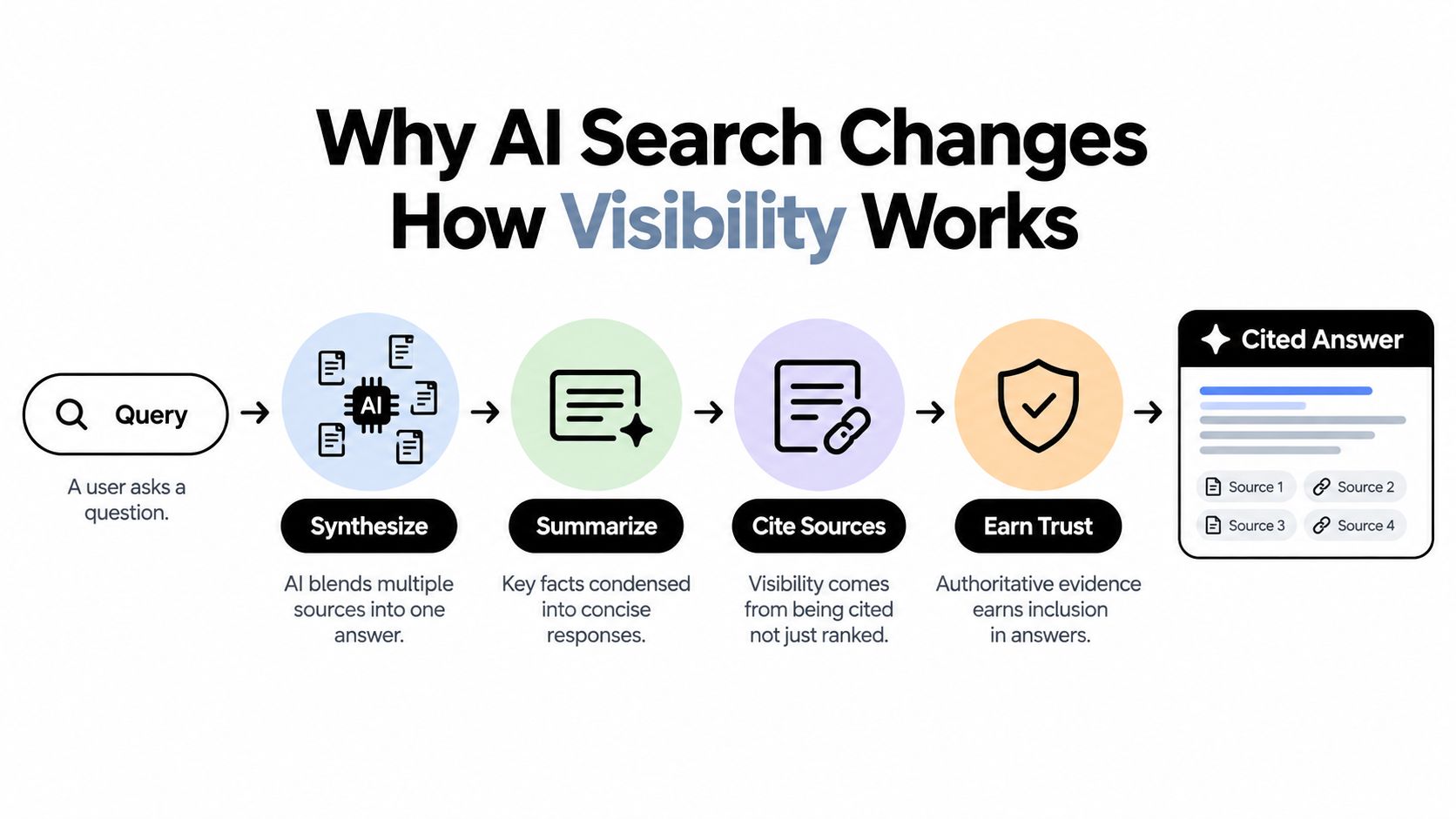
Ranking authority isn't citation authority
A large visibility analysis covering 21,767 domains found weak correlations between traditional authority metrics and AI visibility. Correlations for DR, DA, and DP ranged from –0.08 to –0.21, as documented in Search Atlas's LLM visibility correlation analysis. High authority can still help with discovery and trust, but it doesn't guarantee contextual inclusion.
That's the distinction many teams miss. A page can have strong backlinks and still fail to answer the exact prompt a buyer asks. Meanwhile, a smaller page with a precise definition, a transparent comparison, and a well-supported claim can become more useful to the retrieval system.
The benchmark also found that keyword stuffing performed worse than doing nothing, while quotations, statistics, and source citations improved visibility by up to about 40% across a 10,000-query test set, according to Peec's summary of the Princeton-led GEO research. The lesson is simple: don't write for keyword density. Write passages a model can safely lift into an answer.
Practical rule: Treat every important paragraph as a potential citation. State one clear claim, support it, and make the implication obvious.
For a broader commercial perspective on this shift, AI SEO for revenue-driven brands is a useful resource. You can also use this explanation of AI visibility to separate being mentioned by an assistant from merely having pages indexed.
Build Your Prompt Inventory and Map Intent to Content
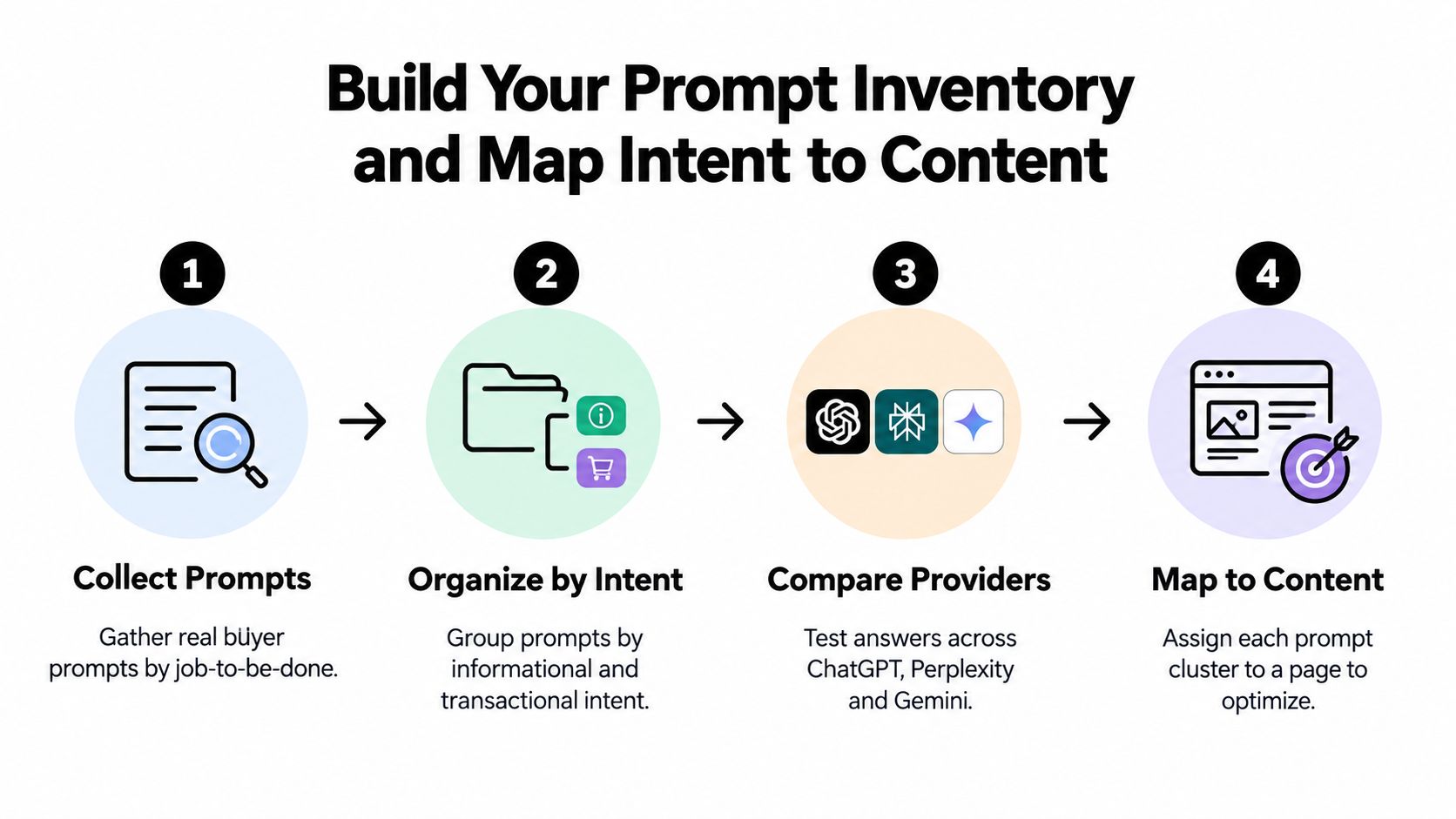
Keyword research starts with phrases. AI search optimization starts with complete buyer questions. A buyer might ask which tool is suitable for a regulated team, how two products compare, whether a platform integrates with a specific workflow, or what alternatives exist for a particular use case. Those prompts reveal the decision context that a keyword list usually strips away.
Collect prompts from real buying situations
Begin with the jobs your product helps someone complete. Pull language from sales calls, support tickets, product reviews, community conversations, customer interviews, and internal search logs. Ask each prompt in the language a buyer would use, not the language your marketing team prefers.
Build a working inventory with fields such as:
- Prompt: The complete question a user might enter into an assistant.
- Job to be done: The decision or task behind the question.
- Audience: The role, company type, or user context.
- Buying stage: Education, evaluation, comparison, implementation, or renewal.
- Desired answer: Definition, shortlist, recommendation, proof, instructions, or objection handling.
- Current coverage: The page, document, review, or external source that addresses it.
- Observed citations: The domains assistants mention when you test the prompt.
Keep prompts specific enough to produce a meaningful answer. “Best analytics software” is too broad to guide a page. “Which analytics platform helps a SaaS marketing team compare AI referral visibility across providers?” gives you a job, an audience, and a product category.
Organize by intent and decision risk
Cluster prompts by the answer the buyer needs. Informational prompts may ask for definitions or operating principles. Commercial prompts ask for recommendations and alternatives. Transactional prompts ask about pricing, implementation, compatibility, or next steps.
Then rank clusters by business value and citation gap, not by theoretical search volume. A prompt deserves early attention when it influences a purchase, competitors appear consistently, or the answer contains an inaccurate description of your product. A low-volume prompt can matter more than a broad category query if it comes from a high-fit buyer close to conversion.
Use a simple backlog label:
- Protect: The assistant already cites you, but the description or source is inaccurate.
- Win: Competitors are cited and your site contains relevant material that isn't being selected.
- Create: No owned or third-party source answers the prompt well.
- Deprioritize: The prompt is outside your audience or has little commercial relevance.
Test providers, then map the gaps
Run the same prompt across the assistants your customers use. Compare which brands appear, how they're described, what sources they cite, and whether the answer changes when you add context. Don't treat one provider's response as universal. Retrieval systems differ, and a page that surfaces for a research prompt may be absent from a recommendation prompt.
Map each prompt cluster to a single primary content destination, then list supporting assets. A comparison page may need product documentation, implementation guidance, customer proof, and independent reviews around it. This prevents the common mistake of publishing another generic article when the gap is a missing FAQ, unclear integration page, or weak third-party reference.
For practical guidance on writing inputs that produce useful testing results, see how to create effective AI prompts.
Author Content and Metadata That AI Assistants Want to Cite
Cite-worthy content answers the prompt before it tries to persuade the reader. Product pages often open with positioning language, broad benefits, and branded claims. Assistants need something more concrete: what the product is, who it serves, how it differs, and what evidence supports those statements.
Turn claims into extractable passages
A useful passage can stand alone when removed from the page. Start with a direct definition, follow with a distinction or supporting detail, and finish with an implication for the buyer.
Weak:
Our platform helps modern teams unlock better visibility and make smarter decisions across the customer journey.
Stronger:
MyMentions is an AI visibility analytics platform that tracks how assistants discover, position, and describe products across supported providers. Teams use prompt-level results and citation sources to identify content, trust, UX, and technical fixes.
The second version gives a model identifiable entities and relationships. It names the category, describes the function, and explains the operational use. Don't hide the answer beneath an introduction that could apply to any company.
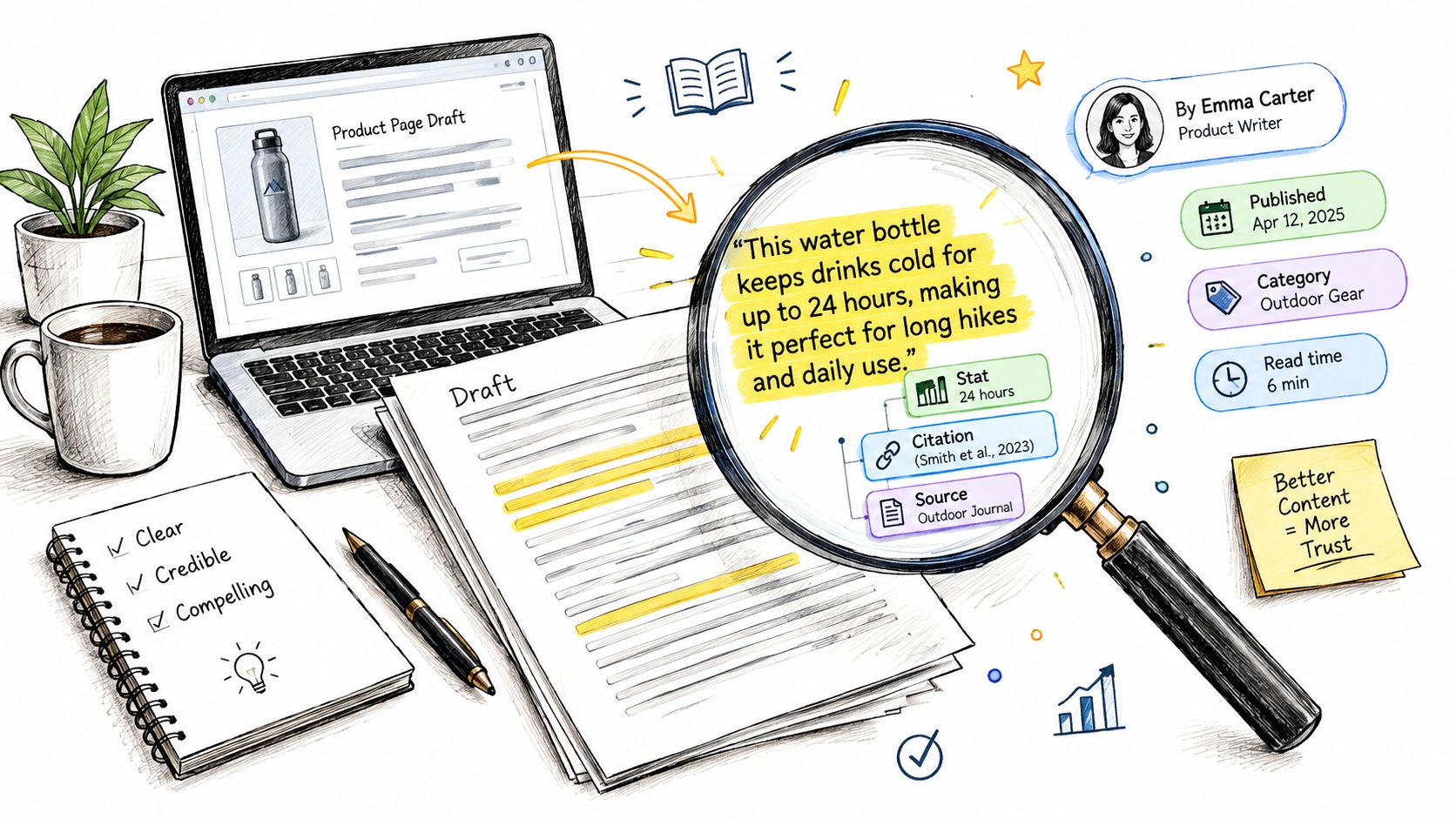
The GEO research supports this evidence-first approach. Citations, quotations, and statistics were the strongest tested content changes, while keyword stuffing underperformed. Use a statistic only when you can explain its source and relevance. An unsupported number creates risk rather than authority.
Add evidence where decisions happen
Build proof into the exact page that answers the prompt. If the prompt asks whether your product supports a workflow, explain the workflow and link to the relevant documentation. If it asks how you compare with alternatives, publish a transparent comparison with shared evaluation criteria. If it asks whether your claims are credible, identify the underlying source, date, scope, and limitations.
Quotations can help when they add a distinct perspective. Use a named expert, customer, analyst, or practitioner only when you have permission and can preserve the original wording. A quotation without context is decoration. A quotation with a clear speaker, role, and connection to the claim gives the assistant a usable evidence unit.
A practical content pattern looks like this:
- Definition: State what the product, category, or method means.
- Answer: Address the buyer's exact question in plain language.
- Evidence: Add a source, quotation, documented result, or specific product detail.
- Boundary: Explain where the recommendation doesn't apply.
- Action: Tell the reader what to compare, test, or do next.
Improve metadata without pretending it drives everything
Titles and meta descriptions still clarify page purpose, but they shouldn't carry the entire optimization strategy. Write a title that names the audience and decision. Use a meta description that summarizes the answer, not a string of repeated terms.
FAQs work best when they cover genuine objections or follow-up prompts. Don't create a long block of near-duplicate questions. Include questions about implementation, limitations, integrations, security, alternatives, and fit. Comparison blocks should use consistent criteria so both readers and machines can distinguish the products without interpreting marketing language.
For the source layer behind these practices, source attribution in AI search offers a focused explanation. The page itself should also show an author, relevant credentials, publication date, update date, and links to primary evidence where available.
Make Pages Machine Readable With Structured Data and Trust Signals
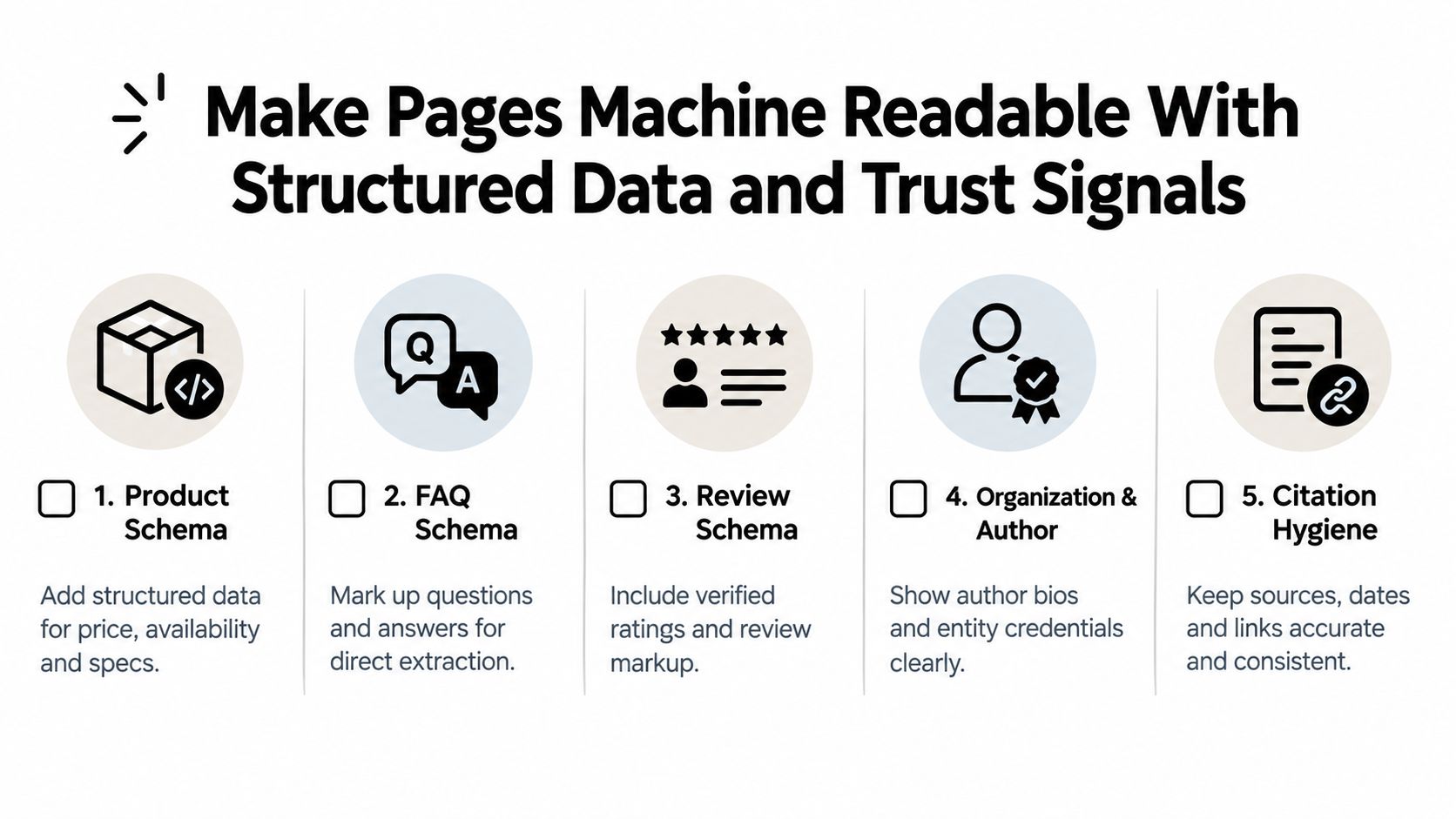
A page becomes easier to cite when its meaning is clear in both visible content and machine-readable signals. Structured data won't rescue vague copy, but it can reinforce what a page represents, which entities it describes, and how its answers relate to one another.
Treat markup as a verification layer
Use structured data that matches the page's actual content. Product pages can describe products, specifications, offers, and availability. FAQ markup can clarify genuine question-and-answer pairs. Article and Organization markup can connect a piece of content with its publisher and author.
The implementation should support, not contradict, the visible page. If the markup says a product is available while the page says it's unavailable, you've created ambiguity. If review markup appears without verifiable reviews on the page, it can weaken trust.
Make trust visible to people
Assistants can only use signals they can access. Put the important details in the page itself:
- Show ownership: Include a clear organization name, author byline, and relevant credentials.
- Explain evidence: Link claims to original sources and identify what each source supports.
- Expose limits: State integrations, exclusions, data boundaries, and known constraints.
- Maintain dates: Display publication and update information when freshness matters.
- Clarify commercial terms: Make pricing structure, availability, trial conditions, and implementation requirements easy to find.
- Use consistent entities: Keep product names, company descriptions, authors, and category language consistent across the site.
Remove extraction friction
Critical content shouldn't depend on a visual component that an assistant may struggle to interpret. Put key facts in semantic HTML, use descriptive headings, and keep tables readable on smaller screens. Check that important text isn't hidden behind an interaction, login wall, or client-side rendering requirement that prevents retrieval.
Internal links should create a clear path from broad explanations to detailed documentation, comparisons, and proof. A cite-worthy hub can organize the topic, while focused pages answer the supporting prompts. This helps users move through the content and gives retrieval systems a coherent set of related resources.
A page-level implementation checklist can include:
- Access: Confirm crawlers can retrieve the important content.
- Structure: Use logical headings, answer-first sections, lists, and tables.
- Markup: Add relevant Product, FAQ, Article, Organization, or Review structured data.
- Attribution: Identify authors, dates, sources, and evidence.
- Accuracy: Test links, claims, product details, and markup against the visible page.
- Usability: Make pricing, comparisons, limitations, and next steps easy to locate.
For product-specific technical guidance, review how to optimize a website for ChatGPT results. The target isn't to make a page look technical. It's to reduce the amount of interpretation required before an assistant can trust and cite it.
Earn Citations Beyond Your Site in Reviews and Partner Pages
Many AI visibility problems aren't caused by weak on-page copy. They're caused by a weak external citation ecosystem. Industry analysis and recent research point to earned media and third-party sources as important parts of the answer environment, while niche brands can face a “big brand bias” when assistants assemble recommendations. The research on big brand bias in generative search is relevant because it shifts attention from page edits to the sources models already use.
Compare the sources that shape answers
Audit the citations attached to your priority prompts. Look for recurring review sites, partner directories, community threads, industry publications, documentation portals, and comparison pages. Then ask whether those sources describe your product accurately, whether they include current information, and whether your competitors control the narrative.
| Source Type | Why AI Cites It | Priority Action |
|---|---|---|
| Independent reviews | They provide third-party evaluation, strengths, weaknesses, and use-case context | Identify accurate reviews and request factual updates without dictating conclusions |
| Partner pages | They connect your product to a known workflow, integration, or customer problem | Build co-marketing pages with clear implementation details and reciprocal context |
| Industry publications | They add editorial authority and category context | Pitch original analysis, expert commentary, and evidence-backed viewpoints |
| Community forums | They contain practical language and user experience | Answer relevant questions transparently, without repeating promotional copy |
| Comparison pages | They compress vendor differences into a decision format | Supply accurate product facts and monitor competitor claims |
| Help and documentation sites | They explain implementation and technical fit | Publish stable, detailed documentation that partners can reference |
Prioritize by influence and effort
Start with sources that appear frequently for valuable prompts and can be improved without compromising editorial independence. A factual correction on a highly cited partner page may be more useful than publishing another article on your own blog. A review that omits a core integration may deserve attention before a broad public-relations campaign.
Don't ask third parties to copy your positioning. Give them usable facts, access to product documentation, product experts for technical questions, and transparent limitations. Reviews become more credible when they include trade-offs. Community participation works when the answer solves the question first and mentions the product only where it fits.
External citation principle: Your site can define the facts, but independent sources often determine whether assistants treat those facts as credible.
Build a source map beside your prompt inventory. For every high-priority prompt, record the pages cited, the claim each page contributes, and the gap you can influence. That map turns off-site work from vague brand building into a practical citation program.
Monitor Visibility and Turn Insights Into a Shipping Backlog
AI visibility monitoring should answer more than “Did we appear?” A useful system shows which prompts produce mentions, where your product appears, how assistants describe it, which sources they cite, and what changed between runs. Track those observations across the providers that matter to your audience instead of treating one assistant as the market.
A 2026 survey reported that 45% of respondents were testing visibility across multiple AI platforms, while 58% weren't updating existing content to improve citation likelihood and 63% weren't mapping content, press, or campaigns to real audience prompts, according to Scrunch's AI search survey. The gap is operational. Teams can collect visibility data without turning it into shipped work.
Build a prompt-level operating loop
Create a dashboard or spreadsheet with these fields:
- Prompt and intent: What the buyer asked and what decision it represents.
- Provider: Which assistant produced the answer.
- Brand position: Whether you appeared and where.
- Description quality: Accurate, incomplete, outdated, or misleading.
- Citation source: Your page, a review, partner content, forum, or another source.
- Fix category: Content, trust, UX, technical, or external ecosystem.
- Owner and status: Who will ship the change and when it's ready for retesting.
Review the highest-value prompts on a consistent schedule. When your product disappears, don't immediately rewrite the target page. First check whether the prompt changed, a competitor gained a stronger source, your documentation became stale, or an external page now carries the answer.
Report movement without promising rankings
AI answers are probabilistic, so report directional movement and concrete changes rather than guaranteed positions. Connect assistant referrals to analytics where attribution is available, then compare visits and conversions with the cited prompt context. A visibility gain matters more when it reaches the right buyer and leads to a meaningful action.
AI search monitoring can help teams organize this measurement layer. Whether you use a dedicated platform or a manual process, the weekly rhythm should stay disciplined: test priority prompts, inspect citation sources, select a small set of fixes, ship them, and retest. Monthly reviews can then group the findings into product marketing, content, technical, and PR priorities.
The winning workflow isn't “publish more AI content.” It's observe, diagnose, fix, verify, and improve the sources assistants trust.
MyMentions tracks prompt-level visibility, position, sentiment, providers, and citation sources, then turns those findings into a backlog across content, trust, UX, and technical fixes. Visit MyMentions to compare how assistants describe your product, identify the external pages shaping those answers, and give your team specific fixes to ship.