AI visibility is the measurable rate at which a brand appears in AI-generated answers, either as a named mention or a linked citation. In Semrush's 2026 index, only 36 brands out of more than 1,200 tracked remained visible in the top-100 most-mentioned lists across every AI platform and every month.
The popular advice says AI visibility is SEO with a new label. That shortcut creates the wrong priorities. Traditional SEO asks where a page ranks among a list of links. AI search asks whether an assistant includes your brand in a synthesized answer, which source it cites, how it describes you, and whether it mentions you early enough for the user to remember.
That makes AI visibility a multi-surface discovery system, not a single ranking position. Your brand can be cited without being named, named without receiving a link, described positively in one model and ambiguously in another, or visible for one buyer prompt and absent for a closely related prompt.
Table of Contents
- Redefining Brand Discovery in AI Search
- How AI Assistants Discover and Surface Brands
- Key Signals and Metrics for AI Search
- Measuring AI Visibility and Tooling Approaches
- Practical Steps to Improve AI Visibility
- Prioritizing Fixes Across Content Trust UX and Technical
- Frequently Asked Questions About AI Visibility
Redefining Brand Discovery in AI Search
AI visibility can be defined as the rate at which a brand appears in AI-generated answers, usually through a named mention or linked citation, rather than a classic search ranking. That definition matters because the user experience has changed. Searchers once scanned competing headlines and chose a result. An AI assistant often synthesizes information into one response and may present only a small set of sources.
A page ranking on the first page of Google and a brand appearing in an AI answer are related outcomes, but they aren't interchangeable. A traditional ranking gives the user several options. An AI mention places the brand inside the answer itself, where wording, sentiment, and first-mention position influence perception before a click happens.
Practical rule: Treat “being present,” “being cited,” and “being remembered” as separate outcomes.
The distinction is visible in the data. One large analysis found that 74.9% of domains were cited as source links, while only 38.3% were mentioned by name in the answer text (AI Visible's analysis of brand mentions and citations). A page can therefore help an AI system construct an answer while leaving the brand invisible to the person reading it.
Why backlinks aren't the whole answer
Backlinks still support discoverability, authority, and conventional search performance. They just shouldn't become the entire AI visibility strategy. Ahrefs-reported correlations cited in recent coverage found that brand web mentions correlate about three times more strongly with AI Overview visibility than backlinks, while referring domains are weaker signals in that comparison (Topify's analysis of changing AI search visibility).
That doesn't mean teams should abandon technical SEO or link acquisition. It means the optimization target has expanded. Marketers need to manage:
- Answer presence, whether the brand appears in the generated response.
- Citation presence, whether the brand's page or domain is linked.
- Brand recall, whether the answer names the company clearly.
- Sentiment, whether the description is favorable, neutral, or negative.
- First-mention position, whether the brand appears early or gets buried.
- Platform consistency, whether the result holds across ChatGPT, Gemini, Perplexity, and Google AI Overviews.
This is why “SEO for AI” is too narrow. SEO remains part of the source-access layer, but AI visibility also depends on entity clarity, third-party validation, source mix, and the way content can be extracted and recombined.
How AI Assistants Discover and Surface Brands
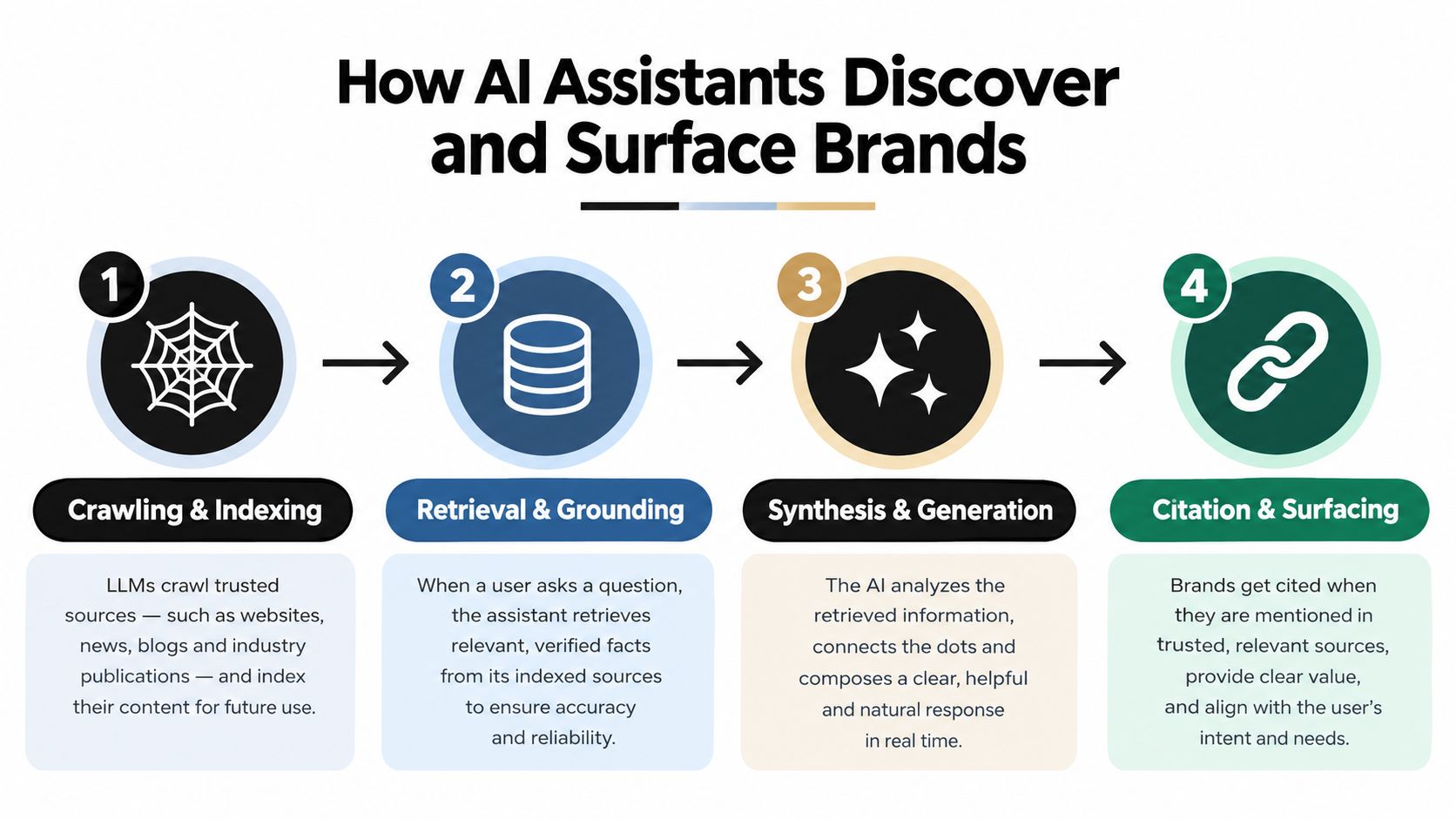
AI assistants generally move through a sequence of discovery, retrieval, grounding, synthesis, and surfacing. The exact workflow varies by product and query, but the operational question stays consistent: can the system find a credible source, understand what it says, and connect that information to the brand the user is asking about?
Retrieval is not the same as recall
A model may retrieve a product page, documentation article, or review to ground a factual statement. It may then produce an answer without naming the company. That is citation visibility without explicit brand visibility. The reverse can also happen. A familiar brand might be named from learned associations while the answer cites another source.
The distinction becomes more important when brand size varies. An academic study summarized by BrandMentions reported a three-tier visibility ladder in first-run AI answers:
- Global household names appeared in 73% of relevant answers.
- Established mid-market and regional brands appeared in 44%.
- Niche or small brands appeared in 11%.
Those figures come from the study discussed in BrandMentions' research on brand visibility across AI search engines. They show why a smaller company shouldn't interpret low initial visibility as a simple content-volume problem. Brand recognition and source credibility create a baseline advantage before a buyer ever asks a prompt.
The same research found that about 78% of citations went to corporate websites. Among non-corporate sources, YouTube led ahead of Reddit, editorial media, and Wikipedia. That source distribution creates a practical tension. Owned content often supplies the clearest product facts, while third-party sources can provide the validation an assistant uses to make a recommendation feel balanced.
Content structure changes what gets surfaced
AI systems don't need a page to look impressive. They need to identify a usable passage, understand its context, and connect it to the prompt. Clear headings, direct explanations, comparison language, product specifications, and well-defined question-and-answer sections make that extraction easier.
Ranked “best-of” listicles accounted for about 21% of citations in the same research frame. That doesn't mean every company should manufacture a self-serving listicle. It does mean that comparison and recommendation formats deserve serious attention, especially when buyers ask which tools, services, or products are suitable for a specific use case.
For a deeper distinction between conventional ranking logic and AI answer visibility, see this guide to AI ranking and discovery. The useful takeaway is simple: write pages that can stand alone when excerpted. A model shouldn't need several paragraphs of context to determine what your product does, who it's for, and how it differs from alternatives.
Key Signals and Metrics for AI Search
AI visibility is not one ranking position. A useful report separates brand mentions, cited sources, and the sentiment attached to each appearance. One score can hide a brand that is named often, a domain that supplies evidence without naming the company, or a product that appears with an inaccurate description.
Start with share of voice across prompts. Semrush's 2026 index uses share of voice across prompts to compare brands with competitors in a market (Semrush's AI Visibility Index). Track prompts tied to the buying journey, including education, recommendations, and comparisons. A brand may perform well in category explanations while disappearing when users ask which option fits a specific need.
Build a metric stack
Use connected measures rather than forcing every result into one number:
- Prompt coverage: The share of relevant tracked prompts where the brand appears.
- Mention rate: How often an answer names the brand directly.
- Citation rate: How often the assistant links to the brand's domain or a specific page.
- Share of voice: The brand's proportion of mentions compared with competitors across the same prompt set.
- First-mention position: Where the brand appears in the response, especially in recommendation answers.
- Sentiment and description: The language used to characterize the product, including strengths, limitations, and category associations.
- Source mix: The pages and domains influencing the answer, such as documentation, reviews, partner pages, YouTube, Reddit, or editorial coverage.
Keep citation frequency and mention rate separate. A domain can provide grounding evidence while the visible answer omits the brand name. Reporting should therefore include both a source eligibility metric and a brand recall metric.
Add context before reporting movement
AI output changes with prompt wording, provider behavior, retrieval freshness, geography, and model updates. Compare like with like. Preserve the wording, record the provider, save the response, and annotate meaningful changes to source pages or product positioning.
A negative mention needs investigation rather than an automatic red flag. The model may repeat an outdated review, confuse similarly named companies, or accurately reflect a weakness in public documentation. Identify the page behind the wording and assess whether the problem is factual, reputational, or caused by unclear source material.
Teams can use this guide to source attribution in AI answers to connect visible claims with the pages that influenced them. That source trail turns model volatility into a review queue: correct the originating page, strengthen missing evidence, and monitor whether the same issue appears across other providers.
Measuring AI Visibility and Tooling Approaches
Manual prompt testing works for an initial audit. It becomes difficult to manage when comparisons span competitors, providers, and repeated reporting. A reliable workflow turns real buyer questions into a monitored dataset, then evaluates visibility as a mix of mentions, citations, sentiment, and outcomes.
Create a prompt portfolio
Group prompts by intent, not keywords alone. Include category education, problem-solving, product discovery, alternatives, comparisons, implementation questions, and objections. Keep core wording stable for fair comparisons, while preserving variants that reflect natural language differences.
For every prompt, record:
- Provider and date, since ChatGPT, Gemini, Perplexity, and other systems can surface different sources.
- Brand presence, including a named mention, citation, both, or neither.
- Competitive position, including which alternatives appear first.
- Sentiment and wording, with claims that require correction.
- Citation sources, including the exact page or external domain.
- Business relevance, based on proximity to a purchase or conversion.
MyMentions can organize buyer-intent prompts, compare results across supported AI providers, and monitor visibility, position, sentiment, citations, competitors, and traffic attribution in one workspace. It can also alert teams when monitored results change, helping turn source gaps into a prioritized backlog. Teams choosing an AI visibility tracking tool should assess provider coverage, reporting needs, and the amount of prompt testing they can maintain. For a broader evaluation of reporting software, see this comparison of ranking tools for teams.
Connect visibility to outcomes
AI mentions do not automatically produce revenue. Track them alongside branded search, direct visits, assisted conversions, demo requests, and trial activity. Use consistent campaign tagging when links permit it, and ask “How did you hear about us?” in conversion forms or sales calls.
Attribution remains incomplete. A buyer may read an AI answer, remember the brand, and return through another channel. Report AI visibility with assisted and self-reported indicators instead of presenting a direct causal conversion path.
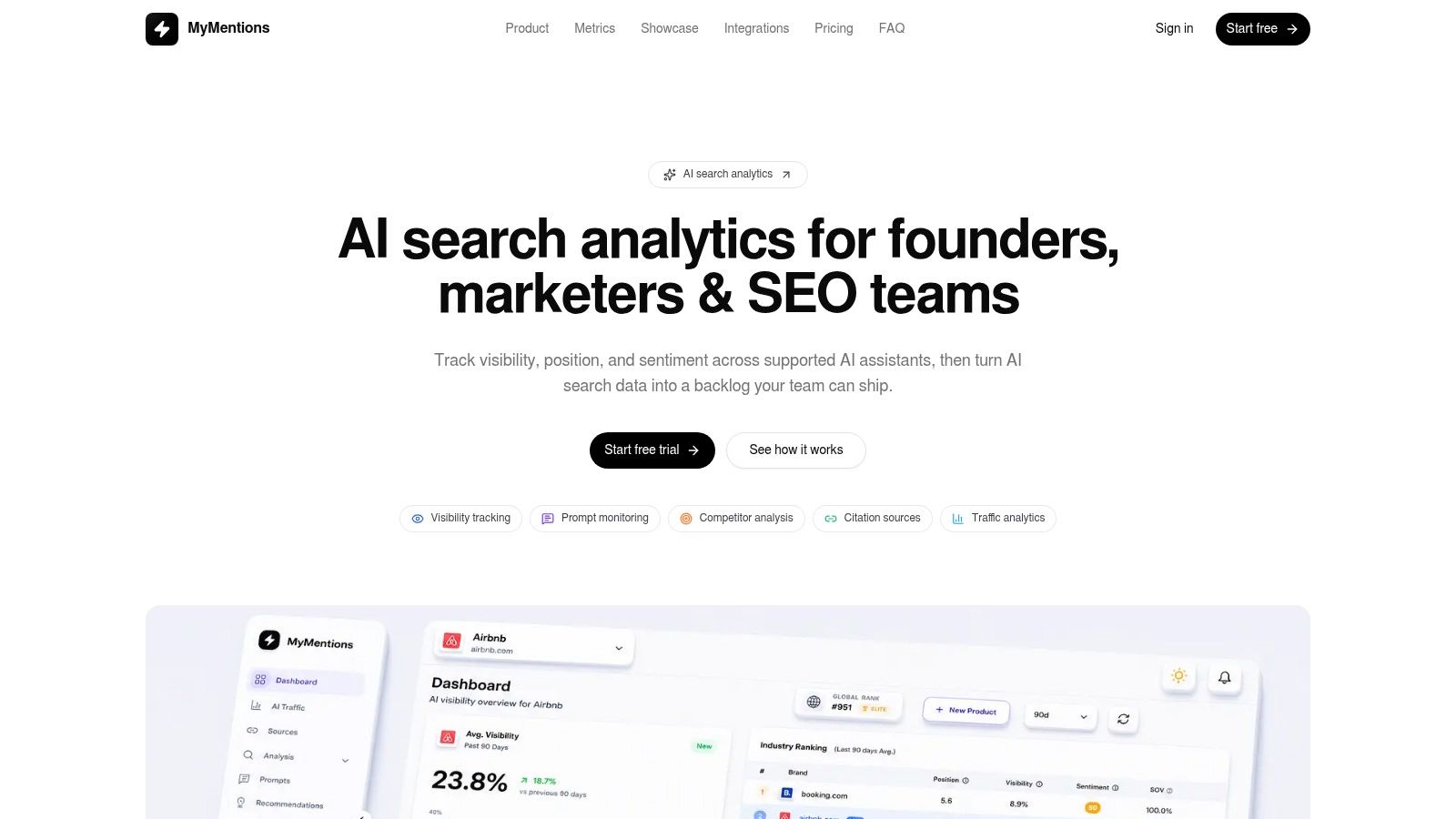
Build a weekly operating rhythm around changed prompts, lost citations, competitor gains, and pages that repeatedly influence answers. Review citation presence separately from brand recall. A domain may support an answer without the model naming the brand. The dashboard matters only when content, product marketing, PR, and SEO teams act on those findings.
Practical Steps to Improve AI Visibility
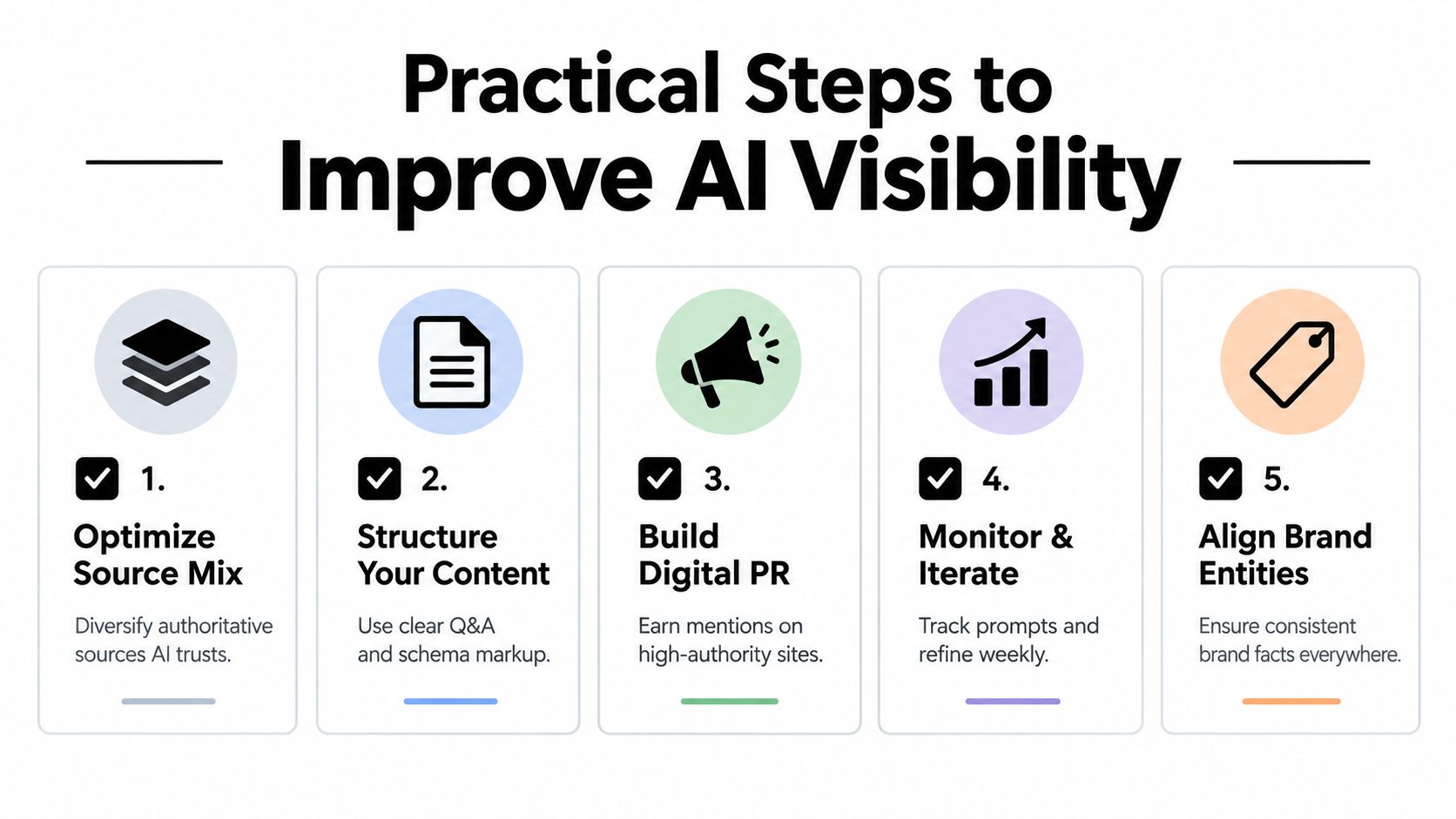
Improvement starts with source hygiene, not with publishing more pages. The objective is to make your brand's identity, claims, use cases, and proof consistent across the sources an AI assistant may retrieve.
Strengthen the source mix
Audit the pages that appear in answers, then classify them as owned, earned, partner, community, or directory sources. Corporate websites receive a substantial share of citations in the research discussed above, so product documentation, pricing explanations, comparison pages, and help content need to be easy to interpret. But owned pages shouldn't be your only asset.
Third-party reviews, editorial coverage, partner pages, YouTube demonstrations, and relevant Reddit discussions can provide context that a product page can't. You can't control every external description, but you can make sure your public facts are consistent enough that third parties have something accurate to reference.
Write for extraction and verification
Use direct answers near the top of a page, descriptive headings, concise definitions, and tables where comparisons help the reader. A “best-of” format can be valuable when it uses transparent criteria and includes real alternatives rather than disguising an advertisement as independent advice.
- Clarify the entity: Use one consistent brand name, product name, category, audience description, and set of core capabilities.
- Document the evidence: Support material claims with accessible documentation, customer proof, demonstrations, or independent coverage.
- Separate facts from positioning: State what the product does before explaining why it matters.
- Maintain the page: Remove obsolete features, outdated integrations, and ambiguous language that models may repeat.
- Earn validation: Give PR and partnerships a source list of accurate facts, expert contacts, and useful data rather than distributing generic promotional copy.
A practical step-by-step AI Overviews strategy can help teams translate these principles into page-level and technical actions. For broader guidance on making pages easier for AI systems to interpret, see this resource on AI content optimization.
Don't attempt to manufacture consensus. Manipulated listicles, fabricated awards, or repetitive self-published claims may create temporary surface visibility, but they weaken trust and can spread inaccurate descriptions. The durable approach is a coherent ecosystem where your own pages explain the product and independent sources confirm its relevance.
Prioritizing Fixes Across Content Trust UX and Technical
AI visibility backlogs grow quickly because every missing citation can look like a new content assignment. Resist that impulse. The highest-value fix depends on the reason the brand is absent, misrepresented, or cited without being named.
Diagnose the failure mode first
Use four lenses:
| Pillar | Typical problem | First practical fix |
|---|---|---|
| Content | The page doesn't answer the buyer's question clearly | Rewrite the opening, headings, comparisons, and product explanations |
| Trust | AI systems find the brand but rely on weak or conflicting validation | Improve reviews, editorial references, partner facts, and author transparency |
| UX | Important information is difficult for users and extractive systems to locate | Improve page structure, navigation, readability, and visible product details |
| Technical | Crawlers or rendering systems can't reliably access the source | Review crawl access, rendering, structured data, and indexing consistency |
Content is the right starting point when citations already point to your domain but the answer misstates your product. Trust deserves priority when competitors dominate recommendation prompts despite comparable product relevance. UX matters when users can reach the page but the key evidence is buried. Technical work comes first when important pages aren't accessible or their essential content depends on fragile rendering.
Make the backlog evidence-led
A useful ticket should name the prompt, the observed answer, the citation source, the desired correction, and the owner. “Improve AI visibility” isn't actionable. “Rewrite the integration page because three monitored prompts describe the feature using outdated terminology” is.
Score each fix by business relevance, frequency of the observed problem, confidence in the diagnosis, and implementation effort. Then ship a small set of changes, monitor the same prompts, and check whether the source mix changes. Don't interpret one fluctuating answer as proof that a page rewrite worked.
A structured AI visibility audit can help teams identify whether the bottleneck is content clarity, source credibility, experience, or access. The goal isn't to chase every model response. It is to remove recurring contradictions and make the most important brand facts easy to find, verify, and reuse.
Frequently Asked Questions About AI Visibility
Is AI visibility just SEO for AI?
SEO remains the foundation for accessible, relevant sources, but AI visibility operates across more surfaces. Track brand mentions, citations, sentiment, first-mention position, prompt coverage, and consistency between providers.
A page can rank well and remain absent from an AI answer. It can also be cited without naming the brand. Treat search rankings as one input, not the complete measurement model.
Should brands optimize only their own website?
Your website should state product facts clearly, yet assistants also use third-party reviews, editorial media, partner pages, YouTube, Reddit, and structured listings to validate and describe a brand. One citation study found 86% of citations came from sources brands already control, while broader research points to the role of earned media and other external sources (Search Intelligence's analysis of AI search visibility).
Start with source balance. Correct owned documentation first, then inspect external pages that influence competitor comparisons, product descriptions, or negative sentiment. AI visibility is a source ecosystem, not a single domain score.
Why do AI visibility results change so often?
AI answers reflect changing retrieval results, model behavior, source updates, and prompt context. Earlier analysis of AI search performance showed limited consistency across platforms and months, so a single response is weak evidence of progress.
Track prompts, providers, dates, citations, and response text. Flag meaningful losses, then confirm the pattern before assigning a major rewrite. A citation shift may reflect retrieval volatility rather than a change to your page.
What should a small brand do first?
Build a focused prompt set around real buyer questions. For each response, record whether the brand appears, which domain is cited, which sources influence the answer, and whether the product description is accurate. Fix inconsistent entity facts and weak documentation before expanding into broad publishing.
Teams assessing related AI workflows can use this Claude Code and Cursor setup FAQ when deciding how technical and content teams should coordinate repeatable research and implementation tasks.
How should leaders judge progress?
Review share of voice, mention rate, citation rate, sentiment, source mix, and business signals together. Compare results by prompt and provider instead of compressing performance into one visibility number.
The practical goal is a stronger, more accurate, and more consistent presence across the prompts that influence consideration. An AI mention does not guarantee a click, so connect visibility changes to qualified visits, assisted conversions, and sales feedback where tracking permits.
MyMentions helps founders, marketers, and SEO teams track AI visibility, position, sentiment, citations, competitors, and traffic attribution across supported AI assistants. Visit MyMentions to organize buyer-intent prompts, identify the sources shaping answers, and turn visibility gaps into an actionable content, trust, UX, and technical backlog.