A SaaS product can be easy to find one week and effectively invisible the next. Your Google sessions look flat, while prospects ask ChatGPT which tools belong in your category and your brand never appears. The team responds by publishing another keyword article, adding more internal links, or tweaking schema without knowing whether the actual problem is ranking, retrieval, trust, or attribution.
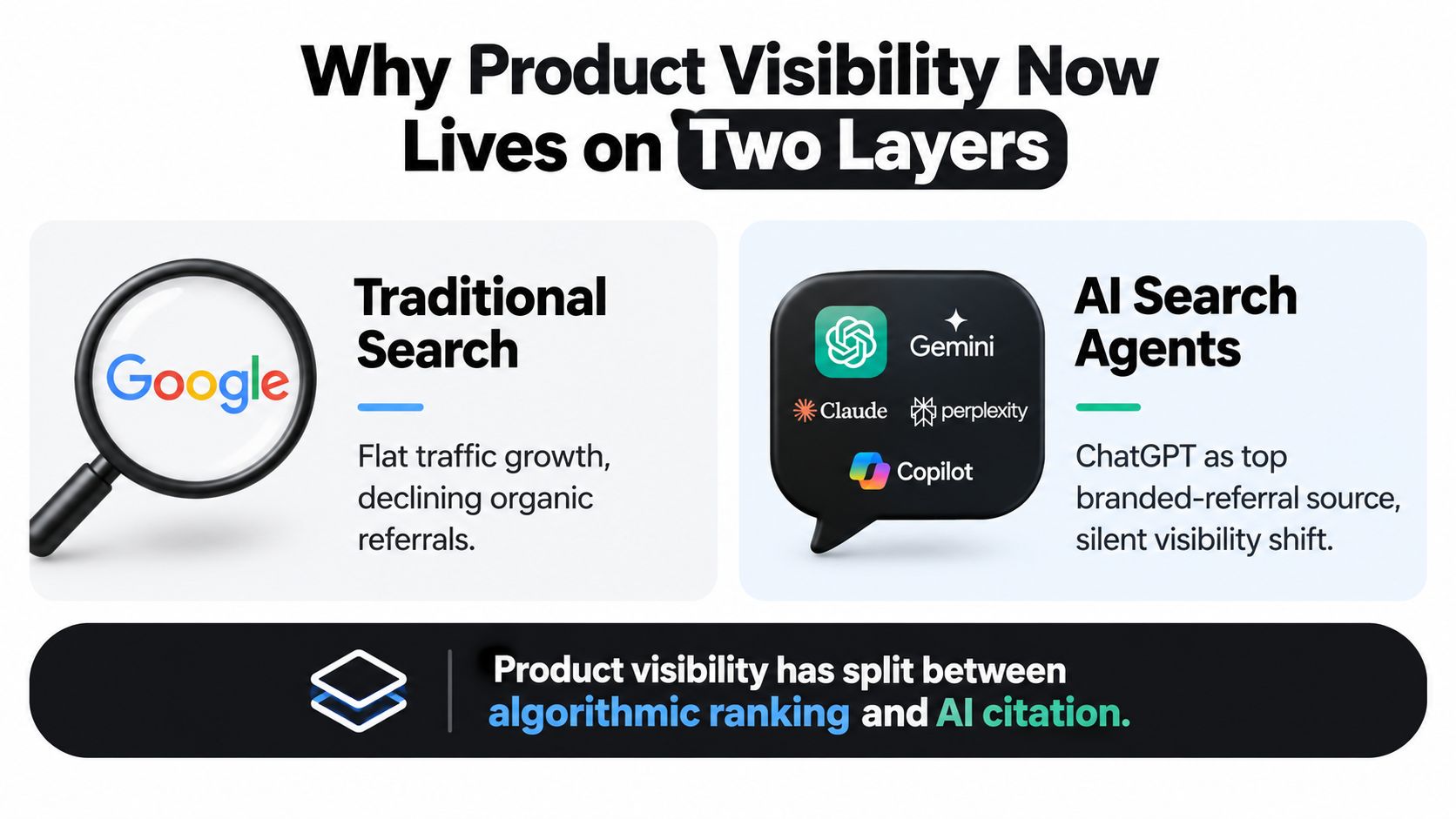
That's the wrong order. Product visibility is now a split problem: classic search visibility gets you ranked and clicked, while AI visibility determines whether assistants retrieve, cite, and describe your product in the answer itself. The fastest path forward is diagnostic, not decorative. Measure both layers, classify the failure, fix the highest-impact source, and connect the change to pipeline.
Table of Contents
- Why Product Visibility Now Lives on Two Layers
- Run a Prompt-Level Visibility Audit Before You Fix Anything
- Diagnose the Four Citation Failure Modes
- Fix the Product Page So AI and Search Can Read It
- Earn the Citations Through Trust and Authority Signals
- Measure Visibility Like a Pipeline Channel
- Your 30/60/90 Visibility Rollout
Why Product Visibility Now Lives on Two Layers
Search still provides the foundation. 93% of online experiences start with a search engine, 71% of B2B shoppers begin research there, and 95% of search traffic goes to the first page of organic results, according to SEO.com's search statistics. The same dataset reports a 27% average click-through rate for the first organic result, with the first result 10 times more likely to receive a click than the tenth.
That makes classic search a ranking problem. Search engines crawl pages, index their content, evaluate relevance and authority, rank results, and earn or lose the click. Your work therefore focuses on crawlability, information architecture, intent alignment, useful content, links, and technical consistency.
AI assistants operate differently. They retrieve candidate sources, select some of them, synthesize an answer, and decide whether to mention your brand at all. A product can rank well in Google yet remain absent from an answer generated for a buyer who uses a conversational prompt.
The two layers need different fixes
Thin internal linking or a successful keyword-cannibalization cleanup can improve a page's position without increasing how often an AI assistant cites it. Conversely, clear product claims, trustworthy comparisons, reviews, partner pages, and consistent structured data can strengthen AI retrieval without producing an immediate blue-link jump.
The shift is measurable. Forbes' 2026 analysis of AI-mediated search cites reporting that 68% of Google searches ended without a click, while other 2026 summaries put zero-click searches at 60%. The same source notes that AI Overviews appear on roughly 48% of queries and can reduce clicks to source pages. These figures point to a practical conclusion: ranking is still essential, but being selected as a source is now part of product visibility.
Start with separate dashboards for search and AI answers. The AI visibility guide from MyMentions is useful for framing that distinction. Don't ship fixes until you know whether your product is not ranking, not being retrieved, being rejected as a source, or being described inaccurately.
Run a Prompt-Level Visibility Audit Before You Fix Anything
Most visibility programs fail before the first fix because the team measures impressions, branded traffic, or a few hand-picked prompts. Those numbers don't tell you whether buyers encounter the product in realistic category conversations.
Build a stable benchmark set first. The recommended methodology uses 50 to 200 high-intent prompts, covering use cases, comparisons, “best” questions, and category discovery, as described in this AI search visibility benchmarking framework. Write prompts in buyer language:
- Use-case intent: “What tools help a product team monitor AI mentions?”
- Comparison intent: “Compare platforms for tracking how assistants describe SaaS products.”
- Category intent: “What are the main options for AI visibility analytics?”
- Evaluation intent: “Which product is suitable for a small SEO team that needs citation tracking?”
The benchmark must stay stable. If you rewrite prompts every week, you'll measure wording changes rather than visibility changes.
Execute the audit consistently
Run the same set across multiple providers, including ChatGPT, Gemini, Claude, and Perplexity. Use consistent sessions and a fixed cadence. The cited methodology recommends testing across multiple engines because the same prompt can return different sources and competitors on different platforms.
Record more than a yes-or-no mention. Score:
- Mention rate, whether the product appears in the answer.
- Citation position, where your source appears among cited brands.
- Mention sentiment, whether the description is favorable, neutral, or negative.
- Answer-body presence, whether the product is named in the prose rather than appearing only in a source link.
- Source mix, which domains the assistant uses to support the response.
A useful reference for designing this process is TheBestReputation SEO guide for AI visibility, particularly its focus on making visibility observable rather than treating AI answers as anecdotal.
Log every result in one sheet:
| Prompt | Provider | Date | Mentioned? | Citation Position | Sentiment | Linked Sources |
|---|---|---|---|---|---|---|
| What tools track AI product visibility? | ChatGPT | YYYY-MM-DD | Yes/No | Position or N/A | Positive/Neutral/Negative | Domain names |
| Which platforms monitor competitor mentions? | Perplexity | YYYY-MM-DD | Yes/No | Position or N/A | Positive/Neutral/Negative | Domain names |
Don't overreact to one response. Ignore one-off prompt wording, model refusals on unusual edge cases, and volatility from a single provider. A benchmark produces a baseline and a gap list, not an explanation. Use prompt regression testing guidance to keep future comparisons consistent, then classify each gap before touching a page.
Diagnose the Four Citation Failure Modes
A missing citation usually belongs to one of four failure modes. Naming the failure first prevents the team from applying schema to a distribution problem or rewriting a product page that assistants never retrieve.
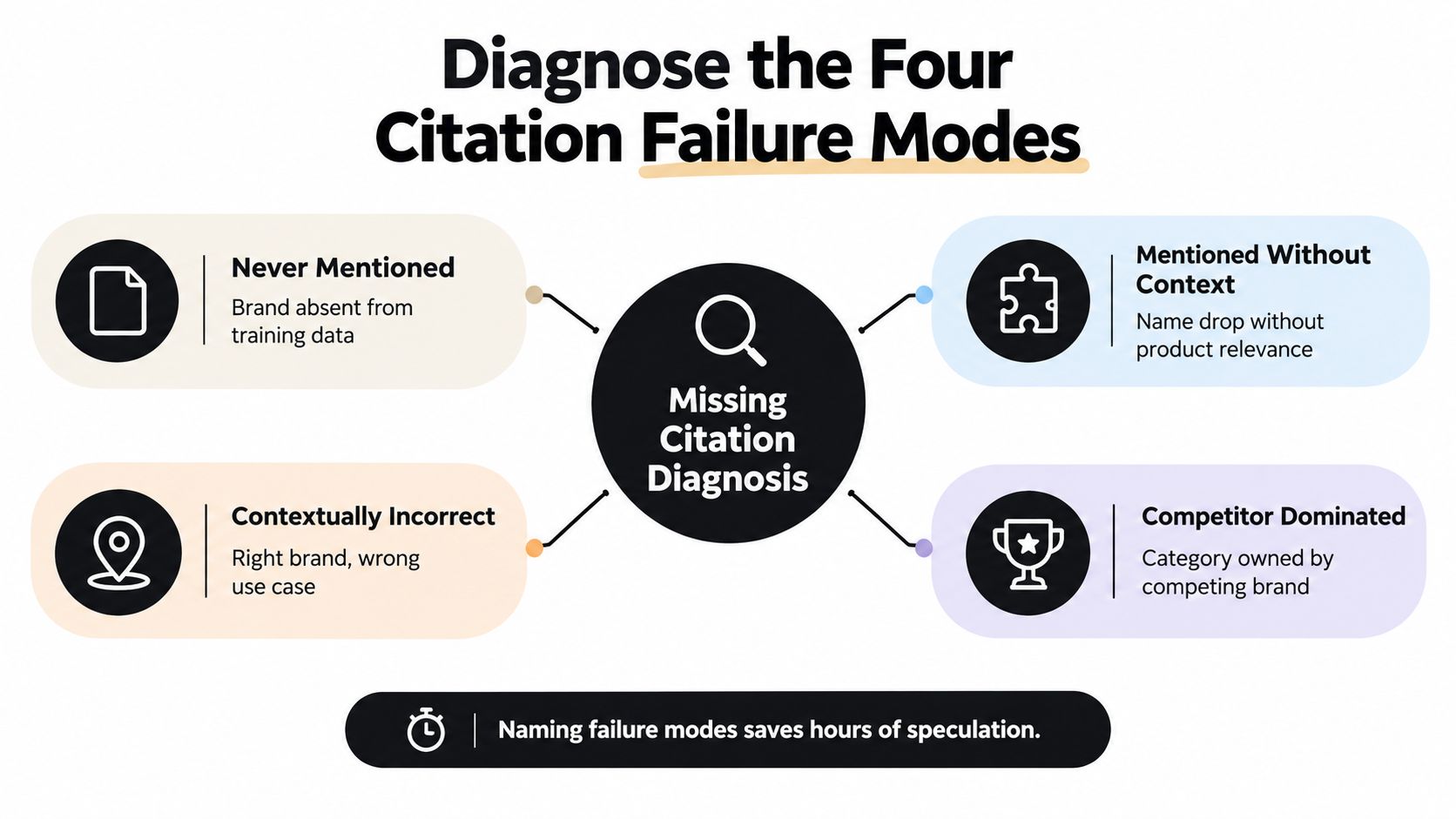
Never retrieved
The assistant doesn't appear to have found a relevant source about your product. The audit signal is zero mention across several realistic prompts, combined with weak educational content, comparison coverage, reviews, or partner pages.
Example: a buyer asks for tools that monitor AI citations, and the answer lists competitors because your site has only a branded homepage and a product page.
Fix category: expand discoverable source coverage. Publish useful category and use-case material, create comparison-ready pages, and earn mentions on credible third-party sites.
Retrieved but not selected
Your domain appears among possible sources, but the assistant chooses competitors. The signal is a linked source or partial mention without consistent answer-body inclusion.
Example: your product page explains the feature, but a competitor presents clearer pricing, integrations, use cases, and structured claims.
Fix category: improve source clarity and selection signals. Make the page easier to extract, resolve important facts directly, and strengthen independent validation.
Selected but misrepresented
The assistant cites your domain but describes the product incorrectly. The log shows a citation paired with inaccurate capabilities, stale positioning, or the wrong use case.
Example: the product supports prompt-level competitor benchmarking, but an outdated integration page describes it only as a rank tracker.
Fix category: create one consistent source of truth. Align visible copy, schema, feeds, documentation, partner listings, and older pages.
Cited without brand authority
The assistant links to your domain but doesn't name your product in the answer. Readers encounter a generic source rather than a recognizable solution.
Example: the answer cites a page about AI visibility measurement but says only “a specialist analytics platform recommends this approach.”
Fix category: connect useful claims to the entity. Use distinctive product naming, clear authorship, descriptive titles, and authoritative pages that explain what the product does.
Diagnostic rule: Assign every material audit gap to exactly one failure mode before changing the product page.
The source attribution guide from MyMentions helps teams examine not only whether a source was linked, but how that source shaped the answer.
Fix the Product Page So AI and Search Can Read It
Start with the cheapest shared fixes. A product page should make its identity, purpose, and commercial facts obvious to both a crawler and a retrieval system.
Ship fixes in this order
| Priority | Fix | What it unlocks |
|---|---|---|
| 1 | Unique title, meta description, H1, and canonical URL | Clear page identity and consolidated indexing |
| 2 | Visible product facts and specifications | Extractable answers for buyers and assistants |
| 3 | Product, Offer, and FAQ schema | Machine-readable entities, prices, attributes, and questions |
| 4 | Answer-first content blocks | Reusable summaries, lists, and comparison points |
| 5 | Server-side rendering and variant consolidation | Reliable crawling and fewer duplicate or thin pages |
| 6 | Consistent product data across channels | Fewer conflicting claims and outdated citations |
Place the core answer directly under the H1. Use a concise summary of the product, a numbered feature list, and a specifications table. For technical products, move key specifications, compliance details, dimensions, tolerances, and application data out of download-only PDFs and into crawlable HTML. Generative engine optimization guidance for manufacturers makes the same operational point, including the need to align visible HTML, structured data, feeds, and backend records.
Use schema to clarify, not to decorate. Product schema should identify the product entity, Offer schema should represent commercial details, and FAQ schema should mark consistently written buyer questions. The visible page and JSON-LD must match. If the page says one thing and structured data says another, you've created an extraction conflict.
Make the page answer-ready
A strong product page gives retrieval systems clean material to lift:
- Summary: What the product is, who it serves, and the problem it solves.
- Feature list: Each capability named with a concrete outcome or use case.
- Specifications table: Technical attributes in real HTML cells, not an image.
- Comparison block: Clear differences between plans, versions, or alternatives.
- FAQ answers: The direct answer in the first sentence, followed by necessary context.
Render important content server-side and consolidate thin variants. Keep canonical URLs deliberate. If color, size, plan, or integration variants create near-identical pages, decide which pages deserve independent visibility and which should consolidate.
Presidio's SEO guide for DTC product pages provides useful background on product-page fundamentals, but don't copy ecommerce conventions blindly into SaaS. Your page needs buyer-specific claims, integration details, limits, and proof, not a pile of keywords.
For a focused AI-specific implementation, this guide to optimizing a website for ChatGPT results offers a practical checklist. The principle is simple: honest, specific copy beats keyword-tuned fluff. Assistants have little reason to select a page that sounds like an SEO draft.
Earn the Citations Through Trust and Authority Signals
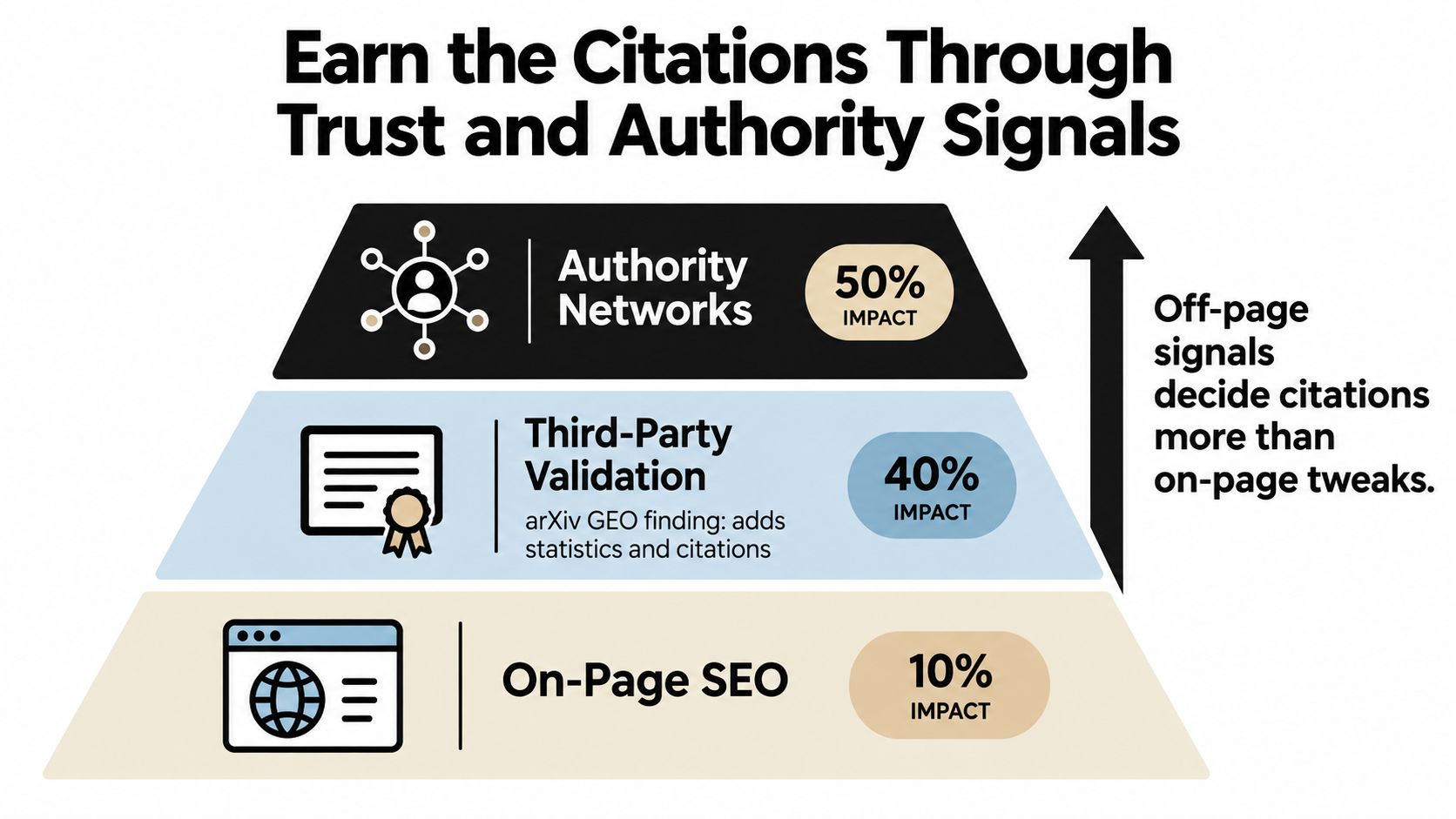
The most contrarian advice in AI visibility is also the most useful: your website may not be the main bottleneck.
An arXiv study of 112 Product Hunt startups across 2,240 queries found that products were recognized when asked about directly at a 99.4% rate, yet a substantial discovery gap remained. The study also found no correlation between Generative Engine Optimization scores and actual discovery rates, while traditional signals such as referring domains and marketplace reputation metrics predicted discovery for some engines. Read the full arXiv study on product discovery in generative engines before investing heavily in another round of prompt wording or schema tweaks.
The implication is uncomfortable. A perfectly structured page with no external validation can lose to a moderately structured page that appears across trusted reviews, comparisons, partner sites, and industry discussions.
Build citation surfaces deliberately
Prioritize places where buyers and assistants can verify your product:
- Review sites and roundups: Give reviewers accurate product facts, use cases, and access to the product.
- Comparison pages: Earn inclusion in pages that compare real alternatives, not generic listicles.
- Integration directories: Keep partner and marketplace listings current and specific.
- Engineering or research content: Publish original explanations that others can cite.
- Third-party press: Offer concrete product developments, technical insights, or category data.
- Public changelogs: Make updates crawlable so assistants can distinguish current capabilities from old ones.
Distribution beats cosmetic optimization. A page cited by trusted sources has more retrieval opportunities than a page cited by nobody, even if the latter has cleaner markup.
Use backlink building sites as a prospecting input, not an excuse to buy indiscriminate links. The target is not a high count. It's a credible network of pages that independently confirms what your product does.
Working principle: Treat “AI SEO” as a trust and distribution program first, then use on-page optimization to make that authority extractable.
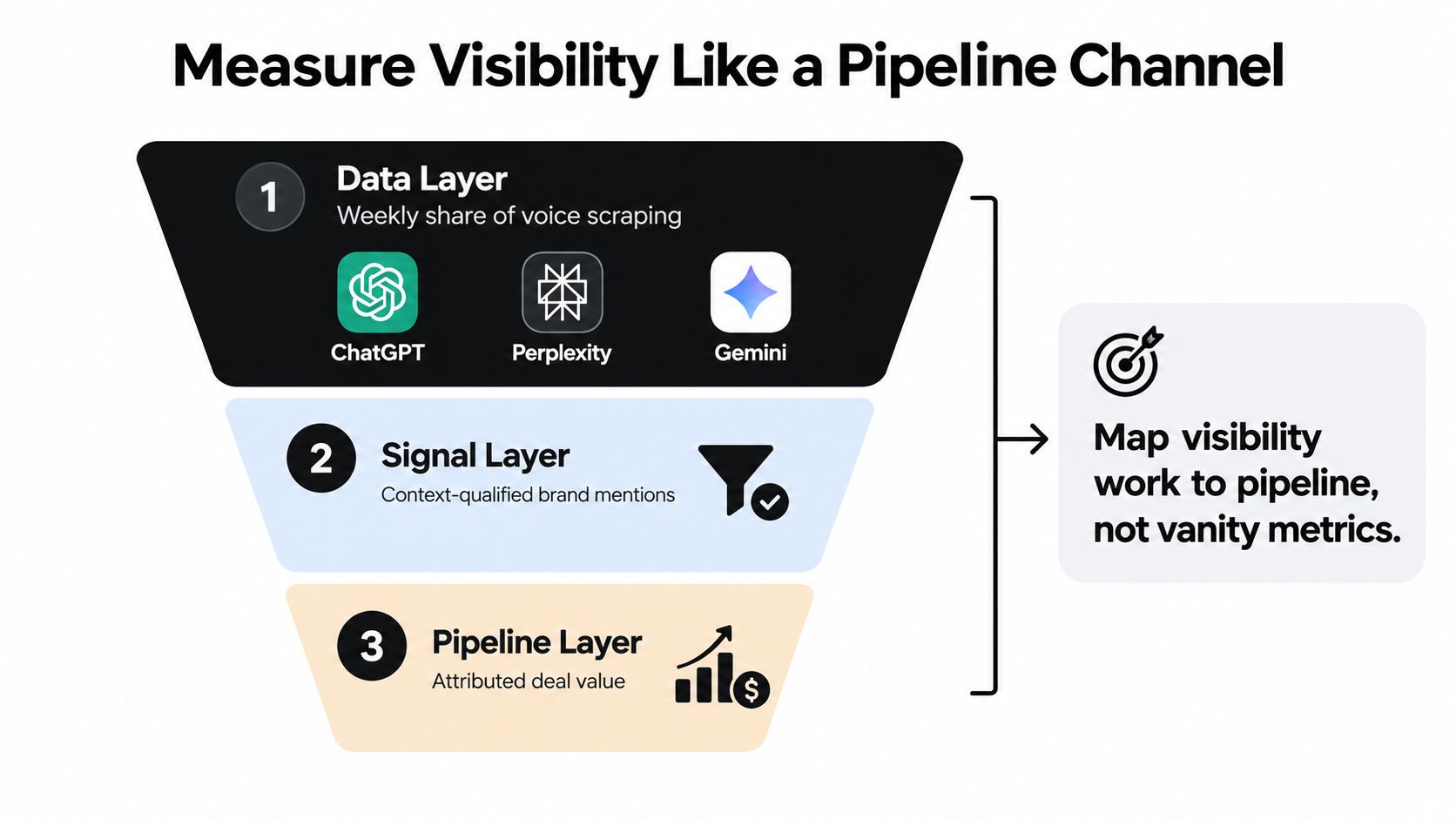
Measure Visibility Like a Pipeline Channel
Visibility metrics become useful when they explain what happened between a buyer's question and a commercial action. A dashboard that reports mentions without source quality or downstream behavior is a vanity display.
Use three measurement layers.
Data layer
Track share of voice across a fixed prompt set on a recurring schedule. Test ChatGPT, Perplexity, and Gemini rather than relying on one provider. The recommended benchmark methodology measures 50 to 200 high-intent prompts, and it separates prompt coverage, citation frequency, and source mix, as documented in this AI search measurement framework.
Signal layer
Record whether the assistant names your product, where it places your citation, which domains it uses, and whether the description is accurate. Separate a branded mention from a generic citation. “An analytics platform” isn't equivalent to your product appearing as a named recommendation.
Pipeline layer
Tag pages that assistants commonly cite. Monitor direct visits and answer-engine referral paths where analytics can identify them. In your CRM, record whether a demo request arrived through a cited page, a branded search, or a direct visit after an assistant interaction.
Compare cohorts before and after a specific visibility push. If you publish a comparison page, earn a review, or correct product schema, annotate the date and watch citation behavior, branded demand, referral traffic, and assisted conversions afterward. Set alerts for sudden citation drops, schema regressions, and new competitor dominance.
This guide to measuring AI search visibility provides a useful model for connecting prompt results to traffic and conversions.
Visibility is a recurring channel. Measure it like paid acquisition, because unmonitored visibility can decline unnoticed as competitors publish, products change, and assistants update their source preferences.
Your 30/60/90 Visibility Rollout
A small growth team shouldn't attempt every visibility tactic at once. Ship the work in the order that reduces uncertainty first, then improves the sources assistants can use, then builds a monitoring habit.
Days 1 to 30, establish the baseline
Create the benchmark prompt set and run it across the selected providers. Include 15 to 20 product and category queries for the first diagnostic pass, then classify every gap as never retrieved, retrieved but not selected, selected but misrepresented, or cited without brand authority.
Create one source of truth containing:
- Prompt and intent
- Provider and date
- Mention status
- Citation position
- Sentiment and accuracy
- Linked source domains
- Product-page, schema, and authority issues
The go/no-go gate is evidence quality. Advance only when the team can identify which failure mode applies to each priority gap and can distinguish a recurring pattern from provider noise. If the log is inconsistent, fix the measurement process before publishing content.
Days 31 to 60, ship high-leverage fixes
Update product-page schema and visible facts. Rewrite priority descriptions using the answer-first format, then consolidate conflicting variants and outdated documentation. At the same time, launch three earned-citation plays:
- Review-source push: Give a relevant reviewer clear product access and factual material.
- Analyst-list inclusion: Identify category pages or directories where buyers already compare options.
- Comparison outreach: Pitch a useful, evidence-based comparison page rather than a branded announcement.
The gate is implementation, not activity. Confirm that critical facts appear in HTML, structured data, documentation, and external listings without contradiction. Drop outreach targets that cannot produce a credible, relevant citation surface.
Days 61 to 90, connect visibility to pipeline
Stand up the prompt-share dashboard and schedule recurring tests. Add alerts for schema changes, citation loss, source displacement, and inaccurate descriptions. Create a CRM field for visibility-influenced pipeline and ask sales to capture the page or assistant context when prospects mention it.
The final gate is commercial usefulness. Keep tactics that improve qualified visibility and create observable buyer paths. Hold tactics that produce mentions without relevance. Cut tactics that generate neither trusted citations nor pipeline evidence.
Monday morning checklist: Build the benchmark, classify the gaps, fix the product source of truth, earn external validation, then monitor the result.
MyMentions tracks prompt-level mentions, position, sentiment, competitor visibility, and citation sources across AI assistants, turning those results into a prioritized backlog for content, trust, UX, and technical fixes. If you want a repeatable way to connect AI answers with traffic and pipeline, visit MyMentions and start with the benchmark your team can sustain.