A top-ten ranking no longer guarantees that buyers will discover your brand. If an AI assistant recommends competitors, summarizes third-party reviews, and leaves your product out of the answer, your search position may offer little protection. The popular advice to publish more content and add AI-friendly keywords misses the bigger issue: GEO is a cross-engine measurement problem, and the sources shaping an answer often sit outside your website.
For founders and growth teams, that changes the work. You still need solid SEO, but you also need to know which prompts surface your brand, which sources influence each answer, and whether those answers describe you accurately. That's what geo generative engine optimization is for.
Table of Contents
- Why Geo Generative Engine Optimization Changes the Search Game
- What GEO Actually Means and How It Differs from SEO
- The Market Shift That Made GEO a Strategic Priority
- The Signal Types That Actually Move GEO Performance
- Why Third-Party Sources Shape Your AI Answers More Than Your Blog
- A Cross-Engine GEO Measurement Framework
- A 90-Day GEO Execution Plan for Founders and Marketing Teams
- Your GEO Starting Checklist and Common Pitfalls to Avoid
Why Geo Generative Engine Optimization Changes the Search Game
Ranking well used to be a reasonable shorthand for being found. It isn't anymore. People can receive an AI-generated answer before they reach conventional results, and an answer engine can combine information from several sources without sending the reader to each one.
Google launched AI Overviews to U.S. users on May 14, 2024. Later, Pew Research Center analyzed 68,879 Google searches by 900 U.S. adults during March 2025. About 18% of searches produced an AI summary. When a summary appeared, users clicked a traditional search result on 8% of visits, compared with 15% when no summary appeared. Links inside the summaries drew clicks on about 1% of visits (Pew Research Center's analysis of real-world browsing).
That's not evidence that SEO is obsolete. It's evidence that a good rank and a strong presence in an AI answer are different outcomes. A page can rank and still be overlooked by the answer layer. A brand can also be named or recommended based on information found on someone else's website.
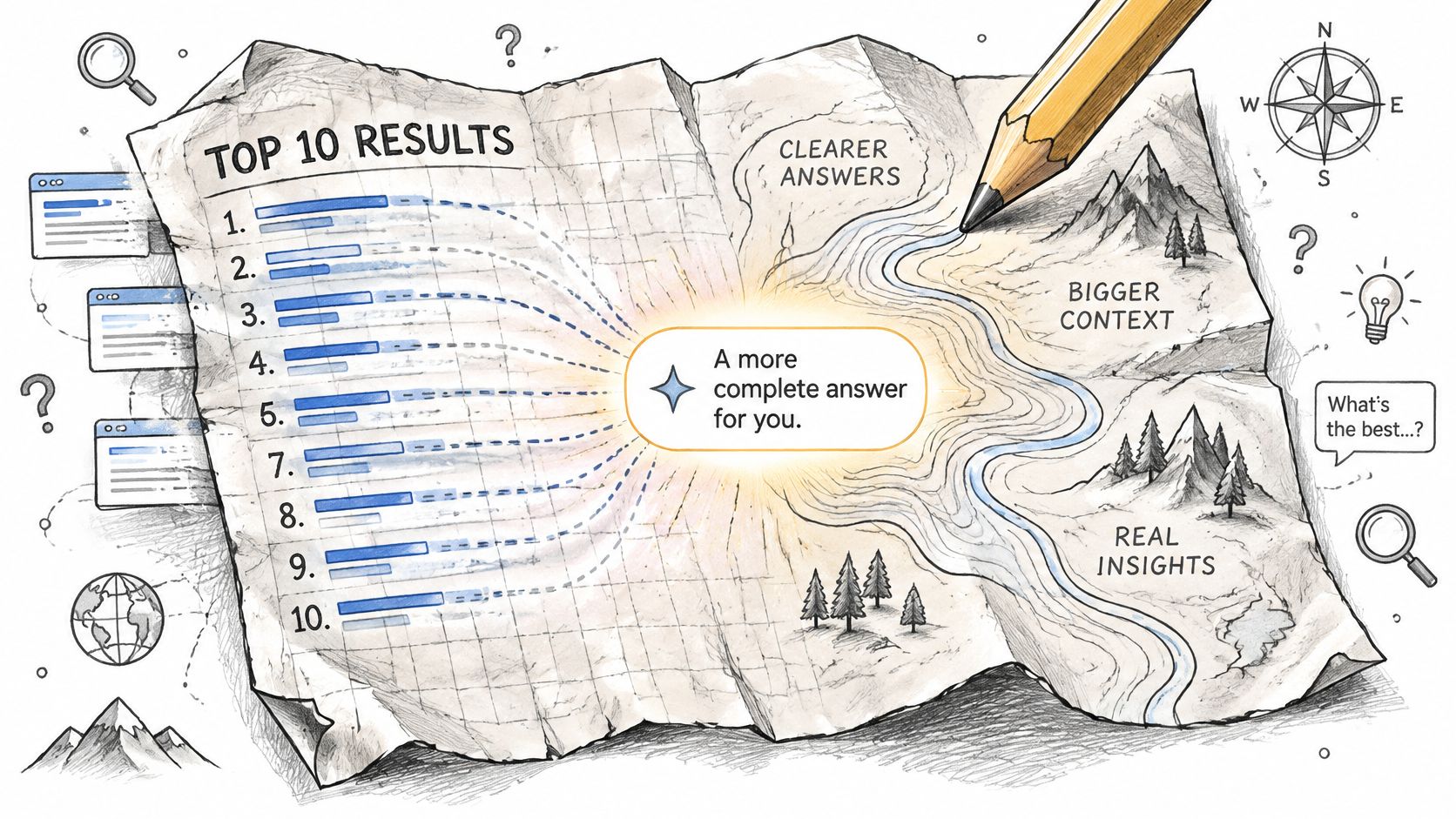
Measure the answer, not just the blue links
For a founder, the practical question isn't only "Where do we rank?" Ask instead: Does the assistant mention us for the questions our buyers ask? Is the description accurate? Which sources support its recommendation? Those answers help you distinguish a visibility problem from a reputation or source-coverage problem.
GEO emerged as a distinct research concept in November 2023, when researchers from Princeton University, Georgia Tech, the Allen Institute for AI, and IIT Delhi published foundational work on optimizing content for generative search responses. Their study examined visibility within generated answers, not just conventional search rankings. In experiments, targeted optimization increased a source's visibility by up to 40%, with results varying by domain (the Princeton-led GEO study).
The implication is straightforward: don't treat ranking as a proxy for recommendation. Track whether the brand gets selected and cited, and whether the answer represents it correctly. That's where SEO and GEO connect, but they aren't interchangeable.
What GEO Actually Means and How It Differs from SEO
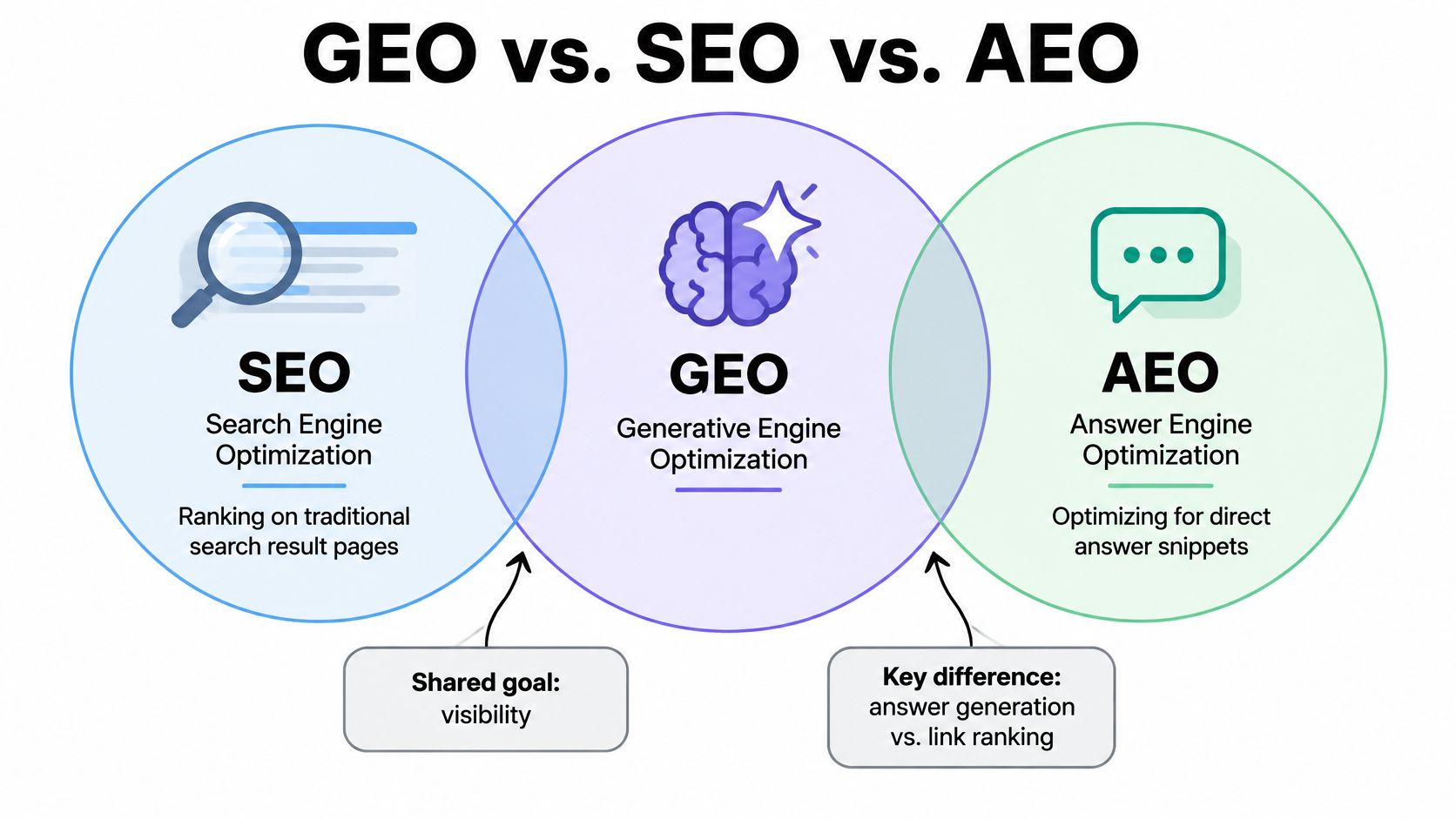
Generative Engine Optimization (GEO) is the work of improving how likely an AI system is to select, cite, summarize, or recommend your information in a generated response. SEO focuses largely on making pages discoverable and competitive in search results. GEO asks whether the system uses your information in the answer it produces.
Answer Engine Optimization, or AEO, overlaps with both. AEO commonly focuses on concise answers and visibility in direct-answer formats, while GEO addresses generated responses that may synthesize material from multiple sources. For a clear primer on that distinction, check VeloCMS's AEO guide.
Treat GEO as an experiment, not a checklist
The Princeton-led research framed GEO as a black-box optimization problem: change content, submit it against target queries, and assess how visible the source becomes in generated answers. Its GEO-bench benchmark covers varied queries and web sources. The key operational point is more useful than any supposed universal tactic: results can differ by domain and query type.
Use a repeatable loop:
- Choose buyer-intent prompts. Include questions about needs, comparisons, implementation, and alternatives, not just branded queries.
- Record a baseline. Save the answer, whether your brand appears, its position, and the sources cited.
- Change one meaningful input. For example, clarify a product capability or strengthen an evidence-backed explanation.
- Run the same prompt again. Compare the new answer with the baseline, and keep track of which engine produced it.
Don't assume a formatting trick that works for software comparisons will work for technical documentation or local recommendations. The study's reported visibility gain is an experimental result, not a forecast for your site. GEO is most useful when you treat it as testing with factual content, rather than a formula for gaming an answer.
The Market Shift That Made GEO a Strategic Priority
Google's AI Overviews changed the stakes for search visibility. Google introduced Search Generative Experience as an experiment in 2023 and launched AI Overviews to U.S. users on May 14, 2024. Pew's browsing-data findings, cited earlier in this article, found an AI-generated summary in about 18% of the Google searches it examined.
An answer can shape a buyer's consideration without producing a site visit. In the same analysis, searches with an AI summary led to a conventional search-result click 8% of the time, compared with 15% without a summary. Clicks on links inside summaries occurred on about 1% of visits. Those figures vary by query and category, but they make one point clear: organic traffic alone cannot show whether your brand is influencing discovery.
Visibility and traffic aren't the same outcome
A brand mention may reach a buyer without appearing in analytics. A mention that misstates your product can do more harm than good. Review the answer itself, then connect its visibility to visits and conversions where your analytics allow.
That measurement needs to span engines. Visibility in Google does not guarantee visibility in ChatGPT or Perplexity. Compare engine-level results with an overview of AI search market share, then use the differences to guide where you investigate.
Keep your SEO fundamentals strong: publish useful, crawlable pages and make sure answer engines can access accurate information about your business. Then measure whether those engines mention your brand, which sources they rely on, and how they describe your offer. That cross-engine view is a more useful management tool than publishing more pages and hoping they appear in generated answers.
The embedded video offers another perspective on the shift:
The Signal Types That Actually Move GEO Performance
“AI visibility” sounds like one metric, but it hides several different questions. A brand can be cited often and still appear low in the answer. It can be prominent but described inaccurately. It can be recommended without driving a qualified visit.
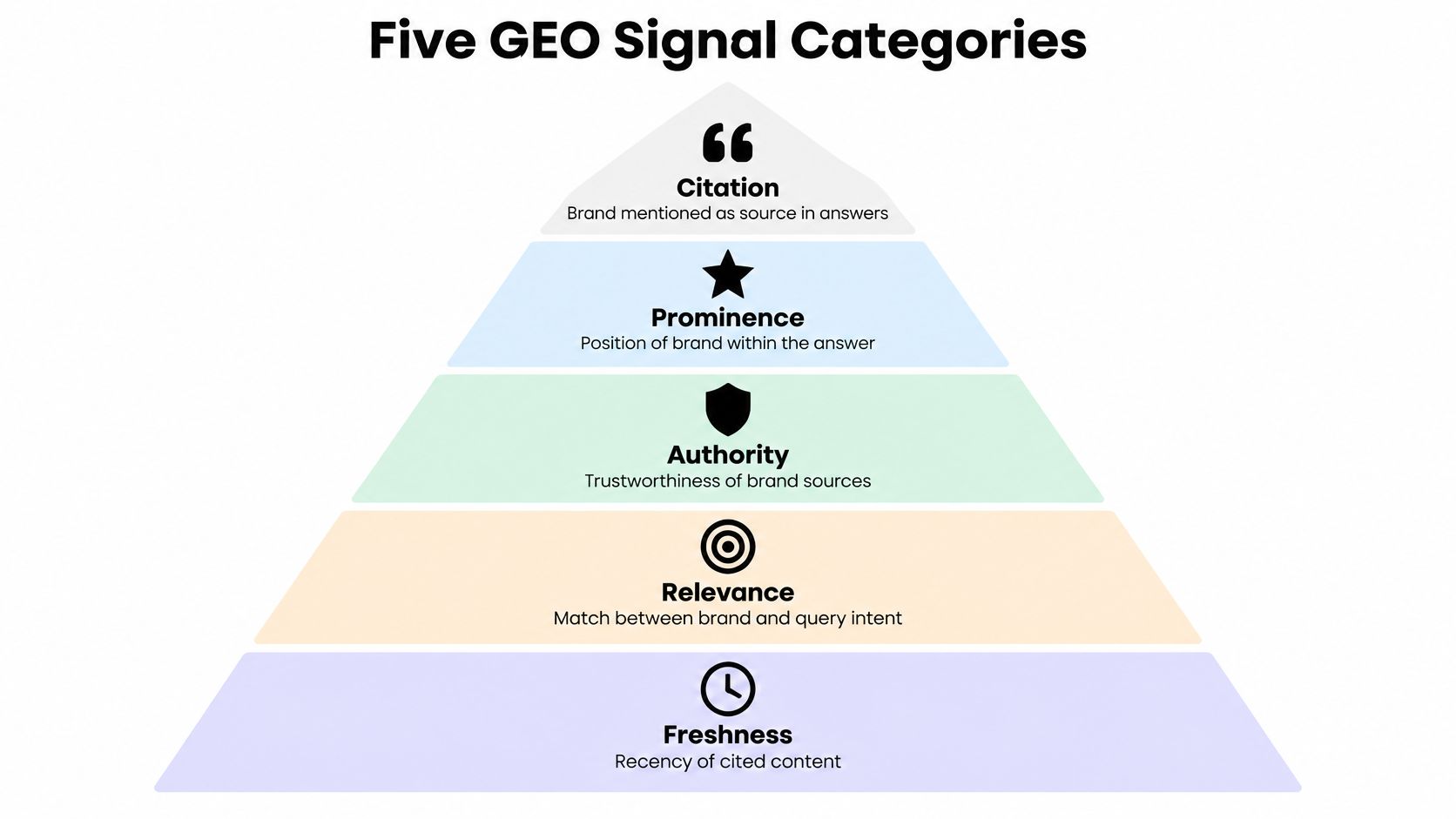
Track these outcomes separately:
- Citation frequency: Does the answer name your brand or cite a page associated with it?
- Prominence: Does the brand appear as a primary recommendation, or only in passing?
- Sentiment and accuracy: Does the answer describe the product correctly and in a way that reflects its actual strengths and limits?
- Answer absorption: How much of the response relies on your brand or its information? A brief mention and a substantive recommendation aren't equivalent.
- Qualified traffic: Do AI-referred visits reach relevant pages and contribute to business outcomes?
Build a useful reporting view
Break results down by engine, prompt, and time period. Add the source URL and the answer text to the record. That context lets the team investigate a change instead of arguing about an overall score that combines unlike signals.
For example, a product could gain citations for integration questions while losing visibility in competitor comparisons. A single blended metric can conceal that difference. Separate results reveal whether the next action should be a documentation update, a third-party source correction, or a change to the prompts you monitor.
Practical rule: If a metric can't point to a specific answer, prompt, and source, it's too abstract to guide the next GEO task.
For a closer look at how answer placement and other visibility measures can be tracked, use this guide to AI search ranking. Don't let a dashboard's simplicity persuade you to collapse citation, prominence, accuracy, and traffic into a single number. They answer different questions, so they need different actions.
Why Third-Party Sources Shape Your AI Answers More Than Your Blog
Publishing useful first-party content matters, but it isn't the whole job. AI systems can draw on reviews, product comparisons, partner pages, documentation, community discussions, and other sources. If buyers and models encounter a weak or outdated third-party description, another blog post on your own site may not correct it.
A 2026 study examining more than 100,000 responses across more than 100 brands reported that about 78% of cited sources were corporate websites, mostly third-party brand pages, rather than the brands' own domains. Ranked best-of listicles represented about 21% of citations (the study of GEO citations at scale). These categories describe citation patterns, not necessarily mutually exclusive slices, so don't add them together as though they make a complete pie chart.
Audit the sources that shape the recommendation
| Source type | Share of citations | GEO implication |
|---|---|---|
| Corporate websites, mostly third-party brand pages | About 78% | Find out which external pages describe your product and correct material gaps. |
| Ranked best-of listicles | About 21% | Identify relevant comparison pages and assess whether your product is included and accurately positioned. |
Treat the table as a prompt for investigation, not a promise that every category will have the same source mix. Start by collecting the citations that appear for your buyer-intent prompts. Then sort them into reviews, comparison pages, partner content, communities, documentation, and your own pages. Prioritize sources that recur in answers or make consequential claims about your product.
Off-domain work still needs judgment. Don't chase every mention or ask for unsupported praise. Correct factual errors, give reviewers useful and current product information, and make it easy for partners to describe capabilities accurately. If you're building an outreach approach alongside your source audit, this practical guide to scaling link building for SMEs offers relevant context.
The underlying source question is worth tracking explicitly. Use this guide to source attribution in AI answers to help make citation discovery a repeatable task rather than an occasional manual search.
A Cross-Engine GEO Measurement Framework
There is no single GEO ranking that reliably describes a brand's visibility everywhere. A site may appear in Google AI Overviews but not ChatGPT, or receive a citation in Perplexity without appearing in Claude. A survey of GEO research reports variation by engine, location, date, query wording, retrieval state, and generation randomness, and analyzes 11,500 queries (the academic review of GEO measurement).
That's why a single brand score is convenient but weak. It hides the specific engine, prompt, and source that drove the result. A cross-engine view is more work, but it reflects how SaaS buyers search.
Use four connected measurement layers
- Prompt-level exposure: Save the prompt and answer. Record whether your brand appears, how it's described, and where it appears.
- Engine-level share of voice: Compare your presence with relevant competitors within the same engine and prompt group. Don't treat results from different providers as identical.
- Source-level influence: Record which URLs the answer cites and which third-party descriptions repeatedly inform recommendations.
- Business outcomes: Connect mentions to referred sessions, relevant page visits, and conversions when your analytics can identify them. Keep attribution limits visible rather than claiming that every conversion came from an AI answer.
This structure makes it easier to decide what to do. Weak visibility across a prompt group may call for stronger evidence or better coverage. A recurring inaccurate citation calls for source correction. Strong answer presence with little measurable traffic may still matter for consideration, but it shouldn't be reported as proven pipeline impact.
Don't confuse rank with business value. Ask which answer appeared, which source shaped it, and whether it reached the right buyer.
For teams already reporting organic visibility, a share of voice SEO guide can provide useful context for competitive measurement. To build the GEO side of that picture, use this practical resource on how to measure generative engine optimization. The principle is simple: segment first, summarize second. A single rolled-up score may help with a quick overview, but decisions should come from the underlying prompt, engine, source, and outcome data.
A 90-Day GEO Execution Plan for Founders and Marketing Teams
A GEO program doesn't need a grand strategy document. It needs a baseline, an owner, and a backlog tied to what answer engines say. Split the work into three phases, and keep SEO maintenance running alongside it.
First phase, build the inventory
Create a prompt set that reflects actual buyer questions: category discovery, product comparisons, use cases, implementation concerns, and alternatives. Run those prompts across the providers that matter to your audience, such as OpenAI, Google, Perplexity, Claude, Grok, Copilot, and DeepSeek. Save the full answers, citations, brand descriptions, and competitor mentions.
Then group cited sources by type. Look for recurring review pages, comparison articles, partner pages, community discussions, and product documentation. This baseline tells you whether your main gap is visibility, accuracy, or source influence.
Second phase, work on the evidence and the sources
Update first-party pages when they bury important facts, make claims hard to verify, or leave common buyer questions unanswered. Add clear, supportable explanations and cite evidence where appropriate. In parallel, contact relevant third-party publishers or partners when their pages contain incorrect information, and prioritize comparison surfaces that appear in your monitored answers.
Don't manufacture numbers, testimonials, or expert endorsements to make content look more authoritative. A false claim can spread beyond your site and make AI descriptions less reliable.
Third phase, measure and iterate
Connect AI-referred activity to traffic and pipeline reporting where possible. Set alerts for meaningful visibility changes, review the associated answers and citations, then test focused revisions against your baseline. Keep a record of what changed and which prompts you reran, so the team can distinguish a content effect from ordinary answer variation.
For a broader operating model, this AI visibility strategy guide can help teams turn monitoring into an ongoing workflow. Keep the backlog practical: fix the most consequential factual gap first, then test whether the answer changes.
Your GEO Starting Checklist and Common Pitfalls to Avoid
Make these decisions this week:
- Choose engines: Track the providers your buyers use.
- Write buyer prompts: Include comparisons, use cases, and alternatives.
- Pick separate metrics: Measure citations, position, accuracy, and qualified visits.
- Audit external sources: Review the pages that appear in answers.
- Improve one page: Publish an evidence-rich update grounded in verifiable facts.
- Connect outcomes: Relate mentions to traffic and conversions where attribution permits.
- Set alerts: Notify the team when visibility or answer accuracy changes.
Avoid treating one brand score as the truth, assuming more blog posts automatically create more citations, or optimizing content with unsupported claims. GEO works best when monitoring leads to a concrete fix and the next measurement checks whether that fix mattered.
MyMentions tracks brand visibility, position, sentiment, competitors, and citation sources across supported AI assistants, then turns prompt-level results into a prioritized optimization backlog. If you want a clearer view of how answer engines represent your product and which sources influence those answers, visit MyMentions to explore the platform.