Gap rules are measurable criteria for finding where a brand is missing from AI answers, whether through absent content, buried evidence, weak third-party citations, or unclear trade-off arguments. They matter more than generic keyword gaps because a page can rank well and still fail to earn a recommendation from ChatGPT, Perplexity, Claude, or Google AI Overviews.
Your SaaS product may hold a page-one position for its core terms, attract steady organic visits, and look healthy in every conventional SEO report. Then a buyer asks an assistant, “What's the best alternative for a regulated team?” or “Which platform has the clearest migration path?” Your brand disappears, or appears briefly while a competitor gets the recommendation.
That outcome isn't necessarily a penalty or a ranking failure. It's a visibility mismatch. Search rankings measure where a page appears for a query. AI answers measure whether a product is understood, supported by evidence, compared fairly, and cited in the sources an assistant uses.
Gap rules give teams a practical way to diagnose that mismatch. They turn “AI doesn't mention us” into specific questions about intent, format, proof, source coverage, and freshness. The result is a backlog that content, product marketing, digital PR, and technical teams can work through.
Table of Contents
- When Ranking Well Means Getting Ignored by AI
- What Gap Rules Are and Why They Exist for AI Search
- The Different Types of Gaps AI Systems Reveal
- How a Real Gap Ruleset Looks for a SaaS Product
- How to Prioritize Gap Fixes for Maximum Impact
- Operationalizing Gap Rules into Content, Trust, and Technical Fixes
- Why Gap Rules Change How You Think About Visibility
When Ranking Well Means Getting Ignored by AI
A strong organic position doesn't guarantee a place in an AI-generated shortlist. Assistants often break a buyer's prompt into related questions, consult several source types, and assemble an answer from documentation, reviews, partner pages, comparison articles, and brand content. Your highest-ranking landing page may be only one small input, not the deciding source.
That explains a common pattern. A product page communicates features well, but it doesn't answer who the product is best for, where it falls short, how migration works, or which integrations matter. An independent review may answer some of those questions about a competitor, so the competitor becomes easier for an assistant to recommend.

Traditional SEO still matters. A sound organic traffic playbook from Kogifi can help a brand build discoverability, useful content, and a healthier search foundation. But AI visibility adds another test: can an assistant retrieve a concise, trustworthy answer and connect it to the buyer's situation?
The missing layer between ranking and recommendation
A conventional keyword gap asks whether competitors cover a topic or phrase that your site doesn't. An AI-answer gap asks whether your brand can satisfy the complete decision context behind a prompt.
That context may include:
- Category fit: Does the content clearly identify the problem and use case?
- Decision evidence: Can an assistant find proof, limitations, comparisons, and outcomes?
- External validation: Do independent sources describe the product accurately?
- Answer usability: Are important facts presented in passages an assistant can extract?
- Current accuracy: Do public pages agree about features, pricing, integrations, and security?
Teams that monitor these signals need prompt-level visibility, not just keyword dashboards. A practical AI visibility monitoring workflow can reveal whether a brand is absent, inaccurately described, cited without being recommended, or displaced by a competitor.
The strategic shift is simple: treat AI discovery as its own visibility environment. Ranking is an input. Recommendation depends on whether the wider information ecosystem gives an assistant enough reason to choose you.
What Gap Rules Are and Why They Exist for AI Search
Gap rules are explicit conditions used to determine whether a brand meets the information requirements of an AI answer. They apply to a prompt or related query cluster, then ask what's missing for the assistant to understand, cite, compare, or recommend the product.
Traditional gap analysis usually starts with a keyword list. A competitor ranks for a term, your site doesn't, and the proposed fix is a new page or an optimization pass. That method can uncover useful opportunities, but it treats visibility as a page-level contest. AI answers operate more like an evidence assembly process.
A buyer prompt about analytics software may contain several hidden demands. The assistant might need to identify the category, compare alternatives, assess security, evaluate integration depth, check pricing fit, and explain limitations. If your site handles only the category definition, it has coverage without decision support.
The rules behind an AI-answer audit
A useful ruleset checks several dimensions:
- Semantic gap: The brand isn't clearly associated with the category, audience, or use case.
- Intent gap: Content answers broad informational questions but not the buyer's actual decision.
- Format gap: Relevant facts exist but are buried in prose, documentation, or promotional copy.
- Evidence gap: Claims lack original data, benchmarks, customer outcomes, or credible validation.
- Source gap: Independent reviews, partner pages, and comparison sources rarely mention the brand.
- Freshness gap: Public information is stale, inconsistent, or no longer reflects the product.
These rules explain why adding another generic article often produces little change. The missing asset might be a comparison table, a limitations page, a security explanation, or an independent source that an assistant trusts.
A structured AI search audit helps teams test those conditions against real prompts instead of inferring them from rankings alone.
The core principle is diagnostic precision. Don't ask only, “What topic should we publish?” Ask, “What information is preventing an accurate, defensible answer about this product?”
The Different Types of Gaps AI Systems Reveal
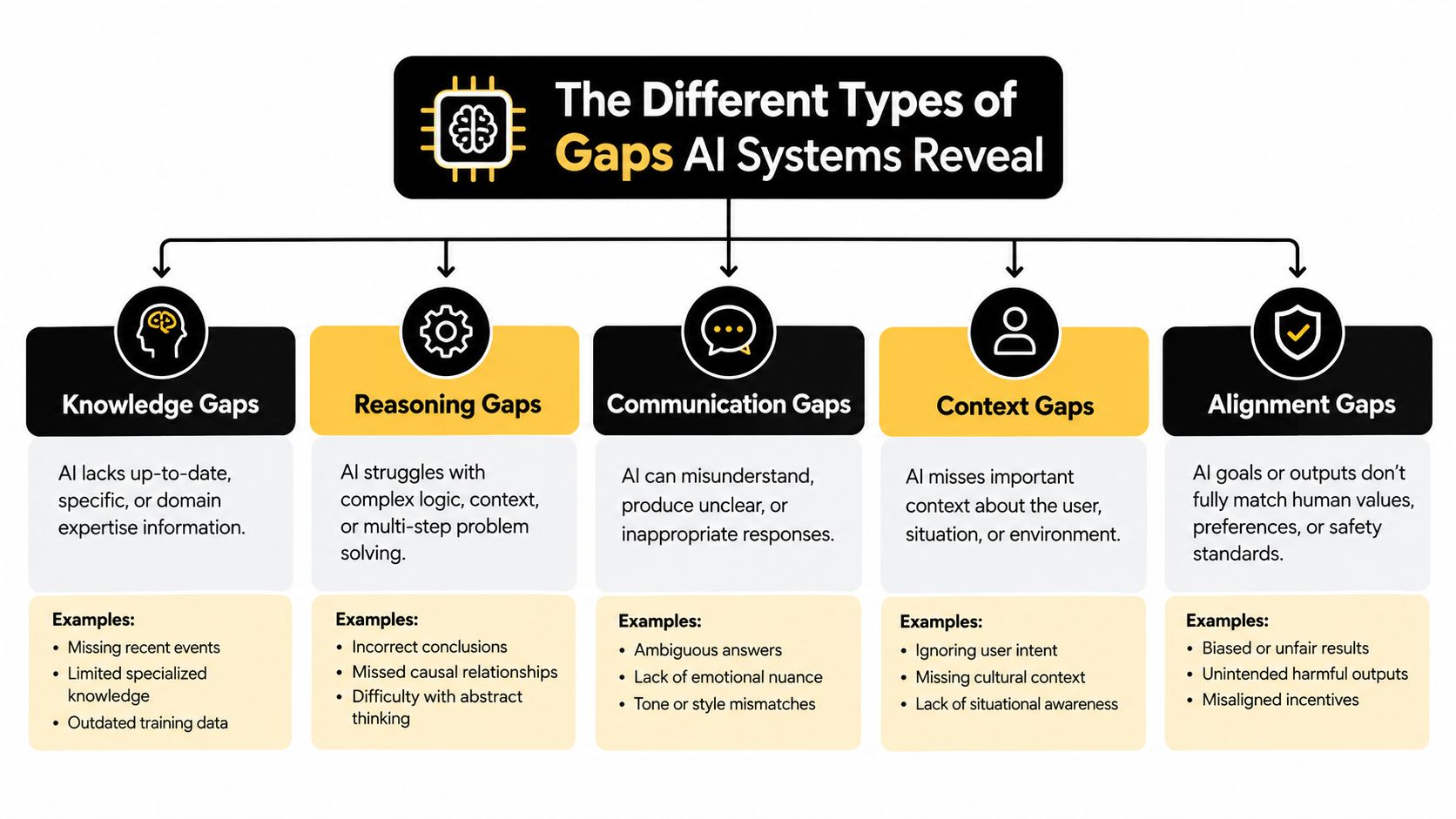
AI omissions usually have a recognizable cause. The challenge is resisting the easy diagnosis that every omission represents a missing keyword. Different gaps require different owners, assets, and measures of success.
Six failure modes worth separating
Semantic gaps appear when the site describes the product in company language rather than the category language buyers and assistants use. A developer tool might rank for its brand name but remain absent when a prompt uses a broader category or a different description of the job to be done. The fix is clearer category framing, use-case mapping, and terminology that connects product capabilities to recognizable needs.
Intent gaps are more commercially serious. A library of educational posts may explain a problem thoroughly while saying nothing about alternatives, limitations, migration risk, pricing fit, or regulated environments. Assistants need those decision signals to answer purchase-oriented prompts.
Format gaps occur when the right fact exists but can't be easily extracted. A security detail buried in a long narrative is less usable than a direct statement supported by a linked document. Decision tables, concise FAQs, comparison sections, and clearly labelled specifications make important information easier to retrieve.
Practical rule: If a buyer would need to read several pages to find the answer, an assistant may struggle to present it clearly.
Evidence gaps weaken claims about performance, security, compliance, or time to value. Marketing assertions aren't interchangeable with original research, customer outcomes, technical documentation, or trusted third-party validation. When a competitor provides stronger proof, the assistant has a safer basis for recommending that competitor.
Source gaps sit outside your domain. A brand may publish excellent material yet remain absent from review platforms, partner ecosystems, documentation hubs, or community comparisons. This is why trust-building work can resemble digital PR and security education. For instance, teams assessing a white-label recurring revenue service may also encounter independent material about monitoring and risk, which can shape how an assistant frames vendor credibility.
Freshness gaps emerge when pricing, integrations, security posture, or feature availability changes without coordinated updates. Contradictory pages create uncertainty, and uncertainty makes confident recommendations harder.
Track these distinctions with AI citation tracking, then assign each gap to the team that can fix it. Content cannot solve an absent partner reference by itself, and technical SEO cannot manufacture missing evidence.
How a Real Gap Ruleset Looks for a SaaS Product
Consider a B2B analytics platform with strong coverage for category terms and educational searches. Its website explains dashboards, reporting, and integrations, yet assistants rarely recommend it for buyer prompts involving alternatives, regulated teams, limitations, migration, security, or pricing fit.
The first finding is an intent gap. The company has awareness content but lacks explicit pages that help a buyer choose. A comparison against a named competitor, a best-fit guide for regulated organizations, and a candid limitations section would address different decision contexts without forcing one generic page to do everything.
The second finding is a format gap. Technical specifications exist in dense documentation, but the commercial site doesn't translate them into concise, decision-oriented passages. A buyer may need to understand authentication, data residency, integration depth, or migration effort without reading an entire documentation tree.
Diagnostic checklist for the product team
| Gap Type | Key Question | Typical Symptom |
|---|---|---|
| Semantic | Does the brand map clearly to the buyer's category and use case? | The product appears for its name but not for category prompts. |
| Intent | Does the site answer selection and procurement questions? | Educational content is strong, while comparisons and limitations are missing. |
| Format | Can an assistant extract the relevant answer quickly? | Important facts are buried in long pages or technical repositories. |
| Evidence | What supports claims about security, performance, or outcomes? | The site relies on assertions without accessible proof. |
| Source | Do independent sources describe and validate the product? | Competitors dominate reviews, partner pages, and comparison discussions. |
| Freshness | Are public details current and consistent? | Pricing, integrations, or security information conflicts across pages. |
An evidence gap may require benchmarks, customer outcomes, security documentation, or third-party validation. A source gap may require coordinated work with review platforms, partners, and industry publications. A freshness gap calls for an ownership process, not a one-time rewrite.
Competitive intelligence analysis, such as competitive intelligence analysis, becomes useful here. Compare the exact sources and passages assistants use for competitors, then identify what your product lacks rather than copying a competitor's topic list.
How to Prioritize Gap Fixes for Maximum Impact
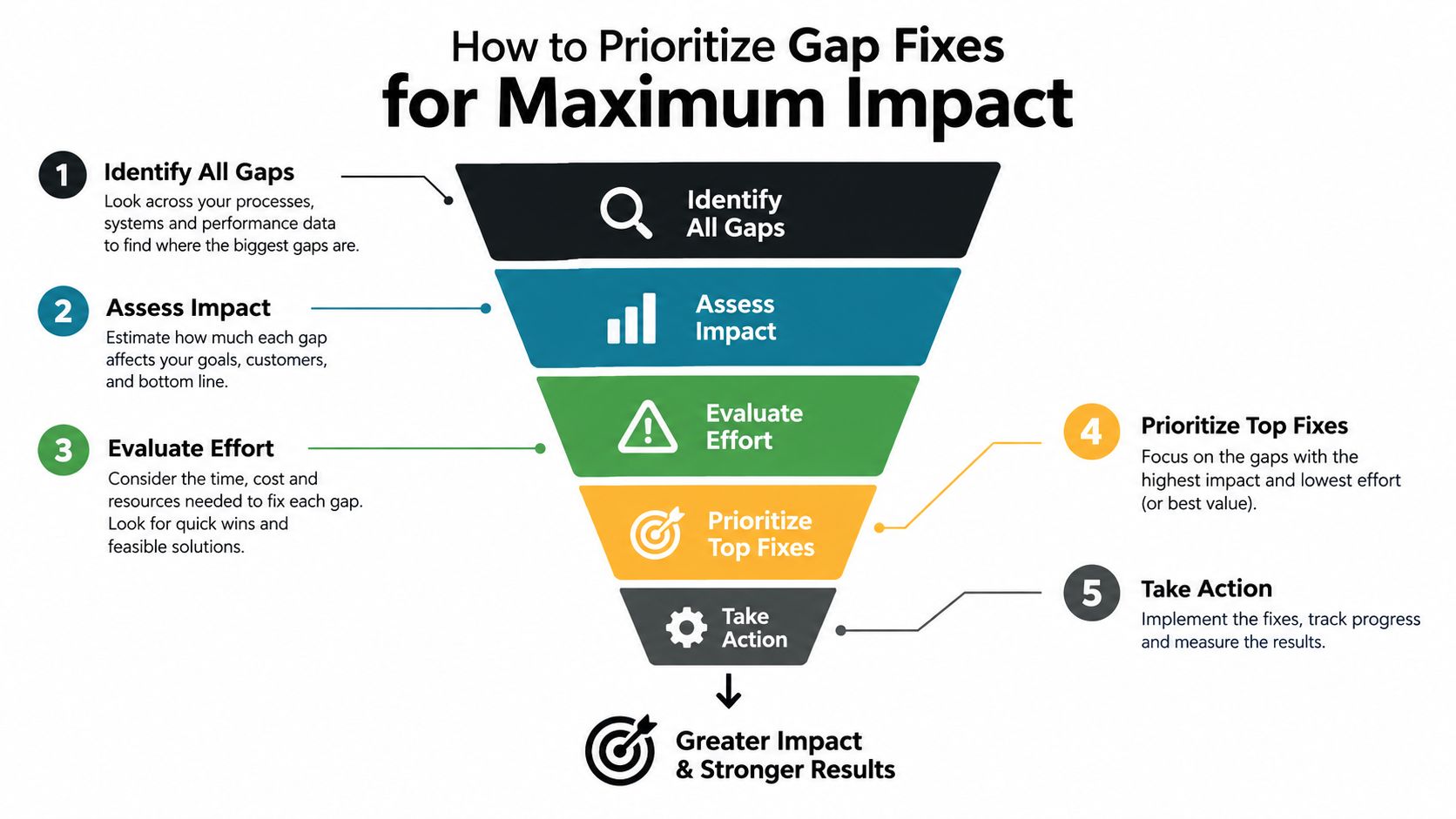
Not every gap deserves immediate production time. Teams often choose the easiest content task, such as another broad article, because it feels measurable. The better choice is usually the gap closest to a buyer's decision and the competitor's strongest advantage.
Use five filters:
- Buyer intent: Start with prompts that signal selection, risk, or procurement. “Best alternative,” “limitations,” “security,” “migration,” “integrations,” and “pricing fit” usually carry more commercial meaning than broad definitions.
- Competitor displacement: Give priority to situations where a competitor is repeatedly recommended because it supplies a missing comparison, proof point, or use-case explanation.
- Source influence: Identify whether the missing information belongs on your own site or on an independent review, partner page, documentation hub, or community resource.
- Factual risk: Fix stale or contradictory information quickly. Incorrect public details can damage confidence even when the page ranks well.
- Conversion impact: Connect each gap to an observable business event, such as a demo request, trial start, sales-qualified conversation, or influenced pipeline opportunity.
A practical scoring conversation
You don't need a complicated scoring model to make this useful. Ask the team to compare candidate fixes using the same questions: Is the prompt close to a buying decision? Is a competitor winning the answer? Does an influential external source need updating? Could stale information create factual risk? Can the team observe a commercial outcome after the fix ships?
A high-priority gap often combines strong intent with clear competitor substitution. For example, if assistants recommend a competitor for “best analytics platform for a regulated team,” but your product has relevant security capabilities that are difficult to find, the fix may involve a structured use-case page, concise evidence, updated documentation, and independent validation.
A broad informational article may attract readers while leaving that recommendation unchanged. SEO recommendations are more useful when they connect the proposed asset to a prompt, a source, and an outcome.
The aim isn't to maximize mentions. It's to improve qualified visibility where an answer can influence the next commercial action.
Operationalizing Gap Rules into Content, Trust, and Technical Fixes
A gap ruleset has value only when teams convert it into shipped work. The wrong response is to open the editorial calendar and add a larger volume of generic posts. If the problem is missing proof or an absent comparison, more educational coverage won't close it.
Match the fix to the failure
Semantic and intent gaps need clearer positioning. Build pages that map use cases to capabilities, compare alternatives transparently, explain best-fit conditions, and state limitations without hiding them in footnotes.
Format gaps call for restructuring existing knowledge. Add short answer blocks, decision tables, labelled specifications, implementation requirements, and FAQs. Keep the detailed documentation, but give assistants and buyers a concise route to the key fact.
Evidence gaps need substantiation. Publish original benchmarks where appropriate, document methodology, connect claims to technical evidence, and present customer outcomes with enough context to make them credible. A stronger adjective isn't proof.
Source gaps require work beyond owned content. Build accurate profiles on relevant review platforms, support partner documentation, contribute useful technical material, and correct misleading third-party descriptions. The goal is not to manufacture praise. It's to ensure independent sources can describe the product accurately.
Freshness gaps need governance. Assign owners to pricing, feature, integration, security, and compliance information, then check consistency across product pages, documentation, comparison content, and partner material.
Technical quality supports every category. Clear navigation, readable pages, accessible content, and dependable user experience make sources easier for people and systems to interpret. For teams that need outside support, seopaslaugos.io AI SEO sprendimai provides a relevant reference point for combining AI-search strategy with broader technical and content work.
Run the loop continuously
Monitor buyer prompts, classify omissions, select fixes by commercial priority, ship the work, and test the same prompts again. Keep a record of whether the brand was mentioned, cited, accurately described, and recommended. That distinction prevents a citation win from being mistaken for a recommendation win.
Why Gap Rules Change How You Think About Visibility
Gap rules change the unit of SEO from the page and keyword to the buyer prompt, evidence set, and recommendation outcome. A brand can rank, receive traffic, and still fail at the moment a buyer asks an assistant for a shortlist.
That doesn't make traditional SEO irrelevant. It makes its limits visible. Rankings help pages enter the discovery system, while structured evidence, clear trade-offs, current information, and independent validation help a product survive synthesis.
The most useful operational shift is to treat every AI omission as a diagnosable condition. Is the product hard to categorize? Does it avoid difficult buyer questions? Is the proof inaccessible? Do competitors own the trusted sources? Is the public information stale? Each answer points to a different fix.
Generic publishing is often the least efficient response. A focused comparison, a transparent limitations page, a better evidence block, or a corrected third-party profile may do more for recommendation visibility than another broad article.
Teams that adopt this approach gain a practical backlog. They can assign content, product marketing, PR, documentation, and technical owners to the exact weaknesses blocking accurate recommendations, then measure whether those weaknesses disappear.
MyMentions helps founders, marketers, and SEO teams monitor how AI assistants discover, describe, cite, and recommend their products across buyer-intent prompts. Visit MyMentions to turn prompt-level visibility gaps into prioritized fixes for content, trust, UX, and technical performance.