A founder opens ChatGPT and asks, “What are the best tools for managing technical SEO at a growing SaaS company?” The company's product ranks on page one of Google for its most important commercial searches. Organic traffic is healthy, the comparison pages are polished, and the sales team recognizes the category language.
The answer still leaves the company out.
A competitor appears instead, supported by a review site and a community discussion. In another assistant, the company is mentioned but never cited. In a third, it appears with an outdated product description. AI visibility monitoring exists to make those differences visible, explain why they happen, and give the team something more useful than a screenshot.
Table of Contents
- The Moment a Brand Disappears From AI Answers
- What AI Visibility Monitoring Actually Means
- The Four Signals That Make Up AI Visibility
- How Citation Footprints Differ Across AI Assistants
- Building Your Prompt Set and Run Cadence
- What Actually Moves Mentions and Citations
- Turning Findings Into a Prioritized Action Backlog
- Treating AI Visibility as a Distribution, Not a Snapshot
The Moment a Brand Disappears From AI Answers
The founder's first instinct is usually to check rankings. That makes sense, because traditional SEO has trained teams to treat visibility as a position on a results page. Yet an AI-generated answer doesn't just reproduce that page. It selects, summarizes, compares, and sometimes cites sources that don't match the results a buyer sees in Google.
That creates three distinct problems:
- The brand is absent. The assistant answers the category question without naming the company.
- The brand is mentioned without evidence. It appears in the prose, but the linked sources belong to competitors, review sites, or unrelated publishers.
- The brand is framed inaccurately. The assistant repeats an old limitation, confuses two products, or presents a neutral feature as a weakness.
Those outcomes require different fixes. More brand awareness might help the first problem. Better source authority may help the second. Clearer product documentation, updated comparison pages, or stronger third-party evidence may help the third. A single “AI ranking” number can't distinguish them.
The operational question isn't only “Did the assistant mention us?” It's “Which assistant mentioned us, for which prompt, with what source, and in what context?”
The distinction matters because AI citation footprints differ sharply by system. A 2025 analysis of 15,000 prompts found that only 12% of URLs cited by ChatGPT, Gemini, and Copilot also ranked in Google's top 10 for the same prompt, while Perplexity showed much greater overlap. The same research reported average citation overlap of just 11% between AI assistants and Google or Bing top 10 results. The underlying AI citation analysis makes the gap clear: traditional search visibility remains useful, but it doesn't fully describe AI discovery.
AI visibility monitoring adds that missing layer. It observes how assistants surface a brand, which pages they use, how competitors appear beside it, and whether the answer helps or harms the buying journey. Teams can also pair it with broader AI brand mention monitoring guidance to separate discovery from reputation risk.
What AI Visibility Monitoring Actually Means
AI visibility monitoring is the repeated measurement of a brand's presence across AI-generated answers. It records more than whether a name appears. A useful system connects four pieces of evidence:
- The prompt, such as “best inventory planning software for a mid-sized manufacturer.”
- The assistant, such as ChatGPT, Perplexity, Gemini, Claude, or Google AI Overviews.
- The answer, including brand position, wording, sentiment, and competitor mentions.
- The sources, including cited domains, linked pages, and source types.
That creates a simple mental model:
One prompt + one assistant + one answer + its sources = one observation.
Classic rank tracking usually evaluates a query on a search engine and records a position. AI visibility monitoring evaluates a matrix. The same buyer question can produce different answers across assistants, and the same assistant can produce different answers after a prompt is rephrased or run again.
A single screenshot is therefore an example, not a measurement. It can help a stakeholder understand the issue, but it can't tell you whether the result is typical, whether the citation is stable, or whether the brand is gaining ground against competitors.
Turn a vanity score into an instrument
Start with a fixed prompt set. Run those prompts repeatedly, store the full responses, and tag each observation by model, intent, brand, competitor, source domain, and sentiment. Add new prompts deliberately rather than changing the set whenever a result looks surprising.
AI brand monitoring workflows become useful here. The objective isn't to manufacture a reassuring score. It's to create a repeatable instrument that reveals distribution: where the brand appears, where it doesn't, and which evidence assistants rely on when they make recommendations.
The measurement should also preserve the underlying URLs. If a citation share falls, the team needs to know whether a product page disappeared, a competitor earned a stronger review, or the assistant changed its source mix. Without source-level detail, monitoring reports a symptom and hides the cause.
The Four Signals That Make Up AI Visibility
A mature program keeps mention rate, citation rate, sentiment, and share of voice separate. These signals answer different questions and can move in opposite directions.
Mention rate asks whether the brand appears at all. A company might be named in an answer to a category prompt, but that doesn't prove the assistant considers its website authoritative. Public discussion, product familiarity, or a passing comparison can increase mentions without creating qualified visits.
Citation rate asks whether the brand's site or another brand-controlled source is used as evidence. A citation usually carries more diagnostic value than a bare mention because it reveals which page the assistant trusts. Still, citation rate alone doesn't guarantee accurate framing or commercial impact.
Sentiment evaluates the way the assistant describes the brand. Positive language can hide a factual error, while neutral language may be appropriate for a comparison answer. Teams should inspect the answer itself instead of treating sentiment classification as a final verdict.
Share of voice compares the brand's appearance with named competitors across the same prompt set. It provides a competitive frame, but it can decline even while the brand's own mention rate rises if competitors grow faster.
| Signal | What It Measures | Where It Misleads | Example |
|---|---|---|---|
| Mention rate | Whether the brand appears in the answer | A mention may not include evidence or buying relevance | The assistant names the product in a long vendor list |
| Citation rate | Whether a brand-controlled or brand-associated source is cited | A citation can point to an outdated or weak page | A pricing page supports the product description |
| Sentiment | The tone and accuracy of the framing | Positive wording can still contain a product error | The assistant recommends the tool but misstates its integrations |
| Share of voice | The brand's appearances relative to competitors | A rising brand rate can coexist with falling competitive share | Two competitors become more visible across comparison prompts |
Read the signals as a matrix
The most useful interpretation combines presence and perception. High mentions with low citations suggest that the brand is known but not trusted as a source. Low mentions with high sentiment among the few appearances suggest a distribution problem. High citations with negative or inaccurate framing point toward reputation, product communication, or source freshness.
Independent guidance also recommends monitoring mention rate, citation rate, sentiment, and citation share of voice as distinct measures rather than blending them into one score. The practical explanation of source attribution and AI mode tracking offers a useful way to think about those failure modes. Your backlog should fix the weakest meaningful signal, not the easiest number to improve.
How Citation Footprints Differ Across AI Assistants
An assistant's citation behavior reflects its retrieval and presentation experience. Teams shouldn't assume that a page cited by one system will automatically appear in another system's answer.
A 2026 independent citation study found that Google displayed an AI Overview on 49 of 50 tested search results pages, a 98% coverage rate, with each overview citing a median of 11 sources. The study recorded 584 cited links overall. Perplexity, by contrast, consulted the web in 32 of 150 runs, or 21%, and cited an average of 7.8 sources per answer when it did search. The full citation study shows why monitoring must preserve both answer-level and source-level data.
The table below is a planning model, not a claim that every response follows one fixed pipeline. Actual retrieval can change by query, account, region, product mode, freshness, and interface.
| Assistant | Primary Retrieval Source | Citation Behavior | Top Cited Domains | Typical Brand Citation Rate |
|---|---|---|---|---|
| ChatGPT | Varies by mode and connected retrieval | May cite selected web sources or provide no visible source list | Varies by prompt and retrieval context | Must be measured, not assumed |
| Perplexity | Web retrieval when activated | Explicit, usually easy-to-inspect citations | Often a mix of editorial, community, and reference sources | Prompt-dependent |
| Google AI Overviews | Google search ecosystem | Inline source links attached to generated claims | Organic results and other Google-discovered pages | Query-dependent |
| Claude | Varies by access and retrieval context | May provide fewer visible sources | Domain mix varies by task | Should be benchmarked directly |
| Gemini | Google-connected experiences and retrieval | Source presentation varies by product surface | Google-discovered pages and connected media | Depends on prompt and mode |
| Grok | Product mode and connected web context | Citation behavior can vary by response | Changes with query and current context | Requires direct observation |
A SaaS brand can therefore be cited in Perplexity for “best alternatives” while remaining absent from ChatGPT for the same wording. The content may be identical on the company site, but the assistants can choose different evidence.
For teams comparing interfaces and discovery products, this overview of top search tools for creators provides useful context. For measurement, run the same prompt set across the assistants that matter to your buyers, then record both brand presence and source ownership. Source attribution in AI answers is the practical layer that turns a model comparison into an optimization plan.
Building Your Prompt Set and Run Cadence
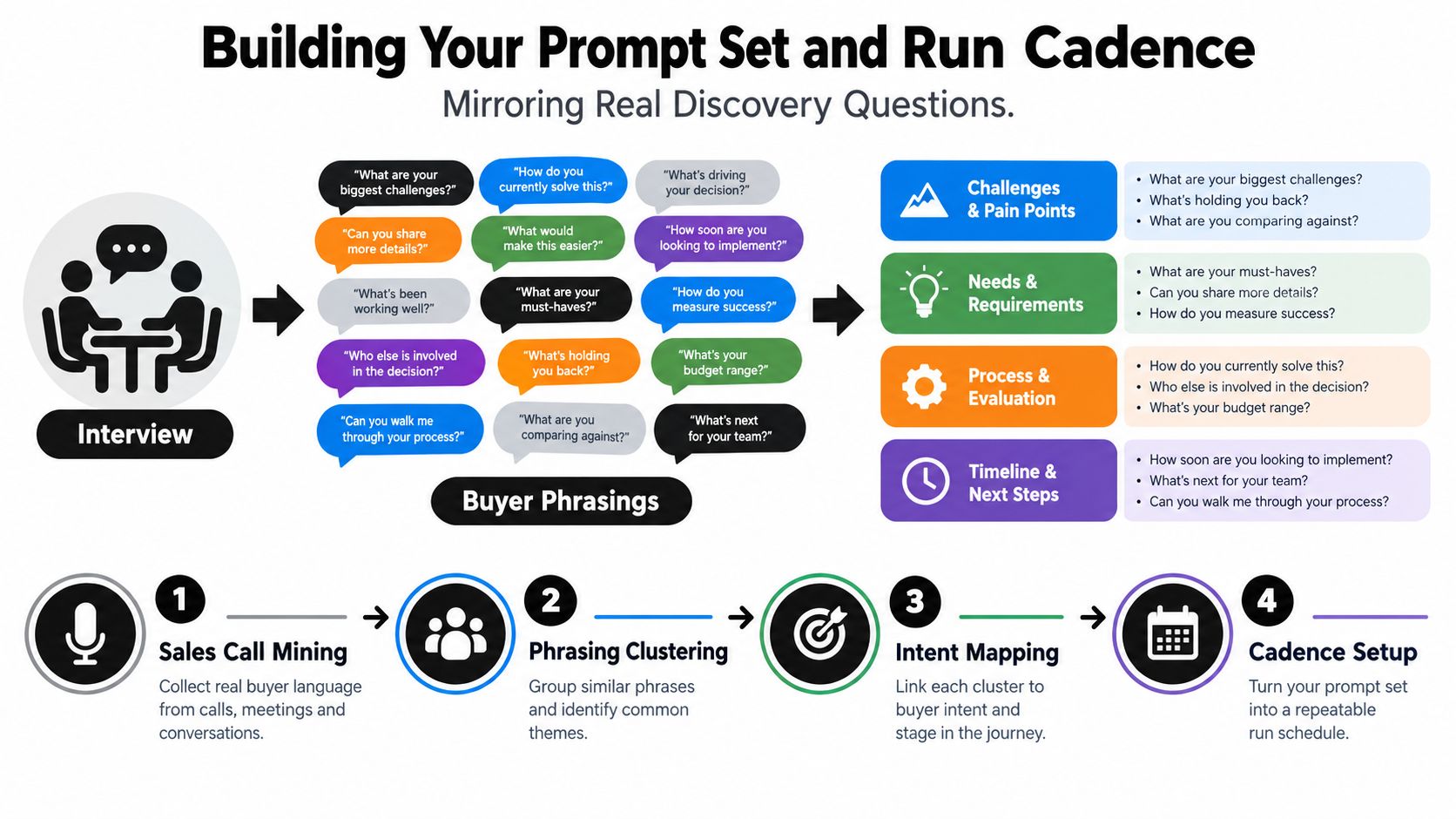
Your prompt set should mirror the questions buyers ask, not the keywords your SEO platform happens to store. Start with sales calls, customer interviews, support tickets, demo forms, and win-loss notes. Capture the language buyers use, including awkward phrasing and comparisons your team wouldn't invent.
Cluster the prompts by intent:
- Problem-aware: “How can a subscription business reduce failed payments?”
- Vendor-aware: “Which tools help subscription teams manage failed payments?”
- Comparison: “What are the alternatives to a specific payment recovery platform?”
- Post-purchase: “How do I configure payment recovery for a global subscription product?”
Include negative controls too. A payroll software brand shouldn't appear for every HR question, and a cybersecurity vendor shouldn't treat irrelevant prompts as wins. Negative controls help detect overbroad classifications and false positives.
Choose cadence and governance together
Run weekly checks when a campaign, launch, or reputation issue is active. A stable category may need less frequent monitoring, while regulated or news-sensitive businesses may require more frequent observation. The right cadence depends on volatility, not on a universal calendar rule.
Use rolling baselines instead of reacting to one unusual answer. One industry guide recommends investigating a citation-share or prompt-coverage shift when it moves more than 15–20% relative to its four-week average and persists for at least two consecutive reporting periods. The citation tracking methodology gives teams a practical starting point for separating signal from model noise.
Don't modify the prompt set after every result. Keep a version history, record additions and removals, review prompts for obsolete products, and rotate exploratory prompts separately from the stable benchmark. Teams interested in the underlying collection mechanics can also review this guide to Google scraping, while the operational test discipline is covered in prompt regression testing.
What Actually Moves Mentions and Citations
Mentions and citations have different earning conditions. An assistant may mention a brand because it recognizes the entity as relevant. It cites a source when that source helps support the answer and appears retrievable, clear, and authoritative for the specific claim.
That distinction changes the content brief. Generic “optimize this page for the keyword” instructions rarely explain why one source should replace another. Stronger citation candidates usually give the assistant evidence it can reuse:
- Original research with a clear method and defined terms
- Proprietary datasets or benchmarks
- Named subject-matter experts with verifiable credentials
- Detailed comparison pages that state inclusion criteria
- Product documentation with current facts and specific use cases
- Transparent pricing, limitations, and implementation details
External validation matters as well. Third-party review platforms, reference pages, engaged community discussions, encyclopedic entity records, and video transcripts can all contribute to how an assistant understands a brand. The useful question is not “Can we get more mentions?” but “What evidence is missing from the sources assistants already consult?”
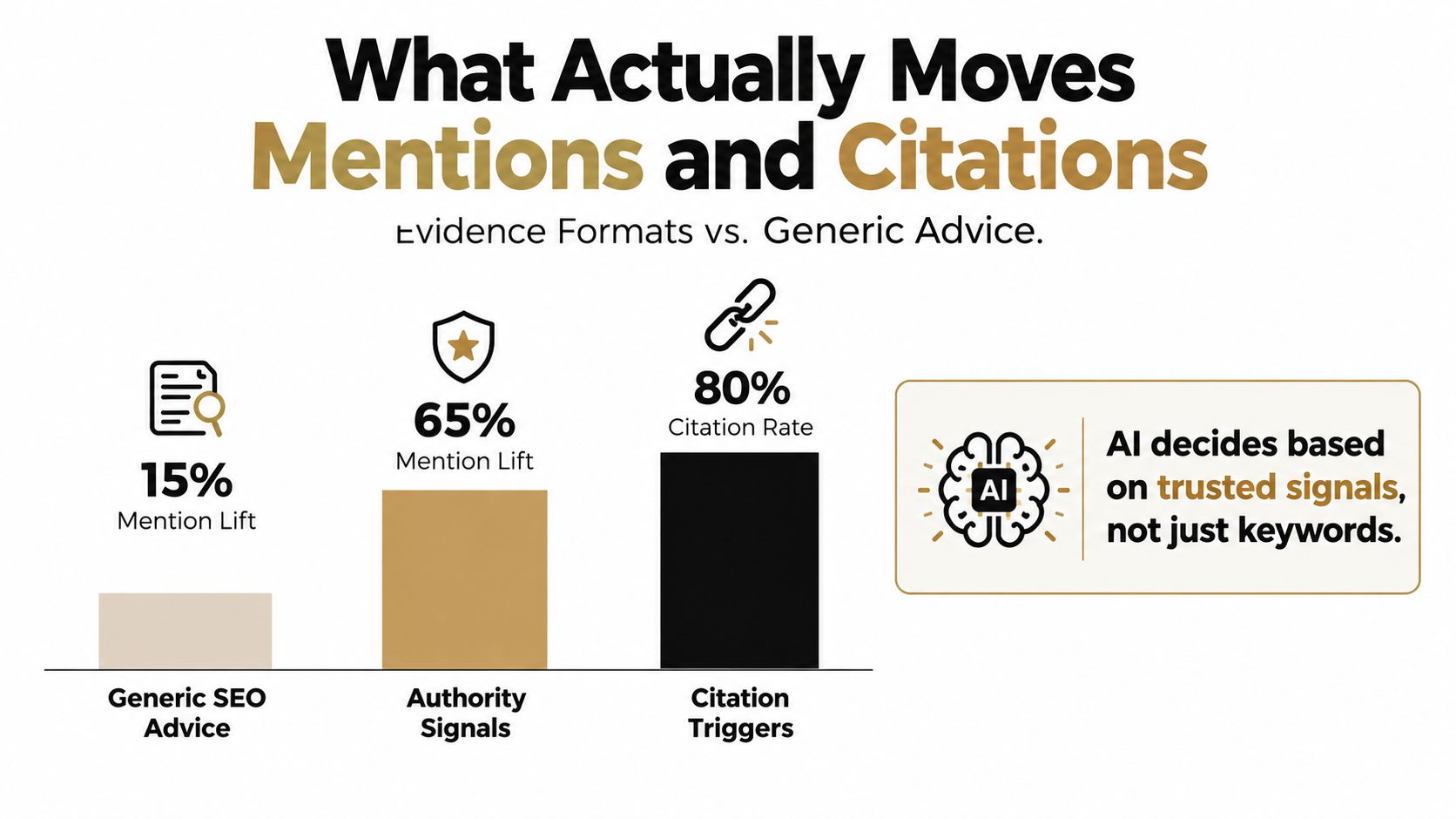
A benchmark from the Cloud Security Alliance notes that fewer than one in five brands in most industries are both frequently mentioned and consistently cited. Its analysis also identifies structured data, transparent pricing, third-party validation, Reddit, and Quora as signals or environments that can influence visibility. The research on the AI visibility deficit supports a practical conclusion: relevance and authority aren't interchangeable.
Consider a hypothetical intervention rather than a claimed case study. If a fintech brand publishes a well-documented benchmark dataset, Perplexity might begin citing that page while ChatGPT mentions remain unchanged. That outcome would show why teams must measure each assistant separately. It wouldn't prove that every dataset will produce the same response.
Turning Findings Into a Prioritized Action Backlog
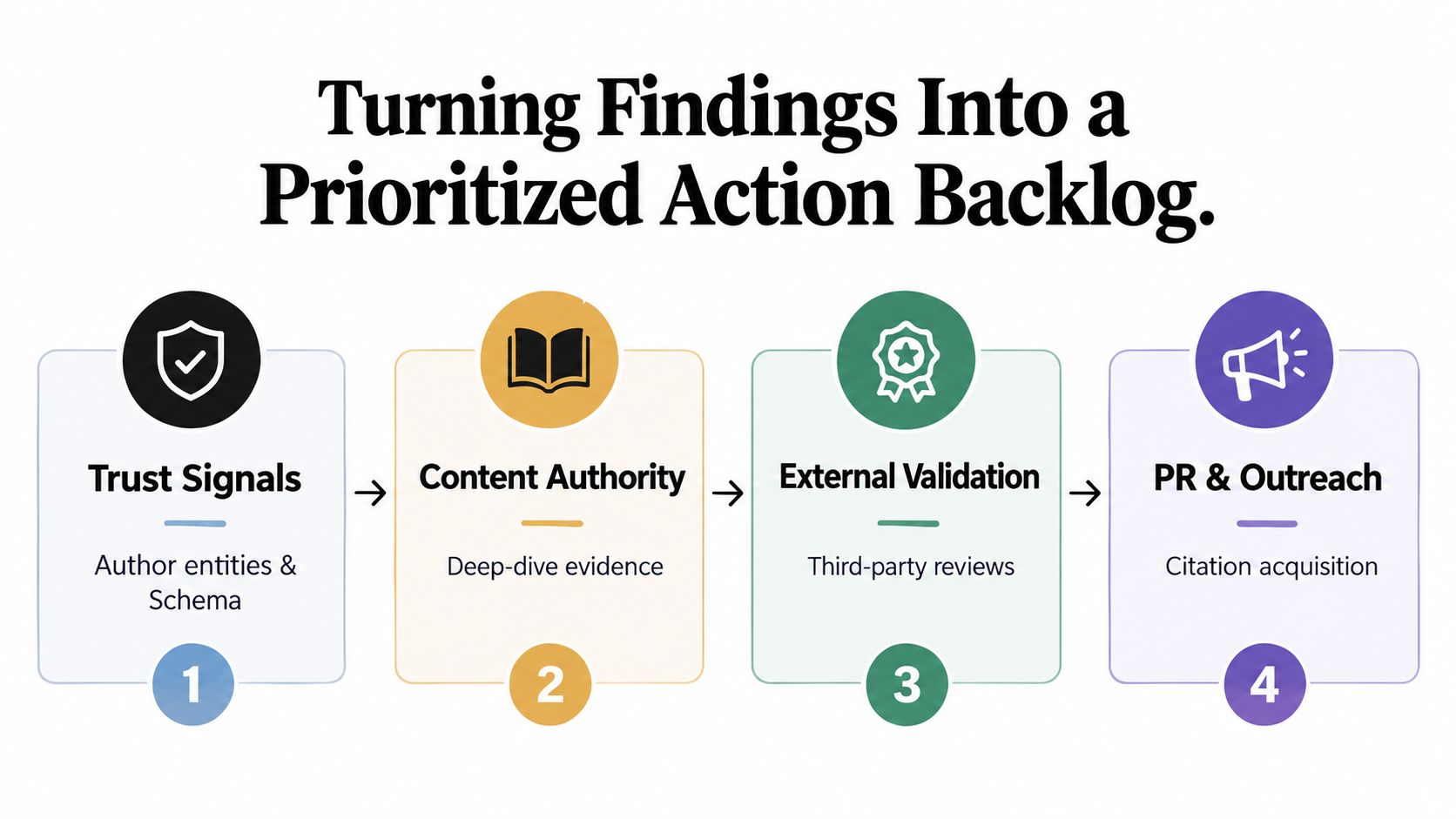
A monitoring report becomes valuable when someone can assign the next task. Route findings into four practical lanes, then connect each item to a signal, an owner, and a confidence level.
- Trust signals: Brand and communications teams can strengthen author entities, organization details, structured data, review coverage, and third-party validation.
- Content authority: Editorial teams can expand comparison pages, answer product objections, publish original evidence, and update stale claims.
- UX signals: Web teams can improve answerable formatting, page structure, accessibility, and the path from a cited claim to supporting detail.
- Technical signals: SEO and engineering teams can inspect crawl access, canonicalization, sitemaps, rendering, and indexable source pages.
Don't write a vague ticket such as “improve AI visibility.” Write “increase citation presence for pricing prompts by updating the pricing explanation and validating the linked source,” then record the current baseline, target direction, owner, and confidence. The target can be qualitative when the dataset is still small.
A sprint board your team can use
Days one through three should focus on diagnosis. Content reviews the cited pages, brand or communications reviews external sources, and engineering checks whether important pages are accessible and technically coherent.
Days four through eight should address the highest-confidence gap. That might mean refreshing a comparison page, adding evidence to a product explanation, correcting an entity inconsistency, or improving the page that assistants already cite.
Days nine through ten should cover validation. Re-run the affected prompts, compare source selection and framing, document what changed, and decide whether the result merits wider rollout.
This routing prevents every problem from becoming a content problem. If the assistant cites a third-party review instead of your documentation, editorial alone may not solve it. If the assistant repeats an incorrect product attribute, the fix may require coordinated changes across product marketing, support, and external profiles.
Treating AI Visibility as a Distribution, Not a Snapshot
There is no universal AI ranking position to optimize for. Visibility is distributed across prompts, assistants, sources, and time. A brand can lead on problem-aware questions, disappear on comparisons, earn citations in one assistant, and receive only unsupported mentions in another.
One-off checks mislead because prompt wording changes the answer, retrieval systems refresh their sources, models are updated, and pages become less current. A monthly summary can still help leadership, but the underlying program should preserve enough observations to show whether a shift is durable.
A practical rollout can follow this sequence:
- Weeks one and two: Establish a baseline across a representative set of buyer prompts and several priority assistants.
- Weeks three through six: Fix the strongest trust, source, and content gaps revealed by the baseline.
- Weeks seven through ten: Expand into long-tail questions, competitor comparisons, objections, and post-purchase prompts.
- Weeks eleven and twelve: Formalize reporting, review prompt governance, and set the next measurement cycle.
A research guide on measurement reliability recommends at least seven runs per prompt per day for brand visibility monitoring and eight runs when source-level coverage matters, with rolling aggregation across two to four weeks for more stable estimates. The AI visibility measurement guidance highlights the core principle: treat visibility as a distribution, not a snapshot.
Optimize for consistency across meaningful buyer questions, not for one impressive answer.
The teams that build this discipline don't chase every fluctuation. They identify persistent gaps, improve the evidence assistants can trust, and watch whether those improvements spread across relevant prompts and models.
MyMentions helps founders, marketers, and SEO teams track prompt-level visibility, citations, sentiment, competitors, and traffic attribution across supported AI assistants. Create a buyer-intent benchmark, inspect the sources shaping answers, and turn the findings into a prioritized backlog by visiting MyMentions.