Competitor Analysis Framework for AI Visibility in 2026
A practical competitor analysis framework for AI visibility: map prompts, benchmark rivals, find citation gaps and turn them into a backlog you can ship.

Your strongest competitor may win the recommendation before a buyer visits either website. That matters in a category where competitive opportunities represented 65% of sales opportunities for the average B2B software company in Crayon's 2024 State of Competitive Intelligence survey. A feature matrix won't tell you whether an AI assistant includes your product, describes it accurately, or recommends a rival instead.
A useful competitor analysis framework needs to capture those answers and trace the evidence behind them. The practical output isn't a leaderboard. It's a defensible shortlist of changes your team can test, with a clear connection to buyer consideration and business outcomes.
Table of Contents
- The Six-Stage Framework at a Glance
- Set the Market Boundary and Freeze the Competitor Set
- How to Map Buyer Prompts and Competitor Answers
- Benchmark Share of Voice, Rank and Sentiment
- Find the Citation Sources Behind Competitor Wins
- Prioritize Gaps by Business Impact
- Start Your First Competitor Benchmark This Week
The Six-Stage Framework at a Glance
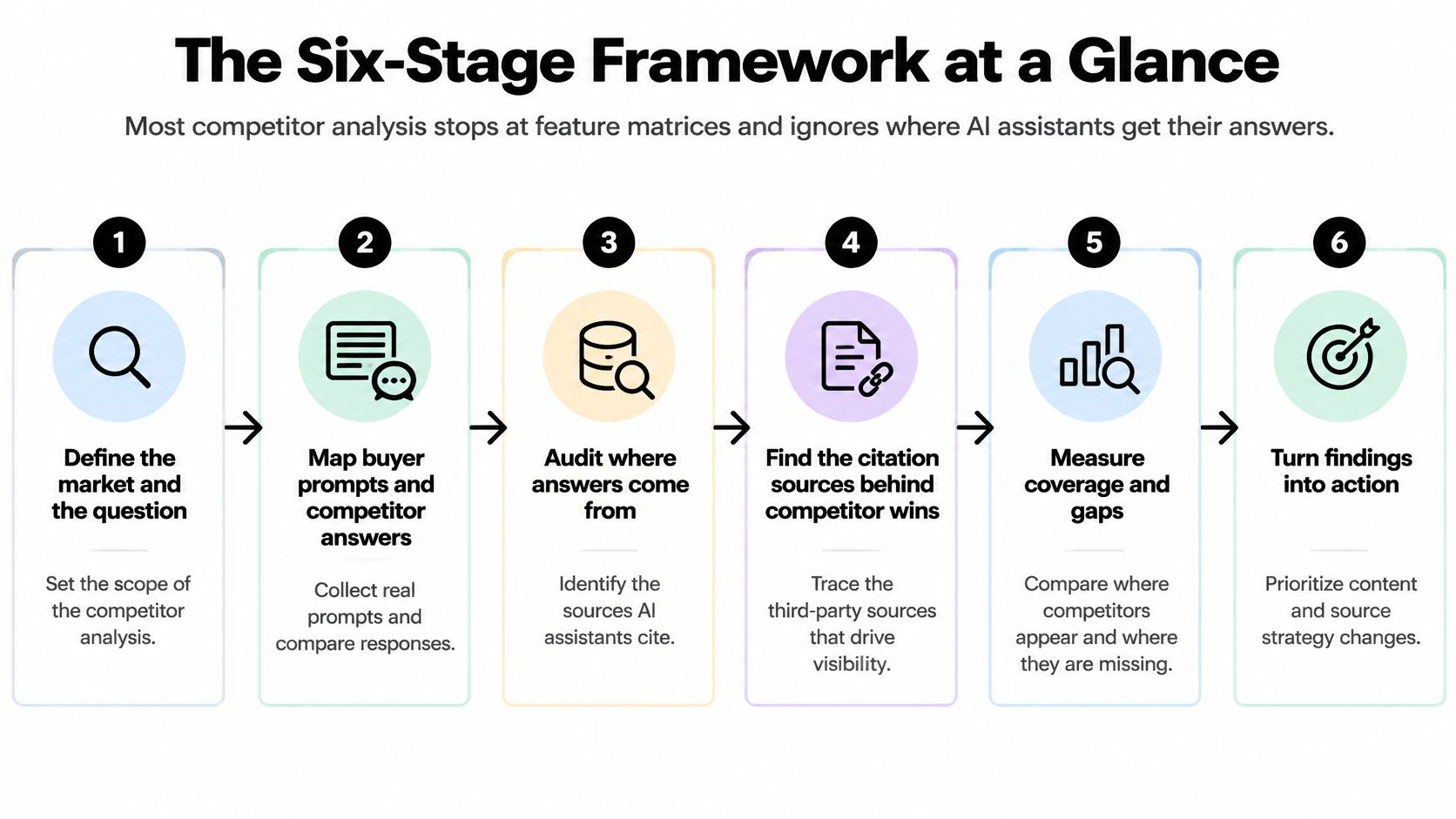
Most competitor analysis stops at feature matrices and ignores where AI assistants get their answers. Keep the product comparison, but add an evidence pipeline that starts with a business decision and ends with a repeatable scorecard.
The Stratrix competitive benchmarking framework describes a six-stage sequence: define the problem, simulate customer search, identify competitors, select comparable cases, audit their communication and experience, and compare observations in a case-by-indicator matrix. For AI visibility, the important adaptation is to treat each answer as an observation, not as an authoritative verdict on the market.
| Stage | Question it answers | Output | Worked example |
|---|---|---|---|
| Define the market and decision | Which buyer choice must this analysis support? | Written scope and decision | Understand agency CRM shortlists |
| Simulate buyer search | What would a customer ask? | Fixed buyer-intent prompts | Best CRM for a small agency |
| Identify competitors | Which brands appear in the answers? | Candidate competitor inventory | Record named CRM products |
| Select comparable cases | Which alternatives serve the same buyer? | Frozen peer set with inclusion rules | Match agency focus and pricing model |
| Audit answers and evidence | How is each brand presented and supported? | Mentions, order, descriptions, cited URLs | Rival recommended for easy setup |
| Compare observations | Which differences deserve investigation? | Scorecard by provider and prompt category | Compare onboarding-related recommendations |
The workflow connects collection to action:
Make the decision explicit
A weak starting question is whether your brand is visible in AI. A useful one is whether buyers evaluating an agency CRM encounter your product, understand its differentiator, and receive evidence that supports choosing it.
That distinction changes what you collect. A brand-history answer might contain your name without helping a buyer evaluate your product. An alternatives answer might omit you entirely at the moment you most want consideration.
Practical rule: Don't collect a metric unless someone can explain which decision it will inform.
Create a collection record before running prompts. Include the date, provider, exact wording, geography, language, available model version, and sampling rules. Save the evaluation rubric alongside it so a different analyst can classify the same answer consistently.
One run is only a snapshot. It describes what the selected systems returned under the recorded conditions, not what every buyer sees or why the system chose those brands.
Set the Market Boundary and Freeze the Competitor Set
Start with the product boundary and the geographic or language boundary. The European Commission's market-definition guidance distinguishes products buyers regard as interchangeable from geographic markets with sufficiently comparable competitive conditions. That's a useful discipline even when you're measuring recommendations rather than revenue share.
Say you sell scheduling software to UK dental clinics. Buyers might consider specialist dental software, generic booking tools, spreadsheets, or their existing practice-management system. Those alternatives solve overlapping problems, but they shouldn't all be scored as equivalent software brands.
Write the boundary plainly:
We're evaluating English-language recommendations for scheduling options available to independent UK dental practices, focusing on appointment administration and compatibility with existing workflows.
Include alternatives without distorting the benchmark
Use separate labels for the options buyers could choose:
- Direct rivals: Products serving the same buyer and primary workflow.
- Substitutes: Other ways to complete the job, including existing systems and manual processes.
- Adjacent brands: Products that appear beside yours but serve a different segment or broader use case.
Porter's Five Forces helps explain why this distinction matters: competitive pressure includes substitutes, buyer and supplier bargaining power, and potential entrants, not just named rivals. For a SaaS company, platform dependence and switching costs can matter as much as feature breadth.
Use discovery answers to build the candidate list, then freeze the scored set before baseline collection. Include brands because they match your criteria, not because someone wants to beat them. Log exclusions too, especially enterprise products that dominate broad answers but don't serve your customer.
For conventional search discovery, Keyword Kick's guide to tools like SpyFu can help you choose complementary tools. Treat those findings as candidates to investigate, not proof of AI recommendation strength.
Keep broader demand questions separate from rival-specific decisions; the distinction between competitive intelligence and market research helps prevent scope creep. Maintain one shared sheet containing the boundary, inclusion rationale, substitute labels, and planned review date.
How to Map Buyer Prompts and Competitor Answers
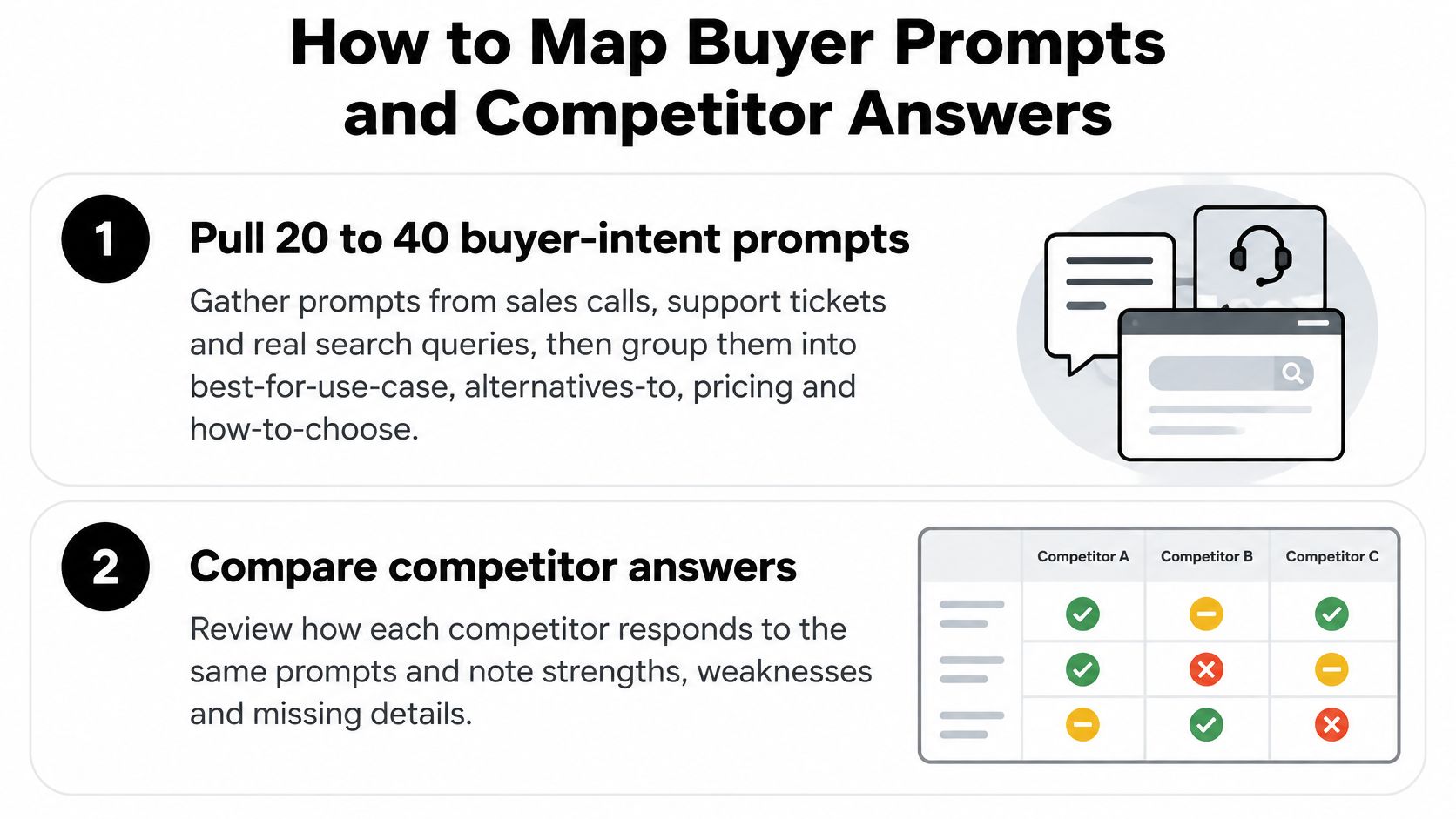
Build the prompt library from buyer language, not from the categories your marketing team wishes buyers used. Sales-call notes, support tickets, site-search terms, and search-query reports give you concrete needs and constraints.
Use this checklist to turn those inputs into comparable observations:
Build the prompt library
Collect decision-oriented questions. Group them into best-for-use-case, alternatives-to, pricing, and how-to-choose categories. Include constraints such as integrations, customer type, geography, and implementation requirements when buyers mention them.
Lock the wording. Save each prompt as a versioned record rather than rewriting it during collection. Use these buyer-intent prompt examples to check coverage, but don't replace specific customer language with generic category questions.
Choose the relevant answer surfaces. Run the same prompts across providers your buyers use, such as ChatGPT, Gemini, Perplexity, and Claude. Our provider checks use provider APIs, don't reproduce every consumer app experience, and don't track Google AI Overviews, Google AI Mode, or Microsoft Copilot; inspect those surfaces separately.
Capture the answer, not just the brand count
Preserve the full response. Record named brands, recommendation order, the description attached to each brand, and every returned citation URL. If an answer groups products without ranking them, mark the order as unranked instead of inventing a position.
Log competitor pairings. Record which brands appear together and whether the assistant presents them as alternatives, complementary tools, or examples. Co-occurrence alone doesn't establish that they compete for the same purchase.
Save timestamped raw outputs. Store the original answer alongside the extracted fields so an analyst can inspect classification mistakes. Keep failed checks and answers without recommendations visible rather than dropping them.
Say a freelancer-invoicing prompt produces a stable shortlist on ChatGPT and Perplexity, while Gemini recommends a different product and cites a separate review page. That isn't a reason to average everything immediately. It's a reason to inspect provider-specific evidence and buyer-fit differences.
The finished grid should let someone select a prompt and see every provider's answer, the brands included, their presentation, and the supporting URLs. Keep branded prompts separate from unbranded discovery prompts: asking for alternatives to your product already introduces your name and changes what inclusion means.
Benchmark Share of Voice, Rank and Sentiment
Define the metrics before collecting the baseline. Every formula needs a denominator, inclusion rule, observation period, and unit. Otherwise, an apparent competitor lead may reflect different samples.
Scorecard metrics, formulas and pitfalls
| Metric | Definition or formula | Report as | Watch out for |
|---|---|---|---|
| Visibility | Answers mentioning your brand divided by tracked answers | Percent | Mixing prompt sets across periods |
| Share of voice | Your mentions divided by all brand mentions in the frozen set | Percent | Competitor list changed mid-quarter |
| Average position | Mean rank when the brand is recommended | Number, lower is better | Ignoring answers where you do not appear |
| Sentiment | Positivity of descriptions across answers | Positive, neutral and negative split | One favourable quote skewing the total |
| Citation frequency | Answers citing a URL from your domain divided by answers | Percent | Counting only owned URLs |
| Confidence | Repeatability of the result across repeated runs | Range across runs | Treating a single run as proof |
For share of voice, specify whether repeated brand names within an answer count repeatedly or whether each brand counts once per answer. Either convention can support a descriptive benchmark, but switching conventions invalidates the comparison. This guide to AI share of voice helps distinguish competitive presence from simple inclusion.
Citation frequency needs a companion measure for third-party citations associated with a brand. Otherwise, your owned-domain score could look weak even when external sources consistently support recommendations.
Validate the gap before assigning work
The Qualtrics benchmarking guide identifies incompatible samples, inconsistent calculations, selective periods, and poorly matched comparisons as benchmarking pitfalls. Report medians and ranges alongside averages, and use quartiles or standard deviations when the sample supports them.
For position, absence is not a good rank or a bad rank; it's a separate outcome. Report average position together with visibility so a brand recommended prominently but rarely doesn't appear stronger than a frequently recommended rival.
Repeat the prompt panel under matched conditions. Calculate your metric minus the competitor's metric within the same provider and prompt category, then inspect whether the direction and practical size persist across runs. For position, a negative difference favours you; for visibility, a positive difference does.
A repeatable gap is a candidate for investigation, not proof that a particular page caused the result.
Netco Design LLC's guidance on how to measure where your business stands provides complementary context for comparison. The operational requirement is stricter: compare like with like before deciding what to change.
Create a gap register with the prompt category, provider, metric, both brands' values, range across runs, observation date, and validation notes. Treat confidence as descriptive repeatability, not a formal statistical confidence interval. Only validated gaps should receive implementation effort.
Find the Citation Sources Behind Competitor Wins
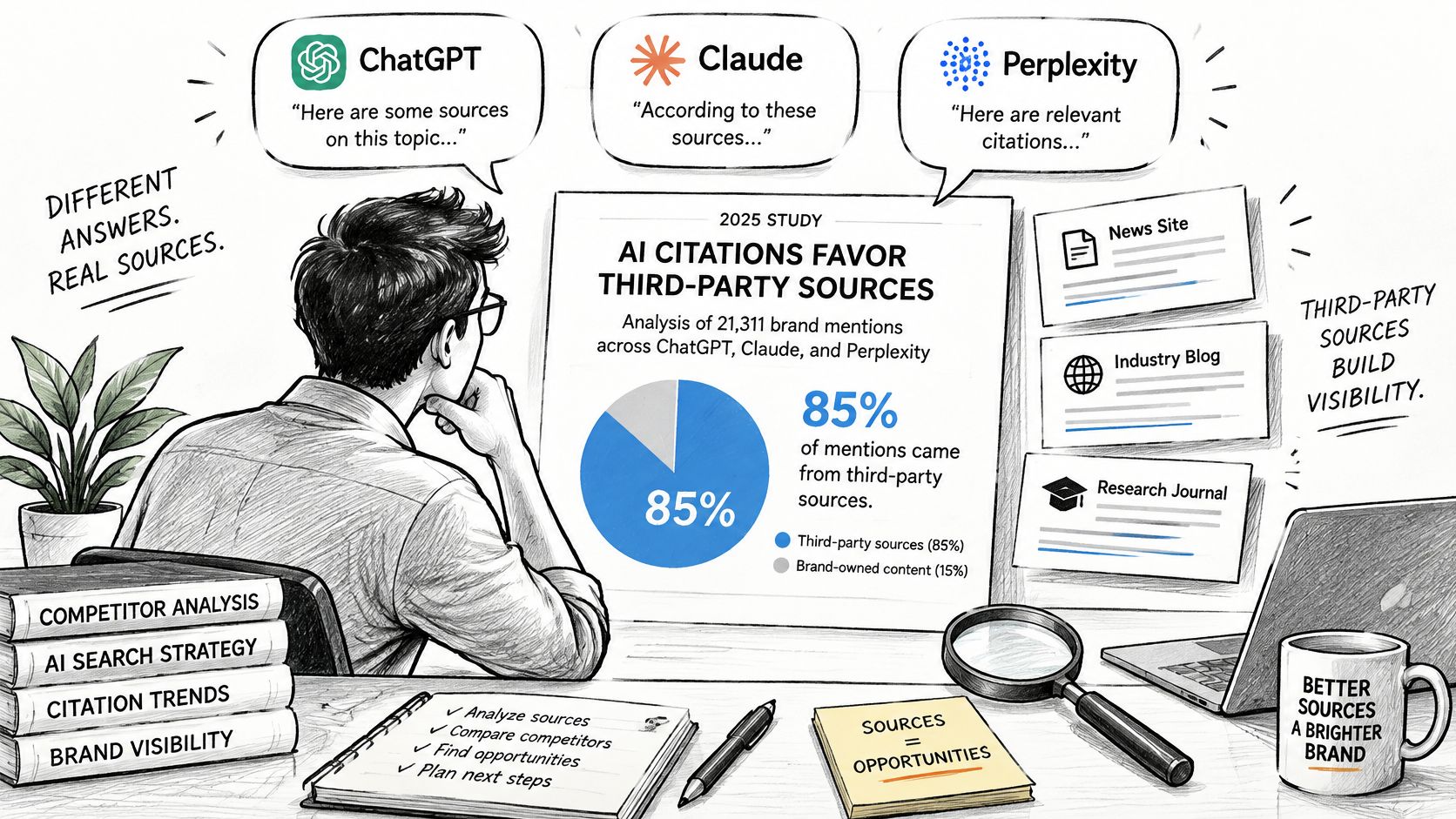
Owned content isn't the only competitive lever. An independent 2025 analysis of 21,311 brand mentions across ChatGPT, Claude, and Perplexity, published by BrandMentions, found that 85% of mentions came from third-party domains, compared with 13.2% from brands' own websites. That finding supports inspecting external evidence before commissioning another batch of blog posts.
It doesn't establish that every citation caused a recommendation or that the same distribution applies to your category. Use it to change the audit question: where does the visible supporting evidence come from?
Build a source-to-outcome map
Extract every returned URL and inspect the page rather than relying on its title. Classify it as a review site, comparison page, partner listing, documentation, community discussion, or press item.
Then connect the page to the claim it supports:
- Source identity: Canonical URL, domain, page type, and accessibility.
- Brand relationship: Which products the page discusses and whether it compares them.
- Supported claim: Pricing, integration compatibility, customer fit, reliability, or another buying criterion.
- Observed outcome: Prompt category, recommendation position, description, and collection date.
Count distinct domains as well as citation occurrences. Repeated citations to a single page indicate a different evidence pattern from support distributed across independent publishers. Neither proves authority by itself, so inspect whether pages contain original information or repeat the same material.
A structured citation analysis should also distinguish a source attached to an answer from a source visibly supporting a particular brand claim. Don't assign every citation in a response to every recommended product.
Choose the intervention that matches the evidence
Suppose a rival appears in comparison answers supported by a detailed industry review, while your documentation appears only in setup questions. The gap isn't necessarily a shortage of content. Buyers lack accessible comparative evidence about your product.
Possible responses include publishing an honest comparison, requesting a factual correction from the review publisher, improving a partner listing, or inviting customers to leave authentic reviews. Don't request favourable ratings or imply that editorial coverage can be guaranteed.
Keep genuine competitors separate from incidental co-mentions. A brand discussed only in category history doesn't belong in the same priority queue as a substitute repeatedly recommended for your target use case.
The deliverable is a source-to-outcome map: an observed recommendation, its visible supporting evidence, the missing or inaccurate information, and a feasible intervention. It's a hypothesis generator, not a map of the model's hidden reasoning.
Prioritize Gaps by Business Impact
Rank each validated gap by buyer intent, recurrence, consistency after normalization, and delivery effort. Add a named owner before accepting it into the active backlog. A missing recommendation in a purchase-comparison prompt deserves different treatment from a neutral description in an educational answer.
Don't equate citations with revenue. A downstream-impact study summarized by Influencer Strategists found that users receiving an AI recommendation were 2.5 times more likely to visit the recommended brand within seven days, while 55.9% of AI-influenced visits arrived through search rather than a direct AI referral. Those findings illustrate why referral-only reporting can miss assisted discovery, not what lift your own intervention will produce.
Separate exposure from business results
Maintain distinct outcome fields:
- Mention: The buyer could encounter the brand.
- Recommendation position: The assistant placed it within an ordered recommendation.
- Assisted discovery: Subsequent behaviour is consistent with increased interest, including branded search or direct visits.
- Attributable conversion: Available tracking connects a visit or conversion to a detectable source.
Branded searches and direct visits are useful context, but they aren't automatic proof of AI influence. Campaigns, launches, seasonality, and existing demand can move them too. Compare your own visibility trends with later behaviour; don't pretend you can observe competitors' private conversion performance.
Gap types, owners and first tests
| Gap type | Typical owner | Fix to test | First check |
|---|---|---|---|
| Missing from comparison prompts | Content or SEO team | Publish an honest comparison page | Is the page cited during the next scheduled review? |
| Rival cited on review sites | Marketing or partnerships | Request updated reviews and case studies | Does average position change? |
| Weak or unclear description | Product marketing | Clarify positioning in docs and key pages | Does sentiment shift across repeat runs? |
| Documentation not cited | Docs or product team | Answer buyer questions in help pages | Are documentation URLs cited in answers? |
| Present but ranked low | Product marketing | Strengthen differentiators in evidence sources | Does average position improve? |
Use these checks as early signals, not completion criteria. A newly cited comparison page hasn't succeeded commercially if the answer still recommends your product to the wrong buyer.
Convert each selected gap into a backlog item containing the gap statement, prompt category and providers, owner, fix to test, and success threshold with a deadline. Set that threshold from the baseline and observed variability rather than choosing an impressive-looking improvement.
Keep the active queue short. Use SEO recommendations to translate evidence gaps into specific tasks, but reject generic recommendations that don't address the observed problem.
Where feasible, stagger changes and retain unchanged prompts as a control panel. If you rewrite documentation, launch a campaign, and secure review coverage simultaneously, you may observe improvement without being able to attribute it to a particular action.
Start Your First Competitor Benchmark This Week
Make the first benchmark small enough to finish and precise enough to repeat. A carefully scoped panel gives you a better starting point than a large dashboard nobody can audit.
A workable opening week
- Monday: Name the decision, buyer segment, product boundary, and geographic or language scope. Ask the person who will act on the findings to approve them.
- Tuesday: Draft buyer-intent prompts from customer language and organize them by decision category. Remove duplicates that add volume without adding a distinct buying question.
- Wednesday: Finalize the competitor set and document inclusion and exclusion decisions. Keep substitutes visibly separate from directly comparable brands.
- Thursday: Collect answers across the selected providers and preserve the raw records. Reserve capacity for repeated checks rather than spending the entire collection budget on prompt breadth.
- Friday: Complete the scorecard and source map, then select validated gaps for investigation. Assign an owner, a test, and a review deadline to each accepted task.
If the answers are too unstable to support prioritization, finish the week with a measurement problem to fix. Don't manufacture a confident recommendation just to complete the report.
Use tooling without outsourcing judgement
MyMentions supports this workflow in one workspace: create a product, choose a plan, and see how AI assistants mention, rank, and describe your brand. You can compare competitor share of voice and sentiment, inspect citations on supported plans, and monitor changes through alerts.
A tool shortens collection and organization. Your team still owns the market definition, prompt quality, comparison rules, and interpretation of results.
Schedule a monthly rerun of the unchanged core prompt panel. Introduce new discovery prompts separately, version any scope changes, and retain the old baseline so the next comparison remains interpretable.
Visit MyMentions to build a buyer-intent prompt workspace and compare how supported AI providers mention, rank, and describe your product against competitors. Start with a defined buyer decision, then use the answers and available citation evidence to create a focused backlog your team can test.