Competitive Analysis Case Study for SaaS Teams
See how a competitive analysis case study turns AI mentions into decisions your SaaS team can ship.
A competitive analysis case study follows one product team as it stacks its product against a couple of direct rivals, makes sense of what shows up, and picks what to test next. Think of it as a contained story in four beats — context, process, findings, and decisions — not a full market tour.
Table of Contents
- What a Competitive Analysis Case Study Answers
- Building the Case Context Before Any Comparison
- Set Up the Product and Comparison Boundaries
- Record Coverage Before Reading Results
- Designing The Research Process For AI Mentions
- Keep Provider Comparisons Consistent
- Inspect Citations And Tracking Limits
- Reading Visibility, Position, and Sentiment Together
- How to Read the Case Metrics
- Recognize Patterns Across Buyer Prompts
- Separate Actionable Findings From Watch Items
- Decisions That Follow the Case Findings
- Separate Shipping Work From Open Questions
- Report Decisions With Their Limits
- Misconceptions That Weaken a Case Study
- Keep Diagnostics and Coverage in Perspective
- Frequently Asked Questions
What a Competitive Analysis Case Study Answers
Think of it like a match replay. You rewatch a single game closely enough to see why the score shifted, instead of trying to rank the whole league.
For a SaaS or digital product team, that means zeroing in on one real buying moment. A good example: do assistants suggest its buyer-intent tool next to two competitors when someone asks for software that spots prospects actively researching a purchase?

That tight focus gives founders, marketers, SEO leads, and competitive intelligence folks something concrete to work from. The question stops being who “wins AI” and becomes something they can actually act on.
- Buyer relevance ties the comparison to prompts real prospects would type.
- Evidence boundaries draw a clear line between what was observed and what is just assumed.
- Decision value links every finding to something the team can dig into or test.
Follow the Evidence Through Four Beats
Recommendations work best when they show up after the proof, not before it. That is why the walkthrough runs in this order, with each step answering its own question.
Here is what each beat of the case study must answer before the team is allowed to make a call:
What Each Beat of the Case Study Must Answer
| Case Beat | Question It Answers | Decision It Can Support |
|---|---|---|
| Business context | Which buying situation matters? | Choose prompts and rivals |
| Research process | How was evidence collected? | Set comparison boundaries |
| Findings | What patterns appeared? | Select gaps to investigate |
| Decisions | What should happen next? | Prioritize tests and owners |
Once those guardrails are set, the team knows exactly which conclusions are fair to draw — and which ones are a stretch.
To gather those signals, MyMentions tracks how AI assistants mention, rank, and describe a product across buyer prompts, pulling visibility, position, sentiment, competitors, citations, recommendations, and AI-driven traffic into one workspace. Explore MyMentions’ AI visibility tracking.
For this case, we will look at visibility, position, sentiment, and citations, then see if AI-referred visits show up at all. Each is a different angle on the same comparison, not a stand-in for buyer preference.
One note before we start: this case shows a method, not a guarantee that one fix will earn more mentions. Write down one buyer question your team needs answered, then name the decision that answer could change.
The job of the case is to turn a comparison into a prioritized backlog, not a trophy chart.
Before you look at a single score, label the replay: what product you're tracking, who buys it, who you're up against, and which conversations count.
Building the Case Context Before Any Comparison
Let's walk through this with SignalHarbor, a fictional buyer-intent tool for sales teams. It flags accounts that are actively researching a purchase.
For this example, SignalHarbor is measured against two fictional rivals, IntentBeacon and AccountRadar. Think of it like a taste test with three unmarked cups — same questions, same judges.
The lens here is tight on purpose. This competitive analysis case study looks only at selected buying questions. Not market size. Not revenue. Not who has the better product.
- Discovery prompt: “Which buyer-intent tools suit a small B2B sales team?”
- Comparison prompt: “How does SignalHarbor compare with IntentBeacon and AccountRadar?”
- Problem prompt: “What software helps prioritize accounts showing purchase intent?”
Those three prompts give every later chart its job. After all, a glowing answer to “Why is SignalHarbor great?” tells you nothing about whether it shows up when a real buyer is still deciding.
Context comes before charts because visibility on vanity questions can hide absence from buying conversations.
Set Up the Product and Comparison Boundaries
Getting started is pretty straightforward:
- Create the product so the workspace knows which brand to watch.
- Choose a plan based on provider coverage and your checking budget.
- Review answers to see if assistants mention, rank, and describe the brand accurately.
Then add your two rival brands. Customers can compare share of voice and sentiment against added competitors, which turns a lonely brand score into a head-to-head result from the same conversations. Explore competitor tracking in MyMentions.
It's also worth keeping this separate from wider customer discovery. Our guide to competitive intelligence versus market research explains that boundary.
Record Coverage Before Reading Results
Starter checks OpenAI, Google Gemini, and Perplexity. Pro and Enterprise also check Anthropic Claude, xAI Grok, Azure OpenAI, DeepSeek, and Meta Llama through Together.ai.
That detail belongs in your case notes, not in a footnote under a chart. A Starter snapshot and a wider provider sample aren't the same test, so they shouldn't be compared like they are.
- Pro: 50 provider checks daily, so you’ll want a tight prompt list.
- Enterprise: 100 provider checks daily, which leaves room for a bigger checking budget.
For this fictional setup, let’s pick Pro. Write down the prompts and providers first, then start collecting answers. Keep that scope the same across all three brands and every future check.
One caveat, though. Provider API checks aren't consumer-app replays. Google AI Overviews, Google AI Mode, and Microsoft Copilot sit outside the tracked set.
Put this question at the top of your brief: How do tracked assistants mention, rank, and describe SignalHarbor against IntentBeacon and AccountRadar across these buyer prompts?
SignalHarbor didn’t start with a dashboard. It started with prompt design.
For this competitive analysis case study, the team grouped buyer questions by the job each answer had to do. Think of it less like keyword research and more like eavesdropping on real buying conversations.
Designing The Research Process For AI Mentions
The prompts fell into three clear buckets:
- Category discovery — which tools actually make a buyer’s shortlist
- Comparison — how SignalHarbor gets described next to IntentBeacon and AccountRadar
- Problem-solution — what helps reps prioritize accounts showing purchase intent
Keeping those groups separate was deliberate. Strong comparison coverage can easily hide being missing from problem-led prompts. It’s like acing the final but failing the midterm — the average looks fine until you look closer.
Then came the budgeting. Checking 1 prompt across 8 providers uses 8 provider checks from the daily allowance. Ask eight people the same question, you’ve had eight conversations.
Review MyMentions’ tracking capabilities.
- Select a tight prompt list.
- Choose the supported providers.
- Reserve capacity for repeat checks.
The workflow below ties those decisions to citation review and traffic collection, so you can see what evidence is pulled at each step.
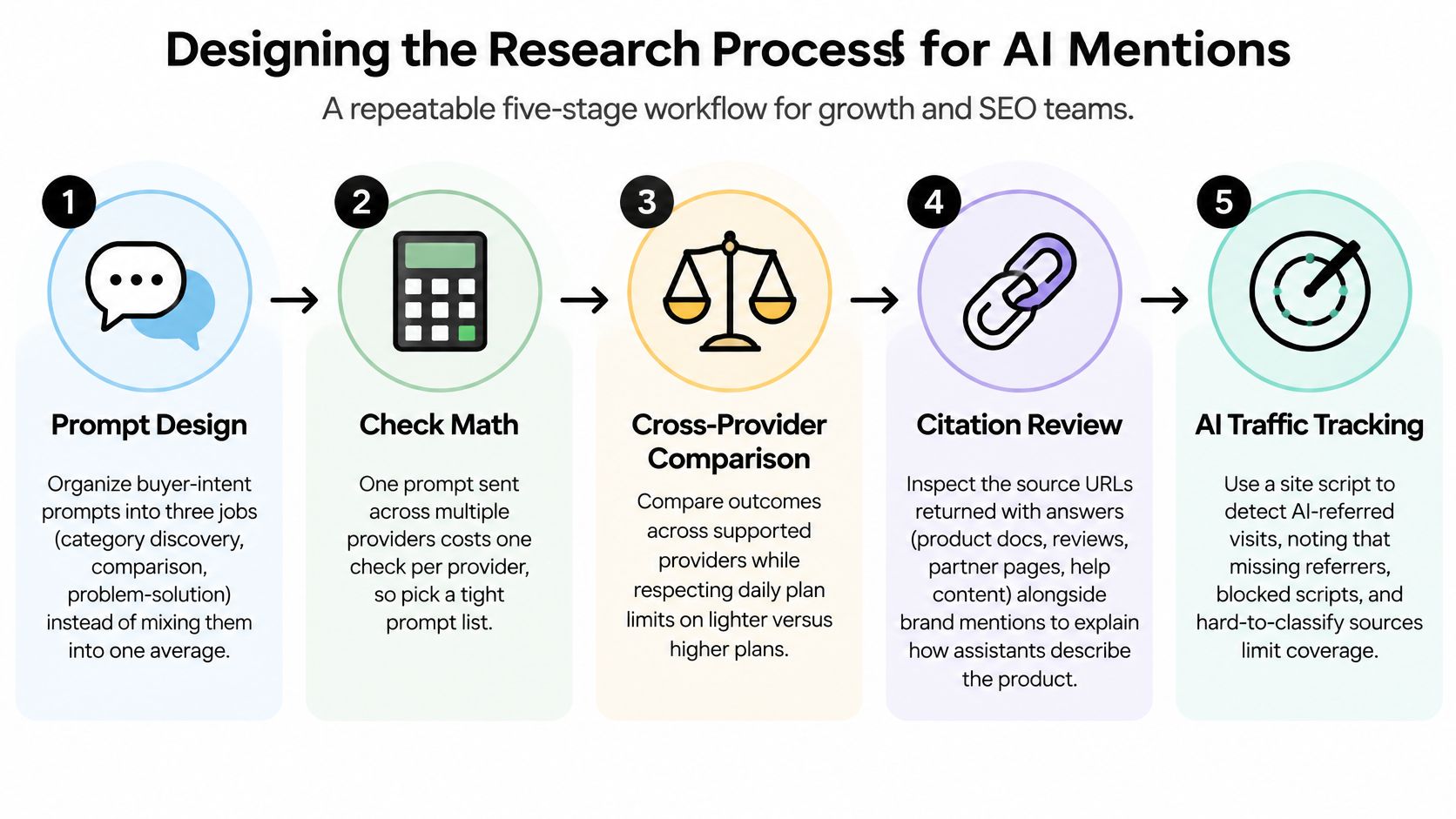
That visible sequence matters. Sampling choices stay out in the open before anyone starts interpreting answers or site visits.
Keep Provider Comparisons Consistent
Inside the workspace, the team ran identical wording and the same competitor set across providers. No mixing samples into one fuzzy trend line.
Daily allowances force a trade-off. A smaller budget means fewer prompts or fewer providers. A larger allowance buys broader coverage or more repeats — not automatically better proof.
| Sampling Choice | Research Tradeoff |
|---|---|
| More prompts | Wider buyer coverage |
| More providers | Wider assistant coverage |
| More repeats | More observations over time |
For a different take on structured tracking, the guide on how to track federal contracting opportunities shows how another team handled it.
Record what was checked before interpreting what appeared.
That log included dates and skipped checks. Simple guardrail: an untested question can’t be mistaken for a brand absence.
Inspect Citations And Tracking Limits
On Pro and Enterprise, citation analysis looks at source URLs returned with answers, side by side with brand mentions. The team tagged product docs, reviews, partner pages, and help content, then checked cited claims against how each assistant described SignalHarbor.
Those sources explain the framing. They don’t prove every influence behind it. The AI search visibility audit guide lays out a useful way to organize that review.
- Site audit scores stay diagnostic suggestions, not AI ranking factors.
- AI traffic tracking needs the website script and only captures detectable sources.
- Coverage gaps include missing referrers, blocked scripts, and sources that defy classification.
Steal their evidence sheet for your next run. SignalHarbor logged prompt groups, providers, dates, mentions, citations, diagnostic notes, and detectable visits — with tracking gaps marked clearly, not buried.
SignalHarbor’s numbers only make sense when you read them together, not as three separate scores. In this competitive analysis case study, it helps to picture visibility as getting invited into buyer conversations, position as where you sit at the table once you’re there, and sentiment as the tone you’re introduced with.
Reading Visibility, Position, and Sentiment Together
Visibility is the share of tracked answers where the customer’s brand shows up. It’s basically how often your name comes up across a fixed set of buyer questions. Explore MyMentions’ visibility tracking.
Position is the average rank, but only in the answers where the brand is actually recommended. Missing answers should stay visible as misses, not get quietly averaged away into a nicer-looking rank.
A strong rank among recommendations doesn’t tell you how many conversations excluded the brand.
Sentiment is about how the description sounds once the brand does appear. A brand can be described warmly yet rarely mentioned, or mentioned a lot in flat, unenthusiastic terms.
How to Read the Case Metrics
Before you compare anything, get clear on what each metric can and can’t tell you. That’s what prevents a decent-looking average from hiding a real gap.
| Metric | What It Measures | What It Does Not Measure |
|---|---|---|
| Visibility | Presence across tracked answers | Website traffic |
| Position | Average rank when recommended | Guaranteed buyer preference |
| Sentiment | Tone of brand descriptions | Customer satisfaction |
None of these is a verdict on its own. Together, they show where SignalHarbor gets seen, how strongly it’s framed, and where the story needs a closer look.
Recognize Patterns Across Buyer Prompts
For the fictional SignalHarbor case, think in terms of three patterns rather than made-up percentages. Each one pairs what you see with a question worth digging into.
- Frequent but secondary: SignalHarbor shows up often, yet the wording positions IntentBeacon as the stronger pick. Counting mentions alone would miss that edge.
- Strong comparisons, missing problems: SignalHarbor ranks well head-to-head with rivals, but vanishes from questions about prioritizing accounts. Buyers who phrase the need differently may get a different shortlist.
- Different citation mixes: IntentBeacon leans on review and partner pages, while SignalHarbor leans on its own docs. That points to a source gap to check, not proof of why it ranks lower.

Taken together, these patterns make competitor share of voice useful as an observed comparison inside your chosen prompts and providers. They don’t prove market share, revenue leadership, or an overall winner.
For another way to structure the comparison, use these practical benchmarking examples. Keep the sample steady before you treat any gap as meaningful.
Separate Actionable Findings From Watch Items
The next step is turning that combined read into a short, practical review list.
- Inspect the missing problem prompts against current content to spot thin or unsupported explanations.
- Review cited pages for differences in claims, context, and source types.
- Use alerts to catch when visibility shifts, then read the actual answers before making changes.
Start with the problem-prompt absence, because it gives you concrete questions and pages to work through. Keep the citation mix as a watch item until a closer review supports a specific fix.
SignalHarbor’s next move is a practice plan, not a victory lap. Think of it like a coach breaking down game film. The team takes this competitive analysis case study and turns it into clear tasks, with the evidence sitting right next to each change.
Decisions That Follow the Case Findings

The citation gap is what links what you saw to what you do next. If IntentBeacon picks up citations from reviews and partner pages while SignalHarbor only shows up in documentation, start by looking at those missing source types. It doesn’t automatically mean IntentBeacon is winning.
A missing source type is a research question, not proof of a ranking cause.
Keep the backlog focused on work the team can actually check and control:
- Trust: Confirm company details are correct and claims hold up.
- Content: Compare your pages against the buyer questions where gaps appeared.
- UX: Make the explanations assistants cite easier to scan and follow.
- Technical signals: Look into page access issues without treating test scores as ranking factors.
Pro and Enterprise include site, content, and UX recommendations tied to the product. Treat these as suggestions to investigate, not promises of more mentions. Explore MyMentions recommendations.
Separate Shipping Work From Open Questions
For this fictional example, fix the known content issues first. Leave the theories for later. A confusing help article that assistants already cite gives you something solid to rewrite, even if the impact on mentions is still unproven.
| Ship This Cycle | Investigate With More Prompts |
|---|---|
| Rewrite an unclear comparison page | Does the gap recur across buyer questions? |
| Clarify a cited help article | Do assistants repeat its ambiguous wording? |
| Correct an inaccurate trust signal | Why is the page absent from citations? |
Give every shipped task an owner and a review date. And don’t call a trust fix on an uncited page an AI visibility win unless later evidence backs that up.
- Record the original answer and citation.
- Describe the change without predicting uplift.
- Repeat the relevant prompts and compare observations.
Report Decisions With Their Limits
Use AI traffic as a coverage check, not as proof of cause. Once the script is installed, see whether detectable AI sources are sending visits to the pages you prioritized. Just remember, missing referrers and blocked scripts leave blind spots.
Reporting takes the case outside the workspace. Exported reports, or scheduled reports on Enterprise, should lay out the decision, evidence, and uncertainty. This competitive analysis deck guide can help structure that handoff.
Before you approve anything, make sure the decision spells out:
- The prompt set.
- The rival.
- The supporting evidence.
- The suggested fix.
- The still unproven outcome.
Pick one well-supported fix, assign an owner, and schedule the next comparison before you ship.
Treat the walkthrough like a referee checking the replay before calling it a win. A competitive analysis case study backs up one clear conclusion, not every story a chart seems to tell.
Misconceptions That Weaken a Case Study
The first misconception is that the case ranks the entire market. It doesn't. SignalHarbor looked at one product, a set list of buyer prompts, and the specific rivals its team chose to include. Swap out any of those inputs and you get a different race.
The second is that showing up means winning the click. Those are two separate things, so keep your notes split out:
- Mention tracks if the brand showed up at all.
- Rank notes where it landed in the recommendation.
- Description captures how the answer talked about it.
- Detectable traffic logs the visits your tracking script can actually identify.
A glowing write-up with no detectable visit, for example, isn't proof of a click. And with missing referrers, blocked scripts, and classification gaps, untracked traffic doesn't mean no traffic.
An answer can show exposure without proving preference, a visit, or revenue.
For a closer read on phrasing, see our guide to sentiment analysis in marketing. Use that qualitative take next to your traffic data, not instead of it.
Keep Diagnostics and Coverage in Perspective
The third misconception treats diagnostics as ranking factors. Site audit scores are helpful hints for what to look at, not the reason an AI model mentions you. A suggested fix is a starting point. It doesn't prove cause, and it won't guarantee more mentions.
Before you declare a rewrite a success, separate what you saw from why you think it happened:
- Note exactly what changed on the page.
- Re-run the same checks.
- Report any shift without saying the edit caused it.
The fourth misconception overlooks check costs. Run one prompt across eight providers and you've just spent eight provider checks, not one. A bloated prompt list burns through your daily limit on low-value questions and leaves little room for the repeats that matter.
The fifth misconception assumes full consumer coverage. These are provider API checks. They don't mirror every consumer app, and they don't cover Google AI Overviews, Google AI Mode, or Microsoft Copilot.
Plan your business-side measurement separately with SaaS metrics with formulas and examples.
Before you publish your case, tighten the takeaway to how your brand is currently described versus those chosen rivals. Then pick one fix backed by evidence to test next.
A useful FAQ keeps the case study contained and, more importantly, makes it obvious who takes the next step.
Frequently Asked Questions
Who Should Own a Competitive Analysis Case Study?
Pick one accountable editor, and make it the person who owns the decision the analysis feeds. Product marketing can pull the story together, SEO can review prompts and cited content, competitive intelligence can push back on which rivals made the list, and founders can sign off on priorities.
Say SignalHarbor's product marketer owns the report while the founder approves rewriting a comparison page. That kind of ownership is about follow-through, not pretending one team can explain every result on its own.
- Assign an owner who can settle scope disputes when they come up.
- Assign contributors who check the evidence falling inside their own specialty.
How Many Competitors and Prompts Are Enough?
There's no magic sample size here. Start with the rivals buyers actually weigh you against and the prompts tied to a real decision, then fit repeat checks into whatever your plan's daily allowance permits.
In practice, that might mean keeping SignalHarbor's initial rival set intact while dropping a vague discovery prompt before you widen coverage. Every provider you add multiplies the cost of each check, so spend the budget on repeated observations instead of breadth for its own sake.
Enough means useful for the decision you stated, not representative of every buyer conversation out there.
Interpret Sources and Changes Carefully
Why Do Citation Sources Matter When Visibility Is Similar?
Two brands can show the same visibility while resting on completely different evidence. If your plan includes citation analysis, look at the returned source URLs next to the mentions instead of treating the mention count as the full picture.
SignalHarbor might surface through its own documentation, for instance, while IntentBeacon surfaces through reviews and partner pages. Dig into which claims each group of sources actually supports, and resist the assumption that third-party citations automatically translate into stronger recommendations.
- Group the cited pages by source type.
- Compare which claims each group backs up.
- Write down gaps as open questions, not confirmed causes.
Does Higher Visibility After an Edit Prove It Worked?
It doesn't. An increase that follows an edit shows a sequence of events, not proof of cause, and no recommendation comes with a guarantee of more mentions.
If SignalHarbor picks up mentions after clarifying its documentation, run the same checks again before crediting that edit. Missing referrers, blocked scripts, and classification gaps all mean that even the visits you can detect won't tell the complete traffic story.
Set up your product in MyMentions, choose a plan, and start comparing buyer prompts. Assign one evidence-backed fix plus a review date before you expand the case any further.