Three weeks after a product launch, a DTC marketing team sees nothing obviously wrong. Engagement is healthy, customer acquisition cost is steady, and the brand's NPS hasn't moved. Then a senior marketer notices that repeat purchases are gradually weakening. She reads support tickets and finds a growing pattern of polite complaints about excessive packaging. Customers aren't angry enough to post publicly, but they're beginning to reconsider whether the brand fits their values.
No dashboard catches the shift because the language is calm. Star ratings remain stable, there's no viral backlash, and the social listening report labels most comments neutral. Sentiment analysis marketing becomes more useful than mention counting in this context. It helps teams detect how customers feel about specific issues, even when that feeling appears as hesitation, disappointment, or restrained criticism.
The same principle applies to AI-assisted discovery. Buyers increasingly ask conversational systems to compare products, explain trade-offs, and recommend vendors before they visit a website. Marketers now need to understand not only what customers say publicly, but also how those narratives influence the descriptions generated by AI assistants. A practical starting point is to connect traditional listening with brand mention tracking in AI search.
The team in this example needed a system that could turn faint signals into decisions on packaging, messaging, retention, and future content. The following playbook shows how to build it.
Table of Contents
- The Moment Sentiment Goes Quietly Wrong
- What Sentiment Analysis Actually Means for Marketing
- The Main Approaches Behind Sentiment Models
- Building a Sentiment Workflow Marketers Can Run
- Matching Sentiment Use Cases to the Right Method
- Where Most Sentiment Programs Still Fail
- Measuring ROI and Connecting Sentiment to Growth
The Moment Sentiment Goes Quietly Wrong
The first mistake was treating sentiment as a volume problem. The team watched for complaint spikes, sudden drops in star ratings, and highly shared negative posts. Those signals matter, but they represent the loudest part of customer opinion, not necessarily the earliest or most commercially important change.
A support ticket saying “The product arrived safely, although the amount of packaging felt excessive” contains more than a neutral statement. It combines satisfaction with a concern about waste. A survey response that says “I like the product, but I'm not sure I'll reorder” may carry stronger retention risk than an openly negative comment from someone who was never likely to buy again.
Why quiet dissatisfaction matters
Sentiment can deteriorate without dramatic language. Customers may stop recommending a product, delay another purchase, downgrade a subscription, or switch to a competitor while continuing to describe the brand politely. If a team only searches for words such as “terrible,” “refund,” or “scam,” it can miss the softer signals that precede those outcomes.
That's why the analyst connected several sources:
- Support tickets: These revealed repeated concerns about packaging and delivery experience.
- Post-purchase surveys: These showed that customers still liked the product itself.
- Reviews: These provided public evidence, but not enough context to explain the retention change.
- Social posts: These helped identify whether the issue was spreading beyond individual interactions.
The point wasn't to replace NPS or star ratings. Those measures provide useful summaries. The problem was allowing one summary metric to stand in for the full customer conversation.
Practical rule: A stable headline score doesn't prove stable sentiment. Always inspect sentiment by topic, source, customer stage, and outcome.
Turning a signal into a planning decision
Once the team grouped comments by topic, packaging emerged as a distinct sentiment driver. Marketing could then adjust product-page language, test clearer sustainability information, brief creative teams on the concern, and share the evidence with operations. Customer support could prepare a consistent response instead of treating each ticket as an isolated complaint.
That's the operational value of sentiment analysis. It gives a marketing team a way to move from “customers seem less enthusiastic” to “customers are positive about product performance but increasingly concerned about packaging waste.” The second statement can shape a campaign brief, a retention experiment, a product message, and an AI visibility review.
What Sentiment Analysis Actually Means for Marketing
Think of sentiment analysis as a translator standing between thousands of customer voices and a marketing team that has time to read only a small sample. The system processes language from reviews, surveys, social posts, chats, support tickets, and call transcripts, then converts it into structured signals that people can compare and act on.
At its simplest, the output is positive, negative, or neutral. Useful programs go further by connecting sentiment to a topic or product attribute. “The battery lasts all day, but the setup was confusing” contains positive sentiment about performance and negative sentiment about onboarding. An overall label would hide that distinction.
The vocabulary marketers need
Several terms appear repeatedly in analytics projects:
- Polarity: The direction of sentiment, usually positive, negative, or neutral.
- Intensity: The strength of the expressed feeling. “Fine” and “excellent” may both be positive, but they don't communicate equal enthusiasm.
- Aspect-based sentiment: Sentiment attached to a specific feature, service, or attribute, such as price, reliability, packaging, or support.
- Emotion categories: More detailed labels such as frustration, trust, excitement, concern, or disappointment.
- Topic-sentiment pairing: A view that connects what customers discuss with how they feel about it.
These distinctions help marketers create better briefs. “Negative sentiment increased” is an alert. “Negative sentiment about delivery delays is concentrated among new customers in paid social campaigns” is a decision input.
What sentiment isn't
Sentiment isn't the same as brand health tracking. Brand health may include awareness, consideration, preference, recall, and other measures. Sentiment contributes to that picture, but it doesn't replace it.
It also isn't share of voice. Share of voice describes how much conversation a brand receives relative to competitors. A brand can have a large share of conversation with poor sentiment, or a small share with very favorable responses.
CSAT and NPS are related but different. CSAT usually asks customers to evaluate a specific interaction, while NPS asks about recommendation intent. Sentiment analysis examines naturally expressed language and can reveal why a score moved, or why it stayed flat while a specific issue worsened.
That connection makes sentiment valuable for messaging, creative testing, campaign planning, customer experience, and AI visibility. AI assistants draw on brand descriptions and third-party narratives, so marketers should examine whether recurring customer themes are being reflected accurately in generated answers. The model choice matters because different methods handle context, cost, speed, and explainability differently.
The Main Approaches Behind Sentiment Models
Marketing teams usually choose among three broad model families. The right choice depends less on technical fashion than on the decision being supported, the languages involved, the volume of data, and the consequences of an incorrect label.
Rule-based and lexicon systems
A lexicon approach uses a dictionary of words associated with positive or negative sentiment. It may assign a positive value to “helpful,” a negative value to “broken,” and combine those signals across a sentence.
The appeal is practical. These systems are relatively inexpensive, quick to configure, and easy to explain to stakeholders. They can work well for stable language and clearly defined categories. They struggle with sarcasm, negation, slang, emojis, mixed opinions, and industry-specific meanings. “That update is sick” could be praise or criticism depending on the audience and context.
Classical machine learning
Classical models, including Naive Bayes, logistic regression, and support vector machines, learn from examples labeled by people. They can adapt better than a fixed dictionary when the training data reflects a brand's language, products, and customer segments.
The trade-off is maintenance. Someone must create reliable labels, monitor class balance, review errors, and retrain the model when language or products change. These models can be efficient for high-volume monitoring, especially when the sentiment categories are stable. Teams exploring broader business applications can use this overview of top machine learning applications for business for wider context.
Transformer and LLM-driven systems
Modern transformer-based and LLM-driven systems can interpret longer context, connect sentiment to specific aspects, and handle more nuanced language. They're useful when a comment contains multiple opinions or when the marketing question involves subtle distinctions, such as whether a customer is disappointed with value rather than product quality.
They also introduce governance concerns. Costs can rise with processing volume, outputs may be harder to explain, and sensitive customer information requires careful handling. Teams should review vendor data practices, retention rules, access controls, and the possibility of inconsistent classifications. A focused discussion of AI and sentiment analysis can help teams think about that connection without treating an LLM output as unquestionable truth.
| Approach | Strength | Weakness | Best fit |
|---|---|---|---|
| Rule-based or lexicon | Transparent, fast, and simple to audit | Brittle with sarcasm, context, and slang | Stable terminology and initial pilots |
| Classical machine learning | Efficient and adaptable to labeled brand data | Needs quality labels and ongoing retraining | High-volume, recurring categories |
| Transformer or LLM-driven | Better context and aspect-level interpretation | Higher governance, cost, and explainability demands | Nuanced feedback and manageable volumes |
A useful test is to ask what happens when the model is wrong. If an incorrect label only affects a weekly trend report, a simpler method may be sufficient. If it triggers customer escalation, changes an audience strategy, or influences a public response, the team needs stronger review and confidence controls.
Building a Sentiment Workflow Marketers Can Run
Start with the operating question, not the software. “What's our sentiment?” is too broad to produce a useful workflow. “Which campaign message is creating concern among first-time buyers?” or “Which product topics are weakening renewal intent?” gives the team a clear design target.
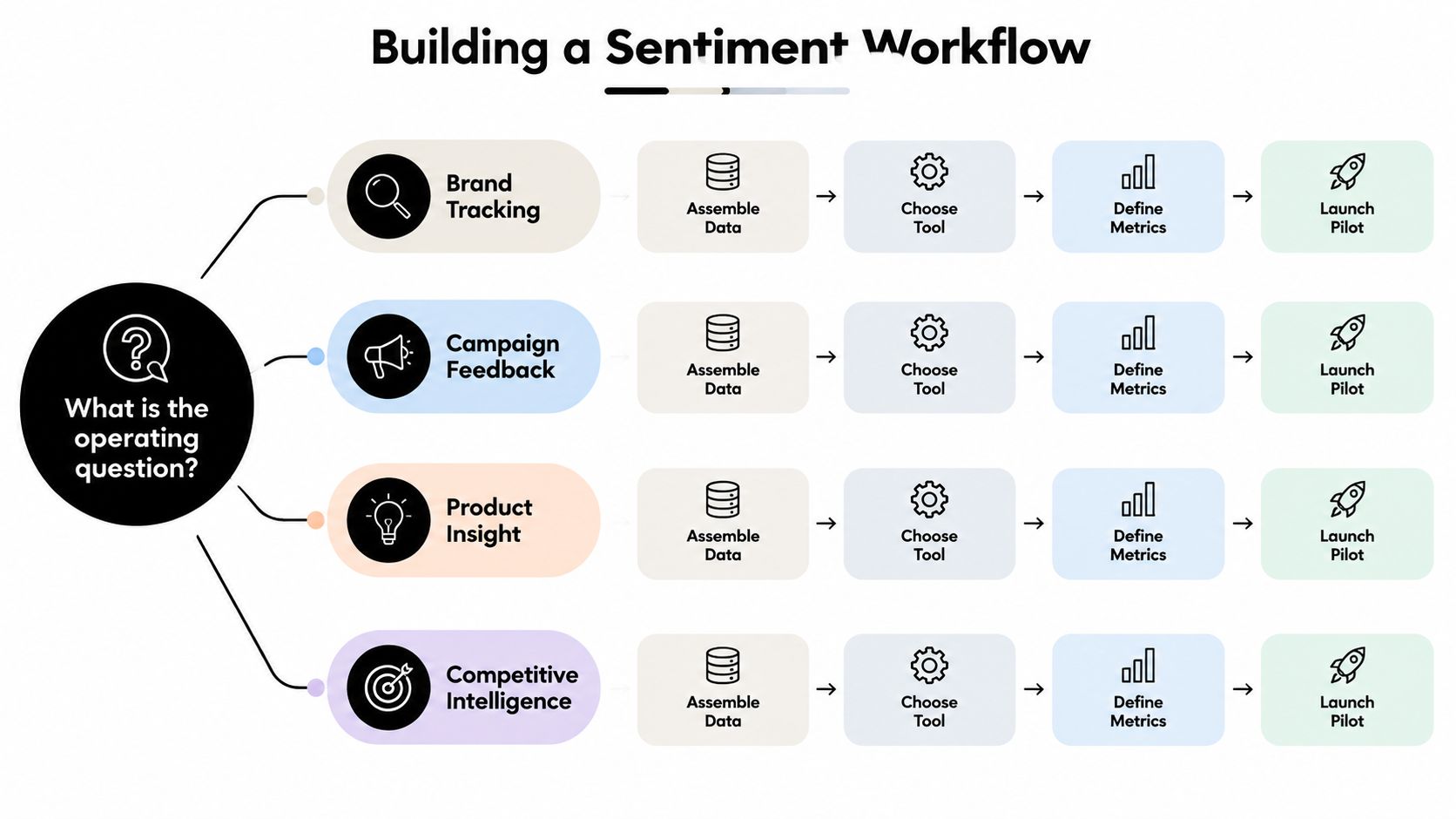
Define the question and assemble the evidence
Choose whether the first project supports brand tracking, campaign feedback, product insight, or competitive intelligence. Then gather the inputs that can answer that question:
- Public conversations: Social posts, forums, reviews, and comments.
- Owned feedback: Surveys, community discussions, and email replies.
- Operational language: Support tickets, chat logs, sales call notes, cancellation reasons, and product feedback.
- Context fields: Campaign, channel, product, market, customer stage, and date.
Internal sources often contain stronger intent than public posts. A cancellation note can explain a decision more directly than a social comment, while a sales call may reveal an objection before it appears in a review.
Before analysis, define sampling and consent rules. Decide which sources may be collected, how personal information will be removed or restricted, and whether customer records can be joined to sentiment data. A representative sample is more valuable than a massive dataset dominated by one channel or unusually vocal group.
Create labels people can defend
Write a labeling guide before selecting a model. Include positive, negative, and neutral examples, but also mark sarcasm, questions, complaints, mixed emotions, and irrelevant content. Add aspect labels such as price, reliability, usability, delivery, support, and trust when the team needs to know what caused the sentiment.
Have human reviewers label a shared sample and resolve disagreements. This creates a reference set for testing and exposes ambiguous language early. The team should preserve the original text, the model score, the assigned label, the topic, and the confidence value. A single blended score can't show whether the model misunderstood a phrase or whether the underlying sentiment changed.
Choose, test, and activate
Select the method according to language coverage, domain fit, latency, cost, and explainability. A classical model may suit stable categories and fast monitoring. An LLM-based approach may handle nuanced product feedback but require tighter privacy and spending controls.
Test the system against human-reviewed examples. Review precision, recall, class balance, and performance by channel, language, and customer segment. Don't accept one aggregate accuracy figure as proof that the workflow works everywhere.
Finally, connect results to action. Use dashboards for trends, alerts for unusual changes, CRM annotations for customer context, and campaign reports for creative decisions. Assign an owner for each alert type, define response expectations, and review model drift regularly.
Operational test: Every sentiment output should answer three questions, what changed, why did it change, and who acts next?
Teams can also monitor whether customer narratives are reaching AI assistants by tracking AI mentions. That extends the workflow from public conversation to the way buyers may encounter the brand during AI-assisted research.
Matching Sentiment Use Cases to the Right Method
The same sentiment model shouldn't serve every marketing job. A broad brand tracker needs consistency across time and channels. A product team needs detailed themes. A customer escalation workflow needs confidence, urgency, and the original message.
For brand health, classify high-volume mentions by sentiment, topic, audience, and time. A classical model may be appropriate when the taxonomy is stable, while a calibrated LLM classifier can add nuance when the volume is manageable. The important point is to benchmark by channel and market rather than compare every source as if it used the same language.
Campaign optimization needs tighter joins. Connect sentiment to creative variant, audience, placement, message, and spend. A campaign with many comments isn't automatically successful. The useful question is whether a particular claim or creative angle produces favorable reactions among the audience that matters.
Product feedback benefits from aspect-level analysis. “The interface is clean, but reporting is limited” should create separate signals for usability and feature depth. Competitive monitoring also needs context. Compare sentiment by topic and conversation share, not just the total number of positive mentions.
| Marketing job | Best data sources | Recommended approach | Action enabled |
|---|---|---|---|
| Brand health tracking | Reviews, social posts, surveys, forums | Consistent classifier with channel and market benchmarks | Identify perception shifts and recurring themes |
| Campaign optimization | Comments, reactions, survey text, landing-page feedback | Fast classification connected to creative and audience fields | Adjust messaging, targeting, or budget |
| Product insight | Support tickets, calls, reviews, feature feedback | Aspect-based analysis with human review | Prioritize friction points and validate fixes |
| Customer escalation | Support, chat, social complaints, cancellation notes | Confidence-aware routing with sentiment and intent | Send high-risk cases to the right owner |
| Competitive intelligence | Reviews, forums, comparison content, social discussion | Topic-level comparison across brands | Refine positioning and proof points |
Source choice should follow the decision. Surveys may offer structured context, but response bias can affect interpretation. Social monitoring provides speed and breadth, but short posts can be ambiguous. Support records provide rich detail, but access and privacy controls matter.
For a quick first-pass experiment, a free sentiment analyzer can help a team inspect language patterns before it commits to a larger system. Treat that output as exploratory unless the model has been tested against examples from the brand's own channels.
Where Most Sentiment Programs Still Fail
A sentiment score is only as trustworthy as the definitions, sources, and review process behind it. Many programs assume that language has a universal meaning, then discover that sarcasm, irony, slang, emojis, and mixed emotions produce misleading labels.
A phrase such as “quiet” may be praise for a laptop fan and criticism of a community. “Sick” may describe an impressive product or an unpleasant experience. A customer can also express strong approval of one feature while warning others away because of price. Binary classification loses that structure.
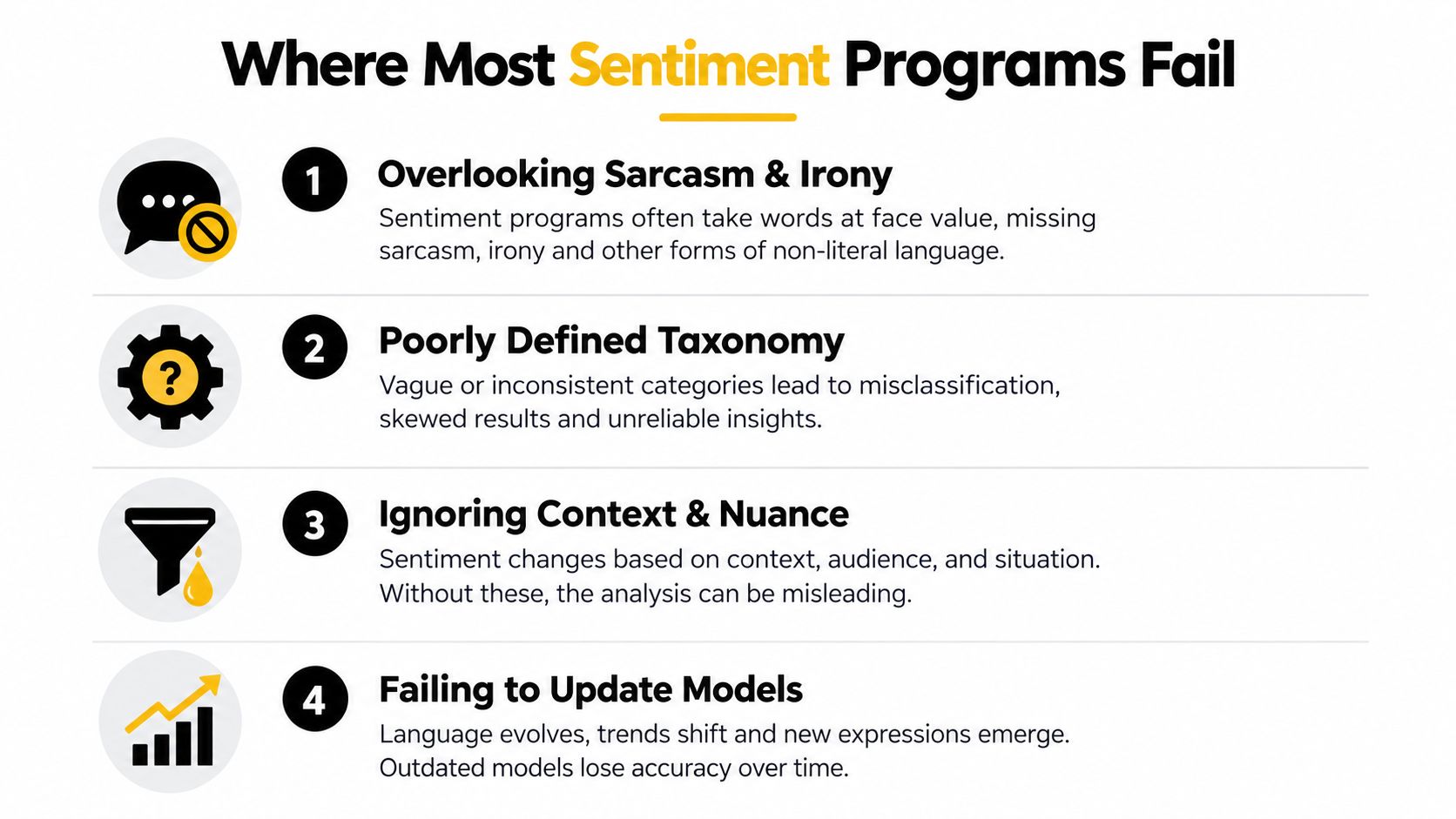
The main blind spots
- Sarcasm and irony: The literal words may be positive while the intended meaning is negative.
- Weak taxonomies: Labels such as “negative” don't tell a product or marketing team what to fix.
- Missing internal data: Support tickets, sales calls, cancellations, and survey comments may reveal intent that public posts don't.
- Stale models: Language changes when products, campaigns, platforms, and customer communities change.
Multilingual work introduces another layer of risk. A model may perform well in English yet miss cultural nuance, spelling variants, code-switching, or local expressions in another language. Recent guidance also highlights weaknesses involving sarcasm, cultural context, and short-form video, with one 2026 guide estimating that production deployments on multilingual or sarcasm-heavy content can run 10 to 15 points below benchmark performance (source).
Aggregation can hide the customer
A sudden movement in the headline score may come from a small number of unusually vocal customers. Preserve segments, topics, source credibility, confidence, and volume alongside the aggregate result. Don't use sentiment alone to infer an individual's intent, loyalty, or future behavior.
Privacy matters when teams connect public text with identifiable CRM records. Establish collection limits, consent practices, access permissions, retention rules, and human review for high-impact decisions.
AI-mediated discovery creates a newer blind spot. A prospect may ask an assistant which product to choose, and the answer may repeat or omit narratives formed across reviews, forums, product pages, and support content. Marketers should therefore inspect whether important customer themes are accurately represented in generated answers, not only whether those themes appear in social monitoring.
Measuring ROI and Connecting Sentiment to Growth
Sentiment earns a place in the growth plan when it connects to an outcome a team already manages. That outcome could be conversion, retention, response speed, pipeline movement, campaign efficiency, or how often AI-generated answers present the brand accurately. Sentiment is a signal, not revenue. Its value comes from testing whether a change in perception appears before a business change, after it, or alongside it.
Use a simple measurement chain:
Sentiment movement → topic or message → marketing action → downstream KPI
Suppose negative sentiment rises around unclear pricing. Marketing might revise comparison pages and campaign copy, then monitor conversions, qualified pipeline, support questions, and AI answers about the product. Treat the result as evidence, not proof. A favorable sentiment shift paired with better performance supports the hypothesis, while controlled comparisons or additional analysis are needed to assess causation.
Use baselines and thresholds
Set baselines by channel, market, topic, and buyer stage. Net sentiment usually means positive share minus negative share, expressed on a scale from -100 to +100 (Umbrex). Some consumer brands sit around +20 to +60 in steady state, but that range is a reference point, not a universal target. Product launches and crises can produce short-term volatility.
Response rules turn a dashboard into a workflow. Assign an owner before an alert appears, and specify whether marketing, support, product, or communications handles each topic. Set separate thresholds for routine variation, investigation, and escalation. The team can then judge urgency by both sentiment movement and business impact, rather than reacting to every fluctuation.
Add the AI visibility layer
A buyer may ask an AI assistant about a product before visiting its website. Sentiment analysis can examine whether the answer is favorable, accurate, and connected to the intended use cases. It can also reveal which customer themes, reviews, or objections appear in generated responses, giving marketers a planning input for AI visibility rather than another reporting-only metric.
MyMentions tracks visibility, position, citation sources, and mention sentiment across supported AI assistants. Teams can turn prompt-level findings into a marketing backlog, such as clarifying a product page, addressing a recurring objection, or strengthening a source that assistants repeatedly cite.
Measure that work with the same discipline used elsewhere. Compare changes in AI mentions with referral visits, assisted conversions, qualified inquiries, and the quality of cited sources. For broader context on whether AI-driven marketing activity can support a viable business model, see this analysis of AI profitability.
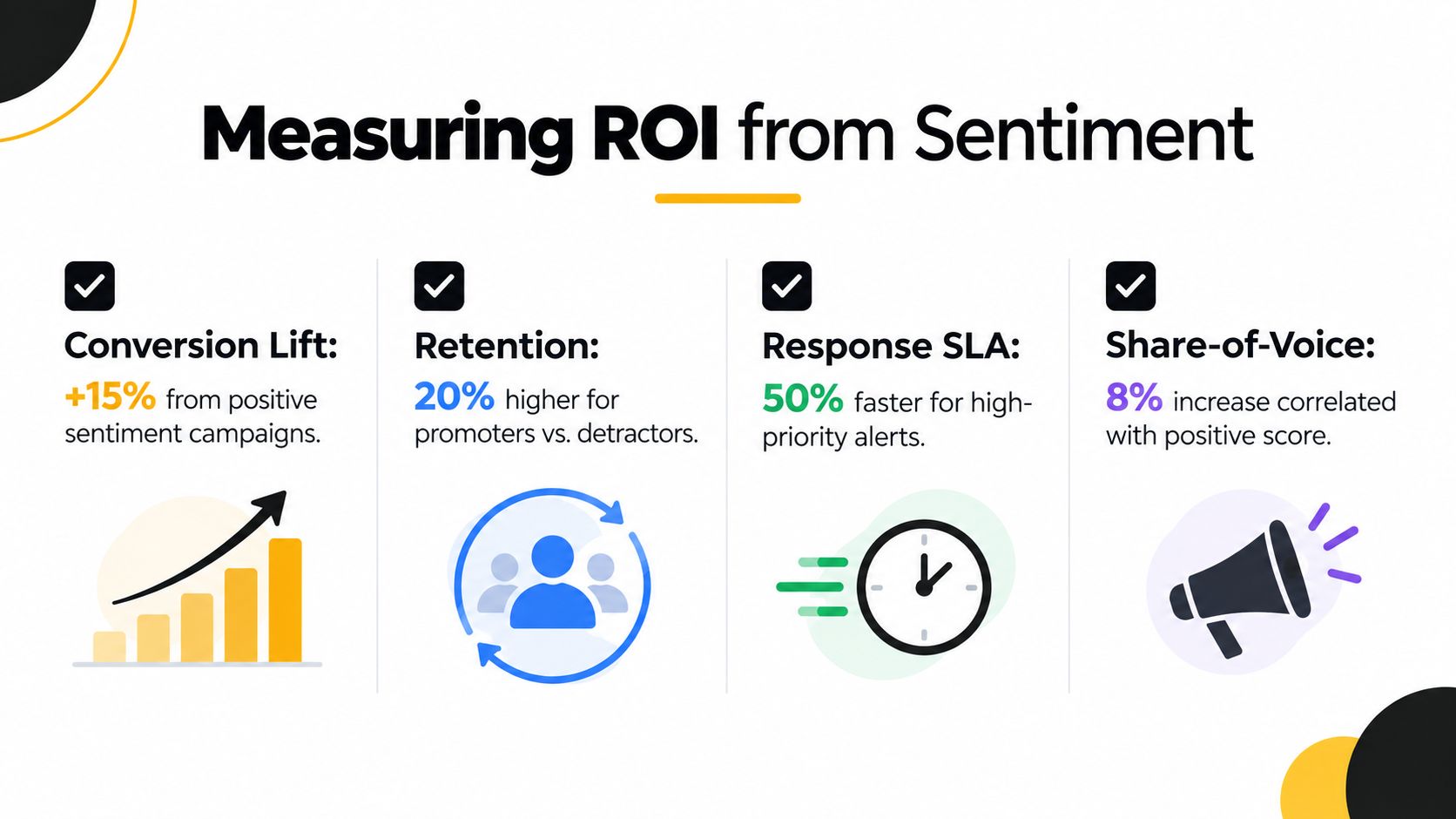
Use this week-one checklist:
- Choose two KPIs: Pair one sentiment measure with one business outcome.
- Define three thresholds: Separate normal variation, investigation, and escalation.
- Assign owners: Give each alert a named team and response path.
- Schedule review: Revisit labels, sources, model errors, and outcomes monthly.
A short video can introduce the workflow to non-technical stakeholders:
MyMentions helps founders, marketers, and SEO teams monitor how AI assistants discover, rank, and describe products, including the sentiment and citation sources shaping those answers. Visit MyMentions to connect sentiment findings with an AI visibility backlog and decide which content, trust, or positioning gaps to address first.