Launch week is supposed to feel controlled. The pages are live, sales has the deck, paid media is queued, and customer success knows what questions are coming.
Then a competitor changes pricing on Tuesday, publishes a comparison page on Wednesday, and announces a feature bundle on Thursday that makes your launch message look late. Nobody on your team missed the market because they were lazy. They missed it because the company was relying on scattered watching instead of a working system.
That's the job of competitive intelligence in marketing. It isn't “keep an eye on competitors.” It's building a repeatable way to notice meaningful changes early, interpret what they mean, and route the right action to product marketing, demand gen, sales, content, and leadership before decisions harden.
If you're a new CI lead, or a product marketer who just inherited the function, this usually feels messier than people admit. You have too many signals, too many opinions, and no shortage of requests for “a dashboard.” What you need first is not another pile of alerts. You need a decision system.
Competitive intelligence is most useful when it changes a decision in time, not when it produces an interesting report after the fact.
Table of Contents
- Introduction Why Competitive Intelligence Decides Marketing Wins
- What Competitive Intelligence in Marketing Really Means
- Key Benefits and KPIs That Prove CI Value
- How Modern Competitive Intelligence Systems Work
- From Monitoring to Action A Practical CI Workflow
- Tools Data Sources and AI Visibility for SaaS Teams
- Putting Competitive Intelligence Into Practice With Examples
Introduction Why Competitive Intelligence Decides Marketing Wins
Many start with good intentions. A few Slack alerts. A spreadsheet of rival pricing pages. Sales notes from deals that went sideways. Someone checks review sites before quarterly planning. Someone else screenshots homepage changes when they remember.
That setup works until the market starts moving faster than your habits.
A common SaaS pattern looks like this: marketing plans a campaign around “fastest onboarding,” only to find that a competitor has shifted its message to “all-in-one automation” and started hiring in implementation, partnerships, and enterprise support. The problem isn't that their homepage changed. The problem is what those changes imply. They're likely moving upmarket, broadening service coverage, and changing the comparison buyers will make.
The cost of ad hoc watching
Ad hoc monitoring creates three failures at once:
- Late detection: You spot the move after your campaign is approved.
- Weak interpretation: The team sees isolated updates, not a pattern.
- No action path: Even when someone notices, nobody knows who should respond.
That's why competitive intelligence in marketing belongs inside operations, not on the edge of research. It should influence positioning, launch timing, paid media themes, sales talk tracks, pricing reviews, and content priorities.
What a workable system changes
When CI works, your team doesn't just know more. Your team decides faster with less confusion.
You can spot a pricing shift and send it to product marketing for packaging analysis. You can detect repeated buyer objections and push them into homepage copy, comparison pages, and sales enablement. You can monitor how AI assistants describe your category and catch when your brand is being summarized inaccurately before that drift spreads across buying journeys.
The difference is simple. Competitor watching collects observations. Competitive intelligence in marketing routes decisions.
What Competitive Intelligence in Marketing Really Means
Think of CI as a radar system for go-to-market decisions. A radar system doesn't stare at one object. It scans the environment, filters noise, flags movement, and gets the right signal to the right operator in time to act.
That's a better mental model than “competitor research.”
Competitive intelligence became a recognized business discipline in the United States during the 1970s, and Michael Porter's 1980 book Competitive Strategy is widely treated as a foundation of modern practice. The field became more formalized with the founding of SCIP in 1986 and the Gilads' 1988 organizational model that helped institutionalize CI inside corporations, as summarized in this history of competitive information.
A practical definition
The literature describes market and competitive intelligence as a “continuing and interacting structure” that gathers, sorts, analyzes, and distributes timely information for marketing decision-makers, as described in this market intelligence framework paper.
That wording matters. “Continuing” means it's ongoing, not a one-time audit. “Interacting” means the pieces connect. Collection without distribution is just accumulation.
What CI is not
People often use several terms as if they mean the same thing. They don't.
| Practice | Main question | Typical output |
|---|---|---|
| Competitive intelligence | What changed, why does it matter, and who should act? | Alerts, briefs, battlecards, routed recommendations |
| Market research | What does the market or buyer segment need? | Surveys, segment analysis, demand insights |
| Competitor analysis | How does one rival compare right now? | Feature matrices, pricing comparisons |
| Social listening | What are people saying publicly? | Sentiment themes, mention trends |
If you need a sharper distinction between CI and broader research work, this guide to competitive intelligence vs market research is a useful reference point.
The mental model to use with stakeholders
When executives ask what CI does, don't say, “We monitor competitors.”
Say this instead:
CI is the operating layer that turns external signals into timed decisions across positioning, pricing, content, product marketing, and sales.
That sentence usually clears up the confusion fast.
Key Benefits and KPIs That Prove CI Value
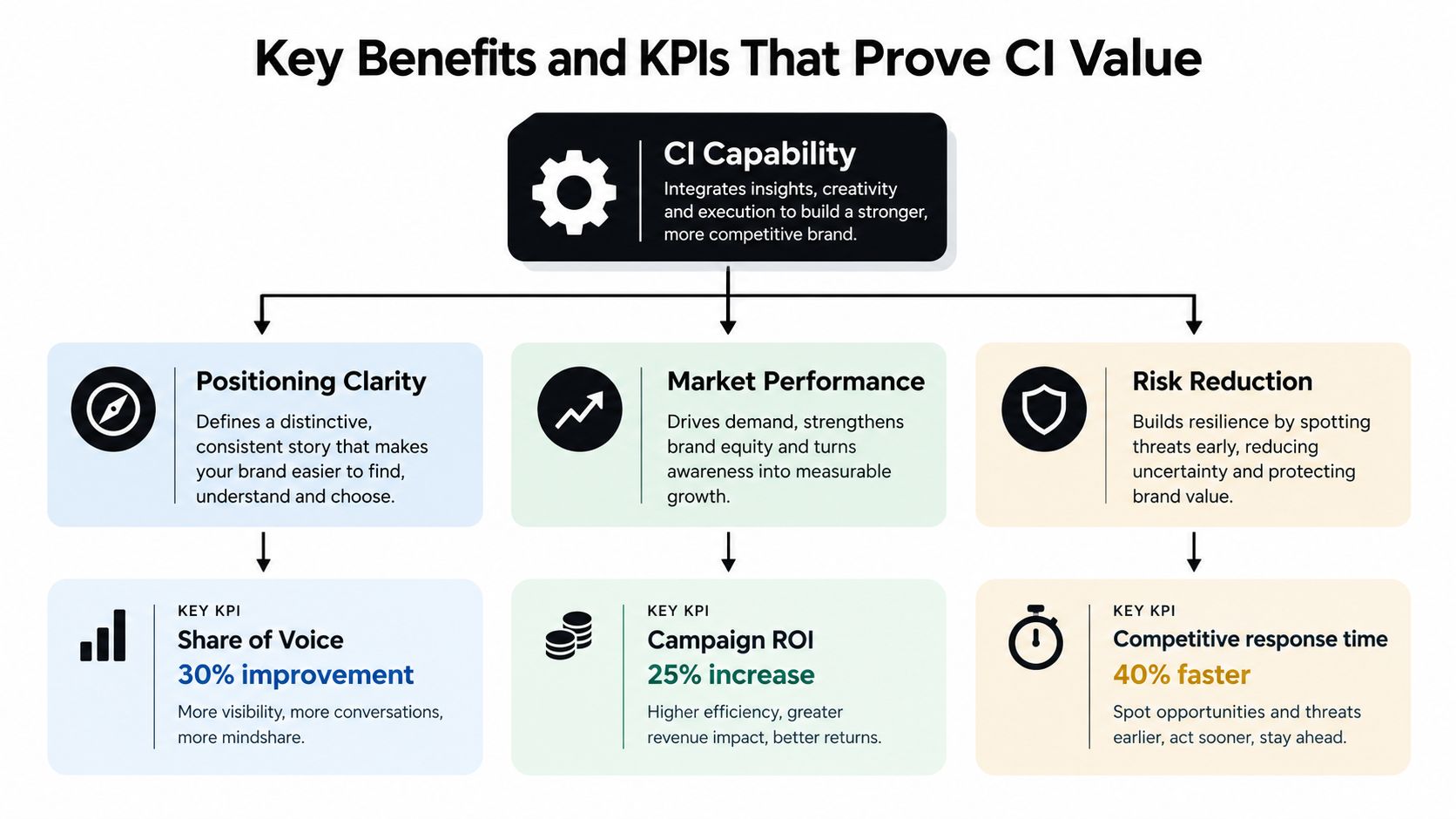
If you want support for a CI program, tie it to execution quality. Research links competitive intelligence capability to stronger marketing capability development and positive market performance overall, with competitor intelligence, market intelligence, and technological intelligence showing the strongest impact among the subtypes studied in this empirical research summary.
That gives marketers a useful prioritization rule. Start with what changes buyer choice: rival moves, market shifts, and technology changes.
Where CI creates value
The strongest programs usually improve five areas.
- Positioning clarity: You stop describing your product in a vacuum. Messaging gets sharper because it answers active buyer comparisons.
- Pricing confidence: Teams can react to packaging shifts, discount patterns, and new bundles before they become sales friction.
- Content relevance: Comparison pages, objection-handling assets, and thought leadership reflect what buyers are hearing in-market.
- Faster GTM decisions: Campaigns and launches adapt earlier because planners receive signals before approvals are locked.
- Lower surprise risk: Fewer painful moments where sales hears about a rival move from a prospect first.
A good CI loop is easier to grasp visually:
KPIs that show whether CI is working
Don't measure CI by volume of reports. Measure whether it helps teams act with better timing and better focus.
A simple KPI set can include:
- Share of voice: Useful for tracking visibility in search, social, media, and category discussion. If you need a framework, this share of voice calculation guide helps define the metric clearly.
- Win and loss reasons: Track recurring competitor mentions, pricing objections, trust concerns, and feature misconceptions.
- Feature parity gaps: Log where competitors are merely claiming parity versus where buyers repeatedly care about the gap.
- Pricing sensitivity themes: Record when deals stall because of packaging confusion, missing bundles, or discount expectations.
- AI visibility signals: Monitor how assistants describe your brand, whether they include you in category comparisons, and which citations shape the answer.
What not to optimize for
Many new CI teams chase completeness. That's a trap.
Practical rule: A shorter signal list tied to live decisions beats a comprehensive archive nobody uses.
Your KPI framework should tell you whether CI changed action. If it didn't influence a message, brief, campaign, roadmap input, or pricing review, it probably wasn't intelligence yet.
How Modern Competitive Intelligence Systems Work
A new CI lead usually sees the same failure pattern in the first month. Sales asks for battlecards. Product asks what rivals shipped. Growth wants to know why a competitor suddenly shows up in category searches and AI assistant answers. The team starts collecting screenshots and links, but the pile grows faster than decisions improve.
Modern CI systems solve that problem by acting like air traffic control. Their job is not to store every signal. Their job is to route the right signal to the right team while there is still time to change a launch, a pricing page, a sales narrative, or a roadmap discussion.
The information flow
At the system level, CI works when different signal types enter one operating loop instead of sitting in separate folders. Competitor moves matter, but so do customer complaints, supplier shifts, technology choices, regulatory changes, and the sources AI assistants cite when they summarize your category. Those inputs only become useful when they reach planners in time to affect pricing, positioning, channel choices, and launch plans.
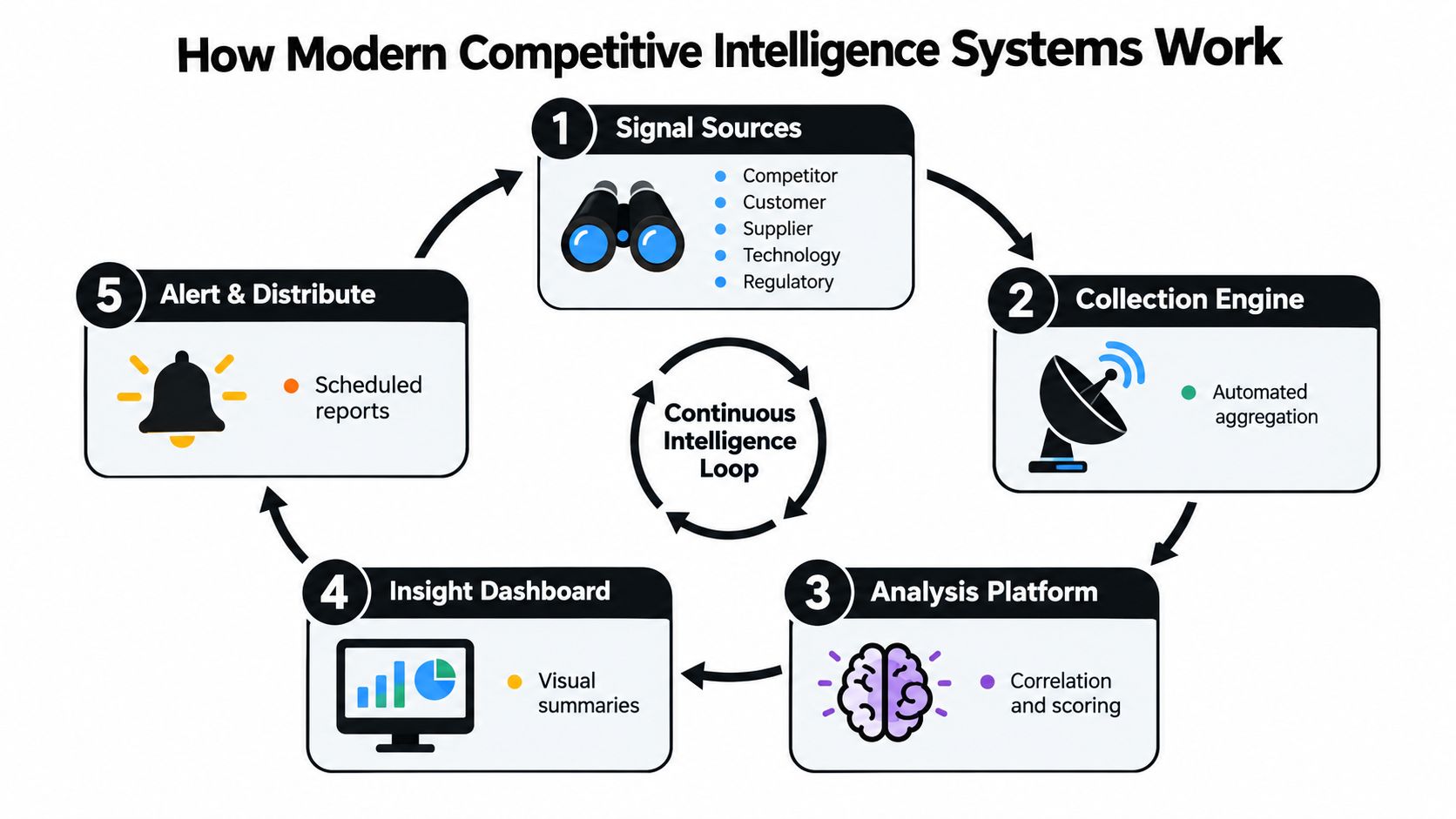
A practical architecture usually has five parts:
- Collection: Website changes, release notes, review themes, hiring patterns, partner pages, analyst mentions, citation sources in AI answers, and sales call notes enter one intake layer.
- Tagging: Each item gets labeled by competitor, topic, buyer stage, product area, and likely business impact.
- Interpretation: A human owner explains the implication. A pricing test means something different from a headline rewrite.
- Routing: Product marketing, demand gen, sales enablement, product, and leadership receive only the signals that match their decisions.
- Feedback: Teams report back on what changed, which sharpens the system over time.
That feedback step gets missed often. Without it, CI becomes publishing. With it, CI becomes operations.
What teams collect now that they ignored before
Older programs focused on visible competitor outputs such as homepages, ads, and launch posts. Modern programs still track those sources, but they also pay attention to quieter clues that reveal direction before a press release does.
Job postings can signal a move upmarket, a new compliance push, or investment in partner sales. Review sentiment can expose where a competitor's promise breaks in real use. Technographic clues can suggest what kind of stack a rival supports, who they integrate with, and what buyer environment they expect. For a practical primer on reading those implementation clues, the AI Website Detector guide to tech stacks is useful because it explains how stack detection can support competitive analysis, partnership assumptions, and product fit hypotheses.
One newer category matters more than many teams expect. AI assistant visibility.
If ChatGPT, Perplexity, Gemini, or other assistants mention a competitor in shortlist answers and cite a review site, comparison page, or documentation source you have ignored, that source has become part of your competitive field. In other words, competitor intelligence now includes learning how machines describe the category, which brands they surface, and what evidence they trust.
If you need one place to organize those streams, a dedicated competitive intelligence dashboard helps centralize signals so teams are not working from screenshots buried in chat.
Why the old dashboard model breaks
Static dashboards often fail because they broadcast too much context to too many people. A sales leader does not need the same view as a PMM running messaging, and neither team benefits from a feed that treats every homepage edit like a strategic event.
The better model is selective. It scores signals by likely buyer impact, revenue impact, and urgency. It also accepts a trade-off that new CI leads learn quickly. Broader monitoring creates more coverage, but it also creates more noise. If every change triggers an alert, teams stop reading alerts.
Good systems reduce that fatigue by narrowing inputs, setting thresholds, and sending role-specific outputs. Product might get a monthly pattern read on roadmap direction. Sales enablement might get same-day alerts on pricing, proof points, and objection handling. Growth might watch share of search, comparison pages, and citation sources that influence AI-generated recommendations.
The goal is simple. Do not build a museum of competitor activity. Build a dispatch system for decisions.
From Monitoring to Action A Practical CI Workflow
A working CI function needs a rhythm. Not a heroic analyst. Not a giant quarterly report. A rhythm.
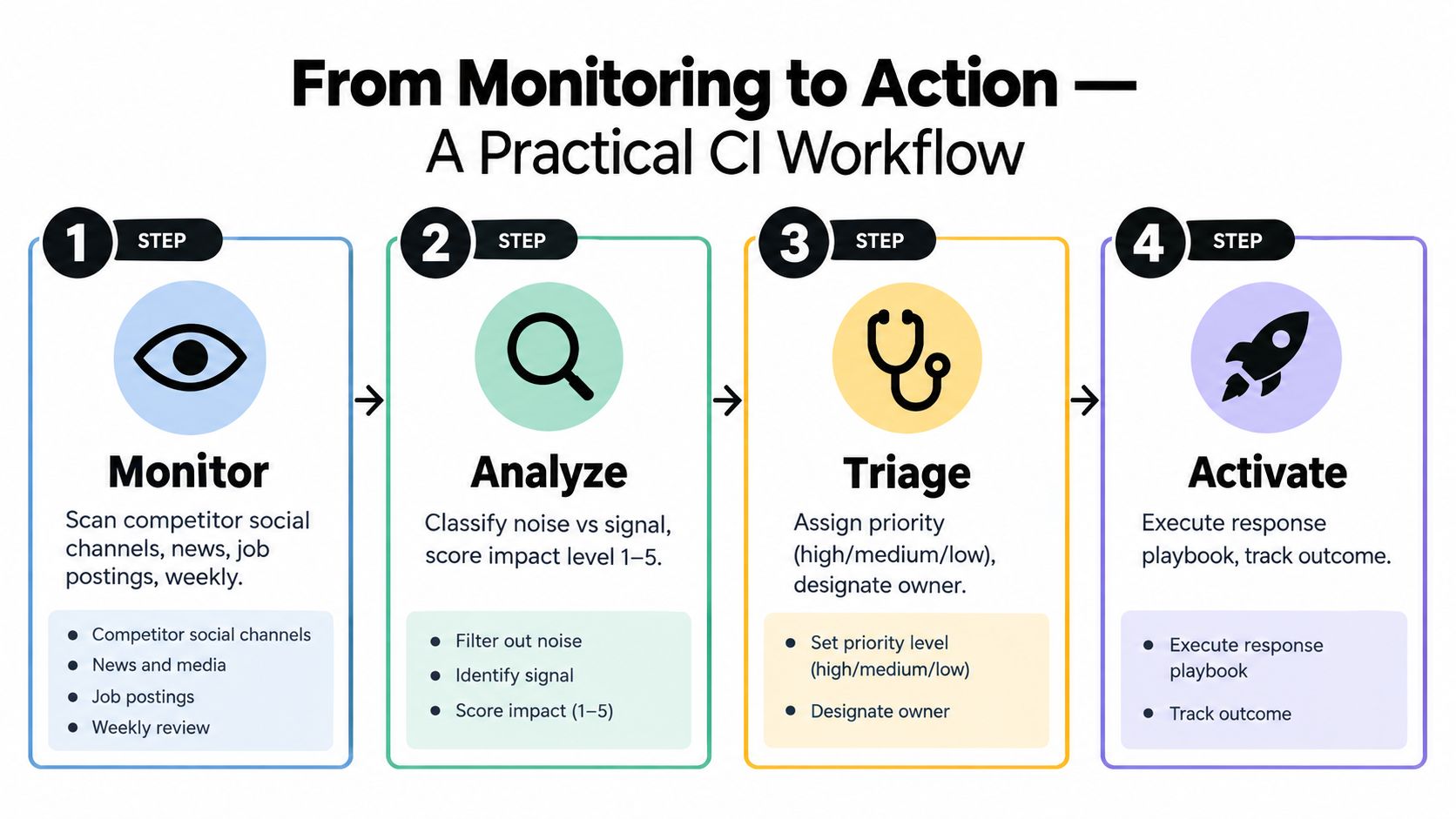
The easiest way to build that rhythm is to treat CI like an operational loop with four stages: monitor, analyze, triage, activate. Each stage needs an owner, a cadence, and a format that downstream teams can use without translation.
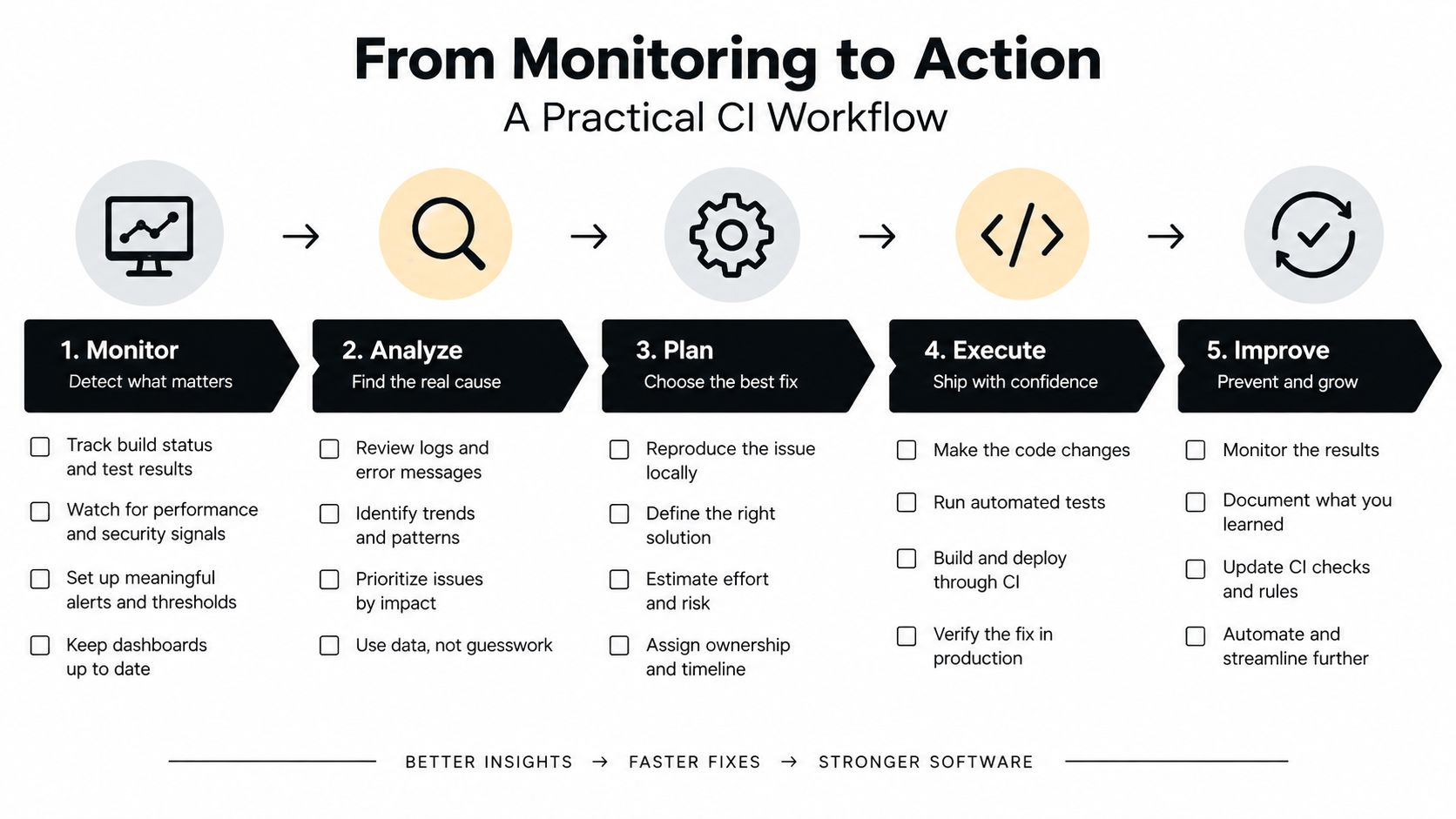
Monitor only the sources that change decisions
Start with a narrow source set. For most SaaS teams, that includes competitor homepages, pricing pages, product release notes, job postings, review sites, sales call snippets, and key AI assistant prompts about your category.
Don't monitor because a source exists. Monitor because a source can force a message, pricing, or campaign adjustment.
Analyze for implication, not novelty
A homepage redesign is rarely the signal. The signal is the strategic direction behind it.
When reviewing updates, ask:
- Buyer impact: Will this change what prospects expect in calls or demos?
- Revenue impact: Could this affect deal velocity, objections, or packaging pressure?
- Market impact: Does this suggest a segment move, category reframing, or trust play?
Many teams get lost. They label updates accurately but interpret them weakly.
A useful CI note doesn't say, “Competitor launched feature X.” It says, “This launch strengthens their case in regulated mid-market accounts, so our current compliance page is now underpowered.”
Triage before you alert
Not every signal deserves a Slack fire drill. Build a simple decision table.
| Signal type | Urgency | Owner | Typical response |
|---|---|---|---|
| Pricing page change | High | Product marketing + sales | Packaging brief, deal guidance |
| Review sentiment shift | Medium | PMM + CS + content | FAQ update, proof points |
| New hiring cluster | Medium | PMM + strategy | Segment hypothesis, watchlist |
| AI answer drift | High | SEO + content + PMM | Source fixes, content revision |
| Minor social post | Low | None unless repeated | Log only |
That triage habit is how you avoid alert fatigue.
Activate inside existing workflows
The best response doesn't live in the CI folder. It appears where teams already work.
- For sales: Update battlecards, objection talk tracks, and call snippets.
- For demand gen: Adjust ad copy, audience exclusions, and landing page framing.
- For product marketing: Refresh comparison pages, launch narratives, and packaging language.
- For leadership: Send a one-page implication brief, not a pile of screenshots.
There's also a contrarian point worth keeping close. More competitor data isn't always the best answer. The same 2026 guide cited earlier argues that post-decision buyer interviews can reveal the unsaid reasons prospects choose one vendor over another better than standard feature matrices do. In practice, that means your best CI input may come from structured win-loss debriefs, not one more rival feature spreadsheet.
Teams exploring broader AI-driven operating models may also find this piece on B2B revenue growth with AI helpful because it frames how insight systems connect to revenue motions rather than staying trapped in analysis.
Tools Data Sources and AI Visibility for SaaS Teams
Most CI stack conversations go wrong because teams shop by tool category before they agree on the job to be done.
A better approach is to choose tools by question. What are you trying to detect? What action should follow? Who needs the answer, and how fast?
A practical stack by job
Here's a useful way to group the stack:
| Job to be done | Common data sources | Typical tool type |
|---|---|---|
| Detect website and messaging changes | Homepages, pricing, docs, release pages | Web change monitoring |
| Track customer perception | Review sites, communities, support themes | Review and sentiment tools |
| Read strategic direction | Job boards, partner pages, leadership content | Hiring and market monitoring |
| Improve sales response | CRM notes, call recordings, win-loss interviews | Enablement and win-loss systems |
| Measure AI assistant visibility | Prompt outputs, citations, answer framing | AI visibility analytics |
The new CI layer most teams still miss
What counts as competitor intelligence has expanded. You're no longer only tracking what competitors publish. You're also tracking how AI assistants describe the category, which brands they mention, and which citation sources shape those answers.
Recent coverage argues that the edge is shifting from what brands can produce to how well they understand and respond to customer and market context, while AI-driven CI depends on evidence-based summaries, explainable signals, and real-time anomaly detection in this Forbes coverage of AI marketing's next frontier.
That changes the CI brief. If an assistant consistently describes a competitor as “simpler,” “more enterprise-ready,” or “better for teams,” that's no longer an SEO curiosity. It's a market perception signal.
How to choose by maturity
Early-stage SaaS teams can start with a lean setup: web monitoring, a shared change log, review tracking, and a weekly review with sales and PMM.
More mature teams usually need a connected stack with alerting, taxonomy, owner routing, and reporting by audience.
For AI-specific work, some teams use specialized visibility layers. MyMentions is one example. It tracks how AI assistants mention, rank, and describe brands across providers, and surfaces the citation sources influencing those answers. That makes it useful when CI includes AI answer monitoring alongside standard competitor signals.
A good cautionary resource here is the CitationOS audit for law firms, because it highlights the difference between surface-level AI measurement and source-aware analysis. The point applies beyond law firms. If you can't see what shaped the answer, you can't improve it confidently.
If you're evaluating options in this category, this guide to AI competitor analysis tools can help compare what different products are built to measure.
Putting Competitive Intelligence Into Practice With Examples
The easiest way to test whether your CI program is real is to ask one question: what changed this week because of it?
Example one pricing repositioning
Sales starts hearing a new objection: “Your competitor's base plan includes more collaboration features.” A shallow response would be to update the battlecard and move on.
A stronger CI response looks broader. Product marketing reviews the rival pricing page change, compares language against recent lost-deal notes, checks whether review complaints mention seat friction, and drafts two actions: a packaging clarification for sales now, and a pricing narrative revision for the next site update.
If your team needs a structured way to monitor this type of change, a competitor pricing tracking workflow is often the fastest place to start.
Example two AI answer drift detection
Your team asks major AI assistants, “What are the best tools in this category for a mid-market SaaS company?” Last month your brand appeared with strengths around speed and ease of use. This month it appears less often, and when it does, the description leans generic while a competitor is framed as more credible for larger teams.
That's a CI event.
The response isn't “write more content” in the abstract. The response is to inspect the cited sources, identify where proof is weak or stale, refresh comparison pages and implementation content, improve documentation language, and brief demand gen so paid and organic messaging reinforce the same trust signals.
The new battleground isn't only whether buyers can find you. It's whether AI systems can accurately explain you with enough evidence to include you in consideration.
Lightweight templates that actually get used
Keep the operating artifacts simple:
- Weekly CI standup note: top signals, likely impact, owner, due date.
- Change log: what changed, why it matters, confidence level, linked evidence.
- Win-loss debrief: competitor named, decision reason, proof behind reason, action proposed.
- Stakeholder brief: one page with implication first, evidence second.
Done well, competitive intelligence in marketing becomes part of normal GTM motion. It shows up in launch reviews, content planning, sales enablement, roadmap debates, and AI visibility checks. That's when the function stops being “research support” and starts acting like market infrastructure.
MyMentions gives SaaS teams a practical way to track one of the newest CI layers: how AI assistants mention, rank, and describe your brand versus competitors, plus the citation sources shaping those answers. If you want competitive intelligence to reach beyond dashboards and turn into a prioritized backlog for content, trust, and positioning fixes, visit MyMentions.