
A marketing lead opens the weekly SEO dashboard and sees familiar blue-link rankings. The numbers look healthy, yet a prospect says they asked Google an important question and received a complete answer from AI Mode without visiting a search result. The team has measured where its pages rank, but not whether its brand appears in the answer that the prospect read.
That gap is what AI mode tracking is designed to close. It treats AI-generated search visibility as an analytics problem: define the prompts, preserve the surrounding context, capture the response and citations, then compare observations over time. The result isn't a collection of screenshots. It's a dataset that helps content, SEO, product marketing, and analytics teams understand how AI assistants describe a brand, which sources influence those descriptions, and whether that exposure leads to visits or other outcomes.
Table of Contents
- What AI Mode Tracking Actually Means
- Prompts as the Unit of Measurement
- Key Signals to Monitor in Every Response
- How AI Mode Differs from AI Overviews and Traditional SERPs
- A Practical Workflow for Tracking Visibility
- The Visibility, Citation, and Traffic KPI Stack
- Limits Every Tracker Has to Work Around
- Getting Started and Common Pitfalls
What AI Mode Tracking Actually Means
AI Mode tracking is the structured, time-series measurement of brand presence inside AI-generated responses. A team repeatedly runs a controlled set of prompts, records the answer, identifies brand and competitor mentions, and stores the cited sources, location, model context, and date. Each response becomes an observation that can be compared with earlier and later observations.
That working definition matters because an AI answer doesn't behave like a traditional results page. A rank tracker usually records a URL, a position, a keyword, and perhaps a device or location. AI Mode can synthesize information from several pages, mention a company without linking to it, recommend one competitor in one response and another in the next, or change its answer after a follow-up question.
A useful record therefore contains five fields:
- Prompt: The exact question and any earlier turns.
- Model: The assistant or search surface that produced the answer.
- Mode: The particular experience, such as Google AI Mode rather than a standard results page.
- Provenance: The pages and domains cited or otherwise identified as sources.
- Confidence: The strength and stability of the observation, based on repetition, citation presence, and answer context.
A single screenshot can show that a brand appeared once. It can't tell you whether the appearance is typical, whether the model cited the brand's page, or whether the same answer appears for buyers in another market. The difference between AI visibility and traditional search visibility becomes practical here: AI Mode tracking measures how an assistant presents a brand, not just where a page sits in a ranked list.
Practical rule: Treat every answer as an observation with context, not as a permanent position.
This makes AI mode tracking a connective layer between SEO, content operations, analytics, and answer-engine optimization. SEO teams can investigate missing citations. Content teams can improve pages that repeatedly lose source attribution. Brand teams can monitor descriptions and sentiment. Analytics teams can compare answer exposure with referral sessions, while keeping those measures separate.
Prompts as the Unit of Measurement
Keywords are useful for classic search, but prompts are the primary unit of measurement in AI Mode. A prompt carries more than a topic. It can include the user's goal, constraints, audience, desired format, location, prior conversation, and an instruction that changes how the answer should be produced.
Consider two questions about customer relationship management software:
- “What's the best CRM for a 10-person startup?”
- “Which lightweight CRM costs under $50 per user and is easy to migrate to?”
Both express commercial intent, but they ask the assistant to solve different problems. The first invites a broad recommendation based on company size and use case. The second emphasizes implementation effort and a price constraint. The answer may mention different vendors, cite different pages, and use a different standard for confidence.
The context that travels with a prompt
Log the exact prompt text, then attach the dimensions that can change its result:
- Model identity: Record whether the response came from Google AI Mode, ChatGPT, Claude, Perplexity, or another supported assistant.
- Model version: Preserve the version or release label when the interface exposes it. An answer from a later version isn't automatically comparable with an earlier answer.
- Conversation context: Store prior turns, follow-up questions, persona instructions, and expected output format.
- Locale and region: Record the market, language, and location settings used for the request.
- Retrieval and tool state: Note whether web browsing, shopping data, or another retrieval function was active.
Logging only the question is like tracking a keyword without its date, device, or location. You might detect a change, but you won't know whether the model changed, the market changed, or the conversation supplied new information.
Prompt design should also mirror real buyer language. Pull questions from sales calls, support tickets, product reviews, internal site search, and customer research. Tag each prompt by intent, funnel stage, market, and competitor relevance. For teams building a repeatable test suite, prompt regression testing guidance provides a useful way to think about preserving test conditions while answers evolve.
A prompt corpus shouldn't aim to represent every possible question. It should represent the questions that matter to the business, especially questions where a recommendation, comparison, or source citation could influence a buying decision.
Key Signals to Monitor in Every Response
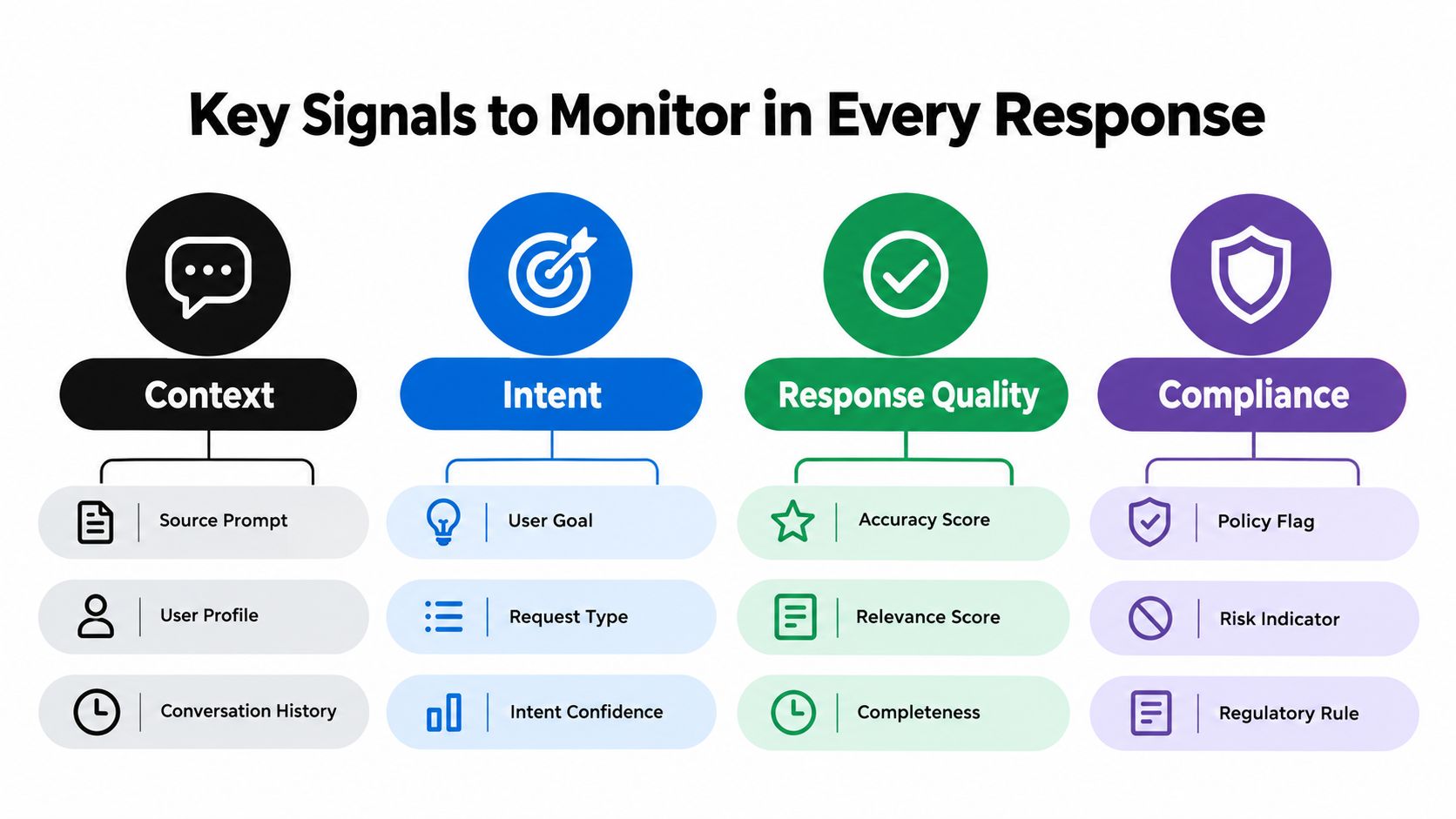
A response contains several signals, and no single one explains visibility on its own. Capture them as related fields so the team can distinguish a prominent, well-supported recommendation from a passing brand reference.
Context and intent
Start with the conditions around the answer:
- Source prompt: Store the exact wording, capitalization, and constraints.
- Conversation state: Include earlier turns and follow-up instructions.
- Locale: Record market, language, and location.
- Intent tag: Classify the prompt as informational, navigational, comparative, transactional, or another business-defined category.
- Output request: Note whether the user asked for a list, table, shortlist, explanation, or recommendation.
These fields explain why two apparently similar tests produce different outputs. They also let content teams group visibility by customer need instead of reporting one blended score.
Provenance
Provenance answers a harder question than “was the brand mentioned?” It identifies the material that supported the response.
Store the full citation URL, normalized domain, page title where available, document type, and source role. A product page, independent review, partner directory, and community discussion may all influence an answer, but they carry different implications for content and outreach. Record whether the source was visibly cited, retrieved during the response, or merely inferred from the available output. Don't treat an uncited mention as equivalent to a linked source.
The first formal work on answer visibility introduced the impression score and the GEO-BENCH benchmark, creating a quantitative way to assess how sources surface inside generated answers rather than only in classic search results. Later approaches added attribution weighting and subjective dimensions, which reinforces the central lesson: position and source strength need lineage. A score is useful only when the team can explain which response fields produced it. The background on AI search analytics can help teams connect these response observations with broader reporting practices.
Confidence and position
Confidence isn't just a model label. Look for hedging language, refusal behavior, explicit uncertainty, and the presence or absence of a citation. These aren't perfect probability estimates, but they help separate a firm recommendation from a tentative mention.
Position also needs a response-specific definition. A brand may appear in the opening recommendation, a comparison row, a supporting example, a footnote, a source list, or nowhere at all. A one-word reference near the end of a long answer shouldn't receive the same interpretation as a cited page that supports the central recommendation.
A useful impression score should be traceable back to the prompt, answer position, citation, and surrounding text.
Keep these signals together. Summing mentions, citations, and confidence into one unexplained number hides the reasons performance changed.
How AI Mode Differs from AI Overviews and Traditional SERPs
A buyer searches “best project management software for a remote team.” Traditional results show an ordered list of pages. An AI Overview may summarize the query above those results and cite supporting sources. In AI Mode, the buyer can ask which option fits a small team, then request a comparison. The surface, answer, and citations may change with each follow-up.
These are separate measurement environments. Traditional SERPs, AI Overviews, and AI Mode have different triggers, answer structures, citation behavior, and data requirements.
| Dimension | Traditional SERP | AI Overviews | AI Mode |
|---|---|---|---|
| Query coverage | Determined by indexed results and ranking eligibility | Appears only for eligible searches | Uses conversational prompts and follow-ups |
| Determinism | Ordered links support position checks | Generated text and source sets can vary | Responses and citations can vary by context |
| Citation depth | Ranking and snippets point to pages | Generated claims include supporting sources | A synthesized answer may draw from multiple sources |
| Personalization | Influenced by location, device, and search settings | Can reflect the search context | Can vary by region, login state, session, and conversation |
| Refresh cadence | Rankings can change as crawling and ranking change | Answer triggers and sources can shift | Prompt-level observations need repeated sampling |
Traditional SERP tracking asks, “What position did this page hold?” AI Overview tracking asks whether a generated summary appeared and which sources supported it. A dedicated AI Overview tracker guide helps compare that surface with classic results. AI Mode tracking asks a broader question: across repeated prompts and follow-ups, how does the answer describe the brand, which sources does it cite, and how does that pattern change by market?
Google said AI Overviews had reached 2 billion monthly users across 200 countries and territories, while AI Mode had passed 100 million monthly active users in the U.S. and India by July 2025, according to reporting on AI Mode tracking and adoption. The scale makes the distinction operational for analytics, content, and regional marketing teams.
The same source describes AI Mode as highly dynamic. In repeated runs using the same user and city, more than 60% of domains and 80% of URLs could disappear. One screenshot therefore captures a moment, not ongoing visibility. The Bazzly on AI search visibility provides broader context for content on answer surfaces, but it does not replace prompt-level, time-series measurement.
Cross-market comparisons add another gap. Region, login state, device, session history, and conversation context can alter both the response and its citations. Traffic attribution is also incomplete because a cited source may influence a visit without producing a clean referral signal.
A rank tracker cannot represent AI Mode, and an AI Overview monitor cannot represent a conversational follow-up. Each surface needs its own dataset and interpretation.
A Practical Workflow for Tracking Visibility
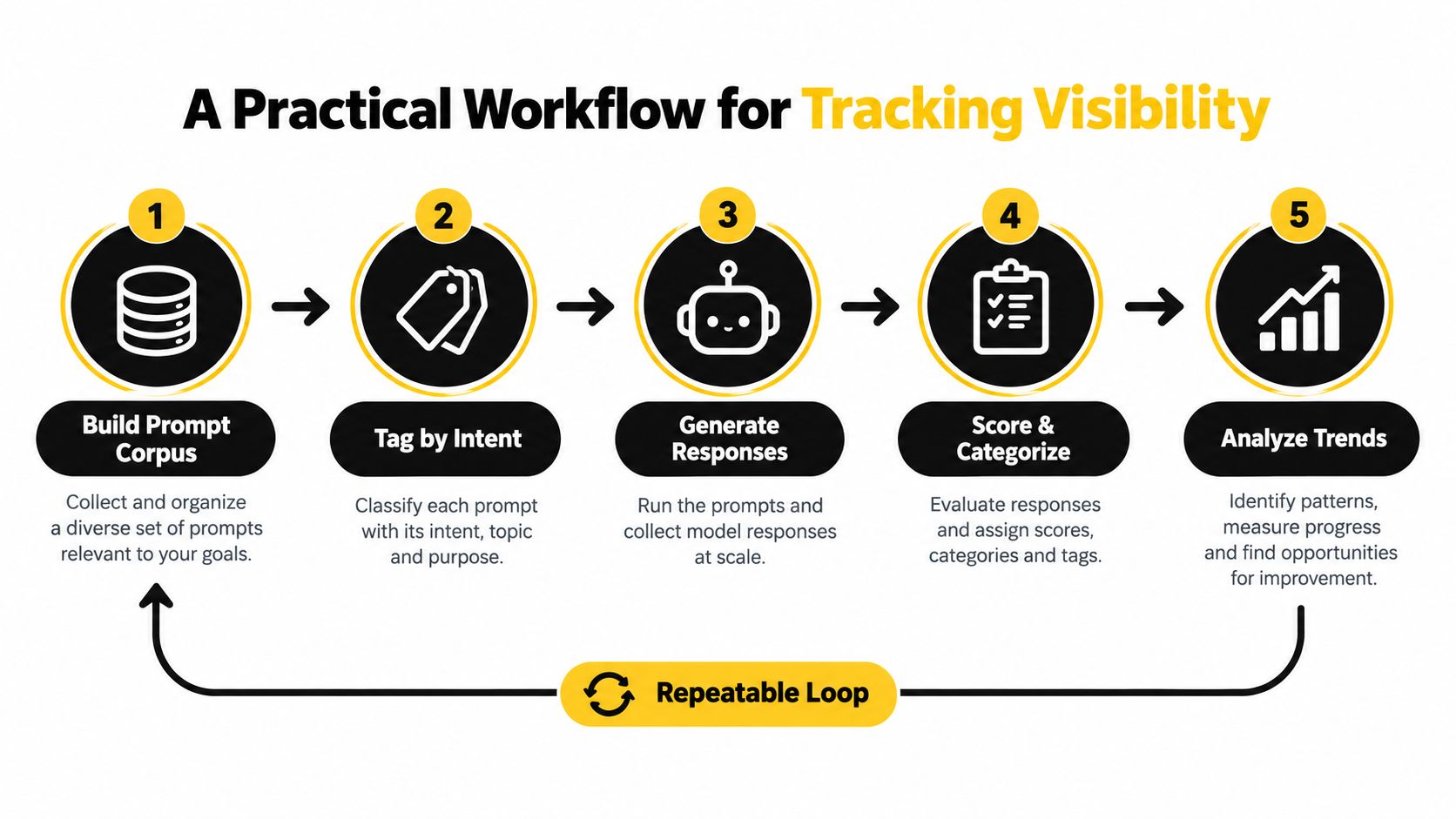
A reliable workflow starts with a prompt corpus, not a dashboard. Use real customer questions, then tag each prompt by intent, funnel stage, locale, and the competitors a buyer might compare. Include direct product questions, category questions, objections, alternatives, and negative or failure-oriented prompts.
Build a comparable observation loop
For every scheduled run, preserve the model, version, region, session state, and system or developer context. Send the same prompt through a fixed client or controlled browser process, then save the complete response rather than only the extracted brand name.
A practical record might include:
- Run metadata: Prompt ID, timestamp, model, version, market, device, and session state.
- Response body: The full text, follow-up context, refusals, and visible answer structure.
- Brand analysis: Brand and competitor mentions, sentiment, recommendation status, and response position.
- Citation analysis: Every cited URL, normalized domain, page type, and citation location.
- Outcome fields: Referral information, landing page, engagement, and conversion data where available.
The operating principle is simple: fixed inputs make changes easier to interpret. If a page update precedes a citation change for the same prompt and market, the team has a plausible lead for investigation. It isn't proof of causation, but it is far more useful than comparing unrelated screenshots.
Parse, store, and alert
A citation parser should normalize tracking parameters, resolve redirects where possible, identify domains, and flag paywalled, user-generated, partner, or editorial sources. Store one time-series row per prompt, model, market, and session so analysts can compare both aggregate movement and individual answer changes.
Set alerts for meaningful changes in visibility, citation share, answer length, refusal rate, or source ownership. The threshold should reflect the team's sampling design rather than a universal rule. For practical background on building an operational program, teams can find AI visibility guidance and review the dedicated approach to AI search monitoring.
Use the workflow as a loop. Prompt performance changes, the team investigates the sources and context, content owners make an update, and the next sampling cycle tests whether the observation changed under comparable conditions.
The Visibility, Citation, and Traffic KPI Stack
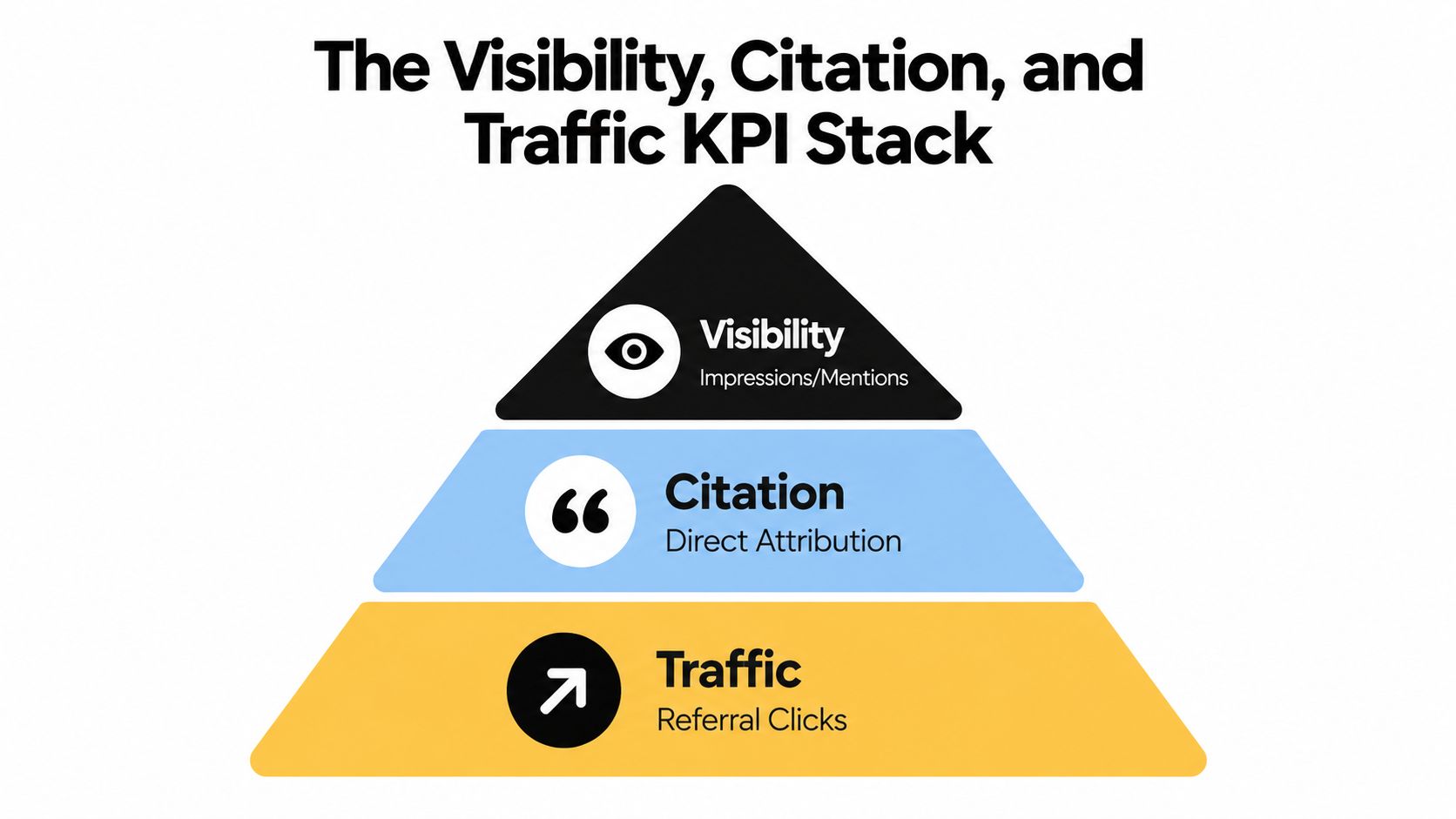
Visibility, citation, and traffic answer different questions. Combining them into one headline KPI makes it difficult to decide what action to take.
Layer one measures exposure
Visibility asks: Did the brand appear, and how prominently?
Track the distinct prompts where the brand appears, answer position, sentiment, recommendation type, and a benchmark-style visibility score over the prompt corpus. A mention at the beginning of an answer can matter more than a brief reference in a closing list. Competitor mentions provide the comparison needed for share of voice.
Mention count is useful for coverage, but it isn't value by itself. If the assistant names a product without describing it, recommending it, or linking to a source, the exposure may be weak.
Layer two measures attribution
Citation tracking asks: Which pages and domains support the answer?
Log citation frequency, source ownership, URL position, and whether the citation appears in the main answer or a secondary source area. A brand may be mentioned while an independent review, marketplace, partner page, or competitor page receives the citation. That pattern points to a content or authority gap, not just a missing brand mention.
The AI visibility metrics framework from Semrush separates visibility, mentions, citation share, and AI referral sessions for this reason. A brand can appear in an answer without earning a citation link, so teams need both prompt-level presence and source-level attribution.
Layer three measures traffic impact
Traffic asks: Did an AI interaction produce a measurable visit or business outcome?
Use analytics data to inspect assistant referral sessions, landing pages, engagement, assisted conversions, and direct outcomes where attribution is available. Keep this layer separate because a citation can influence a buyer without generating an immediately identifiable session, while a visible mention may never receive a click.
A high mention rate can signal awareness, but citation ownership shows which assets influence the answer.
Review the layers in order. First identify where the brand appears, then determine whether its pages support the answer, then examine whether the exposure connects to qualified visits or conversions. This sequence keeps teams from optimizing for volume while ignoring source quality and business impact.
Limits Every Tracker Has to Work Around
A tracker can make AI Mode observable, but it can't make the underlying system deterministic. Answers vary with location, login state, session history, retrieval conditions, and model updates. A clean-session test may not resemble what a returning customer sees after several follow-up questions.
Google AI Mode is also a separate surface from AI Overviews and generic Google traffic. Google Search Console doesn't cleanly separate AI Mode appearances or citations, so standard organic reports can't provide a complete view of this experience. Cross-market measurement matters because a brand can appear consistently in one region and be absent in another.
Technical access creates another constraint. Current coverage notes that AI Mode has no public API and may require repeated browser probes, which makes the resulting measurement probabilistic rather than exact. Sampling also has practical limits: teams must manage rate limits, retrieval failures, session simulation, storage, and the cost of running the same tests repeatedly.
| Limit | Why It Happens | Practical Workaround |
|---|---|---|
| One screenshot misleads | A response can change between runs | Repeat prompts and retain the full history |
| No stable rank position | An answer is generated prose, not a fixed list | Track response position, recommendation role, and citation order |
| Market differences | Locale and region affect retrieval and answers | Tag every run by market and compare like with like |
| Session differences | Login state and conversation history alter context | Use controlled sessions and record their state |
| Limited attribution | Standard analytics may not isolate AI Mode visits | Combine referral data with prompt and citation observations |
| Tool access constraints | Browser probes, failures, and rate limits interrupt collection | Schedule runs, retry safely, and mark incomplete observations |
Don't paper over variance with a single average. Report the sample, conditions, repeat behavior, and confidence in the observation. A change is useful when the team can reproduce it or explain why it remains uncertain.
Getting Started and Common Pitfalls
Start small enough to maintain and broad enough to reflect real demand. A focused corpus of 25 to 50 real customer questions is a practical starting range, as long as every prompt has a business reason for inclusion. Sample it weekly across at least two models and two markets, then review the results alongside traditional search reporting.
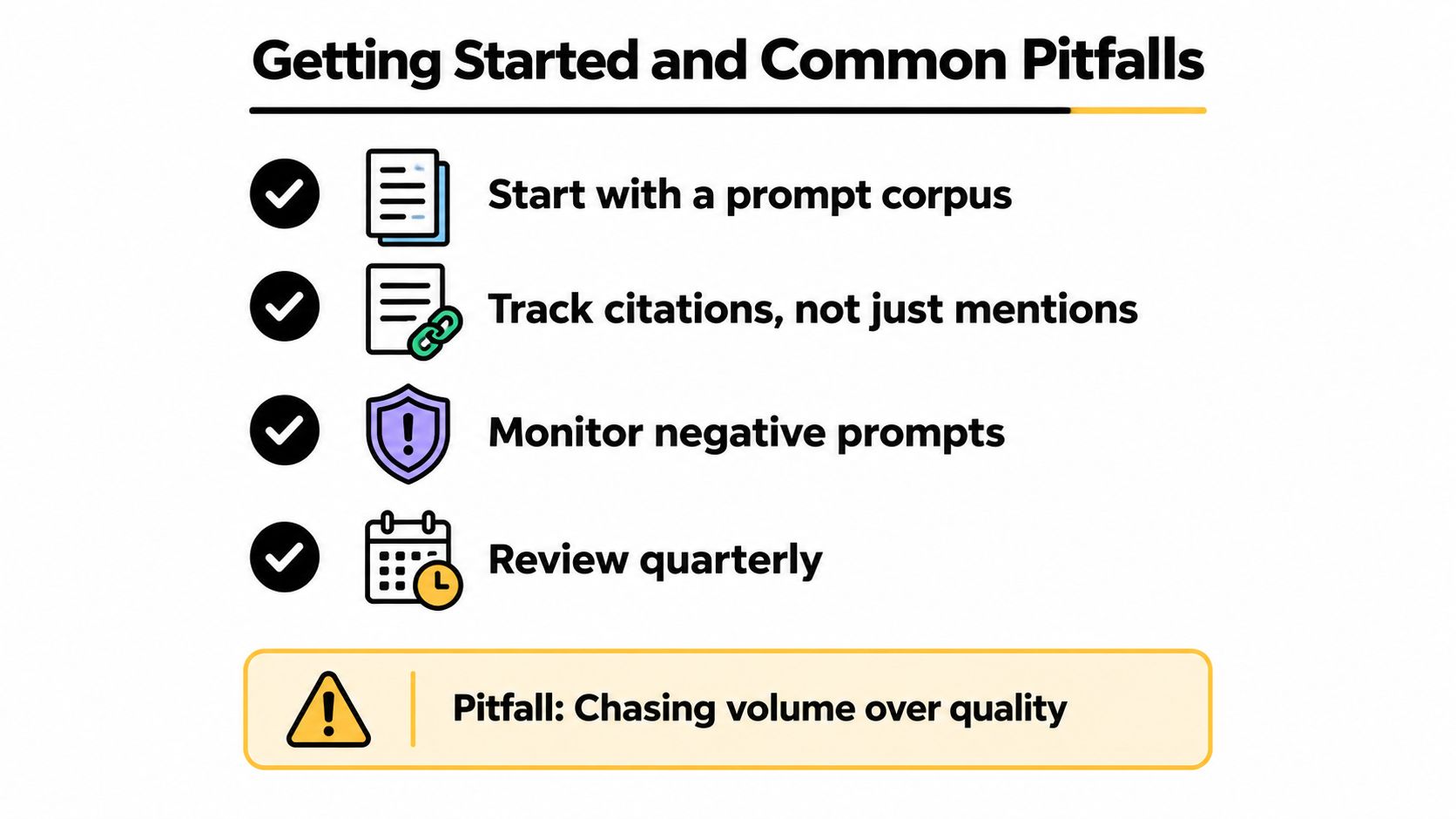
Watch for these failure modes:
- Chasing mention volume: A frequent uncited reference may be less useful than a well-supported recommendation.
- Ignoring context: Prompt wording, market, session, and model version can explain apparent performance changes.
- Treating one model as representative: Visibility in one assistant doesn't prove visibility in another.
- Sampling too rarely: Infrequent checks can miss citation drift and short-lived answer changes.
- Skipping source attribution: Without URLs and domains, content teams don't know which assets to improve or promote.
- Reporting a false precision: A point estimate without repeat runs can disguise normal response variance.
A privacy-sensitive testing environment can also matter when teams study how assistants respond to controlled prompts. A resource on a privacy-first ChatGPT alternative can help teams consider those operational choices without confusing privacy controls with visibility measurement.
For the first reporting cycle, assign one owner to maintain the corpus, one analyst to validate extraction, and named content owners for citation gaps. Store the raw response beside the scored fields. Once the baseline is clean, AI mode tracking can compound like classic rank tracking: each cycle adds context, reveals patterns, and makes the next content decision more defensible.
MyMentions helps teams run prompt-level AI visibility tracking across supported assistants, monitor position, sentiment, competitors, share of voice, and citation sources, then connect those observations with traffic attribution. Build a controlled prompt set and compare your brand across markets by visiting MyMentions.