More than 60% of answers in a 2025 test of eight AI search engines contained incorrect answers to news-citation queries. The problem isn't limited to hallucinations, because AI search can also miss relevant sources, omit pages it used, favor narrow source types, and produce visibility without meaningful referral traffic.
That error rate is the surface symptom of a deeper system problem. AI search combines query interpretation, retrieval, ranking, answer generation, and citation. A failure at any layer can change what a buyer learns about your company, which competitor gets named, whether a source receives credit, and whether anyone reaches your website.
Traditional SEO reporting usually treats a ranking as evidence of exposure. AI search requires a stricter question: what did the system answer for a specific prompt, which sources shaped that answer, and what business action followed? The sections below treat AI search problems as measurable failure modes rather than quirks of conversational software.
Table of Contents
- Why AI Search Problems Deserve Their Own Audit
- The Five Core Categories of AI Search Problems
- Hallucinations and the Citation Illusion
- The Attribution Gap Between Retrieval and Citation
- The Real Business Cost of AI Search Failures
- A Practical Diagnostic Routine for Your Brand
- Turning AI Search Problems into a Prioritized Fix List
Why AI Search Problems Deserve Their Own Audit
DeepSeek misattributed quoted sources 115 times out of 200 in a 2025 test of AI search engines, as reported in the research reference provided for the test. That result identifies a business problem, not just a model defect: a buyer can receive a confident answer while the wrong publisher gets credit, the correct source is omitted, or the path to a product page disappears.
AI search operates through a chain of decisions. It interprets the prompt, retrieves candidate pages, weighs evidence, generates an answer, chooses citations, and presents the result. A failure in any step can alter which vendor appears relevant, how a product is described, whether a competitor receives attribution, and whether the user visits a site.
Each step creates a separate audit surface. A page may be accessible but fail to match the prompt. A system may retrieve a useful page without citing it, cite a real page that does not support the claim, or mention a company without giving the user a usable route to the relevant content. A citation can also point to information that no longer matches the company's current product.
The AI visibility audit framework shifts analysis from individual pages to the prompt-response-source relationship. That unit connects what a user asked, what the system answered, which evidence shaped it, and what action remained possible. A conventional crawl cannot observe that sequence.
Why ranking data isn't enough
Technical SEO audits still find crawlability problems, canonical conflicts, missing metadata, and weak internal links. They do not show whether an assistant recommends the right vendor for a defined use case, describes the product accurately, distinguishes the current offering from an older one, or cites documentation and review pages that a buyer can verify.
The audit must therefore measure prompts, not only URLs. Capture responses for priority use cases, validate every cited source, compare claims with current product information, record omissions, and check whether the answer creates a visit path. This reveals failures that visibility dashboards flatten into a single mention rate.
Practical rule: Record what the assistant says, cites, omits, and enables the user to do. A brand mention alone is not a visibility outcome.
The resulting costs are measurable: lost traffic when no source is credited, misattribution when another publisher receives the citation, and brand risk when a system invents or distorts facts. Prompt-level diagnostics connect each failure to a corrective owner and a business outcome.
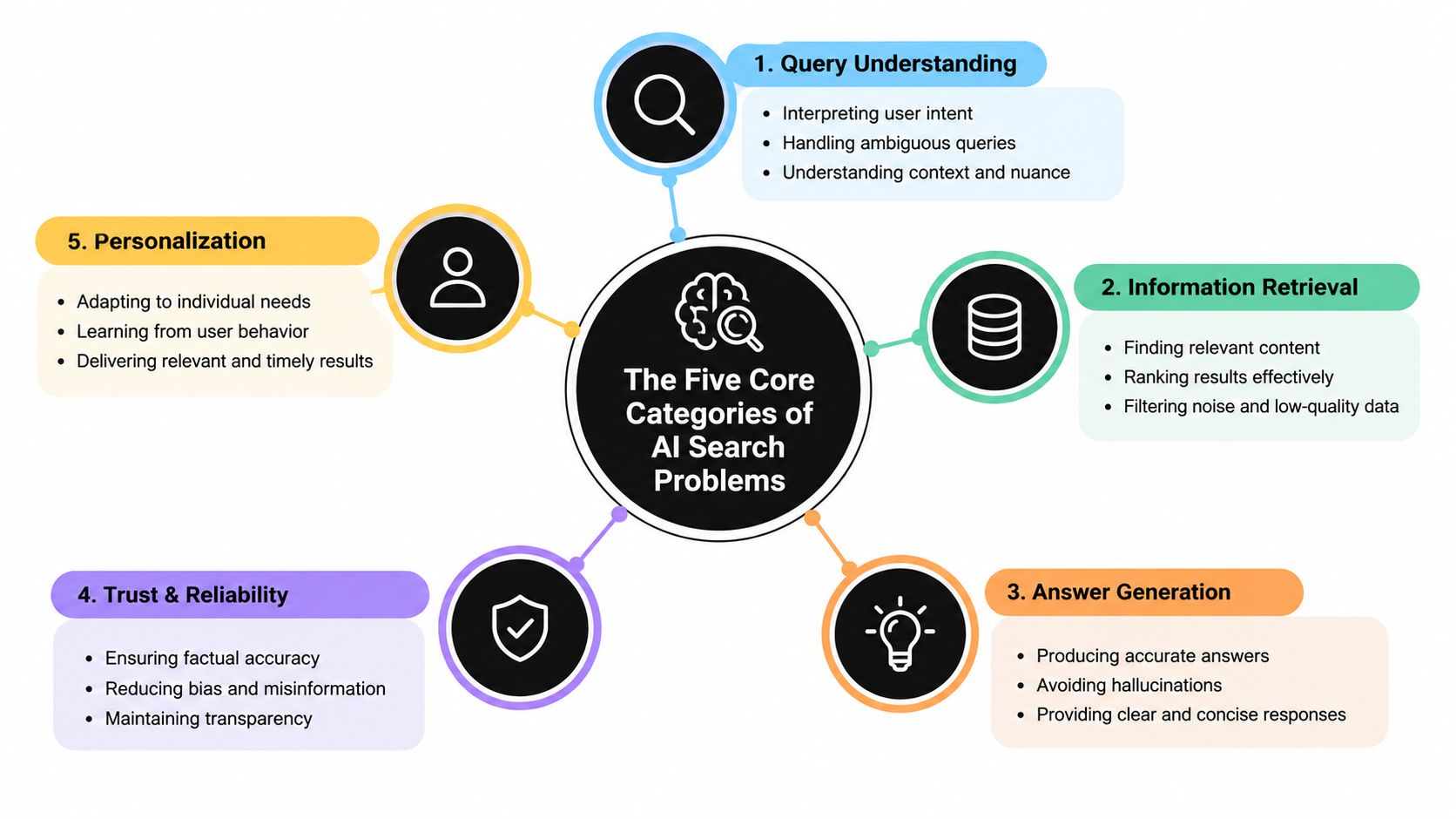
The Five Core Categories of AI Search Problems
The most useful way to organize AI search problems is by failure category. Each category has a distinct diagnostic question and a different owner inside the business.
Relevance drift
Relevance drift occurs when the answer moves away from the user's actual intent. A prompt about implementation may produce a generic category definition. A request for a comparison may return a list of popular brands without matching the buyer's constraints.
Ask: Does the assistant recommend or describe my brand consistently when the prompt includes the specific use case, company size, market, or technical requirement I serve?
The signal is an answer that sounds plausible but solves a different problem. The cost is wasted consideration. Buyers may conclude that your product isn't relevant, even when your page ranks well for the underlying topic.
Hallucinated citations
A hallucinated citation is a reference that doesn't exist, doesn't resolve, or doesn't support the statement attached to it. Citation generation can make an answer look researched while leaving the reader unable to verify its claims.
Ask: Do the cited URLs resolve, and does each source directly support the sentence that cites it?
The signal is a fabricated URL, a mismatched title, or a quote that can't be found on the linked page.
Retrieval bias
Retrieval bias describes the uneven source pool an assistant uses. Some systems may favor highly accessible pages, familiar domains, review sites, or content with machine-readable structure. A company can have accurate information online and still be absent because the system repeatedly retrieves a different source set.
Ask: Which publishers, directories, competitors, and review sites appear repeatedly when the prompt concerns my category?
The signal is source concentration that doesn't reflect the wider evidence available to a buyer.
Stale knowledge
Stale knowledge appears when an answer reflects an earlier product, old pricing, retired feature, previous leadership team, or outdated market position. A model may also combine current and historical facts without showing the boundary between them.
Ask: Does the answer correctly reflect the current state of my product when the prompt includes a date, release, plan, or recent change?
The signal is a recommendation that points to an obsolete page or describes a capability your company no longer offers.
Broken provenance
Broken provenance means there isn't a traceable path from a claim in the answer to the page, passage, author, or evidence that supports it. It differs from a hallucinated citation. The URL may be real, but the user can't tell which claim it supports or whether the system used it.
Ask: Can an analyst map each important claim to a specific source and confirm that the source was retrieved rather than merely named?
A repeatable prompt regression testing process turns these questions into comparable observations across providers and over time.
Hallucinations and the Citation Illusion
A polished answer can fail twice: the claim may be wrong, and the citation may make it appear verified. That combination creates a more serious AI search problem than an obvious factual error because users often trust the reference before checking the source.
A separate benchmark tested 13 state-of-the-art LLMs and found citation hallucinations in every system. Reported rates ranged from 14.23% to 94.93%, depending on the model and domain. Citation validation accuracy reached only 38%, according to the citation hallucination benchmark. The range matters for brand audits. A provider with low average visibility can still expose a company to substantial risk if it repeatedly presents unsupported product claims or misattributes evidence.
What the citation failure looks like
A model can paraphrase a real URL inaccurately, attach a legitimate page to a claim the page does not support, invent a plausible domain, or produce a quote that never appears in the source. It can also cite a relevant article while applying its evidence to a different product, market, or time period. Fluency conceals each failure.
The business cost differs by failure type:
| Failure | What the user sees | Business consequence |
|---|---|---|
| Unsupported claim | A confident statement with a valid-looking citation | Brand risk and corrective work |
| Misattributed evidence | Your company appears to endorse a claim it never made | Reputation and legal exposure |
| Fabricated source | A citation that cannot be opened or verified | Lost trust and weak decision support |
| Inaccurate paraphrase | A real page presented as proof of a different claim | Misleading recommendations and poor conversion quality |
The underlying data problem matters as much as the wording problem. Inconsistent, outdated, or poorly structured evidence gives a system more opportunities to combine facts incorrectly. Teams examining why language models fail without clean evidence can use digna generative AI insights alongside citation-level testing.
Why brands should care
A false citation involving your brand can lend authority to a claim your company never made. It can also attach a negative statement, product limitation, or customer quote to your company without evidence. The user receives the impression before a marketing or communications team can respond.
Mention-count dashboards cannot identify this distinction. Analysts should run a fixed prompt set, capture complete responses, open each cited page, and map every material claim to the supporting passage. Record whether the source is real, relevant, current, and attributable. A citation analysis method for AI search engines provides a repeatable way to compare those results across providers and prompt versions.
The operating rule is simple: citation presence is not citation validity. Track unsupported claims, invalid citations, and brand-attributed errors separately. Those prompt-level measures connect hallucination risk to remediation cost, while a raw mention count cannot show whether AI search is sending qualified traffic or merely displaying your name.
The Attribution Gap Between Retrieval and Citation
An AI system may retrieve a page, use information from it, and still fail to cite it. That creates an attribution gap between the evidence available to the model and the evidence visible to the user.
Cambridge research on LLM search results found that an average answer from Gemini or Sonar left about three relevant websites uncited, according to the study on attribution in LLM search results. The result is not only an answer-quality issue. Publishers may supply useful information without receiving credit, and brands may be unable to identify which page influenced the response.
Following one query through the stack
Take the imagined query, “What is the best CRM for SaaS startups in 2025?”
First, the system interprets “best” as a recommendation request and “SaaS startups” as a segment constraint. It then retrieves product pages, comparison articles, reviews, documentation, and perhaps discussion pages. Ranking determines which material is prominent. Generation compresses that material into a shortlist.
Citation selection happens after, or alongside, synthesis. The assistant may cite a review that influenced the wording, omit a product page it used for a feature detail, and attach a citation to a sentence broader than the source supports. A monitoring tool that sees your domain mentioned might mark the prompt as a success, even though the cited source is a competitor or no traceable path exists.
| Stage | Sources touched | Sources cited | Accuracy |
|---|---|---|---|
| Query interpretation | Potentially relevant source types | None yet | Intent can drift |
| Retrieval | Pages selected by the provider | None yet | Selection can be incomplete or biased |
| Answer synthesis | Retrieved material plus generated wording | Some sources may be chosen | Claims can exceed evidence |
| Citation rendering | A subset of available evidence | The links shown to the user | Attribution isn't guaranteed |
| User action | Cited and uncited information | Sources the user can visit | Traffic path may be absent |
The operational metric is therefore not “Was my domain mentioned?” It is “Was my page retrieved, used, cited, correctly represented, and made actionable?” The distinction is central to source attribution in AI search, especially for teams trying to connect answer visibility with publisher credit.
The Real Business Cost of AI Search Failures
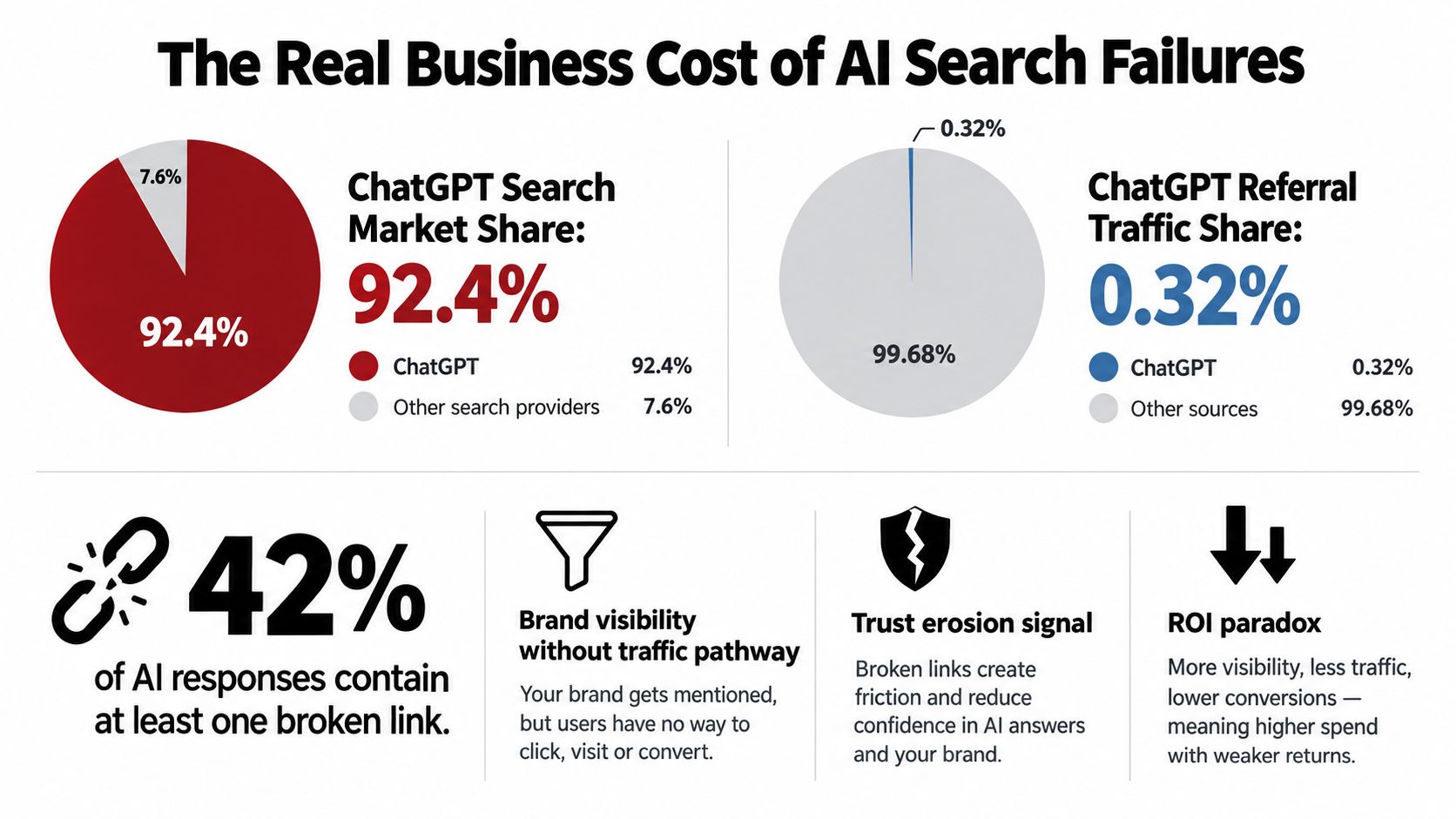
AI visibility and AI traffic are different outcomes. A system can mention a brand in a response while sending almost nobody to its website, particularly when the answer satisfies the user without requiring a click.
Independent research reported AI referral traffic at 0.32% of total website traffic in 2026, compared with 0.24% in 2025 and 0.02% in 2024, while a study of 6.77 million AI-driven sessions across 166 sites found that ChatGPT accounted for 92.4% of trackable standalone referral traffic. These figures come from the AI traffic research study. They point to a practical question: which mentions convert, and on which providers?
Three cost buckets
Lost traffic begins with a missing or unusable path. If an assistant gives a complete answer without linking to your site, your content may influence the buyer while your analytics record no visit. If it cites a third-party page instead, the publisher receives the referral and your team loses the chance to move the user into documentation, signup, or sales content.
Misattribution makes performance harder to explain. A review site, partner page, or competitor comparison may receive credit for information your team produced or maintained. Without prompt-level source logs, marketers may optimize the wrong page because the visible citation doesn't reveal the complete retrieval path.
Brand risk comes from inaccurate descriptions, fabricated quotes, obsolete features, or unverified comparisons. Relevance drift can make a capable product appear unsuitable. Retrieval bias can repeatedly exclude your brand from a category conversation. Stale knowledge can cause a buyer to evaluate a product that no longer exists in the described form.
A framework for tracking AI visibility should therefore connect response data with referral and conversion data. Visibility is an input. It isn't proof of commercial value.
A Practical Diagnostic Routine for Your Brand
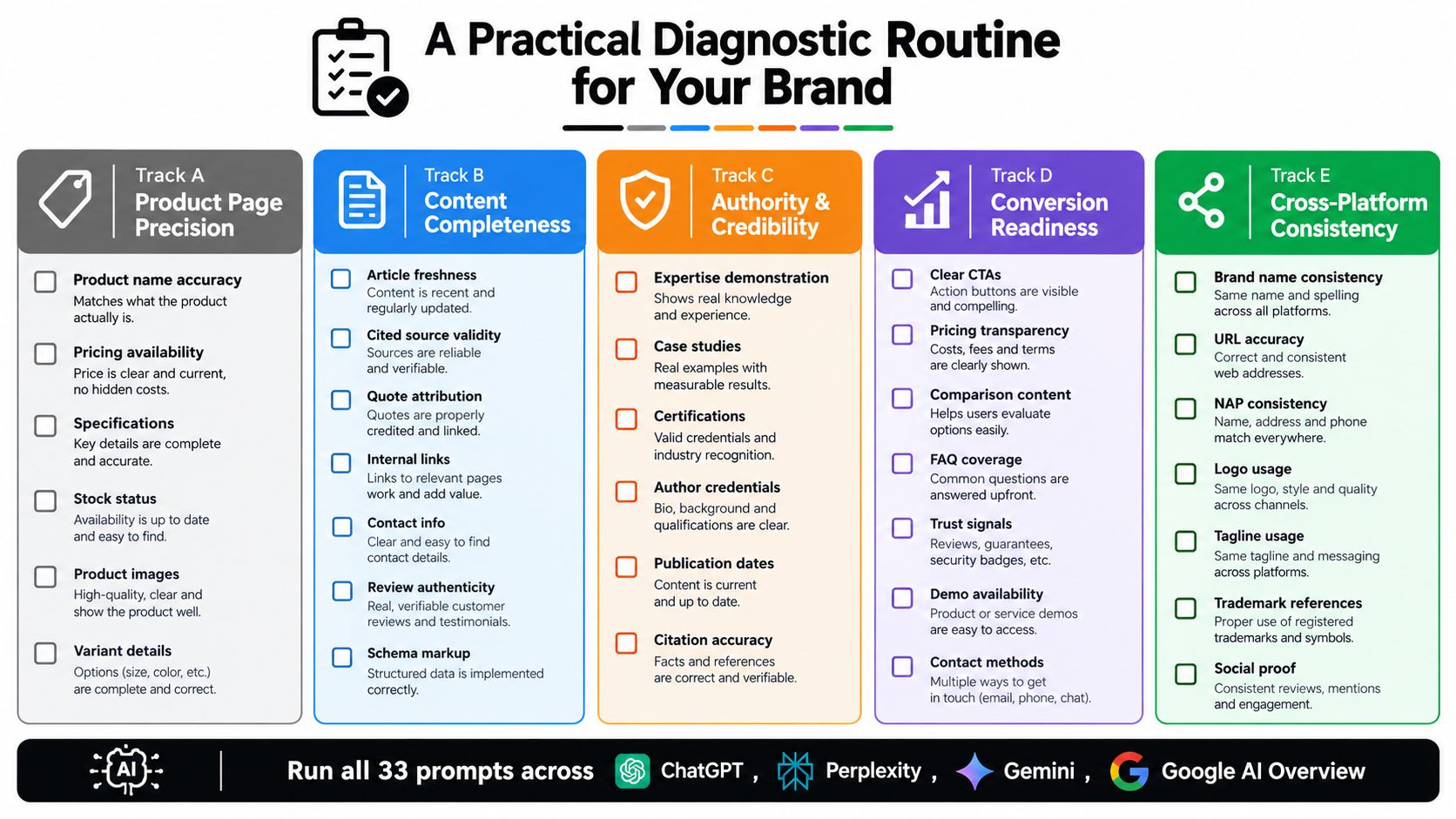
Run the audit as a controlled prompt exercise, not as an occasional search of your company name. Use the same wording across ChatGPT, Perplexity, Gemini, and Google AI Overviews where available, capture the complete response, and record the date, provider, model or experience, cited URLs, and answer outcome.
Track A tests relevance
Use direct brand and use-case prompts:
- “What does [brand] offer for [specific audience]?”
- “Which product is suitable for [job to be done] under [constraint]?”
- “Compare [brand] with [competitor] for [use case].”
- “Who should not use [brand]?”
Log whether the assistant names the right product, describes the correct audience, distinguishes the relevant plan, and answers the actual constraint. Score relevance as pass, partial, or fail. A generic category answer, a competitor substituted for your brand, or a recommendation aimed at the wrong buyer is a relevance failure.
Track B validates facts and citations
Ask factual questions that have authoritative answers:
- “When was [company] founded?”
- “What features does [product] currently include?”
- “Who founded [company]?”
- “What does [brand] say about [specific policy or capability]?”
Open every citation. Check for wrong dates, invented product details, confabulated URLs, unsupported quotes, and pages that resolve but don't contain the stated evidence. Escalate false claims about safety, compliance, legal matters, or customer outcomes to PR, legal, or communications. Fix ordinary page-level discrepancies through content edits only after confirming the source of truth.
Track C exposes retrieval bias
Use comparative and category prompts:
- “What are the main alternatives to [competitor]?”
- “Which tools are commonly recommended for [category]?”
- “Compare [brand], [competitor], and [third option].”
- “Which vendors have the strongest fit for [segment]?”
Record every named brand, source domain, position in the answer, and reason given for inclusion. Look for repeated exclusion, one-sided comparisons, or source types that dominate despite weaker relevance. This track helps separate a content gap from a retrieval pattern. If the assistant repeatedly cites review pages, the response may require reputation and publisher work rather than another product article.
Track D tests freshness
Use time-sensitive prompts:
- “What is the current pricing or plan structure for [product]?”
- “What changed in [product] recently?”
- “Does [brand] still offer [feature]?”
- “What should a buyer verify before choosing [product] this year?”
Log dates, plan names, feature status, and links to current pages. Flag answers that combine retired and current information. Product marketing and engineering should own discrepancies involving releases, availability, or technical behavior.
Track E checks provenance
Use citation-heavy prompts:
- “Answer using official sources and identify the page supporting each claim.”
- “List the evidence for each recommendation.”
- “Which sources did you use, and what does each one support?”
- “Separate verified facts from uncertain statements.”
Score whether the cited page exists, supports the claim, identifies an author where appropriate, and provides a clear publication or update date. A lightweight sheet can use one row per prompt and columns for provider, intent, answer accuracy, citation validity, source type, freshness, referral path, and action owner. Add a short note for every failure, then group findings by product, content, authority, conversion, or technical issue.
The routine is more valuable when repeated with unchanged prompts. It establishes whether a fix changes the answer, not merely whether a dashboard reports a higher visibility score.
Turning AI Search Problems into a Prioritized Fix List
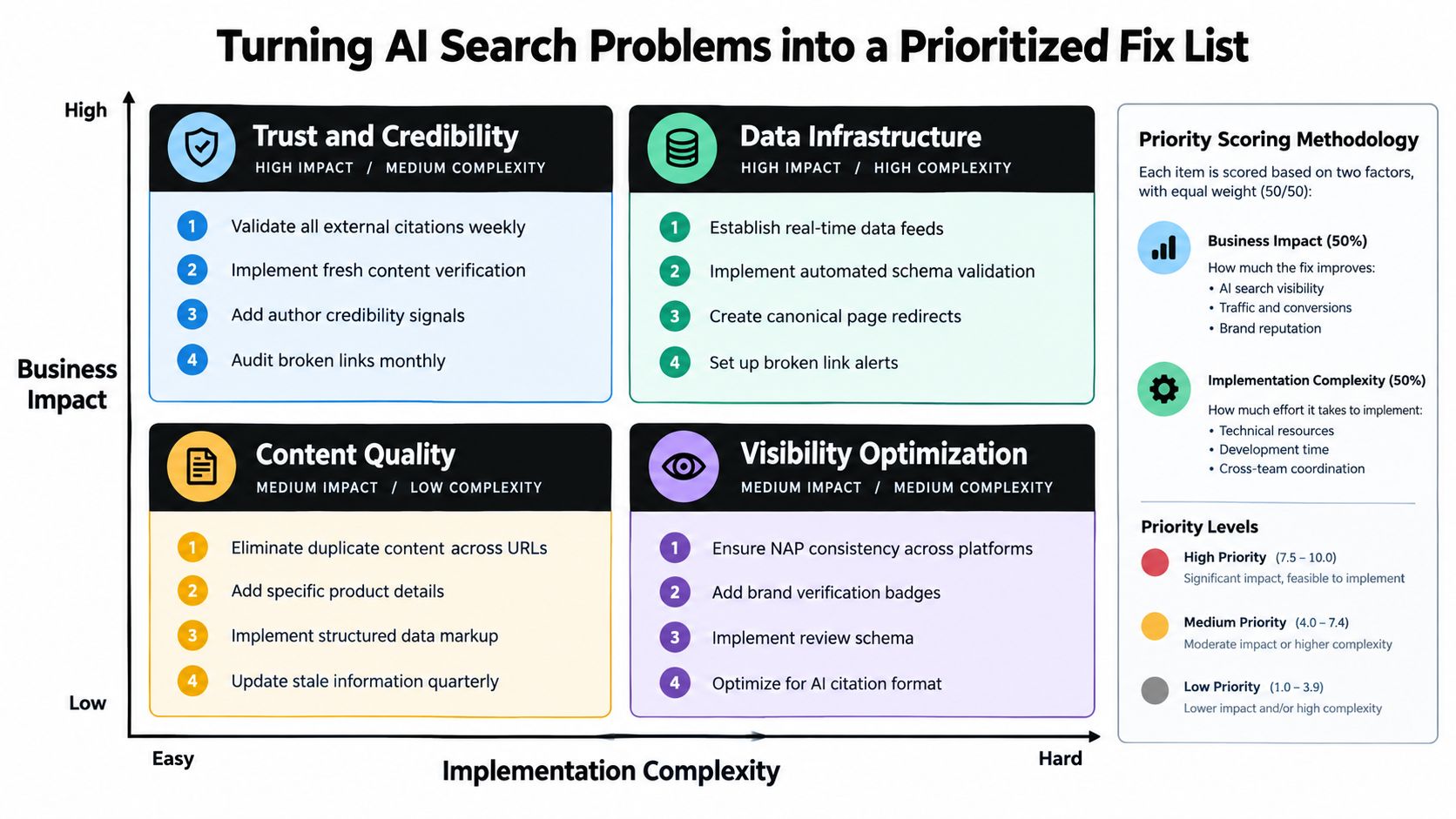
A useful fix list starts with the failure's business consequence, not the team's preferred implementation task. Citation failures need trust and provenance work. Relevance drift needs clearer intent coverage. Stale answers need maintained source pages and dependable update signals. Retrieval bias may require authority-building outside the company website.
Fix trust before polishing visibility
Start with trust and provenance. Validate important external citations, remove unsupported claims, maintain author and reviewer information, repair broken links, and make the relationship between a claim and its evidence easy to understand. This work reduces the chance that an assistant will rely on ambiguous or outdated material.
Next, improve content quality. Give product pages specific names, capabilities, limitations, audiences, and update dates. Write structured answers that can be extracted without losing context. Keep comparison pages factual and make clear which claims are current.
Then address UX and on-site signals. Put concise summaries near the relevant detail, connect related pages with meaningful internal links, and use structured data where it accurately describes the page. These changes don't guarantee citation, but they make the intended source easier to interpret.
Technical work supports all three. Consolidate duplicate URLs, maintain canonical signals, keep important reference pages crawlable, and monitor broken or redirected sources. A technical fix matters most when it changes which page an assistant can retrieve and cite.
A Monday-ready sequence
- Repair citation provenance first. Validate the sources appearing in high-value buyer prompts and correct claims that cannot be supported.
- Refresh the most commercially important pages. Prioritize current product, pricing, comparison, documentation, and policy pages.
- Run prompt diagnostics weekly. Re-test the same questions across providers and log answer, source, and traffic outcomes.
- Resolve high-risk inaccuracies immediately. Escalate false legal, compliance, safety, executive, or customer claims to the appropriate owner.
- Address retrieval bias after the foundation is stable. Improve third-party authority, reviews, partner references, and category coverage when the core facts and citations are reliable.
This order prevents a common mistake: trying to increase mentions before ensuring that the information assistants retrieve is accurate, current, attributable, and useful to a buyer.
MyMentions tracks prompt-level visibility, position, sentiment, competitors, citation sources, and referral attribution across supported AI assistants, turning AI search observations into a prioritized backlog. Use MyMentions to compare provider responses, identify which sources shape your brand's answers, and connect mentions with visits before deciding what to fix next.