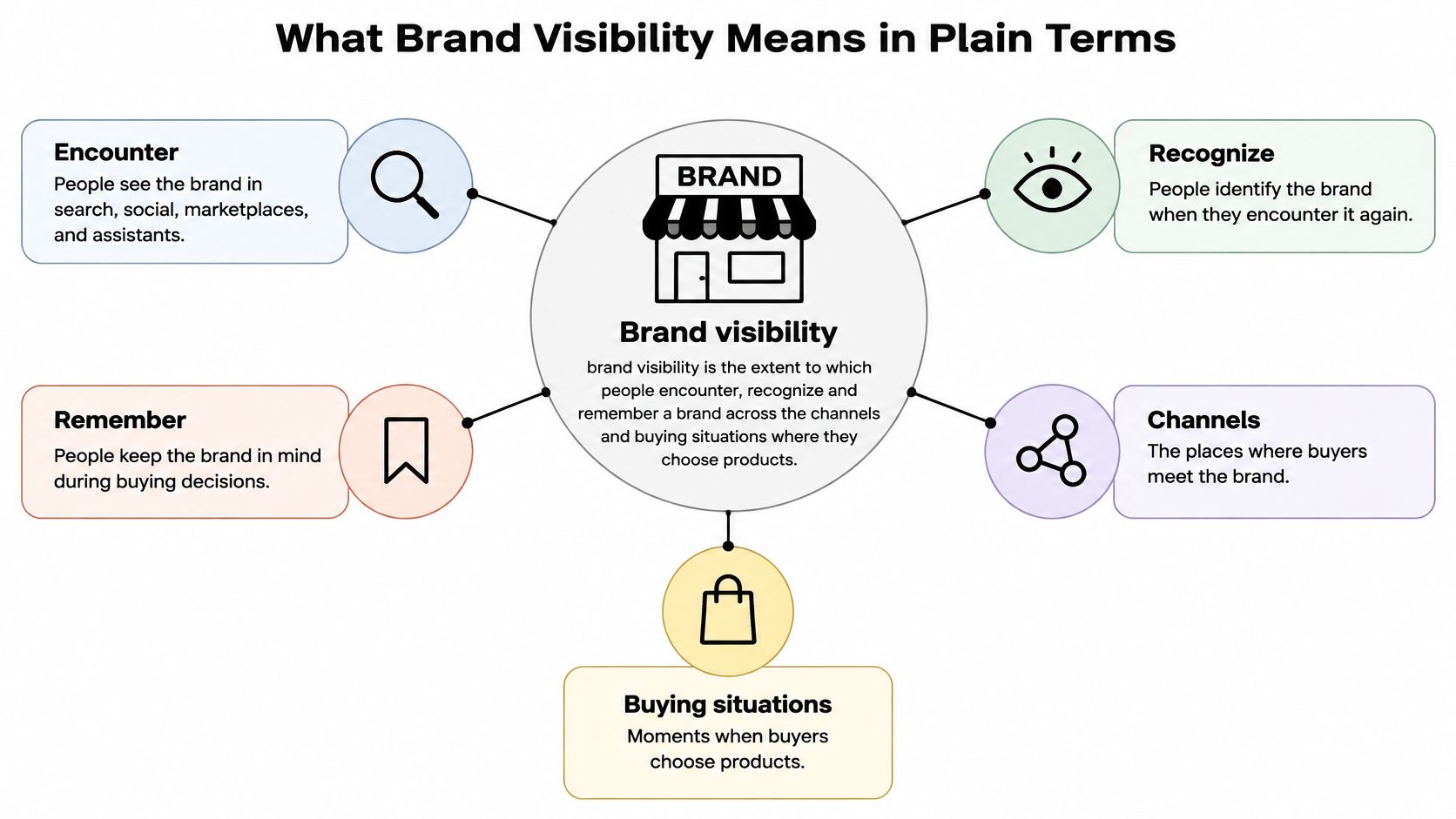
Brand visibility is the extent to which people encounter, recognize and remember a brand across the channels where they buy.
You've published your website, started posting on social media, and perhaps paid for ads. Yet when a prospective customer searches for a solution, checks reviews, or asks an AI assistant for recommendations, you're not sure whether your brand appears or how it's described. That uncertainty is what a useful visibility measurement system should resolve.
Table of Contents
- What Brand Visibility Means in Plain Terms
- Visibility Compared With Awareness, Reach and Ranking
- Where Buyers Encounter Your Brand Today
- Metrics That Show How Visible a Brand Is
- Practical Tactics to Improve Brand Visibility
- Worked Examples and Misconceptions That Mislead Teams
- Measure Visibility Step by Step and Set Your Baseline
What Brand Visibility Means in Plain Terms
Think of a shop on a busy street. Its bright sign attracts attention, and its window display helps passersby understand what it sells. But counting everyone who walks past won't tell the owner whether anyone remembers the shop when they need its products.
Your digital brand has the same problem. Exposure matters, but exposure alone isn't evidence of recognition, consideration, or purchase intent. In Nielsen's 2022 Annual Marketing Report, global marketers identified building brand awareness as their top marketing objective, and 64% said social media was their most effective paid channel.
The distinction becomes clearer when you separate the buyer's experience into connected layers:
- Exposure: A buyer sees your brand in a search result, review, recommendation, or advertisement.
- Retrieval: They remember your name when a relevant need arises.
- Evaluation: They encounter an accurate description that helps them judge whether your product fits.
The diagram maps those layers to the places where buyers encounter a brand.
For a software company, the equivalent of that shop window might be a review profile or partner listing rather than its homepage. A buyer can form an opinion without visiting the company's website, so website traffic can't tell the whole story.
Visibility means being found, recognized and described in the moments that decide a purchase.
Visibility Compared With Awareness, Reach and Ranking
Say a SaaS company reaches a large audience through paid campaigns and earns prominent search rankings. Yet when its marketer tests buyer questions in AI assistants, the brand rarely appears. When it does, the assistant describes a discontinued feature.
Is the company visible? In paid media and traditional search, yes. In those sampled recommendations, not reliably. The answer changes with the outcome you measure.
Brand visibility compared with related measures
| Term | What It Measures | Typical Signal | Blind Spot |
|---|---|---|---|
| Brand awareness | Whether people recognize or remember the brand | Aided recognition in a survey | Recognition can be high while AI assistants never name the brand |
| Reach | How many people see the brand | Unique viewers, with impressions tracked separately | Large reach can still leave the brand misdescribed |
| Search ranking | Position of your page for a query | Average position for a keyword | A top link doesn't mean the brand is named in AI answers |
| Share of voice | Your mentions as a share of category mentions | Mentions compared with tracked competitors | Says nothing about accuracy or sentiment |
| Brand visibility | Presence across relevant answers and touchpoints, considered alongside position and sentiment | Share of tracked answers naming the brand, average rank, and sentiment | Prompt selection and sample size constrain the result, so state denominators |
Awareness asks what people know. Reach describes distribution. Ranking describes placement. Share of voice adds competitive context. Visibility measurement connects these signals without pretending they're interchangeable.
For an offline example, Adwave's guide to TV ads for local brand awareness provides context for planning awareness activity. A campaign's distribution and its effect on recognition still need separate checks.
AI discovery adds another measurement surface, not a reason to abandon search. A 2025 Yext survey of 2,237 consumers across the United States, United Kingdom, France, and Germany found that 62% trusted AI to guide brand decisions, while 57% still preferred traditional search.
Reporting rule: Name the outcome before presenting the score, and identify the answers, audience, or touchpoints included in its denominator.
Where Buyers Encounter Your Brand Today
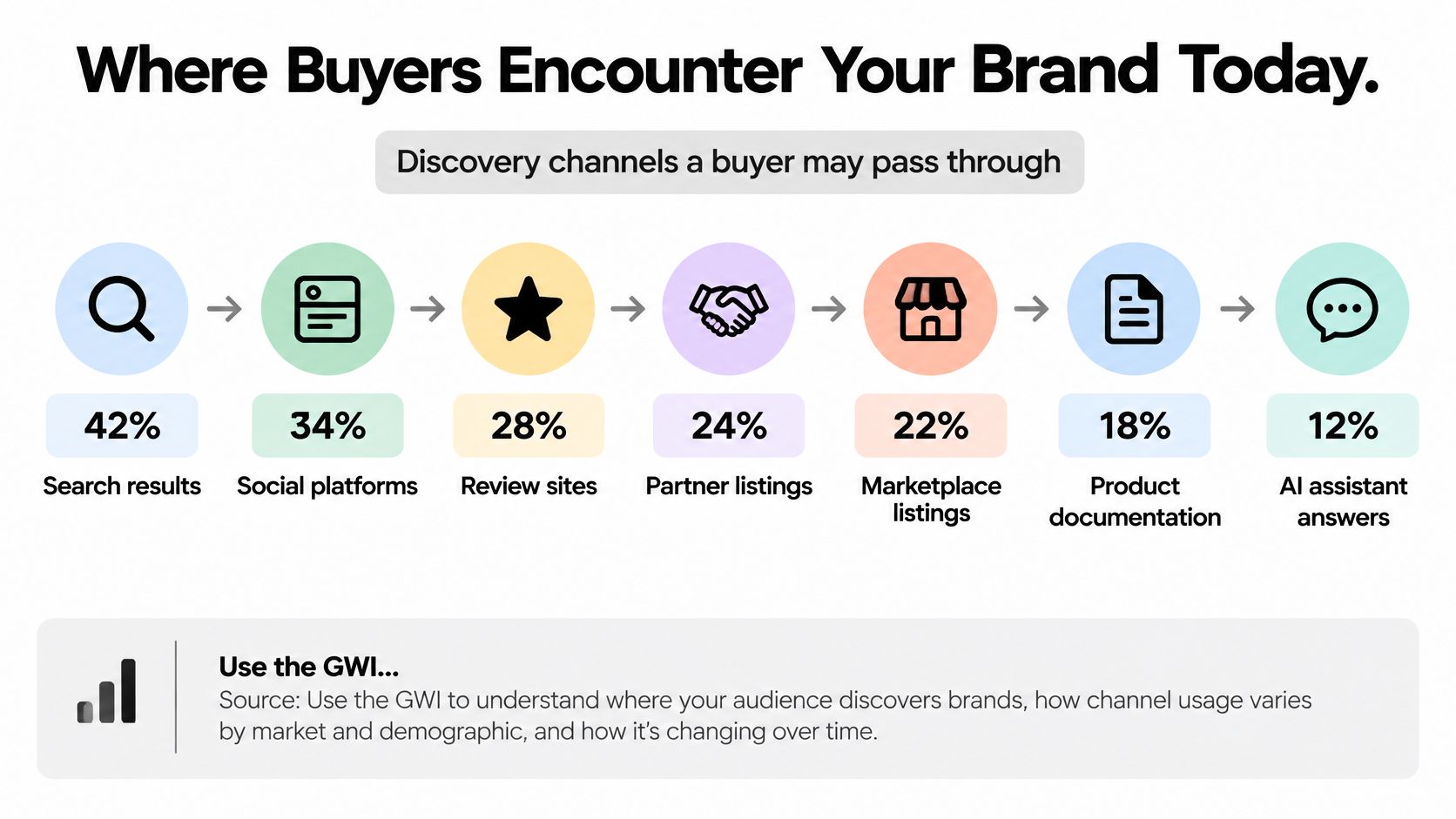
Buyers don't have to follow your preferred route to discover your product. According to GWI's Social Media Trends Report, as reported by Advert On Click, in 2024, 38% of consumers discovered brands through social media ads, recommendations, or brand-page updates, compared with 37% through search engines and 35% through television ads.
Those figures describe discovery channels, not exclusive groups or a fixed purchase sequence. Don't add them together or treat them as a budget allocation formula.
The channel map is a useful starting point for identifying where your own buyers look.
Follow the buyer's questions
Consider someone choosing a project management tool. They might notice a colleague's social post, search for alternatives, read reviews, and inspect an integration marketplace. Product documentation could settle a technical question, while an AI assistant helps them assemble a shortlist.
Your company might win searches for its own name yet enter that AI shortlist through an independent comparison article. The page representing you at that moment isn't necessarily one you control.
That's why brand monitoring should include descriptions and context, not just notifications that your name appeared. Record whether each touchpoint helps a buyer discover, assess, or verify the product.
Use the accompanying video as another format for exploring the topic.
Build a short discovery map with your sales and customer-facing teams:
- Shortlist channels: Name the channels buyers mention when explaining how they found you.
- Buyer questions: Capture their actual searches and prompts, including constraints such as integrations or team needs.
- Representative pages: Identify the profile, article, listing, or documentation page that currently explains your brand there.
This turns a broad question, what is brand visibility, into a concrete audit of the places that influence your buyers.
Metrics That Show How Visible a Brand Is
Use a set of metrics that separates presence, prominence, tone, correctness, and action. A single combined score can conceal the problem your team needs to fix.
Visibility metrics and how to calculate them
| Metric | What It Tells You | How to Calculate It | Healthy Direction |
|---|---|---|---|
| Visibility rate | How often the brand appears in tracked answers | Answers naming the brand divided by all tracked answers | Sustained improvement across repeated samples |
| Average position | How high the brand ranks when recommended | Mean rank across answers recommending the brand | Moving toward the top of lists |
| Sentiment | How positive AI descriptions sound around the product | Positive, neutral, and negative mentions as shares of classified mentions | More favorable, justified descriptions |
| Accuracy | Whether descriptions state product facts correctly | Factually correct answers divided by answers describing the brand | Fewer outdated or incorrect claims |
| Citation rate | How often your pages support an answer | Answers citing your domain divided by all tracked answers | More relevant citations |
| Source-domain share | Which domains supply cited evidence | Citations attributed to a specified domain divided by all counted citations | Stronger representation from relevant, credible sources |
| Competitor overlap | Which rivals appear alongside you | Count prompts naming both brands, with a separate count for competitor-only appearances | Fewer relevant answers excluding you |
| AI traffic | Visits attributed to AI assistants | Sessions classified as AI referrals in analytics | Relevant visits followed by measurable conversions |
Keep counting rules stable. For source-domain share, decide whether repeated citations count separately; for accuracy, specify which product facts you check. Otherwise, a reporting change can look like a performance change.
Read placement alongside presence
A brand named near the beginning of an answer has a different placement from one buried beneath alternatives. Average position adds context to mention rate, but it only includes answers where the brand is recommended, so omissions need their own visibility measure.
Repeated sampling also matters. A cross-provider benchmark on AI brand visibility recommends rolling aggregation over two to four weeks for more stable estimates. Compare a smaller brand with its own baseline and relevant competitors rather than treating the category leader's result as a universal target.
Retain traditional measures alongside AI metrics. Use aided recognition to test whether respondents recognize a supplied name and unaided recall to ask which brands they remember without a list. The first brand named is a narrower, top-of-mind measure.
Track reach and frequency by buying context, and use share of voice against a defined competitor set. For social reporting, ViralBrain's guide to LinkedIn analytics tools can help you evaluate channel-specific measurement options.
Read the results together. Rising visibility paired with worsening accuracy isn't a clean win, and positive sentiment doesn't establish that buyers signed up.
Practical Tactics to Improve Brand Visibility
Choose work according to the failure you can observe. If an answer repeats an obsolete limitation from a cited listing, correcting that listing is more targeted than publishing another general blog post.
Product teams should make facts easy to verify
Write documentation that states current pricing tiers, usage limits, integrations, and eligibility conditions in plain sentences. Keep those facts consistent across pricing pages, feature pages, and help content.
Give someone ownership of external product information:
- Review profiles: Invite honest reviews from customers on platforms buyers use. Respond to feedback and distinguish factual errors from legitimate criticism.
- Partner listings: Send the listing owner the incorrect wording, its replacement, and the product page that verifies the change.
- Marketplace entries: Check screenshots, integration descriptions, and availability claims whenever the product changes.
Marketing teams should address missing context
Build comparison and use-case pages around real buyer questions. Explain who the product suits, which requirements it meets, and where another type of solution may fit better. Specific limitations make the description more useful than unsupported claims of being best.
Use cited-source audits to identify independent comparison articles, directories, and community pages that need updates. Request factual corrections without asking publishers to remove fair criticism.
If directory coverage is a genuine gap, assess relevance and editorial quality before using a service such as the StartupSubmit directory submission service. Submission volume alone isn't a visibility outcome.
Pair awareness campaigns with recognition and recall checks. For search-specific gaps, use a separate workflow to increase Google search visibility, including indexing checks, useful page content, and internal links.
Prioritize the correction you can connect to a documented buyer question and an identifiable source. Don't assume every new page will influence recommendations.
Worked Examples and Misconceptions That Mislead Teams
Consider a hypothetical B2B analytics startup. After correcting review profiles and a partner listing, its marketer observes more mentions and more favorable descriptions across repeated tests. AI referral traffic stays flat, so the team investigates whether those answers contain clickable links and adds signup tracking.
The changes are encouraging, but they don't prove the listing edits caused the improvement. Nor does flat traffic establish that visitors failed to convert. Mentions, visits, and completed actions answer different questions.
When more advertising isn't the fix
A different company runs a display campaign and records improved brand recall. Yet an assistant still describes an outdated pricing tier from an independent article. The immediate task is to request a source correction, not buy more impressions.
Avoid these common measurement mistakes:
- Treating a snapshot as a trend: Repeat the same tests before celebrating movement.
- Equating exposure with persuasion: Check whether the intended audience's awareness, favorability, or intent changed.
- Treating visibility as permanent: Continue checking results after campaign activity ends.
- Assigning every conversion to the last click: Examine the role of earlier exposures without assuming they caused the sale.
Nielsen defines brand lift as the percentage increase in a campaign's primary objective, such as awareness, favorability, or purchase intent. That's different from counting delivery.
For advertising exposure that doesn't produce an immediate click, understand view-through attribution before assigning credit. Small score changes can reflect sampling variation, so retain the underlying answers for inspection.
Measure Visibility Step by Step and Set Your Baseline
Start with a repeatable audit, not a target score. Include questions about discovery, comparison, and product verification so your baseline represents distinct buying needs.
Third-party information deserves explicit attention. MediaPost's coverage of a 2025 multi-country consumer survey describes the importance of ratings and review volume in AI-agent recommendations. Treat review coverage as something to inspect, not a guarantee that an assistant will recommend you.
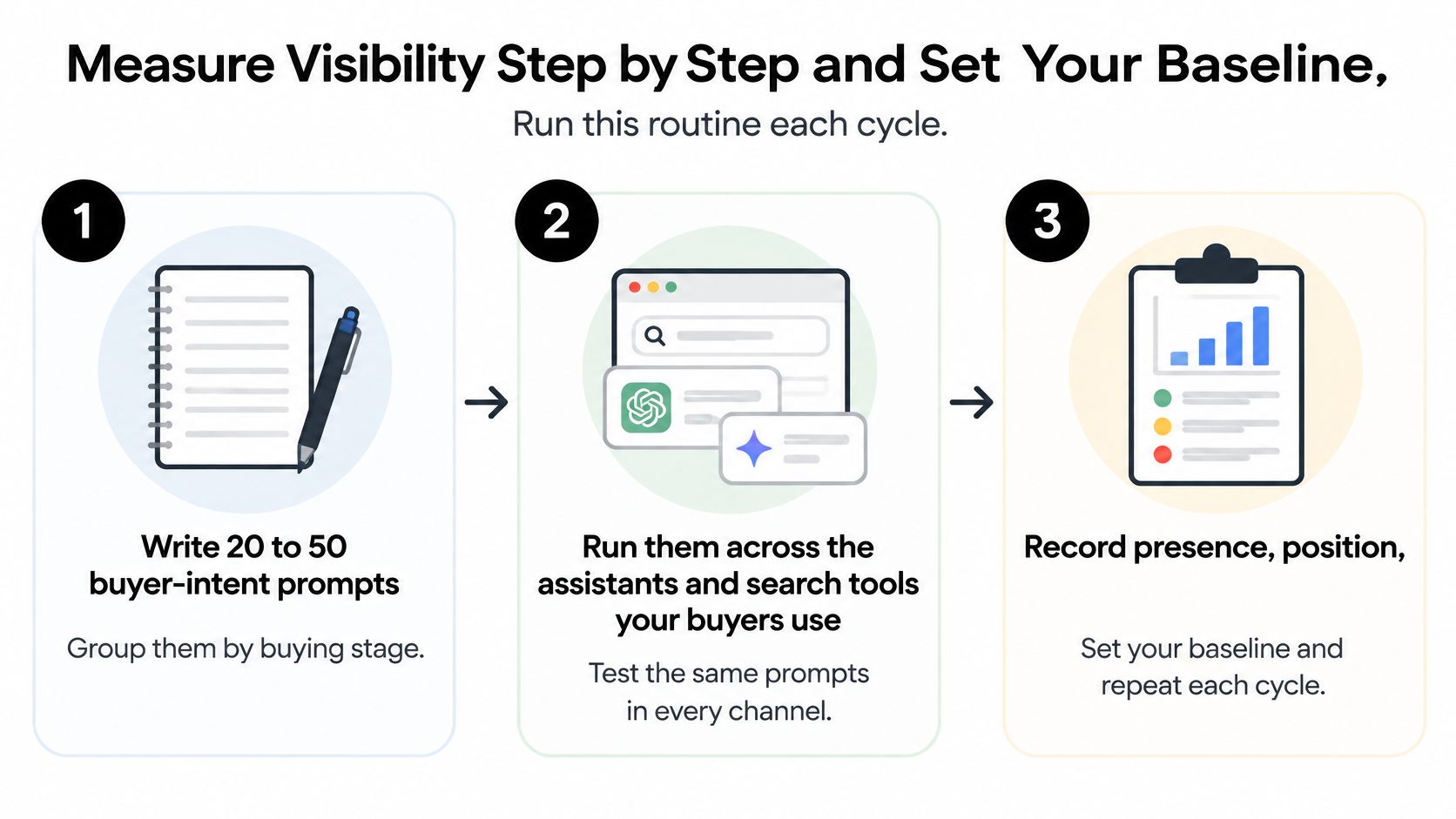
The routine below keeps prompt selection, testing, and recordkeeping connected.
Build a repeatable reporting cycle
- Write buyer-intent prompts. Group them by buying stage so broad discovery doesn't hide weak comparison performance.
- Select relevant tools. Test the assistants and search services your buyers use, recording settings and test dates.
- Capture each answer. Save presence, position, sentiment, factual errors, and cited URLs for inspection.
- Calculate segment baselines. Keep discovery and high-intent evaluation results separate.
- Audit cited domains. Flag outdated facts, inconsistent descriptions, and relevant competitor coverage that excludes you.
- Assign corrections. Give documentation, review-profile, and partner-listing tasks to named owners.
- Repeat comparable tests. Preserve the prompt set and compare aggregated results rather than isolated answers.
Use this guide to measuring AI search visibility when defining your reporting workflow. Add competitors so you can compare share of voice and sentiment within the same sample.
Our visibility score describes responses collected for the selected prompts, providers, and reporting period, not every AI search. In MyMentions, you can create a product, choose a plan, and inspect how assistants mention, rank, and describe it; Pro and Enterprise plans include citation source analysis.
Set your baseline this month and assign the clearest factual correction first. Measure completed conversions in your analytics or billing system, because an AI-referred visit is separate from a signup or purchase.
MyMentions brings brand mentions, position, sentiment, competitor comparisons, and AI-driven traffic into one workspace. Visit MyMentions to organize your buyer prompts, establish a visibility baseline, and identify which descriptions need your team's attention.