
Ranking on page one does not mean you're visible. Most organic clicks concentrate in the top five results, while lower page one positions collect a small share despite earning impressions. That gap explains why many SaaS sites report rising impressions and flat pipeline at the same time.
If you want to learn how to increase Google search visibility in a way you can prove, treat visibility as three separate layers. Track blue link position, AI Overview citation exposure, and branded demand on their own terms. Blending them into one traffic number hides which fix worked, which page stalled, and where demand converted.
Table of Contents
- Establishing a Visibility Baseline in Search Console
- Fixing Crawl, Index, and Structured Data Gaps
- Speeding Up Mobile Pages With Core Web Vitals
- Publishing Helpful Content That Matches Search Intent
- Building E-E-A-T Signals and Earned Links
- Measuring AI Overview Visibility Next to Rankings
- Turning These Fixes Into a 30-Day Plan
Establishing a Visibility Baseline in Search Console
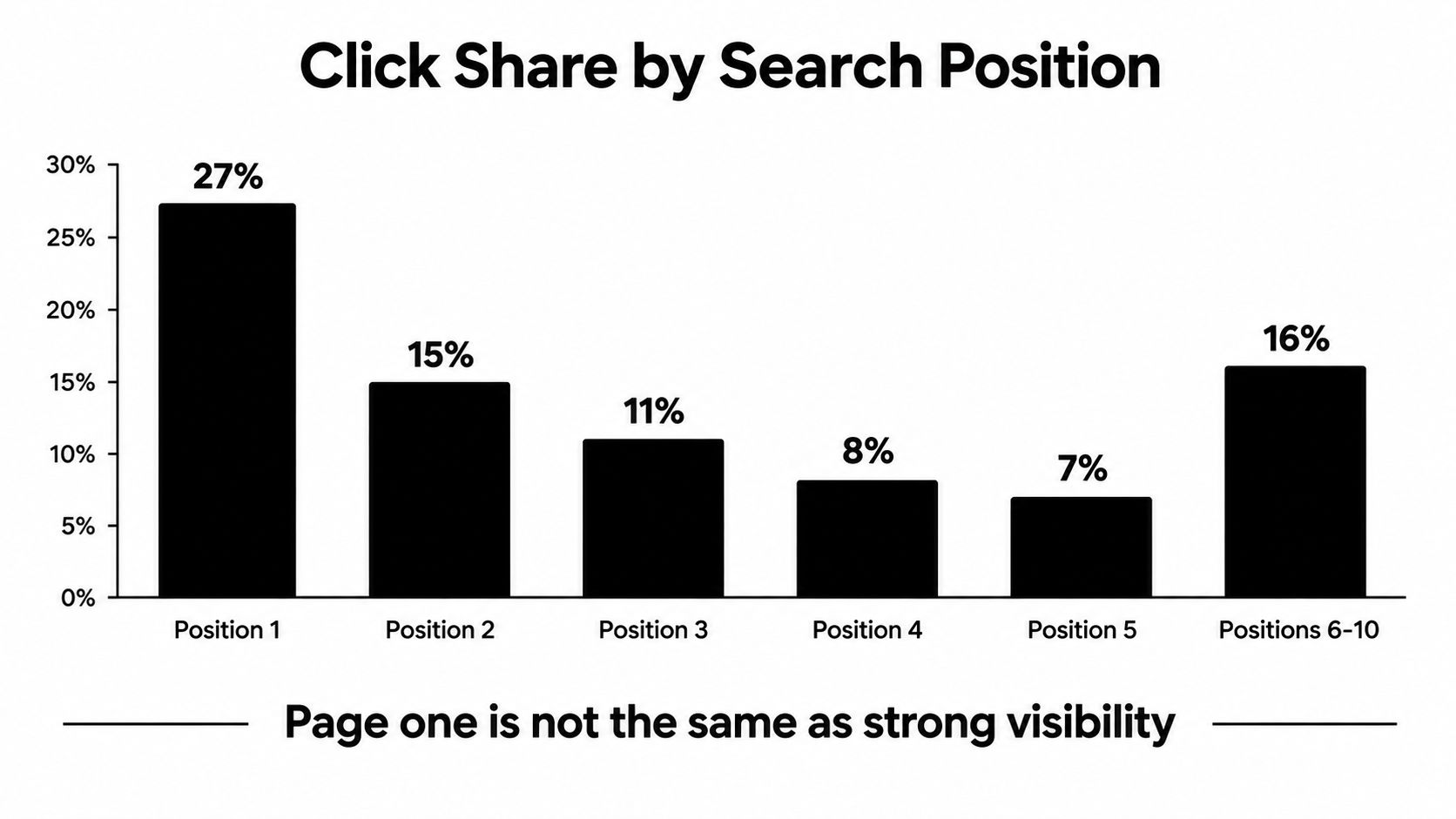
Use Search Console to find pages where a targeted improvement can affect visibility. A click-through-rate study of roughly 465,000 keywords across 5,000 websites reported that 71.33% of all organic clicks went to page one, while pages two and three together received 5.59% of all organic clicks. Within page one, the top five positions received 67.60% of page-one clicks; positions six through ten received 3.73% of page-one clicks. The study covers July 2014, so treat these figures as historical context, not a current forecast. The practical takeaway is to prioritize a relevant page at position eight over a weak new page at position thirty.
The chart shows how click-through rates decrease from position one through position five.
Building the Baseline Sheet
Export 90 days of Search Console data by page and query. Record impressions, clicks, average position, and CTR, then group pages by template, such as blog, integration, pricing, comparison, and documentation. Template-level patterns can reveal a shared problem that individual URLs conceal. For example, an integration directory may sit in positions six through ten because every page has the same thin introduction.
Create two priority sets. First, flag pages with strong impressions and weak clicks: Google is already showing them, but searchers are not choosing them. Review titles and snippets before rewriting the page. Second, flag commercially relevant pages in positions six through ten for focused improvements. Exclude branded queries when assessing non-branded growth, or existing brand demand can distort the CTR picture.
Use examples of turning helpful posts into sustainable traffic to inform your content work, then keep measurement consistent with a method for tracking SEO performance over time. For each page, preserve its starting impressions, clicks, CTR, and position before making changes. Search Console measures blue-link performance; track AI Overview citations and branded demand separately rather than treating either as a ranking metric. Keep dashboard definitions stable during an experiment so you can compare like with like.
Sorting rule: Improve pages Google already shows before funding new pages for the same intent.
The baseline identifies where relevance or presentation may be underperforming. It also gives you a reference point for judging whether a change improved the metric you intended to move.
Fixing Crawl, Index, and Structured Data Gaps
The illustration below groups the three checks that usually decide whether a priority page can be discovered and understood.
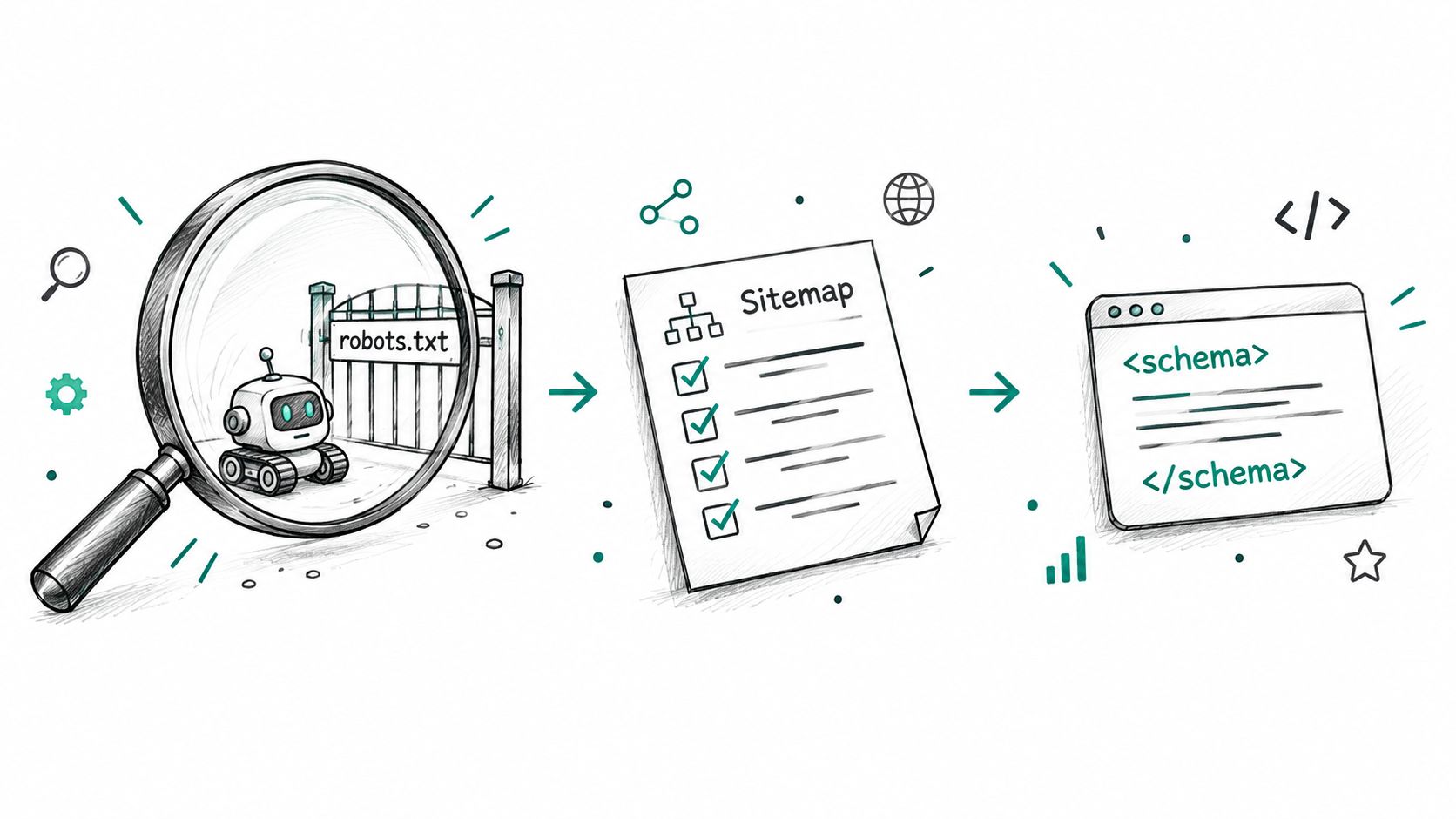
Begin in Search Console's indexing reports. Compare submitted versus indexed URLs, inspect representative pages from each template, and confirm Googlebot can load essential HTML, CSS, JavaScript, and images in the rendered result. I've seen SaaS teams debug content for weeks when a deployment blocked a JavaScript bundle and Google saw navigation without the product details. Check the rendered page before you rewrite copy.
Robots.txt and Sitemap Controls
Use robots.txt to reduce crawling of unnecessary areas, such as internal search results or faceted duplicates. Don't use it to remove an indexed URL or hide a page you still want found. As Google's getting started guidance on sitemaps and structured data explains, sitemaps help identify important pages and non-text content, structured data can improve understanding and rich result eligibility without guaranteeing display, and robots.txt blocking doesn't remove a discovered URL from the index.
Build the XML sitemap from canonical, indexable URLs only. Remove redirects, noindex pages, staging paths, and parameter variants. A large submitted count isn't an achievement if half the file describes pages you don't want indexed. Watch discrepancies by template so one broken integration feed doesn't disappear inside a healthy blog total.
The walkthrough below is useful for checking how crawl controls and index signals interact before you request recrawls.
Structured Data Without False Promises
Add valid JSON-LD matched to the visible page type, such as Article, Product, FAQPage, BreadcrumbList, or SoftwareApplication where appropriate. Every marked up fact should appear on the page, and the page shouldn't hide that content behind robots.txt, noindex, or access controls. Validate templates, fix critical errors, then request a recrawl only after a substantive change.
If your team lacks time for a line by line review, a manual website audit for rankings shows the kind of hands-on crawl and index inspection worth doing before scaling content. Automated scores are useful triage, but they don't replace inspecting server responses and canonical choices. Structured data creates eligibility, not a guaranteed rich result, so judge it by valid templates and report coverage.
Speeding Up Mobile Pages With Core Web Vitals
Speed work fails when teams optimize the homepage and ignore money pages. A fast homepage can hide slow pricing, integrations, and help center templates that carry buyer intent. Review Core Web Vitals by template and device, then rank fixes by affected traffic and commercial value.
Google's history gives this work context. As Google's report on mobile page experience improvements notes, page speed became a mobile ranking factor in 2018, performance for the slowest third of mobile traffic improved 15% to 20% that year, navigation abandonment from Search fell 20%, and developers ran more than 1 billion PageSpeed Insights audits across over 200 million unique URLs. Those numbers show adoption and behavior, not a promise that speed alone rescues irrelevant content.
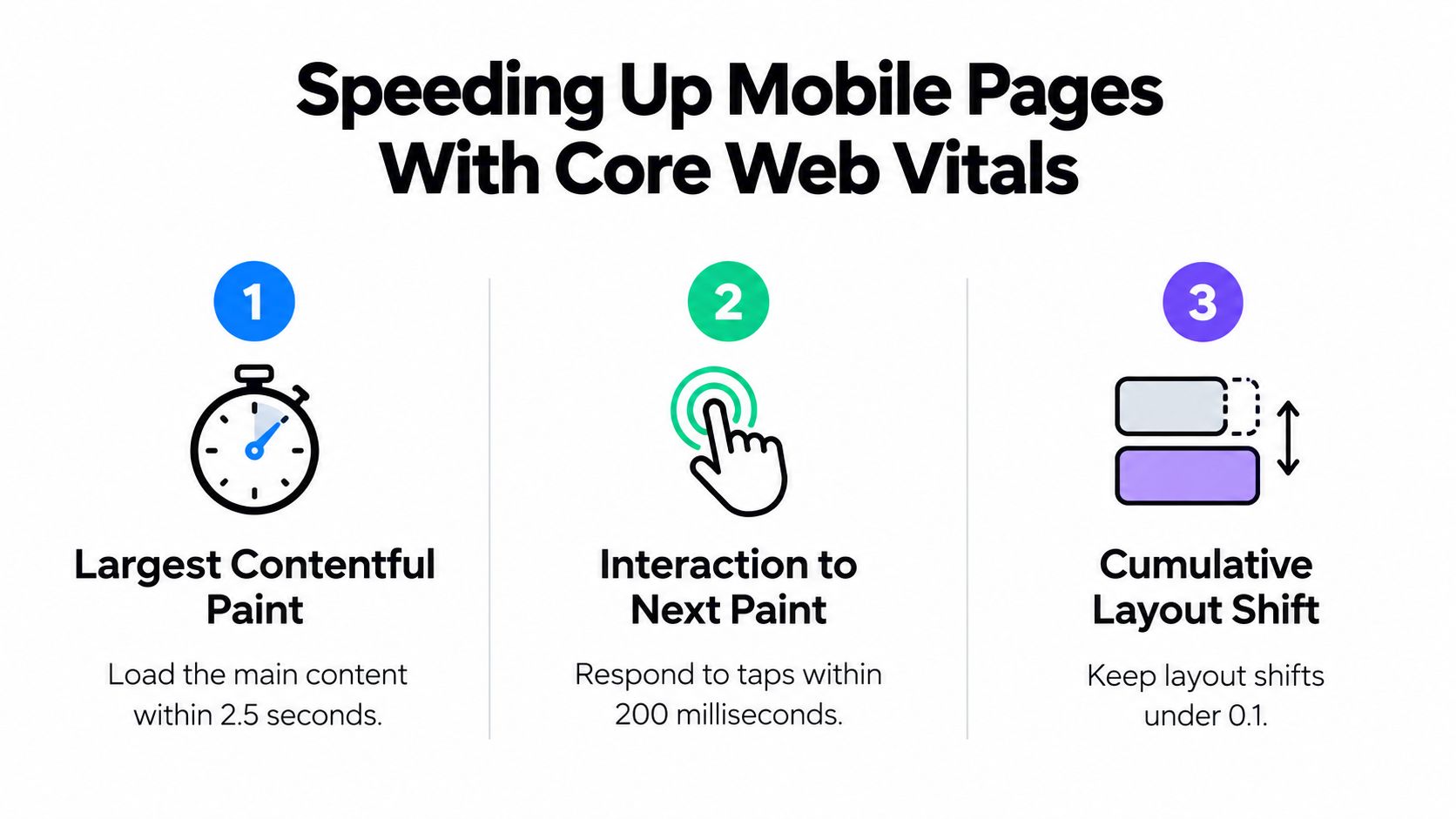
The diagram below separates loading, responsiveness, and visual stability so you can assign each problem to the right owner.
Prioritizing Fixes by Template
- Loading: Compress and correctly size hero images, preload only the critical asset, and reduce server response time with caching or a content delivery network.
- Interactivity: Remove unused JavaScript from marketing and documentation templates, defer nonessential tags, and break up long tasks that delay taps.
- Stability: Reserve space for images, embeds, banners, and consent modules so calls to action don't jump during load.
- Monitoring: Compare field data in Search Console with lab diagnostics in PageSpeed Insights before and after each release.
Don't strip product screenshots or interactive demos just to chase a lab score. Compress them, lazy load assets below the fold, and keep the primary proof visible. The trade-off is straightforward. Users need enough evidence to trust the page, delivered without waiting for decorative scripts.
Speed is a supporting signal. It lets strong relevance and clear content get evaluated and used, but it doesn't substitute for either.
Set release checks for your highest value templates. One new chat widget or uncompressed customer logo strip can undo months of careful work.
Publishing Helpful Content That Matches Search Intent
Search visibility has three separate measures: blue-link position, exposure as a citation in AI Overviews, and branded demand. A query-to-page map helps teams improve the right page for the right task, without treating a ranking change as proof that every kind of visibility improved. Assign each URL one primary intent and a distinct outcome. If a feature page, help article, and blog post target the same buyer question, choose the page that should own it, then link the others to it with narrower supporting angles.
Google's guidance on helpful and reliable content describes how its helpful content system is part of core ranking systems. Use that guidance to review whether a page provides useful, people-first content, rather than attributing unrelated click-through statistics to it. For blue-link performance, compare clicks, impressions, and average position in Search Console. Track AI Overview citations separately, and monitor branded query impressions and clicks as a distinct measure of brand demand. These layers can move differently, so one should not stand in for another.
A Six Step Rewrite Cycle
- Narrow the intent: State the user's task, audience, and desired next action in one sentence.
- Inspect the result format: Check whether the results favor guides, product pages, videos, comparisons, or direct answers.
- Add original evidence: Include verifiable product screenshots, configuration examples, test results, or customer workflow details.
- Strengthen internal links: Link from relevant pages with descriptive anchors that reflect the task.
- Publish cleanly: Align the title, opening answer, headings, and conversion path with the mapped intent.
- Measure a stable window: Compare search performance and conversions with the pre-change baseline, then assess AI citation exposure and branded demand separately.
For example, if queries show that remote teams are evaluating tools, revise “Project Management Software Guide” to “How to Choose Project Management Software for Remote Teams.” Replace a generic opening with selection criteria, trade-offs, and a real setup example. The title, first screen, and evidence should all serve the same intent.
High impressions with weak clicks can point to a mismatch between the result and the page. Tighten title and snippet alignment, answer the task near the top, and remove generic throat clearing. For adapting pages to AI-driven discovery, use these practical AI content optimization methods after mapping the intent. Then measure citation exposure directly rather than assuming stronger rankings will produce it.
Avoid mass-producing near-duplicate programmatic pages. They add URLs, divide internal links, and increase review work without giving users distinct value.
Building E-E-A-T Signals and Earned Links
Trust has to be visible on the page, not asserted in a strategy deck. Experience, expertise, authoritativeness, and trustworthiness show up through named authors with relevant credentials, first-hand product testing, cited primary sources, visible update dates, and clear company details. A pricing page should make plan limits, support terms, and business identity easy to verify. A technical guide should show who wrote it and when the instructions were last checked.
Anonymous content creates avoidable doubt. If a support engineer validated a migration guide, name that person and link to a credible author profile. If a benchmark changed, update the methodology instead of quietly editing the result. Readers and editors notice that discipline, and it gives other sites a defensible reason to cite you.
Link Worthy Assets for SaaS Teams
Earn links with assets other publishers need. Original customer benchmark data, public product documentation, integration partner pages, transparent changelogs, and useful templates can attract references because they solve a citation problem for someone else. Bought placements and mass guest posting create the opposite profile. They produce volume without reliable relevance or referral quality.
Consider a SaaS team that surveys its own customers about onboarding delays. The team publishes the methodology, anonymized findings, and downloadable charts, then pitches a concise summary to industry newsletters and integration partners. The pitch works because editors get evidence, not a request to promote a feature. Follow up by updating the asset and telling previous citers when the data changes.
This reputation work also supports broader answer visibility, a relationship explored in generative engine optimization practices for brands. Keep the evaluation grounded, though. Judge earned links by referral quality, relevance, and movement on target pages, not raw link count.
Editor test: If the linking site removed your brand name, would the asset still be worth citing?
Strong trust signals compound because they make every future guide, benchmark, and partner page easier to believe and easier to reference.
Measuring AI Overview Visibility Next to Rankings
Average position no longer tells the full story when an AI summary sits above traditional results. In Pew Research Center's March 2025 browsing study, users clicked a traditional result on 8% of visits when an AI summary appeared, compared with 15% when none appeared, and clicked links inside the summary on just 1% of visits. AI summaries appeared in 18% of searches analyzed. A page can hold position and lose clicks because the answer layer changed.
That's why your dashboard needs a separate AI layer. Keep blue link performance, AI citation exposure, and branded demand in distinct views, then investigate where they move together or diverge.
Choosing the Measurement Setup
| Setup | What it shows | Main limitation |
|---|---|---|
| Search Console plus analytics | Queries, pages, clicks, position, conversions, and assisted visits | AI feature traffic is aggregated, making citation exposure hard to isolate |
| Dedicated AI visibility tracking | Prompt level mentions, citation sources, average rank, sentiment, and competitor presence | Requires prompt maintenance and separate validation against traffic outcomes |
Search Console remains essential for indexation, query demand, and page performance. It just can't answer which sources an AI system cited, how your brand was described, or whether a competitor replaced you in a buyer prompt. A dedicated tracker fills that gap when prompt volume and stakeholder reporting justify the added workflow.
Track citation sources by type, including product documentation, help content, reviews, partner pages, and editorial coverage. Then connect citation changes to brand searches, direct visits, signups, and conversions instead of judging the layer only by clicks. For tactics behind the citation goal, review methods for ranking in AI Overviews and separate eligibility work from measurement.
Choose the lighter setup if you monitor a small prompt set internally. Choose dedicated tracking when multiple teams need alerts, exports, competitor comparisons, and repeatable prompt history. The wrong choice is forcing Search Console to answer citation questions it wasn't designed to isolate.
Turning These Fixes Into a 30-Day Plan
Sequence matters more than doing everything at once. If content rewrites ship before index problems are fixed, you'll misread the results. If engineering fixes every template before SEO identifies commercial priorities, you'll spend scarce sprint time on pages nobody needs.
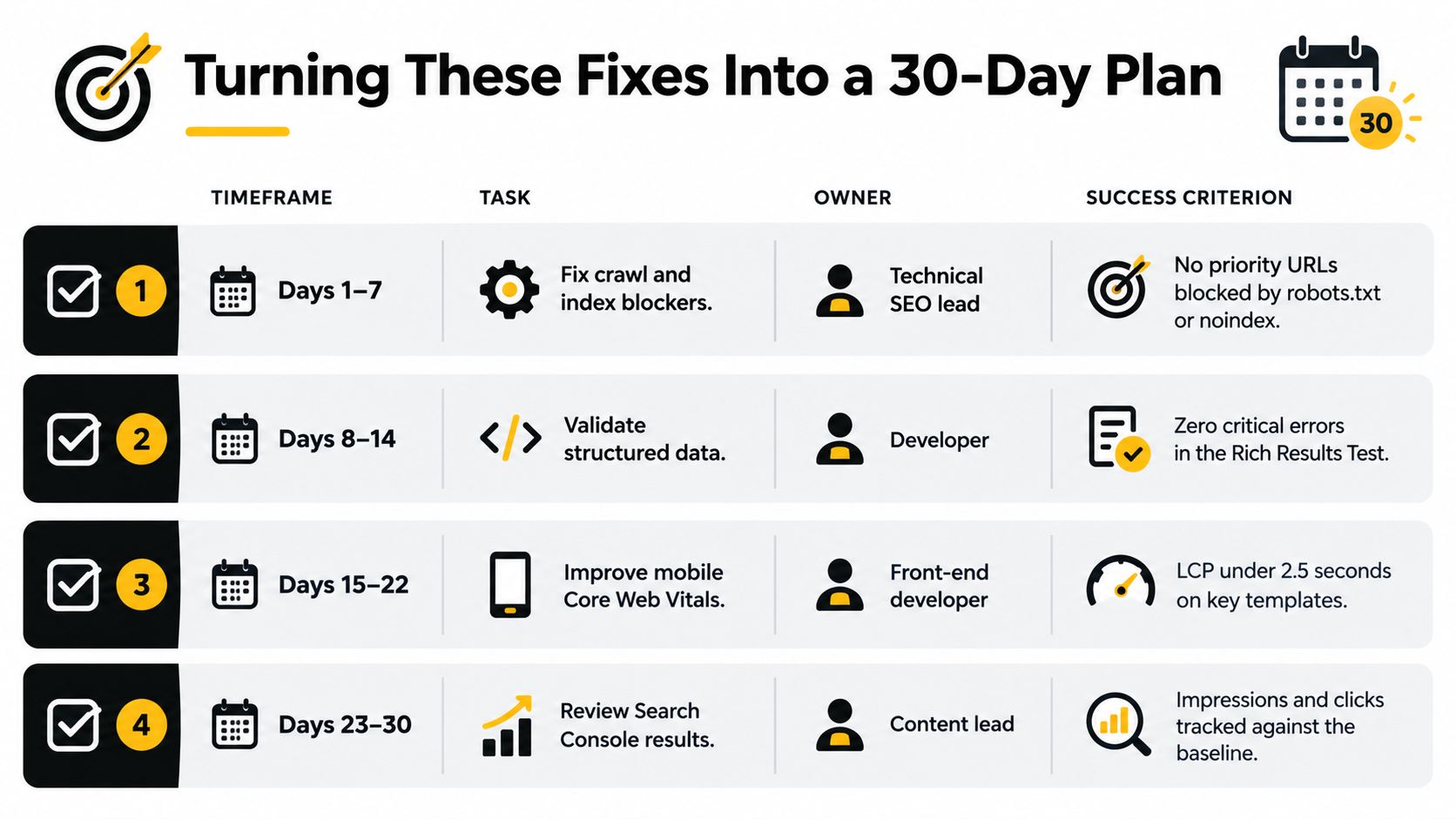
The plan below assigns each phase an owner and a concrete success check.
Thirty Days With Clear Owners
- Week one: The SEO lead exports the baseline, identifies positions six to ten, and completes the indexation audit. Success means every priority URL has a recorded starting state.
- Week two: Engineering and technical SEO fix crawl blockers, sitemap errors, structured data problems, and speed issues on high value templates.
- Week three: Content rewrites titles, snippets, and opening answers on the priority set, while SEO updates internal links from relevant pages.
- Week four: Content and product marketing add author details, primary sources, and update dates, then analytics locks the review dashboard and date.
At day 30, don't declare victory from impressions alone. Compare CTR, average position, indexed status, and conversions for changed pages against the baseline, and keep an unchanged comparison group where possible. For help turning findings into prioritized actions, use structured SEO recommendations for your backlog to keep owners and expected outcomes attached to each task.
Some pages will need a longer measurement window, especially after recrawling or major template changes. Record ship dates and resist rewriting the same page again before the review. Constant changes destroy attribution.
Do one thing today. Export your top pages from Search Console, mark those ranking between six and ten for non-branded queries, and assign the first set to named owners.
You've built the baseline and fixed the pages Google can already see, now make sure AI answers describe your product accurately too. MyMentions tracks brand visibility, position, sentiment, and citation sources across major AI providers, connects mentions to traffic outcomes, and turns gaps into a prioritized backlog for your team. Visit MyMentions to monitor your AI search presence alongside the Google visibility work you're shipping this month.