View-through attribution gives conversion credit to someone who saw an ad but didn't click, as long as they convert within a defined window. Click-through attribution credits the ad interaction after the user actively clicks.
That distinction sounds simple until a SaaS dashboard shows two very different stories. Your LinkedIn video campaign reports assisted trials, Google Analytics shows branded search as the final touch, and your CRM records a sales opportunity created days after the first exposure. The argument usually follows: did the ad influence the buyer, or did the platform claim a conversion that would have happened anyway?
The answer depends on how you define the window, match the person, verify that the ad was viewable, and test whether exposure created incremental demand. In 2026, view-through attribution is a moving measurement practice, not a fixed industry standard. Some platforms have tightened their windows, privacy changes have weakened identity matching, and mature teams increasingly compare platform-reported credit with incrementality tests rather than treating it as ground truth.
Table of Contents
- What Is View Through Attribution in Plain English
- View Through vs Click Through Attribution
- How Attribution Windows Shape View Through Credit
- A View Through Conversion Story for a SaaS Funnel
- Why View Through Is Correlation Not Causation
- Best Practices for Using View Through Attribution
- View Through Attribution in AI Visibility Workflows
- Your View Through Attribution Checklist
What Is View Through Attribution in Plain English
View-through attribution is impression-based conversion credit assigned when a person sees an ad or personalized experience, doesn't click it, and converts within a defined attribution window. The platform connects the later conversion to the earlier exposure, usually through an identifier such as a cookie, mobile advertising ID, logged-in account, or another supported matching method. The MoEngage explanation of view-through measurement describes a current web-experience example using a 12-hour view-through window.
Click-through attribution starts from a stronger behavioral signal. The person clicks the ad, visits a destination, and later converts within the relevant click window. View-through attribution starts with exposure alone. The user may have noticed the creative, ignored it, or never consciously registered it, yet the platform can still assign credit if the conversion and impression match its rules.
Consider a workflow software company. A growth marketer runs a LinkedIn video ad. A target buyer watches the ad without clicking, then signs up for a self-serve trial nine days later after finding the company through a Google search. If the platform's view window still includes that period and the impression can be matched to the conversion, the platform may log a view-through conversion.
That report answers a useful operational question: did upper-funnel media appear before signups that would otherwise look unrelated to the campaign? It can also help a marketer defend spending on video, display, and social placements where clicks are scarce.
It doesn't answer the causal question by itself.
Measurement rule: A view-through conversion proves that an impression and a conversion were connected by a platform's rules. It doesn't prove that the impression caused the conversion.
Use the metric as evidence of possible influence. Then compare it with click data, first-party records, branded search behavior, and controlled lift measurement before making major budget decisions.
View Through vs Click Through Attribution
A buyer watches a workflow software demo, ignores the ad, and later clicks a branded search result before starting a trial. The search click records an active response. The earlier impression may receive view-through credit, even though no visit followed the ad. These metrics describe different contacts with the same buying journey.
Click-through attribution treats an ad click as the qualifying event. View-through attribution treats an eligible impression without a click as the qualifying event. Neither signal automatically proves that the ad created demand, and neither answers every measurement question.
| Dimension | View Through Attribution | Click Through Attribution |
|---|---|---|
| Intent signal | Passive exposure, with no ad click | Active response through an ad click |
| Default window | Platform-specific, often shorter for views | Platform-specific and often broader than the view window |
| Credit logic | Assigns credit when a matched conversion follows an impression | Assigns credit when a matched conversion follows a click |
| Best fit channel | Video, display, social, and other upper-funnel placements | Search, retargeting, shopping, and direct-response campaigns |
| Main risk | Over-crediting impressions that didn't cause demand | Over-crediting the final click while ignoring earlier influence |
| Typical reporting location | Ad platform conversion columns or impression reports | Ad platform, analytics, CRM, and campaign reports |
The comparison depends on each platform's rules. Google Ads, Meta, and app measurement platforms publish or apply their own attribution windows, conversion definitions, and identity requirements. A view can receive credit only when the conversion happens within the configured period and the platform can connect the impression with the later event.
Click-through data usually carries a clearer action signal, but it can still overstate the final interaction. A buyer may see a video, read a review, receive an email, and then click a branded search result. A last-click report can assign the sale to search while leaving the earlier influences invisible.
View-through reporting adds context for video, display, and social campaigns where clicks are limited. It does not establish that the impression caused the signup, nor should it be used alone to justify upper-funnel spending. In 2026, shorter windows and weaker identity signals make reported view credit a moving target. Compare it with first-party records, click paths, branded search behavior, and incrementality tests where possible.
Takeaway: view-through and click-through are complementary lenses. Use click-through to study direct response, view-through to examine possible exposure effects, and controlled lift measurement to test whether those effects exceed what would have happened without the campaign.
How Attribution Windows Shape View Through Credit
A view-through conversion is shaped by three settings, not by whether an ad loaded.
- The attribution window, which sets how long after an exposure a conversion can qualify.
- Identifier matching, which connects the impression with the later conversion.
- Viewability or exposure rules, which decide whether the served ad counts as a meaningful view.
The attribution window creates some of the clearest differences between platforms. Implementations commonly use 24-hour or 1-day view windows, while older configurations may have used 7-day or 28-day windows. Meta removed its longer 7-day and 28-day view-through windows on 12 January 2026, leaving a 1-day view window, according to Dataslayer's explanation of Meta attribution updates.
A buyer who sees an impression on Monday and converts on Friday could receive credit in a platform using a 7-day window. The same conversion would fall outside a 1-day window. The buyer's behavior is unchanged. The reported credit is not.
In 2026, this makes view-through attribution a moving target. A campaign may look weaker because its platform uses a shorter lookback period, not because exposure became less useful. Compare window settings before comparing campaign performance.
The matching problem
The impression also needs to be connected to the later event. Cookies expire or disappear, mobile identifiers may be unavailable, browsers restrict tracking, and a buyer may switch devices before signing up. A platform can retain an impression record while losing the link to the eventual trial.
Online and offline journeys create the same measurement question: which exposure belongs to which person, and what evidence supports that connection? The practical logic resembles foot-traffic attribution, where an observed visit still requires a defensible match to prior exposure.
The exposure problem
A served impression is not automatically a noticed impression. Some measurement rules count a view only when at least 50% of the ad pixels are visible for at least 1 second. Platforms that apply viewability requirements can exclude an ad that loaded but never appeared in the user's visible screen area.
Record the platform, window, matching method, and viewability rule before comparing campaigns. Then reconcile reported view credit with first-party behavior and incrementality evidence. Two “view-through conversions” may describe very different exposures, and neither should be treated as proof of causation on its own.
A View Through Conversion Story for a SaaS Funnel
Priya manages procurement at a growing company. On Monday morning, she sees a LinkedIn ad for a contract-management SaaS product. The ad addresses a problem her team has discussed, but she doesn't click. She's between meetings, and the message is useful without being urgent.
On Wednesday, she sees a retargeting banner from the same company. She still doesn't click. The banner may reinforce the category, remind her of the product name, or blend into the other commercial messages on the page.
On Friday, a colleague mentions that the company is reviewing contract tools. Priya searches the brand directly, visits the website, and starts a self-serve trial. In the first-party dashboard, the final visit may appear as direct or branded search traffic. A last-click report can therefore make the LinkedIn ad look irrelevant.
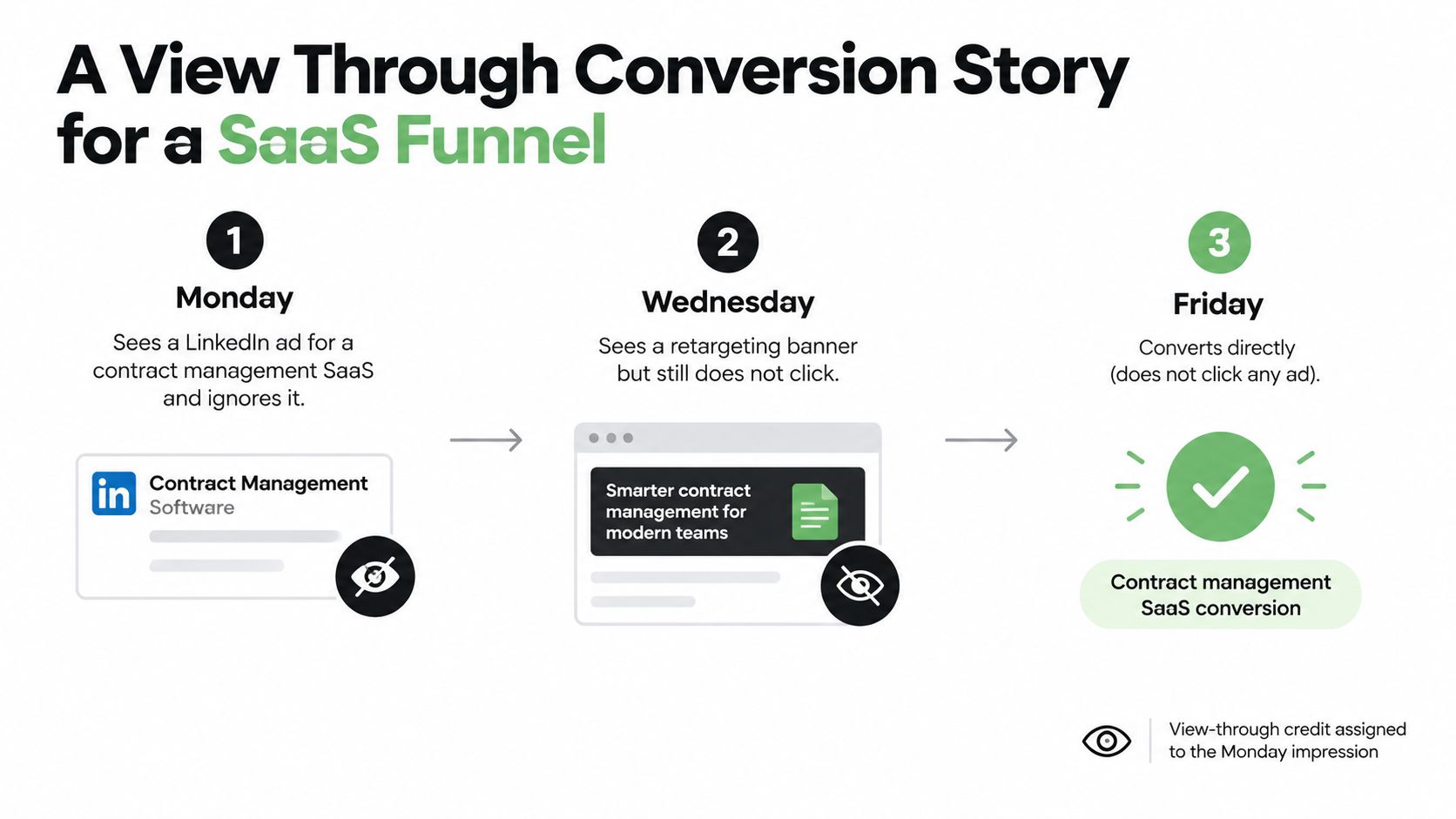
If the LinkedIn impression remains inside the platform's view window and the system can match Priya to the trial, the platform may assign view-through credit to the Monday exposure. The Wednesday banner might also appear in the path, depending on the platform's deduplication and attribution rules. The report then says the impression preceded a conversion without a click.
That doesn't mean LinkedIn created the demand on its own. Priya already had a business problem, her colleague supplied social proof, and branded search captured her active intent. The impression is one touchpoint in a longer journey.
The reporting gap is the important part. The platform counts an impression-based conversion, while the first-party dashboard records a later search or direct session. A useful SaaS funnel maps those separately:
- Exposure: Priya saw the LinkedIn ad.
- Influence signal: the platform matched the impression to a later trial.
- Conversion event: the product recorded the trial signup.
- Independent path evidence: the site recorded branded search or direct traffic.
For teams building customizable SEO dashboards, the same principle applies: preserve the raw touchpoint and label the type of credit instead of collapsing every path into one channel.
Why View Through Is Correlation Not Causation
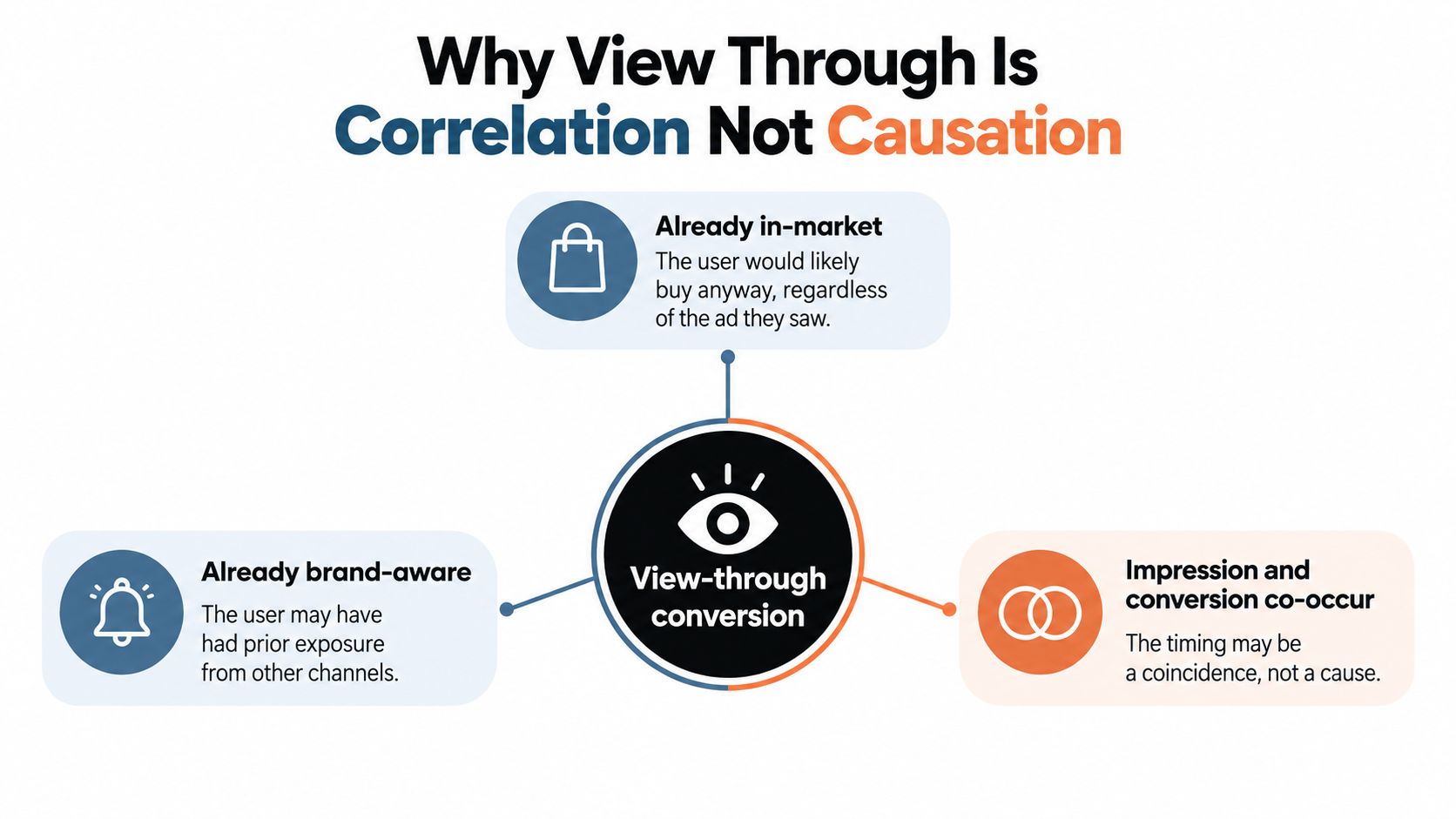
A platform-reported view-through conversion tells you that exposure and conversion co-occurred within a matching rule. It doesn't tell you what would have happened if the person had never seen the ad.
That missing comparison is the counterfactual. Incrementality asks whether the exposure created conversions that wouldn't otherwise have happened. A person may already be researching the category, already recognize the brand from another channel, or receive several impressions before converting. The ad can receive credit even when it didn't change the outcome.
This is why attribution and incrementality serve different decisions. Attribution describes the route or relationship between a touchpoint and a conversion. Incrementality tests whether removing or withholding exposure changes the conversion rate. AI Digital's comparison of incrementality and attribution frames lift measurement as a way to calibrate or validate attribution, particularly where platforms can over-credit impressions.
How teams test for lift
A mature measurement program can use several approaches:
- Ghost ads: create an eligible control group that would have been shown an ad, then compare outcomes for people who received delivery with those who were withheld.
- Geographic holdouts: pause or limit exposure in selected regions and compare conversion behavior with similar regions that continued receiving ads.
- Public service announcement holdouts: use a neutral message in the control group so the auction and delivery conditions remain closer to the exposed group.
These methods aren't interchangeable, and each requires careful design. The point is to estimate the outcome difference caused by exposure rather than count every matched conversion as proof.
A view-through number is useful for directional optimization. A lift result is more appropriate when the question is whether to move budget.
View-through remains valuable when upper-funnel channels generate few clicks. It can reveal that an awareness campaign appears before later demand, giving analysts a signal to investigate. The responsible interpretation is possible influence, not confirmed causation. For source and journey taxonomy, a structured approach such as source attribution guidance can help teams keep the distinction visible in reporting.
Best Practices for Using View Through Attribution
A B2B SaaS team sees a trial start after a display impression, even though the prospect never clicked. The platform assigns view-through credit, while the CRM records a different acquisition source. A workable program begins by deciding what that credit may claim, which events qualify, and how analysts will test the connection.
Choose the window for the objective
A longer window can capture delayed consideration, but it can also attach too much value to a passive impression. A shorter window reduces weak associations. The AppsFlyer definition of view-through attribution explains the matching logic and notes that platform windows vary.
| Funnel Stage | Objective | Recommended View Window | Viewability Standard |
|---|---|---|---|
| Retargeting and brand defense | Capture near-term reminder effects | 24 hours | Use the platform's enforced exposure rule |
| High-intent display | Measure immediate consideration | 1 day | Require a meaningful visible impression |
| Mid-funnel social | Observe short consideration cycles | 7 days only where supported and justified | Separate served from viewable exposure |
| Long-cycle B2B SaaS | Explore delayed influence cautiously | 28 days only with documented justification | Validate exposure quality before crediting |
These are governance starting points, not universal defaults. Meta's 2026 change illustrates why the window must be stored beside each result. Historical reports are not automatically comparable when platform rules change.
Keep exposure quality visible
Record whether the impression was viewable, whether the person was eligible to receive it, and how often the same audience was retargeted. A served impression is weaker evidence than a verified view, so reporting should keep those exposure types separate.
Reconcile platform and first-party data
Send platform-reported view-through conversions to a warehouse or analytics layer, then compare them with first-party conversion events. If privacy controls permit, use appropriately protected conversion data for matching. Pair this reconciliation with AI traffic analytics so non-human and assistant-driven visits do not distort the first-party comparison.
Keep separate fields for:
- Click-through conversion
- View-through conversion
- Assisted or influenced conversion
- Unattributed conversion
- Experimentally measured incremental conversion
Do not replace the CRM's original acquisition source with a platform view-through label. Store both records and document which system owns the conversion event.
Score influence separately
A dashboard can show that a view-through touchpoint preceded a trial without treating it as equivalent to a click. That distinction lets stakeholders examine possible upper-funnel contribution while keeping pipeline reporting from implying certainty.
For teams measuring creator or partner activity alongside paid media, Social Cloud's attribution guide provides context for assisted outcomes and channel-specific measurement.
Run lift or holdout tests often enough to recalibrate the weight assigned to view-through credit. Document the audience, window, exclusions, matching rules, and business decision the test informs. In 2026, shrinking windows and weaker identity signals make reconciliation with incrementality more important than trusting a platform total on its own. A model earns confidence when its assumptions and limits remain inspectable.
View Through Attribution in AI Visibility Workflows
The impression doesn't always appear in an ad slot now. A buyer can ask ChatGPT, Perplexity, Google, Claude, or another answer engine for product recommendations, see your brand mentioned, and continue researching without clicking a citation.
That mention functions like an upper-funnel exposure. It may place your product in the buyer's consideration set, explain a use case, or associate the brand with a category. The challenge is that an AI response doesn't normally contain a conventional advertising pixel, so a team can't match the exposure to a person the way a display platform might.
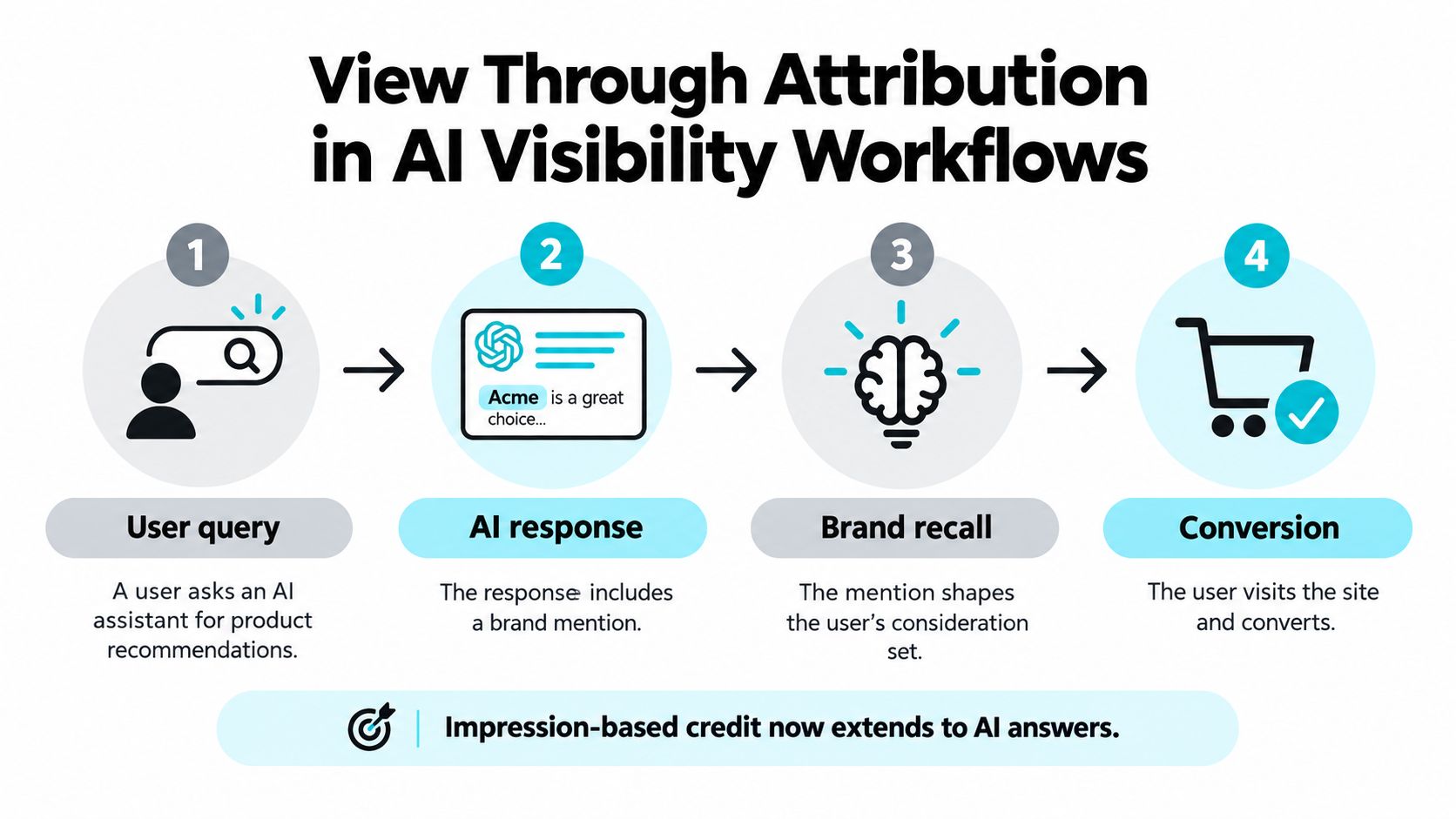
A practical AI visibility workflow treats the prompt result as an observed exposure rather than a directly tracked user event. The team records:
- The user query, including the buyer intent and product category.
- The AI response, including whether the brand was cited, recommended, or merely mentioned.
- The visibility context, such as position, sentiment, competitors, and supporting sources.
- Downstream signals, such as branded searches, direct visits, assisted conversions, or self-reported discovery.
The last step requires careful language. A branded search after an AI mention may indicate influence, but it doesn't prove that the answer caused the search. Identity loss makes the connection even weaker because the workflow usually observes aggregate behavior, not a person-level chain.
Treat an AI mention like a measurable exposure event, not like a tracked click.
Teams can score prompt-level mentions by relevance and quality. A citation supporting a product claim is different from a casual brand reference. A recommendation for a high-intent buyer prompt is different from an irrelevant appearance. Tools focused on agent-ready site scoring can help teams assess whether their site presents the information answer engines need to discover and describe the product.
Log AI mentions beside paid impressions in the same influence model, while preserving the channel distinction. A unified generative AI analytics workflow can connect prompt visibility with citation sources and downstream traffic without pretending that aggregate signals provide deterministic person-level attribution.
Your View Through Attribution Checklist
Use the checklist as a set of decisions with outputs. Each decision should produce a documented field, report view, or test result that another analyst can inspect.
Choose the window by business objective
Write down the reason for the window before selecting it. Retargeting may call for a tighter lookback, while a longer B2B cycle may justify a broader exploratory view window only when the team can explain the added uncertainty. Record the platform and active window beside every reported result.
Separate view and click credit
Create separate conversion fields and dashboard filters. A click-through conversion should never disappear inside a combined number that makes passive exposure look equivalent to an active response. If a platform combines the measures, export the underlying action breakdown when available.
Reconcile against first-party events
Match platform records to the conversion system your business operates. For SaaS, that may include trial creation, qualified account status, activation, opportunity creation, and revenue. Keep the original source, campaign touchpoint, view-through flag, and click-through flag as separate properties.
Test the counterfactual
Schedule an incrementality or holdout test at least annually, or more often when spend, targeting, creative, or privacy conditions change materially. Use the result to adjust how much weight view-through receives in budget discussions. Don't use a lift test as a decorative appendix. Tie it to a decision about continuing, reducing, or expanding a channel.
Extend the model to AI answers
Add AI assistant and answer-engine mentions to your exposure log. Capture the prompt, provider, response context, citation, brand position, sentiment, and downstream traffic signal. Treat the output as influence evidence unless a controlled test supports a causal conclusion.
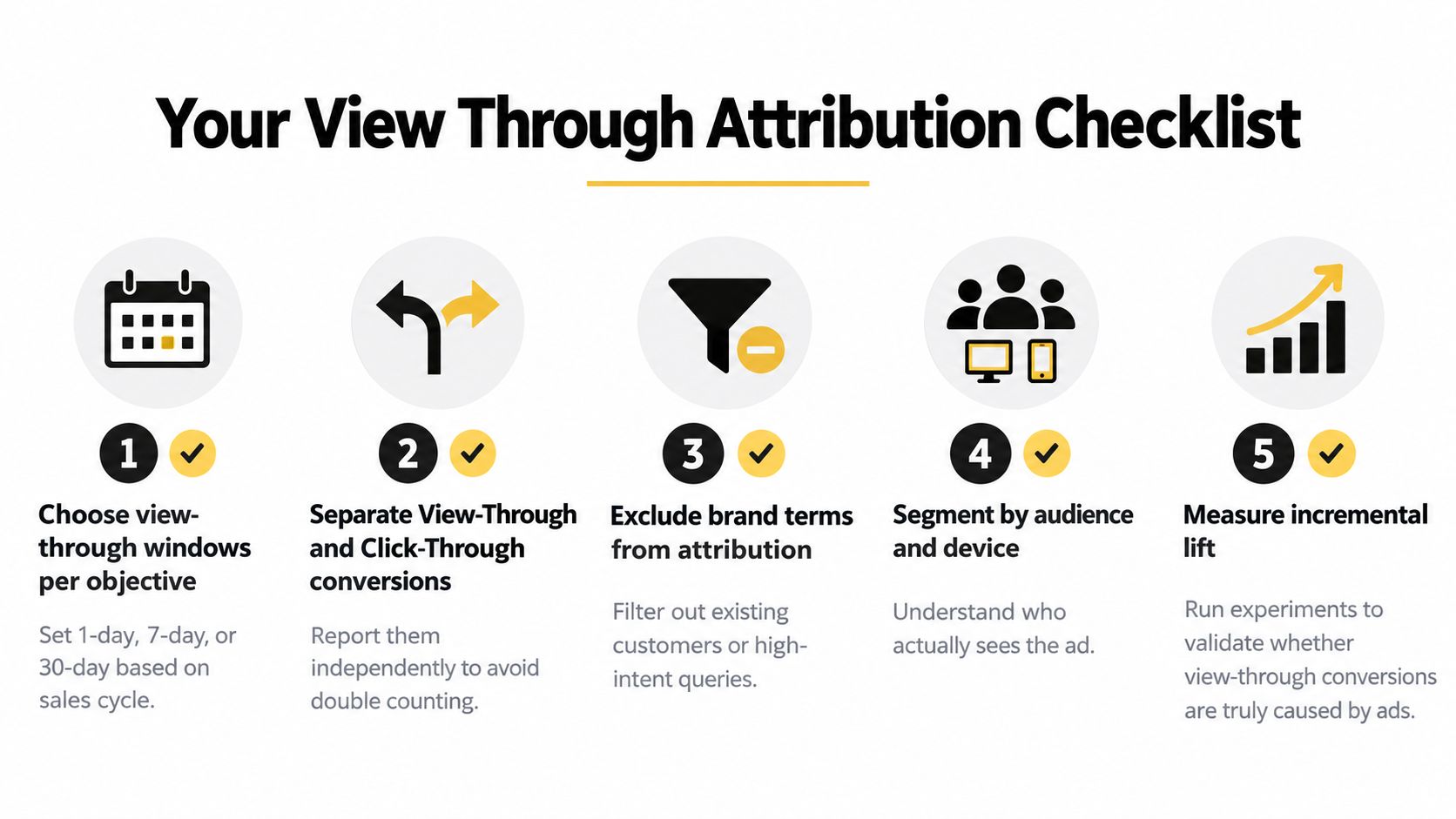
A useful Monday-morning implementation looks simple:
- Window field: store the active view-through duration.
- Credit field: separate view-through from click-through.
- Reconciliation report: compare platform credit with first-party conversion events.
- Validation record: attach the latest holdout or lift result.
- AI exposure log: track relevant assistant mentions beside paid impressions.
MyMentions offers a workspace for monitoring AI assistant visibility, prompt-level results, citation sources, sentiment, and downstream traffic attribution in one dashboard. Visit MyMentions to connect AI visibility observations with the attribution signals your marketing and SEO teams already use.