Generative AI traffic grew 796% from 2024 to 2025, yet it still represented only 0.18% of total sessions. That means an AI visibility forecast should prioritize citation quality, audience intent, and business impact over citation volume alone.
A brand can appear repeatedly in AI-generated answers and still see little direct traffic. Conversely, a smaller number of mentions in authoritative, high-intent answers may influence evaluation, branded demand, and sales conversations more effectively than broad but weak exposure.
Table of Contents
- Understanding the AI Visibility Forecast
- Core Components of Visibility Metrics
- How AI Visibility Forecasts Are Calculated
- The Authority-Traffic Paradox
- Using Visibility Forecasts for Strategy
- Acting on Forecasted Changes
- Conclusion and Strategic Takeaways
Understanding the AI Visibility Forecast
Traditional SEO encourages a straightforward interpretation of visibility: rank higher, earn more clicks, and generate more demand. AI assistants disrupt that sequence. They can summarize a company, cite its documentation, recommend it beside competitors, or use its information without sending the user to the source.
The scale of that shift is easy to misread. Generative-AI traffic grew 796% from 2024 to 2025, but still accounted for only 0.18% of total sessions, according to an analysis of 2.3 billion sessions cited in research on AI citation attention patterns. AI-referred visitors converted at roughly 1.2 times the organic-search rate, which suggests that low volume can still carry meaningful commercial value when the visitors arrive with strong intent.
Consider two software companies. The first appears in many broad product comparisons, but its citations come from thin listicles and low-trust pages. The second appears less often, yet its mentions come from product documentation, independent reviews, and highly specific answers about implementation. A traditional visibility report may favor the first company. A useful visibility forecast may favor the second.

From appearance to influence
A forecast should ask more than whether a brand appears. It should estimate whether the appearance is prominent, trusted, relevant, stable, and commercially useful. That requires prompt-level observation across providers, locations, query types, and follow-up turns, rather than one blended score.
Provider differences matter because AI systems select and present sources differently. Research covering 6.8 million citations from 1.6 million AI responses identified user intent, location, and conversational memory as important determinants of which sources appear. A separate dataset covering more than 24,000 conversations and 65,000 responses found more than 366,000 citations across OpenAI, Perplexity, and Google, with citations concentrated among a relatively small group of sources. These findings are discussed in research on AI citations, user locations, and query context.
Teams building this measurement layer should also examine how structured data, licensed information, and source relationships affect discoverability. A resource such as the SourceX data transaction layer can help teams think about the provenance and availability of information used in AI systems.
For a practical definition of the broader discipline, see what AI visibility means. The central principle is simple: visibility is not the outcome. It's an input into influence and pipeline analysis.
Core Components of Visibility Metrics
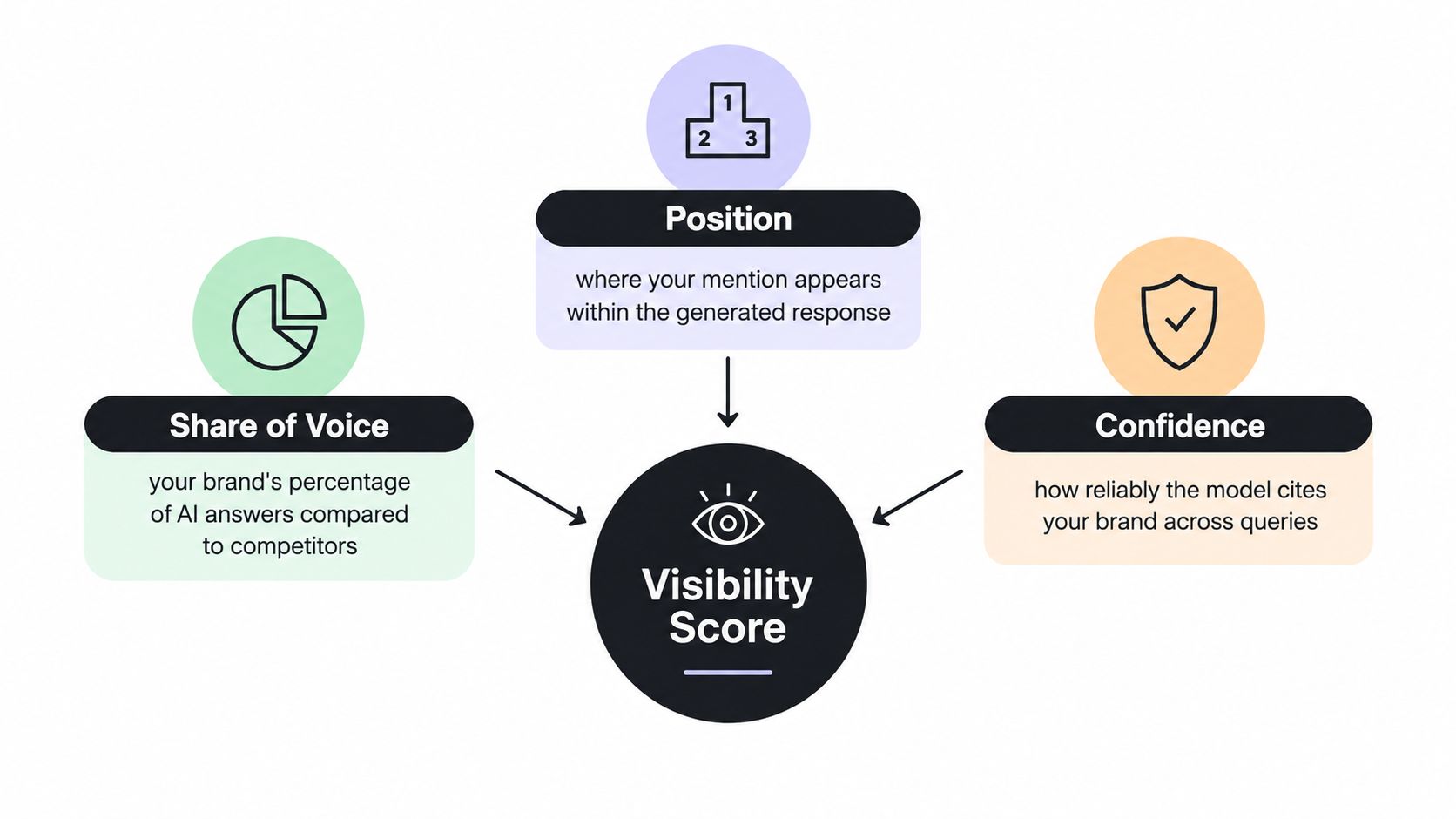
A useful visibility score has three distinct parts: Share of Voice, Position, and Confidence. They answer different questions, and combining them too early hides the reason a brand is winning or losing.
Share of Voice
Share of Voice measures how often a brand appears across a defined set of prompts compared with competitors. The prompt set matters more than the label. Broad discovery questions, category comparisons, implementation questions, and vendor-selection prompts represent different opportunities.
A company may hold strong share in educational prompts while remaining absent from high-intent comparison prompts. A single average can conceal that gap. Segmenting by intent reveals whether the brand is visible where buyers make decisions.
Position
Position records where the brand or citation appears in the generated response. Early placement often gives a mention more attention, but position alone doesn't establish value. A first-listed brand can be poorly matched to the user's needs, while a later citation may provide the decisive technical evidence.
Track position alongside answer structure. Record whether the brand is recommended, merely mentioned, used as supporting evidence, or cited in a caveat. This is closer to measuring influence than copying a traditional search ranking.
Confidence
Confidence reflects how reliably the system cites a brand across repeated prompts, providers, contexts, and time. It should include both model behavior and source quality. A citation that appears once in a volatile answer deserves less strategic weight than a citation that persists across relevant variations and points to authoritative material.
Topical coverage supports this dimension, but it shouldn't be reduced to publishing volume. The explanation of why topical authority drives rankings is useful because it frames authority as coherent coverage and demonstrated relevance, not just a large number of pages.
Measurement rule: Keep raw observations separate from interpreted scores. Store the prompt, provider, location, answer, cited source, position, sentiment, and confidence signal before calculating an executive summary.
The interaction between these metrics creates the strategic picture. High Share of Voice with weak Confidence may indicate broad but fragile exposure. High Confidence with low Position may point to a trusted source that isn't being surfaced prominently. For implementation guidance, compare this framework with how to measure generative engine optimization.
How AI Visibility Forecasts Are Calculated
An AI visibility forecast starts with a prompt universe, not a keyword list. The universe should represent the questions buyers ask at different stages, including category discovery, problem diagnosis, vendor comparison, implementation, pricing, and alternatives.
The process can be organized into five analytical layers:
- Prompt sampling: Group prompts by intent, market, language, provider, and conversational context. Keep the sample stable enough to identify changes, while adding new prompts when buyer behavior changes.
- Response capture: Store the full answer, cited URLs, brand mentions, sentiment, recommendation language, and answer position. A citation without its surrounding text can't reveal whether the assistant endorsed, questioned, or merely referenced the brand.
- Entity resolution: Normalize brand names, product names, parent companies, documentation domains, review sites, and partner pages. Otherwise, one company may appear as several unrelated entities.
- Probability estimation: Calculate the likelihood that the brand appears, receives a prominent position, earns a positive description, or is cited from a trusted source under each condition.
- Business linkage: Connect prompt exposure to referral sessions, branded demand, demo starts, assisted conversions, and sales influence where analytics can support that connection.
This approach differs from traditional rank tracking because an AI answer isn't a fixed list of ten results. It's a generated response whose sources and wording can vary by provider, location, query type, conversation history, and freshness state.
Why one score fails
A blended score can be useful for reporting, but it shouldn't be the primary diagnostic. A brand may perform well in one provider and poorly in another because the systems rely on different retrieval patterns, source preferences, and answer formats.
Forecasts should therefore report distributions and confidence intervals by provider and intent. They should also separate repeatable visibility from stochastic behavior. A result that changes after a follow-up question should be treated differently from one that remains stable across relevant prompts.
The logic resembles forecasting keywords for Google Ads, but the target variable is different. Search advertising forecasts often estimate demand or impression opportunity. AI visibility forecasting estimates the probability and quality of inclusion in a generated answer.
For a practical measurement workflow, see how to measure AI search visibility. The key is to preserve enough detail to explain movement, not just announce that a score rose or fell.
The Authority-Traffic Paradox
AI citations can increase perceived credibility without producing equivalent website visits. A meta-analysis cited in research on AI citation behavior reported citation click-through of about 1% for AI-generated results, compared with 15% for traditional search, a 15:1 difference. That gap changes how teams should interpret a successful visibility forecast.
An AI assistant can answer the user's question inside the interface. The user may remember the brand, trust its category position, or return later through a branded search without clicking the original citation. Direct referral traffic therefore captures only one part of the commercial effect.

Visibility is not one type of value
Separate at least four outcomes:
- Answer inclusion: Did the assistant include the brand?
- Citation authority: Did the answer rely on a source the buyer could reasonably trust?
- Referral probability: Was the user given a reason to visit?
- Business influence: Did the exposure contribute to branded demand, evaluation, or conversion?
These outcomes don't move together. A citation from a highly credible source may produce little immediate traffic but strengthen consideration. A prominent mention on a weak page may generate a click that never becomes a qualified opportunity.
The same session analysis that recorded the 796% growth in generative-AI traffic also found that AI-referred visitors converted at roughly 1.2 times the organic-search rate. The practical conclusion isn't that AI traffic will replace search. It's that teams should judge this channel by both quality and scale, then connect it to the business outcome being measured.
Practical rule: Don't ask whether citations increased. Ask whether the right buyers encountered a credible answer, and whether that exposure changed what they did next.
A measurement setup should combine prompt data with analytics, branded-search trends, assisted conversions, demo starts, and sales feedback. AI traffic analytics can help teams examine the referral side, but referral reporting shouldn't be treated as a complete record of AI influence.
The authority-traffic paradox creates a rational reason to reject more mentions. A smaller number of authoritative citations in high-intent contexts may be more valuable than widespread exposure that fails to influence evaluation.
Using Visibility Forecasts for Strategy
A visibility forecast becomes useful when it changes what a team does next. The same movement can justify different actions depending on the combination of visibility, confidence, intent, and conversion evidence.
| Metric | Definition | Business Impact |
|---|---|---|
| Share of Voice | The proportion of tracked AI answers that include the brand | Indicates category presence and competitive reach |
| Position | Where the brand or citation appears in the answer | Helps estimate prominence and attention |
| Confidence | How consistently the brand appears across relevant contexts | Indicates resilience and repeatability |
| Citation quality | The authority and relevance of the cited source | Shows whether exposure supports trust |
| Referral probability | The likelihood that the answer sends a user to the site | Connects visibility with measurable visits |
| Intent alignment | The degree to which the prompt reflects a buying or evaluation need | Helps prioritize commercially meaningful exposure |
| Conversion influence | The relationship between exposure and downstream actions | Tests whether visibility contributes to pipeline |
Read the matrix, not just the score
| Situation | Likely interpretation | Priority |
|---|---|---|
| High visibility, low conversion | Broad exposure may be educational, poorly targeted, or weakly differentiated | Reclassify prompts and inspect intent |
| Low visibility, high confidence | Strong sources exist, but retrieval or coverage may be limited | Expand relevant topic and comparison coverage |
| High position, low citation quality | The brand appears prominently through weak evidence | Improve authoritative documentation and independent validation |
| Low position, high-intent prompts | The right audience sees the brand, but the answer gives competitors more attention | Strengthen decisive proof points and source clarity |
| Stable visibility, weak referral | AI influences awareness without prompting a click | Measure branded demand and assisted conversions |
This comparison prevents a common mistake: assigning the same content task to every visibility problem. If the brand is absent because assistants lack trustworthy source material, publishing more generic articles may not help. If the brand is cited but described inaccurately, the priority may be clearer product documentation, comparison pages, reviews, or partner content.
Build a prioritized backlog
Start with prompts that combine high buyer intent and weak visibility. Then inspect the sources appearing for competitors. Look for repeated evidence patterns, such as product documentation, independent reviews, implementation guides, or partner pages. The gap isn't automatically a request to copy competitors. It may reveal the evidence an assistant needs to answer a buyer's question reliably.
Next, estimate whether a proposed fix can generalize. A product page that clarifies a single feature may affect only one prompt. A well-structured implementation guide may improve visibility across several related questions, although the effect should be tested rather than assumed.
MyMentions can be used as one option for prompt-level monitoring, cross-provider comparisons, citation-source analysis, competitor benchmarking, alerts, reporting, and traffic-attribution workflows. The tool choice matters less than preserving the link between an observed visibility gap and a measurable business decision.
Acting on Forecasted Changes
Operational teams shouldn't wait for a quarterly report to discover that a provider stopped citing a critical source. A workable process turns forecast movement into an assigned task with an owner, evidence, and a review date.
Create a change protocol
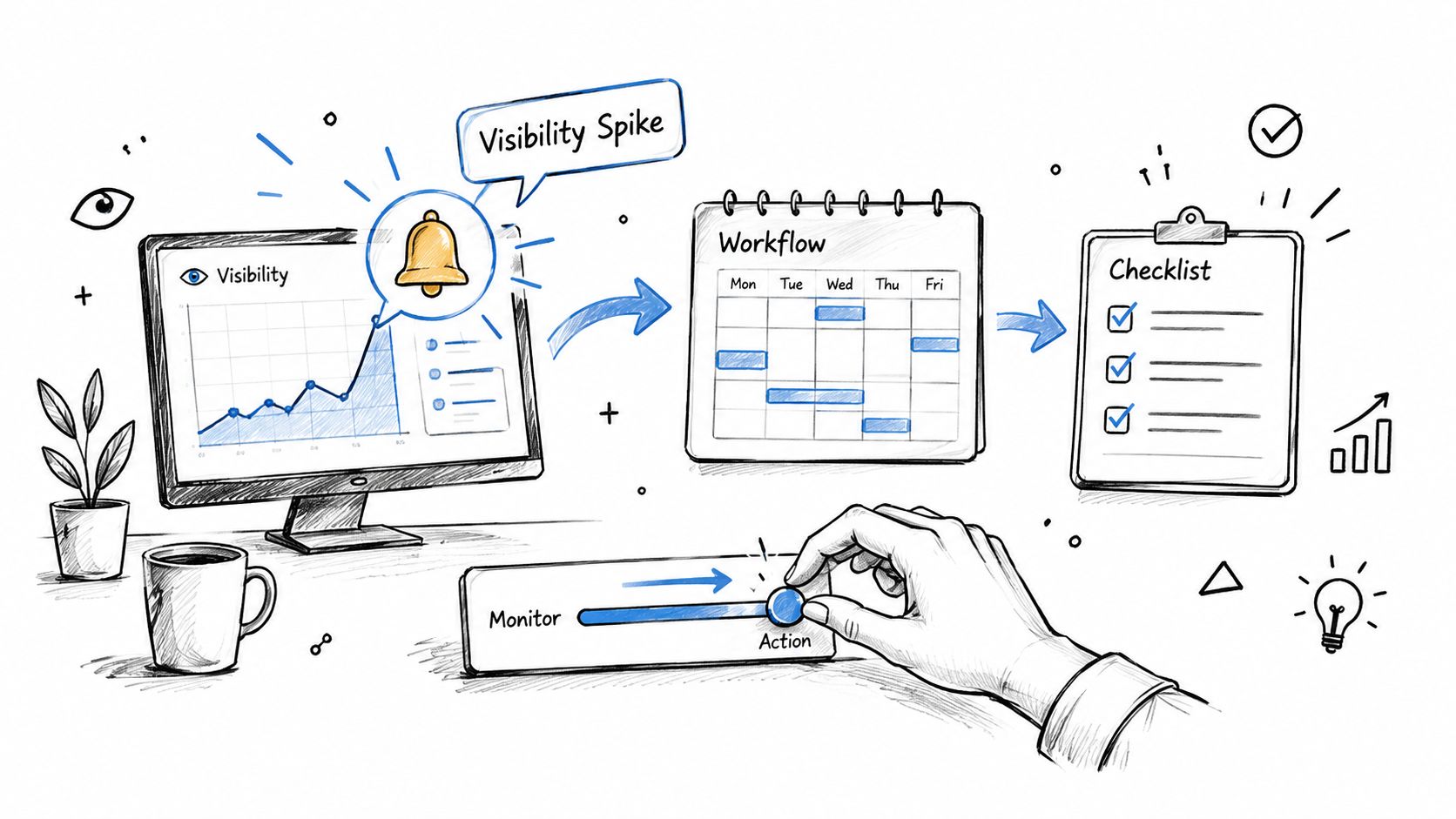
Set alerts for meaningful changes in Share of Voice, position, sentiment, confidence, and citation source. Avoid alerting on every fluctuation. A useful alert identifies the affected provider, prompt group, market, previous state, current state, and likely business relevance.
Use a simple sequence:
- Validate the change: Re-run the affected prompt group and check whether the movement appears across related prompts.
- Classify the cause: Separate source changes, content updates, provider behavior, competitor movement, and measurement noise.
- Assign the response: Give content, product marketing, SEO, analytics, or communications a specific action.
- Record the outcome: Store the change, intervention, and later result so the team can distinguish repeatable improvements from temporary variation.
Sentiment belongs beside visibility because a prominent negative description can be more urgent than a missing mention. Citation source tracking matters for the same reason. If a provider changes from a company-controlled page to an outdated third-party source, the problem is not just a ranking decline. It's an evidence and accuracy risk.
Put alerts into existing workflows
Send high-priority changes to Slack, Discord, or email, then export reports built for executives, product marketing, and content teams. Each audience needs a different view. Executives need commercial implications, content teams need source and prompt detail, and product teams may need inaccurate claims or missing feature evidence.
The AI search audit guide can support a structured review of technical, content, trust, and citation signals.
Operational standard: Every alert should answer three questions. What changed, why might it matter, and who will test the response?
Fast response doesn't mean reacting to every answer variation. It means giving the team enough context to separate volatility from a durable shift.
Conclusion and Strategic Takeaways
A visibility forecast isn't a prettier ranking report. It's a decision-support system that estimates where a brand appears, how prominently it appears, whether the evidence is trustworthy, and whether that exposure can influence business outcomes.
The central mistake is treating citation volume as growth. AI-generated results can produce strong authority signals while sending fewer direct visits than traditional search. At the same time, AI-referred visitors may convert at a stronger rate than organic-search visitors, which makes channel quality and downstream influence more important than raw traffic totals.
A durable measurement model should therefore:
- Segment by intent: Separate research prompts from vendor-selection and implementation prompts.
- Compare providers: Report distributions rather than assuming one assistant represents the market.
- Track evidence: Identify the pages, reviews, documentation, and partner sources shaping answers.
- Measure confidence: Distinguish repeatable inclusion from volatile appearances.
- Connect to outcomes: Compare citations with referral sessions, branded demand, demo starts, assisted conversions, and sales influence.
- Prioritize quality: Prefer authoritative, high-intent visibility over indiscriminate mention growth.
The most useful forecast may recommend fewer content changes, not more. If a brand already appears in the right answers but lacks a clear path to conversion, the next investment may belong in product positioning, measurement, or buyer experience rather than another article.
Teams should treat AI visibility as a portfolio of probabilities and business contexts. The question isn't whether an assistant mentioned the brand. It's whether the brand appeared in a credible answer, for the right audience, with enough influence to change what happens next.
MyMentions helps teams track AI visibility, position, sentiment, competitors, citation sources, provider differences, alerts, reporting, and traffic attribution at prompt level. Visit MyMentions to connect visibility forecasts with the evidence and business actions behind them.