
59% of the intelligence practices examined in a survey of Strategic and Competitive Intelligence Professionals were significantly correlated with organizational innovation, according to a study published in the Journal of Intelligence Studies in Business. That's a more useful starting point than a promise that watching competitors automatically produces growth. The value comes from what teams do with the findings.
The strongest competitor analysis benefits follow an evidence chain: a credible observation changes a decision, someone acts on it, and the team measures the result. For SaaS founders, marketers, and product leaders, that means judging analysis by better positioning, sharper roadmap choices, stronger sales conversations, and more accurate representation in search and AI answers, not by the size of a feature matrix.
Table of Contents
- Core Benefits of Competitor Analysis at a Glance
- How Competitor Analysis Sharpens Strategy and Positioning
- When Competitor Data Misleads and How to Check It
- Finding Product Gaps Before Competitors Do
- Go-to-Market Gains From Competitor Insight
- Search and AI Answer Visibility From Competitor Research
- Measuring Competitor Analysis Results With Clear KPIs
- Start Your Competitor Benchmark This Quarter
Core Benefits of Competitor Analysis at a Glance
Competitor analysis benefits by decision
| Benefit | Decision It Improves | Example Outcome |
|---|---|---|
| Strategy validation | Where to compete and how to price | Rival bundles a planned paid feature; team re-scopes before launch |
| Positioning | Headline, category and proof points | Rival owns the fastest-setup claim; team shifts to integration depth and tests it |
| Product gap discovery | Roadmap priorities | Repeated rival reviews cite the same missing export; feature moves up the backlog |
| Go-to-market | Sales plays, battlecards and targeting | Losses cite a rival's onboarding; sales adds a comparison slide |
| Search and AI visibility | Content and documentation priorities | Rival help pages are cited in AI answers; team publishes structured docs |
| Early warning | Monitoring and response speed | Rival pricing change triggers a prompt review instead of waiting for quarterly planning |
These are hypothetical planning outcomes, not reported company results. Read the table from the middle column outward: identify the decision you need to make, then collect the competitor evidence that could change it.
Strategy validation helps you challenge an assumption before committing resources. If a rival includes your proposed premium feature in its core package, you need to reconsider the offer, not necessarily abandon the feature. The useful question is whether buyers would still pay for your version and why.
Positioning concerns the meaning buyers attach to your product. A feature comparison can establish that you have more integrations, but interviews and sales conversations must establish whether those integrations matter. Without that second check, differentiation is just a factual difference.
Match the benefit to your bottleneck
Product teams should look for unresolved customer jobs rather than collect requests indiscriminately. A complaint about exporting data might reveal a missing feature, confusing documentation, or a workflow your product shouldn't serve. Each interpretation leads to a different investment.
Go-to-market teams need evidence they can use during a buying decision. A battlecard that answers a live objection is more useful than a thorough rival profile buried in a shared folder.
For search and AI visibility, the planning unit is the buyer question and its supporting sources. A competitor's appearance in an answer should prompt investigation into the reviews, documentation, or comparisons accompanying that recommendation.
Early warning serves a different purpose: preserving time to respond. Assign someone to assess a material pricing, packaging, or messaging change, rather than treating every website edit as an emergency.
Decision test: Does this finding change a decision someone needs to make this month?
Choose the benefit that matches your current constraint. If qualified buyers arrive but deals stall, start with sales objections. If buyers misunderstand your category, start with positioning. Collecting everything at once makes it harder to distinguish useful evidence from interesting detail.
How Competitor Analysis Sharpens Strategy and Positioning
A competitor list tells you who sells what. A structural view helps you understand where value is created, who captures it, and which pressures could make your chosen position difficult to sustain.
Michael Porter's 1979 Harvard Business Review framework identified rivalry, new entrants, substitutes, buyer power, and supplier power as forces shaping profitability, while his 1980 book, Competitive Strategy, extended the approach to competitor behavior and strategic responses, as described in The New York Times' discussion of his work.
The distinction matters because your toughest competitor might not be another subscription product. It could be an internal spreadsheet, an agency, or the buyer's decision to leave the problem unresolved.
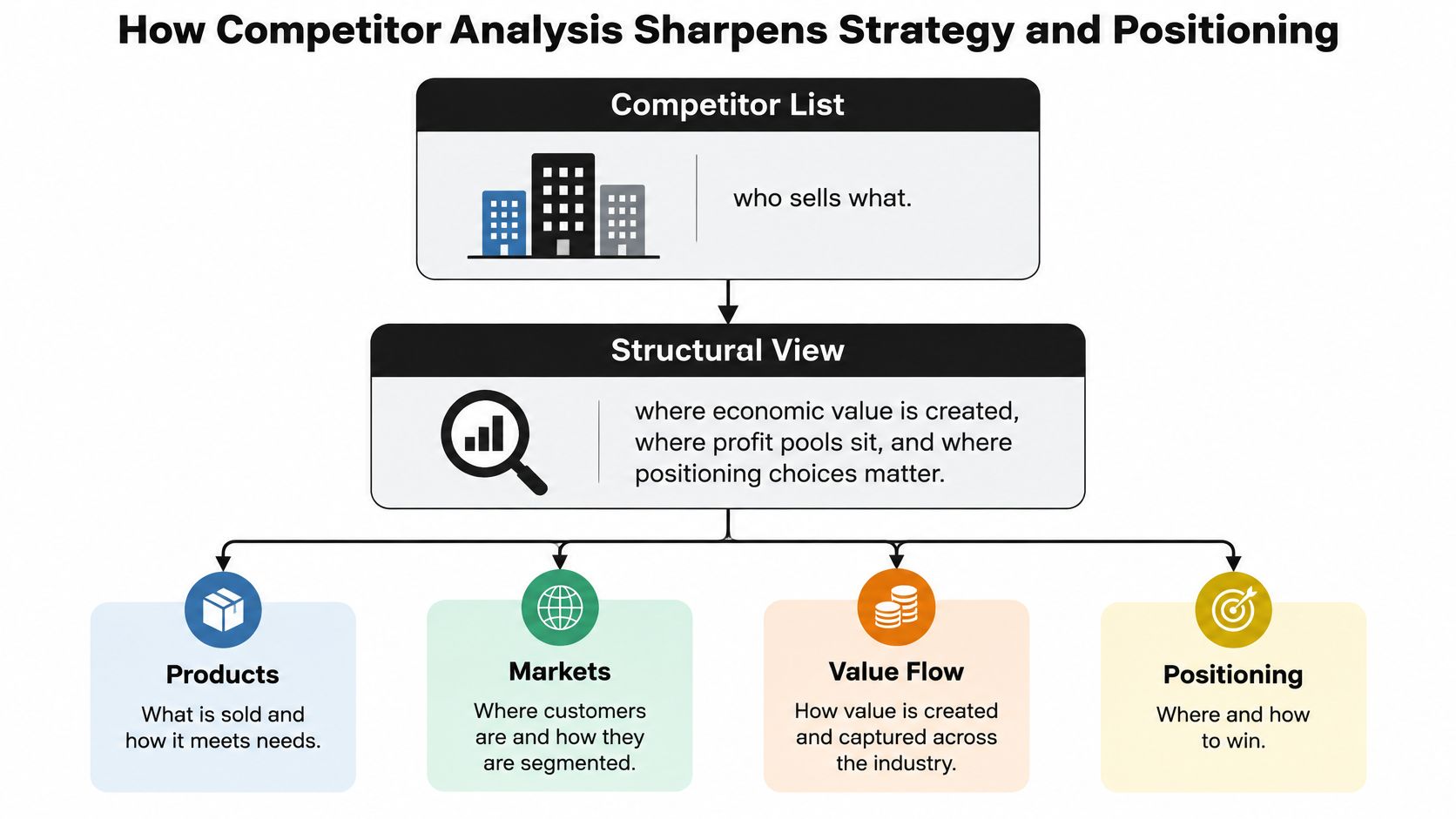
Turn market structure into a positioning choice
- Map the competitive pressures. Identify direct rivals, alternative ways to solve the problem, switching barriers, and dependencies on suppliers or distribution platforms. Ask which pressures affect your target segment rather than treating the whole category as uniform.
- Benchmark the relevant capabilities. Compare positioning, product capabilities, buyer negotiating strength, and threats. When you track competitor pricing, capture packaging and eligibility alongside the headline price so you're comparing equivalent offers.
- Select an underserved dimension. Choose a capability buyers value that you can substantiate and competitors don't already communicate convincingly.
Say a SaaS rival dominates the fastest-setup claim. Your team could spend heavily trying to beat that promise, even though operations buyers in your preferred segment care more about integration depth.
Instead, interview those buyers about the systems they need connected and inspect lost-deal notes for integration objections. Verify that your connectors handle the required workflows, not merely that the integrations appear on your website.
Write a claim your team can defend
Test an integration-led campaign against your existing message while keeping the audience and offer comparable. Evaluate qualified interest and sales progression, not just clicks.
A hypothetical positioning statement could read: For operations teams connecting complex workflows, our platform prioritizes integration depth, supported by tested connector coverage and documented implementation paths. The dimension is explicit, the audience is defined, and the supporting evidence is something a buyer can inspect.
When Competitor Data Misleads and How to Check It
A rival appears above you in an AI answer, so your team copies its comparison-page format. That decision rests on a weak chain: you observed a recommendation and the answer cited a partner directory, yet nothing shows the page format caused either one. Copying the format spends budget on a guess about causation.
Stale pricing, biased reviews, changed packaging, regional differences, and inaccurate AI summaries can each distort what a finding means. Treat them as reasons to inspect the evidence before acting. A distorted signal still tells you something, and the work is figuring out what.
Separate the observation from the explanation
Write findings in two distinct lines:
- Observation: The rival was recommended for an implementation question, and the answer cited a partner directory.
- Interpretation: Relevant partner coverage might help buyers and assistants understand the rival's implementation capabilities.
The first line records what you saw. The second proposes a cause you still need to test, and it stays a proposal until other evidence agrees.
This split matters because the cited sources behind an AI answer point to the actual lever. If the answers name directories, documentation, and review pages, changing your page format addresses none of them.
Confidence levels for competitor findings
| Confidence Level | Evidence Standard | Permitted Action |
|---|---|---|
| High | Multiple independent recent sources agree and customer or conversion data supports the finding | Act, then confirm against the KPI baseline |
| Medium | One strong, recent, independent source with partial corroboration | Run a bounded test with a stated threshold |
| Low | Single unverified observation, stale data or a single-region source | Log it and collect more evidence before changing anything |
A low-confidence finding is still worth logging.
Geographic mismatch warns you about applicability. A regional source supports a decision when it matches your target market, and the same source cannot carry a global conclusion on its own.
Use an evidence check before committing budget
Record the observation with its date and source, then tag the source as owned documentation, customer feedback, independent coverage, or an AI-generated summary. Assess recency, source independence, geographic relevance, and agreement across sources, rating each one strong, partial, or weak.
Score commercial impact on a separate line. It sets how fast you act, while the evidence standard sets whether you should act at all. An expensive potential problem does not become more believable because it matters.
Before changing the roadmap, define what would validate the interpretation. Find Startup Ideas' guidance to run customer interviews before building helps when public complaints suggest an opportunity without establishing willingness to pay.
Tracking also needs qualification. Missing referrers, blocked scripts, and source classification can affect AI traffic tracking coverage, so an apparent absence of visits is weak evidence that buyers never arrived.
A competitor finding should leave the meeting with a confidence level and a validation step attached, because a feature-matrix cell by itself is only an observation.
Finding Product Gaps Before Competitors Do
Competitor signals that reveal product gaps
| Signal Source | What It Reveals | Roadmap Response |
|---|---|---|
| Rival review complaints | Repeated missing or broken feature | Validate demand, then prioritize the fix |
| Support and help-center gaps | Workarounds customers rely on | Build the feature or publish a clear answer |
| Competitor changelog | Where rivals are investing | Match, skip or differentiate |
| Lost-deal notes | Feature cited when buyers pick a rival | Score against revenue at stake |
| Claims repeated by AI assistants | Perceived capability advantages or inaccurate product descriptions | Verify the claim, then improve the product or its supporting evidence |
The strongest product signal isn't necessarily the loudest complaint. It's a recurring problem among buyers you intend to serve, with consequences they can describe.
In a study of 284 executives at Chinese IT small and medium-sized enterprises, competitor intelligence had a positive relationship with product innovation, with β = 0.585 and p = 0.001. The study also identified inter-functional coordination and organizational open-mindedness as factors strengthening the benefit. This supports sharing intelligence across teams, but it doesn't establish that copying competitors produces innovation.
Move from signals to product choices
- Log the source and date. Preserve the original complaint or product claim and identify the buyer's context. A request from an enterprise administrator may have little relevance to a product designed for solo operators.
- Group gaps by buyer intent. Organize observations around jobs such as exporting audit records or connecting customer data, not around whichever feature name the rival uses. Your product discovery techniques should help distinguish the underlying need from a proposed solution.
- Estimate revenue at stake. Connect the gap to qualified opportunities, expansion requests, or retention risks. Label unsupported demand as unknown rather than turning review frequency into a revenue forecast.
- Choose to match, skip, or differentiate. Match a requirement that blocks otherwise suitable buyers, skip work outside your strategy, or solve the underlying problem differently.
A help-center workaround deserves careful interpretation. If customers must manually clean an export, engineering may need to improve the output; if the export already supports the workflow but users can't find it, documentation may be the better response.
Check what comparison content leaves out
Competitor comparisons can help structure your questions without answering them for you. For example, Linkboost's comparison of engagement software options for LinkedIn creators can serve as a starting point for investigating workflow differences, but you should verify vendor-authored claims against current documentation and customer needs.
Bring product, marketing, and engineering into the prioritization discussion. Marketing may recognize a misunderstood capability, engineering may identify a technical constraint, and product may determine that the requested workflow falls outside the intended segment.
After shipping, track the change in competitor-adjusted share of voice or average answer position on a stable buyer-intent prompt set. Use that as a representation check alongside direct evidence that customers can now complete the intended job.
Go-to-Market Gains From Competitor Insight
Say a B2B software team reviews its lost deals and finds that buyers repeatedly mention a rival's easier onboarding. The sales leader initially asks for a discount campaign, but the notes suggest a different concern: prospects fear the implementation work.
A joint review helps the team distinguish a pricing objection from an onboarding objection.
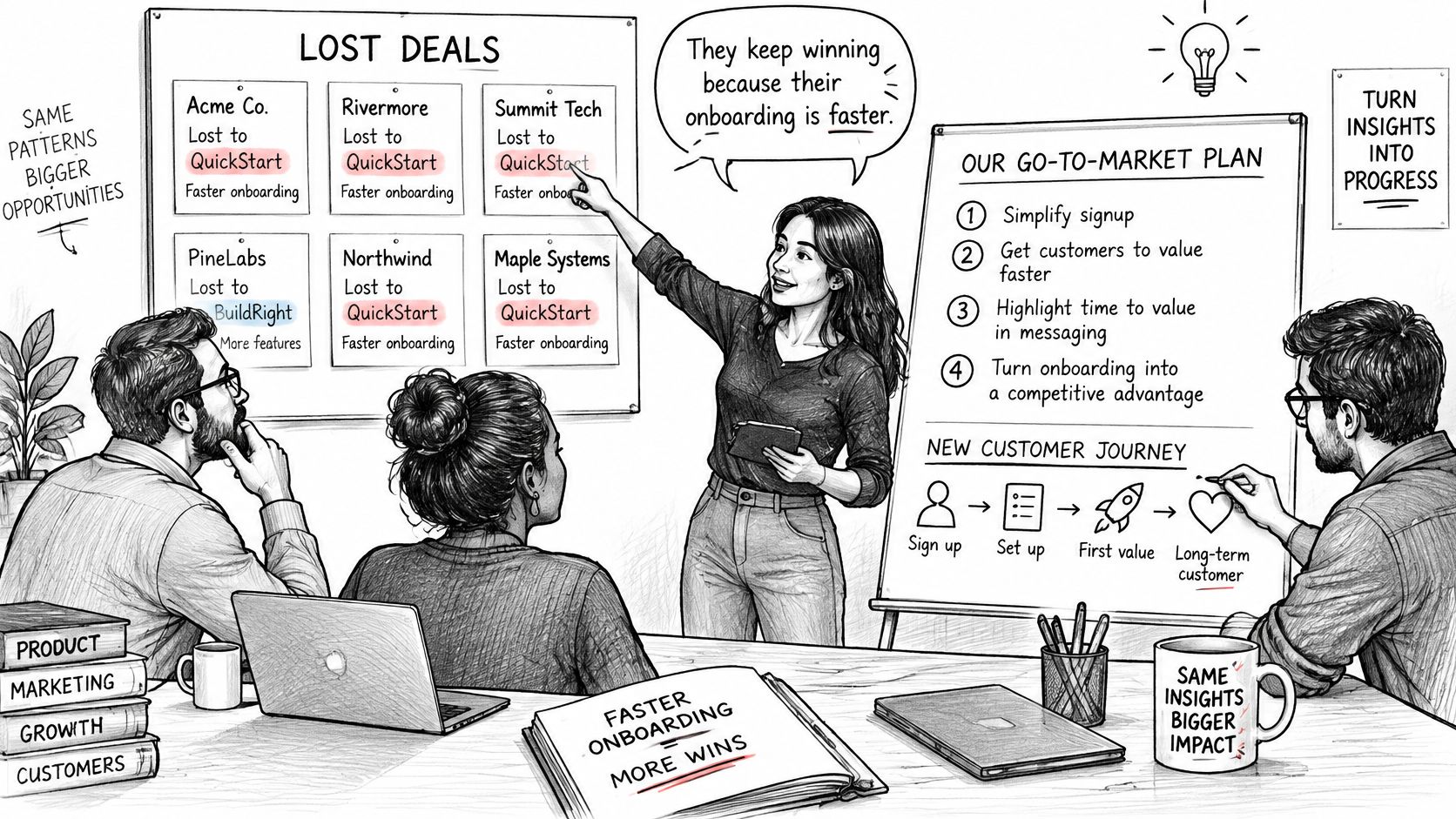
The team checks the rival's current onboarding promise and its own implementation process. It then gives representatives a battlecard they can use during a conversation, rather than a dense dossier they must memorize.
This is a meaningful use case for contested pipelines: 65% of sales opportunities for the average B2B software company were competitive in 2024, according to Crayon's State of Competitive Intelligence report. Separately, 79% of competitive-intelligence professionals reported equipping sales teams with battlecards in 2024, according to Crayon's overview of competitive-intelligence practices.
Make the battlecard usable in a live call
- Rival claim: Summarize the current promise accurately, including any conditions.
- Your proof: Provide a documented implementation path or demonstration relevant to the prospect.
- Buyer objection: State the concern in buyer language, such as uncertainty about migration work.
- Representative response: Acknowledge the concern, explain the relevant difference, and offer a concrete next step.
A useful response doesn't dismiss the rival. It helps the buyer compare the work required in their own environment.
The same discipline applies to pricing. If trial-to-paid conversion weakens after a rival changes its bundle, treat that timing as a hypothesis, then inspect deal feedback, segment mix, and your own trial experience before changing prices.
For a broader view of how sales findings inform targeting and launches, this guide to competitive intelligence in marketing provides a practical starting point. The video below offers another format for exploring the topic.
Connect enablement to deal outcomes
Tag won and lost deals by competitor, buyer segment, and reason. Maintain a battlecard for frequent rivals, review pricing comparisons quarterly, and record whether representatives used the material.
Competitor monitoring can also inform launch timing when buyers describe a segment that rivals serve poorly. Validate that demand before treating a rival's absence as an opportunity.
Look for win-rate changes in comparable segments where the battlecard was used versus where it wasn't. Account for differences in deal quality and representative experience before attributing the improvement to enablement.
Search and AI Answer Visibility From Competitor Research
A brand's own websites represented only 5–10% of the sources cited by AI-powered search in McKinsey's 2025 AI Discovery Survey, with the remainder coming from affiliates, user-generated content, review sites, and other third parties. That changes what a useful visibility audit needs to inspect.
Your competitor's website is only part of its information ecosystem. The practical question is which external sources accompany its recommendations and which missing or inaccurate sources could be weakening your own representation.
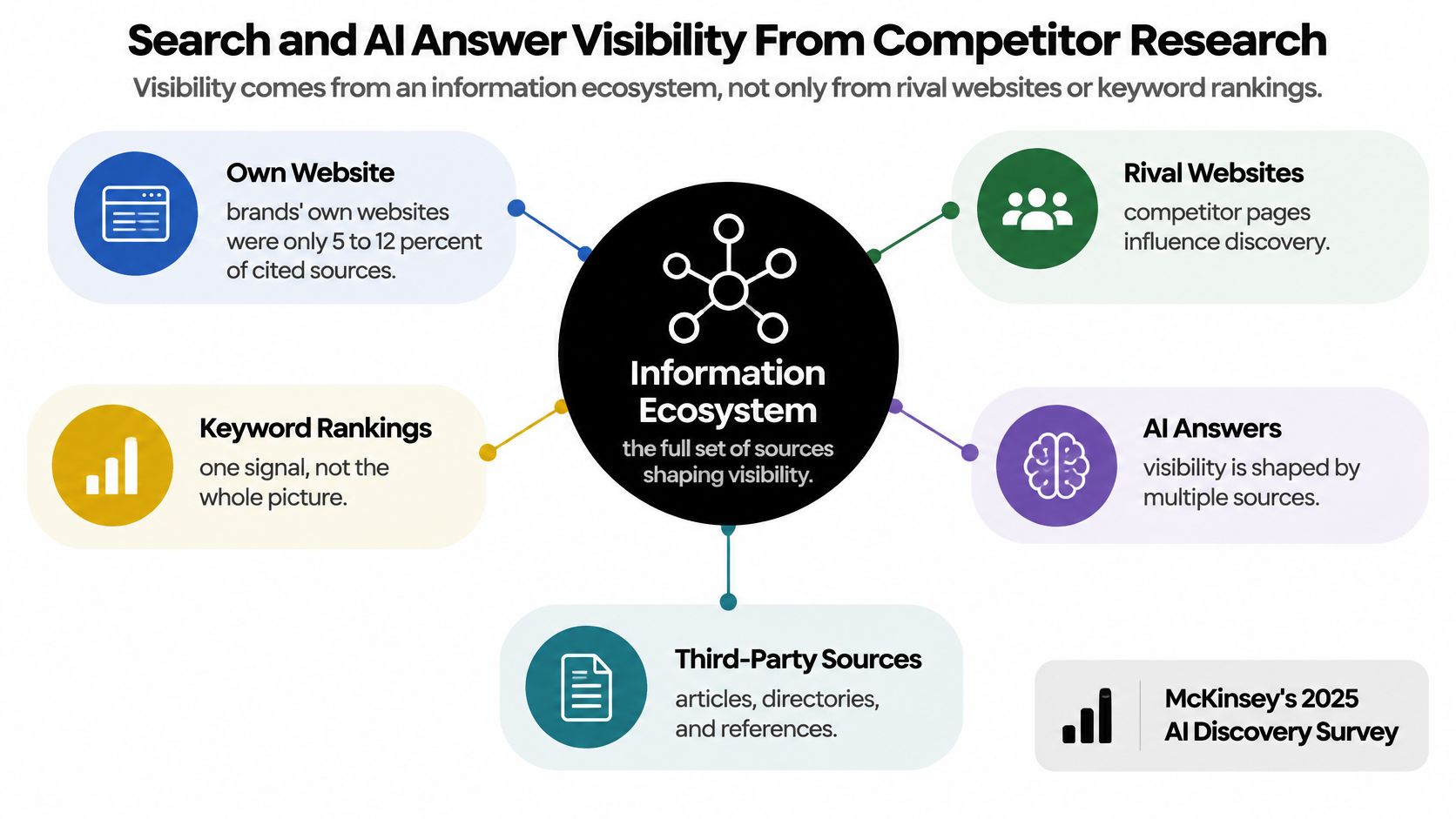
Publishing more owned content won't necessarily address a gap in independent evidence. If an assistant cites outdated reviews or a partner directory that excludes your product, another general-purpose blog post may leave the relevant problem untouched.
Build a source-gap map
| Source Type | Buyer Question It Can Help Answer | What to Inspect |
|---|---|---|
| Reviews | Is this suitable for a team like ours? | Use case, recency, recurring strengths and complaints |
| Partner pages | Will this work with our existing stack? | Listing accuracy and documented integration scope |
| Communities | What happens during real implementation? | Context, firsthand detail and unresolved questions |
| Documentation | Can the product perform this task? | Clear instructions and current capability descriptions |
| Comparison articles | Which alternative fits our constraints? | Selection criteria, independence and outdated claims |
Start with a manageable set of buyer-intent prompts covering selection, implementation, alternatives, and constraints. A prompt such as Which tools support an approval workflow for a distributed finance team? is more diagnostically useful than asking which brand is best.
Record which competitors appear, what the answer says about each product, and which source URLs are returned. Classify sources by independence and recency, then rank gaps by relevance to buyers you can realistically serve.
Turn the map into a remediation backlog
Use AY Rank's guide to AI search monitoring tools to compare approaches to repeated checks, and structure your investigation with an AI search visibility audit. Check whether a tool preserves answers and citations, rather than relying only on a summary score.
In our workspace, customers can add competitor brands and compare share of voice and sentiment against them. Our provider checks use provider APIs; they don't reproduce every consumer app experience or track Google AI Overviews, Google AI Mode, or Microsoft Copilot.
Read the actual claims about your product and its rivals. An answer may recommend you for a capability you don't offer, or overlook a capability that exists but lacks clear supporting documentation.
Treat a citation as a useful lead, not proof that the source caused the recommendation. Prioritize sources that address a consequential buyer question, contain a verifiable gap, and can be corrected legitimately.
For the top-ranked gap, name a concrete next action: correct an outdated review profile, request an accurate partner listing, or publish the missing implementation guide. Assign an owner and preserve the original answer so you can evaluate the change.
Measuring Competitor Analysis Results With Clear KPIs
In Crayon's 2021 benchmark of more than 1,000 competitive-intelligence practitioners and stakeholders, 78% of organizations with defined competitive-intelligence KPIs reported direct revenue impact, compared with 20% without KPIs. That's a substantial association, but it isn't a controlled experiment: respondents reported their outcomes, and measurement discipline may accompany other organizational strengths.
The practical lesson is to define success before acting. Don't commission competitor research and decide afterward which improving metric will count as proof.
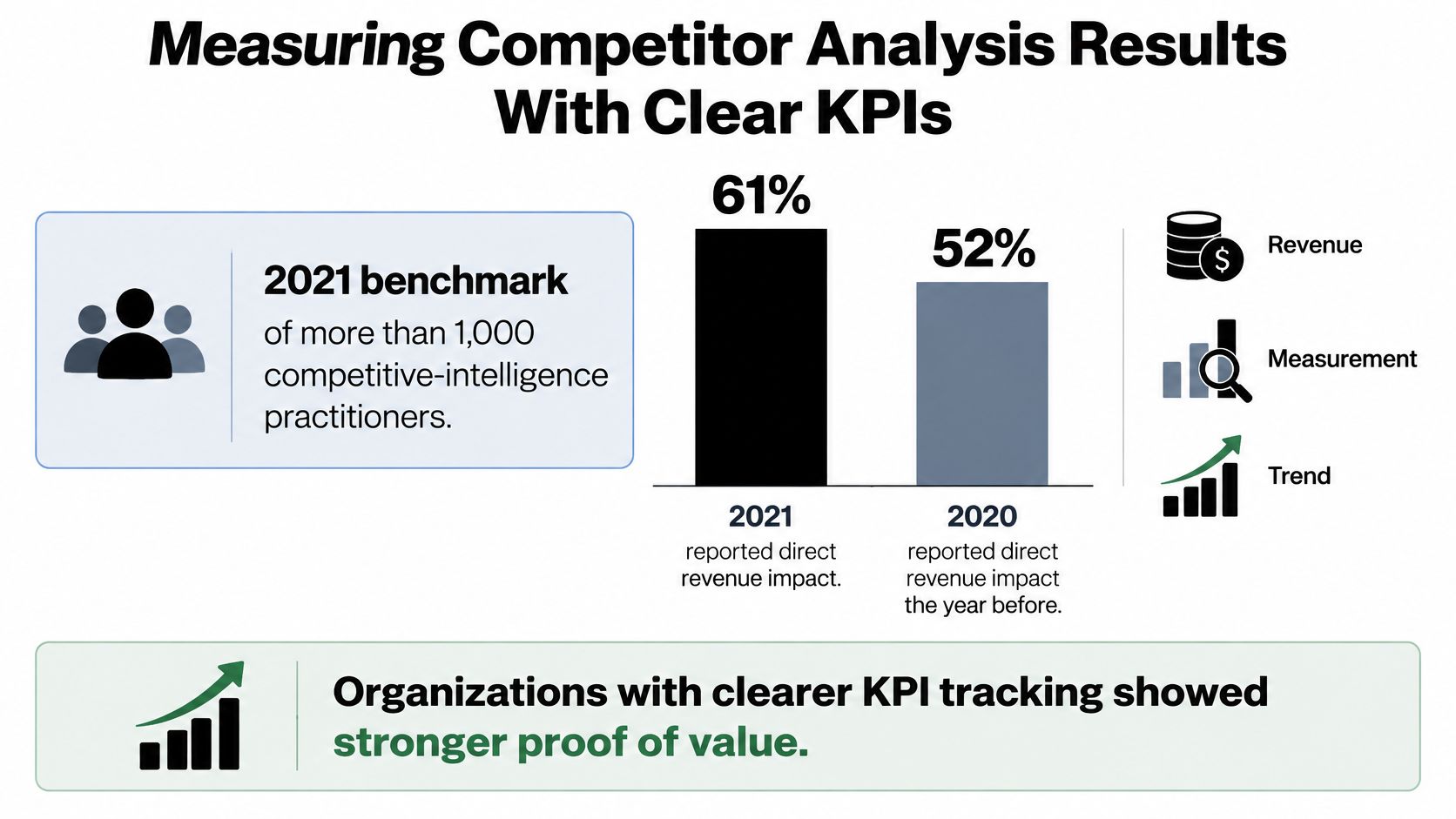
Separate exposure from business outcomes
Competitor analysis KPIs by type
| Metric | Type | What It Tells You |
|---|---|---|
| Visibility | Exposure | Share of tracked answers where your brand appears |
| Position | Exposure | Average rank when your brand is recommended |
| Sentiment | Quality | How positive responses sound about your product |
| Share of voice | Exposure | Your mentions compared with tracked competitors |
| Win rate | Outcome | Share of deals won against each named competitor |
| AI traffic visits | Outcome | Visits from detectable AI sources, before conversion is measured separately |
Visibility describes whether you appear in the collected answers. Position describes your average rank when recommended, so an improved position doesn't automatically mean you appeared more often.
Sentiment adds a quality check. A response can mention your product while describing it as unsuitable for the buyer's requirements, making a mention-only report misleading.
Measurement rule: More exposure is useful only when the representation is accurate and relevant to buyers you can serve.
An AI traffic visit is separate from a mention, signup, or purchase. Completed conversions must be measured in your analytics or billing system, rather than inferred from an AI answer or a detected visit.
Keep the comparison conditions stable
Establish a baseline using a fixed prompt set, competitor list, and provider coverage. Save the reporting period and metric definitions so another team member can reproduce the comparison.
Review results monthly, then compare post-change performance against the same prompts. Record the intervention date and any simultaneous changes to your product, campaigns, or website that could affect interpretation.
A structured approach to competitor benchmarking helps prevent mismatched comparisons. Don't compare a broad exploratory prompt set with a later set concentrated on questions your product already answers well.
Read the metrics together
Suppose documentation becomes clearer and visibility improves, but qualified visits don't. Investigate whether the newly gained prompts represent commercial intent, whether the answer offers a reason to visit, and whether the landing page matches the question.
If qualified visits rise but purchases don't, inspect the conversion path rather than concluding that the visibility intervention failed. Buyers may encounter an unclear offer, an unsuitable package, or a signup process that doesn't meet their expectations.
Keep an intervention log with the hypothesis, owner, shipped change, exposure result, and business outcome. Retain changes that help customers and improve commercial performance; revise changes that merely make the dashboard look better.
Start Your Competitor Benchmark This Quarter
You don't need a complete market database to begin. You need a controlled comparison tied to a decision your team is prepared to make.
Start with a shortlist of rivals that appear in buyer questions and sales conversations. Include alternatives customers consider, not just companies with similar homepages.
Use a focused closing checklist
- Choose the comparison group. Name the rivals most relevant to your target buyers and record why each belongs. Keep aspirational brands separate from products you routinely encounter in deals.
- Fix the buyer questions. Write a manageable prompt set covering evaluation, implementation, and alternatives. Keep the core wording stable throughout the quarter, and label exploratory additions separately.
- Capture the baseline. Use a tracking tool that records visibility, average position, and sentiment across the providers you want to evaluate. Preserve the underlying answers so you can inspect changes rather than rely on aggregate scores.
- Ship the highest-value fix. Select a supported gap with meaningful revenue at stake. Assign an owner and choose a concrete intervention, such as clarifying integration documentation or correcting an inaccurate external listing.
- Review the competitive delta. Recheck the same prompts after the change has had time to be discovered. Compare representation with qualified visits, deal feedback, and conversion evidence before deciding whether to retain or revise the intervention.
Keep the scope small enough that someone can explain why the result changed. If you rewrite positioning, rebuild documentation, and change pricing simultaneously, you'll struggle to identify which action helped.
The objective isn't to react to every rival movement. It's to build a repeatable habit of making better-supported decisions while preserving your own strategy.
Start this week by recording the baseline before you change anything.
MyMentions helps you track how AI assistants mention, rank, and describe your product across buyer prompts, then compare that representation with competitors. Visit MyMentions to establish your baseline and turn a supported visibility gap into your next measurable improvement.