The popular advice is to choose the “best” competitive intelligence platform and make it the center of every team's workflow. That advice misses the main buying problem. A platform built for sales battlecards may be a poor choice for AI visibility, while a strong digital benchmarking tool may tell you little about pricing changes, buyer objections, or social perception.
This roundup compares ten distinct approaches across AI visibility, sales enablement, web monitoring, market research, digital benchmarking, alerts, and social intelligence. The practical criteria are data scope, pricing visibility, implementation effort, workflow fit, alert quality, and the type of decision each platform can improve. The category itself is expanding rapidly, although market estimates differ sharply because some reports measure software platforms while others include broader tools and services. One estimate places the market at USD 0.59 billion in 2025, with a projection of USD 1.46 billion by 2030 at a 19.96% CAGR. Mordor Intelligence's market analysis illustrates why buyers should assess the category carefully rather than assume all platforms solve the same problem.
Use the list by starting with the decision you need to improve. Then shortlist platforms whose evidence sources match that decision, and validate the coverage, integrations, alert quality, and export options during a trial or demo. For a practical approach to finding actionable competitor signals, focus on what your team can act on, not how many features a vendor can display.
Table of Contents
- 1. MyMentions
- 2. Crayon
- 3. Klue
- 4. Kompyte by Semrush
- 5. Contify
- 6. Similarweb
- 7. AlphaSense
- 8. WatchMyCompetitor
- 9. Owler Including Owler Max
- 10. Digimind
- Top 10 Competitive Intelligence Platforms, Quick Comparison
- Match the Platform to the Decision You Need to Make
1. MyMentions
Best for AI visibility and prompt-level competitor benchmarking
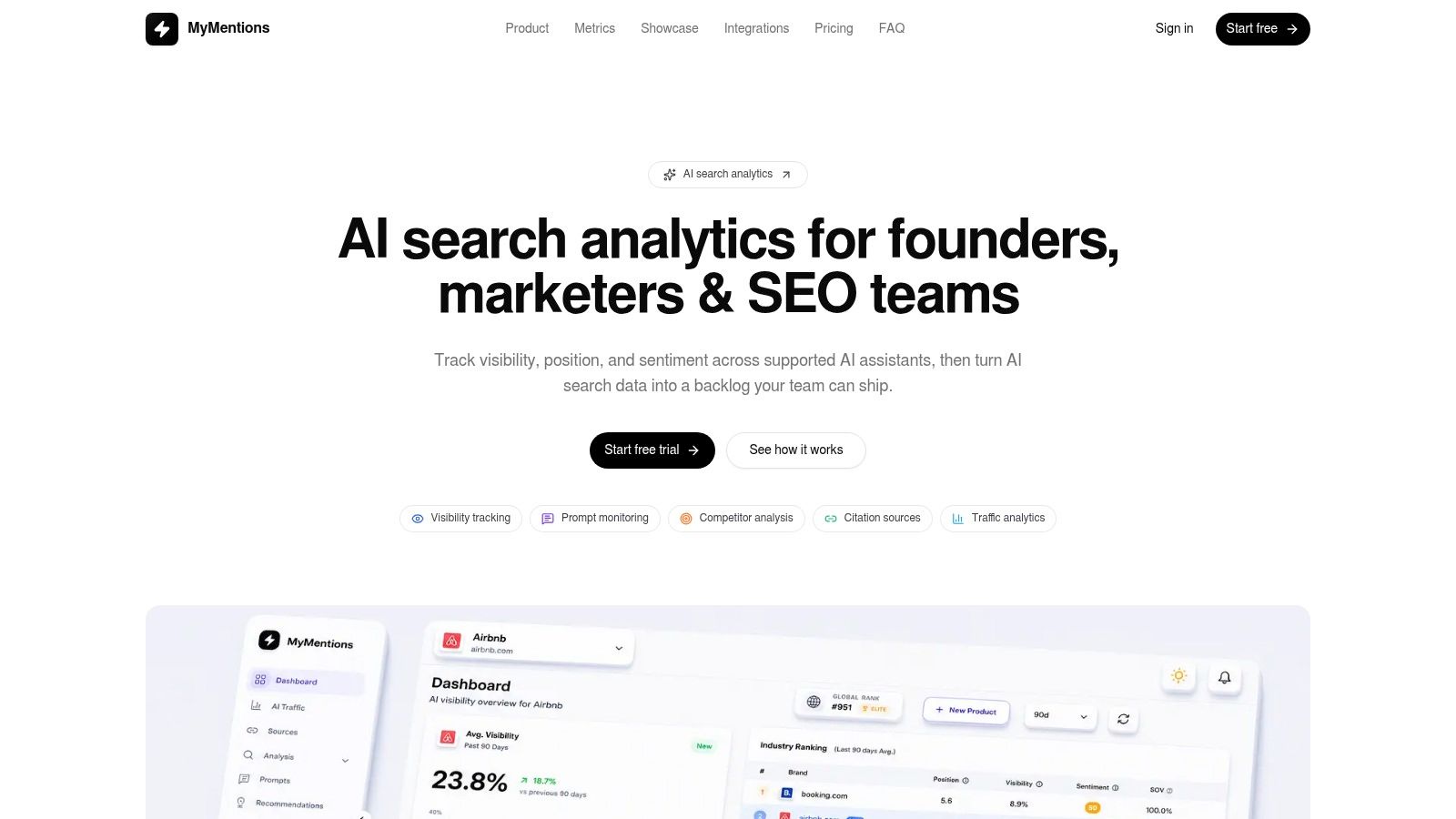
MyMentions is designed for teams that need to understand how AI assistants discover, rank, and describe their products. That makes it notably different from traditional competitive intelligence platforms, which usually focus on web changes, financial documents, news, sales enablement, or social conversations.
The core workflow starts with buyer-intent prompts. MyMentions analyzes how a brand and its competitors appear across supported AI providers, including OpenAI, Google, Perplexity, Claude, Grok, Copilot, DeepSeek, and Meta Llama. It then connects the result to the pages influencing the answer, such as product documentation, reviews, partner pages, and help content. That source-level view is more useful than a simple mention count because it shows what your team may need to improve.
Where the workflow is strongest
The workspace combines visibility, position, sentiment, confidence signals, traffic attribution, and competitor benchmarking in one dashboard. Daily prompt analyses can become a prioritized recommendation queue covering trust, content, UX, and technical issues. Slack, Discord, and email alerts help teams notice changes without requiring everyone to open another dashboard.
The recommendation queue is the important distinction. A visibility report tells you what happened. A prioritized work queue gives SEO, content, and product teams a starting point for responding. MyMentions also supports AI brand monitoring, which is relevant for teams treating AI answers as an ongoing discovery channel rather than a one-time research project.
Pricing is unusually visible for this category. Starter, called Protocol Alpha, costs $49 per month and includes 25 provider checks per day across three providers. Pro, called Protocol Delta, costs $99 per month and includes 50 checks per day, eight providers, and two seats. Enterprise, or Protocol Omega, costs $199 per month and includes 100 checks per day, eight providers, five seats, scheduled reports, and billing management. Paid plans include a 7-day free trial.
Practical rule: Validate whether the prompts reflect real buyer questions before judging the platform's value. More checks won't compensate for weak prompt design.
The trade-off is plan-based provider and check limits. Teams that need broad, frequent monitoring may need Pro or Enterprise. The site also doesn't list public customer testimonials, independent case studies, or third-party certifications, so a trial should focus on whether the citation findings lead to work your team would prioritize.
Best fit: Founders, growth marketers, SEO teams, product marketers, and competitive intelligence teams that need to measure AI assistant visibility and convert citation gaps into trackable improvements.
2. Crayon
Best for sales enablement and a formal compete program
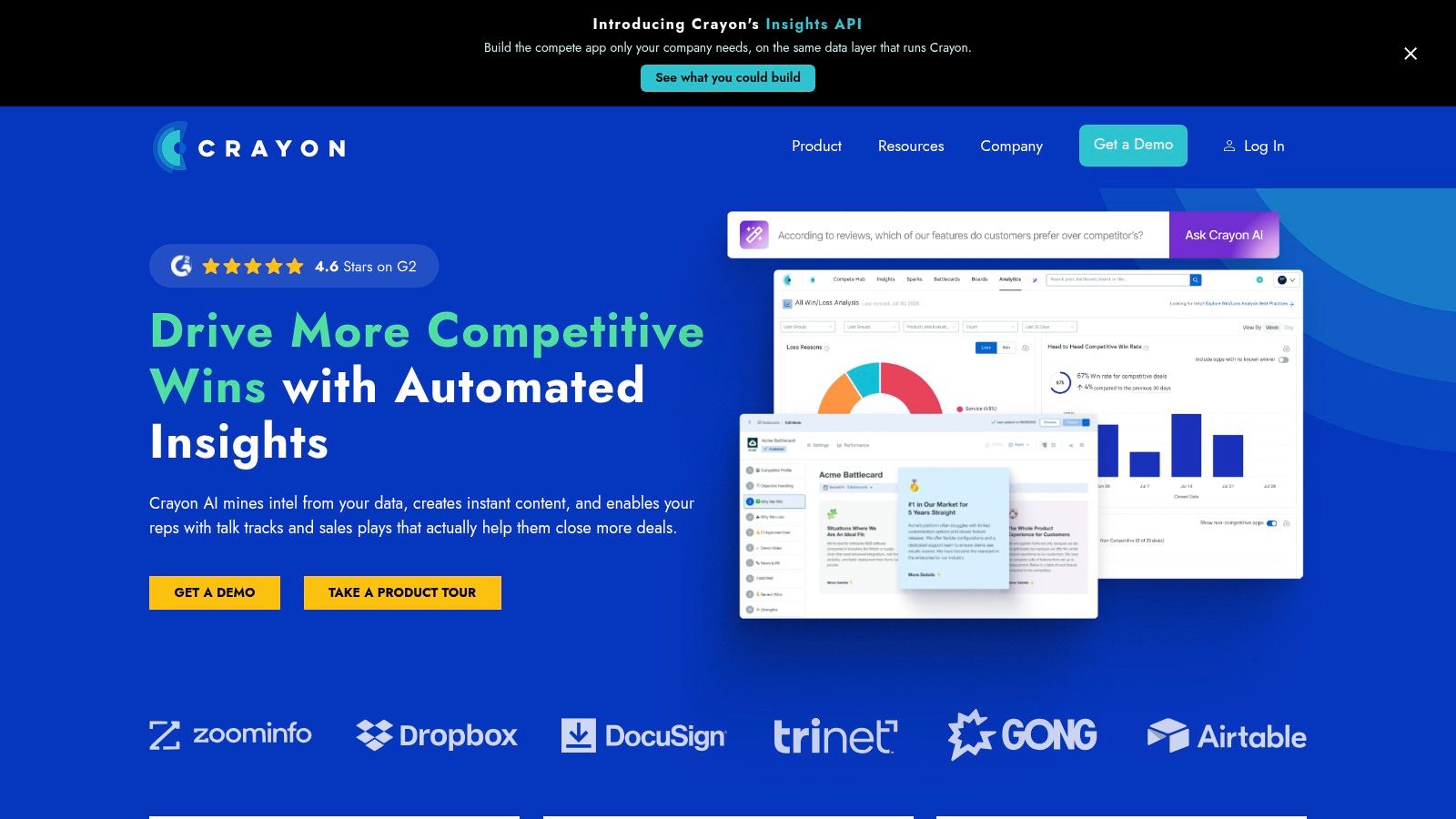
Crayon is not primarily a change-detection tool. Its value appears after a competitor signal is found, when product marketing must turn that change into guidance a seller can use. The platform monitors competitor websites and digital footprints, classifies updates across positioning, pricing, products, reviews, public relations, and hiring, then routes relevant findings into enablement workflows.
Crayon supports a formal compete program through battlecards, alerts, and sales or product marketing deliverables. Integrations with Salesforce, Slack, Teams, Highspot, and other revenue tools place competitive context in existing workflows. Its AI features, including Sparks and Answers, help create and refresh enablement content from current intelligence.
The adoption question
Crayon makes sense when a named owner runs the compete program. That person must set signal priorities, maintain battlecard quality, coordinate with product marketing, and encourage seller adoption. Without that operating role, Crayon can become an expensive feed that produces information without changing sales behavior.
Pricing is not published publicly, and the buying process is oriented toward enterprise requirements. Smaller teams may find it difficult to estimate total cost before speaking with sales. A more useful evaluation is specific to Crayon's workflow. During the trial, import five to ten priority competitors, tag changes by positioning, pricing, and hiring, then test whether Sparks correctly classifies a pricing-page change and sends an updated battlecard to Slack without manual rewriting.
Crayon also provides benchmarking and program-impact reporting. Treat those outputs as measurement infrastructure, then check whether they connect intelligence activity with adoption, enablement usage, and commercial decisions. For teams building battlecards manually, Crayon can consolidate collection, curation, distribution, and measurement. See this guide to how to do competitor benchmarking before configuring the competitor set.
For a founder or small marketing team that mainly needs website change alerts, the implementation effort and enterprise buying process may be disproportionate.
Best fit: Mid-market and enterprise product marketing, sales enablement, and revenue teams with a named compete owner and a clear need for integrated battlecards.
3. Klue
Best for competitive enablement and win-loss feedback
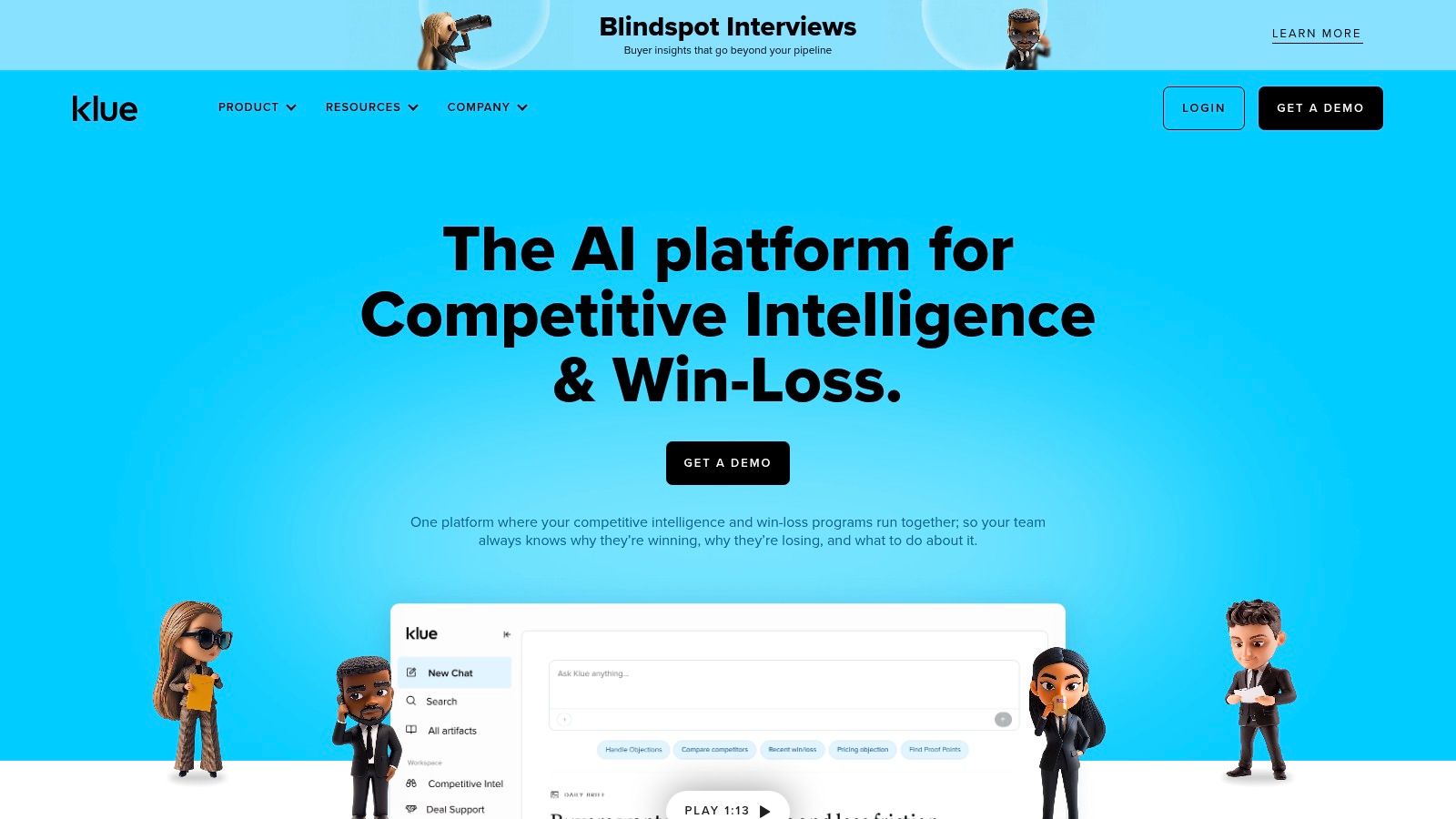
Klue takes the sales distribution problem seriously. It combines automated competitive intelligence collection with curation and pushes living battlecards into CRM, Slack, and mobile workflows. That makes it suitable for organizations where the main question is not “What changed?” but “How can a seller use this information during an active opportunity?”
The platform also supports win-loss analysis through DoubleCheck Research. That creates a useful feedback loop. Monitoring shows what competitors are changing externally, while win-loss work helps explain why buyers chose one option over another. Those are different evidence sources, and combining them can prevent product marketing teams from treating competitor messaging as the only explanation for deal outcomes.
What buyers should test
Ask sellers to find and use a battlecard inside their existing workflow during the evaluation. A polished central library isn't enough if representatives still need to leave the CRM, search through outdated content, or interpret raw alerts themselves.
Klue's program measurement and enablement workflows are valuable for teams that want to understand whether competitive content reaches the field. The platform is less suitable as a lightweight monitoring tool because it generally requires more setup, governance, and ongoing ownership than a simple alerting product.
Pricing isn't publicly listed, and the platform is generally positioned for mid-market and enterprise contracts. Buyers should clarify how seats are structured, what implementation includes, how win-loss research is scoped, and whether the team can export curated battlecards and underlying intelligence.
The strongest argument for Klue is workflow proximity. The platform is designed to put intelligence in front of sellers rather than leave it with analysts. The main risk is operational: if nobody maintains the content or reviews the feedback, the system loses the context that makes battlecards useful.
Best fit: Product marketing and sales enablement teams that need competitive guidance in seller workflows and want win-loss evidence to inform future positioning.
4. Kompyte by Semrush
Best for practical web monitoring and revenue-team distribution
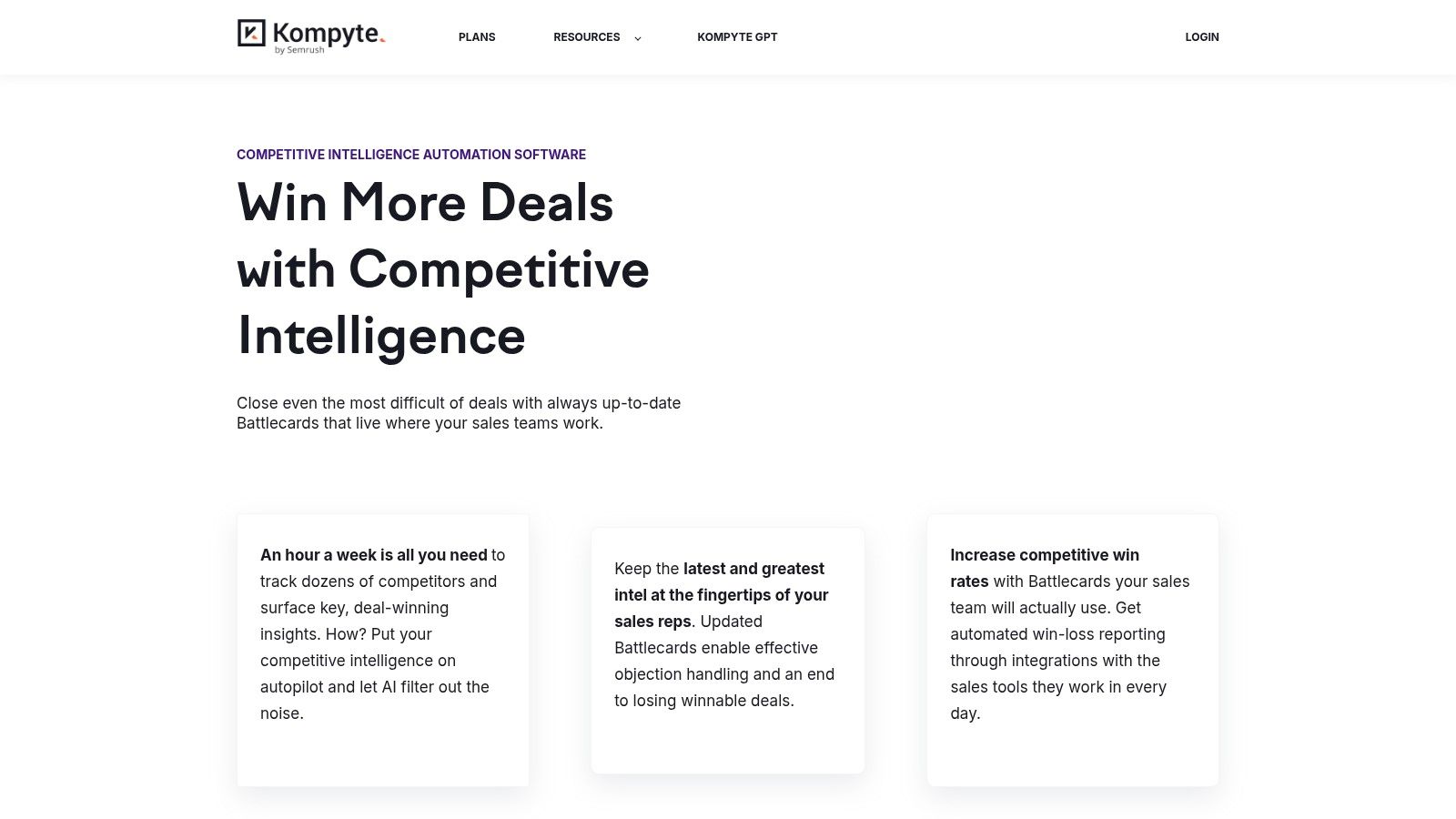
Kompyte focuses on competitor tracking, battlecards, and delivery into sales and marketing systems. Its connection to Semrush makes it a logical consideration for teams already using that ecosystem, particularly when web and messaging monitoring need to sit alongside search and digital analysis.
The platform can monitor competitor websites and messaging, identify page changes, and help prioritize updates. It also supports automatic battlecards and enablement content, with integrations that include Salesforce, HubSpot, Highspot, Showpad, Slack, and Teams. Controls for competitor scope, URL depth, and tracking limits matter here because monitoring every available page can create noise faster than insight.
Where it fits in the stack
Kompyte is strongest when the team wants a quicker path from web change detection to sales enablement. If you already use Semrush, adoption may be easier because the broader digital intelligence context is familiar. Teams should still evaluate whether Kompyte's monitoring depth covers the competitor pages and content types that matter to their decisions.
Pricing is quote-based and depends on factors such as tracked competitors, seats, and single sign-on requirements. That limits upfront comparison, so ask for a quote based on your actual competitor set rather than a generic package. Also confirm which capabilities are included in the proposed tier and which require additional modules.
The trade-off is depth versus operational simplicity. Kompyte may be easier to operationalize than a larger enterprise deployment, but teams with complex taxonomies, broad research requirements, or extensive strategic workflows may need a more configurable platform.
For a team that wants to track messaging changes, produce usable battlecards, and connect findings to the revenue stack, it offers a focused route. It isn't a substitute for financial research or deep social intelligence.
Best fit: Growth-stage marketing and revenue teams, especially Semrush users, that want web and messaging monitoring connected to enablement workflows.
5. Contify
Best for curated market research and multi-source intelligence
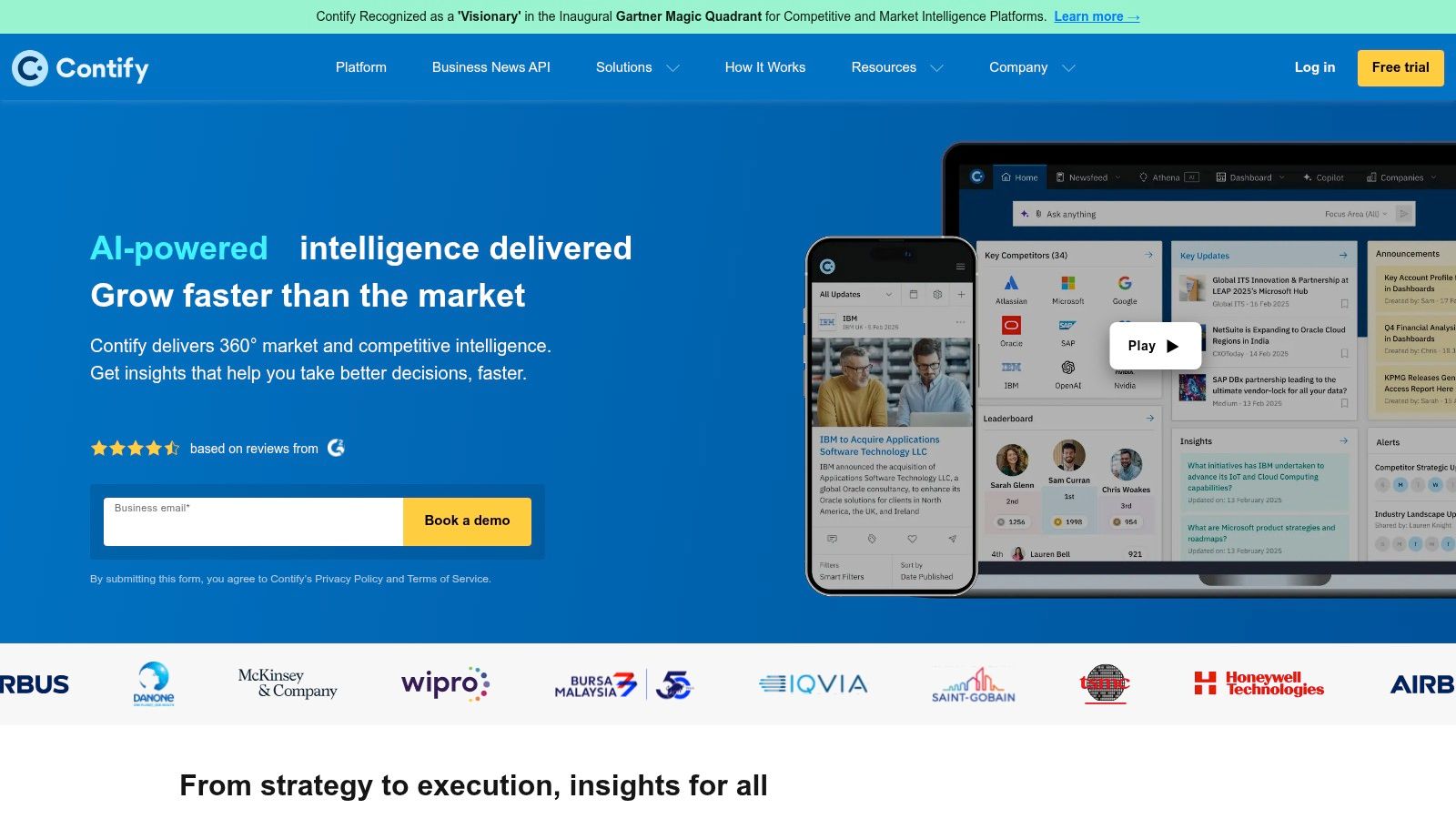
Contify takes a broader market intelligence approach than dedicated sales battlecard tools. It brings together information from owned channels, news, reviews, patents, transcripts, and other sources, then uses configurable taxonomies and templates to organize the results around a company's intelligence priorities.
That breadth can help strategy, product marketing, and market intelligence teams answer questions that sit beyond direct competitor activity. A team might want to monitor product launches, executive changes, industry developments, regulatory signals, and customer perception in one environment. Contify's Athena AI adds automated analysis while retaining human checkpoints, an important design choice when raw relevance isn't enough.
Configuration is part of the purchase
Contify's value depends on the quality of the taxonomy. Teams need to define competitors, entities, topics, markets, and reporting requirements before the platform can consistently separate useful intelligence from general industry noise. That upfront work isn't a flaw, but it should be included in the implementation plan.
The platform supports custom topics and entities, newsletter and report templates, email, Slack, Teams, Salesforce, and export options. Those capabilities make it suitable for organizations that distribute intelligence to several stakeholder groups rather than only to sales representatives.
Pricing is opaque and oriented toward enterprise requirements. A configured 7-day trial is available, which gives buyers a practical opportunity to test source coverage and relevance using their own competitors and industry terms. During that evaluation, measure whether analysts can tune the taxonomy without constant vendor assistance.
Contify is a better fit for curated intelligence than for instant, low-effort alerts. It can support a central intelligence hub, but teams shouldn't underestimate the effort needed to define categories, review outputs, and maintain reporting templates.
Best fit: Strategy, market intelligence, and cross-functional marketing teams that need broad source coverage with configurable filtering and human validation.
6. Similarweb
Best for digital benchmarking and channel analysis
Similarweb answers a specific competitive question: how does a competitor's digital performance compare with ours across traffic, sources, search share, and site segments? Its clickstream-based approach gives marketing and growth teams a way to examine channel mix, audience behavior, and digital market dynamics without relying solely on what competitors publish about themselves.
The platform supports competitive benchmarking, page and segment analysis, search insights, and modular packages. It also addresses the effect of AI chatbots and changing search results on digital traffic, which is increasingly relevant to teams measuring both conventional search and emerging discovery channels.
Use estimates as directional evidence
Similarweb is a benchmarking and research platform, not a direct view into a competitor's analytics account. Estimates can be less dependable for small or niche sites, so buyers should compare the platform's outputs with known first-party data where possible. The value usually comes from trends, relative movement, channel patterns, and segment comparisons rather than treating every estimate as an exact measurement.
Self-serve tiers have feature and credit limits, while advanced datasets are positioned for enterprise buyers. That modular structure can be helpful because a team may start with competitive analysis and add capabilities as its questions become more complex. It can also make the final price harder to predict, so request clarity on history, domains, segments, exports, and add-ons.
Similarweb won't replace a sales enablement platform. It doesn't primarily create battlecards or route competitive guidance into CRM opportunities. Its role is to inform digital strategy, content planning, paid acquisition, market sizing, and channel decisions.
Teams evaluating share of voice in marketing should distinguish between digital traffic share, search visibility, and AI answer visibility. Those measures can complement one another, but they describe different discovery environments.
Best fit: SEO, growth, paid media, and digital strategy teams that need traffic, channel, search, and segment benchmarking.
7. AlphaSense
Best for research-grade market and financial intelligence
AlphaSense is designed for teams that need depth in filings, earnings content, broker research, expert calls, trade publications, and news. Its generative and semantic search tools help analysts find themes across large collections of premium and public content, while Smart Summaries and related AI features reduce the amount of manual document review.
That makes AlphaSense a strong choice for corporate strategy, competitive research, investor relations, and teams evaluating strategic shifts. It can help answer questions about a competitor's stated priorities, financial direction, executive commentary, and market narrative. Those are important signals, but they differ from daily website monitoring or in-workflow battlecards.
Depth creates a responsibility
Premium content doesn't automatically produce better decisions. Analysts still need to frame the research question, compare sources, understand context, and distinguish a management statement from an operational move. The platform accelerates research, but it doesn't remove the need for judgment.
Enterprise options include APIs, private cloud deployment, alerts, watchlists, and collaboration features. Pricing isn't public and typically requires an enterprise subscription. Buyers should ask about content entitlements, user roles, API access, private deployment requirements, and what happens to saved research if the contract ends.
AlphaSense is likely overbuilt for a team that only needs to know when a competitor changes a pricing page or publishes a new feature. It becomes more compelling when competitive intelligence feeds market entry, board preparation, financial benchmarking, corporate development, or strategic planning.
A useful test is to give analysts a defined question and a set of known source types. Evaluate whether the platform helps them reach a defensible answer faster, not whether the interface produces impressive summaries. Teams building a central competitive intelligence dashboard may use AlphaSense as a research source, but it should have a clearly defined role in that wider system.
Best fit: Strategy, corporate development, investor relations, and market intelligence teams that need curated financial and strategic research.
8. WatchMyCompetitor
Best for decision-ready monitoring with optional human support
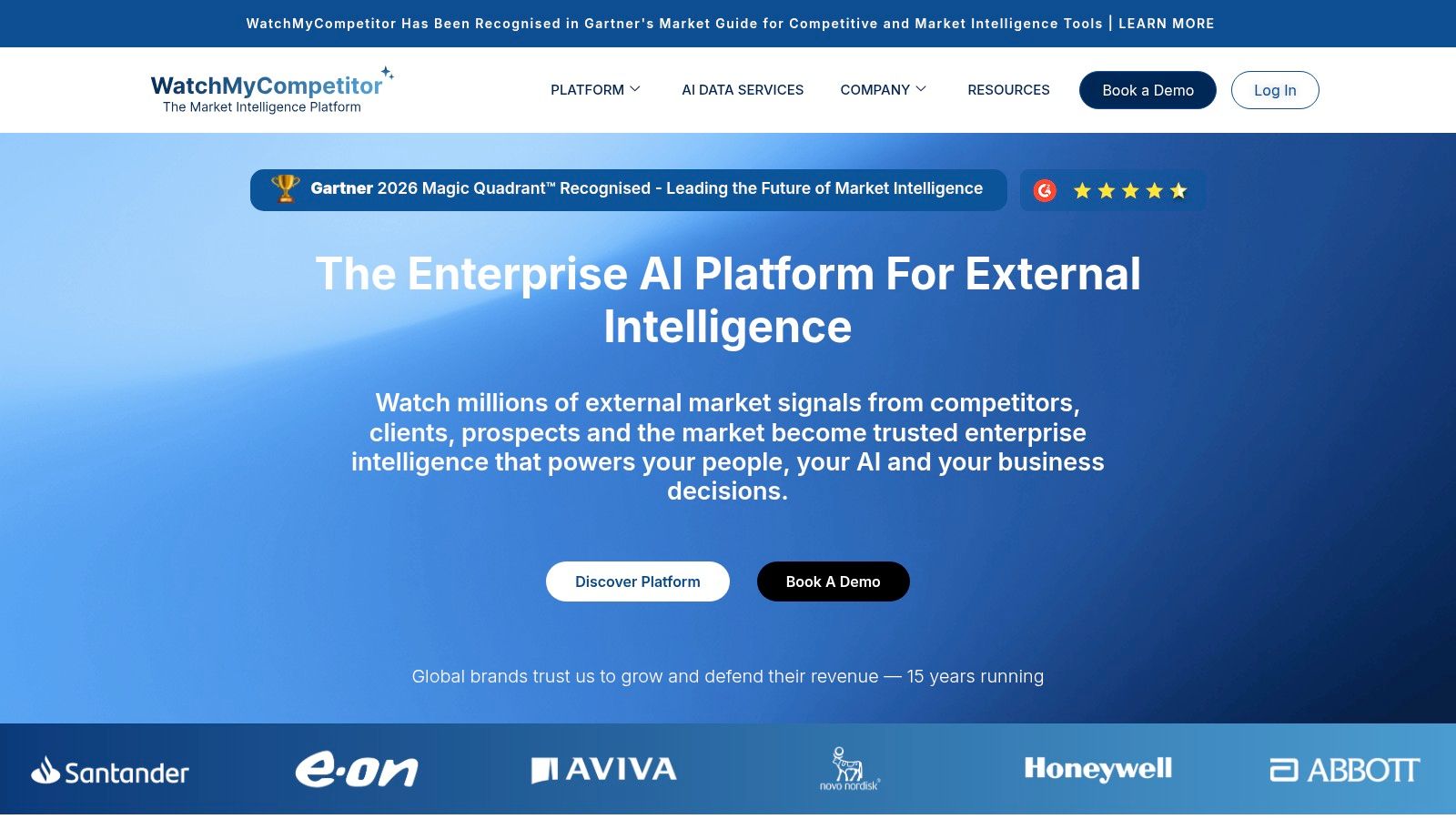
WatchMyCompetitor, often called WMC, focuses on continuous monitoring of competitor products, pricing, promotions, launches, events, and news. Its private intelligence layer is intended to turn changes into updates that decision-makers can use, rather than just presenting a long stream of raw page differences.
The platform also offers AI assistants grounded in validated intelligence, custom reporting, and alerts through email, Slack, and Teams. Optional managed analyst support gives teams a way to combine automation with human validation. That combination is relevant when a company wants continuous coverage but doesn't have the internal capacity to interpret every signal.
Assess the validation layer
The key evaluation question is how WMC distinguishes a meaningful competitive move from a routine update. Ask to see examples based on your own competitors, particularly for pricing, product packaging, promotions, and event activity. A useful alert should explain what changed, why it matters, and which team should decide what happens next.
Onboarding is demo-driven, and pricing isn't published publicly. The platform is generally aimed at mid-market and enterprise buyers, so implementation and managed support should be treated as part of the commercial decision. Clarify which services are included, who reviews the intelligence, and whether reports can be customized for product, sales, or executive audiences.
WMC is less focused on deep financial research and filings than AlphaSense. It therefore makes more sense for operational competitive monitoring than for investment-grade market analysis. Its strength is the combination of a continuous capture layer, a knowledge base, and optional human assistance.
Best fit: Product, pricing, strategy, and marketing teams that want curated competitor updates and may need external analyst support.
9. Owler Including Owler Max
Best for lower-lift company alerts and sales awareness
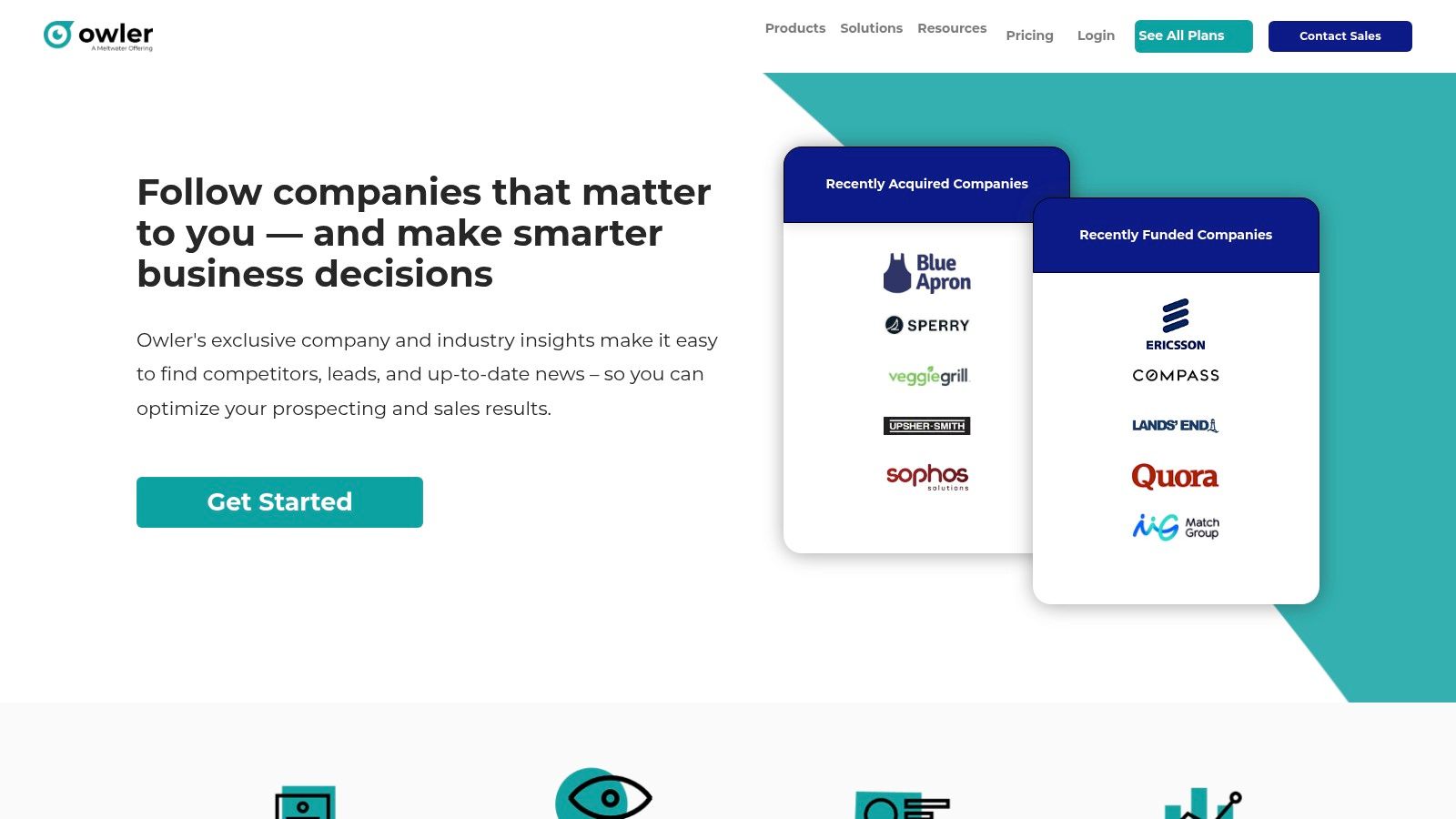
Owler takes a lighter approach to competitive intelligence. It provides company profiles, competitor lists, news alerts, funding and event signals, and daily snapshots that sales and marketing teams can use without building a formal compete program.
Owler Max extends the workflow into Salesforce, HubSpot, Slack, and Teams. That matters because the product's main value is timely awareness. A sales representative may not need a complete battlecard library to benefit from a relevant company update appearing inside an existing workflow.
Start with the decision, not the dashboard
Owler is useful when the team wants basic coverage quickly. The Community and Pro tiers provide an accessible entry point for company tracking, while the Max product is more relevant to teams that need alerts inside revenue and collaboration systems.
The trade-off is analytical depth. Owler isn't a full compete suite, so it won't provide the same battlecard management, win-loss workflows, or strategic research capabilities associated with Klue, Crayon, or AlphaSense. Pricing for Max and enterprise options isn't consistently published and may vary, which means buyers should request a quote tied to the number of users, integrations, and monitored companies.
A sensible evaluation is to define the company events that should trigger action. If the answer is funding, leadership movement, company news, or a relevant business event, Owler may cover the need with relatively little implementation. If the answer is “explain why the competitor changed its positioning and prepare a seller response,” a deeper platform is more appropriate.
Best fit: Sales and marketing teams that want fast setup, broad company coverage, and practical alerts without operating a full competitive enablement program.
10. Digimind
Best for social intelligence and public conversation analysis
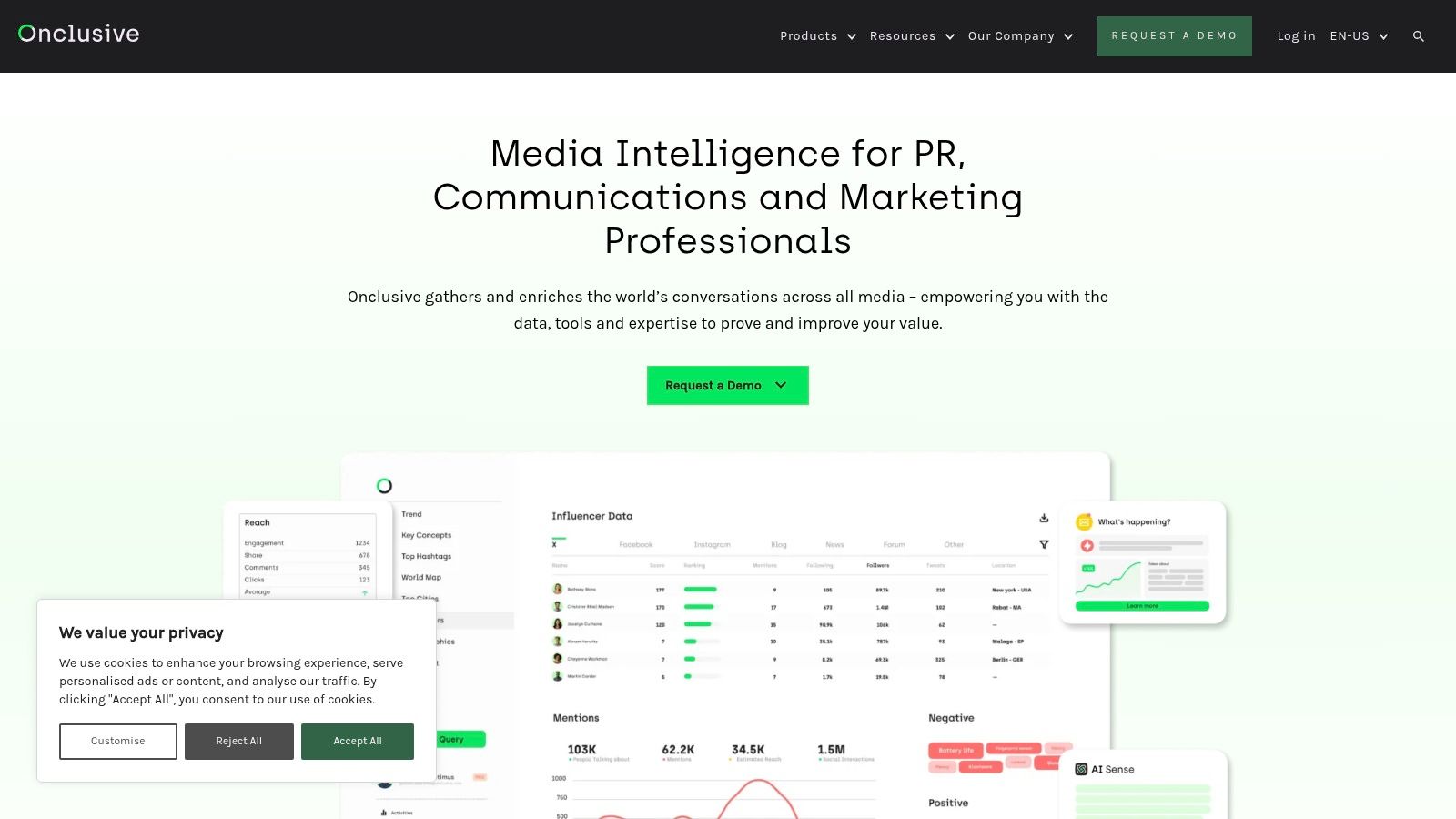
Digimind is centered on social listening, brand perception, campaign intelligence, and competitive monitoring across social and media environments. It suits teams whose competitive decisions depend on what customers, communities, journalists, and influencers are saying, not only on what competitors publish through their owned channels.
The platform supports competitive dashboards, alerting, reporting, mobile access for analysts, and AI-assisted analysis. Managed services and Data-as-a-Service options make it relevant to larger programs where social data needs to be collected, interpreted, and distributed across communications, marketing, and strategy teams.
Social coverage isn't the whole market picture
Digimind's strength is also its boundary. A social-centric platform can reveal perception, conversation themes, campaign response, and competitor visibility in public discussion. It may need to be paired with a web monitoring tool for detailed page changes or with a financial intelligence platform for filings and earnings research.
Pricing is custom and may be premium, while onboarding can take time because teams need to define topics, brands, competitors, markets, and reporting requirements. Buyers should test language coverage, source availability, historical access, sentiment interpretation, alert controls, and the workflow for escalating an emerging issue.
The most useful evaluation won't ask whether the platform finds mentions. It will ask whether communications and marketing teams can distinguish a meaningful shift in perception from a temporary spike in conversation. That distinction determines whether social intelligence informs positioning or merely generates reports.
Teams assessing AI competitor analysis tools should also clarify whether the analysis is grounded in social sources, web sources, AI assistant responses, or a combination. Different source types answer different competitive questions.
Best fit: Enterprise communications, public relations, brand, and social teams that need structured social intelligence and reporting.
Top 10 Competitive Intelligence Platforms, Quick Comparison
| Product | Core features | UX / Quality (★) | Value & Pricing (💰) | Target audience (👥) | Unique / Why choose (✨) |
|---|---|---|---|---|---|
| MyMentions 🏆 | Prompt-level AI visibility; source citation surfacing; live dashboard & alerts | ★★★★☆, daily prompt analyses, actionable backlog | 💰 Starter $49/mo; Pro $99/mo; Enterprise $199/mo; 7‑day trial | 👥 Founders, marketers, SEO teams | ✨ Source-level fixes + prioritized recommendation queue; 🏆 built for AI mention visibility |
| Crayon | Automated web intel; battlecards; revenue-stack integrations | ★★★★, mature enterprise workflows | 💰 Enterprise pricing (quote) | 👥 PMM, sales enablement, large GTM teams | ✨ Auto-refresh battlecards; deep sales integrations |
| Klue | Automated capture; living battlecards in CRM/Slack; win/loss analysis | ★★★★, strong in‑flow distribution | 💰 Quote-based; mid‑market/enterprise | 👥 Sales ops, enablement, PMM | ✨ Integrated win/loss + seller delivery |
| Kompyte (by Semrush) | Website & messaging monitoring; automatic battlecards; Semrush tie‑in | ★★★☆, fast time‑to‑value | 💰 Quote-based; depends on competitors/seats | 👥 Marketing & sales teams using Semrush | ✨ Tight Semrush ecosystem fit; quick operationalization |
| Contify | Broad source coverage; AI + human validation; configurable taxonomies | ★★★★, strong noise filtering | 💰 Enterprise pricing; 7‑day configured trial | 👥 CI teams, enterprises needing curated intel | ✨ Human‑in‑the‑loop validation; tailored trial setup |
| Similarweb | Clickstream traffic, market share, channel mix, SERP insights | ★★★★, robust historical & segment views | 💰 Modular packages; advanced datasets enterprise-priced | 👥 Growth, SEO, paid & product teams | ✨ Traffic & channel benchmarking; AI search impact tracking |
| AlphaSense | Generative/semantic search over filings, research, calls & news | ★★★★, research‑grade synthesis tools | 💰 Enterprise/quote; premium content access | 👥 Strategy, finance, market research teams | ✨ Deep premium content + AI summarization |
| WatchMyCompetitor (WMC) | Continuous competitor updates; AI assistants; optional analyst support | ★★★☆, demo‑driven onboarding, validated intel | 💰 Quote-based; mid‑market/enterprise | 👥 Product & competitive teams wanting managed support | ✨ Managed analyst services + decision‑ready alerts |
| Owler (incl. Owler Max) | Company profiles, news alerts, CRM integrations; community tier | ★★★, quick setup, basic insights | 💰 Free community tier; Pro/Max paid options | 👥 GTM teams needing low‑lift alerts | ✨ Budget-friendly entry; broad company coverage |
| Digimind | Social listening, brand perception, campaign intelligence & reporting | ★★★★, social‑centric insights & reporting | 💰 Enterprise pricing; managed services/Data‑as‑a‑Service | 👥 PR, communications, social & CX teams | ✨ Deep social data + managed analytics services |
Match the Platform to the Decision You Need to Make
There isn't a universal winner among competitive intelligence platforms because the category is fragmented by evidence source and workflow. One market estimate values the category at USD 5.78 billion in 2025 and projects USD 19.85 billion by 2035 at a 13.16% CAGR, while other estimates measure a much narrower software segment. The separate Mordor Intelligence market view helps explain why vendor comparisons can look inconsistent. Buyers aren't always comparing like with like.
The first decision is therefore not which vendor has the longest feature list. It's which external evidence should change an internal decision.
- AI visibility: Choose MyMentions if your team needs to know how AI assistants discover, rank, cite, and describe your product compared with competitors. Its value sits at the intersection of prompt research, citation analysis, visibility measurement, and prioritized SEO or content work.
- Sales enablement: Choose Crayon, Klue, or Kompyte when the outcome is a current battlecard, a seller alert, or competitive guidance inside the revenue workflow. Crayon and Klue are better suited to formal programs with dedicated ownership. Kompyte is more practical for teams seeking a focused route into web monitoring and enablement.
- Curated monitoring: Choose Contify or WatchMyCompetitor when raw alerts aren't enough and the team needs filtering, taxonomy, validation, or managed support. Contify is broader across market sources, while WMC emphasizes decision-ready competitor updates.
- Digital benchmarking: Choose Similarweb when the question concerns traffic, channel mix, search share, audience segments, or digital market movement. It should complement, not replace, a battlecard or market research system.
- Strategic research: Choose AlphaSense when filings, earnings content, expert calls, premium research, and market context matter more than daily operational changes.
- Lower-lift alerts: Choose Owler when company events and news updates are sufficient and the team wants quick setup with practical CRM and collaboration integrations.
- Social intelligence: Choose Digimind when public conversation, brand perception, campaigns, and social signals are central to competitive decisions.
Cloud delivery is now a defining characteristic of the category. One market report estimates that cloud deployment represented 67.8% of the market in 2025, while another describes more than 70% of new deployments as cloud-based. Precedence Research's competitive intelligence tools overview connects that shift with the need for low-friction onboarding, frequent refreshes, collaboration, and centralized reporting. The practical implication is simple: a platform that collects strong data but doesn't fit daily workflows may still fail.
Before signing, ask:
- Source coverage: Does the platform monitor the pages, providers, publications, social networks, filings, reviews, or AI systems that inform your decision?
- Alert quality: Can you tune relevance, prioritize competitors, suppress noise, and explain why an alert matters?
- Integrations: Will sales, product, marketing, strategy, and communications teams receive intelligence where they already work?
- Pricing model: Is pricing transparent, usage-based, seat-based, modular, or quote-only? What changes when your competitor scope expands?
- Implementation ownership: Who defines the taxonomy, validates alerts, maintains battlecards, and distributes findings?
- Export needs: Can you export reports, source records, prompts, battlecards, and historical intelligence in usable formats?
- Competitor scope: Are you tracking direct rivals only, or also substitutes, emerging entrants, partners, and category signals?
- Trial validation: Can you test the platform with your own prompts, competitors, sources, integrations, and decision workflows?
Real-time intelligence is useful only when someone can convert it into a decision. A practical real-time decision-making guide from SpecStory reinforces the broader principle, speed matters when teams have a defined action path, not when they receive more notifications.
Define the decision before purchasing. If the decision is how your product appears in AI answers, start with MyMentions. If it's how sellers respond to named competitors, evaluate Crayon, Klue, or Kompyte. If it's market direction, digital performance, company events, or public perception, choose the platform whose evidence matches that question. The right competitive intelligence platform is the one your team can trust, access, and use when the decision is still changeable.
MyMentions helps founders, marketers, and SEO teams track how AI assistants discover, rank, cite, and describe their products, then turns competitor gaps into prioritized work. Visit MyMentions to compare AI visibility across providers, inspect citation sources, and start a focused trial for your market.