Brand Sentiment Tracking: A Step-by-Step Setup Guide
Learn how to set up brand sentiment tracking across AI assistants and social channels, validate scores, and turn shifts into product and content fixes.

Your weekly deck shows a clean win: the product looks about 72% positive, and the room treats that number as proof the launch landed. The same week, an assistant answering “best tool for a 10-person support team” has stopped naming you, or it ranks you behind a rival with thinner reviews. Brand sentiment tracking only works when that polarity score is one signal among several, and when you refuse to ship a fix until the score survives a check.
Table of Contents
- Signals Behind Brand Sentiment Tracking
- Where AI Answers, Reviews and Social Posts Differ
- How to Set Up Brand Sentiment Tracking Step by Step
- Check Whether Your Sentiment Scores Deserve Trust
- Turn Sentiment Shifts Into Product and Content Fixes
- Confirm Your Baseline Before You Act
Signals Behind Brand Sentiment Tracking
A positive percentage is the direction of the language, not evidence that a buyer saw the answer, trusted it, or acted. In Nielsen's 2013 Global Trust in Advertising study, which surveyed respondents across 58 countries, 84% considered recommendations from friends and family the most trustworthy form of advertising, and 68% trusted consumer opinions posted online, a 7-percentage-point rise from 2007. Trust in branded websites reached 69%, up 9 percentage points from 2007. People weigh independent customers and public commentary more heavily than many owned-channel metrics, so a score built only on your own pages will flatter you.
Read the table across each row. No row settles a question by itself.
| Signal | What it measures | What it cannot tell you |
|---|---|---|
| Sentiment | How positive AI responses sound about your product | Whether buyers saw the answer or acted on it |
| Visibility | Share of tracked answers where your brand appears | Coverage of every AI search, only the prompts you selected |
| Position | Average rank when your brand is recommended | Whether the recommendation converts into visits or sales |
| Share of voice | Your mentions compared with tracked competitors | Why a competitor is mentioned more often |
| Citations | Source URLs returned with AI answers | Whether the cited page is accurate unless you review it |
| AI traffic | Visits from detectable AI sources | Mentions, signups, or purchases, which need your own analytics |
Sentiment can rise while visibility falls, which means fewer answers mention you and the ones that do sound warmer. Position can improve while citations still point at an outdated help page. Share of voice can climb because a rival had an outage, not because your product got better. Pair the row with a method for sentiment analysis in marketing so the percentage never travels alone.
Lock the brief before you collect
Finish this checklist before anyone pulls a feed.
- Name the signals. Write the six rows above into the brief, plus the competitor set you will use for share of voice.
- Name the provider and the collector. For each signal, list the channel it comes from and the tool that collects it. The tool must repeat prompts under fixed conditions and keep the query text and the collection date on every record.
- Fix the comparison period. Pick the start date, the end date, and the prior window you will compare against. A score with no period is not a trend.
Where AI Answers, Reviews and Social Posts Differ
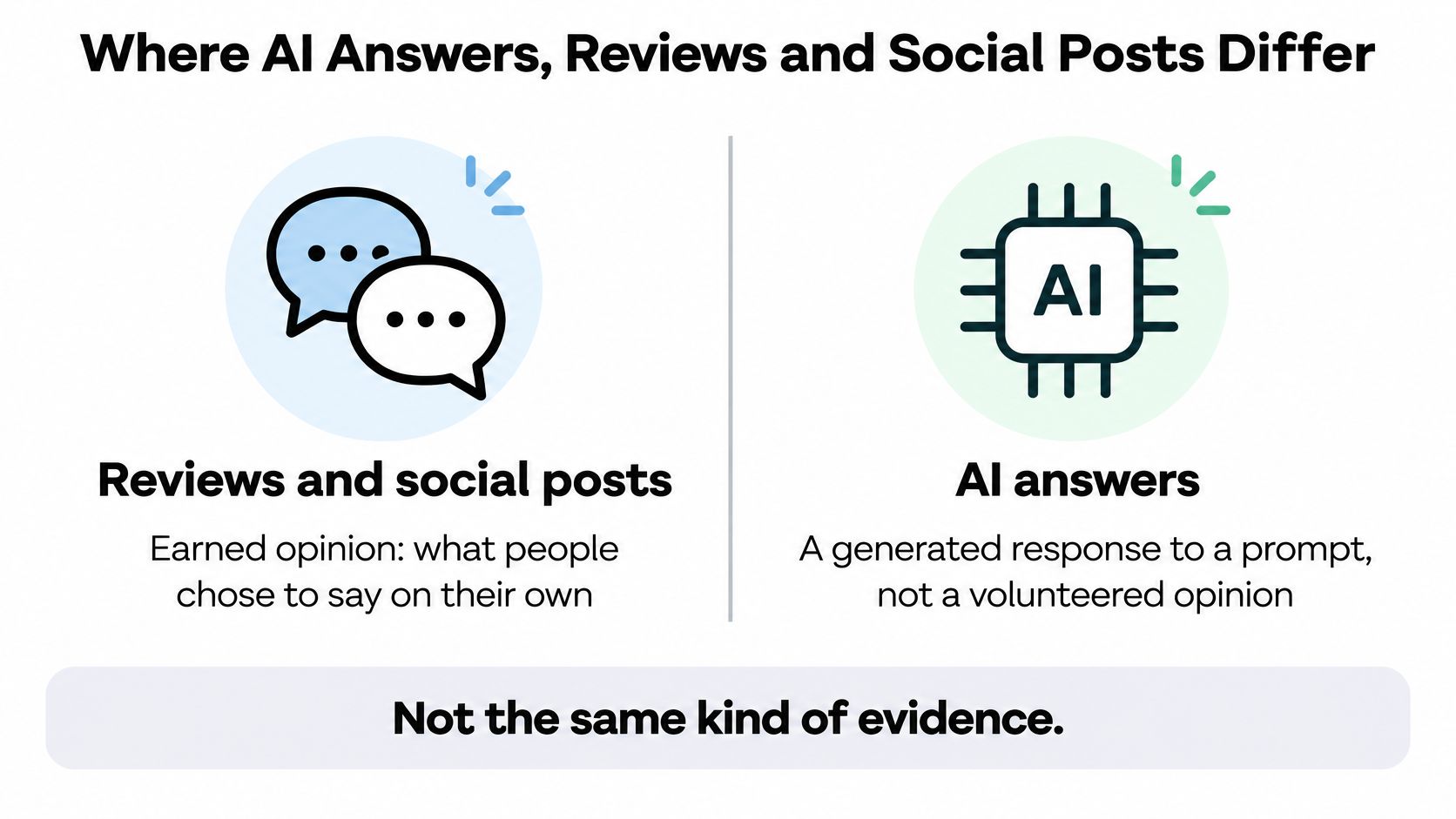
A crowd of reviews and an AI answer are not the same kind of evidence. Earned opinion is what people chose to say. An AI answer is a generated response to a prompt. In Nielsen's 2011 global trust research, more than 28,000 internet respondents in 56 countries were surveyed, and 92% trusted earned media such as word-of-mouth recommendations from friends and family more than any other advertising source, 18 percentage points higher than in 2007. Online consumer reviews ranked second at 70%, while only 36% considered advertisements on social networks credible and 47% trusted television advertising. Volume is not favorability, and paid exposure is not advocacy.
| Channel | What you capture | Main limitation | Scope note |
|---|---|---|---|
| AI assistant answers | Mentions, rank, and description from provider API checks | Not every consumer app experience is reproduced | Treat as a sample of prompts and providers |
| Google AI Overviews and AI Mode | Whether you appear, your rank, and the wording in a hand-run sample | Not tracked by provider checks | Sample manually with a fixed prompt set |
| Microsoft Copilot | Whether you are named, your rank, and the description in that same hand-run sample | Not tracked by provider checks | Sample manually with a fixed prompt set |
| Review sites | Ratings and written opinions | Volume depends on public activity | Weight by source and date |
| Social posts and forums | Unprompted commentary | Sarcasm, spam, and bots | Filter before scoring |
| AI-sourced visits to your site | Visits from detectable AI sources | Missing referrers and blocked scripts | Visits are not signups or purchases |
Provider API checks do not reproduce every consumer app experience, and they do not cover Google AI Overviews, Google AI Mode, or Microsoft Copilot. Until those surfaces are in a tracker, run the same prompt list by hand, save the date, and label the sample as manual. AI-sourced visits need the tracking script on your site. It records visits classified from detectable AI sources, the landing page, and engagement. Missing referrers, blocked scripts, and source classification leave holes, so a quiet traffic line can mean a measurement gap rather than a quiet brand.
A practical split for how to track AI visibility is to keep human social sentiment and AI-answer sentiment on separate lines. Never average them into one number. Strip sponsored posts and paid placements out of the volume before you report it. A high mention count after a boosted post is visibility you bought, not a shift in what customers think.
Social conversation is still worth collecting. In 2024, 48% of consumers in the United States, Canada, the United Kingdom, Ireland, and Australia said they interacted with brands on social media more often than before, in Sprout Social's survey of 4,400 consumers. That activity is unprompted talk. It is not a substitute for the answer an assistant writes when a buyer asks which product to pick.
The short walkthrough below shows how those two evidence types get mixed up in a live dashboard, and why the split has to happen before the weekly report.
Practical rule: If you cannot say whether a line is earned opinion or a generated answer, do not publish the line.
How to Set Up Brand Sentiment Tracking Step by Step
Honest numbers come from a fixed order. Skip a step and a later “improvement” may only be a cleaner query or a noisier channel.
Write the brief, then the prompts
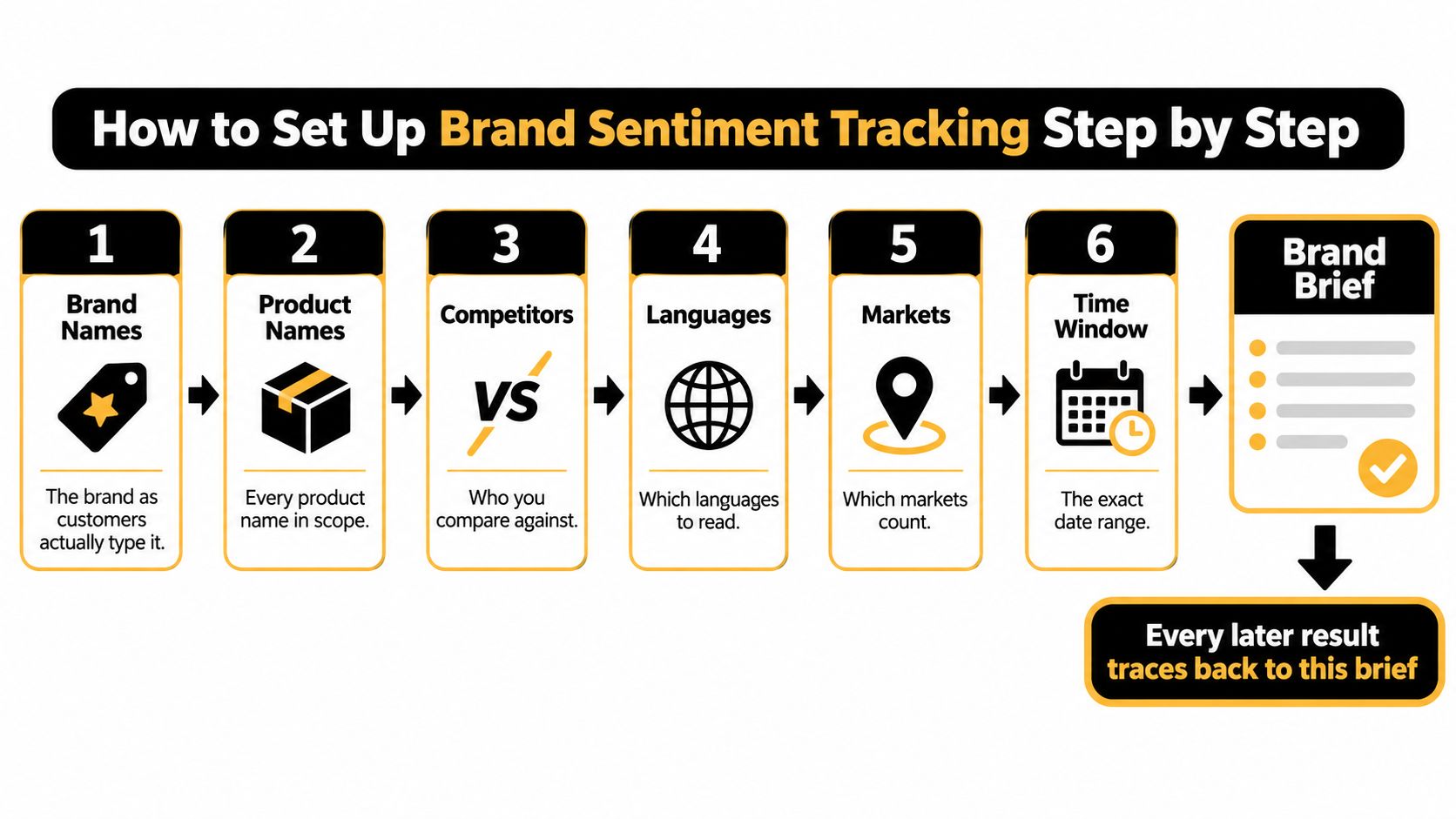
- Define the scope in one written brief. Name the brand as customers type it, the product names, the competitors, the languages, the markets, and the time window. Every later chart should trace back to that page, so a new analyst can see what was in and what was out.
- Build buyer-intent prompts and repeat them. Use the questions a prospect would ask an assistant, such as which tool fits a stated job. In one workspace we track how assistants mention, rank, and describe the product across those prompts, alongside visibility, position, sentiment, competitors, citations, recommendations, and AI-driven traffic. Repeat each prompt under the same conditions, or a model update will look like a brand change.
- Collect with reproducible queries. Pull posts, reviews, and answers with queries you can rerun. Save the query text and the collection date on every record. A free sentiment analyzer is fine for a first pass on a saved export. It is not a substitute for the saved query.
Clean the sample before you trust a label
- Deduplicate and normalize before scoring. Remove spam, keep emojis (they often carry the tone), and normalize URLs and usernames. Scoring duplicates lets one angry thread vote five times.
- Stratify by platform, language, date, and topic. A busy forum should not drown a quieter review site. Do not weight a high-volume platform or a highly active user unless you have written a reason. Set any alert threshold from historical variance on that slice, not from a round number you like.
- Label a human benchmark. One published brand-opinion method, described in a pipeline paper on defensible sentiment measurement, sampled 3,000 records from 37,234 valid comments and used three independent annotators with majority voting. Measure agreement with Cohen's kappa or Krippendorff's alpha so you can see how much of the match is chance.
- Score the classifier by class. Report precision, recall, and F1 for each class, plus a confusion matrix. A test-set win is not population truth. The same discussion notes that one automobile-brand study called its social sample quota-based and non-probability, and that TweetNLP reached 84% accuracy on a balanced binary test set, which is not a guaranteed 84% on your market, platform, or topic.
- Report the trend with a sample count and a confidence interval. Do not ship a single polarity score. Track sentiment separately by source and by intent. Pair each trend with mention volume, topic, source authority, and confidence, or a small viral complaint will read like a broad change in customer opinion.
The first report should show the period, the sample size, and the classifier version. A later reader needs those three fields to tell a real movement from a tooling change.
Check Whether Your Sentiment Scores Deserve Trust
Say a Monday alert claims negative sentiment jumped. You open the underlying posts and find one angry thread, quoted, screenshotted, and replied to until the counter looks like a market shift. That is the failure mode that makes brand sentiment tracking dangerous if you alert on the percentage alone.
Four things break labels. Context is missing when a short post never says what failed. Sarcasm flips the words, as in “great, another outage,” which a model scores as praise until a reviewer labels a sample of similar posts and the class flips. Multilingual variation and code-switching trip models trained on one language. Domain shift means a model fit on one platform or product category degrades on another. A review of sentiment methods treats sarcasm, spelling variation, weak non-English resources, and a lack of standardization as recurring problems, and notes that short posts often omit the cues irony needs.
Run the review loop before you publish
Route low-confidence, negated, ironic, code-switched, and high-impact mentions to a person. Keep a separate validation slice for each platform, market, language, and product category. Relabel a fresh sample on a schedule so drift shows up as drift. Compare automated labels with the newest adjudicated set before you publish a trend change.
Prefer macro-F1 beside accuracy. A sea of neutral or positive posts inflates accuracy while the negative class, the one you act on, stays weak. Vendor scorecards will not rescue you. A review of public vendor disclosures) found that published accuracy claims are generally not comparable, because vendors use different metrics, datasets, languages, and methods, and that a widely cited multi-vendor comparison measured agreement between tools rather than whether any tool was correct. The same review pooled 195 trials from 20 Twitter studies and estimated 0.80 accuracy, with a 95% confidence interval of 0.76–0.84. That interval is a benchmark for one kind of public post, not a promise for your language or your industry. For a closer look at sentiment analysis with AI, treat any headline accuracy as a starting question, then test it on your own labeled slice.
A visibility score only describes the responses collected for the selected prompts, providers, and reporting period. It is not every AI search.
| Check | Pass condition | If it fails |
|---|---|---|
| Mention volume | Minimum count met for the period | Hold as a watch item |
| Statistical change | Non-overlapping bootstrap intervals, or an adjusted two-proportion test | Do not alert |
| Class balance | Macro-F1 reported beside accuracy | Relabel the benchmark |
| Cross-market comparison | Same annotation policy, language treatment, and sampling frame | Compare within each market only |
| Label traceability | Original text and model version stored for each label | Flag the trend as a possible classifier change |
Never compare raw sentiment percentages across markets unless annotation policy, language treatment, sampling frame, and class definitions match. Keep the original text and the model version on every label, or you cannot tell a brand movement from a query change, a classifier update, a platform-mix shift, or a moderation change.
Turn Sentiment Shifts Into Product and Content Fixes
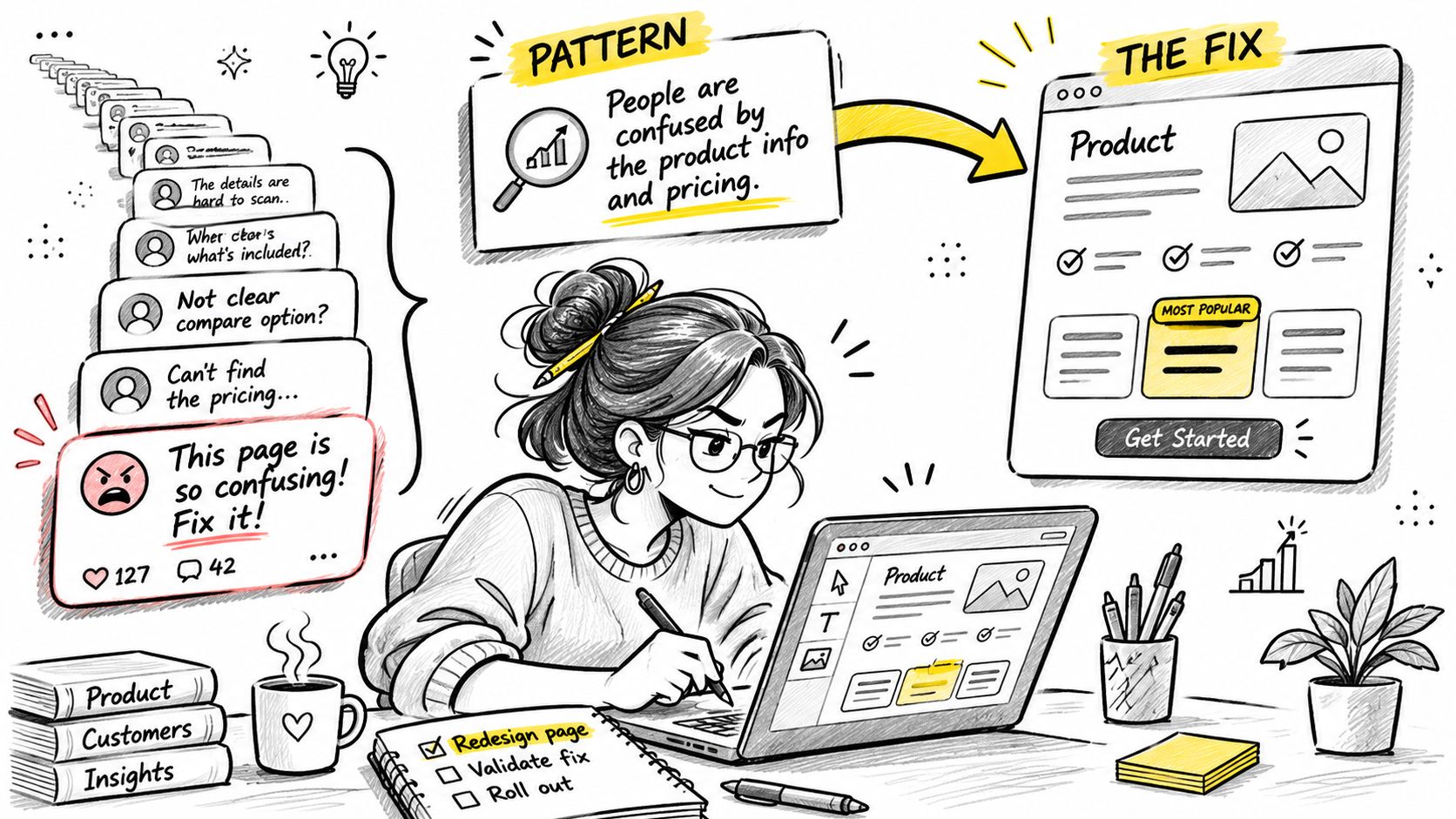
The expensive mistake is rewriting a product page because sentiment dipped, then discovering the dip was one complaint thread. A shift is actionable only after the pattern matches a cause. In a 2025 survey of 1,200 marketing leaders, fewer than half rated their social team expert at measuring business impact, and more than half cited incompatibility between social tools and the wider marketing stack as the leading barrier, alongside unreliable attribution and limited internal expertise. A polarity move that never touches traffic or conversion is a conversation, not a business result.
Read the pattern, then pick the fix
- Sentiment falls while visibility holds. The answers still mention you, and they sound worse. Read the reviews, the support threads, and the claims on the product page. Fix the specific complaint in the docs or in the product. A blanket rewrite hides the sentence buyers are reacting to.
- Visibility falls while position holds. When you do appear, your rank is stable, and you appear less often. Check whether the prompt list or the provider mix changed before you blame the page. A dropped prompt is a measurement change.
- Citations point at stale help pages or partner listings. Assistants quote what they can retrieve. Update those URLs first. A fresh homepage will not outrank a cited article that still describes last year's pricing.
- AI traffic rises and signups do not. An AI visit is separate from a mention, a signup, or a purchase. Completed conversions belong in your analytics or billing system. Inspect the landing page and the path after the click. Use product discovery techniques to see which prompt brought the visit, then judge the page against that intent.
Site audit scores are diagnostic suggestions. They are not AI ranking factors. Chase the signal the evidence points at, not the audit number.
Give each fix an owner
Trust owns reviews, claims, and third-party listings. Content owns pages, FAQs, and the passages assistants are likely to quote. UX owns the landing path from an AI visit to a signup. Technical owns crawlability and the tracking script, so a missing visit is not mistaken for a missing customer. One owner per category stops the same dip from spawning four competing projects.
Confirm Your Baseline Before You Act
Run one baseline for one product line before you expand. I would start there even if leadership wants every SKU in the first month. A wide first cut mixes languages, prompts, and products until no shift is interpretable.
Pick a short list of buyer prompts that cover the core purchase questions, including which tool to choose for a stated need. Run each prompt across the AI providers your buyers use, repeat it under the same conditions, and save the collection date. Pair that baseline with one business metric, qualified traffic or conversion from AI-sourced visits, so the team can see whether a sentiment or visibility move matters.
The Starter plan costs $49 per month and is built for an individual product starting AI search tracking. It includes 25 provider checks per day, data updated daily, tracking of 3 AI providers, AI traffic analytics, root cause analysis, and PDF reports. That cap is a reason to keep the first prompt list small, not a reason to skip the human benchmark.
Confirm all four points before anyone edits a page.
- Definitions are written. Brand, competitors, and markets are defined.
- A human-labeled benchmark exists for your main language.
- Each trend carries a sample count and a confidence interval.
- The classifier version is logged with every label.
Set a 30-day review date. Ship a content or product change only when the shift passes every check in the escalation table. The first number I would watch is visibility on your core prompts, read next to sentiment, so you know whether the next test is a coverage problem or a wording problem.
MyMentions tracks how AI assistants mention, rank, and describe your product, and it keeps sentiment next to visibility, citations, and AI-sourced visits so you can validate a score before a fix ships. Start with one product line, a fixed prompt list, and a baseline you can defend. Visit MyMentions to set that baseline up.