
One dashboard can't answer every brand visibility question. A social listening platform may catch public conversations, while a media monitoring system finds news and broadcast coverage. Visual monitoring identifies logos and products inside images or video. PR measurement focuses on earned coverage and share of voice, customer-care workflows route mentions to people who can respond, and AI visibility tracking measures how assistants describe your brand in buyer-intent answers.
That distinction matters because brand monitoring tools increasingly serve different operational layers. A 2022 global survey of more than 650 professionals found that almost 61% of businesses had a social listening system, while more than 82% viewed social listening as strategically important (Social Media Today's survey summary). Yet mature programs rarely rely on one source. Research cited by Mordor Intelligence found that more than 80% of surveyed social-listening professionals used multiple tools.
The comparison below separates source coverage, workflow fit, analytical depth, cost considerations, alert quality, collaboration, and implementation effort. Founders may need a lightweight alerting layer, PR teams may prioritize news and broadcast, agencies may need reporting and seats, while global organizations may justify governance-heavy enterprise platforms. There isn't one universal winner. The right choice depends on which conversations influence decisions and how quickly your team can act on them.
Table of Contents
- 1. Brandwatch Consumer Intelligence
- 2. Talkwalker
- 3. Meltwater
- 4. Sprinklr Social Listening
- 5. Sprout Social Listening
- 6. Mention
- 7. Brand24
- 8. Awario
- 9. YouScan
- 10. Determ
- Top 10 Brand Monitoring Tools, Feature Comparison
- Build the Monitoring Stack Your Team Can Use
1. Brandwatch Consumer Intelligence
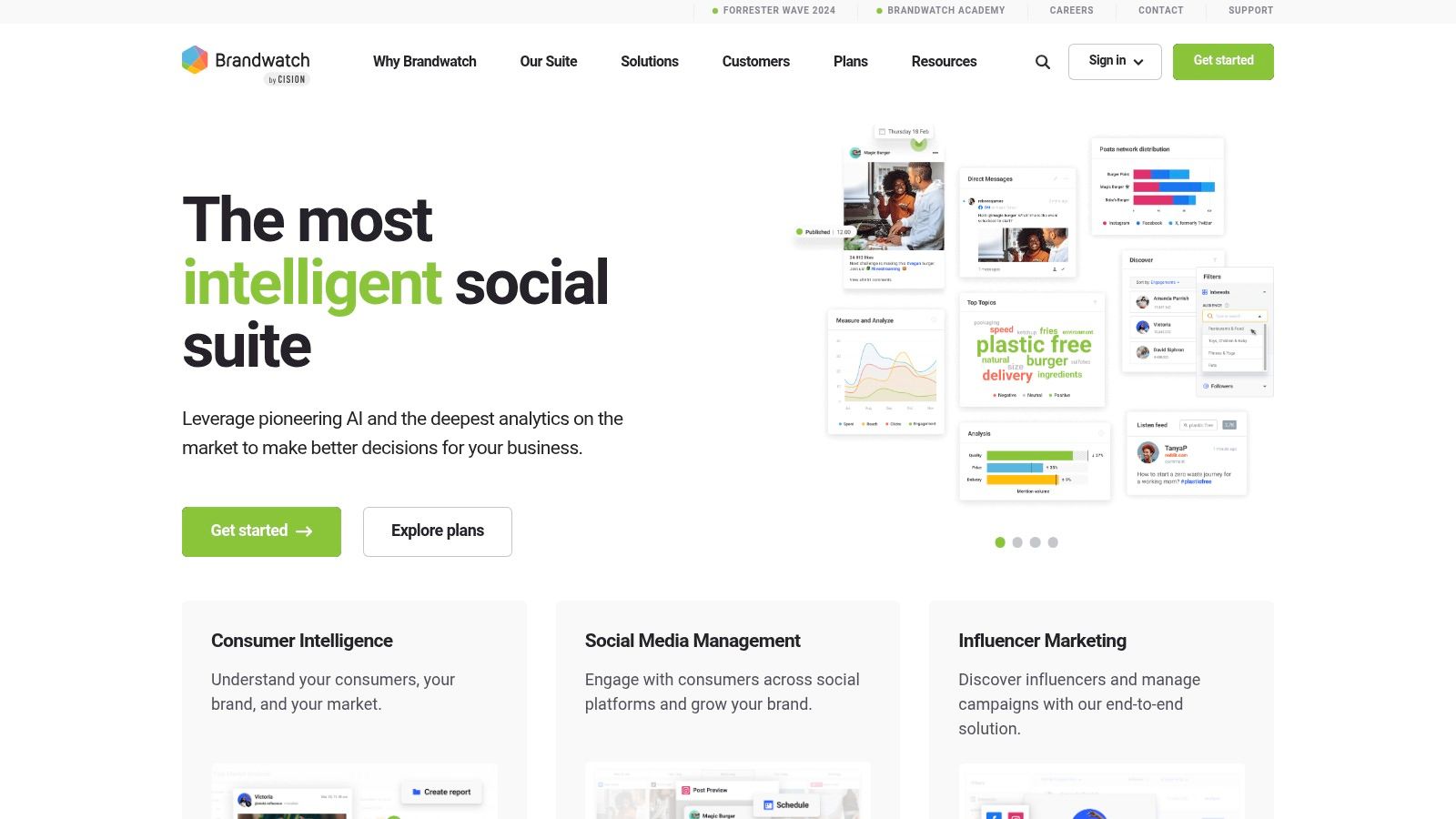
Brandwatch Consumer Intelligence is built for organizations that need research-grade social and consumer intelligence across markets. Its coverage spans major social networks, forums, and news, with historical depth that supports campaign analysis, recurring reporting, and comparisons between current conversations and earlier periods.
Where Brandwatch fits
The platform's AI-assisted query building can reduce the work involved in constructing complex searches, but teams still need to understand Boolean logic, exclusions, entity ambiguity, and brand-name collisions. Sentiment, themes, audience attributes, dashboards, exports, and collaboration features make it suitable for insights teams that turn monitoring data into executive or market research reports.
Brandwatch is a strong candidate when historical context and governance matter as much as real-time alerts. A global brand can use it to compare markets, investigate a reputation event, and give research stakeholders controlled access to the same evidence.
Practical rule: Don't judge an enterprise listening platform by the number of mentions it collects. Test whether analysts can explain why a result belongs in a query and reproduce the analysis later.
The trade-off is commitment. Pricing is custom, and the interface can require onboarding before teams build reliable queries. Smaller marketing teams may pay for analytical breadth they won't use. Before requesting a quote, define the markets, languages, source types, archive requirements, seats, exports, and reporting cadence. For background on the underlying discipline, see what brand monitoring means in practice.
2. Talkwalker
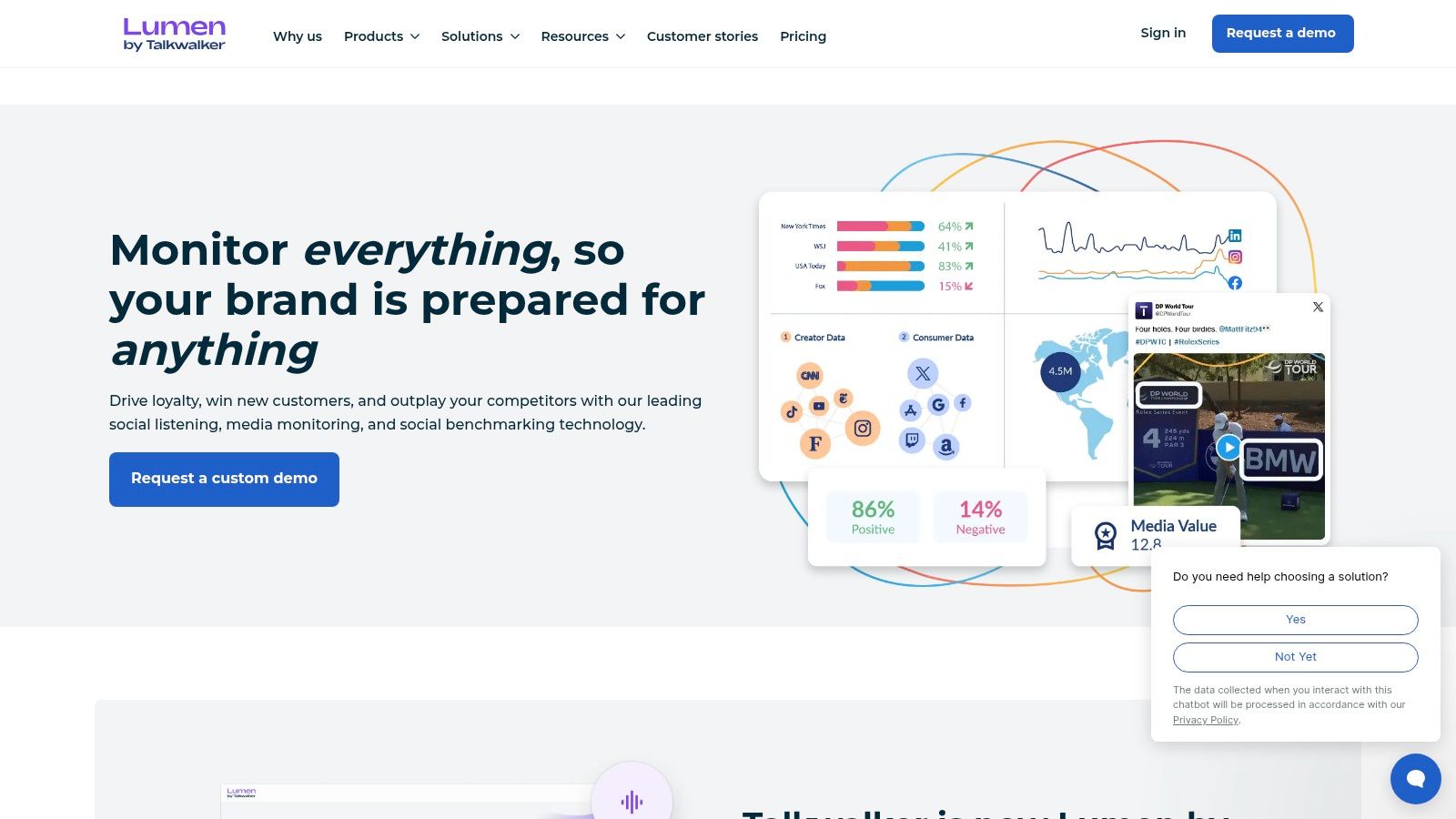
Talkwalker suits enterprise teams that need real-time listening combined with visual recognition. It monitors social, web, and news conversations, then adds image, logo, and video analysis for cases where people show a product without naming it in text.
Beyond text mentions
Visual listening changes the question from “Who wrote our brand name?” to “Where does our brand appear?” That distinction matters for consumer products, sponsorships, retail environments, packaging, and user-generated video. Talkwalker's anomaly and trend capabilities can help teams identify unusual changes in conversation, while audience analytics and API access support broader reporting systems.
The platform's strength is therefore not source volume alone. It combines social and media signals with visual evidence, which makes it a better fit for brands whose visibility exists in photos and video as much as in posts.
A smaller team may find that breadth excessive. Enterprise pricing isn't public, and implementation can involve more stakeholders than a basic monitoring rollout. Marketing teams already using another publishing or engagement platform should compare the value of visual recognition against the cost of adding a specialist layer.
Use Talkwalker when a missed logo in a video could matter as much as a missed written mention. If your priority is understanding how AI assistants describe your products, that requires a separate measurement question, explained in this guide to tracking brand mentions in AI.
3. Meltwater
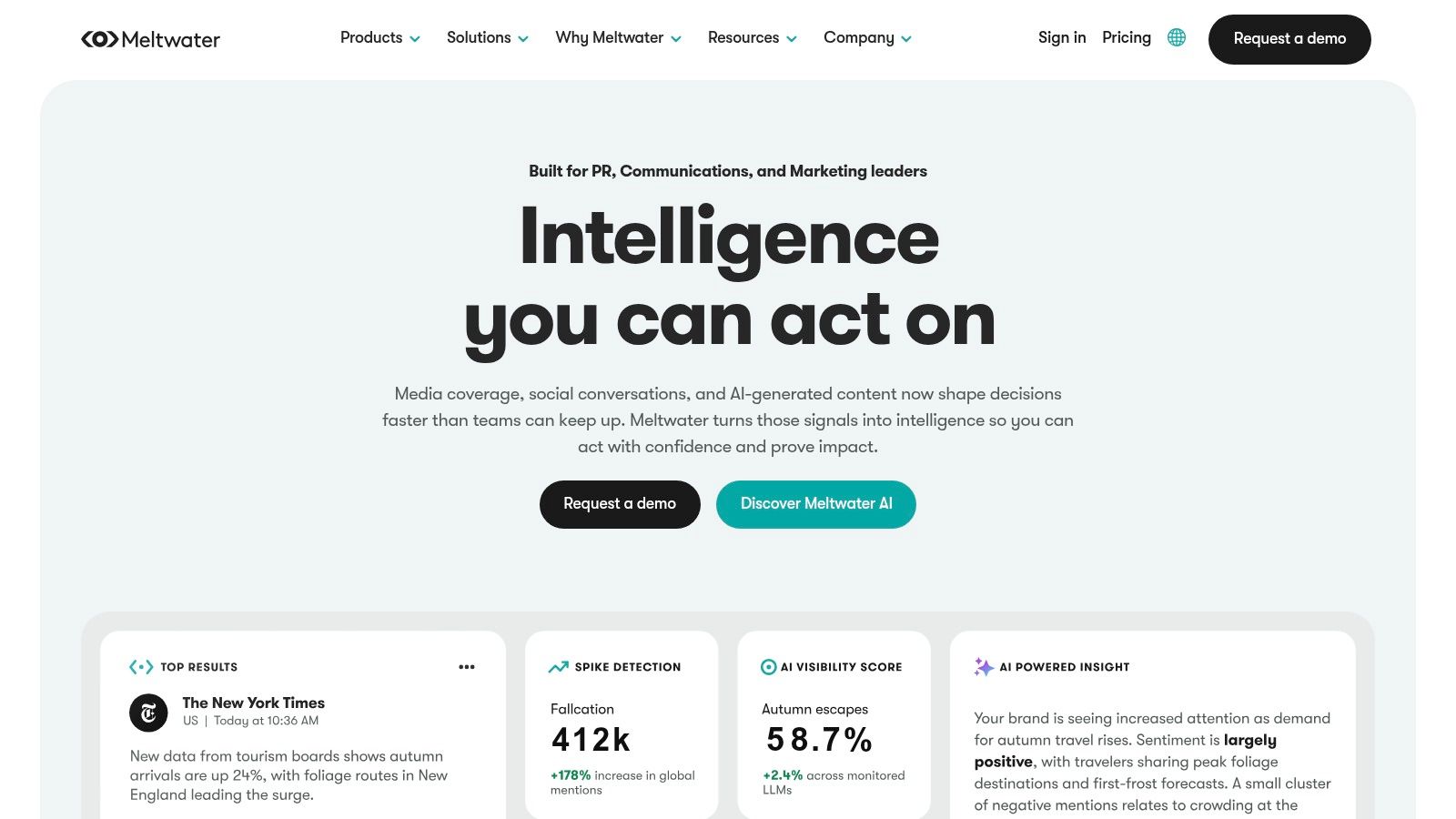
Meltwater is a logical shortlist option for PR and communications teams that need traditional media and social listening in one environment. Its monitoring scope includes news, social, and broadcast, with alerts, earned media dashboards, share-of-voice reporting, influencer discovery, and integrations for enterprise workflows.
A PR-first operating model
Meltwater's main advantage is workflow continuity. A communications team can monitor coverage, identify influential voices, prepare stakeholder reporting, and assess the relationship between earned media and broader conversation without stitching together several separate systems.
That makes it different from a social-first product. If the team's central question is “How are people discussing our product in online communities?”, another tool may offer better specialist depth. If the question is “What did journalists, broadcasters, social audiences, and influencers say about this launch?”, Meltwater's cross-channel orientation is more relevant.
The modular structure deserves close attention during procurement. Custom packaging can make the total cost depend heavily on the media types, analytics, influencer functions, seats, and integrations included in the agreement.
Ask before buying: Which sources are included in the quoted package, which require additional modules, and can your team export the underlying evidence rather than only presentation-ready charts?
Meltwater works best when PR owns the monitoring program and needs reports for executives or clients. It's less compelling when a product, support, or SEO team needs a narrow alerting system with minimal setup. Teams comparing it with other intelligence platforms should also consider how competitive intelligence platforms support broader market decisions.
4. Sprinklr Social Listening
Sprinklr Social Listening is listening inside a broader customer experience suite. It's designed for large organizations that want to connect social monitoring with publishing, engagement, customer care, advertising, governance, compliance, and business intelligence.
Best when monitoring ends in a workflow
Sprinklr's differentiator is operational handoff. A negative customer mention can move toward care, a regulated issue can follow a governed escalation path, and social data can feed dashboards used by multiple departments. AI classification and sentiment help organize large volumes, while security and governance controls matter to organizations with strict access requirements.
This also creates the central limitation. A marketing-only team may not need an omnichannel CX system. The platform's breadth can introduce more configuration, procurement complexity, and training than a focused listening tool.
Sprinklr's value depends on whether the organization is consolidating systems. If customer care already operates in Sprinklr, adding listening may reduce fragmentation. If the team only needs competitor mentions and campaign reporting, a lighter platform may produce a faster return.
Evaluate it through a routing test rather than a dashboard demonstration:
- Classification quality: Can it distinguish customers, prospects, employees, and unrelated conversations?
- Escalation control: Can severe or sensitive mentions reach the right team without flooding everyone else?
- Governance: Can administrators manage access, approvals, auditability, and compliance requirements?
- Integration depth: Can useful signals reach the CRM, BI environment, or collaboration tools already in use?
Pricing is custom and generally positioned for larger deployments, so compare the cost of consolidation with the cost of maintaining separate listening, care, and governance tools.
5. Sprout Social Listening
Sprout Social is primarily a social management platform with Listening available as an add-on. That makes it especially practical for marketing teams already using Sprout for publishing, engagement, reporting, and day-to-day community management.
The workflow advantage
Sprout's appeal is familiarity. Teams can connect topic and brand listening with existing social analytics and operational routines rather than introducing an entirely separate research interface. Real-time dashboards, trends, sentiment, and competitor monitoring support routine brand-health reviews and campaign checks.
The limitation is equally clear. Listening adds cost on top of per-seat plans, and specialist enterprise suites generally offer deeper historical analysis and more complex research workflows. Teams monitoring forums, niche communities, or media beyond mainstream social networks should validate coverage with actual brand queries before choosing convenience.
Sprout is a good fit when the decision is really about extending an existing social workflow. It's a weaker fit when the team needs broad media intelligence, advanced consumer research, visual recognition, or a carefully governed enterprise archive.
A sensible trial should include:
- Brand terms with common-word ambiguity, to measure irrelevant results.
- Competitor terms, to test comparison and share-of-voice workflows.
- Customer-care language, to see whether urgent issues can be routed.
- Historical questions, to determine whether the available archive supports the reporting period you need.
The best reason to select Sprout isn't that it replaces every monitoring layer. It's that it can reduce friction for a social team that already works there. If the add-on still leaves PR, care, and AI visibility in separate systems, treat it as one component of the stack.
6. Mention
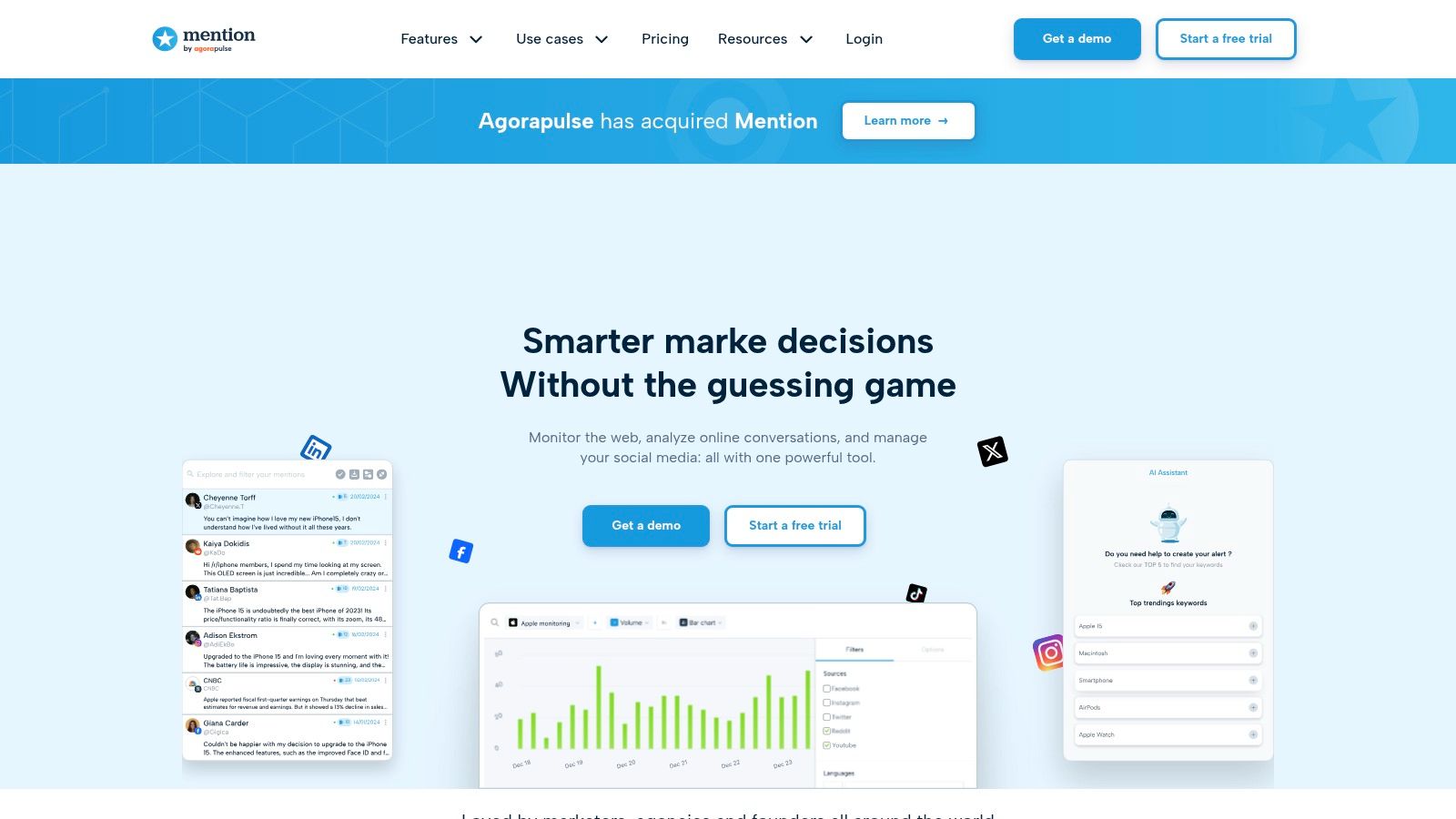
Mention targets SMB and mid-market teams that want web and social monitoring without the implementation burden associated with large enterprise suites. It tracks brand and competitor keywords, provides alerts and scheduled digests, and supports basic sentiment, share-of-voice reporting, collaboration, and stakeholder summaries.
Simple monitoring with clear boundaries
Mention's value lies in accessibility. A communications or marketing team can create searches, receive alerts, review mentions, and produce reports without building a research program first. That's useful for organizations moving beyond manual checking of search results and social feeds.
It isn't designed to replace a consumer intelligence function. Teams needing deep historical research, extensive custom taxonomies, complex audience analysis, or advanced data science workflows should compare it with enterprise platforms.
Alert limits and plan quotas also shape the experience. A low-cost plan can work well for a small set of brand, product, and competitor queries, but a growing monitoring program may need more capacity as it adds markets, languages, exclusions, and stakeholders.
A useful test: Give the same query set to the tool and to a human reviewer. Compare relevance, missed mentions, sentiment errors, and the time required to turn an alert into an assigned action.
Mention is most suitable when the team needs straightforward web and social visibility, not a full customer intelligence operating system. It can serve as a focused first layer, while media, visual, review, or AI monitoring gets added only when the organization has a decision that justifies it.
7. Brand24
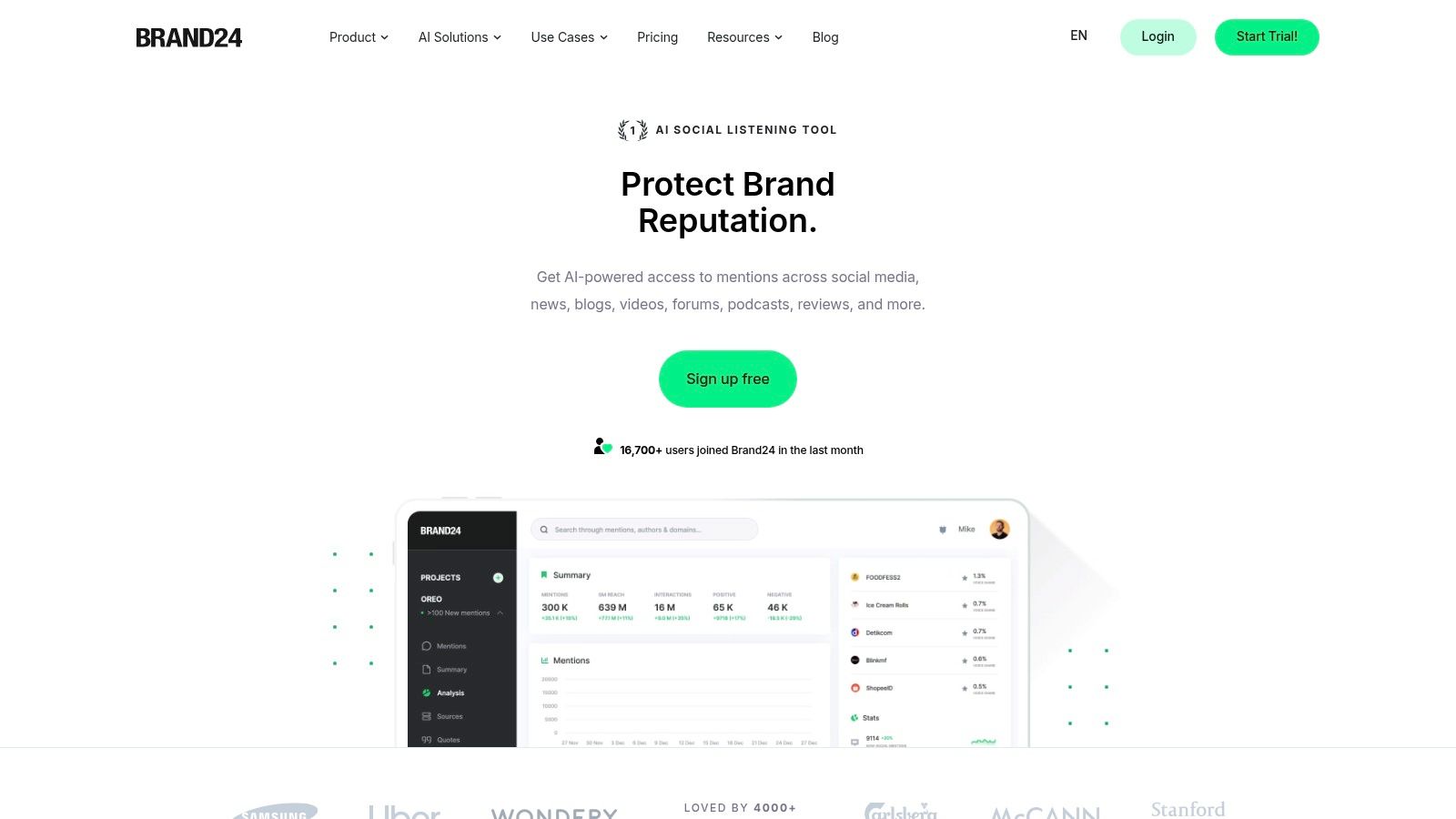
Brand24 is built for startups, agencies, and smaller marketing teams that need practical monitoring across social media, web sources, forums, podcasts, and video. Its feature set combines alerts, sentiment, influence indicators, share-of-voice views, competitor tracking, trends, and PDF or CSV exports.
A useful starting layer for agencies
Brand24's strongest use case is fast deployment. An agency can create a project for a client, monitor brand and competitor terms, and produce a client-facing summary without building a complex analyst workflow. Transparent published pricing also makes initial evaluation easier than a sales-led enterprise process.
The trade-off is depth. Teams conducting long-term research, complicated market segmentation, or custom historical analysis may find the archive and query controls less flexible than those in enterprise platforms. Seat and keyword limits can also become important as agencies add clients or internal departments.
Sentiment should be treated as an organizing signal, not a final verdict. Technical summaries report that production sentiment classification on noisy social data is commonly closer to 82% to 88%, despite curated benchmark results above 94% (technical discussion of brand reputation monitoring). Sarcasm, slang, multilingual posts, mixed opinions, bots, and ambiguous references all require human review.
For teams using sentiment in client reporting, this explanation of sentiment analysis in marketing provides useful context. Brand24 is a good fit when speed, alerts, and shareable summaries matter more than research-grade customization.
8. Awario
Awario is a budget-oriented option for teams that want social and web mention tracking with Boolean query support, sentiment, basic influencer metrics, email or Slack alerts, and scheduled reports.
Lightweight coverage without a long rollout
Awario's quick setup makes sense for a founder, small marketing team, or SEO practitioner who needs immediate visibility into brand, product, and competitor terms. Boolean search support gives users more control than a simple exact-match alert, especially when a brand name overlaps with a common word or unrelated entity.
The platform is less suited to teams that need extensive integrations, advanced audience research, visual recognition, or a large historical archive. Its analytics are intentionally lighter, which keeps the operating model understandable but limits the depth of strategic analysis.
That balance can be an advantage. A small company doesn't benefit from paying for governance features, custom dashboards, and analyst tooling that nobody uses. It does benefit from receiving a relevant alert in Slack or email and having enough context to decide whether the mention needs a response.
Before rollout, test:
- Query exclusions: Remove unrelated uses of the brand term.
- Alert timing: Confirm whether the update cadence matches the risk of the issue.
- Source relevance: Check the communities and websites that matter to buyers.
- Reporting effort: Measure how much manual cleanup is needed before sharing results.
Awario fits a focused monitoring brief. It doesn't need to be the foundation of an enterprise intelligence architecture to be useful.
9. YouScan
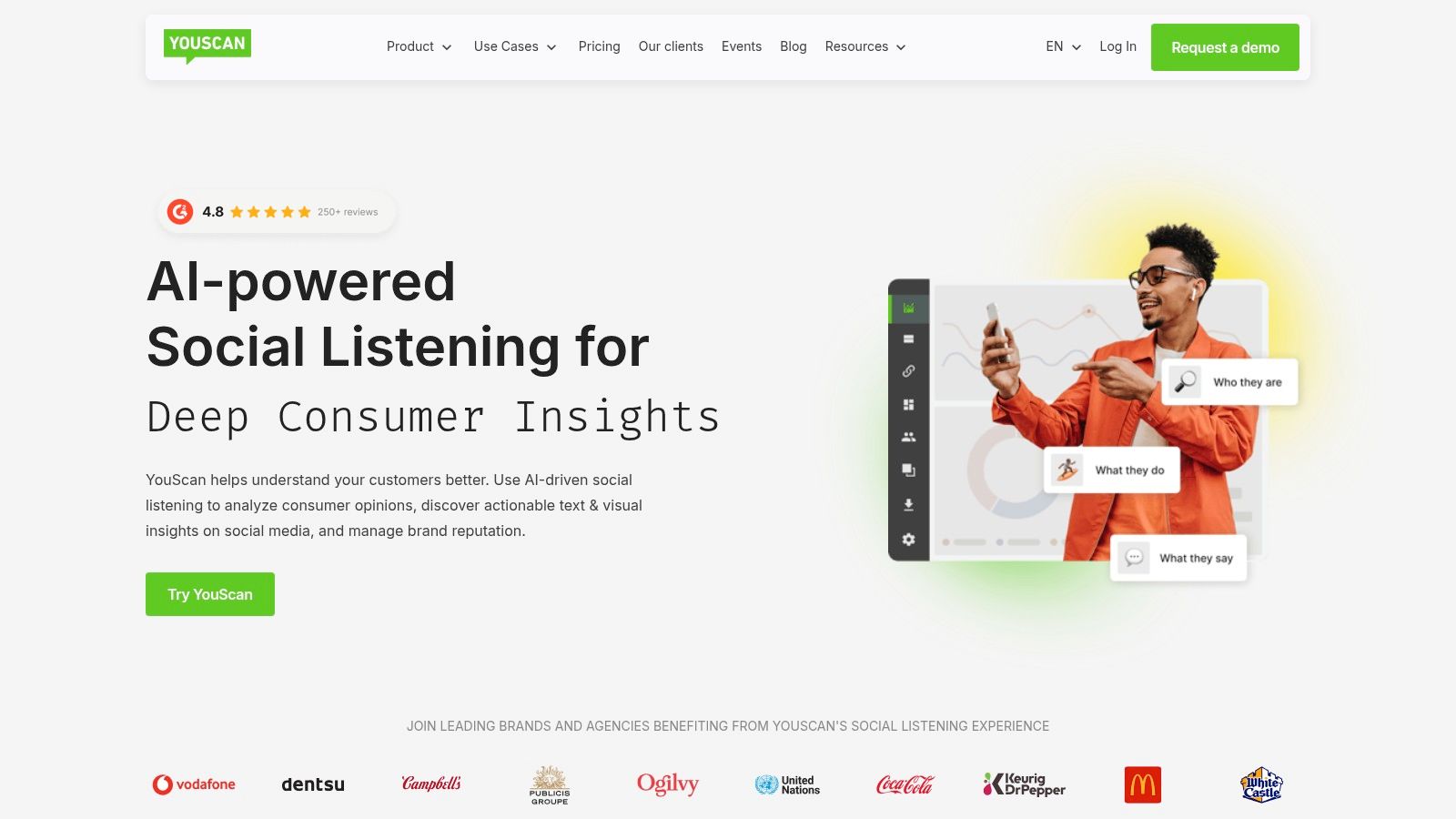
YouScan focuses on consumer brands where images can reveal more than captions. It combines text listening with image and logo recognition, visual analytics, audience attributes, sentiment analysis, and an Insights Copilot for conversational exploration.
When the logo matters more than the caption
Text can show that people discussed a product. Visual recognition can show how the product appears in real settings, whether packaging is displayed correctly, which logos appear alongside it, and how customers use it without naming the brand.
That source layer suits food, fashion, beauty, hospitality, retail, and consumer electronics teams. The Copilot can surface conversation patterns through natural-language questions, although analysts should review the underlying posts before treating an inferred theme as a business conclusion.
YouScan's main constraint is coverage. Its emphasis on social sources means teams with substantial news or broadcast requirements may need another monitoring layer. Pricing may also place the platform outside the reach of smaller teams.
Don't confuse visual coverage with representative coverage. Public posts reflect only part of customer behavior, while private conversations remain outside conventional listening systems, as discussed in Merciv's analysis of social listening limits. Visual volume is therefore directional evidence, not a market-share measure.
YouScan works best as a visual layer within a broader stack. Teams should pair it with media monitoring when earned coverage matters, and assess AI brand monitoring separately when they need to understand how generative systems describe a brand. The right choice depends on source priorities, workflow integration, and whether visual context affects decisions.
10. Determ
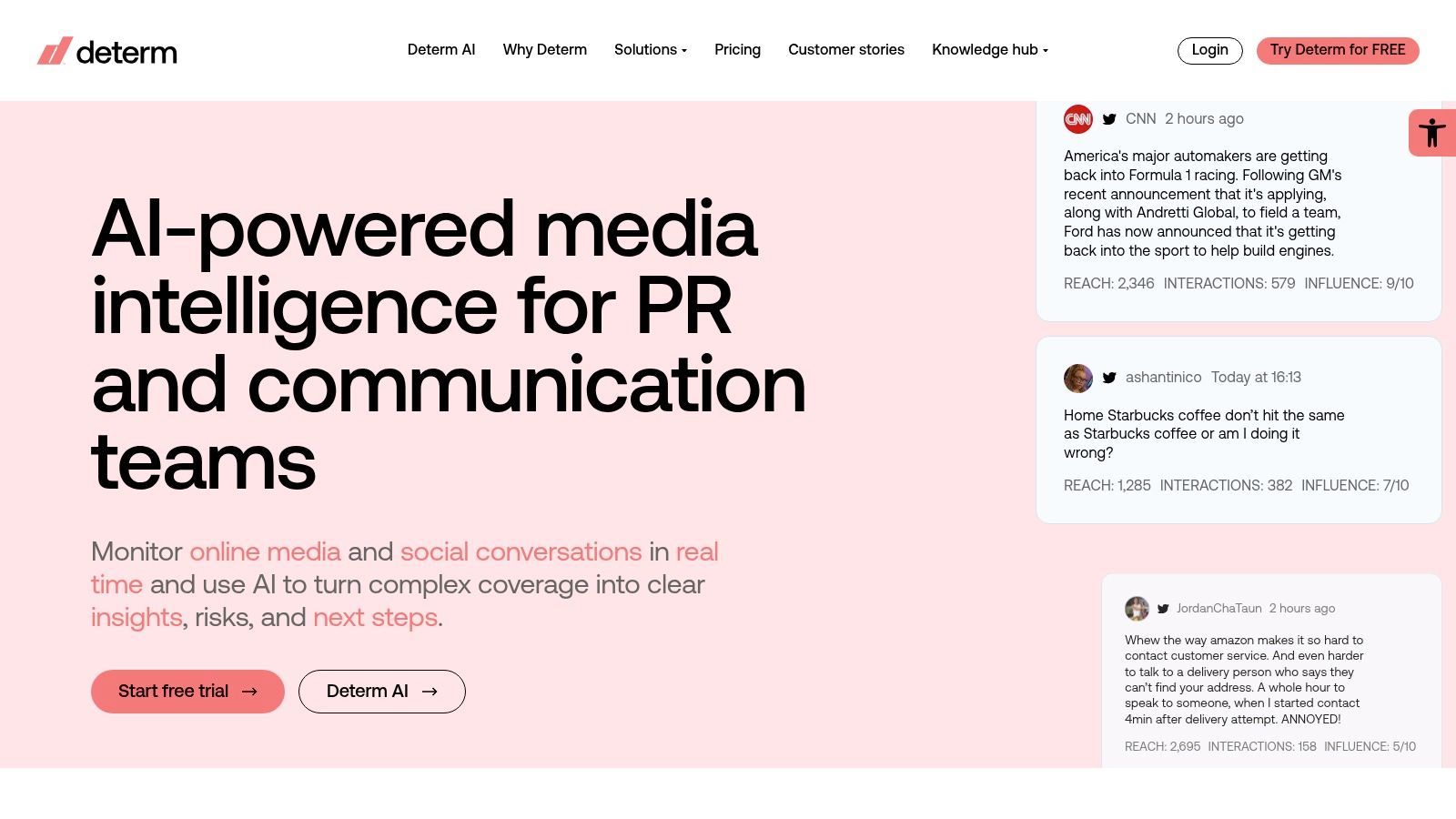
Determ, formerly Mediatoolkit, combines web, social, and traditional media monitoring with PR-oriented dashboards, sentiment, share-of-voice reporting, branded reports, and real-time alerts. Its positioning can appeal to agencies and organizations that want to add users across multiple teams without making every seat a separate cost decision.
A middle path for media intelligence
Determ sits between lightweight alerting products and legacy enterprise suites. It can support teams that need news, blogs, forums, podcasts, social sources, and selected traditional media in one reporting environment, without immediately committing to the complexity of a large consumer intelligence program.
Historical access and regional media coverage need careful validation. The available archive and traditional media options can depend on the scope of the agreement, so buyers should test the exact countries, publications, languages, and source types that matter.
The platform's unlimited-seat approach may be useful for agencies, communications departments, and cross-functional programs. More users can review the same reports or receive relevant alerts without forcing the organization to restrict access to a small analyst group.
Determ is a reasonable fit when the priority is PR-ready monitoring across several media types, especially for a mid-market team. It may be less suitable for visual-first brands, advanced customer-care routing, or AI assistant visibility. Ask for a live demonstration using your own brand name, competitor terms, crisis phrases, and regional publications rather than relying on a generic dashboard.
Top 10 Brand Monitoring Tools, Feature Comparison
| Product | Core features ✨ | Target audience 👥 | Pricing / Value 💰 | Quality ★ | Standout 🏆 |
|---|---|---|---|---|---|
| Brandwatch Consumer Intelligence | Broad social, forum & news coverage; AI query + sentiment; deep historical data ✨ | Global enterprises & research teams 👥 | Custom / premium 💰 | ★★★★☆ | Archive depth & governance 🏆 |
| Talkwalker | Real-time listening, image & video recognition, anomaly detection ✨ | Enterprises needing visual & rapid alerts 👥 | Custom / enterprise 💰 | ★★★★☆ | Visual analytics & trend detection 🏆 |
| Meltwater | News, broadcast & social monitoring; influencer discovery; PR workflows ✨ | PR & comms teams across channels 👥 | Modular (can add up) 💰 | ★★★★☆ | Unified earned-media + PR ops 🏆 |
| Sprinklr Social Listening | Global social listening with AI classification; CX workflows & compliance ✨ | Large orgs consolidating CX & social 👥 | Enterprise / high 💰 | ★★★★☆ | Omnichannel CX governance 🏆 |
| Sprout Social (Listening add‑on) | Topic/brand listening + real-time trends integrated with Sprout ✨ | Marketing teams already on Sprout 👥 | Add-on on per-seat plans 💰 | ★★★☆☆ | Fast path to value for Sprout users 🏆 |
| Mention | Keyword & brand monitoring, sentiment, alerts, simple reports ✨ | SMB & mid‑market teams 👥 | SMB‑friendly tiers 💰 | ★★★☆☆ | Easy setup & straightforward reporting 🏆 |
| Brand24 | Real-time web & social monitoring, alerts, share‑of‑voice, exports ✨ | Startups & agencies needing client reports 👥 | Transparent & good value 💰 | ★★★★☆ | Client-ready summaries & quick setup 🏆 |
| Awario | Social & web mention tracking, Boolean queries, alerts & reports ✨ | Small teams & budget-conscious brands 👥 | Affordable / clear quotas 💰 | ★★★☆☆ | Low-cost continuous monitoring 🏆 |
| YouScan | Image/logo recognition + text listening; Insights Copilot & APIs ✨ | Consumer brands focused on visual UGC 👥 | Quoted / enterprise-tier 💰 | ★★★★☆ | Best-in-class visual analytics 🏆 |
| Determ (formerly Mediatoolkit) | Real-time monitoring, PR dashboards, historical archive options ✨ | Agencies & scaling teams (unlimited seats) 👥 | Competitive / transparent 💰 | ★★★★☆ | Unlimited-seat packaging & PR-ready dashboards 🏆 |
Build the Monitoring Stack Your Team Can Use
The most reliable selection process starts before the vendor shortlist. Define the sources that influence your decisions, the markets and languages you need, the competitors worth tracking, the alert thresholds that require human action, the audiences for reporting, the history needed for comparisons, the number of seats, and the exports or integrations your team already depends on.
Then separate the monitoring layers. Traditional social listening helps teams understand public conversation, themes, and sentiment. Media monitoring supports PR coverage and earned-media reporting. Visual monitoring matters when logos, packaging, products, or scenes appear without written brand references. Customer-care workflows turn mentions into assigned cases. AI visibility monitoring measures whether assistants discover, cite, rank, and describe a product in response to buyer-intent prompts.
That last layer deserves separate treatment because public conversation and AI answers are not interchangeable. A brand can generate social discussion while remaining absent from the sources that shape an assistant's response. Conversely, an assistant may describe a company using product documentation, reviews, partner pages, or help content that traditional listening tools don't evaluate.
A lightweight tool is enough when the team has a narrow set of brand and competitor terms, limited markets, low operational risk, and a clear owner for reviewing alerts. Awario, Mention, Brand24, or a similar platform can provide a practical starting layer. Choose an enterprise suite when multiple departments need governed access, analysts require historical depth, PR needs traditional media, or customer-care and compliance workflows must connect to monitoring.
Buy for the decision, not the dashboard. A sophisticated interface has little value if the team can't identify relevant signals, assign an owner, and record what happened next.
Run a pilot using real buyer-intent queries, known brand terms, competitor terms, ambiguous terms, and escalation phrases. Review false positives, missed mentions, sentiment errors, alert latency, export quality, and whether the people responsible for action use the system. One buyer guide argues that real-world monitoring accuracy can fall to 60% to 75%, while another identifies 85% as a practical minimum for some use cases (Fullintel's buyer guide). Those figures shouldn't become universal acceptance criteria. They show why every organization should test its own data and distinguish detection accuracy from sentiment accuracy.
The pilot should also document blind spots. Industry analysis reports that approximately 45% of third-party listening tools lost data access between 2022 and 2024 as major platforms restricted APIs (Merciv's research). Source availability can change, so procurement should include access limitations, sampling changes, geography, language coverage, private-channel blind spots, and data retention terms.
For reputation and customer sentiment, require precision and recall by alert type, language, market, and severity. Human review should remain part of the process for low-confidence, safety-related, crisis, cancellation, security, and misinformation mentions. The best stack isn't the one with the most automation. It's the one that gives people enough evidence to act without creating a stream of alerts they stop trusting.
Use Bragly to manage testimonials when customer proof is part of the broader reputation workflow. If AI discovery is a priority, MyMentions can provide a separate visibility layer that tracks prompts, position, sentiment, citations, and competitor presence across supported AI assistants, with alerts through Slack, Discord, or email. That data can sit beside social and media monitoring rather than being mistaken for a replacement.
MyMentions helps founders, marketers, and SEO teams track how AI assistants discover, rank, cite, and describe their products across buyer-intent prompts. Visit MyMentions to compare AI visibility with competitors, identify the sources shaping answers, and turn visibility changes into a prioritized improvement backlog.