Nielsen's analysis of Canadian digital advertising campaigns found that 37% of measured campaign ads failed to generate any lift in brand awareness, favorability, or purchase intent among exposed consumers. The same analysis found that three out of four campaigns built for awareness did move awareness, while campaigns aimed at favorability and purchase intent lifted those outcomes less often, at 59% and 38%, according to Nielsen's look at whether reaching the audience makes a campaign resonate.
A brand awareness strategy that only buys impressions can look busy and still fail the memory test. For SaaS, I would keep three signals apart: what people remember, how machines describe you, and what buyers do next. Fold them into one score and you will either double-count the same person or celebrate a mention that never became a visit.
Table of Contents
- Awareness Metrics to Set Before You Launch
- Channel Mix That Builds Trusted Awareness
- Split the Budget Between Short-Term and Long-Term Awareness
- Reach and Frequency Targets for Priority Segments
- Measure Brand Lift with a Repeatable Survey
- Track AI Visibility Next to Traditional Awareness
- Build the Strategy and Lock the Baseline
Awareness Metrics to Set Before You Launch
In 2025, 48% of North American marketers surveyed by Nielsen's 2025 Annual Marketing Report ranked brand awareness as a top marketing priority. The goal is common. The scorecard behind it usually isn't. Lock one metric per layer before you spend, or later movement has nothing honest to compare against.
| Layer | Metric | What it proves | How to measure |
|---|---|---|---|
| Memory | Unaided recall | People name your brand before seeing a list | Open-text survey question asked first |
| Memory | Aided recognition | People recognize your brand from a list | Randomized list with competitors and decoy brands |
| Representation | AI mention rate | Share of tracked buyer prompts where your brand appears | Prompt tracking across AI providers |
| Representation | AI position | Average rank when your brand is recommended | Rank within tracked answers |
| Demand | Branded search volume | People look for your brand by name | Search console and analytics trends |
| Action | Visits from AI sources | Traffic separate from mentions, signups, or purchases | Tracking script plus analytics |
Why the layers stay separate
Memory is whether a category buyer can name you, then recognize you. Unaided recall is the harder number. Aided recognition only tells you the name is familiar once it is on a page.
Representation is a different object. Visibility is the share of tracked answers where your brand appears. Position is the average rank when your brand is recommended. A visibility score describes the prompts, providers, and period you chose. It does not describe every AI search on the internet.
Demand and action sit downstream of both. Branded search shows people hunting for the name. A visit from an AI source is still only a visit. Signups and purchases have to come from your analytics or billing system, not from the mention log.
Practical rule: Pick one metric per layer as the baseline, write the number down, and refuse to launch until that sheet exists.
I would not average recall, mention rate, and visits into a single “awareness index.” They move on different clocks, and a gain in one can hide a drop in another.
Channel Mix That Builds Trusted Awareness
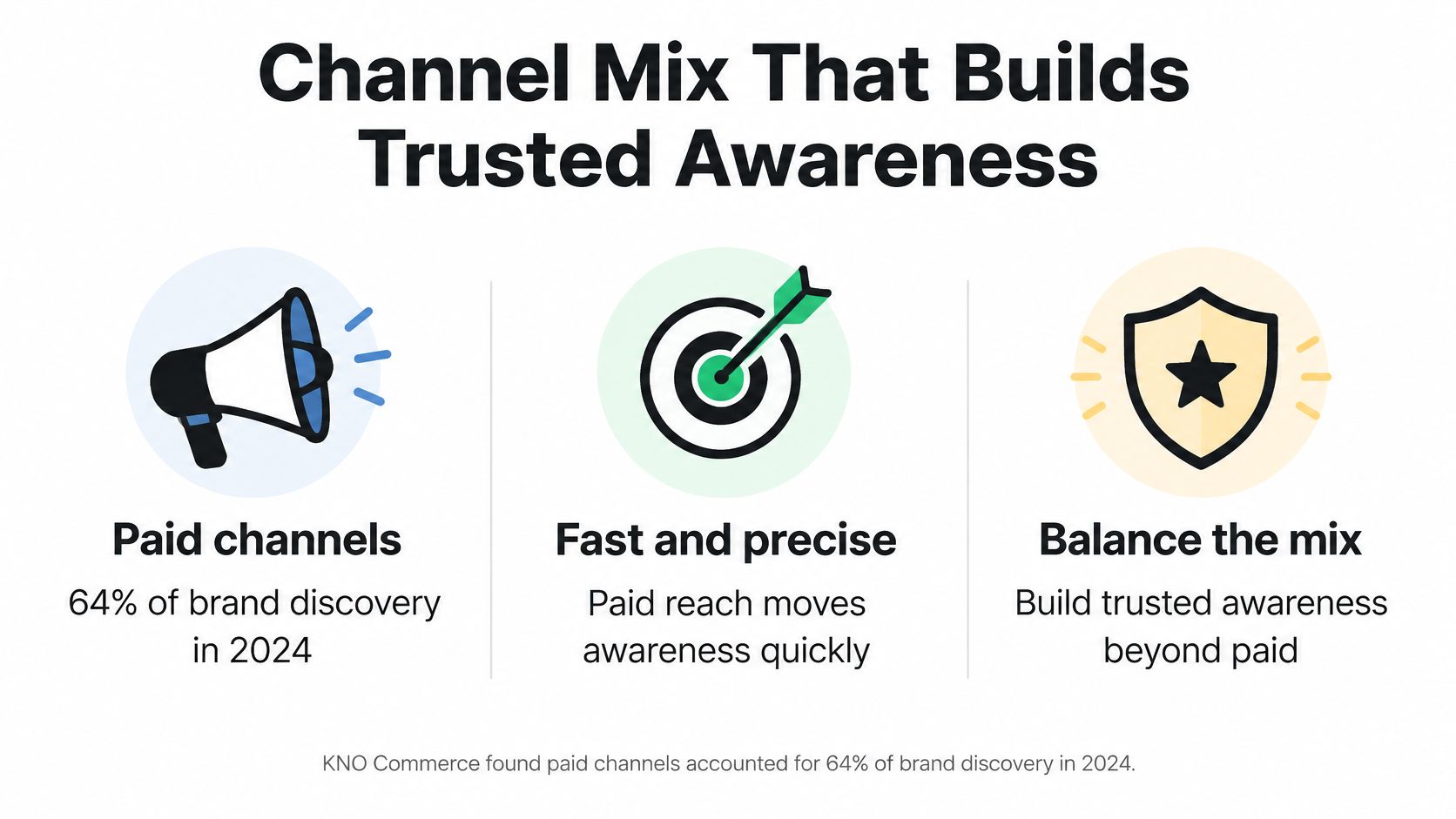
Paid still does most of the first introduction. In 2024, paid channels accounted for 64% of brand discovery among 17.9 million respondents analyzed by KNO Commerce's brand discovery research. Paid reach is fast and precise. People also discount what they read as an ad. Earned signals move slower and carry more weight when a buyer is choosing between tools that look alike.
That trust gap is old and stubborn. Nielsen's 2012 Global Trust in Advertising survey, covering more than 28,000 internet respondents in 56 countries, found that 92% of consumers trusted earned media, especially word-of-mouth from friends and family, more than any other advertising format. Online consumer reviews ranked second, trusted by 70%.
| Channel | Best for | Trust signal | Main risk |
|---|---|---|---|
| Customer reviews and review sites | Consideration and proof | High, third-party validation | Thin or outdated profiles |
| Community and peer recommendations | Early adopter reach | High, peer-driven | Slow to start and hard to scale |
| Paid search and social | Fast reach in priority segments | Medium, seen as advertising | Frequency concentration and quick decay |
| Authoritative educational content | Category association and search presence | Medium, earns repeat visits | Long lead time before results |
| Partner and integration pages | Reach inside existing ecosystems | Medium, borrowed credibility | Depends on partner control |
| Product docs and help content | Accurate facts for AI answers | Medium, factual source | Left unmaintained and out of date |
Lean on the job, not a fixed percentage
Use paid search and paid social when a priority segment has almost no memory of you and you need reach inside a set window. Use reviews, communities, and peers when the gap is trust, not coverage. Use docs, help centers, and partner pages when the gap is a wrong or missing description that both buyers and answer engines can cite.
I would not copy someone else's media mix. Split by the hole you found. If founders already search your name but review profiles are thin, more paid social will not fix consideration. If nobody in the category can recall you, a perfect help center will not create that first memory on its own.
Teams that buy social reach still need a clean read on whether those impressions became memory. FindClout's guide to awareness measurement for paid social buyers is a useful companion when you are separating ad exposure from real recognition. Pair that with share of voice so paid volume is not mistaken for category presence.
The common failure is spending the whole budget on paid, watching impressions climb, and then wondering why unaided recall barely moves. Paid introduces the name. Reviews, peers, content, and docs are what make the name believable the second time someone meets it.
Split the Budget Between Short-Term and Long-Term Awareness
Decide the split before the next campaign dollar goes out. Short-term activation, paid search and social aimed at priority segments, can move visits and demo starts inside a few weeks. Long-term brand building, educational content, docs, community, and reviews, is what creates the associations and branded search that still exist after the flight ends.
In 2025, Kantar's guidance for marketers reported that 81% of senior marketers globally considered a mix of short- and long-term measurement the most important way to evaluate campaign ROI, and cited the commonly used 60:40 long-term brand-building versus short-term activation split. Treat 60:40 as a reference point to test, not a rule to copy. A young product with no recall may need more activation for a quarter. A known product with weak category association may need the reverse.
Judge each side on its own job. Short-term spend should show movement in branded search and qualified visits inside the campaign window. Long-term spend should show recall and AI representation moving across several re-measurements, not inside one week. Nielsen has cautioned that channels that are easy to measure are not necessarily the most effective or highest-ROI channels, so don't slide money toward a placement only because its dashboard is simpler.
If both layers don't agree, leave the split alone until the next check.
Paid brand flights also hide a lot of value in people who saw the ad and never clicked. Reading view-through attribution stops you from killing a reach buy because last-click looks empty. Review the split on each re-measurement date and move money only when memory and demand point the same way.
Reach and Frequency Targets for Priority Segments
Brand-building media should chase unduplicated reach among likely buyers before it piles on repetition. Umbrex's brand reach analysis lays out operating benchmarks that are useful as planning ranges, not as trophies: roughly 30 to 60% weekly reach at one or more exposures, and 60 to 80% reach across a four-to-eight-week campaign in priority markets. An average frequency of 3 to 6 exposures is a common planning range. A tail in which more than 10% of impressions hit users at 10 or more exposures is a sign of wasteful concentration.
| Metric | Common planning range | Warning sign |
|---|---|---|
| Weekly reach at one or more exposures | 30-60% of priority buyers | Below 30% means too few people see the message |
| Campaign reach over four to eight weeks | 60-80% of priority market | Reach plateaus early, so the audience is saturated |
| Average frequency | 3-6 exposures | Above 6 means repetition is replacing new reach |
| High-frequency tail | Under 10% of impressions at 10+ exposures | Above 10% signals inefficient concentration |
| Exposures per audience member per period | 2-3 for continuous campaigns | Higher frequency with no lift means overspend |
Established-brand evidence generally favors new people over hammering existing customers. Some research puts 2 to 3 exposures per audience member per campaign period as an effective frequency for continuous campaigns. Past that, you are often paying to remind people who already know you.
A five-step check before you add budget
- Define eligible reach for founders, marketing leaders, SEO teams, and product marketers. Impressions are not people.
- Set a minimum incremental-reach target for the window, such as moving weekly reach from the low 30s toward the middle of the range.
- Cap or rebalance placements that build a high-frequency tail. Frequency above the planning range with flat recall is overspend.
- Measure aided and unaided awareness before the flight and again after it, with the same questions.
- Compare exposed and unexposed groups when the design allows it. If only the exposed group moves, the flight did something. If both move, something else did.
Success for a SaaS audience is branded searches, qualified visits, AI citations, demo starts, and pipeline. A reach chart that looks full while those stay flat is a media report, not a brand result.
Measure Brand Lift with a Repeatable Survey
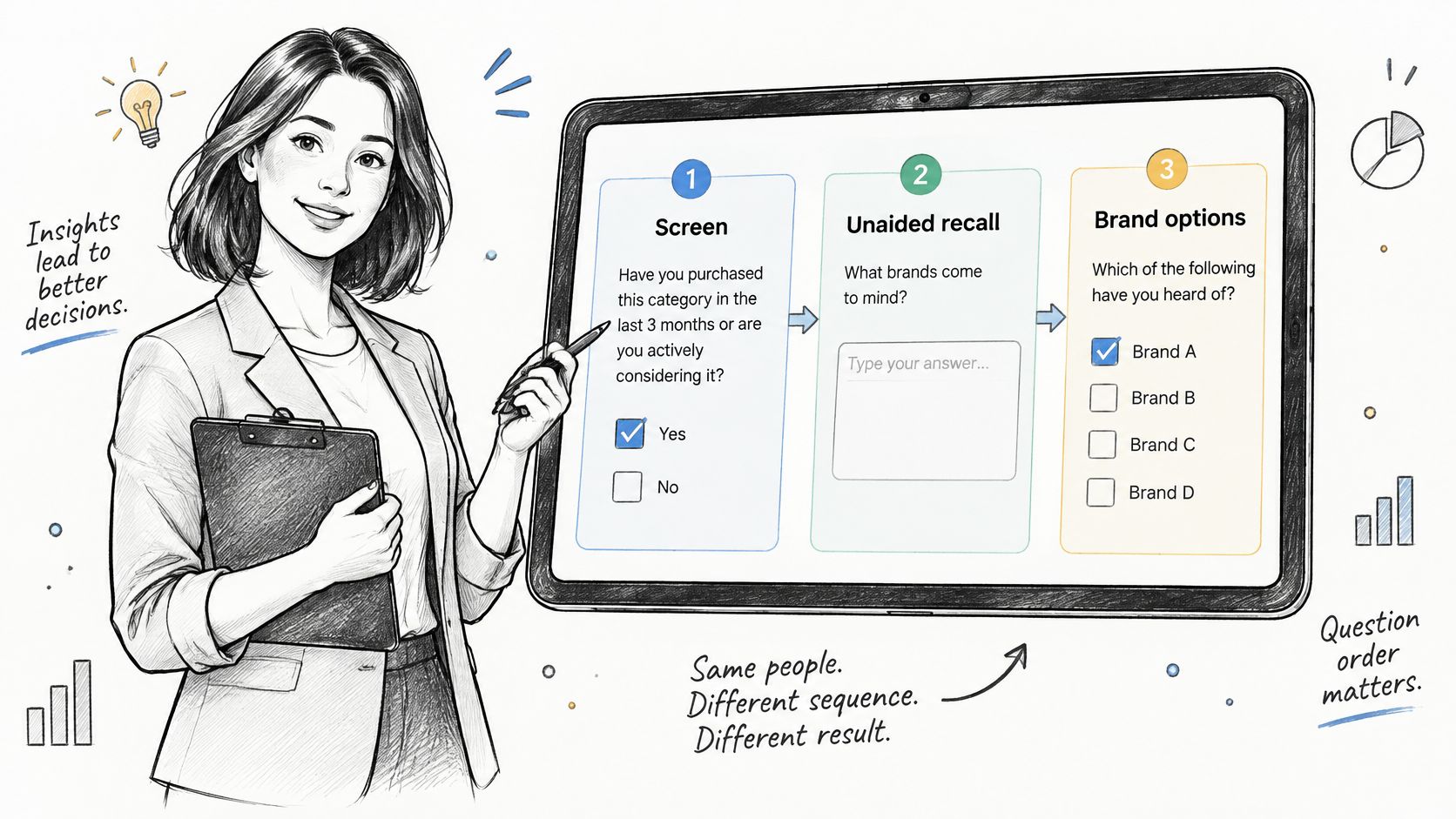
A lift number is only as honest as the order of the questions. Use a fixed sample of category buyers and run the same instrument every wave. Sprig's guide to brand awareness surveys is the sequence I would not rearrange.
Run the questions in this order
Screen first. Keep people who bought in the category recently or who are actively considering a tool. A survey of your own users only tells you what customers already think, and that number will flatter you.
Ask unaided recall in open text before any list appears. “Which products come to mind for this job?” Showing logos first teaches the answer. That inflated memory then gets reported as a campaign win.
Measure aided recognition on a randomized list that includes competitors and fictitious decoy brands. Decoys catch people who tick every name. Drop them and recognition looks stronger than it is.
Then ask consideration and associations. Which tools would they shortlist, and which phrase do they attach to you? Awareness without consideration is a logo people nod at and never buy.
Repeat the identical instrument on a fixed calendar. Change the order, the list, or the wording and the delta is noise.
Read the math without flattering yourself
Include every qualified respondent in the denominator, including people who pick “none” or skip the question. Dropping them shrinks the base and lifts the percentage. Report 95% confidence intervals, preferably Wilson intervals, on each metric.
For a single market estimate near 50% awareness, about 385 qualified completes give a ±5-percentage-point margin at 95% confidence. About 1,068 completes tighten that to ±3 points. A 2-point “lift” on a 150-person wave is usually a wobble.
Two more ways teams lie to themselves: leading questions (“How familiar are you with our award-winning platform?”) and one company-wide average that hides a drop among SEO leads while founders look fine. Segment by company size, role, use case, and buying stage. Then tie movement to branded search, direct traffic, pipeline, and share of voice. Recall alone is not a growth metric. If the words people attach to you turn sour while recognition rises, sentiment analysis in marketing is the check that stops you from calling that a win.
Track AI Visibility Next to Traditional Awareness
Strong recall does not mean an assistant will name you, rank you, or describe you fairly. A buyer can know your product and still get an answer that skips you, files you in the wrong category, or repeats an outdated limitation. That is a separate awareness layer, and it needs its own measurement.
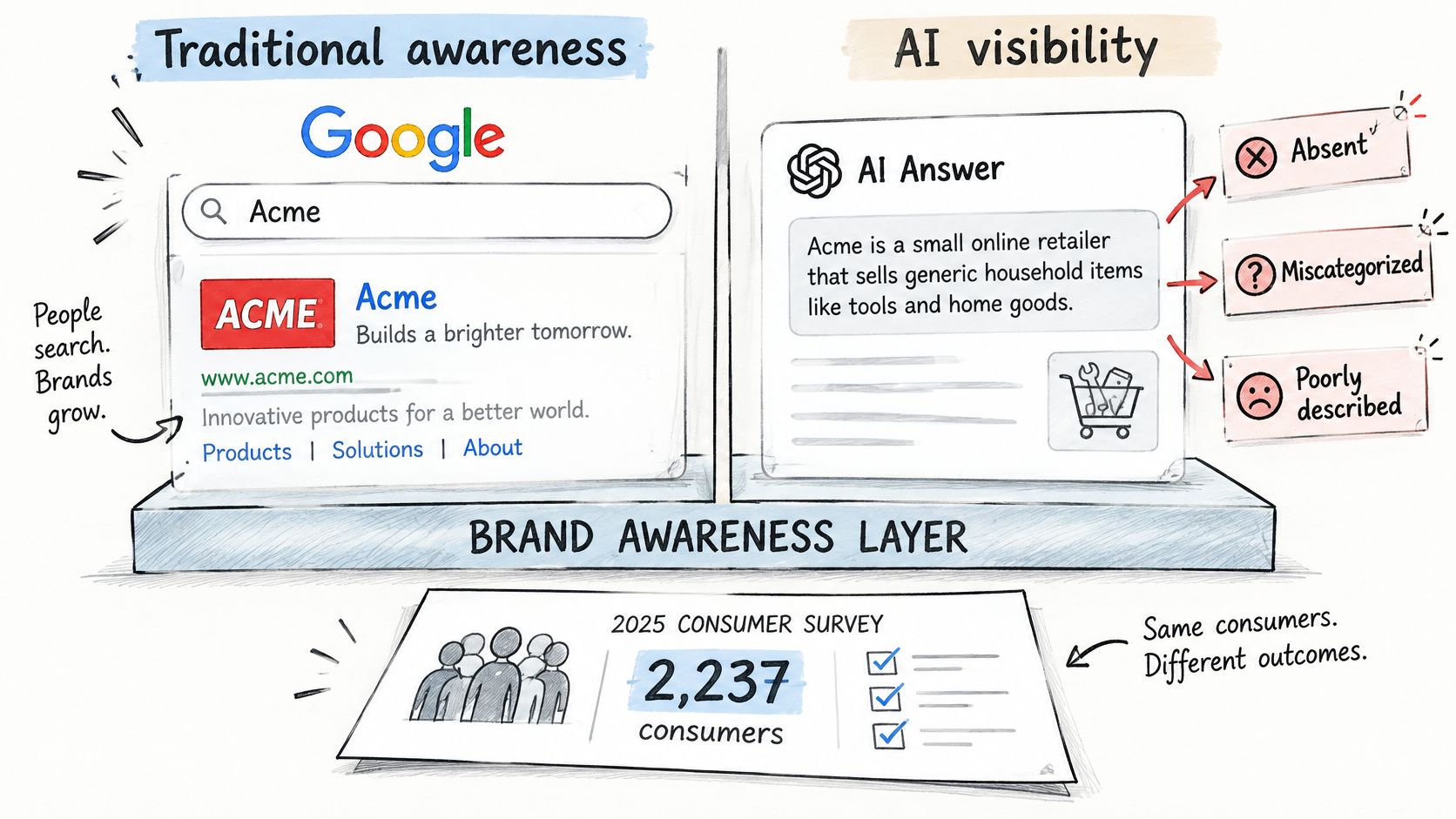
A 2025 survey of 2,237 consumers in the United States, United Kingdom, France, and Germany found that 62% trusted AI tools to guide brand decisions, while 43% used AI search tools daily, according to Yext's 2025 AI archetypes study. The same survey found that 57% still preferred traditional search for personal, medical, or financial research. Don't retire SEO because assistants got popular. Don't ignore assistants because Google still matters. Count them as different signals so a citation and a branded query are not added together as if they were the same person.
A working check you can run this month
Write 20 to 30 buyer-intent prompts as the questions people ask. “Best alternative for a small SEO team” belongs on the list. Your brand name does not, or you will only measure prompts that already assume you.
Run those prompts across the assistants your buyers use. For each answer, record whether you were mentioned, your rank, the sentiment, whether the facts are right, and which sources were cited. A score from that set covers those prompts, those providers, and that period. It is not a census of AI search.
Then read the citations. Docs, reviews, and partner pages are what many answers lean on. If the sources are thin, old, or missing, fix those pages before you rewrite ad copy. Our tracking script, installed on your site, records visits classified from detectable AI sources, along with landing pages and engagement. An AI visit is not a mention, a signup, or a purchase. Completed conversions still belong in your analytics or billing system. The steps for how to measure AI search visibility keep that chain from collapsing into one vanity number.
The clip below is a plain walkthrough of why answer interfaces change what “being known” means, without replacing the prompt log you should keep yourself.
I would review the prompt set monthly and resist adding prompts just to make the chart look healthier. A stable list is what makes a drop real.
Build the Strategy and Lock the Baseline
Spend nothing on the campaign until the segments and the baseline are both real, and a re-measurement date is on the calendar.
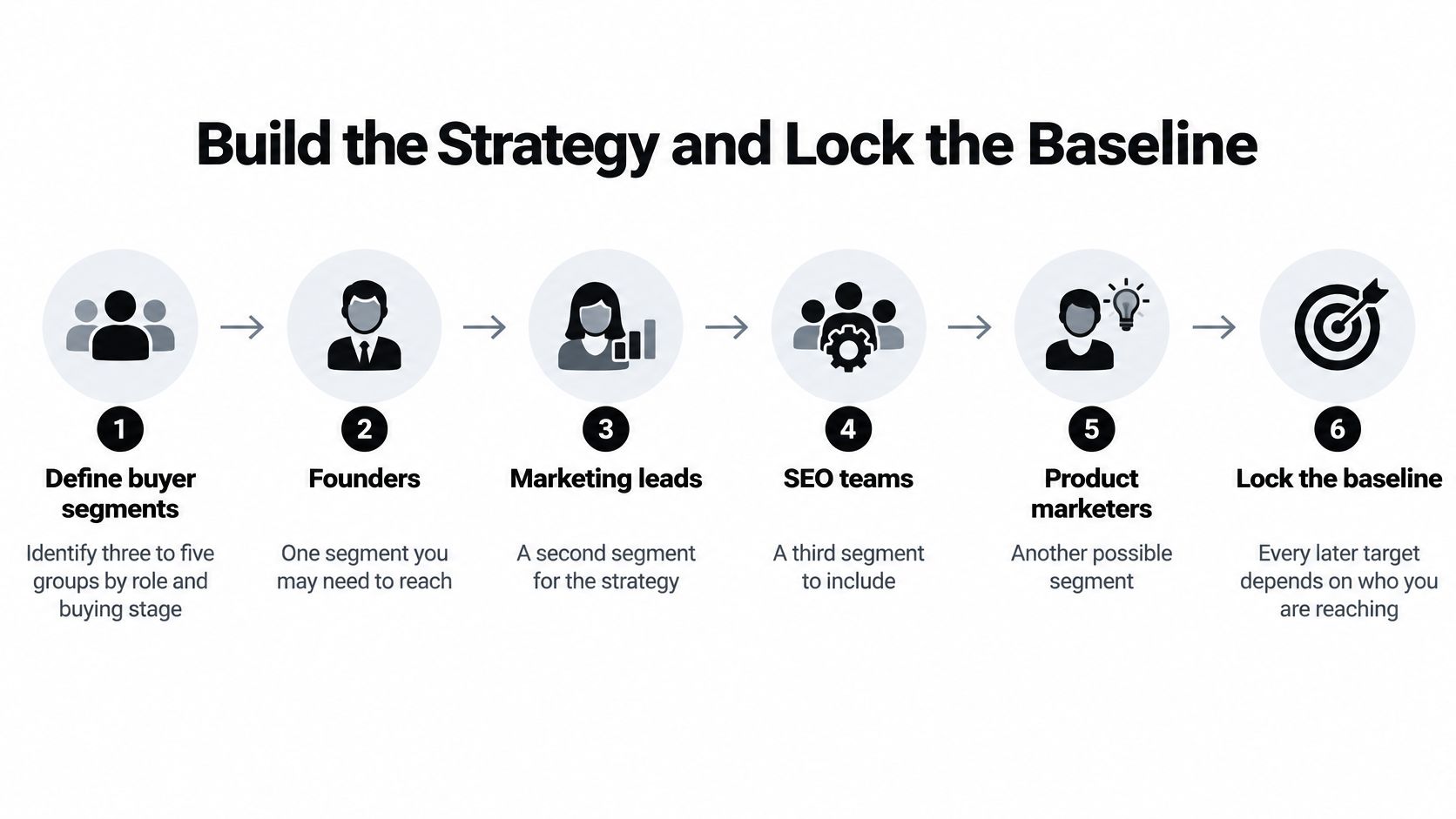
1. Name three to five buyer segments by role and stage. Founders, marketing leads, SEO teams, and product marketers are a usable start for most SaaS products. “Everyone in our ICP” is not a segment, and every later target depends on who you meant.
2. Audit the signals you already have. Pull the branded search trend, direct traffic, and the state of review profiles. Then run 20 to 30 buyer prompts, written as real questions, and record how assistants mention, rank, and describe you today. Prompts that contain your brand name don't count as discovery.
3. Set a reach goal per segment for a defined window. Unique people in that segment, not raw impressions. A four-to-eight-week flight with a minimum incremental-reach number is enough to manage.
4. Pick channels that fill the hole from step 2. Memory gap, use paid reach into that segment. Trust gap, use reviews and community. Description gap, use docs, help content, and partner pages. Mixing all four by habit wastes the ones you don't need yet.
5. Write one distinctive promise and repeat it. The same line should show up in ads, docs, review profiles, and partner pages. A new slogan on every channel creates recognition of nothing.
6. Lock the baseline before launch. Run the unaided and aided survey and the AI checks, store both in one place, and fix the first re-measurement date. Keep the survey wording unchanged between waves. To get started on the machine side, you create a product, choose a plan, and then see how assistants mention, rank, and describe the brand. The Starter plan costs $49 per month and is built for an individual product starting AI search tracking. No baseline means you cannot show lift later, only a story.
7. Name an owner and a monthly review. One person compares the three layers against the stored baseline. A shared Slack channel with no owner will not do it.
Put the scorecard, the prompt log, and the traffic read on one internet marketing dashboard so the monthly review isn't a scavenger hunt across five tools. This week, confirm the segments and record the baseline. Check results on the date you set. If either piece is missing, the campaign can wait.
MyMentions tracks how AI assistants mention, rank, and describe your product across buyer prompts, next to visibility, position, sentiment, citations, and AI-driven traffic. If your brand awareness strategy still stops at impressions and recall, that missing layer is where buyers now compare tools. Start with your own prompts at MyMentions.