7 Best AI Monitoring Tools for Brand Visibility in 2026
Compare the best AI monitoring tools for 2026: prompt tracking, provider coverage, alerts, pricing, and pros and cons to help founders and SEO teams choose.
The most popular advice for choosing AI visibility software is to buy whichever tool tracks the most engines. That's a poor starting point. Two tools can report opposite results for the same brand because they check different prompts, providers, interfaces, and reporting periods. Neither dashboard necessarily contains an error.
A provider API response isn't the same measurement as a consumer search interface. Likewise, a broad prompt database answers a different question from a saved list of your buyers' actual evaluation prompts. Before comparing visibility scores, establish what was checked, where it was checked, and which answers counted.
Coverage rule: Treat every visibility score as a description of a sample, not your brand's universal standing across AI search.
The best AI monitoring tools also differ in what happens after you find a gap. Some help analysts explain the cited sources. Others connect findings to content workflows, website audits, or prioritized recommendations. For SaaS and digital-product teams, that distinction matters more than another chart. These picks focus on brand visibility, not the engineering tools used to monitor model latency, token costs, or application failures.
Table of Contents
- 1. MyMentions
- 2. Peec AI
- 3. Otterly.AI
- 4. Profound
- 5. Scrunch
- 6. Semrush AI Visibility Toolkit
- 7. Ahrefs Brand Radar
- How the seven tools differ on provider coverage, team access, entry pricing, and best-fit users
- Matching the Right AI Monitoring Tool to Your Next Decision
1. MyMentions
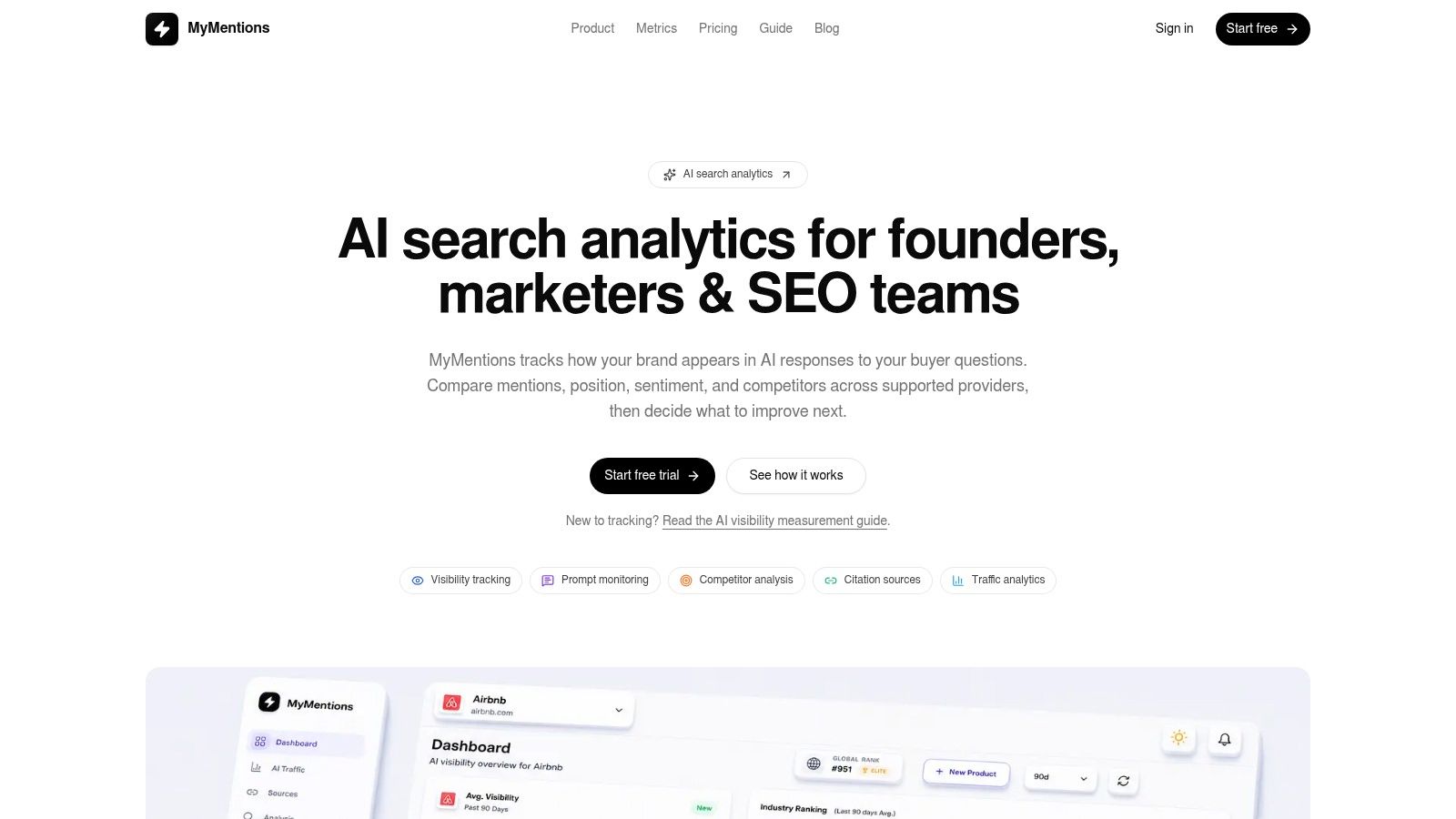
Best for SaaS teams that want prompt-level findings connected to a prioritized improvement backlog. Our workspace brings mentions, position, sentiment, competitors, citations, and detectable AI-referred traffic together. You can organize buyer-intent prompts and investigate where a competitor appears while your product doesn't.
The practical advantage is the connection between monitoring and the next task. Pro and Enterprise include site, content, and UX recommendations, plus citation-source analysis. Those suggestions give your team something to investigate rather than asking an analyst to translate every ranking change into a brief.
Coverage and commercial trade-offs
Our Starter plan checks OpenAI, Google Gemini, and Perplexity. Pro and Enterprise expand to eight providers, adding Anthropic Claude, xAI Grok, Azure OpenAI, DeepSeek, and Meta Llama through Together.ai.
These are provider API checks. We don't reproduce every consumer app experience or track Google AI Overviews, Google AI Mode, or Microsoft Copilot. If those interfaces drive your monitoring brief, this isn't sufficient coverage on its own.
- Starter: $49/month includes 25 daily provider checks, AI traffic analytics, root cause analysis, and PDF reports.
- Pro: $99/month includes 50 daily checks, two seats, personalized recommendations, citation analysis, and alerts through Slack, Discord, or email.
- Enterprise: $199/month includes 100 daily checks, five seats, scheduled reports, and competitor tracking.
- Trial: Every paid plan starts with a seven-day free trial.
A provider check means a prompt run against a provider, not unlimited monitoring of that question everywhere. Our guide to tracking brand mentions in AI explains how to frame the prompt set.
For traffic measurement, customers install our website tracking script. Missing referrers, blocked scripts, and source classification limit coverage, and a recorded visit isn't a signup or purchase. Recommendations remain hypotheses to test, while site audit scores are diagnostic suggestions, not AI ranking factors.
2. Peec AI
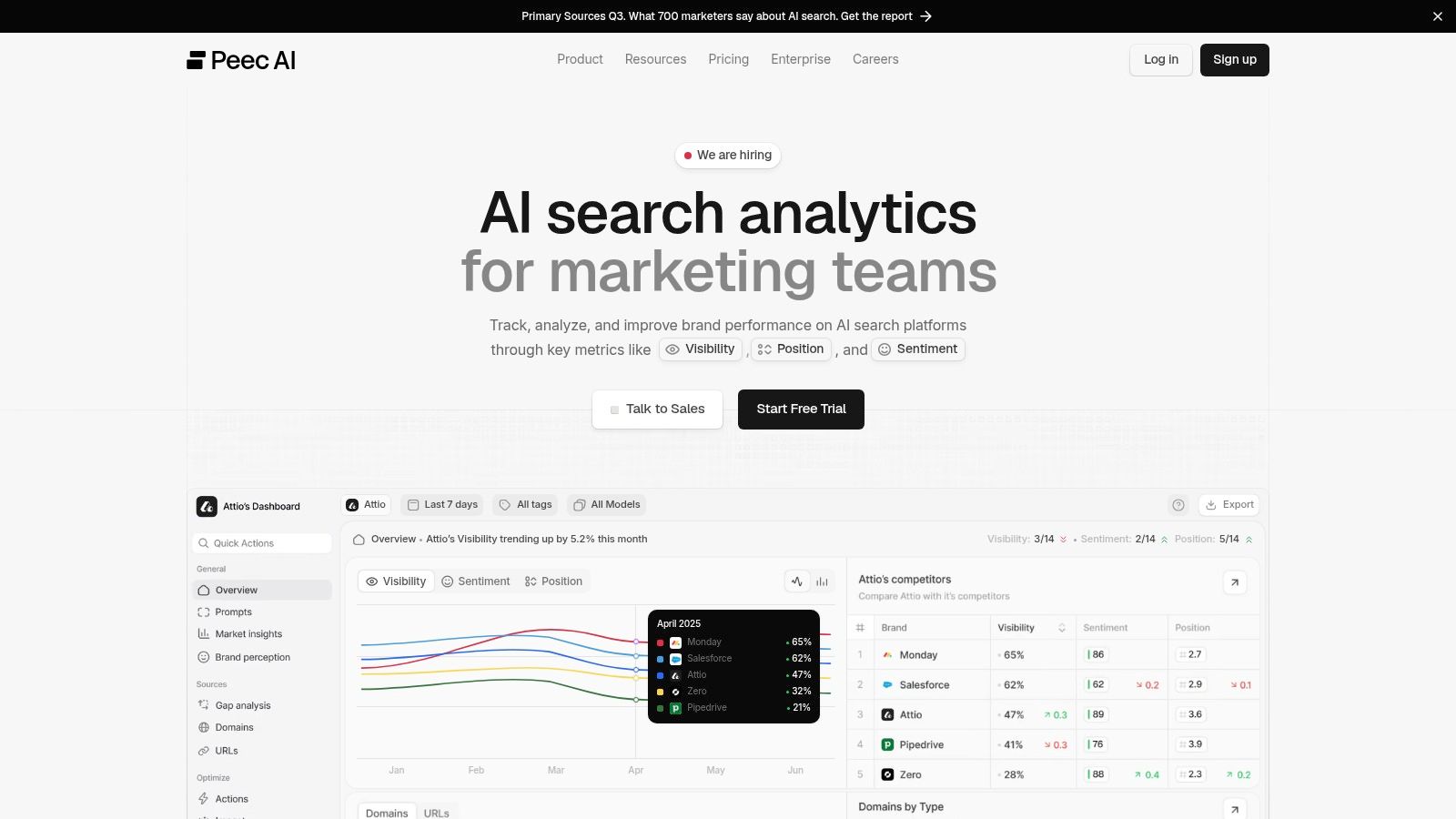
A marketing analyst and a content lead often need different views of the same visibility problem. Peec AI suits that shared analysis workflow, with saved-prompt tracking, competitor comparisons, and source insights in a dedicated AI search workspace.
Its strongest fit is collaborative diagnosis. The listed plans include unlimited users, so colleagues can inspect findings without a per-seat purchasing decision. Multiple projects help separate brands, while higher plans add multi-country tracking and Looker Studio integration.
Strong analysis, with implementation still owned by your team
When a competitor gains visibility, the useful move is to inspect the underlying answers and cited sources. Peec helps organize that investigation, but I'd evaluate it primarily as an analytics product, not as a replacement for content production, technical SEO, or a full search suite.
- What works: Saved buyer prompts provide a repeatable basis for brand and competitor comparisons.
- What needs budgeting: Entry plans limit prompts, projects, and selected models; broader or custom model coverage requires a higher tier.
- What remains outside scope: Don't interpret selected-model tracking as coverage of every AI interface, personalized conversation, or follow-up answer.
The available information doesn't establish a universal engine list or explicit exclusions for every tier. Treat any unlisted interface as unconfirmed coverage, especially when Google's different AI experiences are considered separately.
Before configuring reports, define how you'll measure AI search visibility. Otherwise, teammates can agree that a chart moved while disagreeing about whether the movement deserves work.
3. Otterly.AI
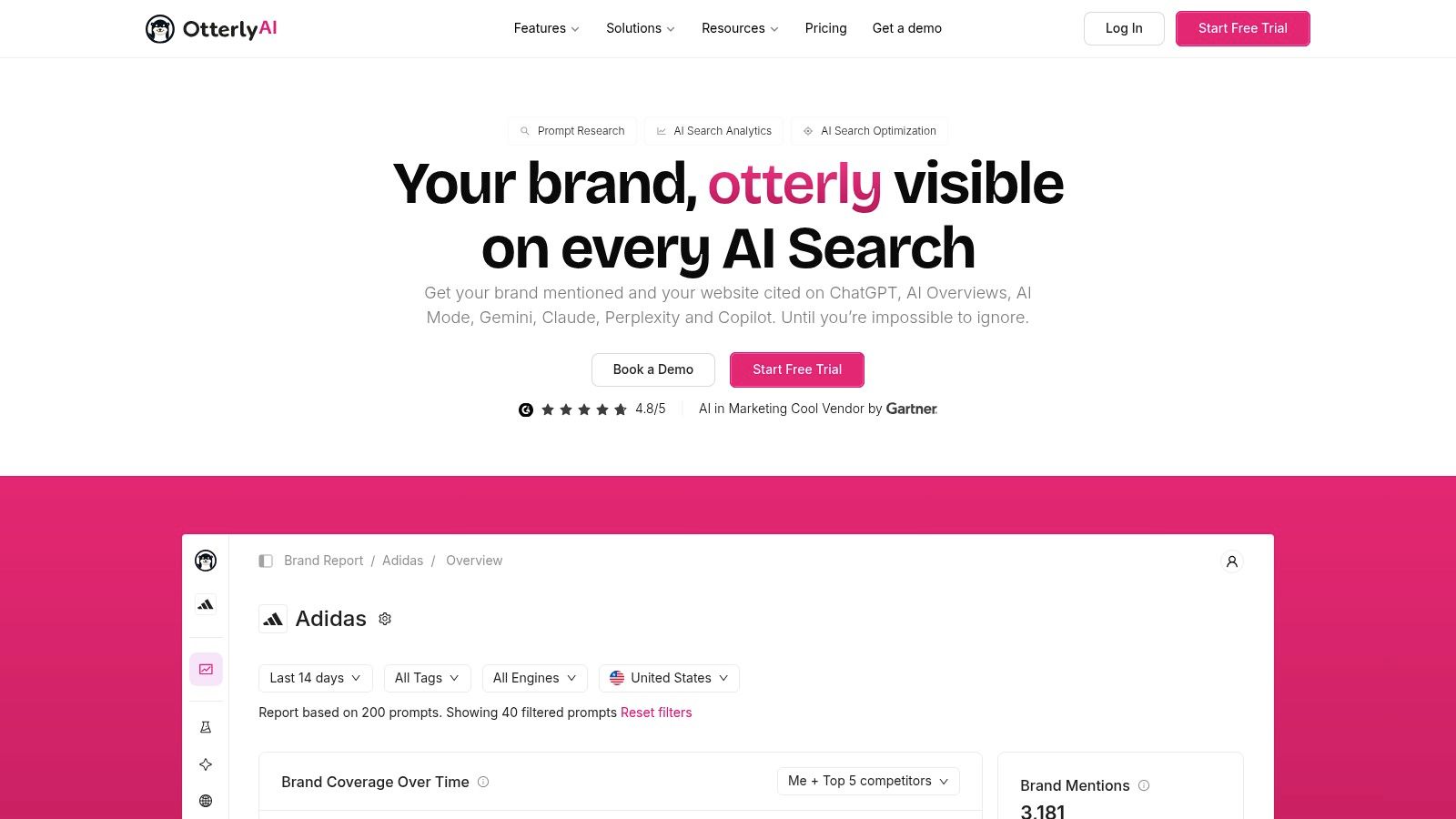
Interface coverage is the reason to shortlist Otterly.AI. Its listed monitoring surfaces include ChatGPT, Google AI Overviews, Perplexity, Microsoft Copilot, Google AI Mode, Gemini, and Claude. That makes it relevant when your buyers' questions span both assistants and Google's AI search experiences.
The product combines prompt monitoring with brand visibility, sentiment, competitor analysis, and citation tracking. GEO audits and optimization recommendations extend the workflow beyond counting mentions, although your team still needs to validate and implement the proposed changes.
A long engine list is only useful if your budget lets you check the prompts that matter on those engines.
Each prompt-engine check consumes credits. Broad coverage can therefore compete with prompt depth: tracking more interfaces may leave less capacity for use cases, alternatives, integrations, and industry-specific questions.
Evaluate the monitoring footprint, not just entry pricing
The self-serve setup and public pricing make initial evaluation straightforward. Unlimited team members and brands are listed, but credit allowances remain the operational constraint.
For a useful trial, compare an important buyer question across the interfaces your audience uses. Inspect whether citations and recommendations differ before expanding the prompt library.
Otterly isn't a replacement for a full traditional SEO suite or a content-generation platform. Its listed engine coverage also doesn't establish monitoring for every provider or every logged-in, personalized experience. Keep your AI visibility monitoring scope explicit so nobody mistakes broad coverage for exhaustive coverage.
4. Profound
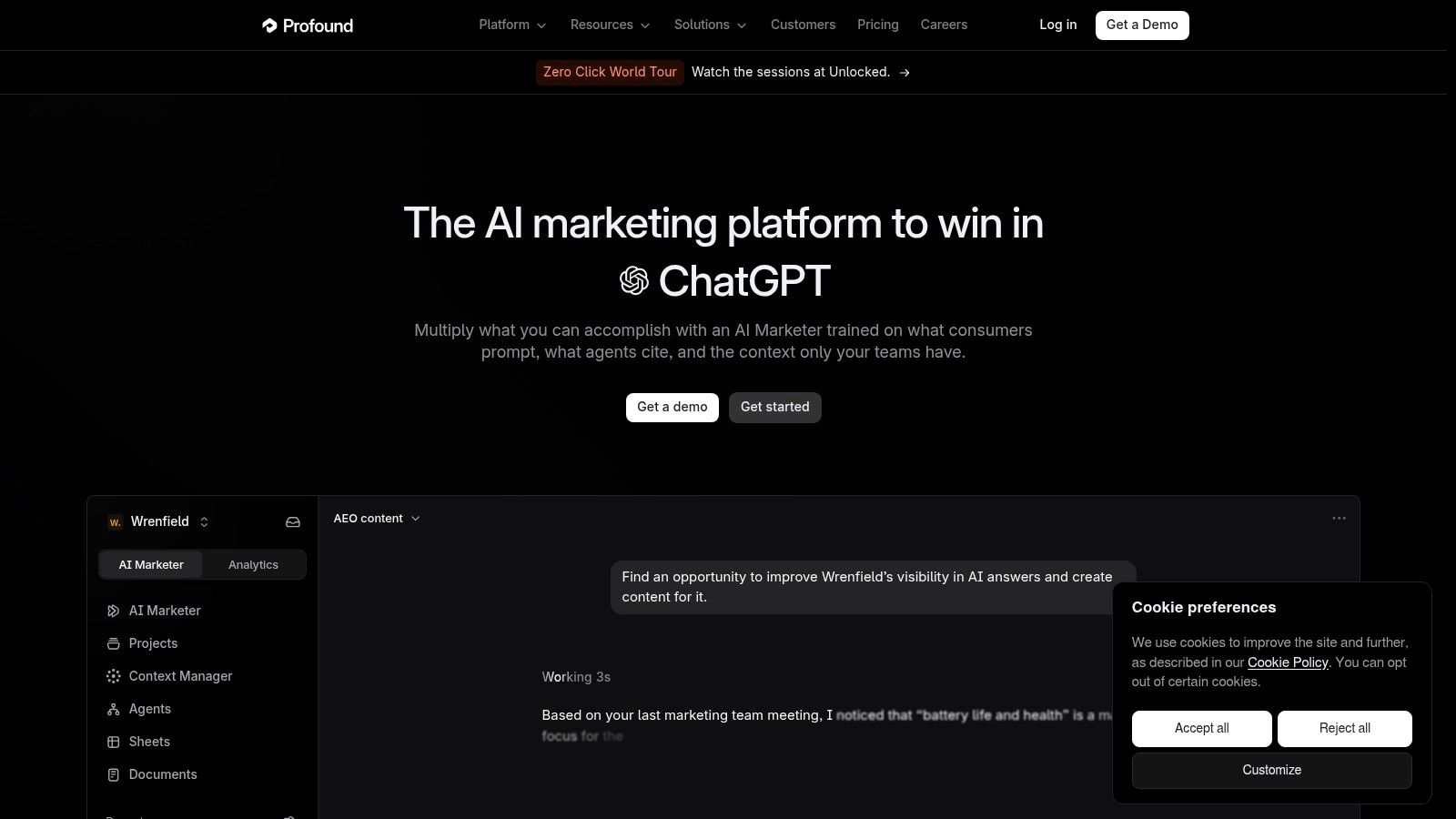
Profound makes sense when AI visibility is becoming an ongoing marketing function rather than a side report. It combines analysis of brand appearances, citations, sentiment, ranking, and competitors with research, content, and agent-based workflows.
The buying question is whether those workflows shorten the route from an answer-level finding to approved marketing work. Detailed reporting alone won't resolve an unclear product claim, an unsupported comparison, or a missing buyer guide. Your team needs a way to carry the evidence into the task.
Test workflow fit separately from measurement fit
The described trial covers ChatGPT, Gemini, and Google AI Overviews, but its prompts aren't customizable. That's useful for exploring the interface and reporting approach, less useful for proving coverage against a highly specific SaaS buying journey.
- Measurement fit: Inspect the answers and sources behind brand, competitor, and sentiment summaries.
- Workflow fit: Follow a finding through research and content preparation, including the review work your team would still perform.
- Commercial fit: Ongoing enterprise pricing and coverage require a sales conversation.
The trial's named surfaces shouldn't be read as a promise that every other assistant or interface is included. Broader ongoing coverage needs to be established in the proposed package, and unlisted surfaces remain unconfirmed.
I'd shortlist Profound for an organization that has people ready to use its broader workflows. For a founder who only needs a small prompt tracker, the extra scope may create evaluation work without solving a pressing problem. A useful AI visibility platform should match the team's operating model, not just its reporting ambitions.
5. Scrunch
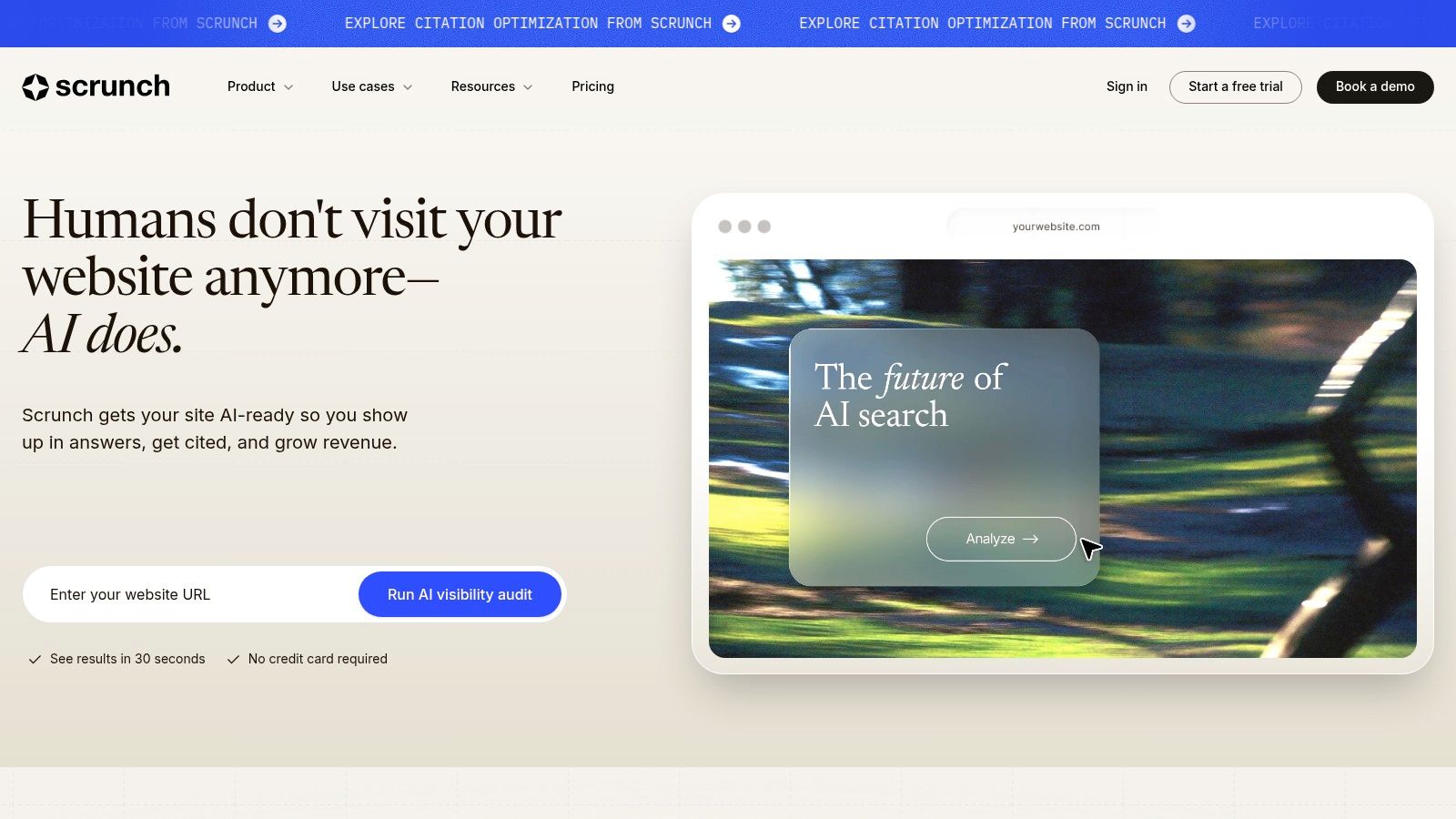
Say your product is absent from an important answer, but you already have a page that addresses the question. Rewriting that page immediately may be the wrong response. First, inspect whether agents can access and interpret the relevant content.
That's the appeal of Scrunch. Alongside brand and citation monitoring, it emphasizes site audits, technical access, content gaps, recommendations, and AI-agent content delivery. Its scope is closer to diagnosis and implementation than a standalone mention dashboard.
Best when the website itself needs investigation
Scrunch is worth considering when your team needs to distinguish an answer-level visibility gap from a site-level problem. Audits can help frame the investigation, while its agent content-delivery capability introduces a more substantial implementation decision.
- Useful depth: Teams can investigate crawler access and content availability alongside brand appearances.
- Operational trade-off: Broader optimization capabilities require technical ownership, testing, and a clear deployment plan.
- Potential mismatch: Teams seeking only prompt tracking and competitor benchmarking may not need the added scope.
Don't treat an audit finding as proof of why an assistant omitted your brand. Validate access issues directly, inspect the cited alternatives, and then decide whether the appropriate fix is technical, editorial, or offsite.
The available product description doesn't establish an exact interface-by-interface coverage list. Google AI Overviews, Google AI Mode, Copilot, and individual assistants should remain unconfirmed until included in your evaluation scope. Use a concrete set of AI search problems to test the product rather than assuming a broad optimization platform monitors every surface.
6. Semrush AI Visibility Toolkit
For a team already running search research and audits in Semrush, Semrush AI Visibility Toolkit offers a familiar place to add AI-answer monitoring. It combines custom prompt tracking, brand and competitor reporting, prompt research, and an AI-readiness site audit.
Its advantage is proximity to existing SEO work. An analyst can investigate a visibility gap alongside the broader search and website questions the team already manages. The AI toolkit is a separate purchase, however, so existing platform access shouldn't be confused with included AI monitoring.
Convenient integration, bounded monitoring
The listed coverage names ChatGPT, Google AI, Gemini, and Perplexity. The phrase Google AI needs particular attention: don't assume it means identical tracking of AI Overviews and AI Mode without confirming the specific report and interface.
The named list doesn't establish coverage for Claude, Copilot, Grok, DeepSeek, or Meta Llama. If those are central to your buyer prompts, don't count them as covered.
Buying test: Ask whether your team can move from a missing mention to a specific page, source, or technical task without rebuilding the investigation elsewhere.
Base-plan custom prompt volume and domain scope can constrain a broad monitoring program, and additional users cost extra. Enterprise options add multi-brand tracking, integrations, and reporting, but those capabilities shouldn't be assumed in the entry package.
I'd favor this option when the team's next decision is already an SEO decision: which page to improve, which competitor to investigate, or which site issue to resolve. A dedicated visibility workspace may fit better when cross-provider prompt analysis is the primary daily task.
7. Ahrefs Brand Radar
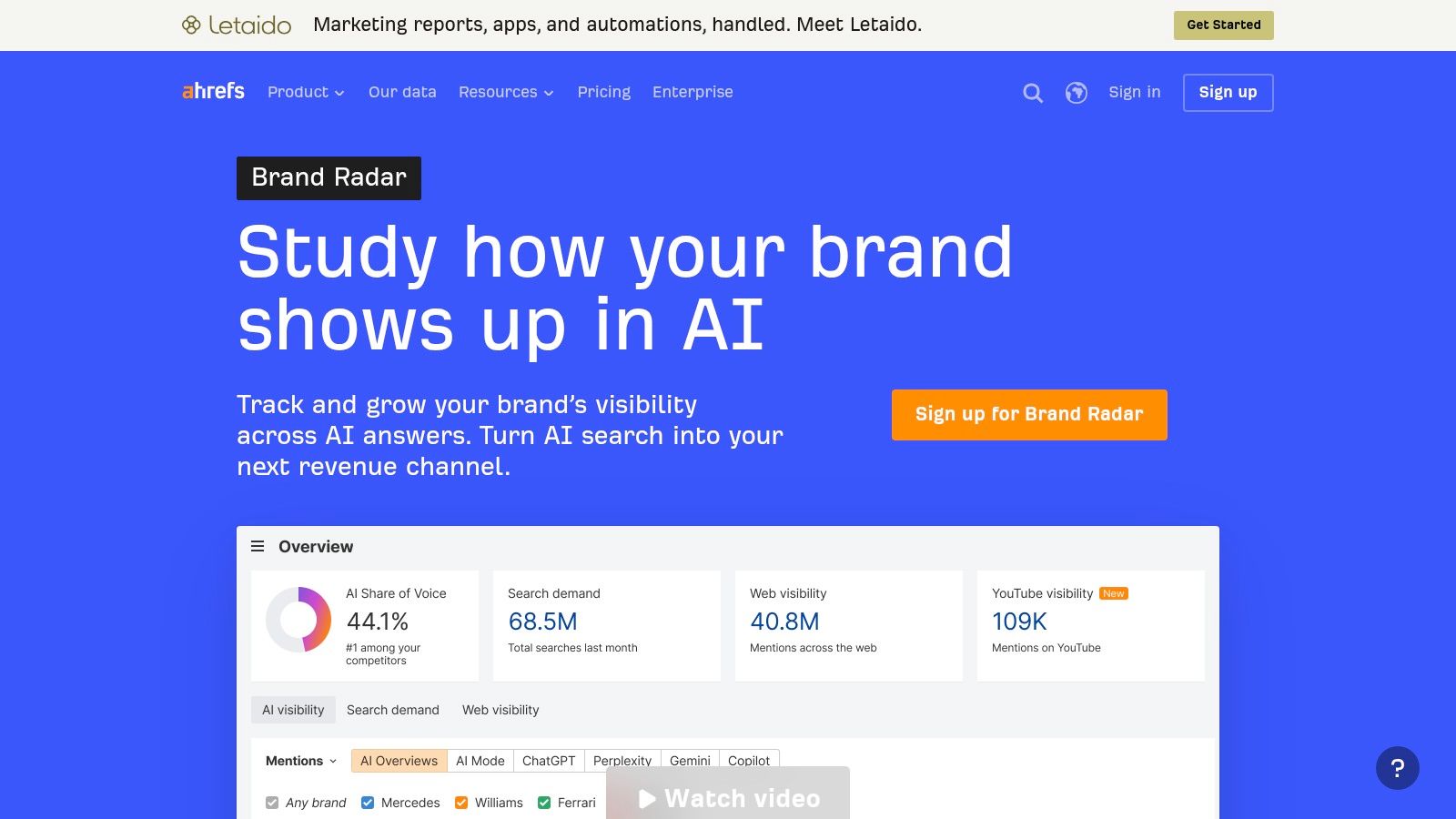
Discovering the questions you forgot to monitor is different from checking the questions you already know. Ahrefs Brand Radar is particularly relevant to the discovery side, combining brand research across a search-backed AI prompt database with familiar SEO research workflows.
That broader view can help a team investigate category visibility and competitors beyond its own saved prompt list. Research across surfaces including YouTube and Reddit also gives analysts places to investigate how buyers encounter and discuss brands outside their websites.
Separate database research from custom tracking
Brand Radar access and custom prompt monitoring are separate purchasing considerations. A database result can reveal an opportunity, but it isn't automatically a recurring measurement of your exact question.
- Research strength: Explore category and competitor presence without relying entirely on the prompt library your team created.
- Monitoring consideration: Budget separately for the custom checks needed to follow specific buyer questions.
- Workflow limitation: Analysts still need to turn findings into content, source-development, or technical tasks.
The available description doesn't provide an exhaustive named list of AI interfaces. Treat specific assistant coverage, Google AI Overviews, Google AI Mode, and Copilot as unconfirmed unless the package explicitly includes them. YouTube and Reddit research also shouldn't be mistaken for monitoring every AI answer that might cite those platforms.
I'd choose Brand Radar when the next decision is where to investigate, especially for an SEO team already using Ahrefs. It's less obviously suited to a team whose main requirement is a dedicated workspace that turns each tracked visibility gap into a prioritized fix list.
How the seven tools differ on provider coverage, team access, entry pricing, and best-fit users
| Item | Provider Coverage | Team Access | Entry Pricing Signal | Best For |
|---|---|---|---|---|
| MyMentions | 3 providers on Starter; 8 on Pro and Enterprise | Pro: 2 seats; Enterprise: 5 seats | Starts at $49/month; 7-day free trial | SaaS teams seeking prompt monitoring and actionable visibility recommendations |
| Peec AI | Selected AI models; broader coverage on higher plans | Unlimited users | Pricing not stated | Marketing teams needing shared AI visibility analytics without per-seat costs |
| Otterly.AI | ChatGPT, Google AI Overviews, Perplexity, Copilot, Google AI Mode, Gemini, and Claude | Unlimited team members and brands | Public self-serve pricing; amount not stated | Teams starting AI monitoring with broad engine coverage |
| Profound | Trial covers ChatGPT, Gemini, and Google AI Overviews; broader coverage requires sales contact | Unlimited seats in trial and enterprise offer | 7-day trial; ongoing enterprise pricing not public | Organizations connecting AI visibility measurement with marketing workflows |
| Scrunch | AI search experiences; specific providers not stated | Not stated | Described as more expensive than entry-level tools | Teams linking visibility monitoring to site audits and optimization |
| Semrush AI Visibility Toolkit | ChatGPT, Google AI, Gemini, and Perplexity | Additional users cost extra | Public pricing; amount not stated | Semrush users wanting AI visibility monitoring alongside SEO tools |
| Ahrefs Brand Radar | Large AI prompt database; custom tracking across AI platforms | Not stated | Public pricing; custom prompt tracking separately priced | SEO teams researching AI visibility alongside search and social surfaces |
Matching the Right AI Monitoring Tool to Your Next Decision
Start with your buyers' questions, not a vendor's aggregate score. Write prompts around product categories, alternatives, integrations, constraints, and purchase criteria, then identify which providers and interfaces matter for those questions. Coverage comes before dashboard design.
Set a budget for the monitoring footprint you need. Account for prompt-engine combinations, check frequency, markets, brands, and seats rather than comparing subscription labels alone. A cheap plan that can't cover your decision-stage prompts isn't a useful saving.
Run a trial that produces a decision
Use the same buyer-prompt list wherever customization is available. Compare the underlying answers, not just each vendor's summary score, and record whether the product helps you complete the next task.
- If you need a baseline: Favor clear prompt tracking, understandable limits, and reliable access to collected answers.
- If you need an explanation: Prioritize citations, competitor comparisons, and source-level investigation.
- If you need execution support: Test whether recommendations identify a specific change, an owner, and evidence worth validating.
Keep human review in the loop. A production study of AI practitioners identifies human verification as the primary evaluation method, with automated judges supplementing rather than replacing it. For brand monitoring, that means reading whether an answer accurately describes your product, not merely accepting its sentiment label.
A useful recommendation explains what to investigate. It doesn't promise that an edit will earn a citation.
Finally, connect monitoring to commercial outcomes without confusing the measurements. A mention isn't a visit, and a visit isn't a conversion. Measure detectable AI-referred visits in your analytics, then verify signups, qualified opportunities, and purchases in your own analytics and billing systems.
Choose the tool that supports the next decision your team can act on. Preserve the prompt and coverage context when reporting results, and judge proposed fixes against both subsequent answers and customer outcomes, not visibility scores alone.
MyMentions brings buyer-prompt monitoring, citation analysis, competitor comparisons, and detectable AI-referred traffic into one workspace, with personalized recommendations on Pro and Enterprise. Visit MyMentions to create your product, choose a plan, and start a trial using the buyer questions your team needs to understand.