AI Search Grader Explained: Metrics, Scoring and Fixes
Learn what an AI search grader measures, how it scores citations and visibility, and how MyMentions turns grades into concrete fixes.
In July 2024, ChatGPT and Google Gemini together accounted for 78% of global traffic to AI search models, according to Semrush Trends. That concentration makes provider selection consequential: a brand's grade can look different depending on which systems a tool tests. But coverage is only the starting point. A useful AI search grader must distinguish being mentioned from being described accurately, then establish whether either result survives a change in prompt wording.
Table of Contents
- What an AI Search Grader Is and Why It Matters
- The Core Metrics an AI Search Grader Scores
- Why Citation Accuracy Matters More Than Mentions
- How to Score Each Citation Claim by Claim
- Why Grades Shift Between Runs and Prompt Wording
- How MyMentions Surfaces Grades, Alerts and Reports
- Confirm a Grader Before You Act on Its Score
What an AI Search Grader Is and Why It Matters
An AI search grader is like a credit report for your brand inside AI answers. It combines many small observations into a profile rather than treating a single answer as a verdict.
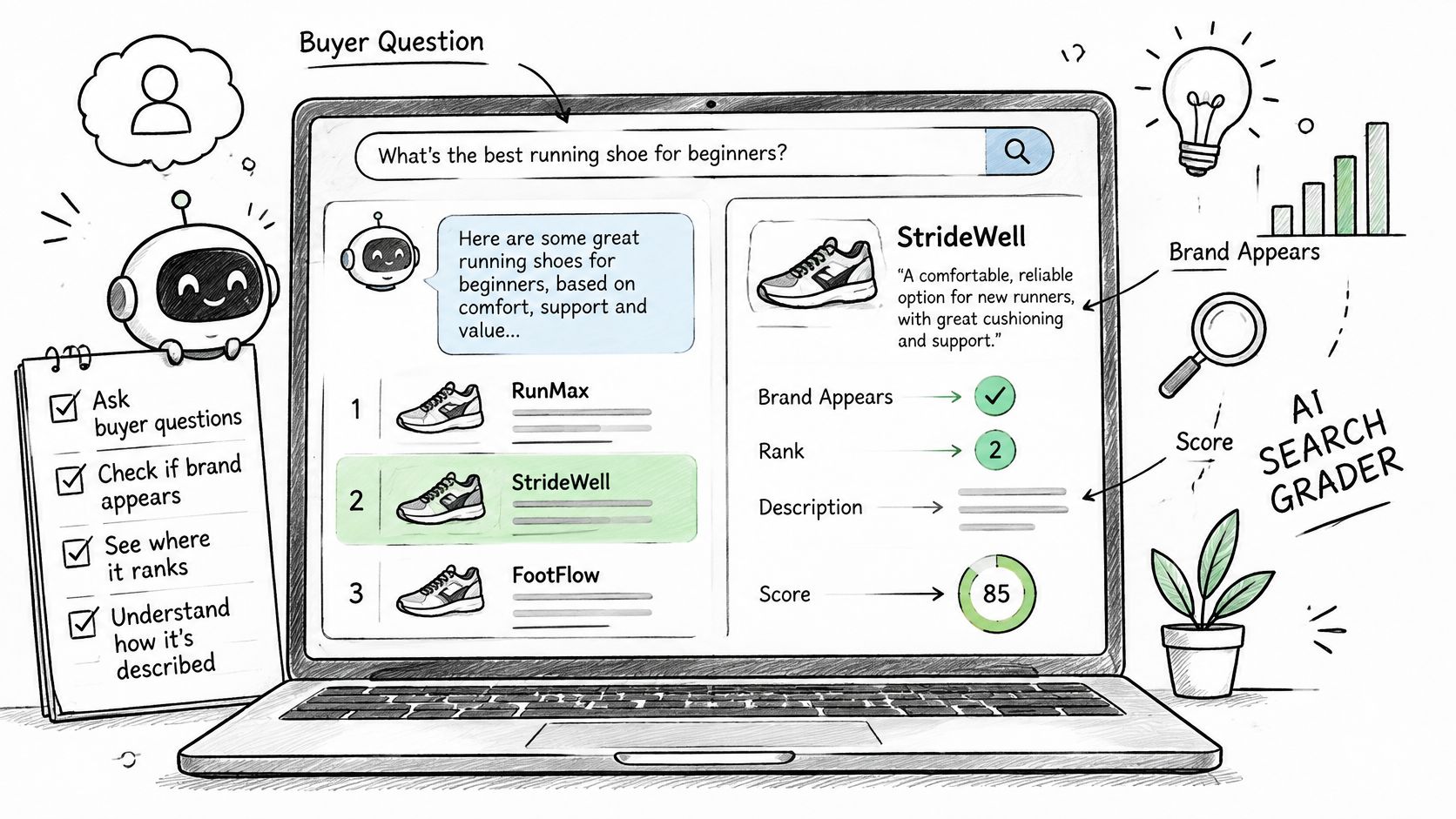
Say a buyer asks an assistant to recommend project management software for a security-conscious agency. A grader submits that question and related buyer prompts, records which brands appear, their recommendation order, how they're described, and which sources accompany the answer. It then aggregates those observations into metrics or a headline grade.
The diagram shows the basic relationship between a query, an answer, and the observations a grader collects.
Answers are the object being measured
A traditional SEO audit inspects pages: their accessibility, structure, content, and technical condition. An answer-based grader inspects what an assistant returns. A technically sound product page and an accurate AI recommendation are different outcomes, so they require different measurements.
The audience for those answers isn't hypothetical. In 2024, 44% of surveyed U.S. adults said they had used AI-powered search engines to learn or explain concepts, according to Statista. That finding concerns learning and explanation, not purchase conversion, but it establishes why answer-level measurement deserves attention.
For a product team, the practical concern is early consideration. If a buyer builds a shortlist from an assistant's answer, an omitted brand won't receive consideration through that interaction. Bruce and Eddy's explanation of why answer engine optimization matters provides useful context for connecting this answer-first experience with content strategy.
Measurement principle: A grade is only as useful as the prompts, providers, and reporting window behind it.
Treat the grade as a structured record of tested interactions, not a universal assessment of your brand's standing.
The Core Metrics an AI Search Grader Scores
An AI search grade should separate brand presence from citation quality. Presence describes whether and how the assistant includes a brand. Citation quality describes whether a reader can verify the factual statements attached to that inclusion.
The distinction matters empirically. In a citation evaluation benchmark, leading models achieved more than 94% link validity and over 80% source relevance, yet factual accuracy of cited claims ranged from 39% to 77% across systems. A working URL and a relevant page therefore aren't sufficient evidence that a claim is correct.
Core metrics in an AI search grade
| Metric | What It Measures | How It Is Scored | Weak Signal |
|---|---|---|---|
| Visibility | Share of tested prompts where the brand is named | Mentions divided by prompts run | Absent from buyer-intent answers |
| Position | Average rank when the brand is recommended | Mean rank across recommending answers | Named only after competitors |
| Sentiment | How positive the brand description sounds | Tone of brand sentences in each answer | Caveats, outdated pricing, or complaints |
| Share of voice | Brand mentions relative to rivals | Brand mentions divided by all tracked brand mentions | Competitors dominate category prompts |
| Citation link validity | Whether cited URLs load and resolve | Share of cited URLs returning valid pages | Broken, error, or fabricated links |
| Citation relevance | Whether the cited page covers the topic | Topical match between page and claim | Cited page discusses a different product |
| Claim support | Whether the source substantiates the claim | Fully supporting, partially supporting, or unsupported per claim | No supporting passage found |
| Citation precision and recall | Share of citations supporting their claims, and share of key claims with support | Supported citations over total citations; supported claims over important claims | Many citations, few supporting |
| Confidence and volatility | Stability across repeated runs | Spread of results across runs and paraphrases | Score swings with small wording changes |
Read the denominator before the score
Position excludes answers in which the brand isn't recommended. A brand can therefore have a favorable average position while appearing in relatively few tested answers. Visibility supplies the missing context.
Share of voice requires another check: the tracked competitor set. Adding competitors can change the denominator without changing your brand's underlying mentions. Sentiment also needs careful interpretation because positive wording doesn't establish factual correctness. An enthusiastic description of an unavailable feature is still an error.
For reporting design, use the guide to measuring AI search visibility to keep presence metrics explicit. Connect those observations to website analysis separately. DesignStack's guidance on using analytics to identify pages that drive customer interest is useful for assessing what happens after someone visits, rather than treating a mention as a visit.
Before accepting a dashboard's headline grade, check whether it includes citation-level rows and confidence information. Without those, you can't distinguish well-supported presence from confidently worded exposure.
Why Citation Accuracy Matters More Than Mentions
An inaccurate recommendation can be worse than an omission. If an assistant names your product but attributes a capability you don't offer, the mention creates an expectation your sales or support team must later correct.
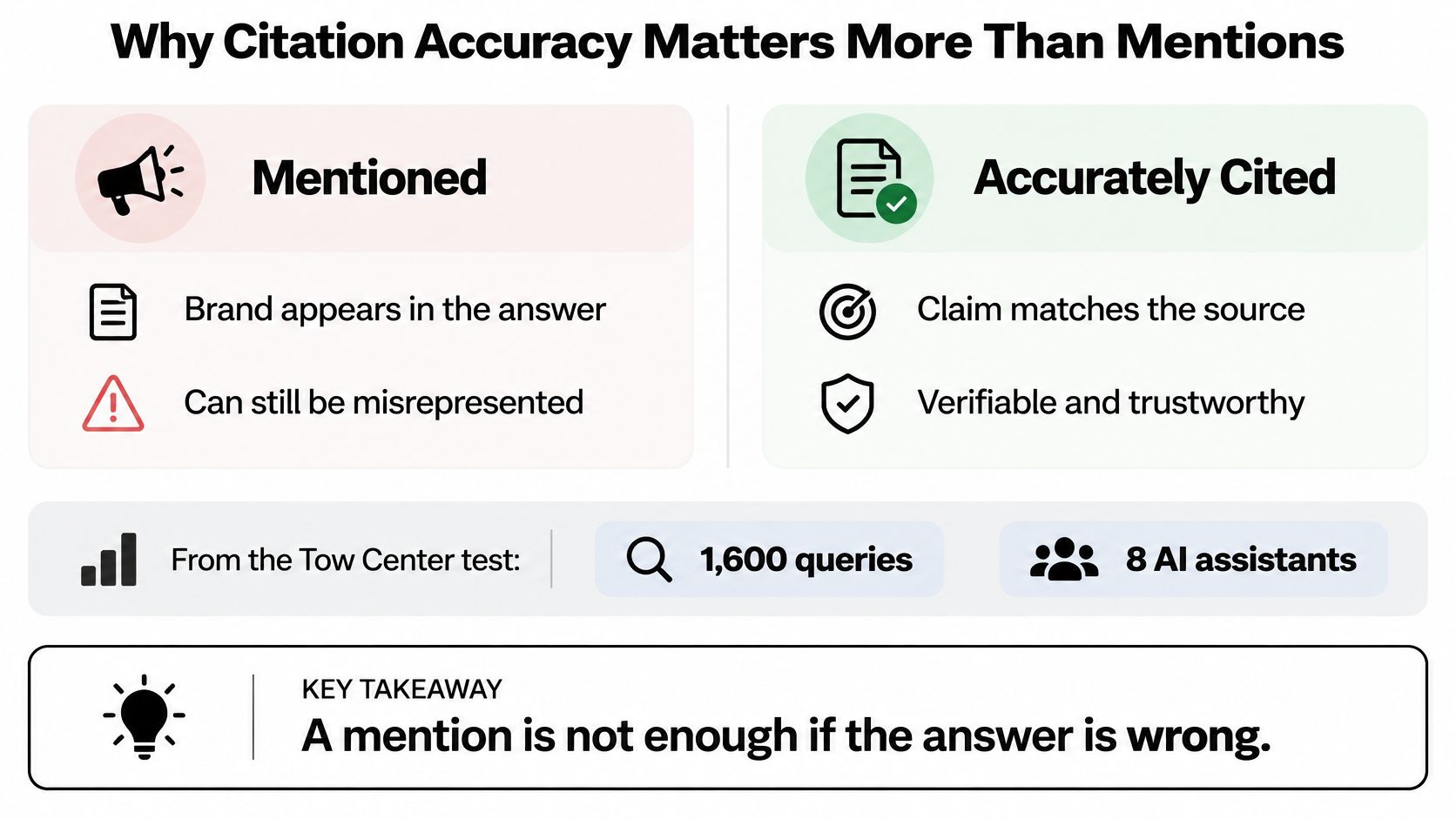
The Tow Center's test of AI search systems examined 1,600 queries across eight systems and found incorrect information in more than 60% of responses. Its task concerned identifying news articles, so the result shouldn't be presented as a product-recommendation error rate. It does demonstrate why citation correctness needs direct inspection rather than inference from an answer's polished presentation.
The distinction is simple: appearing in an answer and being accurately cited are different outcomes.
Diagnose the failure before choosing the fix
Consider a hypothetical SaaS recommendation that says an entry-level subscription includes a security certification and a native accounting integration. The cited page discusses the company's security practices but establishes neither claim. A visibility-only grader would count the brand's appearance while overlooking the unsupported purchase criteria.
Different failure types call for different investigations:
- Retrieval failure: The answer doesn't surface the page containing the relevant information. Investigate whether that information is accessible, identifiable, and clearly associated with the product.
- Generation failure: The answer cites the relevant page but misstates its contents. Inspect ambiguous wording, omitted qualifications, and the exact passage the assistant appears to have used.
- Source identity failure: The citation points to an aggregator or another company's similarly named product. Verify the publisher, product identity, and original source.
Understanding source attribution helps separate the page an assistant names from the evidence that supports its statement. Preserve both the URL and the supporting passage so reviewers can reconstruct the judgment.
A mention is not enough if the answer is wrong.
For high-stakes product statements, prioritize the mismatch over the mention count. Outdated pricing, an unshipped integration, or a misrepresented certification deserves a different response from an unfavorable adjective. Increasing exposure before correcting those claims can expand the audience for the error.
How to Score Each Citation Claim by Claim
A defensible citation grade starts with explicit claims and a fixed rubric, not a general impression of answer quality. Automated judges also need calibration: in a long-form question-answering evaluation, aligning claim spans and citation criteria improved agreement between an LLM judge and human assessors to 69% for citation recall and 75% for citation precision.
Those agreement levels aren't a guarantee for another grader. They support retaining evidence and auditing judgments instead of assuming an automated label is ground truth.
Build an auditable scoring record
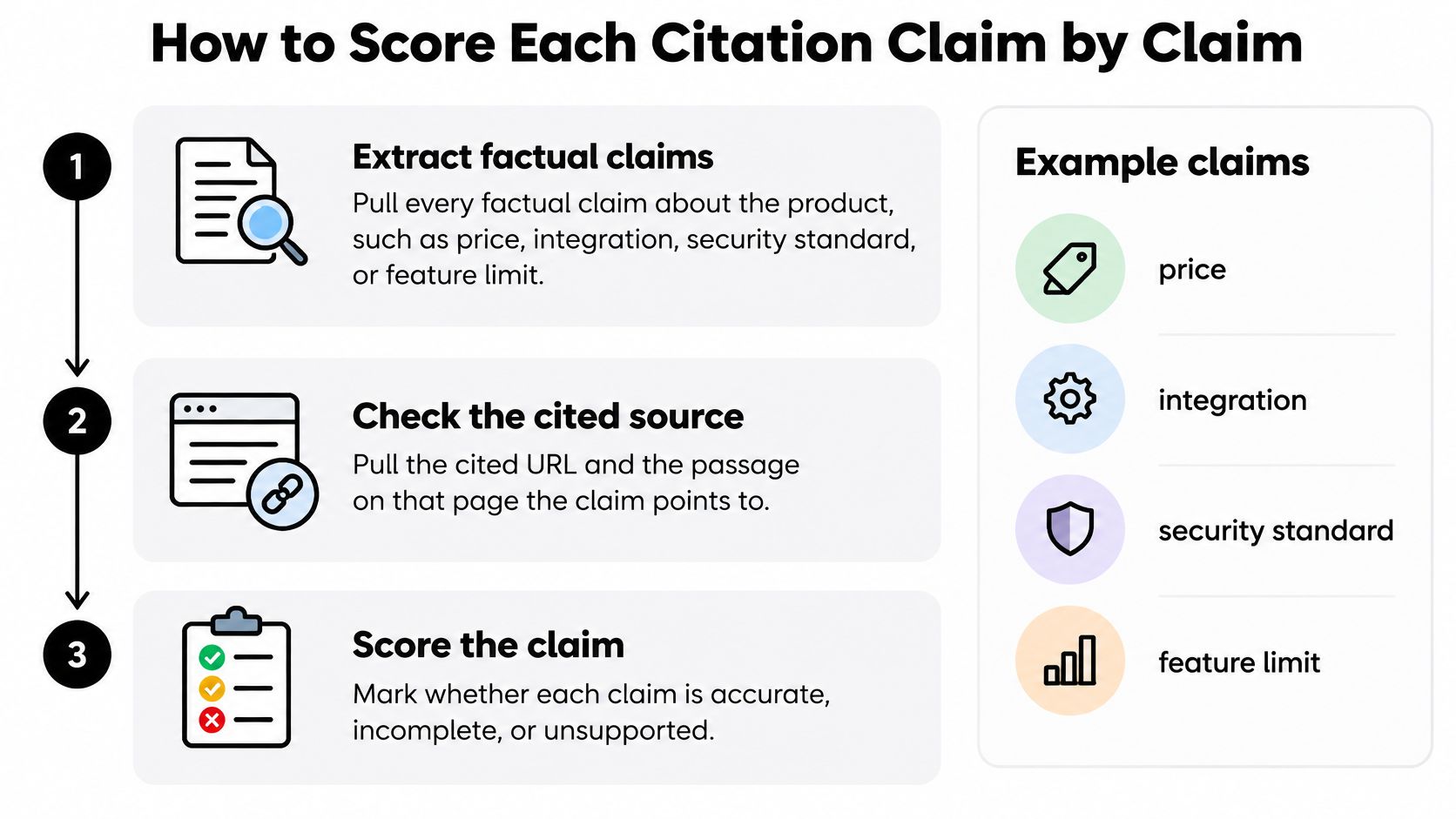
Extract factual claims. Separate statements about pricing, integrations, security standards, and feature limits into independently checkable units. Don't let a compound sentence receive a passing label when only part of it is supported.
Retrieve the cited evidence. Save the URL and the passage that allegedly supports the claim. Record inaccessible sources as unverified rather than inferring their contents from a title or search snippet.
Assign a support label. Use fully supporting, partially supporting, or unsupported. Say an answer describes SSO as generally available, while the source restricts it to a higher subscription tier: the citation is partially supporting because it omits a material condition.
Calculate citation precision. Divide adequately supporting citations by all evaluated citations. State whether partial support receives credit, and keep that rule unchanged between reporting periods.
Calculate citation recall. Divide important claims with adequate support by all important claims. Include uncited factual statements in the denominator so an answer can't improve its apparent quality by avoiding citations.
Audit automated decisions. Have a reviewer apply the same rubric to a sample, then inspect disagreements. Distinguish ambiguous source wording from inconsistent claim extraction or an overly lenient judge.
Preserve evidence and uncertainty. Retain the answer, claim text, source passage, labels, and evaluation context. Where the sampling supports it, report a confidence interval and explain how it was calculated.
The workflow below summarizes the core extraction, verification, and scoring sequence.
Keep freshness separate from support
A historical pricing page might support what a product cost previously without supporting a present-tense price claim. A valid but off-topic citation should pass link validation and fail relevance, while a claim without a source should remain unsupported for citation scoring.
Don't collapse those outcomes into a generic failure label. Keeping them separate tells a content owner whether to update a page, clarify a qualification, or investigate missing evidence.
Before trusting an AI search grader, manually inspect a small set of consequential product claims. Check whether you can reproduce its labels from the saved passages, not merely agree with its overall impression.
Why Grades Shift Between Runs and Prompt Wording
A grade describes a sample of answers, not a permanent property of a brand. Say a team replaces implementation questions with broad category-discovery prompts between reporting periods. A changed average could reflect the new question mix rather than any change in how assistants describe the product.
Query wording can affect the search experience itself. A study discussing AI search behavior cites an analysis of 55,393 trending queries in which AI Overview activation was highly sensitive to query phrasing. That finding concerns activation, not brand-ranking volatility, but it makes prompt formulation an important experimental variable.
Separate buyer intent from wording effects
Build a stratified prompt set rather than filling the tracker with slight variations of the easiest category question:
- Discovery and comparison: Test category recommendations, direct comparisons, and alternatives.
- Commercial evaluation: Include pricing, implementation effort, and product-fit questions.
- Operational confidence: Cover support, security, compliance, and other high-stakes trust questions.
- Market context: Test relevant geographic and language variants without mixing them into an unexplained aggregate.
Keep a stable baseline set for comparisons. Run exploratory prompts separately so expanding your measurement doesn't redefine the historical score.
Persistence matters too. Check whether the brand remains present across paraphrases, follow-up questions, and fresh runs. The explanation of why ChatGPT answers can differ between users provides useful context for avoiding comparisons between interactions with different conditions.
State coverage limits plainly
Our provider checks are provider API checks. They don't reproduce every consumer app experience, and they don't track Google AI Overviews, Google AI Mode, or Microsoft Copilot.
A visibility score describes the responses collected for the selected prompts, providers, and reporting period, not every AI search. Don't extend a result from a tested endpoint to an unmeasured interface.
Comparison rule: Preserve the measurement conditions before interpreting a change as progress or decline.
Before comparing a grade with last month, confirm that the report lists its prompts, providers, and date range. If any of those changed, segment the results or establish a new baseline rather than presenting an uninterrupted trend.
How MyMentions Surfaces Grades, Alerts and Reports
Consider a weekly review in which your brand's recommendation position has slipped. In MyMentions, the team can review visibility alongside position, sentiment, competitors, citations, recommendations, and AI-driven traffic in one workspace, then investigate the answers behind the movement.
The dashboard illustration shows how those observations fit into a monitoring workflow.
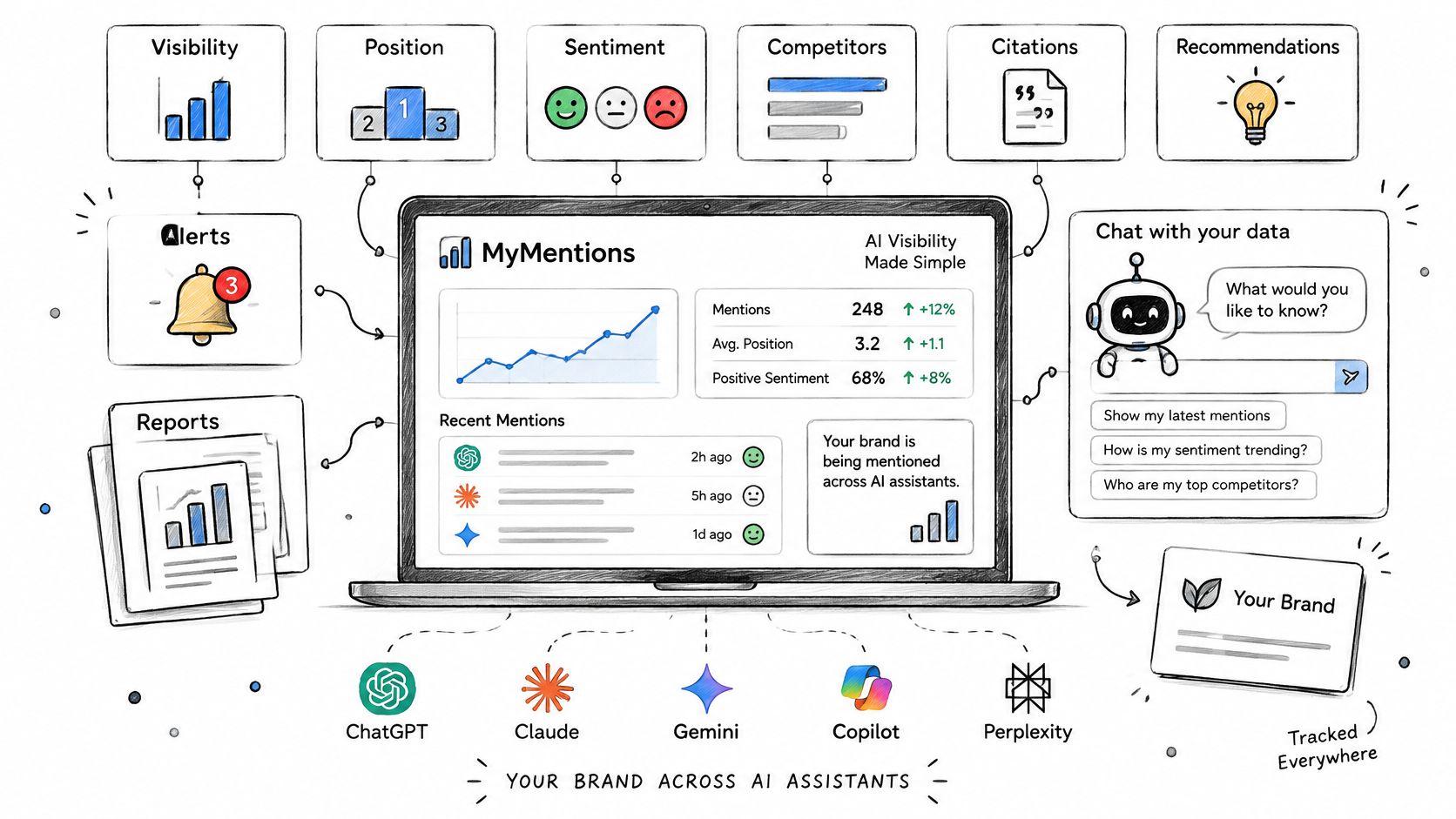
Start by checking which buyer prompts contributed to the decline. Position is the average rank when the brand is recommended, so review the recommending answers rather than assuming the movement represents disappearance. Then open the returned citation sources and inspect whether the answers rely on outdated documentation, third-party comparisons, or pages missing an important qualification.
Where MyMentions shows grading results
| Output | What It Shows | Best Used For |
|---|---|---|
| Live dashboard | Share of voice, average rank, and confidence signals | Weekly review of visibility trends |
| Position view | Average rank when the brand is recommended | Spotting where rivals outrank you |
| Citation source view | Source URLs returned with AI answers and brand mentions | Finding the pages that shape answers |
| AI traffic attribution | Visits from detectable AI sources and landing pages | Checking whether mentions drive visits |
| Alerts | Notices when visibility changes, sent to Slack, Discord, or Email | Catching sudden drops quickly |
| Exported report | Tailored summary for stakeholders | Sharing progress with leadership |
Citation source analysis is available on Pro and Enterprise. Source inspection isn't equivalent to a claim-level correctness verdict: a returned URL gives the reviewer a place to investigate, not automatic proof that the answer is supported.
Use the reports dashboard examples to organize a stakeholder summary around the affected prompts, evidence, and proposed action. In the hypothetical weekly review, a useful outcome would be a named owner correcting an ambiguous feature page, followed by a controlled rerun, rather than a generic instruction to publish more content.
The video provides another view of the workflow.
Read traffic as observed attribution
AI traffic tracking requires installing our website tracking script. It records visits classified from detectable AI sources, landing pages, and engagement.
Missing referrers, blocked scripts, and source classification can affect coverage. Treat attributed visits as observed traffic, not a complete count of every visitor who encountered the brand through an assistant. Keep that distinction in exported reports so stakeholders don't confuse visibility, detectable visits, and commercial outcomes.
Confirm a Grader Before You Act on Its Score
A headline score should trigger an investigation, not dictate a content roadmap. Before assigning work, establish whether the measurement supports the decision you're about to make.
Apply a decision checklist
- Confirm scope: Require the prompt list, provider coverage, and reporting period. Compare like-for-like segments rather than differently constructed averages.
- Inspect citation judgments: Verify that the grader evaluates support for individual claims instead of merely counting URLs. Use these criteria for reliable citation analysis to structure the review.
- Read uncertainty: Look for a confidence range or an explanation of repeated-run variability. Investigate whether the headline movement exceeds the baseline's ordinary fluctuations.
- Separate diagnostics from outcomes: Our site audit scores are diagnostic suggestions, not AI ranking factors. Fixing a flagged issue isn't proof that recommendations will improve.
- Respect exclusions: Keep unmeasured consumer interfaces out of claims about coverage.
Run a controlled baseline
Choose buyer-intent prompts that represent actual evaluation decisions. Freeze the baseline set, run it across supported providers, manually verify consequential claims, and repeat the collection before treating a change as durable.
Assign work according to the evidence: missing information needs a different intervention from a misread qualification or an inaccurate third-party page. Record the intended correction so the next review tests a specific hypothesis.
Act on a movement only when the answer, cited source, and claim grade remain stable across repeated runs. Otherwise, log it as low-confidence noise and keep measuring. That rule prevents a volatile score from becoming an unsupported business decision.
MyMentions brings buyer-prompt monitoring, citation sources, competitor comparisons, and detectable AI traffic into one workspace. Visit MyMentions to establish a visibility baseline, inspect the answers behind your grades, and turn supported findings into a prioritized improvement backlog.