AI-generated recommendations can overlook a globally recognized brand. A benchmark of the top 80 brands recorded just 4% average visibility across three generative AI models, with 16 of the 80 brands absent from every answer, according to the Geometriqs global benchmark. Recognition alone no longer guarantees inclusion.
The growth playbook now requires more than rankings, domain strength, and branded demand. Those signals still support discovery, yet they do not fully predict whether ChatGPT, Google AI Overviews, Claude, Perplexity, or another assistant will mention, recommend, or cite a company. Brand visibility in AI is becoming a share-of-voice problem inside generated answers.
Teams therefore need to track signals beyond traditional SEO, including off-site media mentions, third-party references, and citation quality. These inputs can influence which brands assistants retrieve, compare, and present when buyers ask solution-focused questions.
Table of Contents
- The Invisibility Problem in the Age of AI
- What Brand Visibility in AI Really Means
- Why AI Visibility Is Your New Growth Engine
- The Signals That Influence AI Visibility
- Strategic Levers to Improve Your AI Visibility
- How to Measure and Benchmark Your Performance
The Invisibility Problem in the Age of AI
Search visibility no longer guarantees inclusion in an AI-generated answer. Assistants compress discovery into a short response, select a limited group of companies, and may resolve the question without sending the buyer to another search result. That changes the competitive problem from ranking for a page to being selected as a credible answer.
The benchmark discussed earlier shows why this gap matters. Strong recognition, extensive content, and substantial search demand can coexist with weak representation in generative answers. A brand may be familiar to the market yet absent when a buyer asks for products, providers, or solutions that influence a purchase.
Awareness isn't inclusion
Traditional brand awareness measures whether people recognize a name. AI visibility asks a more operational question: does an assistant retrieve that name when a buyer asks for a solution? The two outcomes overlap, but neither reliably predicts the other.
Consider prompts with direct commercial intent. A buyer might ask an assistant to compare customer support platforms, recommend a payroll provider for a growing team, or identify tools that integrate with a specific workflow. The response may include only a short list of vendors. Brands outside that list lose an opportunity before a website visit, branded search, or sales conversation occurs.
The underlying selection process also differs from conventional search. Assistants assemble responses from information they can retrieve and interpret, including third-party coverage, references, and citations. That makes off-site presence and citation quality part of the visibility problem, alongside rankings and domain strength. A brand can publish more pages without becoming more retrievable if independent sources do not reinforce its relevance or credibility.
Measurement needs to reflect that reality. Teams should define prompts around real buyer questions, run them consistently, inspect cited sources, and record how competitors are described. A structured AI brand monitoring workflow creates a baseline that occasional manual searches cannot provide.
Practical rule: Treat an AI answer as a distribution channel with limited shelf space, not as a replacement for a conventional rankings report.
Content provenance creates a related, separate review requirement. Marketers assessing whether material was produced or altered by AI can use an insight into AI text watermarking technology when auditing publishing workflows. Watermarking does not determine brand visibility, but understanding automated interpretation helps teams evaluate how content enters the information sources assistants may use.
The strategic risk is missed demand capture. Companies that measure only organic rankings will overlook whether assistants mention them, cite them, or position competitors more favorably. The stronger response is not merely publishing more content. It is building a credible presence across the external sources that shape AI-generated discovery.
What Brand Visibility in AI Really Means
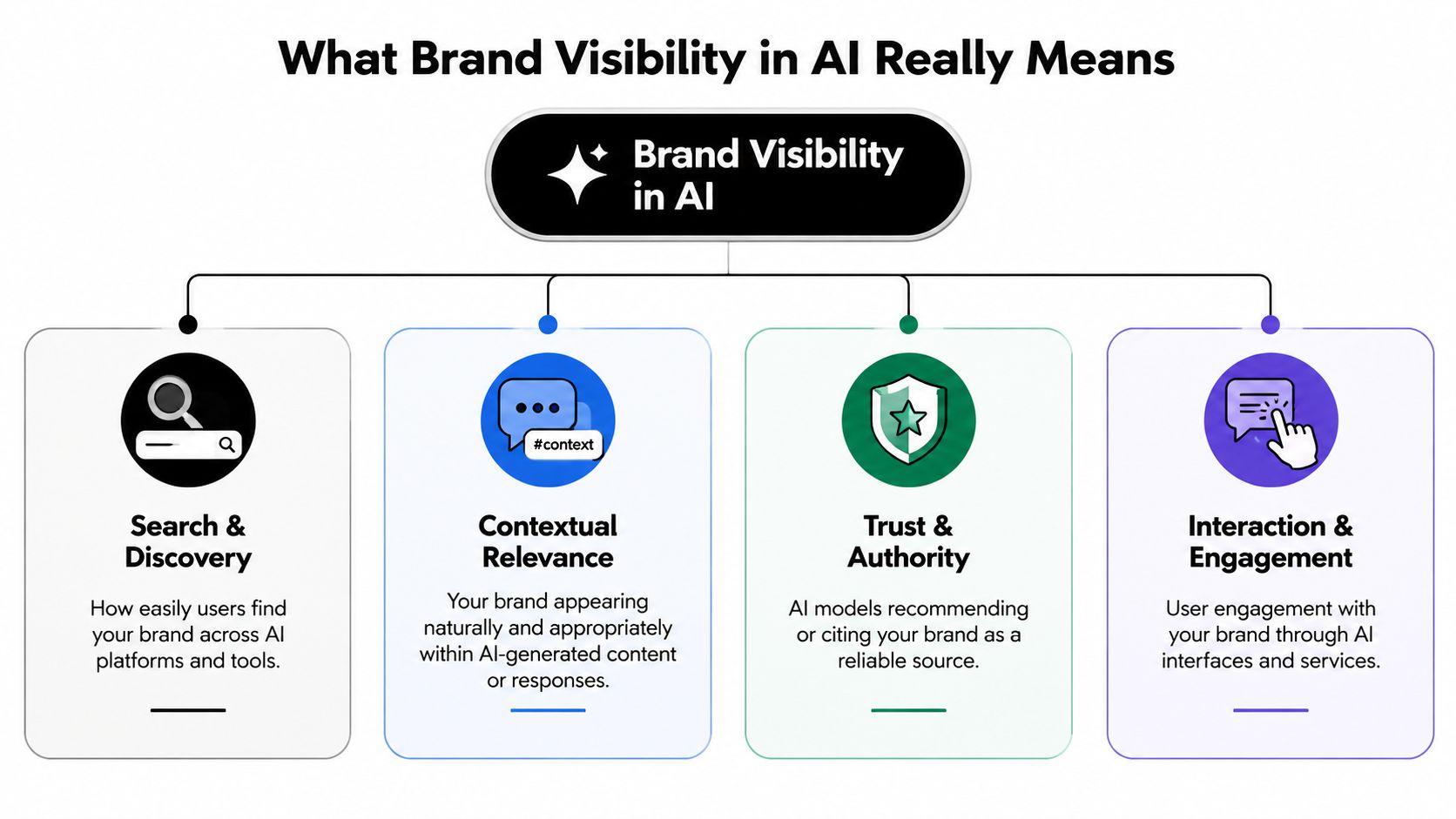
Brand visibility in AI is a composite metric, not a yes-or-no status. A practical model tracks four dimensions: mention frequency, rank and prominence, sentiment, and citation presence. Together, these signals show how often assistants surface your brand, how they position it, and whether their answers give buyers enough context to evaluate it.
Mention frequency
Begin with presence. Measure how often your brand appears across a defined set of relevant prompts. One mention may indicate basic recognition. Repeated inclusion across category, comparison, and problem-based questions provides stronger evidence that the system associates your brand with the topic.
Segment frequency by intent rather than combining every prompt into one score. Informational questions test topical association. Comparison questions test consideration. Recommendation questions test commercial relevance. A brand can appear consistently in one group while remaining absent from another, so the breakdown matters more than a single total.
Rank and prominence
A mention buried in a long answer does not carry the same weight as a leading recommendation. AI responses lack the stable ordering of conventional search results, but teams can still record whether the brand leads the response, appears in a shortlist, or is presented only as an alternative.
Capture the surrounding wording as well. “Suitable for small teams” creates a different commercial impression from “an option worth considering.” Position and description should be reviewed together.
Sentiment and context
AI systems may describe a brand accurately, positively, cautiously, or incorrectly. Sentiment tracking therefore needs claim context, not only a positive or negative label.
Record recurring statements about strengths, weaknesses, pricing posture, customer fit, integrations, and limitations. If an assistant repeatedly assigns your product to the wrong segment, the issue involves entity clarity and messaging, even when mention frequency appears healthy.
Citation presence
A citation indicates that the assistant used a source to support its answer. Track whether cited material comes from product documentation, reviews, partner pages, analyst content, or other independent sources. Citation quality matters because a passing mention creates awareness, while a credible source supports trust and gives the buyer a route to verification.
Research on AI-generated brand answers found that 85.7% of cited URLs came from websites brands didn't own, compared with 14.3% from owned properties (research on LLM brand grounding). The implication is practical: AI visibility depends partly on off-site authority, not only on publishing and optimizing owned pages.
Use an AI ranking framework that evaluates presence, prominence, sentiment, and source quality together. This separates simple name recognition from reliable representation and helps teams prioritize the signals they can improve.
Why AI Visibility Is Your New Growth Engine
AI visibility influences the moment when a buyer turns a problem into a shortlist. A user who asks an assistant for software, services, products, or vendors isn't conducting a passive awareness exercise. They often want a filtered answer that reduces research effort.
That makes inclusion commercially meaningful. A recommendation inside an AI response can place your brand beside competitors before a buyer visits any website, reads a comparison page, or speaks with sales. The assistant may summarize your positioning, identify your target customer, and frame your strengths in the same response.
Discovery is becoming conversational
Search behavior has always included broad research, but AI interfaces compress multiple steps into a dialogue. A buyer can describe their team, constraints, existing tools, and desired outcome in one prompt. The assistant then produces a response shaped around that context.
Your growth team should respond by creating content that clearly answers those contextual questions. Product pages alone won't define every use case. Buyers need comparisons, implementation guidance, integration details, category explanations, and honest limitations. Those assets help external sources describe the brand with precision, while owned content gives assistants material that is easy to interpret and validate.
Visibility affects consideration quality
High visibility isn't valuable if the surrounding context is wrong. A brand recommended for the wrong audience may attract unqualified clicks and create confusion for sales. A smaller but better-matched presence can be more useful than broad inclusion with weak relevance.
Track the relationship between prompt intent and brand description. For example, a project management platform might appear frequently but be described as suitable only for large enterprises. If the company targets smaller teams, its visibility problem isn't merely frequency. The brand needs clearer third-party and owned signals around its actual audience.
A useful growth question: When an assistant recommends your company, does it also explain why the recommendation fits?
AI visibility can shorten the path from problem recognition to evaluation because the user receives a synthesized shortlist. It can also create defensive value. If competitors define your category in assistant answers while your brand remains absent, they influence the language buyers use to assess alternatives.
That makes share of voice a planning metric, not a vanity metric. A focused share-of-voice marketing strategy helps teams compare their presence with competitors across the prompts that matter most to revenue.
The strongest programs connect visibility to downstream behavior. Track assistant referrals where available, assisted conversions, branded searches, demo requests, and sales conversations that mention AI recommendations. Don't assume every impression produces a click. The value may appear first as shortlist inclusion, then later through direct traffic or a branded search.
The Signals That Influence AI Visibility
Traditional SEO asks whether a page can compete for a query. AI visibility asks whether a model can identify your brand, connect it to a need, and support its recommendation with credible evidence. The signals overlap, but their priorities differ.
A 2026 analysis found that YouTube mentions had the strongest reported correlation with AI visibility, about 0.737, across ChatGPT, Google AI Mode, and AI Overviews. Branded web mentions showed correlations of roughly 0.66 to 0.71, while branded search volume was 0.352, domain rating 0.266, and site page count 0.194 (Ahrefs analysis of AI brand visibility correlations). These figures do not prove causation. They do challenge the assumption that owned-site scale drives recognition by itself.
The signal shift
| Signal | Traditional SEO impact | AI visibility impact, correlation | Takeaway |
|---|---|---|---|
| Domain rating | Often used as a proxy for authority | 0.266 | Useful context, but weak on its own |
| Site page count | Supports broader topical coverage | 0.194 | More pages do not automatically create recognition |
| Branded search volume | Indicates existing demand | 0.352 | Awareness helps, but does not ensure inclusion |
| Branded web mentions | Supports reputation and discovery | Roughly 0.66 to 0.71 | External references deserve active investment |
| YouTube mentions | Limited as a conventional ranking metric | About 0.737 | Video presence may materially support AI association |
The practical conclusion is clear: AI systems build brand understanding from an ecosystem, not just a domain. Reviews, comparison pages, partner directories, podcasts, video transcripts, community discussions, and specialist publications all add language and context around your entity.
Third-party evidence beats self-description
Research on LLM grounding found that 85.7% of cited URLs came from non-owned sites, making external validation part of the information layer assistants use when forming brand answers. The finding reinforces the shift from traditional SEO metrics toward off-site evidence.
Your website still needs to define products, use cases, terminology, integrations, and proof points with precision. Owned content establishes the facts. Independent sources confirm how the market understands those facts, and their relevance depends on context, not mention volume alone.
Synthetic user testing can help teams examine how people or AI agents might interact with different product experiences. A guide to synthetic user testing supports better research design by clarifying prompt variation and the difference between simulated behavior and real customer evidence.
The strategic trade-off: Publishing another generic article may expand topical coverage, while earning a credible external mention can strengthen entity signals that owned content cannot provide alone.
The weaker metrics still matter. Domain authority, branded demand, and page depth support discoverability and trust across the broader ecosystem. They are incomplete indicators of whether an assistant will name your brand.
Use AI citation tracking to identify which sources appear in answers, then compare those sources with current PR, content, and partnership activity. The result is a practical source acquisition plan, grounded in citation quality and relevance rather than page count alone.
Strategic Levers to Improve Your AI Visibility
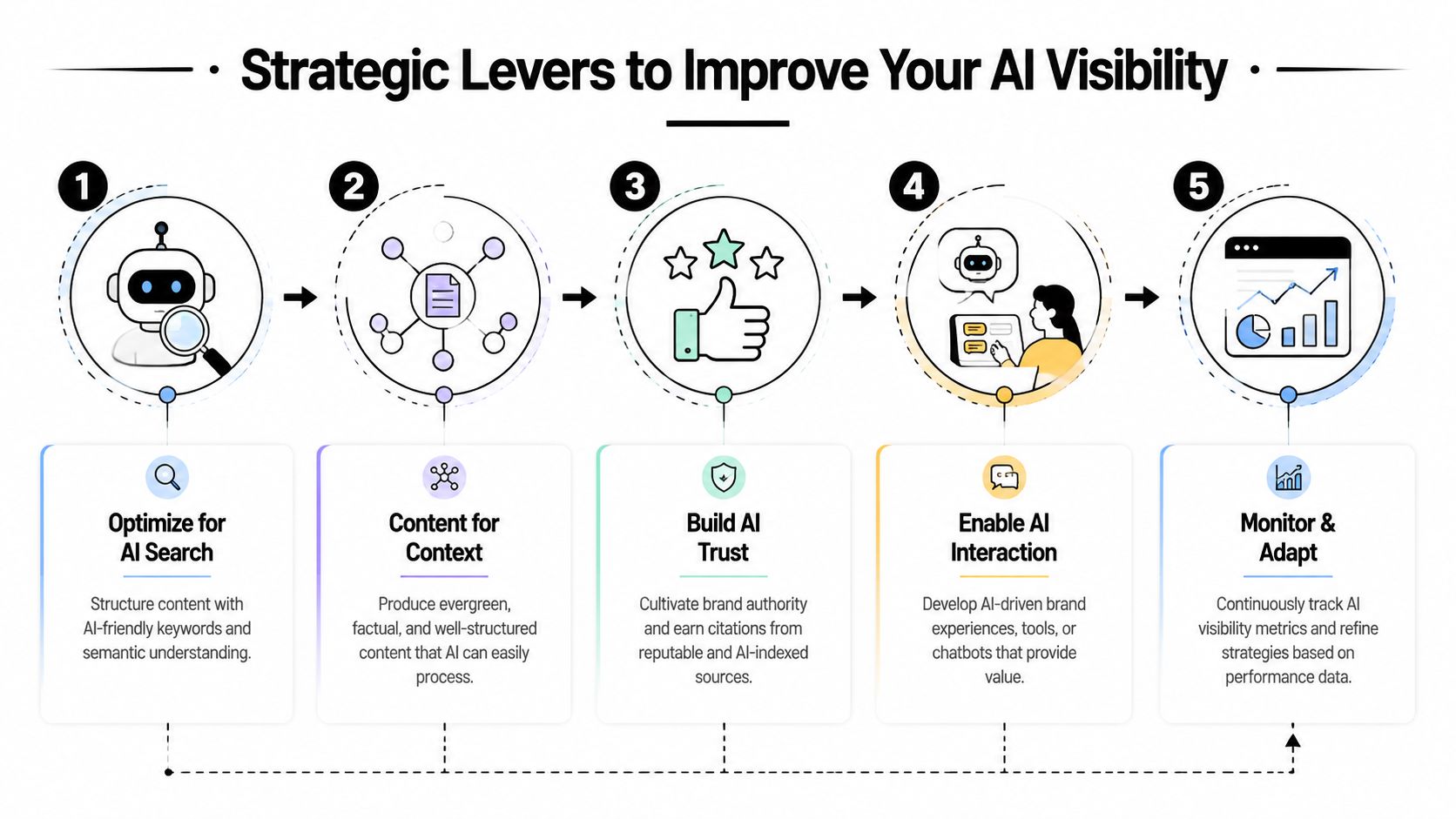
Improving AI visibility starts with a simple shift: stop trying to manufacture isolated appearances and build a durable citation graph. Your brand should be described consistently across independent, crawlable, contextually relevant sources.
Build external coverage around buyer language
Digital PR works better when it creates useful category evidence, not just a logo mention. Pitch proprietary observations, original frameworks, customer-problem analysis, and expert commentary to publications that already cover your market.
Prioritize sources based on relevance and clarity. A niche publication that explains your product in the language buyers use may be more valuable than a broad publication that mentions the company without context. Seek coverage across several source types, including reviews, partner pages, industry media, comparison sites, and video.
Make your entity easy to understand
Your website should answer basic identity questions without forcing an assistant to infer them. State what the product does, who it's for, which problems it solves, how it differs, and which integrations or workflows it supports.
Use consistent naming across product pages, documentation, profiles, and external listings. Organize content with descriptive headings, concise definitions, comparison tables, FAQs, and evidence that a retrieval system can extract without losing meaning.
Create sources others can cite
A strong citation graph needs material worth repeating. Publish original research, practical benchmarks, implementation guides, glossaries, and clear explanations of difficult category concepts. Give partners, journalists, reviewers, and customers specific facts and language they can reference accurately.
Don't confuse volume with authority. Ten shallow pages that repeat common advice won't necessarily help an assistant understand your brand. One valuable resource can create more downstream references if it answers a question that independent writers and buyers already have.
Treat reviews and communities as information assets
Reviews don't just influence human prospects. They can clarify use cases, strengths, limitations, and customer fit for systems that synthesize third-party information. Encourage honest feedback, respond to recurring concerns, and make sure profiles on relevant platforms accurately describe the product.
Participate in communities without turning every discussion into a sales pitch. Helpful answers create language around the brand, while promotional repetition can weaken trust and produce low-quality signals.
A 2026 analysis reported a possible durability threshold: visibility gains held more than twice as often for brands with four or more offsite mentions than for brands with only one to three (coverage of the offsite mention threshold analysis). The finding suggests that repeated, diverse references may be more durable than a single placement, but it doesn't prove that purchasing mentions causes AI systems to recommend a brand.
Don't buy the conclusion too quickly: Correlation can identify a promising lever, but it can't establish a causal guarantee across every model, market, or query.
The practical allocation is clear. Build a balanced mix of authoritative coverage, useful reviews, partner references, community expertise, and video content. Then test whether those activities change visibility for the exact prompts your buyers use.
Use the strategy as an operating loop, not a launch campaign.
Review the sources that assistants cite, identify where competitors appear instead, and give content and PR teams a prioritized list of gaps. Over time, the objective is a stronger, more coherent external record of what your brand does and when it fits.
How to Measure and Benchmark Your Performance
Measurement begins with a prompt set, not a dashboard. Build a library of buyer-intent questions that reflects category discovery, problem solving, comparisons, alternatives, integrations, and use cases. Include prompts that mention competitors and prompts that describe the problem without naming any vendor.
Run the same prompt families across the AI platforms that matter to your audience, then record the answer rather than relying on a single output. AI responses can vary, so a useful benchmark looks for patterns across repeated observations. Avoid treating one surprising recommendation as a strategic truth.
Track the complete answer
For every response, capture:
- Presence: Whether the brand appears at all.
- Prominence: Where it appears and how prominently the answer presents it.
- Sentiment: The tone and recurring claims associated with the brand.
- Citation quality: Which sources support the answer and whether they accurately represent the company.
- Competitive context: Which alternatives appear, how they're framed, and which sources support them.
Calculate share of tracked answers where the brand appears, then segment the result by prompt intent, model, geography, and product category when those dimensions matter. Review changes over time alongside publishing, PR, partnership, and product-marketing activity.
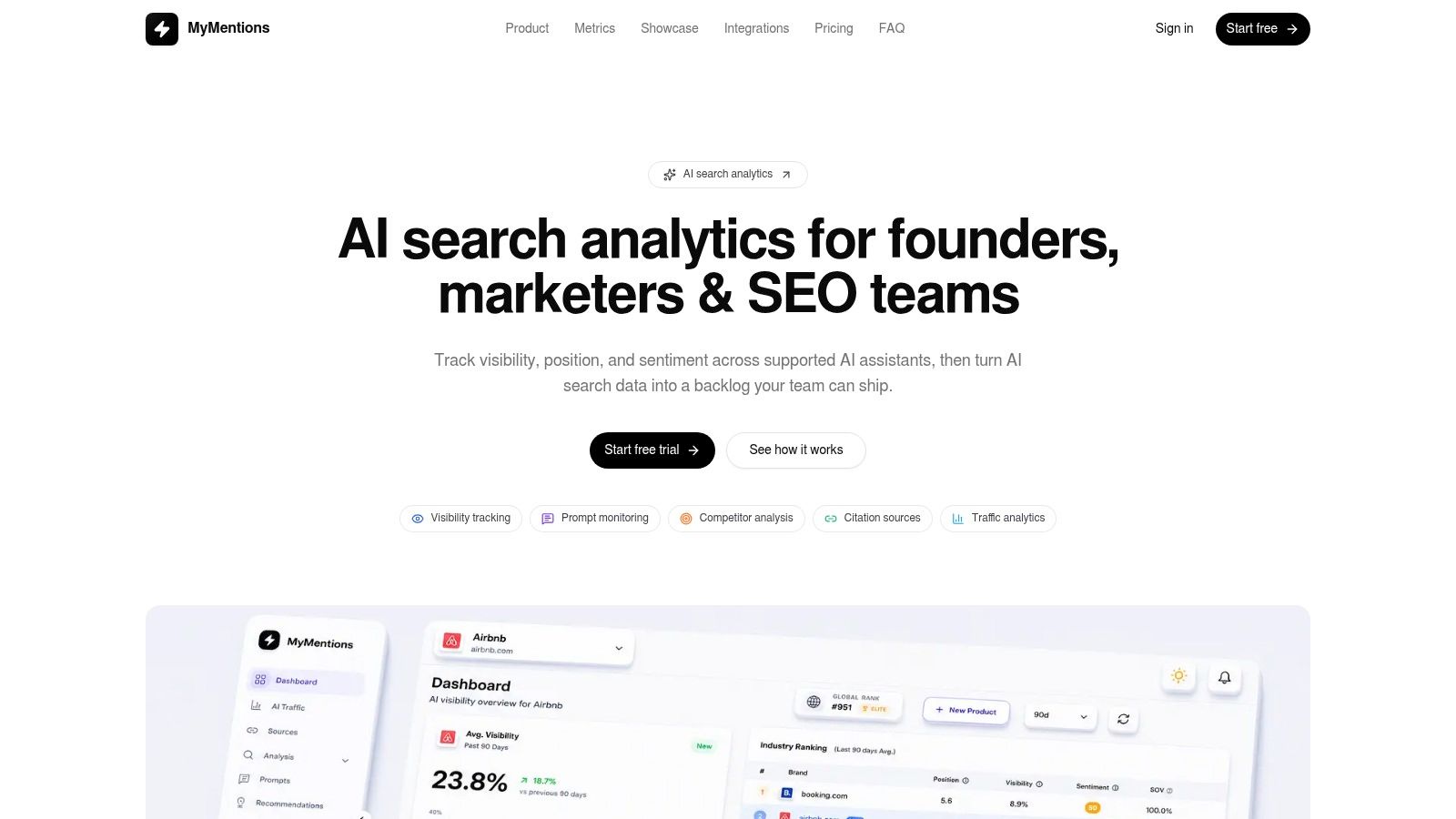
A dashboard should turn observations into decisions. If your product appears for “best tools for remote teams” but not for “tools that integrate with your existing workflow,” the next action may be a content or positioning fix. If assistants repeatedly cite an outdated review, the priority may be updated third-party coverage rather than another page on your own site.
Benchmark against competitors
Absolute visibility can mislead. Compare your brand with the alternatives buyers are likely to consider, and inspect the source mix behind each result. A competitor may appear more often because several independent publications describe its use cases clearly, not because its domain has more pages.
Keep a record of prompt wording and provider behavior. Don't change the prompt set every time results move, or you'll lose the ability to distinguish real change from measurement noise. A documented method for measuring AI search visibility gives your team a repeatable basis for reporting and prioritization.
The most useful benchmark connects visibility to business outcomes. Compare AI mentions and citations with referral traffic, assisted conversions, branded demand, and qualified pipeline where attribution allows. Visibility isn't revenue by itself, but it can reveal whether your brand enters the buyer's consideration set before conventional analytics records a visit.
MyMentions tracks whether AI assistants mention your brand, where it appears, how it is described, and which sources shape the answer, while helping teams compare competitors and organize buyer-intent prompts. Visit MyMentions to turn AI visibility observations into a monitored workflow with actionable citation and content priorities.