What Is Search Engine Visibility and How to Measure It
What is search engine visibility? See how impressions, average rank, clicks, and share of voice differ from SEO and brand reach.
Search engine visibility is how often a relevant audience can encounter a page or brand for a defined query set, not a single rank or a traffic total. That challenges the most popular advice in this space, which tells you to check one keyword, celebrate position one, and call the job done. A rank can hold while clicks fall, a famous brand can vanish on comparison queries, and a page can be indexed yet never appear where buyers look. If you measure exposure, inclusion, clicks, and outcomes separately, across classic results and AI answers and over time, you'll see what a single position hides.
Table of Contents
- What Search Engine Visibility Means
- Metrics That Show Whether You Are Visible
- Visibility Compared with SEO and Brand Reach
- Why Product Teams Lose Clicks When Rank Holds
- Visibility Examples Across Queries and Time
- Readings That Misstate a Visibility Score
- Choose the Queries Worth Tracking First
What Search Engine Visibility Means
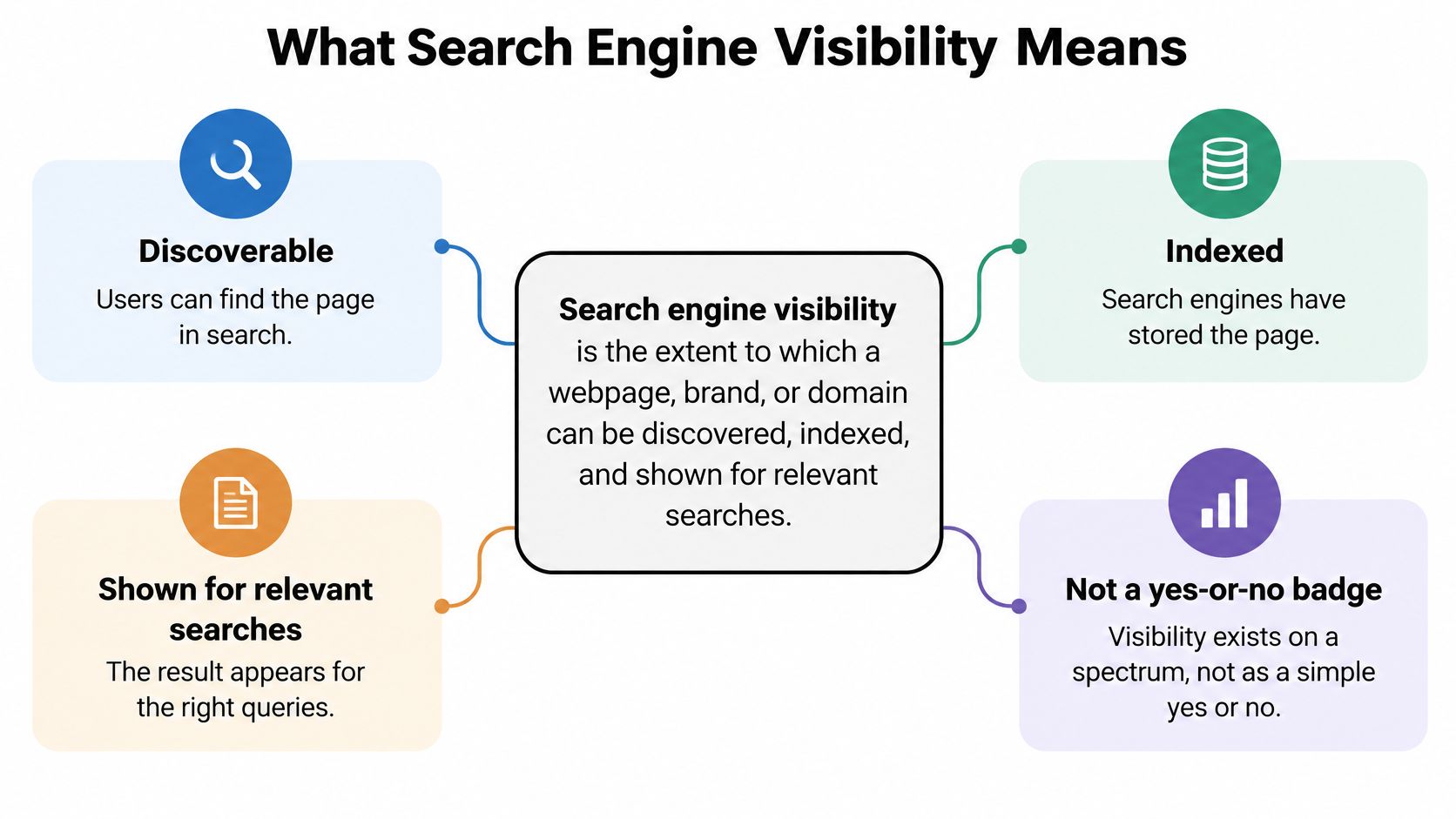
Search engine visibility is the extent to which a webpage, brand, or domain can be discovered, indexed, and shown for relevant searches. It's not a yes or no badge, and it's not the same as holding position one for one term.
Say a SaaS team ships a new pricing page and asks why no one finds it. The answer depends on where the page stops in a three stage system. It might never reach a searcher, or it might reach the index and still miss the query.
Crawling, Indexing, and Serving in Order
Google's guide to how search works describes crawling as automated programs discovering and downloading webpage content, indexing as analyzing text, images, videos, titles, and other attributes and storing that information, and serving as selecting results judged relevant and high quality for a query. Google reports its index contains hundreds of billions of webpages and other digital items and is well over 100,000,000 gigabytes in size.
That scale makes visibility a distribution problem. You're not asking whether a page exists. You're asking whether systems pick it from an enormous pool for a specific person, query, and moment.
Two Ways a Page Stays Invisible
A page search engines can't crawl or index is generally not eligible to appear at all. Blocked resources, broken internal links, or a page no other page points to can stop it before ranking is even possible.
An indexed page can still get little exposure. If it ranks poorly or misses user intent, searchers won't encounter it for the queries that matter. Relevance can depend on hundreds of factors, including the searcher's location, language, and device, so the same page can show well in one market and barely appear in another.
Practical rule: Fix eligibility first, then relevance. A brilliant page that isn't indexed has no visibility to improve.
For a product team, the usable question is narrow. For the queries buyers use, are the right URLs eligible, how often do they show, where do they show, and do they earn attention? Service firms face the same sequence, which is why resources on SEO optimisation for service businesses start with crawl access and page relevance before they talk about rankings. That order matters for SaaS docs, comparison pages, and landing pages too.
Technical accessibility, useful content, and structured page information all contribute, but none guarantees prominent placement on its own. Visibility is the combined result, measured query by query.
Metrics That Show Whether You Are Visible
A single rank hides absence. A founder sees position 3 on two queries and assumes buyers find the product, while twenty other buying queries return no mention at all. Visibility is a stack of exposure, inclusion, clicks, and outcomes, sampled over time for a fixed query set. The table below breaks that stack into readings you can pull today.
| Metric | What it counts | What it does not count | Where to read it |
|---|---|---|---|
| Impressions | Times a result was shown for the tracked queries | Clicks, citations, or revenue | Google Search Console |
| Clicks | Selections of that search result | Assisted demand or off-site branded searches | Google Search Console |
| Click-through rate | Clicks divided by impressions | Visit quality; position 1 averages about 27.6% of classic clicks per an SEO statistics compilation | Search Console, compared with a rank study |
| Average position | Mean rank when the URL is shown | Queries where the URL never appears | Search Console or a rank tracker |
| Share of voice | Share of a fixed query or answer set where the brand appears | Total market reach outside that set | Query list, rank tracker, or prompt tracker |
| Index status | Whether the URL is eligible to be served | Prominence, clicks, or intent match | Search Console page indexing |
What Each Number Actually Tells You
Impressions count times a listing was shown, not visits. Rising impressions mean more exposure, even when clicks stay flat. That early signal matters because exposure has to happen before any click or conversion is possible.
Clicks count selections of that result. They show exposure turned into a visit. They do not show whether the visit answered the need, or whether a buyer saw you cited elsewhere and later searched your brand name directly.
Click-through rate is clicks divided by impressions. It reflects layout and intent as much as rank. The top organic result in classic search typically earns roughly a quarter to a third of clicks, with one SEO statistics compilation putting that average at 27.6%. Use it as a benchmark for classic listings. AI summaries work differently, with citations, chat answers, and follow-up questions changing what gets selected.
Average position is the mean rank when your URL is shown. It says nothing about queries where you never appear. A tidy average can hide complete absence on the buying queries you care about most.
Share of voice corrects that blind spot. The measure is simple. Take your written list and count the share where the brand appears at all. Rank first on two terms and stay silent on twenty others, and the share is low even though average position looks excellent.
Index status only means the URL can be served. No prominence is promised. No click is promised. No match with intent is promised.
How to Pull a Clean Baseline
Open Google Search Console and pull impressions, clicks, click-through rate, and average position for one country and one device type at a time.
Mixing countries and devices blends different layouts into one misleading average. A phone result with local packs and AI summaries behaves nothing like a desktop result for the same words. If you want this as a repeatable routine, a step by step guide on how to track SEO performance helps you set the reporting cadence.
Calculate share of voice only on a written query list. Split that list into branded and non-branded from the start. Branded queries, where searchers already know your name, will flatter every metric and hide weak discovery.
Read the columns together. One number moving alone rarely means what it looks like.
The Paired Movement That Confuses Teams
Watch for this pattern. Average position improves while impressions fall.
That combination often reads as progress. It can mean demand for those queries dropped, so fewer searches happened. It can also mean the layout changed and the listing now shows less often, but ranks higher on the times it does show. Fewer people encountered you. Rank improved and exposure fell.
Visibility Compared with SEO and Brand Reach
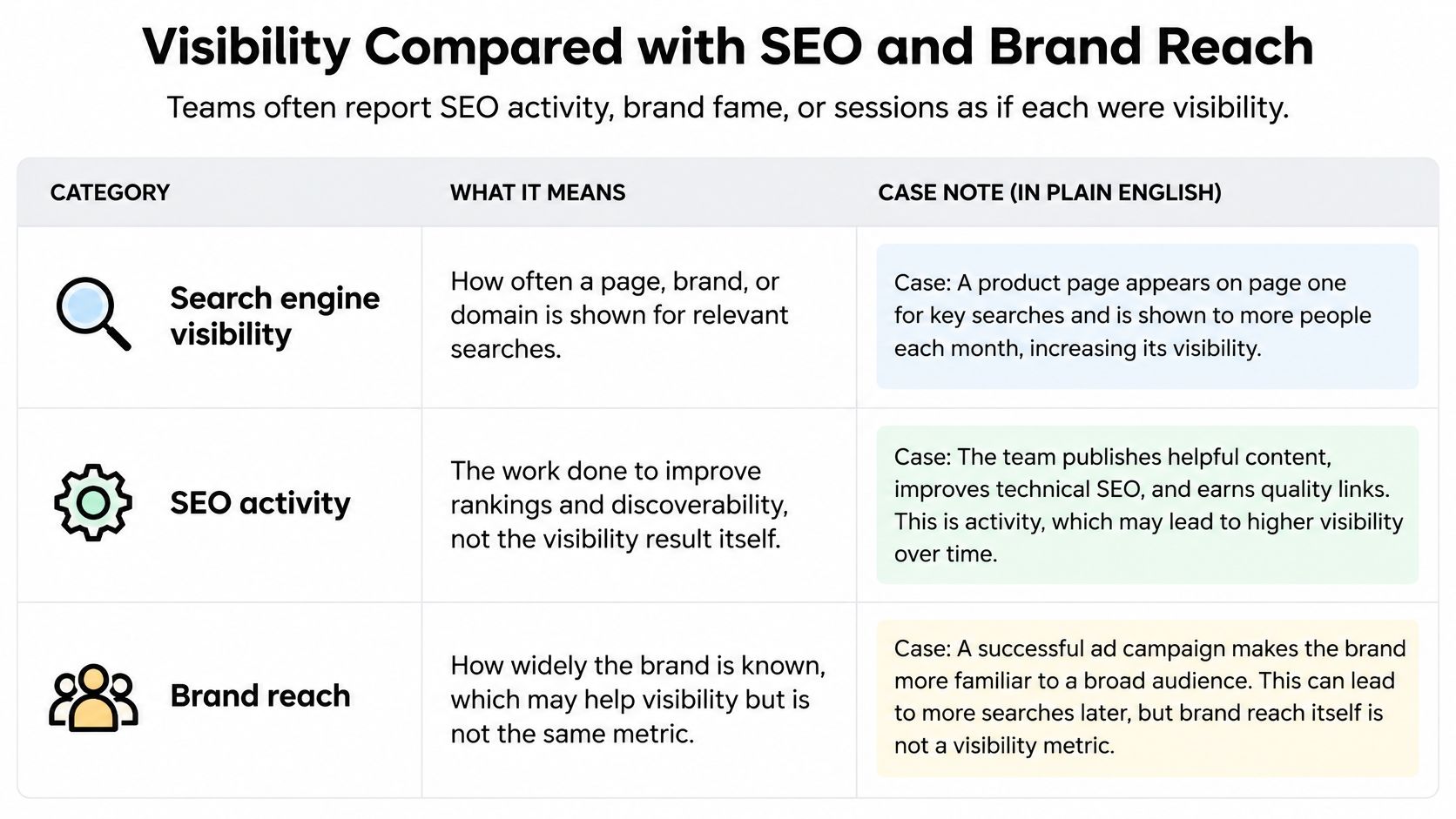
Teams waste quarters reporting SEO activity, brand fame, or sessions as if each one were visibility. They're related, but they answer different questions and use different units.
| Idea | Question it answers | Unit | Can look strong while search visibility is weak |
|---|---|---|---|
| Search engine visibility | Will the right searcher encounter us for these queries | Exposure across a fixed query set | No, by definition of that set |
| SEO | What work might improve eligibility and relevance | Projects, pages, and fixes | Yes, if pages stay unindexed or off intent |
| Brand visibility | Do people know the name anywhere | Mentions, ads, social, and PR | Yes, if non-branded queries never show the brand |
| Organic traffic | Did someone click through | Sessions from search | Yes, if exposure or citations do not earn the click |
Where Each Idea Diverges
SEO is the work, not the result. Crawl fixes, clearer titles, internal links, and deeper topical coverage aim to improve eligibility and relevance. A busy program can ship all of that and still have weak visibility if key pages stay unindexed or target queries buyers don't use.
Brand visibility is wider and looser. Ads, social posts, press coverage, and word of mouth build name recognition anywhere. That helps, but a well known brand can still be nearly invisible on non-branded comparison queries where buyers haven't picked a vendor yet. If you want the mechanics of turning search presence into enquiries, Wojo Media's Google lead guide walks through that path for service businesses.
Organic traffic requires a click. Sessions can fall while exposure holds steady. If an answer cites your brand and the searcher gets what they need without leaving the results, you were visible and earned no visit. Counting only sessions calls that a failure and misses the exposure entirely.
One Product, Four Different Verdicts
Say a project tool ranks first for its own name, gets regular press, and runs an active content program. Branded retrieval is strong, brand reach is broad, and the SEO team is busy. Yet on "best alternative" and "tool for remote teams" queries, competitors fill the results and the answers. Its share of voice on buying queries is near zero.
That's not a contradiction. Each metric measured a different thing. A clear explainer on what share of voice means helps teams keep that query set measure separate from fame.
Fund SEO work to change visibility. Judge brand work on awareness. Judge traffic on visits and what those visits do. And judge search visibility on the query set metrics, not on how busy the team was.
Why Product Teams Lose Clicks When Rank Holds
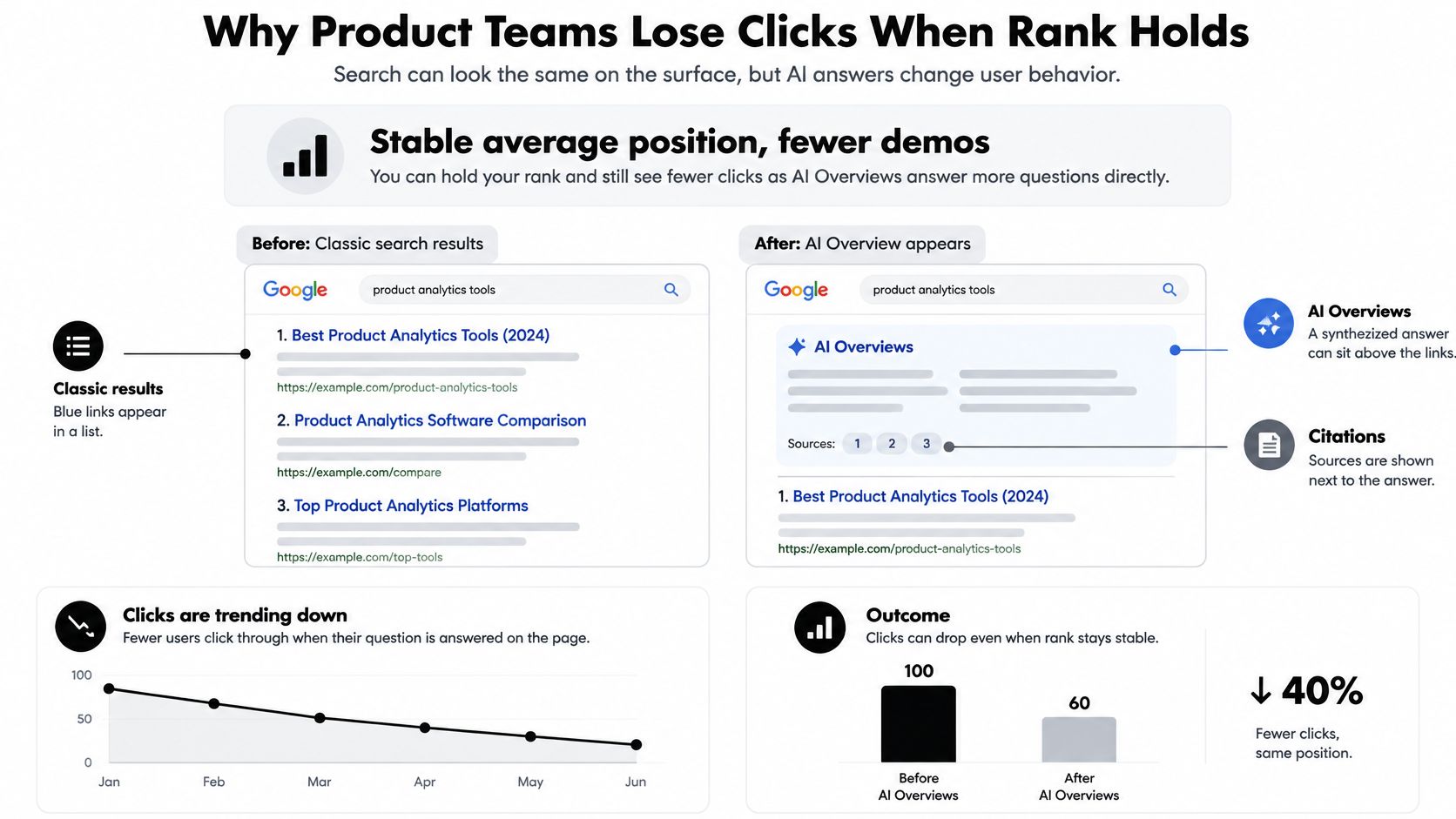
Your average position holds steady, yet demos slip. The list did not move. The page around the list did.
Classic results show a blue link in a list and invite a click. AI Overviews place a synthesized answer above those links, add citations, and shrink how many listings a searcher notices. Your link can sit in the same slot, lower on the screen, beneath an answer that already resolved the question. Same rank, less prominence.
The Click Evidence
Google's account of AI search behavior associates AI Overviews with longer, more complex queries and more links shown on the page. Independent research finds users click links less often on searches that include an AI-generated summary, since many searchers stop at the summary itself.
More links on the page does not mean more clicks for you. Rank stability is not evidence that visibility held.
A Four Layer Stack for Reporting
Visibility works like a stack of exposure, inclusion, clicks, and outcomes, sampled over time for a fixed query set. Separate these layers and the confusion clears up.
Exposure: An impression in classic results, or an appearance inside an AI answer. Someone could have seen you.
Inclusion: A citation to your page or a mention of your brand name in the answer. You were part of the answer itself, not just listed below it.
Click: An organic visit, or a detectable referral from an AI surface. Someone arrived.
Outcome: A signup, demo, or pipeline event in your own analytics. The visit did something you value.
A page can gain inclusion and lose clicks in the same week. The answer names your product, readers trust the summary, and fewer of them visit your site to confirm it. Track only clicks and you will call that a decline. Track only mentions and you will call it growth. Both readings miss half the story. A practical primer on AI traffic analytics shows how to keep referral visits distinct from mentions so one does not inflate the other.
For product teams, the pages AI answers draw on are often documentation, comparison pages, review profiles, and help content, not only the homepage. A pricing detail buried in a sales deck will not be cited. The same detail stated plainly in crawlable docs, matched on a comparison page, gives systems something to quote and corroborate. Report impression-like exposure separately from citations, clicks, and conversions.
A flat rank chart during a layout change isn't reassurance. It's an incomplete report.
When demos dip, check the format before you rewrite the page. Ask whether an answer now appears above you, whether you are cited in it, and whether click-through rate fell while impressions held. Those three checks tell you if you lost prominence, lost inclusion, or lost the click after being seen.
Visibility Examples Across Queries and Time
The same SaaS product can score as visible, invisible, and unstable in one month. The query changes the result. The week changes it again. That is why visibility works like a stack of exposure, inclusion, clicks, and outcomes, sampled over time for a fixed query set.
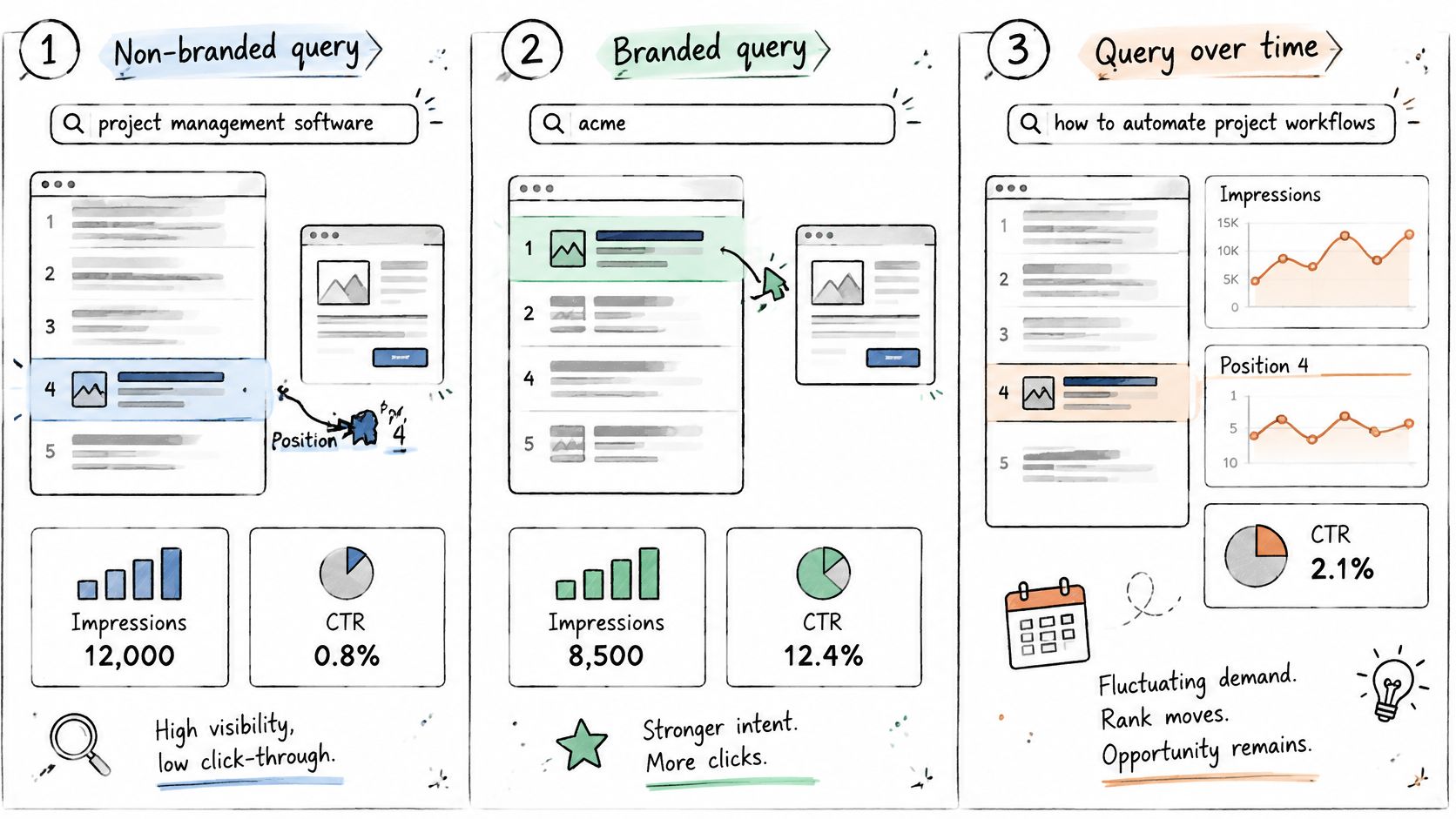
A product page holds around position four for a “best tool for” query. Impressions look healthy, so exposure is decent. Clicks stay weak because an AI answer above the listings cites a review site instead of the vendor.
Call this exposure without inclusion. The page is served. The brand is not named in the answer that gets the attention. The repair starts in the sources that answer trusts. Add a comparison page that states use cases, limits, and differentiators in plain sentences that systems can quote and corroborate.
Now run the brand name query. The same product ranks first with a high click rate. Branded retrieval works. People who already know the name reach the site without friction.
That result measures memory, not discovery. Keep branded clicks out of non-branded share of voice. Mixing them hides the gap from the first case and makes the dashboard look stronger than the pipeline feels.
Time adds the third layer. A 2025 Semrush analysis of more than 10 million keywords found AI Overviews appearing for 6.49% of keywords in January, nearly 25% in July, and 15.69% in November. Answers also shift often between observations, with cited sources rotating in and out. A one day check expires fast.
So AI share of voice is modeled potential exposure, not measured audience reach. You are sampling answers, not counting every searcher who saw one. The better question is visible to whom, for which intent, in which market, on which provider, and for how long. Repeated sampling answers it, and a setup for monitoring Google search presence covers the classic side of that routine.
Fix the prompt list first for answer tracking. On that list, visibility is the share of tracked answers where the brand appears, and position is the average rank when the brand is recommended. A visibility score describes the responses collected for the selected prompts, providers, and reporting period, not every AI search.
Readings That Misstate a Visibility Score
Treat visibility as a probability. It's the chance a relevant audience encounters your page for a defined query set, multiplied by the chance that encounter earns attention and a click. Google's ranking systems guide states its ranking systems operate largely at page level and evaluate hundreds of billions of pages using multiple automated systems rather than one universal score. One average rank summarizes that distribution. It isn't the distribution.
Three Misreadings to Correct
Indexed doesn't mean prominent. Crawlable doesn't mean served, either. Generative systems use publicly accessible, crawlable content, yet crawlability still doesn't guarantee serving. A page can be eligible and absent from every result that matters.
A citation isn't a visit, and a visit isn't a signup. An AI traffic visit is separate from a mention, signup, or purchase, and completed conversions must be measured in your analytics or billing system. Stitching those together invents revenue you can't verify.
A tool's number is only as wide as its sample. Our provider checks are provider API checks. They don't reproduce every consumer app experience, and they don't track Google AI Overviews, Google AI Mode, or Microsoft Copilot. Missing referrers, blocked scripts, and source classification can also affect AI traffic tracking coverage. Write down what each tool samples, including surfaces, locations, and devices, before you compare scores.
Then act. Pull pages that are indexed but underperforming, and test titles, descriptive content, internal links, and topical completeness. Separate algorithm driven exposure changes from demand changes before deciding what caused a drop, or you'll fix a page when the market searched less.
Choose the Queries Worth Tracking First
- Write 15 to 30 buyer queries. Label each informational, comparison, or high-intent buying, and keep branded queries in a separate bucket so they can't inflate share of voice.
- Pull the classic baseline. In Google Search Console, filtered by country and device, record impressions, clicks, click-through rate, and average position for the non-branded list. Add a rank tracker where position history needs more detail. Guidance on how to increase Google search visibility helps you act on what that baseline reveals, and the AdCrunch marketer tool comparison is useful when you're choosing supporting tools for the workflow.
- Pair prompts with counterparts. Match each AI prompt to its classic search query, then sample the same intents in AI answers on a repeating schedule, because a one day check expires.
- Add the AI workspace last. MyMentions tracks how AI assistants mention, rank, and describe a product across buyer prompts, and monitors visibility, position, sentiment, competitors, citations, recommendations, and AI-driven traffic in one workspace. To get started, you create a product, choose a plan, and then see how assistants mention, rank, and describe your brand. The Starter plan costs $49 per month and is designed for individual products starting AI search tracking.
- Check the list is done. Every prompt has an intent label and a classic counterpart. Read scores as descriptions of the tracked set, and confirm conversions in your own analytics.
You've defined your query set and separated exposure from clicks and outcomes, so now track how AI assistants mention, rank, and describe your product across those buyer prompts. MyMentions brings visibility, position, sentiment, competitors, citations, and AI-driven traffic into one workspace, so you can spot gaps and act on them. Create your product, choose a plan, and see where your brand appears, and where it doesn't, today.