
A brand can appear in an AI-generated answer and still receive no direct visit. Pew Research Center's analysis of 68,879 Google searches from 900 U.S. adults found that an AI-generated summary appeared in 18% of searches, while users clicked a traditional result in only 8% of visits with a summary, compared with 15% without one. Only about 1% of visits included a click on a source link inside the summary. (Pew Research Center findings)
That changes the evaluation question. The useful question isn't just whether a brand ranks, appears, or gets mentioned. It's whether the right prompt retrieves the right source, whether the answer cites that source prominently, and whether the resulting exposure contributes to qualified demand.
Table of Contents
- Why AI Search Changed What SEO Toolkits Must Measure
- How Retrieval and Generation Shape Modern Answers
- Inside the SE Ranking AI Search Toolkit
- Practical Workflows for SEO and Product Teams
- Precision, Recall, and the Metrics That Actually Matter
- Comparing SE Ranking With MyMentions and Other Platforms
- Tying AI Visibility to Revenue Instead of Just Rankings
- A 30-60-90 Day Rollout Plan You Can Actually Run
Why AI Search Changed What SEO Toolkits Must Measure
A marketing lead sees branded traffic soften while the company continues to appear in ChatGPT answers. A conventional rank tracker shows stable keyword positions, Search Console still reports impressions, and the backlink profile looks healthy. Yet the buyer journey has moved into an answer interface where the brand may be visible without earning a click.
The SE Ranking AI Search Toolkit sits in this changing layer of discovery. It should be evaluated as a measurement system, not as another collection of dashboards. Traditional SEO tools remain useful for crawlability, organic rankings, links, and website performance, but they don't reveal whether an AI system selected a product page, summarized a comparison, or cited a third-party review.
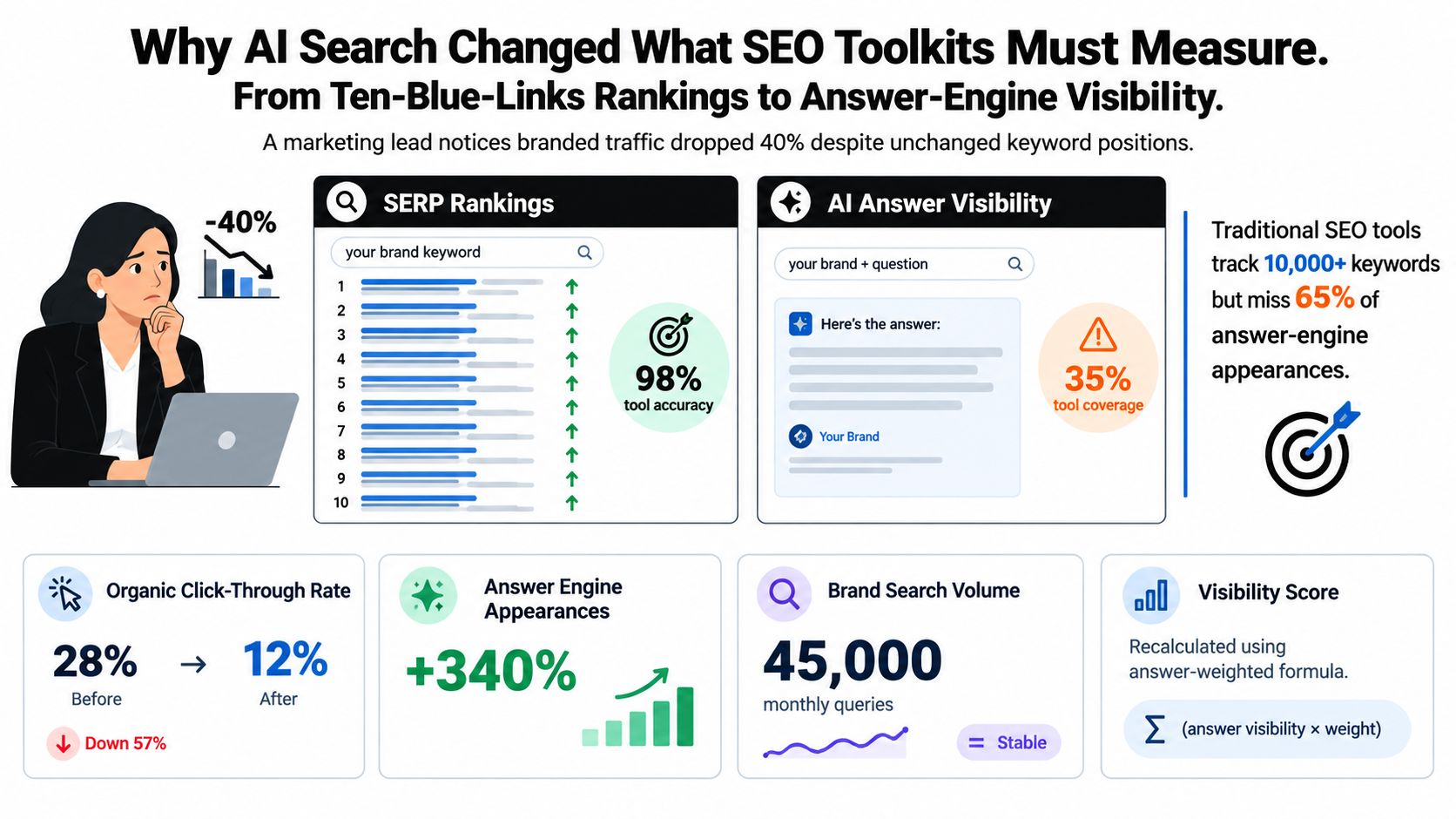
The measurement layer now needs to answer four separate questions:
- Retrieval eligibility: Can the system find and understand the page for a relevant prompt?
- Answer inclusion: Does the brand appear in the generated response, and in what context?
- Citation position: Which URL or domain supports the answer, and how prominently is it placed?
- Business consequence: Does the exposure lead to engagement, a later branded search, an assisted conversion, or no observable action?
This is why a conventional “visibility score” can mislead. A branded navigational prompt may produce an easy mention, while a non-branded comparison prompt may expose a much more valuable gap. Teams that blend both into one score risk reporting familiarity instead of buyer-stage visibility.
Practical rule: Treat every AI appearance as an evidence record. Store the prompt, provider, answer text, cited URL, citation position, brand context, and downstream outcome together.
Google's ranking history helps explain why this shift isn't a rejection of SEO. PageRank, described in the 1998 Stanford paper by Larry Page and Sergey Brin, used link structure to estimate page importance, moving search beyond word matching toward relationships between pages. (PageRank history and context) AI search extends that principle into answer construction. The system still needs discoverable, relevant evidence, but the visible output may be a synthesized answer rather than a list of links.
For teams building a broader framework, AI search optimization is best understood as the work of improving both the source material and the evidence trail that answer engines rely on. The toolkit's job is to show which part of that chain is failing.
How Retrieval and Generation Shape Modern Answers
An AI search system runs two stages. It retrieves candidate passages for the prompt, then generates an answer from the passages it selects. Answer quality is therefore bounded by retrieval quality, even when the final prose sounds fluent.
Google describes retrieval-augmented generation as a process in which responses are grounded in pages retrieved by core Search systems, followed by information extraction and supporting links. Its documented systems include passage ranking, BERT, and RankBrain. These systems evaluate page sections, query meaning, and relationships between concepts, rather than relying only on exact keyword matches. (Google's ranking systems guide)
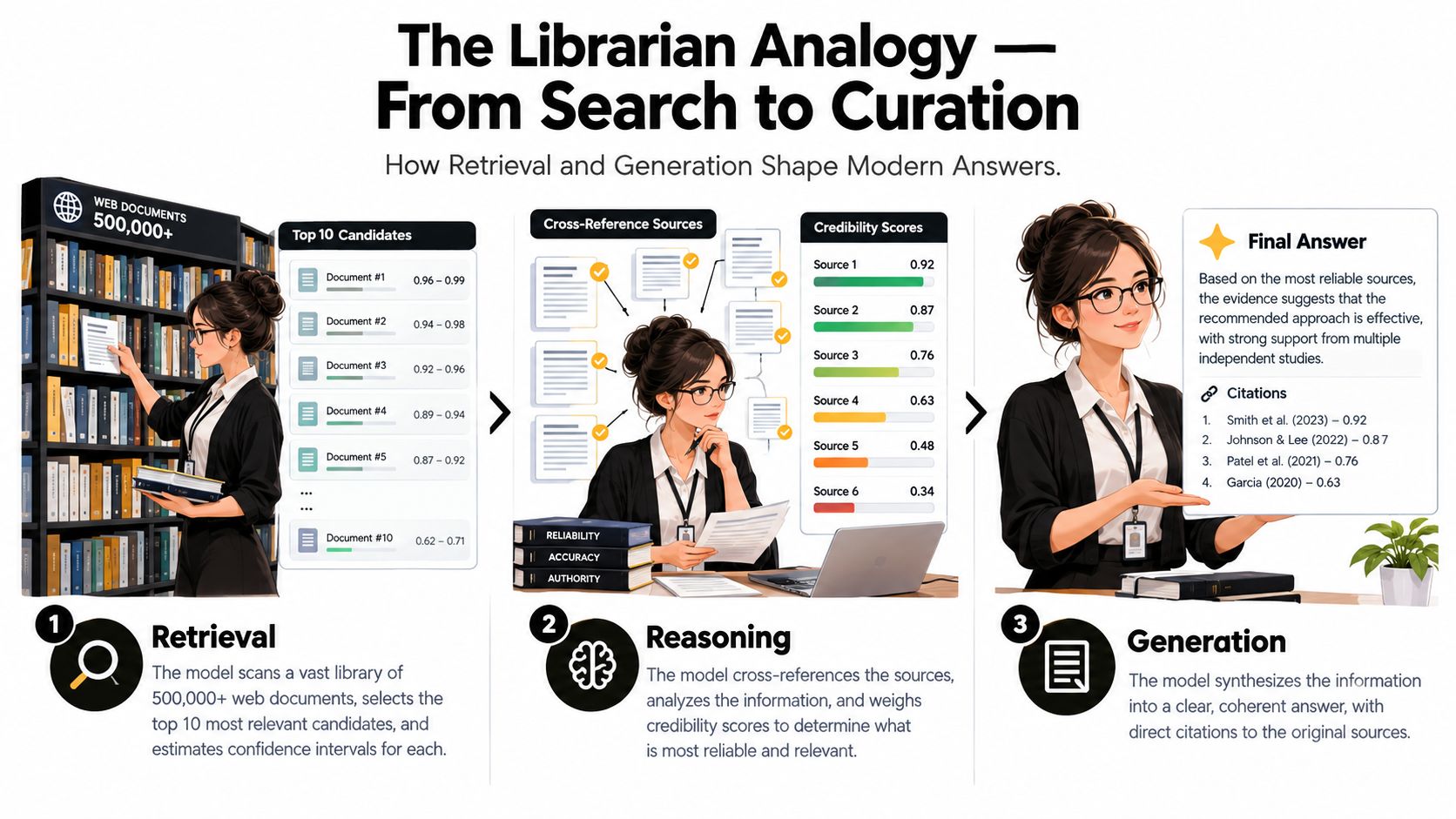
An AI search toolkit must preserve several separate events:
- Retrieved but uncited: A page may enter the candidate set without appearing in the final references.
- Cited but not central: A source can support a minor detail while another source shapes the main recommendation.
- Mentioned without owned evidence: A brand may be named, while the answer relies on a review, directory, partner page, or community discussion.
- Semantically relevant: The system may select a page because it explains an entity, use case, or comparison clearly, even without repeating the prompt's exact wording.
A query fan-out process can turn one user question into several related searches. The practical implications are outlined in this guide to query fan-out. Measurement should therefore record which source and passage contributed to the answer, rather than only whether a brand string appeared.
A report that counts brand mentions treats a retrieved-but-uncited page and a first-position citation as the same event. That hides the difference between a documentation page supporting a technical detail and a comparison article driving the recommendation. “Mentioned” does not equal “recommended,” and “cited” does not equal “influential.”
A defensible workflow stores results at prompt, passage, answer, and source-URL level. If a page disappears, analysts can test whether relevance, freshness, authority, crawlability, or answer composition changed. That granularity connects retrieval precision and citation position to the downstream conversion analysis required for a credible AI-visibility evaluation.
Inside the SE Ranking AI Search Toolkit
SE Ranking positions its AI visibility coverage around major answer surfaces, including Google AI Overviews, AI Mode, Gemini, ChatGPT, and Perplexity. The useful comparison isn't the provider list alone. It's whether the toolkit records the answer context, competitor presence, sentiment, and sources consistently enough to support an action.
The core modules
Prompt management is the foundation. Teams can group prompts by topic, product, funnel stage, geography, or competitor set. That grouping matters because a brand can perform well on navigational prompts and remain absent from “best tool” or comparison prompts. A useful toolkit should make that gap visible rather than blending every prompt into a single average.
The visibility layer measures whether the brand appears and where it appears relative to competitors. Source analysis then identifies the domains and URLs shaping the response. Sentiment adds another dimension, especially when the answer includes outdated pricing, incorrect product positioning, or negative commentary.
| Module | Primary metric | What it tells you |
|---|---|---|
| Provider visibility | Brand appearance by engine and prompt | Where the product enters AI answers |
| Prompt research | Prompt coverage and grouping | Which buyer questions deserve monitoring |
| Competitor benchmarking | Relative presence and position | Where competitors win answer exposure |
| Source analysis | Cited domains and URLs | Which evidence shapes the response |
| Sentiment analysis | Positive, neutral, or negative context | How the brand is represented |
| SEO integration | Organic and technical signals | Whether conventional search supports retrieval |
The connection to SE Ranking's broader rank tracker and site audit can help teams compare conventional search performance with AI visibility. But the data shouldn't be interpreted as a direct conversion between the two. A strong organic ranking can improve retrieval opportunity, yet it doesn't guarantee citation or favorable wording.
Product and ecommerce teams should also inspect how catalogs are represented in answer systems. Guidance on GEO performance for catalogs is useful when product attributes, structured descriptions, and category relationships influence whether an answer engine can distinguish one item from another.
The toolkit's practical limitations deserve equal attention. Coverage depends on the providers, regions, languages, prompt sets, and refresh behavior available in the selected plan. A broad provider list can still produce shallow insight if it doesn't preserve raw answers, source URLs, regional context, or change history. Before adoption, ask how the platform handles answer volatility, repeated runs, exports, and evidence retention.
A tool that captures a daily answer but cannot show the source passage leaves the analyst with an observation, not a diagnosis. The AI visibility tracking workflow should therefore connect provider results to page-level recommendations and a repeatable experiment log.
The video below can help teams understand the product interface, but a demonstration should never substitute for a data-quality test. Use a controlled prompt panel and compare raw outputs, cited URLs, competitor detection, and export fields before committing to a reporting process.
The decisive question is not how many cards appear on the dashboard. It's whether an SEO manager can move from “we disappeared” to “this comparison page was retrieved less often, a competitor replaced it as the first citation, and the revised page recovered on the next controlled run.”
Practical Workflows for SEO and Product Teams
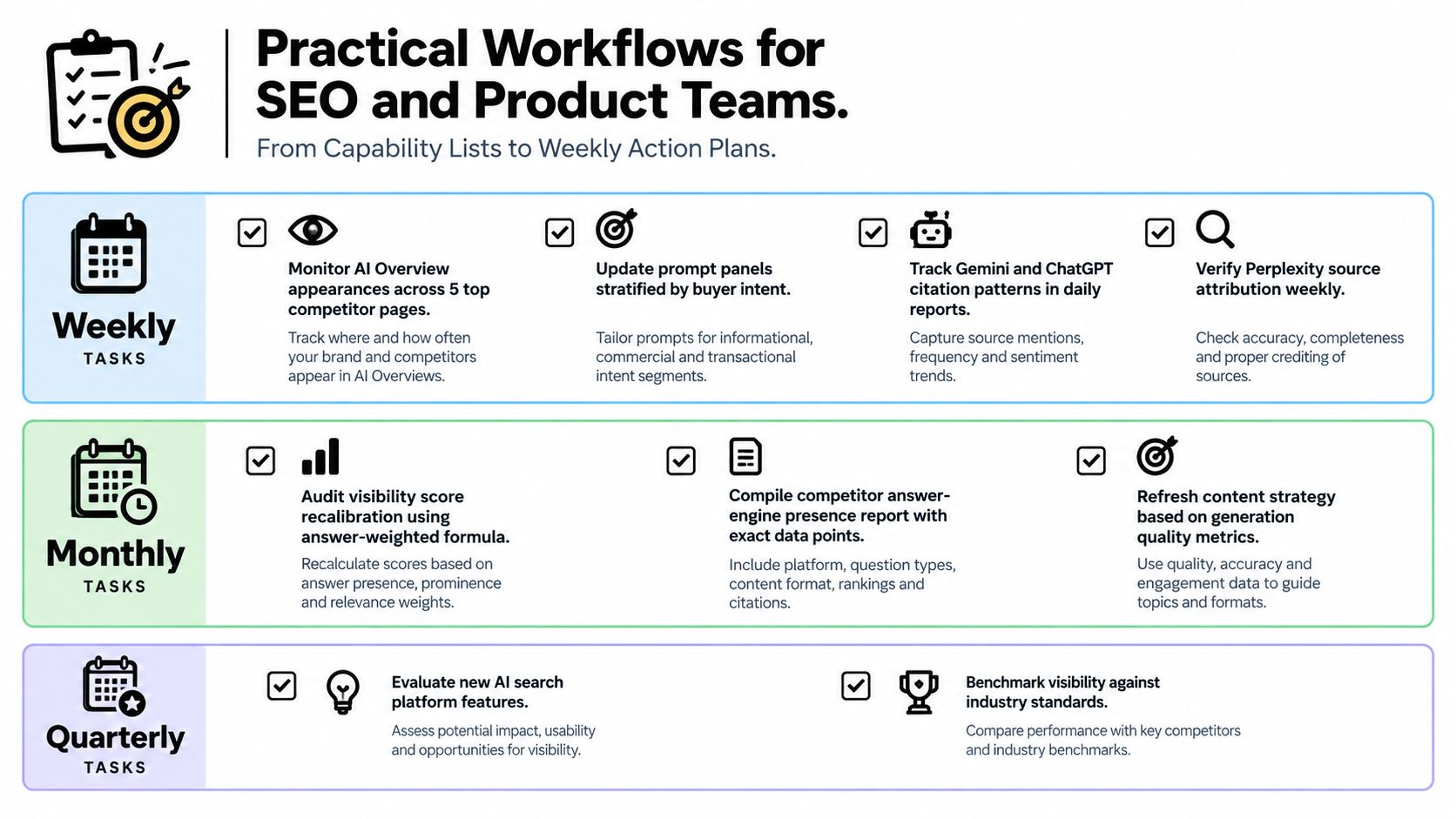
AI visibility becomes useful when it produces a repeatable deliverable. A weekly report that only says “share of voice changed” gives leadership a signal but gives writers, developers, and product marketers no next action.
Build the prompt panel around intent
Start with a fixed panel divided into four groups:
- Informational prompts reveal whether the brand contributes to education and problem definition.
- Comparison prompts test differentiation against named alternatives.
- Best-of prompts expose recommendation and shortlist behavior.
- Navigational prompts confirm whether the system understands the brand and core product.
Keep the wording stable during the baseline period. If prompts change every week, the team can't tell whether visibility moved because the product changed or because the sample changed.
Run the panel on a regular schedule, save the raw answer and cited sources, then produce a change log. The weekly deliverable should identify new appearances, lost citations, competitor substitutions, sentiment shifts, and pages that need review. Alerts can route the highest-priority changes to Slack, email, or a project board, but the alert should contain evidence rather than a bare score.
Give product documentation its own workflow
Support and product teams should monitor technical prompts separately from marketing prompts. A missing citation on a documentation page may indicate unclear terminology, weak internal linking, incomplete feature explanations, or a source-authority problem. The response isn't always “write more content.”
A useful ticket includes the exact prompt, the answer, the cited competitor or third-party URL, the relevant product page, and the proposed revision. After publication, rerun the unchanged prompt and record whether retrieval, citation position, or wording changed. That creates a content experiment instead of an anecdotal before-and-after claim.
Use monthly and quarterly reviews for interpretation
Monthly reviews should examine whether the prompt panel still represents priority markets and buyer stages. They should also separate genuine visibility changes from provider-specific behavior, source churn, and sampling noise.
Quarterly reviews can address larger questions:
- Coverage: Are important providers, regions, and languages represented?
- Evidence: Do source records include URLs and answer captures?
- Attribution: Can analytics identify AI referrals and assisted paths?
- Ownership: Does each recurring gap have an accountable team?
- Decision quality: Are leaders seeing confidence limits alongside scores?
A practical AI search audit should end with a prioritized backlog, not an abstract readiness label. The strongest outcome is a short list of pages, source relationships, and measurement fixes that the team can test in the next cycle.
Precision, Recall, and the Metrics That Actually Matter
Share of voice is easy to display and easy to misuse. A brand can receive many mentions from navigational prompts while remaining absent from the commercial questions that influence vendor selection. Analysts should separate prompt intent before interpreting any aggregate score.
NIST defines precision as the fraction of retrieved documents that are relevant and recall as the fraction of all relevant documents that are retrieved. In ranked retrieval, precision can be evaluated after each result position, and precision and recall commonly trade off as retrieval expands. (NIST information-retrieval definitions)
Applied to AI citations, the metrics become operational:
| Metric | Definition | Why it matters |
|---|---|---|
| Precision@1 | Whether the first cited source is relevant | Tests the most prominent evidence |
| Precision@3 | Whether the first three cited sources are relevant | Measures shallow citation quality |
| Precision@10 | Whether the first ten cited sources are relevant | Shows broader source quality |
| Recall | Share of the known relevant evidence set retrieved | Reveals missed authoritative material |
| MAP | Mean average precision across prompts | Summarizes early ranking quality |
Precision@3 is especially useful for answer-engine analysis. If the first three cited sources consistently match the user's intent, the answer has a stronger evidence foundation. If a brand page appears among many weak or tangential references, mention volume may look healthy while usable visibility remains poor.
Recall helps diagnose a different problem. A page can be highly relevant but rarely retrieved, which suggests discoverability, authority, structure, or coverage issues. Conversely, a page can be retrieved frequently but appear below the shallow cutoff where answer systems and users are most likely to rely on it.
Audit question: If a report shows perfect visibility, ask which prompt types it includes, how relevance was judged, and whether the score changes when branded prompts are removed.
Track branded and non-branded buyer-intent prompts separately. Then add confidence intervals or other uncertainty indicators where repeated runs reveal volatility. AI search visibility tracking can provide useful category context, but the central standard remains reproducibility: fixed prompts, documented relevance judgments, stable cutoffs, and preserved raw answers.
Comparing SE Ranking With MyMentions and Other Platforms
No platform wins every evaluation because the tools solve different measurement problems. SE Ranking is a natural fit for teams that want AI visibility alongside conventional rankings, site audits, and broader SEO workflows. Its usefulness depends on how much the team needs to inspect prompt-level evidence and business outcomes.
MyMentions is positioned around prompt-level visibility, position, sentiment, competitor comparison, citation-source detection, and traffic attribution across supported AI assistants. That makes it relevant when the reporting question extends beyond “did we appear?” to “which page influenced the answer, and did the exposure contribute to a visit or conversion path?”
Semrush's AI tooling is attractive to teams already using its keyword, site audit, and reporting ecosystem. Ahrefs Brand Radar suits organizations that value large-scale brand and citation research within an established link-analysis environment. Profound and similar enterprise platforms may fit companies that need deeper operational integrations, large-scale monitoring, or custom reporting.
Otterly, Peec AI, Scrunch, Rankscale AI, and other focused tools can work well when the priority is a fast visibility baseline, prompt monitoring, or a clear action layer. Homegrown pipelines offer maximum control, but they also require the team to handle provider access, answer changes, storage, relevance judgments, and attribution design.
Use these trial questions:
- Provider coverage: Are the engines and markets relevant to your audience?
- Prompt depth: Can you segment informational, comparison, best-of, and navigational intent?
- Evidence quality: Are raw answers, cited URLs, and citation positions retained?
- Competitor logic: Can you distinguish co-mentions from genuine competitive displacement?
- Business reporting: Can the tool connect exposure to referrals, assisted conversions, or later branded demand?
- Export and integration: Can analysts move the data into existing dashboards and workflows?
A broader comparison of best AI visibility tools can help create a shortlist, but a live trial with your own prompts is more reliable than a feature checklist. The correct choice is the one whose data model matches the decisions your team needs to make.
Tying AI Visibility to Revenue Instead of Just Rankings
AI visibility should be evaluated through its effect on consideration, engagement, and revenue, not through mention counts alone. Pew's analysis indicates that AI summaries can reduce immediate clicks on traditional results, making visibility harder to interpret from sessions alone. (Pew Research Center analysis)
A citation may answer a product question, reinforce credibility, or place a brand on a shortlist before the eventual visit. A dashboard that counts mentions without connecting them to business outcomes can therefore misrepresent performance.
Use one measurement chain:
Prompt intent → answer inclusion → cited-source position → downstream engagement → assisted conversion
Assign each tracked prompt to a business category and label its intent as informational, evaluative, or navigational. Preserve the answer, cited URL, and citation position so analysts can compare exposure with the quality of the evidence supporting it.
For example, if an AI-referred visitor reads a comparison page, leaves, and returns later through a branded search before submitting a demo form, analytics should record the first visit as an assisting interaction rather than crediting the final search alone. That attribution remains incomplete when offline conversations or untracked devices influence the decision.
Executive reporting should separate three outcomes:
- Exposure: The brand appeared in a relevant answer.
- Evidence: The brand or its source held a meaningful citation position.
- Impact: The exposure corresponded with a measurable downstream action.
This framework links prompts and retrieval evidence to conversion analysis without claiming that more citations automatically produce more revenue.
A 30-60-90 Day Rollout Plan You Can Actually Run
Days 0-30: Select priority prompts, segment intent, establish a baseline, and connect alerts and exports. Deliver a prompt register and evidence-backed benchmark.
Days 31-60: Fix missing or weak sources, update documentation and comparison pages, and rerun unchanged prompts. Deliver a prioritized content and technical backlog with precision, recall, and citation-position targets.
Days 61-90: Connect visibility records to analytics, train owners, and schedule quarterly reviews. Deliver an executive report that separates exposure, evidence quality, and assisted business impact.
MyMentions helps founders, marketers, and SEO teams track prompt-level visibility, position, sentiment, competitors, citation sources, and traffic attribution across supported AI assistants. Visit MyMentions to build a measurement workflow that connects answer-engine evidence with the pages and conversion paths your team can improve.