Only 37.9% of AI Overview citations came from pages in Google's top 10, while 31.2% came from pages ranked 11–100 and 31.0% came from pages outside Google's top 100, according to a 2026 analysis of 863,000 SERPs and 4 million AI Overview citations (Promptwatch's analysis of AI search citations). That changes the practical answer to how to rank in AI search.
Traditional SEO still matters, but a blue-link position is no longer a dependable proxy for being included in a synthesized answer. AI search rewards pages and brands that systems can discover, understand, verify, and reuse. The work is closer to citation engineering than conventional rank chasing.
The operating model is simple: improve discoverability, then improve citation absorption. Discoverability gets your pages, listings, documentation, reviews, and partner content into the retrieval pool. Citation absorption gives an AI system a clean, authoritative passage it can confidently use in an answer.
Table of Contents
- Why Ranking in AI Search Works Differently Now
- Audit Your Current AI Visibility With Prompt Families
- Make Your Content Citable and Trustworthy
- Fix Technical and UX Signals That Block AI Retrieval
- Choose Between Owned Content and Earned Authority
- Turn Monitoring Into a Shippable Backlog and Keep Improving
Why Ranking in AI Search Works Differently Now
AI search doesn't present a list of pages and leave every interpretation to the user. It assembles an answer from sources, chooses which claims to include, and may attach citations to only part of the response. A company can rank well for a conventional result and still fail to appear in an AI answer because another source offers clearer evidence, stronger context, or better alignment with the prompt.
The shift is visible in the citation data. Only 37.9% of AI Overview citations came from Google's top 10, while 31.2% came from positions 11–100 and 31.0% came from outside the top 100 in the 2026 Promptwatch analysis cited above. The same analysis found that only 38% of citations came from the top 10, down from about 76% in mid-2025 (Promptwatch).
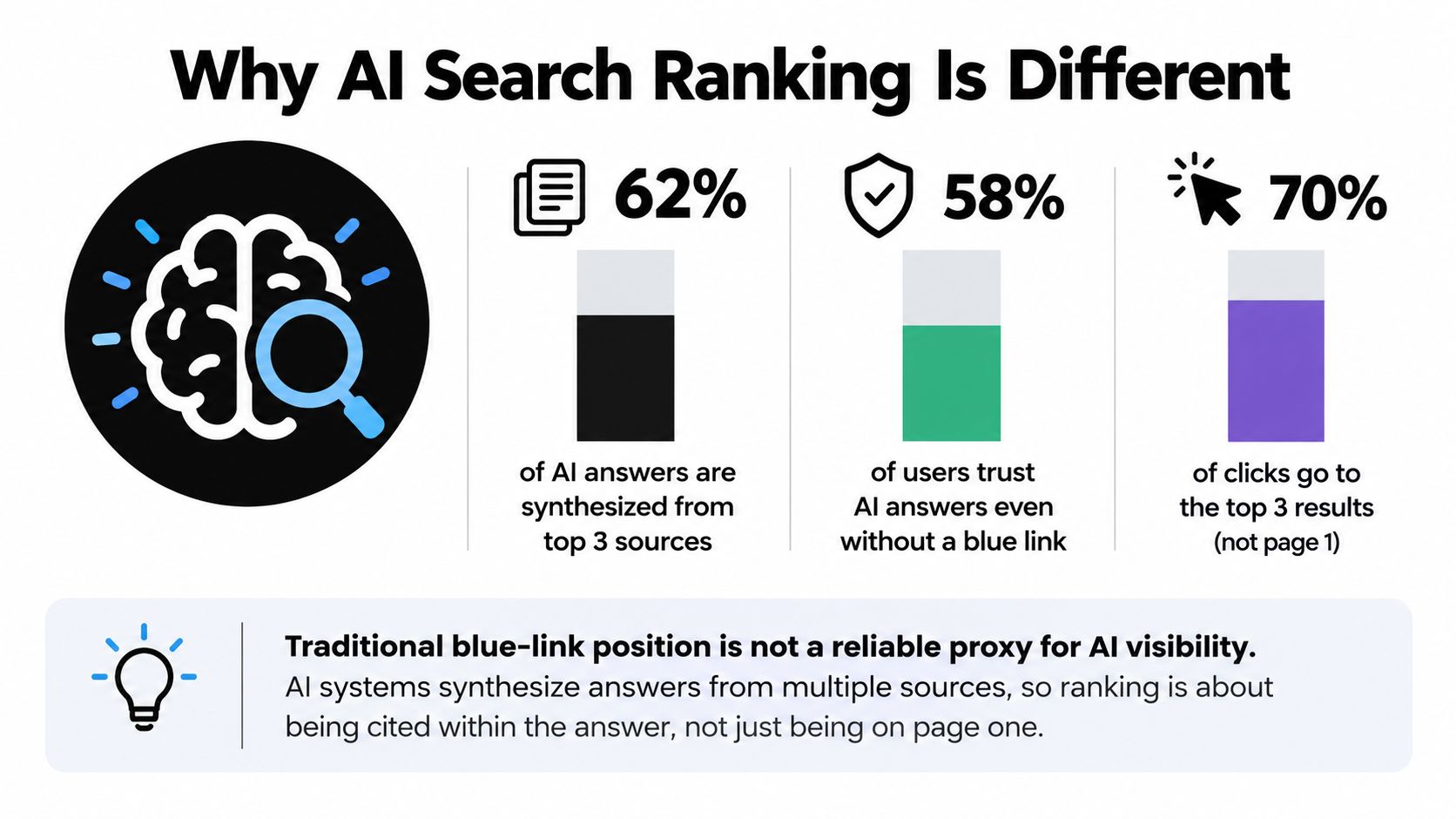
That doesn't make classic SEO irrelevant. Search visibility can still help systems find and evaluate your content, but position is only one input. Provider behavior, query intent, source reputation, page structure, freshness, and the availability of corroborating information all affect whether your brand gets mentioned or cited.
A provider-agnostic definition of success
Different assistants retrieve and combine information differently. The 2026 Yext source analysis found that citation behavior varies materially by model across a dataset of 17.2 million AI citations from Q4 2025, so there isn't one universal ranking formula for ChatGPT, Gemini, Perplexity, Copilot, or other assistants (Yext's AI citation research).
That means your KPI shouldn't be “rank first in AI.” Track whether your brand appears for relevant buyer prompts, where it appears in the answer, how it's described, which sources support the answer, and whether the mention produces qualified visits. A useful dashboard combines:
- Share of voice, your presence relative to named competitors.
- Average position, where your brand appears when it is mentioned.
- Sentiment and accuracy, whether the description supports or undermines the buying decision.
- Citation sources, the pages and properties AI systems repeatedly reuse.
- Referral attribution, whether visibility turns into visits and pipeline activity.
I use a practical guide to AI ranking as a useful framing for the distinction. The task isn't to abandon SEO. It's to expand the optimization surface from one ranking page to the entire evidence network around your company.
Audit Your Current AI Visibility With Prompt Families
Start with measurement, not a content sprint. A single prompt run can give you a misleading picture because generated answers change with wording, provider, location, device, and other conditions. A 2026 survey of GEO research recommends repeated runs, paraphrases, controls, human validation, and multi-actor checks, while empirical research across Google Search, Gemini, and AI Overviews found meaningful variation in cited source lists under repeated conditions (2026 GEO research survey).
Build prompts around buying situations
Create prompt families instead of isolated keywords. Each family should represent a decision a real buyer might make, then include several natural variations.
Useful families include:
- Category discovery: “What tools help a SaaS team monitor AI visibility?”
- Use-case fit: “Which platform is suitable for tracking competitor mentions in AI answers?”
- Comparison: “Compare [brand] with [competitor] for prompt-level monitoring.”
- Problem diagnosis: “Why is my product missing from AI search recommendations?”
- Trust and risk: “What should a marketing team check before relying on AI visibility data?”
- Commercial evaluation: “What features matter in an AI search monitoring platform?”
Include branded and unbranded prompts. Add competitor names, alternative wording, different levels of technical detail, and prompts that imply different stages of the buying journey. The aim is to learn not just whether your brand appears, but which interpretation of your category makes it appear.
Prompt quality matters because a poorly scoped test produces noisy conclusions. For useful background, engineering effective prompts offers practical context on making prompts precise, comparable, and fit for the question being tested.
Record the answer, not just the mention
For every run, capture the complete response, cited URLs, brand position, competitor presence, sentiment, and any factual errors. Save the exact prompt and provider so later comparisons use the same inputs.
A practical audit sequence looks like this:
- Create the family. Group prompts by intent rather than by keyword alone.
- Add paraphrases. Ask the same question in natural variations.
- Add controls. Test prompts where your brand should be relevant and prompts where it shouldn't be a likely recommendation.
- Run across providers. Compare OpenAI, Google, Perplexity, Claude, Grok, Copilot, DeepSeek, and any other assistants that matter to your audience.
- Map sources. Note whether citations point to your product pages, documentation, listings, reviews, forums, partners, or competitors.
- Benchmark competitors. Compare inclusion, position, sentiment, and source patterns.
The source map is often more useful than the headline visibility score. If competitors appear because review sites explain their strengths clearly, publishing another general blog post won't address the actual gap.
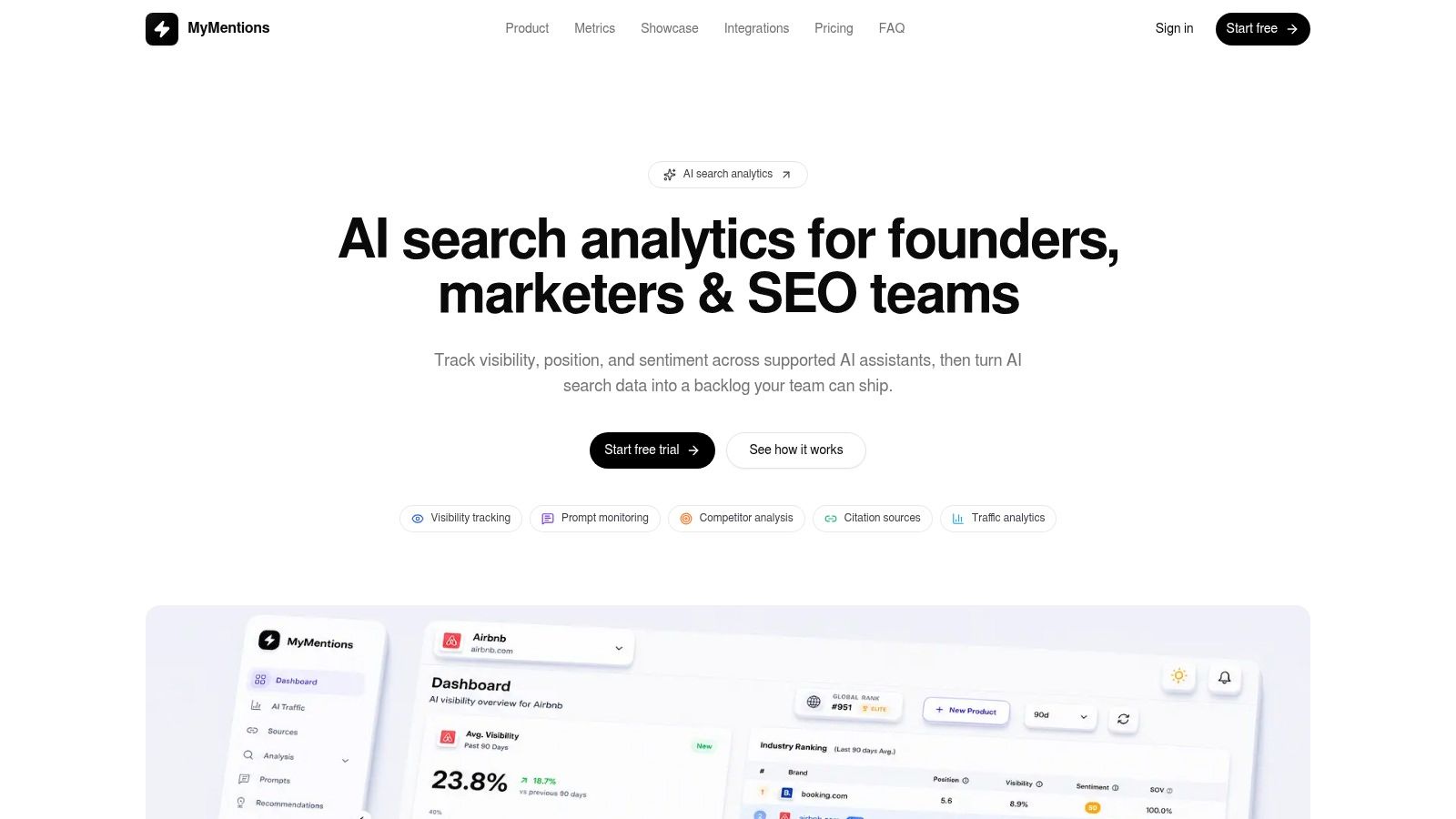
MyMentions' AI visibility audit guide provides a useful structure for organizing this baseline. The platform can also organize prompts, compare providers and competitors, and surface the sources influencing answers. Treat the output as a diagnostic dataset, not a verdict from one query.
Repeat the audit after material changes and compare prompt families over time. You're looking for persistent movement across related prompts, not a lucky appearance in one generated response.
Make Your Content Citable and Trustworthy
AI systems need more than topical relevance. They need material they can reuse without making the answer less defensible. Editorial teams improve citation absorption by putting the answer early, separating claims cleanly, and attaching evidence directly to the statements most likely to be extracted.
A controlled GEO study found that adding relevant statistics, quotations, and citations increased generative-engine visibility by up to 40% versus baseline. The strongest tactics were citation-oriented rewrites such as source citation, quotation addition, and statistics addition, although the research also warns that generic tactics can transfer poorly and that evidence additions can sometimes reduce retrieval quality (controlled GEO study).
Rewrite for evidence density
Take a vague product statement such as:
Our platform helps companies improve their AI search performance with powerful analytics.
It sounds positive, but it gives a retrieval system little to work with. A stronger version identifies the audience, object, action, and proof:
MyMentions tracks brand visibility, position, sentiment, competitor presence, and citation sources across supported AI providers. Teams use those prompt-level findings to prioritize changes to product pages, documentation, reviews, partner content, and technical signals.
The second version is easier to quote because each sentence makes a distinct, testable claim. It also gives the system context about who uses the product and what the product measures.
Use this editorial workflow:
- Answer first. Put a direct response beneath each descriptive heading before adding background.
- Name the subject. Replace “it” and “this solution” with the actual product, feature, or process.
- Attach evidence locally. Place a source next to the claim it supports, rather than collecting unrelated links at the end.
- Use relevant numbers selectively. A statistic should clarify the decision, not decorate the page.
- Add precise quotations. Quote a source only when the wording is exact and the attribution is verifiable.
- Separate fact from interpretation. Label your recommendation as analysis instead of presenting it as external evidence.
Preserve retrieval focus
Evidence stuffing can make a page harder to understand. A page about choosing AI visibility software shouldn't become a broad essay on every adjacent marketing channel because those topics are semantically related.
Review each section with three questions:
- Does it answer a prompt the buyer asks?
- Can a reader identify the main claim in the opening sentence?
- Does every added example, citation, or statistic improve confidence in that claim?
Use clear H2 and H3 headings, short paragraphs, lists, comparison tables, descriptive anchor text, and consistent terminology. Add author information, product ownership details, documentation links, and review context where they help establish trust.
For a deeper explanation of how citations function in AI answers, see what source attribution means in AI search. Then test the edited page against the same prompt families used in the baseline. Keep a control version where possible, repeat the runs, and judge both visibility and answer quality. A page that gets cited more often but causes inaccurate or diluted answers still needs work.
Fix Technical and UX Signals That Block AI Retrieval
A strong page can't earn a citation if crawlers can't access it, parsers can't interpret it, or users can't verify what it says. Technical SEO and UX should therefore share one backlog. The question isn't only “Can a search engine index this URL?” It's also “Can an AI system retrieve a clear, trustworthy passage from it?”
Run the access and parsing check
Start with crawlability. Review robots directives, indexation, status codes, canonical signals, redirect paths, orphan pages, and duplicate versions. Make sure important content isn't hidden behind interactions that a retrieval system may not execute.
Then inspect the page as rendered HTML, not only as a visual interface. Product descriptions, comparison details, FAQs, help articles, and author information should exist in text that crawlers can process. JavaScript-heavy interfaces deserve special attention because content that appears in a browser may not be equally available to every crawler.
Structured data can support interpretation when it accurately describes the visible page. Use relevant types such as Organization, Product, Article, FAQPage, or HowTo where appropriate, then validate the implementation. Don't add schema to label content that users can't see. Misaligned markup creates a trust problem rather than solving one.
Make the information architecture reinforce the claim
Your homepage, product pages, help center, documentation, listings, and partner pages should tell a consistent story. Internal links should connect category explanations to product detail, product detail to documentation, and documentation to implementation guidance.
Use this shared checklist:
- Crawlability: Important pages are accessible and indexable.
- Structured data: Markup accurately identifies the content type.
- Internal linking: Related pages form a logical, descriptive path.
- Page speed: Key content loads without avoidable delay.
- Mobile usability: The page remains readable and functional on smaller screens.
- Security: HTTPS and clear ownership signals support user confidence.
The UX layer matters just as much. State what the product does, who it serves, what it integrates with, and where buyers can verify the information. Keep names, descriptions, categories, and contact details consistent across owned listings.
Use this guide to optimizing a website for ChatGPT results as a focused reference, but validate every recommendation against your own providers and query classes. Technical fixes remove barriers. They don't compensate for weak evidence or absent authority.
Choose Between Owned Content and Earned Authority
Defaulting to publishing another article is tempting because the website is within their control. That instinct is understandable, but it can waste time when the sources shaping your target answers sit elsewhere.
Yext reported that 86% of citations came from sources brands already control, including websites and listings. Its dataset attributed 44% of citations to first-party websites and 42% to listings, with each category producing 2.9 million citations (Yext's citation findings). Those findings support a serious investment in product documentation, listings, help content, and accurate commercial pages.
At the same time, a 2025 study described a “systematic and overwhelming bias” toward earned media over brand-owned and social content in the AI search context discussed by the source (Digital Strategy Force's analysis of the research). The practical conclusion isn't that one channel always wins. It's that provider and prompt intent determine the better bet.
| Query Class | Best Bet Investment | Why It Wins in AI Search |
|---|---|---|
| Product capability and implementation | Owned product pages, documentation, and help content | Your site can provide the most precise, current explanation of what the product does. |
| Category education | Owned guides supported by credible citations | Structured explanations give systems reusable definitions and context. |
| “Best tool” and shortlist prompts | Reviews, comparison pages, partner content, and selective PR | Buyers often want independent evaluation, not only vendor claims. |
| Competitive comparisons | Accurate comparison pages plus third-party validation | First-party pages clarify differences, while external sources add credibility. |
| Local or listing-led discovery | Controlled listings and review ecosystems | Consistent business information and customer feedback can influence retrieval. |
| Technical or integration questions | Documentation, partner pages, and implementation references | Concrete compatibility details are easier to verify than broad marketing copy. |
Use the citation source as the budget signal
Pull the source URLs from your prompt audit and group them by ownership. If most relevant citations come from your documentation or listings, fix completeness, accuracy, structure, and freshness before commissioning more PR.
If competitors are repeatedly cited from respected reviews, partner pages, or industry publications, your next investment should create credible reasons for those sources to mention you. That could mean offering expert commentary, supplying original data, improving a partner integration page, correcting inaccurate descriptions, or making a product available for an honest review. Paying for generic mentions without editorial relevance rarely solves the underlying retrieval gap.
Reviews need the same discipline. Build a review ecosystem around real customer experiences, clear category language, and accurate product details. Don't script praise or pressure customers into claims they can't substantiate. AI systems and human buyers both benefit more from specific descriptions of use cases, limitations, integrations, and outcomes than from repetitive adjectives.
This overview of AI brand visibility is useful when deciding whether your problem is reach, reputation, or source coverage. Make the decision at the prompt-family level. A single brand may need better owned documentation for technical queries and stronger earned authority for evaluation queries.
Turn Monitoring Into a Shippable Backlog and Keep Improving
AI visibility monitoring only creates value when it changes what the team ships. A dashboard full of fluctuating mentions is not a strategy. The operating system should connect each observed gap to an owner, an action, a target prompt family, and a later validation run.
Start with daily or scheduled prompt analyses across the providers that matter to your buyers. Configure alerts through Slack, Discord, or email when visibility, position, sentiment, competitor presence, or citation sources change. Review the alert before reacting. A source change may reflect normal model variation rather than a durable loss.
Prioritize fixes by leverage and control
Use a simple backlog with four categories:
- Trust: Correct inaccurate listings, outdated reviews, missing authorship, and conflicting product descriptions.
- Content: Rewrite pages where answers are buried, claims lack evidence, or intent is diluted.
- UX: Clarify product capabilities, use cases, limitations, integrations, and paths to supporting documentation.
- Technical: Resolve access, indexation, rendering, linking, markup, and performance barriers.
Assign each task to the team that can ship it. Product marketing can clarify positioning, content can improve evidence density, SEO can repair discovery paths, product teams can update documentation, and partnerships or PR can address third-party authority gaps.
Measure experiments without chasing noise
Run changes against prompt families, paraphrases, controls, and repeated provider checks. Compare the post-change citation sources with the baseline, then check whether mentions are accurate and whether referral traffic shows meaningful engagement. Don't declare success because one assistant named your brand once, and don't roll back a useful fix because one refresh changed the answer.
Export stakeholder reports that show the business story: which buyer prompts improved, which competitors gained ground, which sources now influence answers, and which actions remain blocked. A live dashboard can combine share of voice, average rank, sentiment, citation sources, and traffic attribution, while a prioritized backlog turns those observations into work.
AI search monitoring guidance can help teams formalize that cadence. Keep the process provider-aware, because the Yext research discussed earlier found material differences in citation behavior across models. Optimize for durable source coverage and accurate answers, not a temporary win in one assistant.
The next actions are straightforward:
- Build prompt families around your highest-value buyer decisions.
- Establish a repeated baseline across providers.
- Map the sources that produce competitor citations.
- Repair owned pages when the evidence gap is on your site.
- Invest in reviews, partners, or PR when independent authority is missing.
- Re-run the same tests and ship only changes supported by repeated results.
MyMentions tracks prompt-level visibility, position, sentiment, competitor presence, and citation sources across major AI providers, then turns those findings into a prioritized backlog for content, trust, UX, and technical fixes. Visit MyMentions to organize your AI search monitoring and identify which changes are most likely to earn accurate citations.