A SaaS buyer opens ChatGPT and asks, “Which project management tools are best for a distributed product team?” Your company has a strong website, helpful documentation, and pages that rank well in conventional search. Yet the answer recommends three competitors, cites their comparison pages, and describes your product using outdated information. You won't see that missed recommendation in Google Analytics because the buyer may never click a result or visit your site.
That's the problem generative engine optimization software is designed to investigate. It helps teams observe how AI assistants discover, compare, cite, and describe products, then turns those observations into experiments rather than a list of generic content edits. For SaaS marketers, the important question isn't only, “Can we appear in an AI answer?” It's, “Why did the engine choose that source, will it keep choosing it, and can we connect visibility to business outcomes?”

This guide is for founders, product marketers, SEO teams, and growth leaders who need a practical way to evaluate GEO platforms. It covers the underlying model, the monitoring loop, the metrics that matter, implementation decisions, and B2B SaaS use cases. If your team is also building a broader AI-assisted content workflow, this guide to growing on X with AI writing offers useful context on production without confusing content output with visibility measurement. You can also explore the related discussion of AI ranking to see how answer visibility differs from conventional results.
Table of Contents
- Why AI Answers Are the New Search Results
- What Generative Engine Optimization Software Actually Does
- How GEO Software Detects and Improves Your AI Visibility
- Core Features Metrics and Workflows Inside GEO Platforms
- How to Evaluate and Implement GEO Software in Your Stack
- Real World Use Cases for SaaS Founders and Marketing Teams
- Putting GEO Software to Work for Long Term AI Visibility
Why AI Answers Are the New Search Results
A buyer researching software no longer has to scan ten blue links, open several tabs, and assemble a shortlist alone. They can ask an assistant to compare tools by use case, budget, integrations, security requirements, or team size. The assistant then produces a synthesized recommendation, often with citations and a short explanation of trade-offs.
That changes the point of competition. In traditional SEO, your page competes for a position in a results list. In an AI answer, your company competes to become part of the explanation itself. A competitor might be mentioned as the best fit for enterprise teams, while your product is reduced to an alternative, omitted entirely, or described with a capability you don't offer.
The visibility gap is difficult to detect because the answer may not create a conventional referral session. A buyer can read the recommendation, remember the brand, and return later through a direct visit, branded search, or a sales conversation. Standard analytics can measure the eventual session, but they often can't prove that an assistant introduced the company in the first place.
Practical rule: Treat an AI recommendation as a decision-surface event, not merely another ranking position.
The research field behind this shift is young. “GEO: Generative Engine Optimization,” published in 2024, is described as the foundational paper and the first novel framework for helping creators improve visibility in generative engine responses. A later critical survey reviewed 45 studies published or accepted between November 16, 2023 and July 14, 2026, showing how quickly the subject developed from one originating paper into a broader research area across peer-reviewed work, workshops, accepted papers, and preprints. The ACM record for the foundational GEO work provides the relevant research context.
The commercial category is developing alongside the research. One market estimate projects AI search optimization software to grow from USD 1.03 billion in 2025 to USD 1.23 billion in 2026, then to USD 3.32 billion by 2031, with a projected 21.97% CAGR from 2026 to 2031. The related services market is estimated to rise from USD 3.71 billion in 2025 to USD 10.72 billion by 2031, at a projected 19.55% CAGR, according to Mordor Intelligence's AI search optimization software market analysis.
For buyers, that growth doesn't mean every dashboard deserves a place in the stack. It means the category is becoming substantial enough to require careful evaluation. The strongest platforms will help your team measure, diagnose, test, and attribute AI visibility, while weaker ones may only offer a score without explaining what changed.
What Generative Engine Optimization Software Actually Does
Traditional SEO asks a search engine to rank a page for a query. GEO asks a generative engine to find, understand, reuse, and cite evidence about your company inside an answer. The two disciplines overlap, but they optimize different moments in the buyer journey.
The foundational GEO method describes a black-box optimization framework for proprietary, closed-source generative engines. It takes a source website and produces an optimized version by changing presentation, writing style, and content. The point isn't to reveal the model's private ranking formula. It's to test which observable changes make the content easier for retrieval and generation systems to extract and reuse. The foundational GEO paper explains this framework.
A useful analogy is an AI librarian. A traditional librarian can hand you a book because it has a clear title, catalog entry, and location. An AI librarian must also select a passage, understand its meaning, combine it with other passages, and write a new response. If your product page buries a key capability in vague marketing language, the model may find the page but still lack a clean sentence it can safely reuse.
From pages to evidence
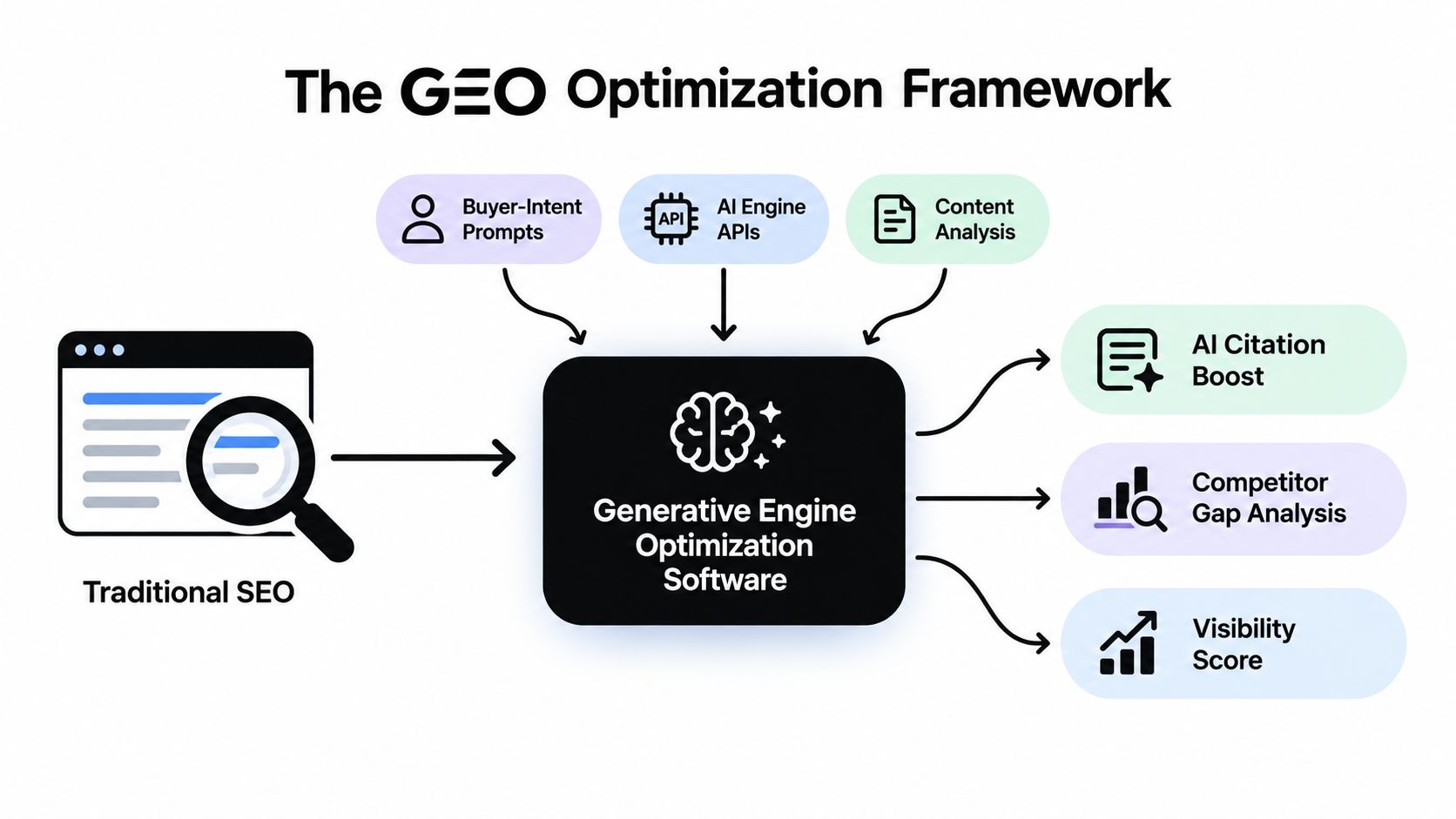
Generative engine optimization software usually works across four related questions:
- Can the engine retrieve the page? Technical accessibility, rendering, information architecture, and clear page structure influence whether content can be processed.
- Can the engine extract the answer? Direct definitions, descriptive headings, concise comparisons, and logically grouped facts make content more answerable.
- Can the engine trust the evidence? Documentation, reviews, partner references, and other independent sources can shape whether a model treats a claim as credible.
- Can the engine cite the source accurately? A mention without a reliable citation may create awareness, but it doesn't give the buyer a dependable path to verification.
This is why answerability, chunking, and citation-friendly structure matter. A page doesn't need to sound mechanical. It needs to make important facts easy to locate, interpret, and quote without forcing the model to infer too much.
Why black-box testing matters
You can't inspect the internal weights or complete retrieval pipeline of a proprietary assistant. You can, however, define prompts, run them consistently, record the resulting answers, identify cited domains, and compare outcomes after a controlled change.
That makes GEO software less like a keyword density editor and more like a measurement and experimentation layer. It should help you distinguish a page that ranks well from a page that an assistant repeatedly selects as evidence. For a practical introduction to the broader category, see this guide to an AI visibility platform.
The distinction prevents a common mistake. A team may rewrite every article to include direct answers, yet never check whether the relevant assistants cite those pages, whether competitors remain more visible, or whether a citation persists across repeated tests. Optimization without observation is guesswork with better formatting.
How GEO Software Detects and Improves Your AI Visibility
A strong GEO workflow begins with the buyer's language, not with a random collection of keywords. A product marketer might create prompts such as “best customer feedback software for a small SaaS team,” “alternatives to product analytics platforms,” or “which tools integrate with our existing CRM?” Each prompt represents a decision a real buyer could ask an assistant to help make.
The platform then runs those prompts across supported engines and records the response. Depending on the product, that may include systems from OpenAI, Google, Perplexity, Anthropic, and other providers. The valuable output isn't just whether your brand appeared. It includes visibility, position, sentiment, confidence, competitors, and citation sources.
The detection loop
Suppose an assistant answers a comparison prompt and recommends a competitor. A useful platform should preserve the response, identify the cited pages, and show whether your company was absent, mentioned without a citation, or included with an inaccurate description.
The next step is source analysis. Did the engine rely on a competitor's documentation, an independent review, a partner page, or a community discussion? That distinction changes the action. A missing feature explanation may require better documentation. A weak trust signal may require third-party validation. An inaccurate claim may require consistent updates across owned and external profiles.
The improvement loop
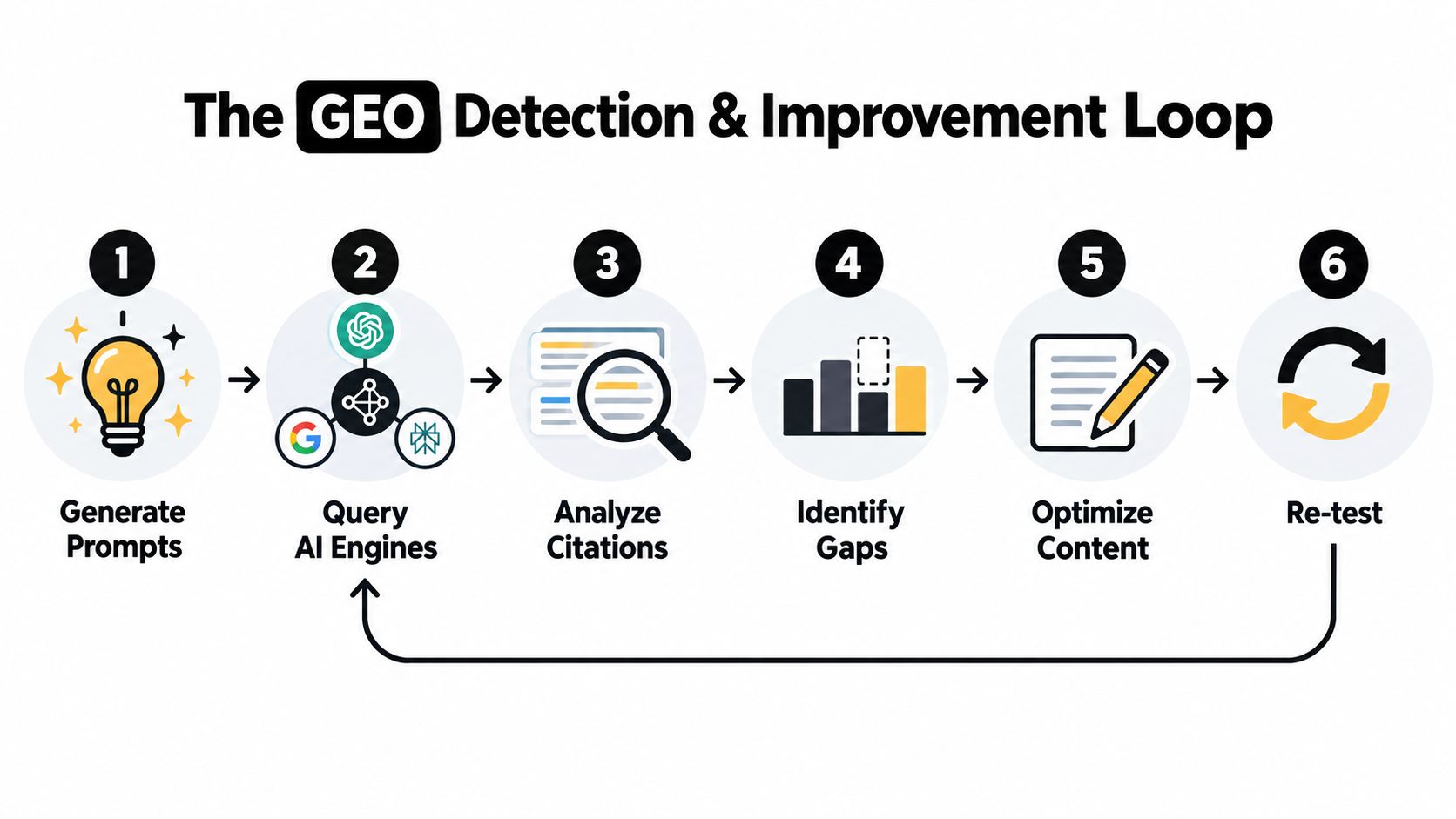
The workflow becomes useful when it produces a prioritized backlog:
- Generate prompts: Organize questions by use case, funnel stage, persona, competitor, and product category.
- Query engines: Run comparable prompts across the providers your buyers use.
- Analyze citations: Record which pages and domains support each answer.
- Identify gaps: Find missing facts, weak evidence, outdated descriptions, and competitor advantages.
- Optimize content: Update documentation, comparison pages, product explanations, structured content, or external authority signals.
- Re-test: Run the same prompt set after the change and compare the new answer with the baseline.
The retrieval process explains why structure matters. Generative engines typically need to locate relevant passages before they can compose a response. A clear heading such as “Integrations for B2B SaaS teams,” followed by specific and verifiable details, gives the system a more usable evidence unit than a broad paragraph about “connectivity.”
Citation quality requires caution. One study of eight AI search engines found incorrect or fabricated citations in more than 60% of 1,600 tests, according to Nieman Lab's coverage of the Tow Center study. That finding makes source validation part of the workflow, not a cosmetic reporting feature.
A separate analysis found that 96.8% of cited domains and 97.2% of mentioned brands showed no week-over-week change, which suggests citation behavior can be highly sticky even while attribution quality remains unstable. Your platform therefore needs to monitor two separate outcomes: whether a source is correct and whether the engine continues to reuse it.
Teams that want to inspect this process at the prompt level can use an AI rank checker as part of a broader testing routine. The key is to treat each result as an observation, not a permanent truth.
Core Features Metrics and Workflows Inside GEO Platforms
GEO platforms vary widely. Some focus on monitoring, some on content production, and others on technical or reputation workflows. A buyer should separate capabilities into three jobs: observe what assistants say, compare your position with alternatives, and create actions the team can verify.
| Capability Group | What It Measures | Why It Matters |
|---|---|---|
| Prompt management | Buyer-intent questions, categories, personas, and funnel stages | Keeps testing connected to real purchasing decisions |
| Cross-engine monitoring | Mentions, positions, sentiment, and answer differences across providers | Shows whether visibility is consistent or engine-specific |
| Citation analysis | Pages and domains that assistants cite or reuse | Reveals the evidence shaping recommendations |
| Competitor benchmarking | Relative presence, source overlap, and recommendation patterns | Exposes gaps that your own site data can't show |
| Alerts and reporting | Changes delivered through Slack, Discord, Email, or dashboards | Helps teams respond without checking every result manually |
| Attribution | AI-referred visits, assisted sessions, and downstream actions | Connects visibility observations to commercial reporting |
| Optimization workflows | Content, trust, UX, and technical recommendations | Turns monitoring into a prioritized backlog |
| Experiment support | Baselines, change logs, retesting, and comparisons | Helps separate signal from prompt and model variability |
Monitoring features
At the foundation, look for a prompt library that supports buyer language rather than only importing search keywords. You should be able to group prompts by problem, category, competitor, persona, and commercial intent. A platform that cannot preserve the exact question and response makes later analysis harder.
Cross-engine comparison is equally important. An answer from Perplexity may cite a review site, while another provider may rely on documentation or a partner page. The difference isn't noise to discard. It can reveal where your authority is strong and where your content or source coverage is thin.
Benchmarking features
Share of voice and average position are useful summaries, but they should never stand alone. Add sentiment, confidence, citation correctness, and source persistence. A brand that appears frequently but is described inaccurately has a different problem from a brand that appears less often but is presented as a trusted category specialist.
Competitor benchmarking should show the path behind the result. If a competitor wins a prompt, you need to know whether the advantage comes from its own page, third-party reviews, implementation documentation, or a specific comparison article. For more detail on interpreting these signals, explore AI search analytics.
Action and attribution features
A useful platform can send alerts when visibility changes and provide exports for product marketing, SEO, content, and leadership teams. Slack, Discord, and Email notifications are practical when assigned owners need to act quickly.
Attribution remains the hardest layer. Standard analytics may record a direct visit but not the assistant that influenced it. Look for dashboards that connect prompt-level observations with traffic and conversion data, while labeling correlation appropriately. A good system won't claim certainty where the data only supports a directional relationship.
How to Evaluate and Implement GEO Software in Your Stack
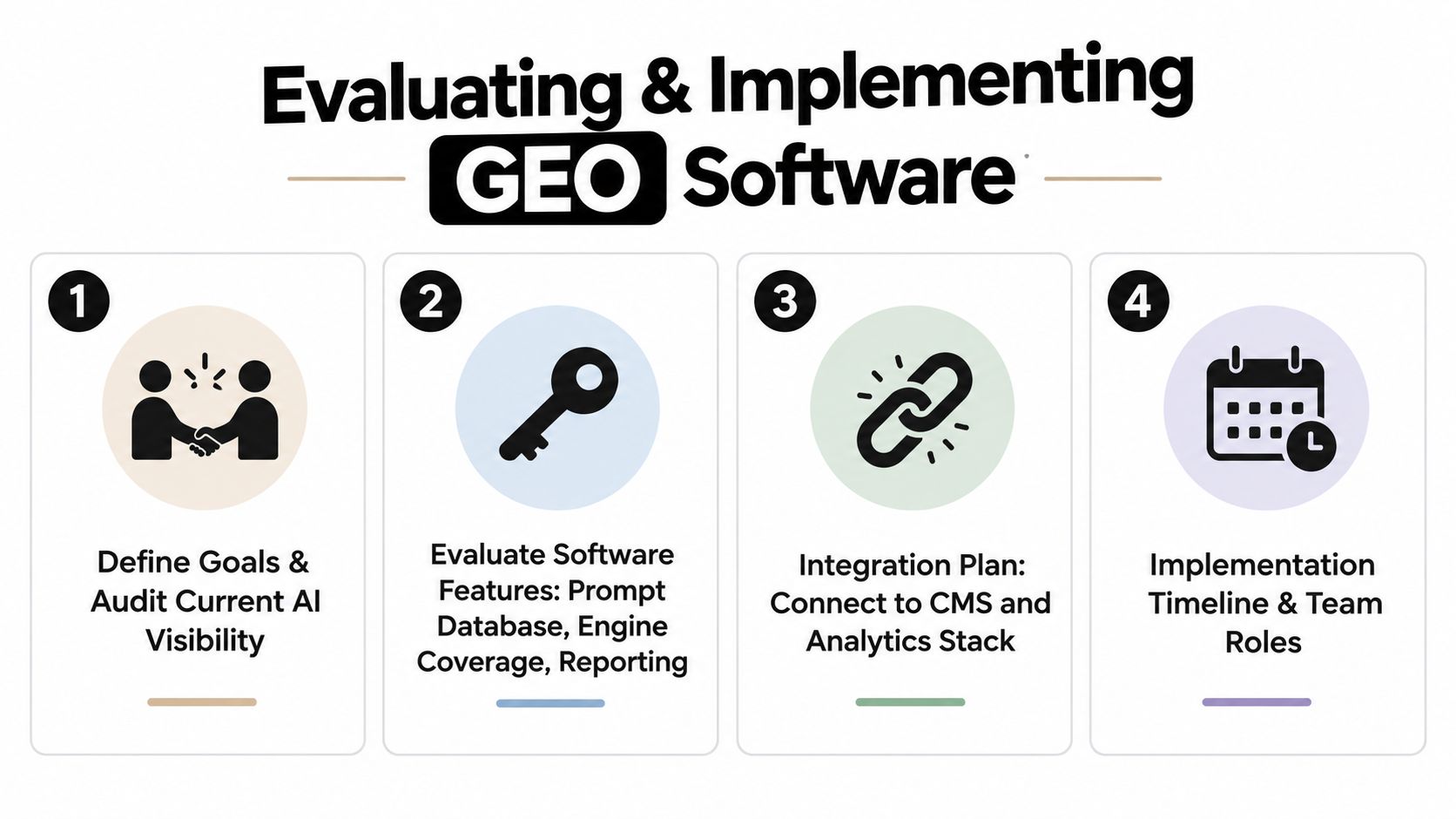
Choose GEO software by starting with the decision it must support. If your team needs to know whether a product appears in high-intent comparison answers, prompt coverage and citation tracking matter most. If leadership wants evidence that AI visibility influences pipeline, attribution, export flexibility, and integration with your analytics stack become essential.
Use a staged evaluation rather than a feature-counting exercise.
Start with the evidence
Ask vendors how they collect answers. Do they use browser-based observations, APIs, modeled prompts, or a mixture? Can you see the complete answer and citation context, or only a score? A clean interface can't compensate for data that doesn't reflect the environments your buyers use.
Then test engine coverage. Your relevant providers may include OpenAI, Google, Perplexity, Claude, Grok, Copilot, DeepSeek, or others. Coverage should follow your audience, geography, and product category, not a vendor's generic list.
Prioritize these questions:
- Prompt quality: Can your team create, tag, edit, and version buyer-intent prompts?
- Citation persistence: Does the platform show whether a source remains cited across repeated runs?
- Experiment support: Can you compare a baseline with a specific content or technical change?
- Attribution: Can results connect to analytics, CRM, server logs, or pipeline reporting?
- Workflow control: Can marketing, SEO, product, and content owners collaborate without duplicating work?
- Governance: Does the platform offer appropriate access controls, data handling, and export options?
The measurement gap is well documented. Independent coverage notes that standard analytics often miss citations, paraphrases, and omissions, while commercial audits show low source overlap and substantial run-to-run variability. Recent research on reproducibility and GEO levers also indicates that topical relevance and context position are more reproducible than generic heuristics, and that citation-focused rewrites can sometimes reduce retrieval quality.
Roll out in controlled stages
Begin with a baseline audit. Select a focused set of prompts covering your main use cases, competitors, and product categories. Record the answer, citations, brand position, sentiment, and known inaccuracies before changing content.
Next, connect the platform to the systems your team already uses. A CMS connection can support publishing workflows, while analytics and CRM connections help investigate downstream impact. Don't treat every recommendation as an immediate production task. Prioritize changes by buyer importance, evidence quality, implementation effort, and the likelihood that the change improves answerability.
Run one experiment at a time where possible. For example, revise a comparison page to clarify integrations and use cases, document the change, and retest the same prompt set. Avoid changing the page, launching a PR campaign, and restructuring the site simultaneously, because you won't know which action influenced the result.
For teams reviewing their wider SEO environment, this overview of an SEO platform for digital teams can help frame how GEO monitoring should fit beside existing search workflows. GEO software should add an evidence loop, not create another disconnected dashboard.
Real World Use Cases for SaaS Founders and Marketing Teams
A founder can use GEO software to audit the questions a prospect asks before booking a demo. Consider a prompt such as, “What are the best product analytics tools for a B2B SaaS company that needs event tracking and warehouse integration?” The result may mention the company, but describe it as a lightweight dashboard even though the product has strong governance and enterprise controls.
The founder now has a specific correction to make. The product page, integration documentation, and comparison content should explain those capabilities in clear, independently supportable language. The team can then retest the prompt and check whether the assistant's description changes.
Product marketing and competitive prompts
Product marketers can create prompt groups around alternatives:
- “What are the best alternatives to [competitor] for a growing SaaS team?”
- “Which platforms support [specific workflow]?”
- “Compare [company] with [competitor] for [buyer use case].”
- “What should a buyer verify before selecting a [category] platform?”
These questions expose more than visibility. They reveal the attributes assistants use to separate vendors, the competitors they treat as comparable, and the sources they trust when explaining the category.
Smaller brands face a structural challenge because assistants may favor familiar names with broader recognition and more external references. A current analysis describes big brand bias as a disadvantage for smaller players and argues that earned-media authority, machine-scannable proof, and engine-specific tactics can matter more than publishing generic content volume. The analysis of GEO challenges for B2B and enterprise teams provides that context.
Turning citation sources into work
An SEO team might discover that a competitor is repeatedly cited from a review profile, partner directory, or implementation guide rather than its homepage. That finding changes the backlog. The team can improve its own documentation, correct inconsistent product facts, strengthen partner pages, or pursue credible third-party coverage.
The important distinction is between producing more content and improving the evidence available to an engine. A large blog library won't automatically resolve a missing trust signal. The team needs to know which source type influences the answer and whether the proposed fix changes that source.
Research is also moving toward engine-aware optimization rather than static checklists. One cited learned-optimization approach reported a +35.99% average improvement under a specific retrieval setup, as described in the current GEO challenge analysis. That result shouldn't be treated as a universal promise. It does show why controlled, engine-specific testing is more useful than assuming one rewrite works everywhere.
Putting GEO Software to Work for Long Term AI Visibility
GEO software becomes valuable when it behaves like an ongoing research system. Your team defines buyer prompts, establishes a baseline, records citations and descriptions, ships a focused change, and measures what happens next. The content optimizer is only one part of that loop.
A practical starting plan looks like this:
- Choose a narrow business question. Start with a category, use case, or competitor set tied to active pipeline.
- Build a representative prompt library. Include discovery, comparison, alternative, implementation, and trust questions.
- Audit the answer evidence. Record who appears, what each brand is credited for, and which domains assistants cite.
- Ship one controlled improvement. Update the page or source most closely connected to the observed gap.
- Retest across relevant engines. Compare the response, citation, position, sentiment, and description with the baseline.
- Connect visibility to business data. Use traffic and pipeline signals carefully, distinguishing influence from direct attribution.
- Scale only after the workflow works. Add products, regions, personas, and teams once the measurement process is repeatable.
The field has moved quickly from the 2024 foundational paper to a survey covering 45 studies by July 14, 2026, according to the ACM research record cited earlier. That progression suggests GEO will continue shifting toward testable, engine-aware workflows rather than fixed SEO-style checklists.
Your next decision isn't whether to rewrite every page. It's whether your team can observe how assistants describe the product, identify the evidence behind those descriptions, and learn from controlled changes. Start with the prompts closest to revenue, document the baseline, and choose software that helps you prove what changed.
MyMentions tracks AI visibility, position, sentiment, competitors, and citation sources across supported providers, then turns prompt-level findings into a prioritized optimization backlog. Visit MyMentions to evaluate a workflow for monitoring AI answers, organizing experiments, and connecting visibility changes with traffic signals.