A marketer refreshes ChatGPT with a simple comparison prompt: which products belong on a shortlist for a specific buyer? The answer names a competitor, cites an industry review, and leaves your brand out. You open Google to investigate, but the familiar blue-link report says nothing about the response you just saw. Your pages may rank well while the AI answer sends attention elsewhere.
That gap is where an AI rank checker fits. It queries AI assistants with a curated set of buyer prompts, then records whether your brand appears, where it appears, how it's described, and which sources support the answer. Unlike a classic rank tracker, it treats AI visibility as a measurement problem involving incomplete citations, changing language, and results that can vary between runs.
Table of Contents
- Why AI Rank Tracking Is Suddenly on Your Roadmap
- How an AI Rank Checker Actually Works
- The Five Metrics That Actually Matter
- Use Cases for Product and SEO Teams
- Reading Results and Prioritizing Fixes
- Choosing the Right Tool Without Getting Burned
- A 30 Day Playbook to Improve AI Visibility
Why AI Rank Tracking Is Suddenly on Your Roadmap
Classic SEO reporting answers a narrow question: where does a page appear on a search engine results page? An AI rank checker asks a broader one: when a buyer asks an assistant for advice, does your brand enter the answer at all?
That distinction matters because LLM search systems cite fewer sources than traditional search engines. A large-scale study found an average of 4.3 URLs and 3.4 domains per LLM response, compared with 10.3 URLs and 7.3 domains for traditional search engines (the study's findings on under-citation). A brand can therefore sit somewhere in the retrieval process without receiving a visible citation in the final response.
A useful checker records five things:
- Presence: Is the brand mentioned?
- Position: Where does it appear in the answer or recommendation list?
- Confidence: Does the result persist across repeated runs?
- Citation: Which URLs and domains support the answer?
- Sentiment: Does the assistant describe the brand favorably, neutrally, or negatively?
The most important addition is absence. A report that only shows prompts where you appeared can make visibility look healthier than it is. As this explanation of the AI visibility gap makes clear, the prompts where a competitor appears and your brand is completely missing may represent the most valuable opportunities.
Why blue-link instincts mislead
AI assistants synthesize responses rather than display a fixed list of pages. They may combine product documentation, review pages, comparison articles, partner content, and other sources into a single recommendation. That means a strong traditional ranking can help, but it doesn't guarantee a mention, a citation, or positive framing.
The commercial interest reflects that shift. One industry projection puts the AI search visibility services market at USD 3.71 billion in 2025, growing to USD 10.72 billion by 2031, with a projected 19.55% compound annual growth rate from 2026 to 2031 (market estimate). The category is moving from occasional manual checks toward a shared reporting line for SEO, content, product marketing, and brand teams.
How an AI Rank Checker Actually Works
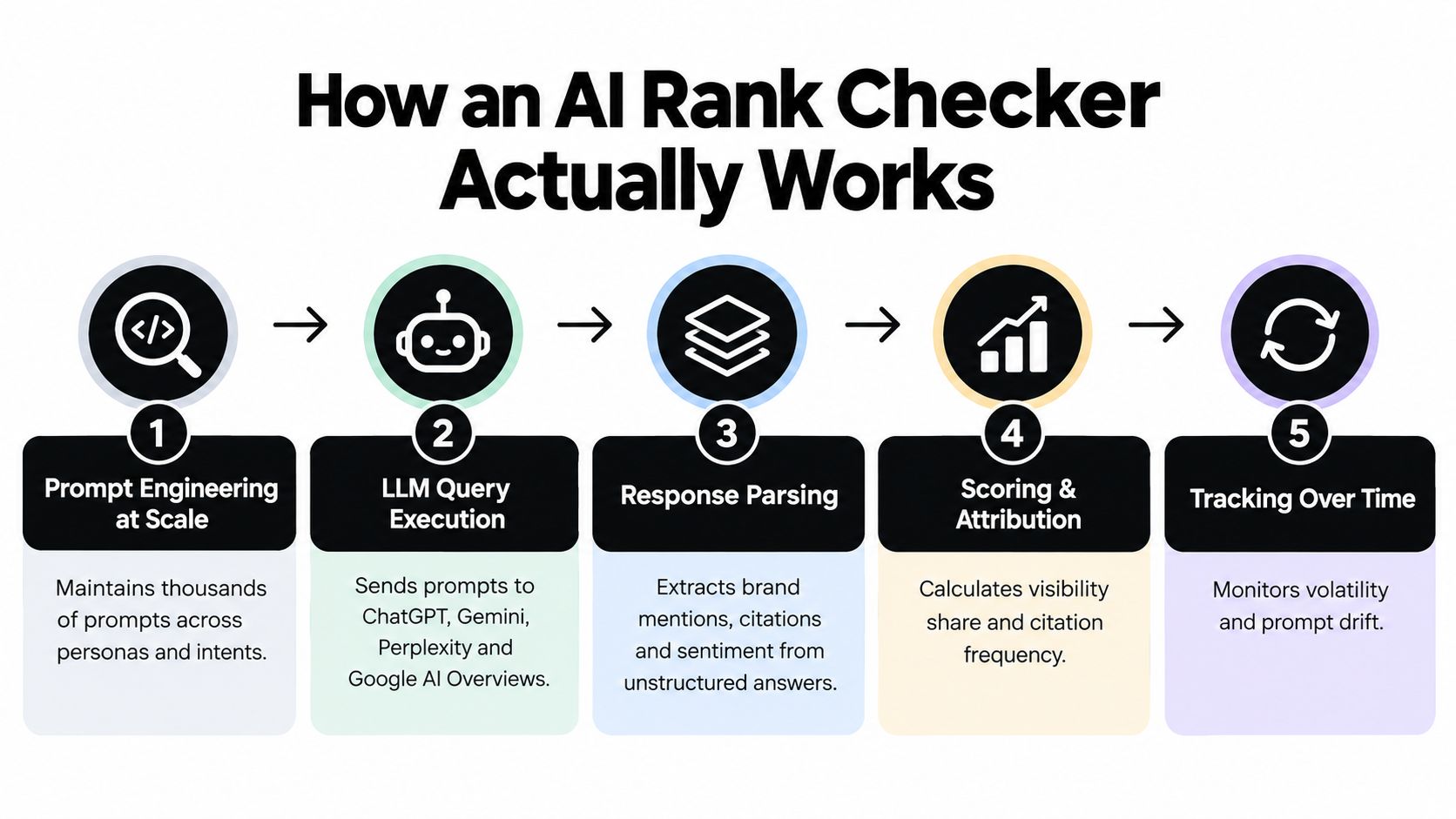
Think of traditional rank tracking as checking a shelf in a store. The tool looks for your product, notes its position, and repeats the check over time. An AI rank checker does something harder. It asks a question, receives an unstructured answer, and interprets the answer's wording, order, sources, and omissions.
Step one, build a useful prompt set
The tool starts with prompts that mirror real buyer language. A SaaS team might track:
- Category discovery: “What are the best [category] tools for [persona]?”
- Competitive comparison: “[Brand] versus [competitor] for a growing team”
- Alternative research: “What are the alternatives to [competitor]?”
- Commercial evaluation: “Which [category] products support enterprise requirements?”
- Problem exploration: “How should a team solve [specific problem]?”
The prompt library needs owners, labels, and revision history. Buyer language changes, and a static collection of prompts slowly becomes disconnected from actual demand.
Step two, query each provider
ChatGPT, Gemini, Claude, Perplexity, and Copilot don't share identical retrieval systems or response behavior. A checker must query the providers separately rather than assume that visibility in one assistant carries across the others. This overview of AI ranking is useful for understanding why provider-level results deserve their own comparisons.
Step three, parse the answer
The system identifies brand mentions, extracts linked citations, determines mention order, and classifies surrounding language. A response can mention your product in the third position, cite a competitor's review instead of your site, and describe your pricing inaccurately. One overall score would hide those differences.
Model version, temperature, grounding settings, session state, and prompt wording can all affect an answer. Repeated sampling is therefore more informative than a single screenshot. Research across Perplexity Search, OpenAI SearchGPT, and Google Gemini found substantial run-to-run variability and concluded that AI visibility should be reported with uncertainty estimates rather than treated as a fixed position (research on generative-search instability).
The Five Metrics That Actually Matter
Not every dashboard number deserves equal attention. The best metrics connect an observed answer to a decision your team can make.
1. Visibility share
Visibility share measures the proportion of tracked prompts where your brand appears at all. It should be the first health indicator because it exposes silent absence. A brand that ranks first on a small set of prompts may still be missing from the category questions that matter most to revenue.
2. Position within the response
Position tells you whether the assistant introduces your brand early, places it among alternatives, or mentions it only as an afterthought. Treat it as a distribution across responses, not a permanent rank from one to ten. The cited set is sparse, and large-scale tracking found 4.3 URLs per LLM response on average across 55,936 queries (independent tracking of LLM citations).
3. Confidence
A credible tool shows a range produced by repeated runs. If a brand moves from position two to position one in one response, that change may be noise. A confidence interval helps your team distinguish a durable shift from normal sampling variation.
4. Citation coverage
Citation tracking shows which pages influence the answer. It can reveal that assistants repeatedly cite a comparison article, review site, or partner page while ignoring a product page that contains more accurate information. That evidence turns an abstract visibility problem into a content, outreach, or reputation task.
5. Sentiment
A mention isn't automatically valuable. Sentiment classification highlights positive, neutral, and negative framing, including cases where an assistant associates your product with limitations, confusing pricing, or outdated positioning. Teams can then decide whether the response requires clearer content, stronger third-party coverage, or a public relations response.
| Metric | What it answers | Decision it drives | Common pitfall |
|---|---|---|---|
| Visibility share | Where are we present or absent? | Which prompt groups need attention? | Ignoring untracked prompts |
| Response position | How early are we recommended? | Which competitors need comparison work? | Treating one run as a fixed rank |
| Confidence | Is movement larger than normal variation? | Should the team act now or keep sampling? | Reporting a precise point estimate |
| Citation coverage | Which sources support the answer? | Which pages or publishers should we influence? | Counting mentions without checking URLs |
| Sentiment | How does the assistant describe us? | Is the response a content or reputation issue? | Treating every mention as positive |
For a practical measurement framework, use this guide to measuring AI search visibility alongside raw response exports. The dashboard should help you decide what to investigate, not replace inspection of the underlying answers.
Use Cases for Product and SEO Teams
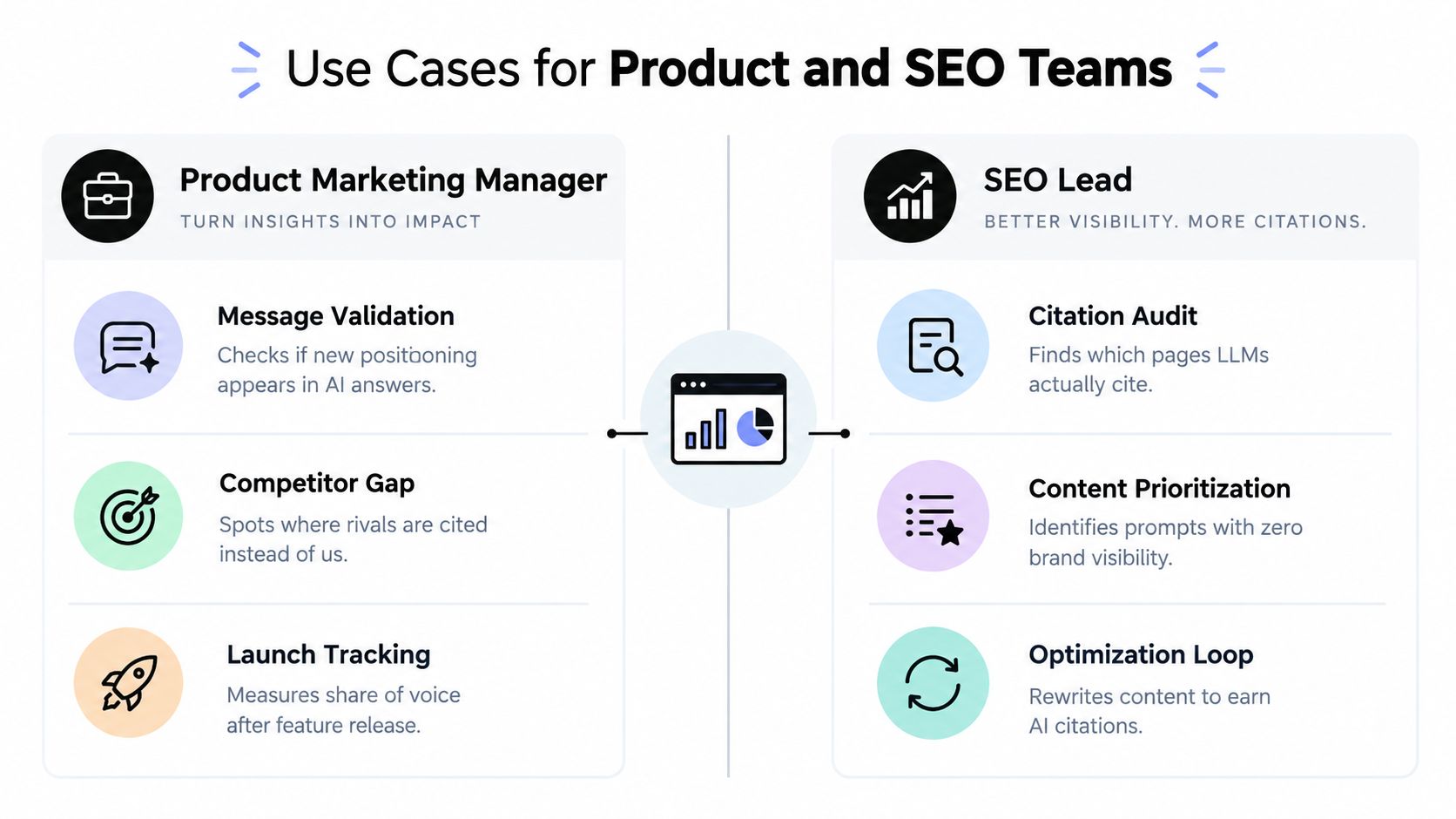
A product marketing manager and an SEO lead can open the same AI rank checker dashboard and reach different, equally valid conclusions.
The product marketer starts with a recent launch. They test prompts such as “best [category] tools for enterprise teams” and “alternatives to [competitor]” across ChatGPT, Gemini, and Claude. The new feature may appear in one provider's answer but not another. The responses may cite third-party pages that still describe the old product, giving the team a distribution problem rather than a simple ranking problem.
The SEO lead studies the same results differently. They group missing mentions by topic, inspect cited URLs, and compare the brand's visibility with competitors. If a competitor appears consistently because several independent comparison pages mention it, the SEO response might include a content update, digital PR outreach, or a stronger explanation of the relevant use case.
The reactive scenario
Suppose a competitor suddenly dominates a prompt for “best workflow platform for distributed teams.” Before rewriting a homepage, the team should inspect the response history. Did the competitor gain citations from a new review? Did your product disappear entirely, or did the assistant move it lower? Did the wording change from a feature comparison to a pricing comparison?
Those answers lead to different actions. A missing feature explanation calls for content. A missing third-party citation may call for outreach. An unfavorable description may require product messaging or public evidence that addresses the concern.
The proactive scenario
A quarterly prompt-library review catches buyer language before it becomes a reporting blind spot. Product marketing can add prompts around a new persona or feature. SEO can create prompt clusters around evaluation, alternatives, implementation, and pricing. Teams that need to demonstrate product workflows can also use a resource such as the ShipTeaser product video tool to create clear visual explanations that support launch and education content.
The shared question is not just, “What is our rank?” It is, “Which answer is the buyer receiving, who shaped it, and what can we change?”
For a broader operating model, see this guide to generative engine optimization. It helps teams connect prompt monitoring with the content and trust signals that influence AI answers.
Reading Results and Prioritizing Fixes
A report becomes useful when it changes what the team does next. Start by separating signal from sampling noise. If a brand moves from position three to position five for one prompt during a single observation, don't treat that as a confirmed loss. Review repeated runs, provider consistency, citation changes, and the confidence interval before opening a sprint.
Business intent should determine priority. A missing mention for “what is [category]?” may matter for awareness, but an absence from “alternatives to [competitor]” can affect an active evaluation. The gap between current visibility and the visibility you want matters only after you've weighted the prompt by commercial importance.
Practical rule: Never prioritize a prompt because its score changed. Prioritize it because the answer creates a meaningful business risk or opportunity.
A worked example
Imagine two drops occur in the same reporting period. First, your brand appears lower for a broad educational prompt, but the citation set remains stable and repeated runs overlap heavily. That looks like noise, so the team keeps monitoring.
Second, your brand disappears from a high-intent comparison prompt while a competitor gains a new citation from a respected industry page. That change deserves investigation. The likely work includes reviewing the cited page, checking whether your own comparison content answers the same question, and considering a credible outreach opportunity.
Sentiment changes need their own path. A neutral omission suggests a visibility or retrieval gap. A negative description tied to outdated documentation suggests a content correction. A negative description repeated across independent sources may require product marketing and PR involvement rather than another blog post.
| Prompt intent | Visibility gap | Recommended action | Effort |
|---|---|---|---|
| Educational | Brand rarely appears | Improve topical coverage and clear definitions | Low to medium |
| Category evaluation | Competitors appear, brand is absent | Build comparison and use-case evidence | Medium |
| “Alternatives to” | Competitor is consistently favored | Audit cited sources and strengthen differentiation | Medium to high |
| Pricing or implementation | Inaccurate or negative framing | Correct authoritative pages and supporting sources | Medium |
| Branded evaluation | Brand appears but is described poorly | Coordinate content, product marketing, and reputation work | High |
The goal isn't to chase every fluctuation. It's to find durable gaps where better evidence can change the answer.
Choosing the Right Tool Without Getting Burned
Many products can show an AI response. Fewer can explain how that response became a metric. During a trial, test the measurement process rather than admiring the dashboard.
Five checks for a serious evaluation
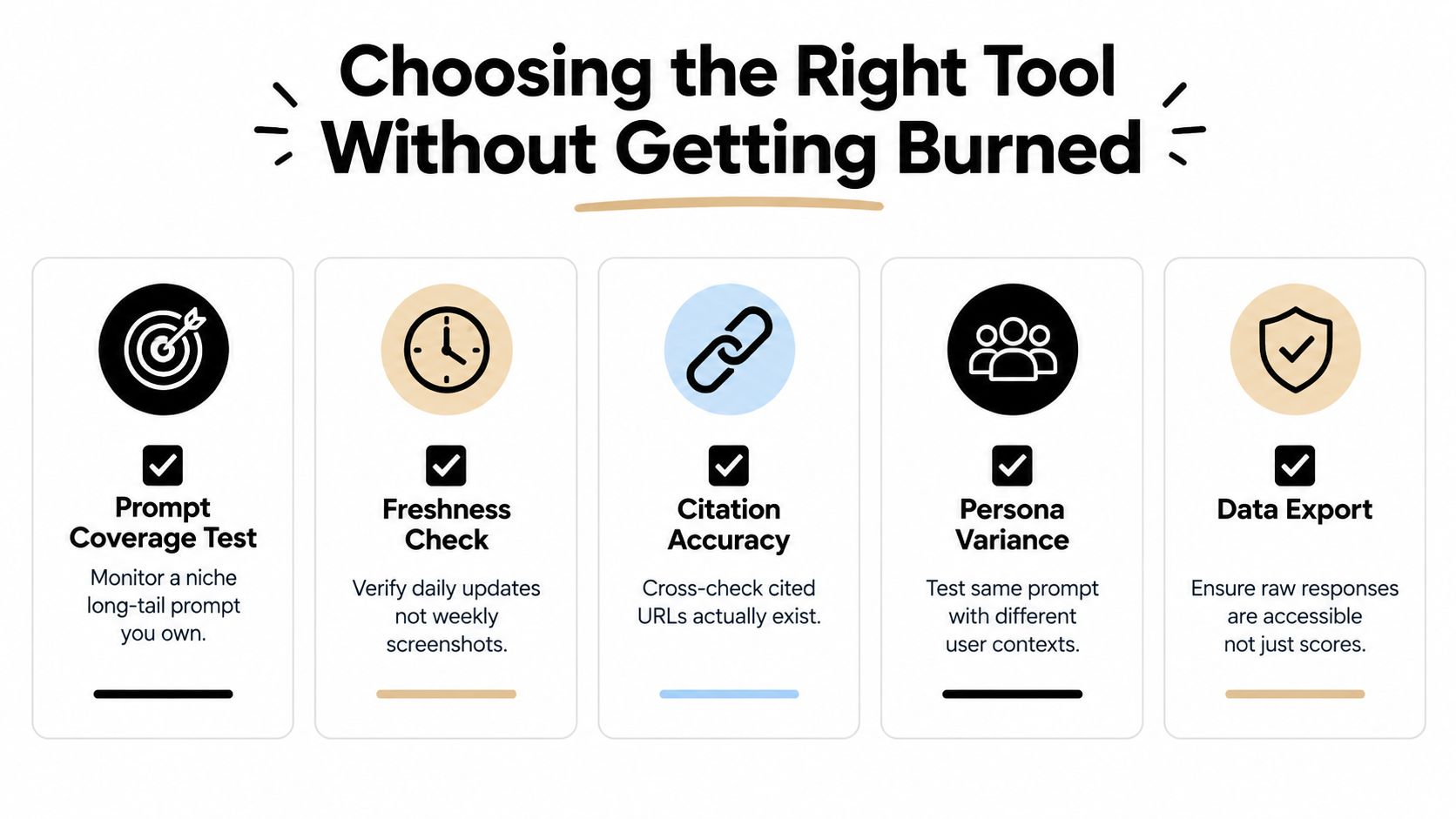
- Run a manual comparison. Give the tool a prompt you already know well, then compare its captured response with your own controlled runs. Differences should be explainable, not dismissed.
- Inspect uncertainty reporting. A point estimate without repeat-run context can encourage false precision. Look for confidence ranges, run counts, and provider-specific breakdowns.
- Audit the prompt library. You should be able to see, edit, group, and retire prompts. Opaque prompt selection makes the resulting score difficult to interpret.
- Verify citation extraction. The tool should record source URLs, not merely say that your brand was mentioned. Open those URLs and check whether they support the answer.
- Test sentiment changes. A rank-only report misses harmful framing. Run prompts that could surface objections, comparisons, and product limitations.
A credible platform should also provide raw response access, provider coverage, competitor comparisons, and exportable evidence. Be cautious with single-provider tools, unexplained scoring formulas, and products that blend AI visibility with classic SERP rank as if they were interchangeable.
Teams that need broader search strategy support may also evaluate Rankingonai.com, a SaaS SEO agency, especially when monitoring reveals that content and authority work must accompany measurement. The decision rule is simple: if a tool can't explain why a brand appears, disappears, or is described a certain way, it can't tell you how to improve.
For a wider comparison of platforms, consult this review of AI visibility tools, then validate each candidate against your own prompts and providers.
A 30 Day Playbook to Improve AI Visibility
Treat the first month as four connected sprints. Each sprint should produce an artifact that the next sprint can use, rather than another dashboard no one owns.
Week one is instrumentation. Build a baseline across ChatGPT, Gemini, Perplexity, and Google AI Overviews. Use 40 to 60 prompts mapped to your highest-intent topics, then export the raw responses, citations, provider names, and sentiment labels. Assign an owner for prompt quality, not just report delivery.
Week two is the citation gap audit. Identify the sources assistants rely on, then compare those sources with pages your brand controls or could credibly influence. Mark missing, outdated, and unfavorable references. Rank the ten highest-priority fixes by commercial intent and evidence quality.
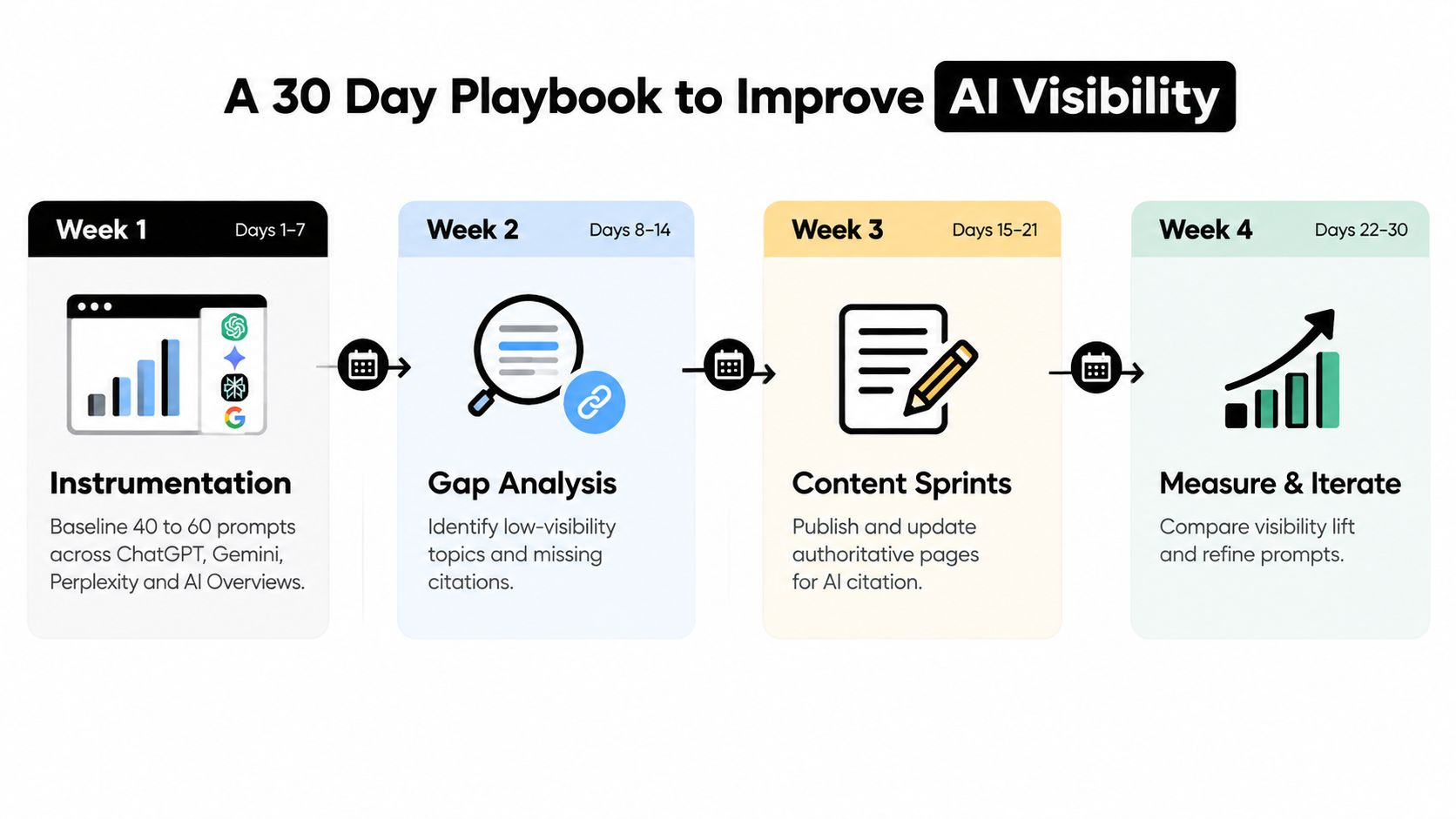
Week three is the content sprint. Rewrite pages that should answer the tracked prompts, put direct answers where assistants can interpret them, and update product facts across authoritative properties such as Wikipedia, Wikidata, and review platforms when those properties accurately represent the business. Don't optimize for length alone. Make the evidence easy to find and consistent across sources.
Week four is measurement and iteration. Run the same prompt set again, compare response distributions rather than isolated positions, and separate durable movement from noise. Retire prompts that no longer represent buyer language, add newly important questions, and set a recurring cadence with named owners.
Your operating checklist should include a provider dashboard, a prompt owner, a citation audit log, a content backlog, a sentiment review queue, and a stakeholder report. That structure turns AI rank checking into an improvement loop instead of a weekly screenshot ritual.
MyMentions helps founders, marketers, and SEO teams track prompt-level visibility, position, sentiment, citations, and competitor share across supported AI assistants. Visit MyMentions to organize buyer-intent prompts, identify citation gaps, and turn changing AI answers into a prioritized backlog your team can act on.