Most advice about the best AI visibility products with generative engine optimization assumes that every platform measures the same thing. They don't. A tool that checks whether a keyword triggers a Google AI Overview is solving a different problem from one that sends buyer-intent prompts across ChatGPT, Perplexity, Claude, and other assistants, then analyzes mentions, sentiment, and citations.
That distinction matters because prompt-level visibility describes how an assistant answers a question, while AI Overview tracking describes how Google changes a search result for a monitored query. Some products connect both views. Others remain strongest in established SEO, SERP, enterprise governance, or market-intelligence workflows.
This comparison evaluates platforms by the visibility problem they solve. The criteria are provider coverage, prompt or keyword depth, citation analysis, competitor benchmarking, reporting, integrations, scale, and buying fit. MyMentions is the most workflow-oriented choice when findings need to become prioritized fixes, while the other products are often better suited to teams already operating inside a mature SEO or enterprise stack.
Table of Contents
- 1. MyMentions
- 2. Semrush
- 3. seoClarity
- 4. BrightEdge
- 5. STAT Search Analytics by Moz
- 6. Conductor
- 7. SE Ranking
- 8. Advanced Web Ranking
- 9. SISTRIX
- 10. Similarweb Rank Tracker and Rank Ranger
- Top 10 AI Visibility Tools, Generative Engine Optimization Comparison
- Choose Coverage Before You Choose a Platform
1. MyMentions
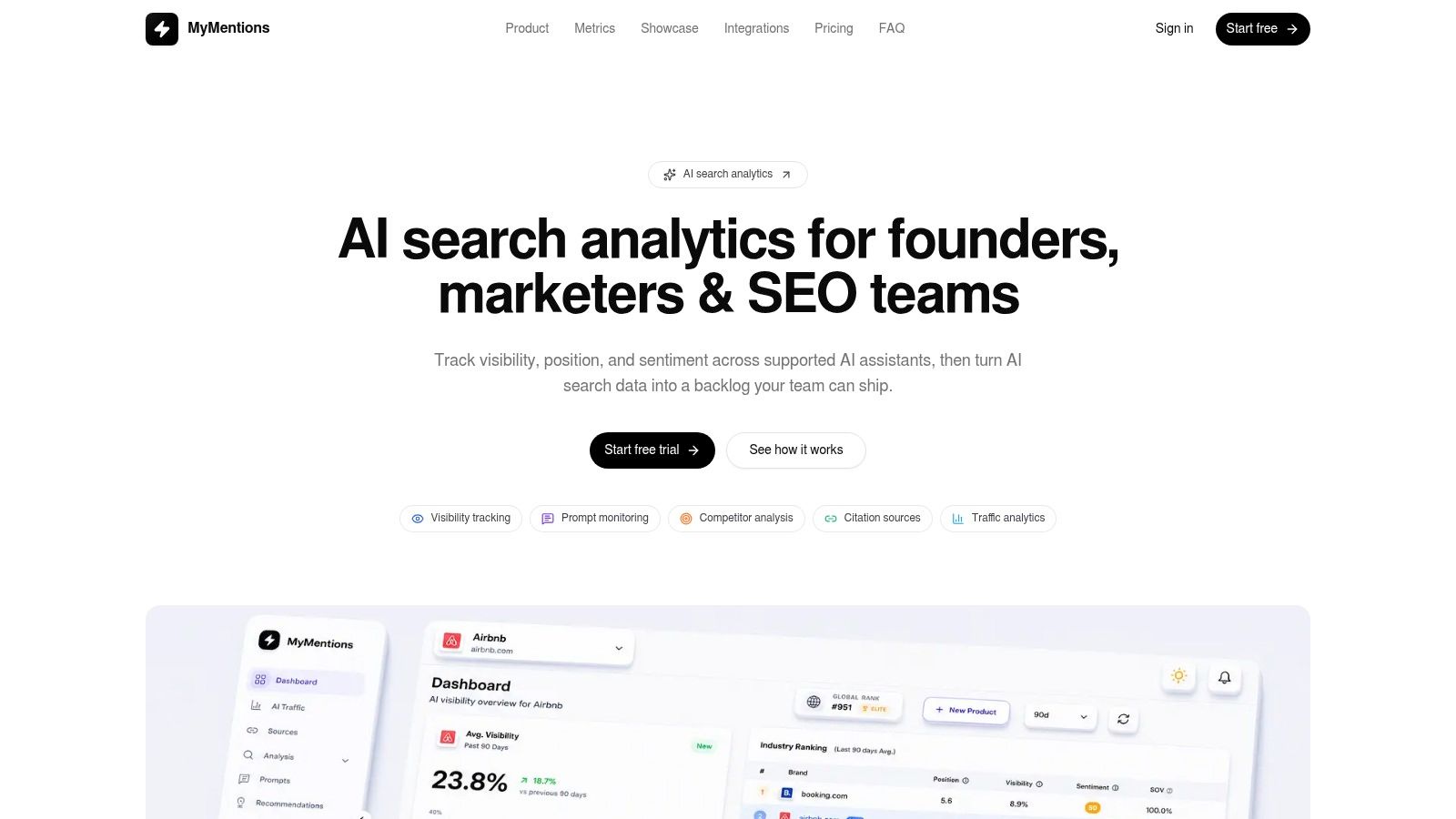
MyMentions is built around the question many GEO dashboards leave unanswered: what should the team change after it discovers a visibility gap? Its workspace analyzes prompt-level results across supported providers, including OpenAI, Google, Perplexity, Claude, Grok, Copilot, and DeepSeek. Teams can see whether a product appears, its average position, how it's described, the sentiment attached to the recommendation, and which sources influence the answer.
That source layer gives the product a practical advantage for teams investigating why a competitor is being recommended instead. MyMentions can surface product documentation, reviews, partner pages, and help content that shape an assistant's response. The platform then turns those findings into a prioritized backlog covering trust, content, UX, and technical signals. That makes it less of a passive reporting tool and more of an operating workspace for GEO.
Where MyMentions fits best
The strongest use case is a SaaS founder, product marketer, or SEO team that wants to compare the same buyer-intent prompts across assistants, benchmark competitors, and assign work from the results. Its dashboard brings together share of voice, average rank, sentiment, confidence, and traffic attribution, so teams can examine whether mentions are associated with visits rather than treating visibility as the final business outcome.
Alerts through Slack, Discord, and Email help distribute changes beyond the SEO team. Reports can also be exported for stakeholders. Plans scale from solo users to larger teams, with daily prompt analyses, multiple seats, broader provider access, competitor tracking, scheduled reports, and advanced recommendations available at higher tiers. Pricing is transparent, with a 7-day free trial, a $49 per month Starter plan, a $99 per month Pro plan, and a $199 per month Enterprise plan, as listed in the supplied product brief.
Practical rule: Use MyMentions when your success criterion is not simply “did the brand appear?” but “which source or signal should we improve next?”
The trade-off is tiered coverage. Provider checks and access to the full provider set increase with the plan, so buyers should test their actual prompt portfolio during the trial. The public site also doesn't show third-party certifications, customer testimonial quotes, or detailed SLAs. Read the platform's guide to tracking AI visibility, then validate data quality and workflow fit before committing.
2. Semrush
Semrush is the pragmatic choice for teams that already use its SEO suite and want AI visibility beside rankings, backlinks, keyword research, and competitor analysis. Its AI reporting covers mentions, citations, and cited pages across Google AI Overviews and AI Mode, Gemini, and ChatGPT, while Position Tracking can alert teams when AI result features appear or change.
That combination makes Semrush useful for separating two related questions. First, does a page rank for the conventional keyword? Second, does the brand or domain appear in an AI-generated answer associated with that search intent? The platform's side-by-side competitor comparisons can help teams identify whether a visibility gap is specific to the brand or reflects a broader shift in the search environment.
The main trade-off
Semrush's advantage is consolidation, not necessarily the deepest prompt-level workflow. Teams that only need lightweight GEO monitoring may find the broader platform heavyweight. Some AI visibility capabilities are restricted to higher-tier or enterprise plans, so the subscription level matters as much as the feature list.
Its frequent research and documentation around AI Overviews can help marketers interpret changes instead of reacting to a single observation. That's valuable for organizations where SEO managers, content teams, and executives already share Semrush reports. It's less compelling when the primary requirement is multi-provider answer comparison with source-level recommendations and direct execution.
Semrush's own site is the right place to confirm current availability, since plan packaging can change. For a second perspective on evaluation criteria, consult this comparison of AI visibility tools. The platform is strongest when the buying decision is really “extend our existing SEO system,” not “adopt a dedicated GEO operating layer.”
3. seoClarity
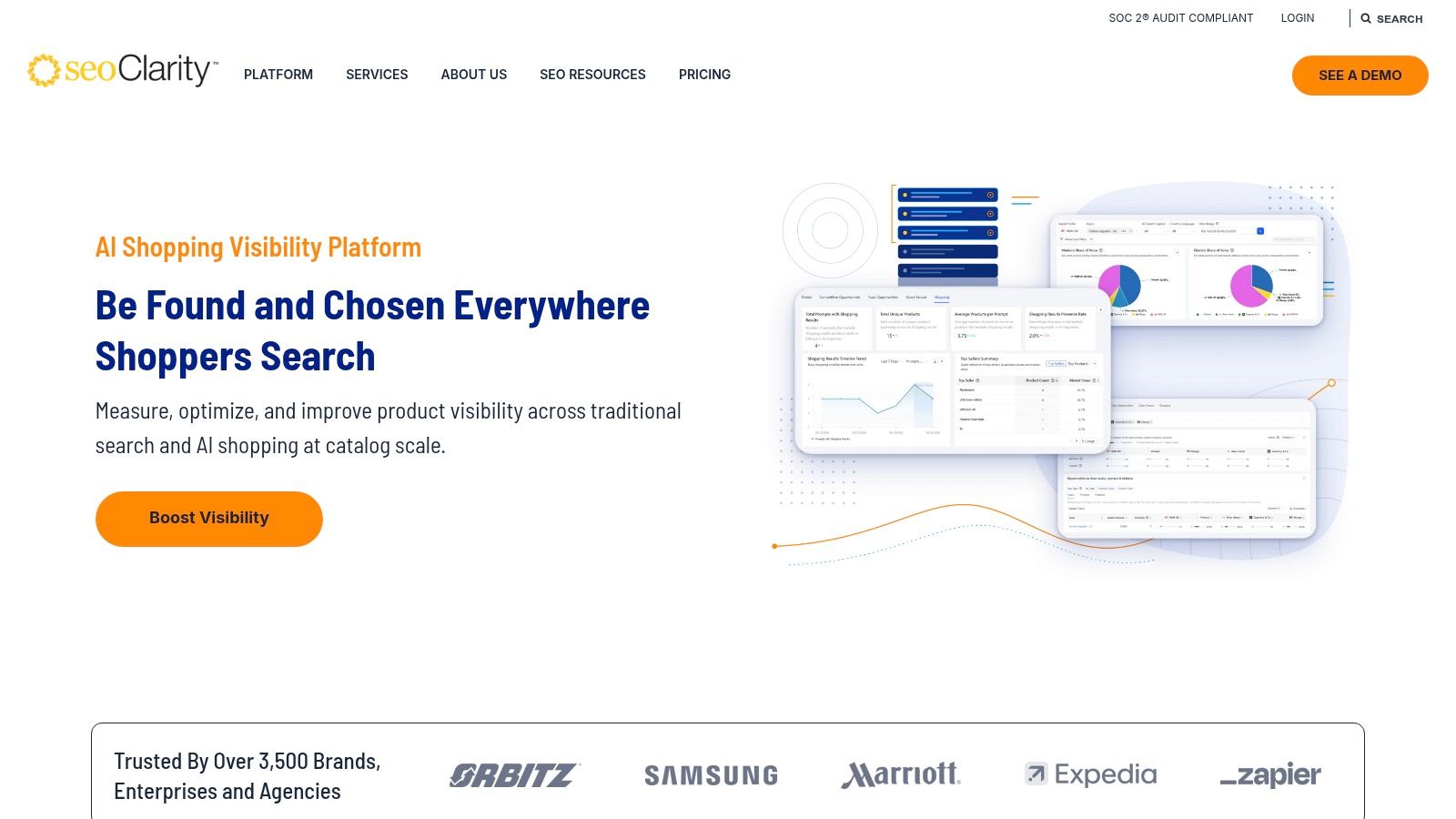
seoClarity targets organizations that need enterprise governance around Google AI search. Its dedicated tracking for AI Mode and AI Overviews gives large sites a way to monitor how Google's answer experiences affect visibility and performance, while its research program helps explain changes in AIO presence and trends.
The product's fit is clearest for brands with complex reporting structures, multiple stakeholders, and a need for controlled access to search data. Enterprise SEO teams rarely need another isolated chart. They need repeatable reporting, historical comparisons, governance, and a way to distinguish a real visibility change from a temporary result fluctuation. seoClarity's positioning addresses that operating model.
Why it isn't a universal GEO choice
seoClarity is primarily Google-centric for AI search tracking today. That makes it a strong candidate for a company whose strategic exposure is Google AI Mode and AI Overviews, but a less complete answer for teams that need prompt-level comparisons across independent assistants.
Pricing is enterprise and quote-based, which can be appropriate for large programs but excessive for smaller teams that want to test a limited prompt set. Buyers should also ask how the product handles locations, devices, refresh frequency, exports, and historical retention for their specific account.
The key interpretation is simple. seoClarity solves a governance and Google measurement problem more directly than it solves a broad, cross-provider recommendation problem. It belongs on an enterprise shortlist when reporting rigor and scale matter more than self-serve experimentation.
4. BrightEdge
BrightEdge combines AI Overview monitoring with established enterprise SEO, making it useful for organizations that need daily visibility into Google's evolving answer layer. Its capabilities include tracking how often monitored keywords trigger AI Overviews, analyzing presence and citations, and publishing industry research about what AIO results cite and how prevalence changes.
The platform's research cadence is part of the value. Executives often don't need a raw list of changed keywords. They need a defensible explanation of whether AI results are expanding in their market, which query groups are affected, and whether competitors are gaining exposure. BrightEdge's broader data environment is designed for that kind of operational and strategic reporting.
What buyers should verify
BrightEdge is an enterprise-grade platform, so its pricing and implementation model aren't aimed at small budgets. Its productized reporting also has a strong Google AIO focus, while coverage of non-Google LLMs may be more limited. That distinction should be explicit in procurement discussions.
For a marketing organization already using BrightEdge, adding AI Overview signals to existing keyword and competitor workflows can be efficient. For a product team trying to understand why ChatGPT recommends a rival, the platform may not offer the same prompt-level and citation-source depth as a dedicated multi-provider workspace.
The practical takeaway is that BrightEdge is best viewed as an AIO monitoring and market-research system at enterprise scale. It's a good fit when daily Google trend visibility supports executive decisions. It's a weaker fit when the central requirement is turning cross-assistant findings into a prioritized content and trust backlog. The supplied GEO guide provides useful context for distinguishing those measurement models.
5. STAT Search Analytics by Moz
STAT Search Analytics is an established rank-tracking platform that extends conventional SERP analysis into Google AI Overviews. It can detect whether an AIO appears for a monitored keyword, extract cited URLs, and place AI results alongside other SERP features in enterprise dashboards.
That makes STAT especially useful for analysts who want a clear mapping between keyword intent, SERP composition, and cited source. Instead of treating an AI Overview as an abstract visibility score, teams can examine the result within the context of the search environment they already monitor. The mature collection and parsing environment also suits agencies and large SEO departments that need dependable exports and repeatable reporting.
A Google-first measurement layer
STAT's limitation is the same feature that defines its usefulness. Its AI search coverage is primarily Google-first, while tracking outside Google's chat and answer environments varies. A team that wants to know how the same software category prompt performs across ChatGPT, Perplexity, Claude, and Google will likely need another product or a separate data workflow.
Enterprise contracts and fewer self-serve options can also make STAT less convenient for smaller teams. The buying decision should focus on whether AIO citation extraction improves an existing rank-tracking program enough to justify the commercial and implementation overhead.
For SEO leaders, STAT is a strong option when the main question is, “Which URLs appear inside Google's AI result for our tracked query set?” It isn't necessarily the best answer to, “How does every major assistant describe our brand, and what should we fix?”
Visit STAT Search Analytics. Teams comparing this model with broader AI measurement can also review AI search analytics guidance.
6. Conductor
Conductor's AI Search Performance module is designed for cross-functional marketing teams that want visibility data connected to content workflows. It tracks brand mentions and citations across ChatGPT, Perplexity, Google AI Mode, and AI Overviews, then organizes results by topics, personas, and intelligent prompt sets.
That topic and persona structure matters for larger marketing organizations. A product marketer may care about comparison prompts, while a brand team monitors reputation language and an SEO team studies informational questions. Conductor's reporting can bring those views into a shared system, with sentiment and competitive share included alongside mentions and citations.
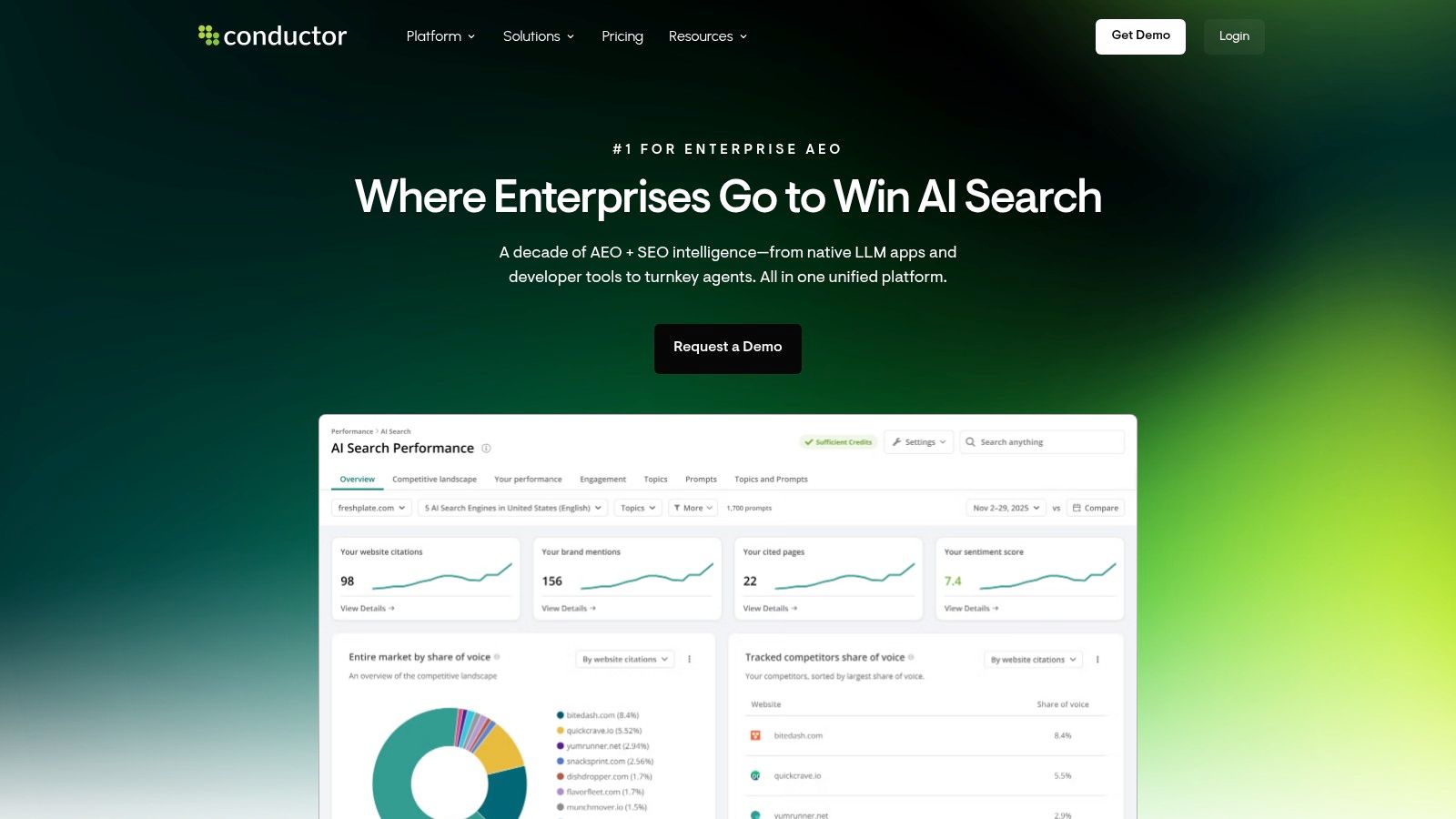
Workflow value, configuration cost
Conductor's strength is the bridge from analysis to execution through its content tools. Its official ChatGPT app integration can provide visibility summaries where teams already work, reducing the distance between a report and a content brief.
The compromise is enterprise positioning and quote-based pricing. Teams also need to configure topics and prompt sets before the reporting becomes useful. That setup can be worthwhile for a multi-market organization, but it's not the fastest route for a founder who wants to enter a few buyer prompts and see immediate cross-provider results.
Conductor therefore solves a workflow coordination problem. It makes sense when SEO, content, and marketing teams already operate in Conductor and want AI search signals added to the same governance model. It's less attractive when the priority is transparent self-serve pricing, rapid experimentation, or a highly action-oriented citation backlog.
7. SE Ranking
SE Ranking brings AI Overview monitoring into a mid-market SEO suite. Its AI Results or AI Overviews Tracker identifies tracked queries that trigger AIO, shows whether a site's pages are cited, and lets teams compare organic performance with AI result presence.
This is a useful entry point for SMBs and agencies that don't want a separate enterprise platform for every emerging search feature. Keyword, backlink, and competitor data remain in the same environment, which helps an SEO practitioner connect a cited page to the broader optimization work already underway.
Good value, narrower scope
SE Ranking's lower cost of entry is a practical advantage for smaller teams. Daily snapshots and reporting can support a regular review process, while cross-tool links make it easier to inspect keywords and backlinks after an AIO change appears.
The product is primarily focused on Google AIO, however. LLM and chat coverage is more limited, and the granularity of data and usage limits can vary by plan. Buyers should verify which regions, keyword volumes, refresh schedules, and exports are included before comparing it with a multi-provider product.
SE Ranking is best for teams that define GEO as Google AI Overview monitoring inside an affordable SEO workflow. It's not an interchangeable substitute for prompt-level analysis across assistants. That distinction may save a smaller team from buying a tool that reports the wrong layer of visibility.
8. Advanced Web Ranking
Advanced Web Ranking, or AWR, is a veteran rank-tracking platform with native Google AI Overview support. Its dedicated “Google Search + AIO” engine can detect AIO appearances, show the SERP with the AI block, and identify cited sources. Historical timelines, device data, and location granularity make it particularly relevant for agencies managing clients across markets.
AWR's value appears when the analyst needs to inspect the result itself rather than rely on a blended visibility number. Seeing the AIO block in the SERP context helps teams understand which organic results remain visible, which URLs are cited, and whether the result changes by device or location.
Agency-friendly reporting
Flexible reporting and exports support client-facing workflows. AWR can also offer strong price-to-volume economics at higher keyword counts, which matters for agencies that need to track many accounts without moving to a larger enterprise platform.
The limitations are clear. AWR is focused primarily on Google, and broader LLM or chat engine coverage is more limited. Lower tiers may default to weekly checks, which won't satisfy teams that need high-frequency monitoring during a volatile campaign or launch.
AWR solves a granular Google SERP and AIO tracking problem. It's a strong shortlist candidate for agencies and SEO teams that care about locations, devices, historical snapshots, and exports. It's not the right standalone choice for a brand-reputation program spanning several answer engines.
9. SISTRIX
SISTRIX combines international AI Overview tracking with an AI and Chatbot Research tool that monitors prompts across AI Overviews and AI Mode, ChatGPT, and Perplexity. That combination gives users a bridge between classic visibility metrics and a more conversational view of how brands appear in answers.
Its international orientation is a meaningful differentiator. A company operating across markets may need to know whether an AI Overview appears in one country but not another, or whether prompt visibility changes as the same product category is evaluated in different search environments. SISTRIX's country coverage and keyword filters support that analysis.
Powerful, but not lightweight
SISTRIX's module structure can be difficult for new users to manage. Pricing and quotas need close attention, especially when prompt monitoring volume is a central requirement. A team may find that the overall ecosystem is valuable while still needing to control how many prompts it tracks and how frequently it refreshes them.
The platform is a strong fit for international SEO practitioners who want AI signals inside an existing visibility system. It's less straightforward for a founder who wants a simple workflow from prompt result to recommended fix.
SISTRIX solves a hybrid problem: international SERP visibility plus structured prompt monitoring. That makes it more expansive than a pure AIO tracker, though teams should confirm whether its provider coverage and quotas match the assistants their customers use.
10. Similarweb Rank Tracker and Rank Ranger
Similarweb's Rank Tracker, including Rank Ranger functionality, flags when tracked keywords trigger Google AI Overviews. It adds AIO presence to daily position tracking and SERP-feature reporting, then places those findings beside web traffic and competitive-intelligence data.
That context is the product's main strategic advantage. An SEO manager can monitor a keyword's AI feature status, while a market-intelligence team examines traffic patterns, category movements, and competitor activity in the same broader environment. The tool therefore helps answer not only whether AIO is present, but how that presence fits into the market being measured.
Useful context, limited assistant coverage
The rank tracker remains primarily focused on Google AIO. LLM and chat coverage outside Google is limited in that workflow, so buyers shouldn't interpret Similarweb's AI Overview flags as a complete view of generative search visibility.
Feature inclusion, pricing tiers, and historical limits vary by plan. Teams should confirm exactly what their subscription includes, particularly if they need daily tracking, long historical windows, exports, or integrations.
Similarweb is best for organizations that treat AI visibility as part of a wider traffic and market-intelligence program. It's less suitable as the only system for prompt-level monitoring across multiple assistants. Before selecting it as an enterprise rank-tracking foundation, review how enterprise rank trackers should be evaluated.
Top 10 AI Visibility Tools, Generative Engine Optimization Comparison
| Tool | Key features ✨ | Quality (★) | Price / Value 💰 | Target audience 👥 | Standout 🏆 |
|---|---|---|---|---|---|
| MyMentions 🏆 | ✨ Prompt‑level multi‑provider visibility; citation sourcing; prioritized backlog | 4.5★ live dashboard & alerts | 💰 Starter $49 / Pro $99 / Enterprise $199 (7‑day trial) | 👥 Founders, marketers, SEO & product teams | 🏆 Recommended, multi‑LLM prompt comparisons + traffic attribution |
| Semrush | ✨ SEO + AI visibility (AIO/ChatGPT/Gemini) & competitor context | 4★ unified workflows | 💰 Tiered; AI features often in higher plans | 👥 SEO teams, agencies wanting one platform | Integrates classic SEO with GEO monitoring |
| seoClarity | ✨ Dedicated Google AIO tracking & research | 4★ enterprise‑grade reporting | 💰 Quote‑based enterprise pricing | 👥 Large sites requiring governance & analysis | Strong AIO research and governance |
| BrightEdge | ✨ Daily AIO triggering rates, citations & market insights | 4★ daily monitoring | 💰 Enterprise positioned (higher cost) | 👥 Enterprise marketing & executive reporting | Category‑leading AIO research cadence |
| STAT (Moz) | ✨ Detect AIO per keyword; extract cited sources; SERP parsing | 4★ mature data collection | 💰 Enterprise contracts / fewer self‑serve tiers | 👥 Enterprise SEO teams & agencies | Mature SERP parsing and keyword→AIO mapping |
| Conductor | ✨ Multi‑platform AI visibility tied to content workflows | 4★ execution‑focused | 💰 Quote‑based enterprise pricing | 👥 Cross‑functional marketing & content teams | Bridges analysis → execution; ChatGPT app integration |
| SE Ranking | ✨ AIO detection with cited‑URL extraction & daily snapshots | 3.5★ solid SMB UX | 💰 SMB‑friendly pricing; good value | 👥 SMBs & agencies wanting integrated GEO signals | Best price/value for mid‑market GEO tracking |
| Advanced Web Ranking (AWR) | ✨ Native Google AIO engine; device/location granularity | 4★ granular reporting | 💰 Competitive at high keyword volumes | 👥 Agencies & teams needing exportable reports | Flexible reporting and agency exports |
| SISTRIX | ✨ Country‑level AIO tracking + prompt monitoring (ChatGPT, Perplexity) | 4★ international coverage | 💰 Modular pricing; quota limits apply | 👥 International SEO teams & analysts | Strong country coverage and prompt tool |
| Similarweb (Rank Tracker) | ✨ AIO flags integrated with traffic & market intelligence | 3.5★ market‑intel focus | 💰 Part of broader suite; pricing varies by plan | 👥 Market intelligence & competitive analysts | Combines AIO visibility with traffic/market data |
Choose Coverage Before You Choose a Platform
The market is developing because the underlying discovery behavior is changing. One market estimate places the U.S. GEO market at USD 365.4 million in 2026, with a 42.9% CAGR over its forecast period, while another estimate places the global market at about USD 1.09 billion in 2026 and projects USD 17.15 billion by 2034, at a 40.6% CAGR. These are projections and estimates, not guarantees, but they explain why platforms now package very different forms of AI visibility under the same GEO label. The U.S. market estimate and growth forecast and the global market projection should be read as market signals rather than interchangeable measurements.
Start by defining the visibility problem. If the team needs prompt-level visibility across assistants, prioritize provider breadth, prompt controls, citation sources, sentiment, competitor comparisons, and actionable recommendations. If the priority is Google AI Overviews or AI Mode, an established rank tracker may be the better fit. Many organizations need both, but they shouldn't assume one product covers both with equal depth.
A practical buying sequence
Define the discovery surfaces: Decide whether your program covers ChatGPT, Google AI Overviews, Google AI Mode, Perplexity, Claude, Gemini, Copilot, or other supported assistants. The right list depends on your audience, region, and product category.
Build a test set: List the buyer-intent prompts, conventional keywords, locations, devices, competitors, and product categories that matter. Include comparison, alternatives, problem, and branded queries rather than relying only on head terms.
Inspect the evidence: Confirm whether each tool extracts citations, identifies cited pages, records sentiment, reports share of voice, and preserves historical answers. A visibility score without source context may be difficult to act on.
Check operating limits: Verify refresh frequency, prompt quotas, keyword limits, seats, locations, exports, integrations, API access, and plan restrictions. These details can change the usefulness of a product more than its headline feature list.
Pilot against identical prompts: Run the same buyer-intent queries through shortlisted tools and record whether the results are reproducible, understandable, and actionable. The best product is the one that helps your team make a better decision, not the one with the longest feature page.
The need for this discipline is reinforced by the GEO-bench research. Researchers created a 10K-query benchmark because no public dataset existed for generative-engine queries, which supports a prompt-level measurement approach rather than one-off manual checks. The GEO-bench dataset also points to the importance of comparing providers and query types instead of treating traditional rank as a complete proxy.
Measurement should also distinguish visibility from traffic. One study of 6.77 million LLM-driven sessions reported that ChatGPT represented 92.4% of trackable AI referral traffic, while another dataset found AI referrals remained under 2% of total referral traffic on average and grew 80% from H1 to H2 2025. Those figures come from different datasets and describe different measurement frames, so they shouldn't be combined into one universal channel benchmark. They do support a narrower conclusion: platform mix matters, and a ChatGPT-first, then expand approach may be more realistic than treating every assistant as equally important. The AI traffic analysis provides the underlying context.
Clicks are an equally imperfect endpoint. Independent reporting found that more than 97% of visits from one assistant carried no trackable link back to the assistant, while a separate analysis of 15,252 AI queries and 90,232 citations connected reduced outbound links with lower referral traffic. At the same time, another 2026 analysis reported 1.5x to 2.5x higher visit rates after a brand was named in an AI answer. The evidence points to a measurement problem, not a simple “AI sends traffic” or “AI sends no traffic” conclusion. The reporting on zero-click AI search is useful when evaluating attribution claims.
Choose MyMentions when the priority is connecting multi-provider visibility, citation sources, competitor benchmarking, traffic attribution, and prioritized recommendations. Choose Semrush, seoClarity, BrightEdge, STAT, Conductor, SE Ranking, AWR, SISTRIX, or Similarweb when their established SEO reporting, enterprise governance, market intelligence, international tracking, or Google-focused rank capabilities better match the operating model. The right answer may be a combination, but only after each product has been tested against the same business questions.
For historical context, ChatGPT launched in November 2022, and by mid-2025 roughly 5.6% of all U.S. searches were reported as being conducted through AI-powered LLMs as the primary search tool. The broader GEO market context helps explain why teams should establish a baseline now, including by using GSC data for pre-AI Overview benchmarking, rather than waiting for referral reporting to become complete.
MyMentions tracks prompt-level visibility, position, sentiment, citations, competitors, and traffic attribution across supported AI providers, then turns those findings into a prioritized GEO backlog. Visit MyMentions to compare buyer-intent prompts across assistants and connect visibility findings with work your team can ship.