The most popular search engine isn't automatically the best one for every query, workflow, or product-visibility goal. Google remains the dominant starting point, with an estimated 89.6% share of global queries by May 2025, while Bing was around 4%, according to Omnius's 2025 AI search industry report. But reach answers only one question. It doesn't tell you whether an engine cites sources clearly, handles research well, protects privacy, supports customization, serves developers, or represents your product accurately.
This ranking evaluates the best AI search engines 2025 through those separate lenses: discovery reach, citation transparency, answer quality, research depth, privacy, controllability, developer utility, and product discovery. It includes consumer search surfaces and programmable tools, with access and pricing distinctions noted only where supplied. For a broader perspective on optimizing for AI search agents, use the same prompts across providers and record the result rather than trusting a generic popularity list.
Methodology: The ranking weighs practical usefulness for marketers, founders, and SEO teams. It separates audience reach from evidence quality, then considers how much control a team has over retrieval, citations, privacy, and product representation.
Table of Contents
- 1. Google Search with AI Overviews and AI Mode
- 2. Microsoft Copilot Search
- 3. Perplexity
- 4. Brave Search with Answer with AI and Search Premium
- 5. DuckDuckGo with Search Assist and Duck.ai
- 6. Kagi
- 7. You.com
- Top 7 AI Search Engines 2025, Feature & Performance Comparison
- Turn the Ranking Into an AI Visibility Test Plan
1. Google Search with AI Overviews and AI Mode
Google earns the top position because broad consumer discovery still begins there more often than anywhere else. Its AI Overviews and AI Mode extend the familiar results page with generated summaries, source links, conversational follow-ups, multimodal queries, and more complex exploration. The result is a larger visibility surface than the traditional blue-link page, but also a less predictable one.
Google says publishers can use controls in Search Console to opt in or out of AI grounding. That gives site owners an important lever, although it doesn't let them decide when an AI Overview appears or guarantee that a particular passage will be used. The supplied product notes also acknowledge that quality and fidelity have required ongoing fixes, so teams should treat every generated answer as something to audit rather than assume.
A useful test starts with one broad category prompt and one branded prompt. Check whether an Overview appears, which pages it cites, whether the brand is included, and whether the description matches the product. Then compare the result with standard organic listings.
Best visibility playbook for Google
Prioritize clear, crawlable product information, direct answers to buyer-intent questions, and consistent claims across product pages, documentation, reviews, and partner sites. Monitor branded and non-branded prompts separately in MyMentions. Branded prompts measure recognition, while non-branded prompts reveal whether Google connects the product with the category at all.
For teams refining their approach, this guide to ranking in Google SGE provides a relevant supporting workflow.
- Reach: Highest among the ranked options for broad discovery.
- Citation visibility: Strong when an AI Overview appears, but appearance varies by query.
- Control: Moderate, with publisher controls but limited control over inclusion.
- Consumer-discovery fit: Excellent for category, product, local, and multimodal exploration.
2. Microsoft Copilot Search
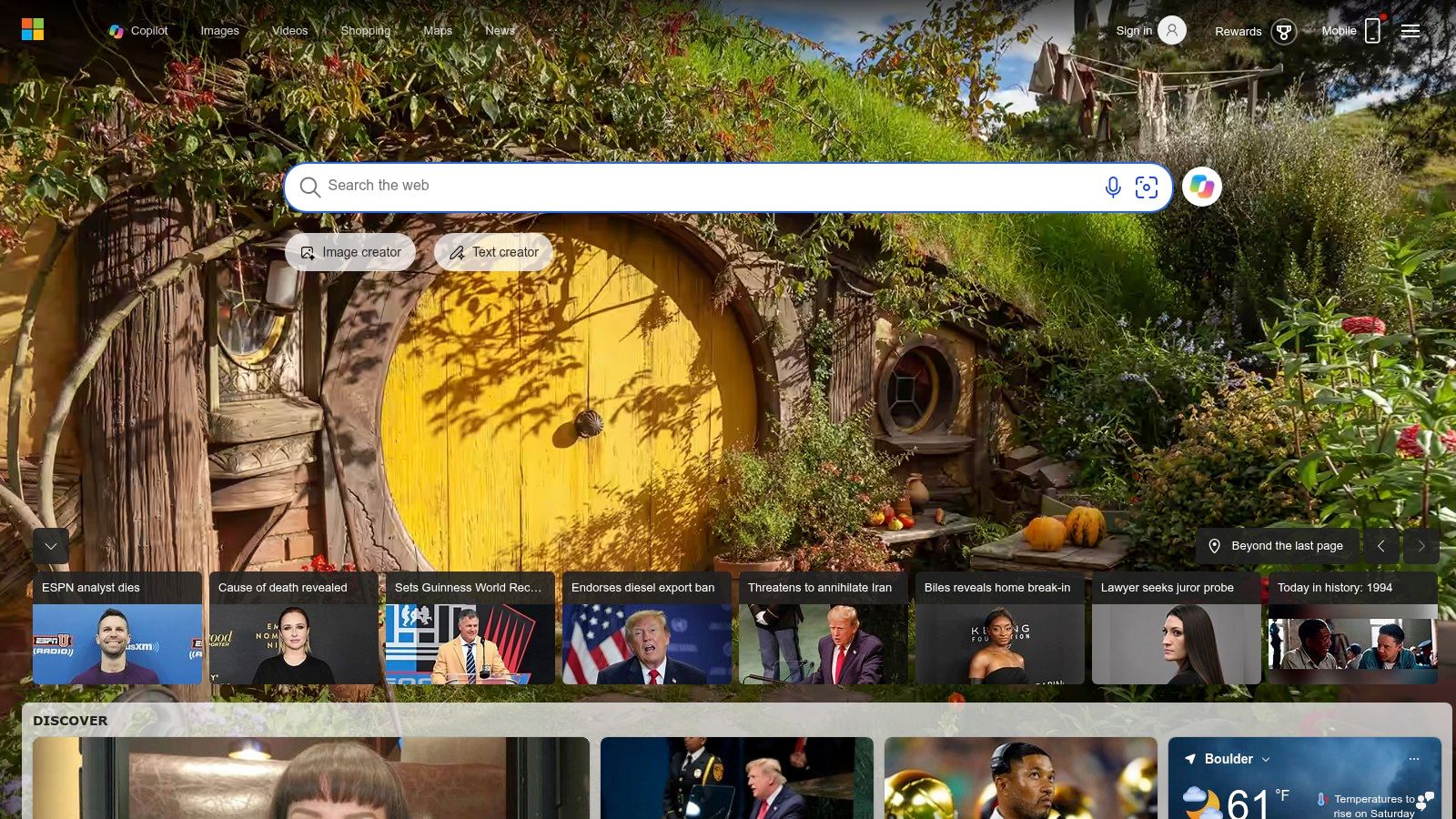
Microsoft Copilot Search is a strong option for teams that need cited summaries within the Microsoft ecosystem. It combines an answer, visible source lists, follow-up context, and related topics on one page. That format supports query expansion while keeping the evidence behind the summary accessible.
Its reach differs from Google's across regions, but Copilot is available on the web, mobile, Edge, Windows, and Microsoft applications. This distribution gives it practical value for B2B and technical discovery, particularly when buyers already use Microsoft tools. Copilot Pro for Microsoft 365 apps adds connected productivity features. Those features should be evaluated separately from access to Copilot Search itself.
The main trade-off is clear: broad availability does not guarantee reliable product representation. Test the engine with identical prompts for two competing products. Record which sources it uses, whether the links lead to current pages, and whether the summary preserves technical details. Official documentation, independent reviews, partner pages, and older references can produce very different outcomes.
Practical rule: A citation that supports the summary but sends buyers to an obsolete page is a visibility problem, not a success.
For B2B teams, documentation is the highest-impact control point. Use consistent product terminology across feature pages, support content, and partner materials. If Copilot cites an integration page but misstates compatibility, correct the source page first, then inspect third-party references that may repeat the error. This approach improves accuracy and gives search systems clearer evidence to associate with the product.
Use a provider comparison workflow to test Copilot and Google with the same branded and non-branded prompts. Compare cited pages, missing entities, and incorrect claims rather than relying only on ranking positions.
- Source transparency: High, because source lists are prominent.
- Research usefulness: Strong for technical comparisons and query expansion.
- Reach: Broad availability, with smaller market share than Google in many regions.
- Product implication: Current, consistent documentation improves the accuracy of technical summaries.
Visit Microsoft Copilot Search on Bing
3. Perplexity
Perplexity ranks highly for users who need current answers with inline citations. Competitive scans, market research, executive briefs, and content-gap analysis all benefit from its visible evidence trail. Sources appear alongside the response as it develops, allowing a researcher to inspect whether each citation supports the claim.
A marketer asking for alternatives to a software product may receive several vendor names in the first response. The more useful test follows: can the user reach relevant review pages, comparison articles, product documentation, and further research through the cited sources? A brand mention has limited value when its citation is weak, outdated, or unrelated to the statement.
Its Pro and Max modes support multi-model orchestration, including GPT, Claude, and Gemini models supplied in the brief. Research Projects and Spaces support multi-step investigations and collaboration. Pro and Enterprise queries also carry the supplied privacy assurance that they are not used to train third-party models. Heavy research can reach plan limits without Pro or Enterprise access. Reported billing or support friction remains anecdotal, so it should not be treated as a universal product judgment.
For SEO teams, citation quality creates a practical visibility test. Ask the same category and brand questions repeatedly, record recurring sources, and check whether those pages describe the product accurately. The guide to ranking in Perplexity provides a framework for turning those observations into content priorities. MyMentions can help monitor recurring citation sources across prompts, giving writers a basis for choosing which influential pages to address first.
Create content that answers the next specific research question. Precise comparisons, implementation guides, compatibility explanations, and independently supported reviews usually provide clearer evidence than broad category copy.
- Research depth: Excellent for multi-step investigation.
- Citation transparency: Excellent, with inline source links.
- Privacy: Clear assurances for Pro and Enterprise queries.
- Best fit: Competitive intelligence, executive research, and cited content planning.
- Product implication: Accurate, well-supported pages have a better chance of shaping cited answers.
For local marketers, the AI Tools for Local SEO playbook adds a complementary perspective on local discovery.
4. Brave Search with Answer with AI and Search Premium
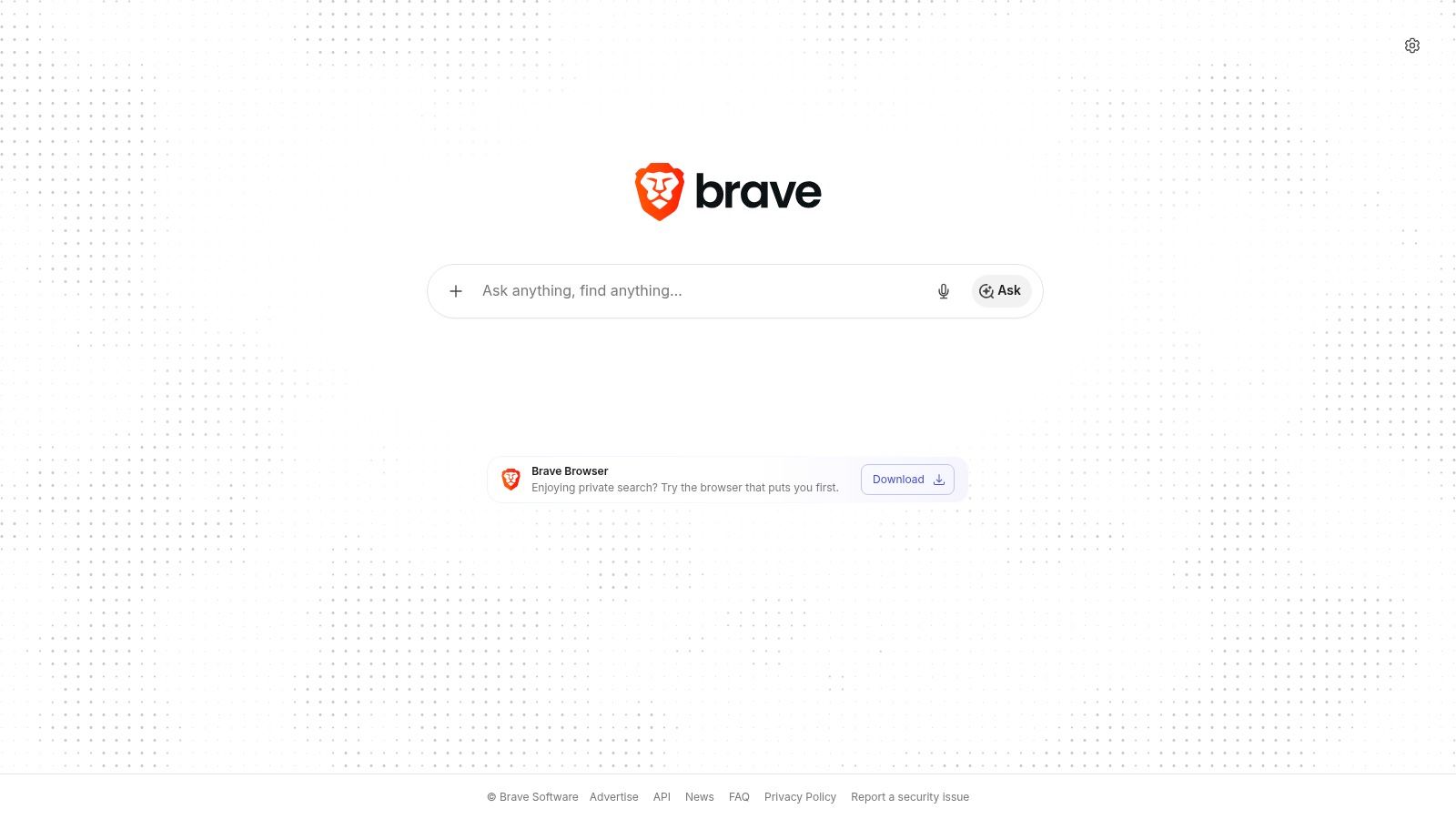
Brave Search combines an independent index, privacy-oriented defaults, result controls, and programmatic access. Answer with AI places a generated response above the results and supports one-click follow-ups. Goggles lets users rerank or filter results, while the Search API provides LLM context endpoints and skills for retrieval workflows.
These controls make Brave useful for testing how resilient a brand's visibility is. Run a product-category prompt with default results, then apply a Goggles configuration that filters or reranks the set. Compare the answer, cited sources, and brand mentions. A product that disappears after a reasonable filtering change may have a source-quality or topical-relevance problem, even if its general search reach appears adequate.
Brave's index has less coverage than Google or Bing in some niches. Answer with AI is optional and may require manual activation for each query. The trade-off is clear: Brave offers less general-purpose exposure, while giving privacy-conscious users, independent-index advocates, and developers more control over retrieval.
A practical Brave workflow
Start with product pages that describe the offering plainly. Test technical documentation and independent reviews using several query formulations to determine whether trustworthy sources remain discoverable as the question becomes more specific. If citation quality is weak, improve factual clarity on owned pages and address gaps in independent coverage rather than repeating keywords.
- Privacy: Strong, with no profiling and in-house AI features.
- Control: High through Goggles, filtering, and API options.
- Developer utility: Strong for retrieval experiments and AI applications.
- Reach: Lower than the general-purpose leaders in some topic areas.
This LLM search engine guide can help teams assess how retrieval and source attribution affect visibility.
5. DuckDuckGo with Search Assist and Duck.ai
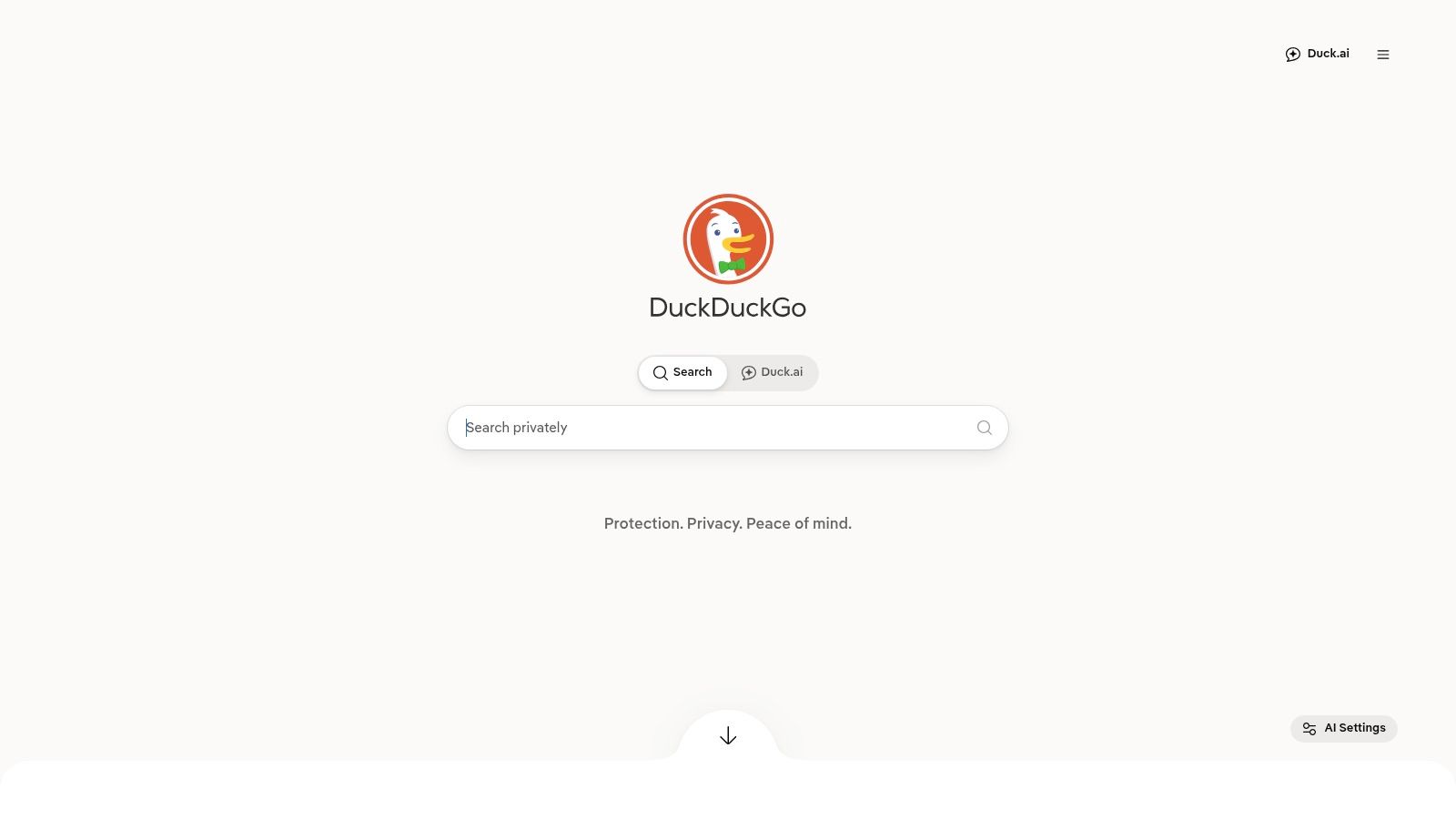
DuckDuckGo suits users who want private search while choosing how often AI appears. Search Assist returns concise answers with direct links to one or two sources. Duck.ai provides anonymized chats across a catalog of models, and its settings let users choose often, sometimes, on-demand, or never.
That control also supports a practical product-visibility test. Run the same product prompt under each AI frequency setting, then compare the response, linked sources, and description of the product. Search Assist may send a user directly to a credible help page, while a broader conversational answer can add useful context yet describe the product less accurately.
For marketers and SEO teams, the implication is specific: make important product facts easy to retrieve and verify. DuckDuckGo offers fewer shopping and local features than Google and Bing, while advanced chat models and higher limits require a paid subscription. The recommendation rests on privacy defaults, source links, and user control over when AI appears, rather than maximum breadth.
Make direct citations easy
Publish concise answers that remain accurate when an AI response links to them without surrounding context. Help content, documentation, comparison pages, and transparent product-fact pages give Search Assist a clear destination and help users verify a claim. Review whether each page states the product's capabilities, limits, audience, and relevant evidence plainly.
- Privacy: Strong defaults, with anonymized chats not used to train models.
- AI control: High, because users can adjust answer frequency.
- Citation quality: Clear within the limited source set shown in Search Assist.
- Best fit: Privacy-conscious discovery with controlled AI exposure.
The source attribution guide explains why linked evidence matters as much as the mention itself.
6. Kagi
Kagi is a paid search engine for power users and research teams that prioritize an ad-free, high-signal environment with deep personalization. Unlimited searches and built-in assistant access to premium models support repeated analysis, while Lenses and custom ranking let users shape results around specific topics. Its Search API preview extends that control to programmatic searches across web, news, and images.
A focused Lens provides a practical test. Build one for a product category or recurring research task, compare its results with a general engine, and record which sources repeatedly appear. The comparison can reveal a different mix of documentation, specialist publications, reviews, and community discussions. That makes Kagi useful for assessing whether a brand is supported by credible, relevant references rather than broad visibility alone.
The subscription cost narrows its audience, and feature changes or add-on pricing may affect the value assessment. Kagi therefore fits teams willing to pay for control and result quality, rather than organizations measuring maximum consumer reach.
Personalization changes the visibility test
Kagi rewards relevance over indiscriminate volume. To earn accurate mentions, publish technical explanations, detailed reviews, and precise comparison pages that answer focused research questions. Test those pages through relevant Lenses, then check whether the content remains visible after ranking preferences are applied.
- Personalization: High, through Lenses and custom ranking.
- Research quality: Strong for focused, ad-free research.
- Developer utility: The API preview supports internal tools and builder workflows.
- Consumer reach: More limited than major general-search platforms.
7. You.com
You.com ranks seventh because its clearest strength is developer-led search integration. Its Web Search API targets AI agents and returns structured results with domain filters. Quickstart resources, end-to-end onboarding, pay-as-you-go access, and enterprise options support teams that control the interface, retrieval process, and citation layer.
A product team can restrict domains, retrieve structured results, retain source URLs, and test whether an agent attributes evidence correctly. The team's goal extends beyond earning a mention: it determines how retrieved evidence enters the answer and appears to the end user. That makes You.com more relevant to product builders than to teams measuring public search visibility.
You.com places greater emphasis on API use than consumer app tiers, and its consumer reach is smaller than Google, Bing, or Perplexity. It therefore offers a weaker measure of direct awareness, while fitting teams embedding search in agents, internal tools, analytics pipelines, or product experiences.
Match retrieval to buyer intent
Use MyMentions to find buyer-intent prompts where brand coverage is weak or competitors appear more often. Publish documentation, comparison pages, and support content that answer those questions directly. Then test the pages through a programmatic retrieval pipeline and retain returned URLs for citation review.
For SEO teams, the practical priority is evidence control. Keep product terminology consistent across technical pages, comparison content, and support documentation. That consistency gives retrieval systems clearer passages to select and lets developers verify whether the application presents the correct source.
- Developer utility: Excellent for AI features and internal search.
- Controllability: High, through structured results and domain filters.
- Citation ownership: Strong, because the application controls presentation.
- Consumer discovery: Limited compared with general-search leaders.
Top 7 AI Search Engines 2025, Feature & Performance Comparison
| Search Engine / Tool | 🔄 Implementation complexity | ⚡ Resource & operational requirements | 📊 Expected outcomes (reach & impact) | ⭐ Key advantages (quality/effectiveness) | 💡 Ideal use cases / Tips |
|---|---|---|---|---|---|
| Google Search (AI Overviews & AI Mode) | Low–Medium: standard SEO + structured data to influence Overviews | Moderate: maintain crawlable product info, consistent claims, monitor Search Console | Very high reach; generated summaries can surface brands but citation fidelity varies | Massive scale, integrated AI summaries, clear ad/organic delineation | Optimize buyer‑intent pages, track branded vs non‑branded prompts in MyMentions |
| Microsoft Copilot Search (Bing) | Medium: keep authoritative technical docs and consistent terminology for citations | Moderate: audit citations, ensure current landing pages; some features tied to Microsoft ecosystem | Good evidence trail with source lists; smaller market share vs Google in many regions | Strong source transparency, multi‑turn exploration, Microsoft app integration | Best for B2B/technical discovery; benchmark vs Google in MyMentions |
| Perplexity | Medium: prioritize high‑quality, well‑cited third‑party sources and follow‑up content | Higher for heavy research, Pro/Enterprise advised for volume and privacy | High‑quality, well‑cited research briefs ideal for market scans and exec summaries | Real‑time inline citations, multi‑model orchestration, research Projects/Spaces | Use for competitive scans, content‑gap analysis; monitor recurring citation sources |
| Brave Search (Answer with AI & Search Premium) | Medium: earn inclusion in independent index; test Goggles and reranking workflows | Low–Moderate: API/programmatic tuning for reranking, manual activation of AI answers per query | Moderate reach with privacy‑focused users; discovery varies by niche/index footprint | Strong privacy posture, independent index, programmable Goggles and APIs | Good for privacy‑first experiments and developer reranking tests; validate discoverability across Goggles |
| DuckDuckGo (Search Assist & Duck.ai) | Low: ensure concise, linkable answers and clear product facts | Low–Moderate: maintain direct linkable docs; paid tiers for advanced chat models | Moderate impact within privacy‑focused audience; limited shopping/local features | Strong privacy defaults and clear source citations in AI answers | Target concise Q&A, help pages; test AI frequency settings (often/sometimes/on‑demand/never) |
| Kagi | Medium: curate high‑signal sources and build Lenses for personalized ranking | Moderate–High: subscription costs for heavy users; API available for tools | High relevance for power users and research workflows but lower overall volume | Ad‑free, personalized ranking (Lenses), API for internal analytics | Ideal for research‑heavy teams who pay for ad‑free, personalized search experiences |
| You.com | Medium–High: integrate structured results, domain filters, and preserve source URLs in apps | Moderate: developer integration of Web Search API; usage‑based pricing and enterprise options | Lower consumer reach; strong control and citation fidelity when embedded in apps | Developer‑focused API, structured results, flexible pricing for embedding search | Best for embedding search in agents/internal tools; define allowed domains and test retrieval accuracy |
Turn the Ranking Into an AI Visibility Test Plan
The right choice depends on what you need the engine to do. Choose Google for broad consumer reach and category discovery. Choose Copilot Search for Microsoft-connected research with visible citations, Perplexity for current, source-rich investigation, Brave for privacy and retrieval control, DuckDuckGo for privacy with adjustable AI frequency, Kagi for paid high-signal personalization, and You.com for developer-led search integration.
The market is growing, but it remains concentrated. One 2025 industry estimate placed AI-powered search tools at roughly 12% to 15% of the global search market by the end of 2025, up from about 5% to 6% at the start of the year, while another benchmark assigned ChatGPT about 59.7% of AI search chatbot usage, followed by Microsoft Copilot at 14.4%, Google Gemini at 13.5%, and Perplexity at 6.2%. These figures come from PushLeads's 2025 AI search report. An independent analysis of 2.8 million sessions across 41 sites found ChatGPT responsible for 89.10% of AI-search sessions, with Copilot at 3.20% and Perplexity at 3.10%, as reported by HiGoodie. The practical lesson is simple. Benchmark the providers that matter to your audience, rather than treating every engine as equally important.
A 30-day testing sequence
- Define buyer-intent prompts: Include category discovery, product alternatives, comparisons, implementation questions, local queries, and branded prompts.
- Run consistent tests: Submit the same prompts across the engines relevant to your customers.
- Record visibility signals: Capture mentions, position, sentiment, answer accuracy, and cited URLs.
- Classify citation gaps: Separate missing official documentation from weak reviews, outdated partner pages, and incomplete help content.
- Improve priority pages: Fix the sources that influence the most valuable prompts, not every page at once.
- Rerun the benchmark: Compare the new outputs with the original results and document changes.
Don't claim that a tactic guarantees rankings or citations. AI answers can vary by query, source set, product context, and provider behavior. A defensible program reports what appeared, which evidence supported it, and whether the description was accurate.
MyMentions can organize prompts, compare providers and competitors, surface influential citation sources, track visibility, position, and sentiment, send visibility-change alerts through Slack, Discord, or email, and connect AI visibility with traffic attribution. Its dashboard turns prompt-level observations into a prioritized backlog for founders, marketers, and SEO teams.
Before choosing an engine or launching an optimization initiative, check that you can answer these questions:
- Which buyer-intent prompts matter most?
- Which providers do your customers use?
- Are your cited sources current and authoritative?
- Does each engine describe the product accurately?
- Can your team repeat the test and measure change?
Use MyMentions to track how your brand appears across supported AI providers, compare competitors, and identify the citation sources shaping buyer answers. Create a prompt-level visibility benchmark for your highest-value queries, then visit MyMentions to turn the findings into prioritized content and SEO actions.