A marketing lead runs a routine ChatGPT prompt: “What's the best tool for this category?” A competitor appears repeatedly, supported by several source links. Their own product, despite strong search rankings and a substantial content library, doesn't appear at all.
That moment exposes a measurement problem. Traditional SEO reports can show rankings, impressions, and clicks, but they don't show how generative systems construct a shortlist, which sources they trust, or how confidently they describe a brand. An AI signals review therefore needs to evaluate more than a dashboard's mention count. It needs to ask whether the signals are reproducible, whether the collection method is transparent, and whether visibility connects to a business outcome.
The category is moving quickly, but its measurement standards haven't settled. A large 2026 study of about 900,000 AI answers found that the 25 most-cited human-written webpages represented 23% of all webpage citations, while the 25 most-cited AI-written webpages represented 4%. The leading human-written pages averaged 682 citations each, compared with 119 for the leading AI-written pages, approximately 5.7 times more (Yahoo Finance coverage of the AI visibility study). The practical lesson is uncomfortable: producing more pages isn't enough if the pages AI systems rely on aren't authoritative, specific, and useful.
Table of Contents
- Why AI Signals Matter for Modern Marketing Teams
- What AI Signals Actually Measure
- Comparing Top AI Signals Platforms Side by Side
- Core Features of an AI Signals Platform
- Best Use Cases for AI Signals Tracking
- AI Signals Pricing and Total Cost of Ownership
- Which AI Signals Tool Fits Your Team
- AI Signals FAQs for 2026 Buyers
Why AI Signals Matter for Modern Marketing Teams
The first step is to treat AI visibility as a separate observation layer, not as a renamed version of rank tracking. A buyer who asks ChatGPT, Gemini, Claude, or Perplexity for a recommendation may never inspect a conventional results page. If your reporting only includes organic positions, you won't know whether your brand survives that change in discovery behavior.
AI signals are intended to answer three operational questions:
- When does the brand appear? Track branded, category, comparison, problem-aware, and use-case prompts.
- How does it appear? Record position, description, sentiment, qualifications, and competing products.
- What supports the answer? Capture citation URLs and classify the source as documentation, review content, a partner page, a help article, or another influential page.
This differs from a standard SEO feedback loop. A SERP has a visible page structure and a comparatively stable set of ranking results. An AI answer can change with the provider, model version, prompt wording, user context, retrieval results, and response generation. The tool must therefore preserve the prompt and response, not just the summary metric.
Practical rule: Treat every aggregate AI metric as a conclusion drawn from individual prompt-response observations. If the raw observations aren't available, the conclusion is difficult to audit.
A useful explanation of AI visibility helps teams separate “being mentioned” from being recommended, cited, or described accurately. That distinction matters because a brand can receive a mention in a negative comparison, appear below competitors, or be cited only through a weak third-party source.
The business feedback loop is also incomplete. Teams increasingly monitor traffic attribution alongside share of voice and average rank, while examining whether AI answers cite product documentation, reviews, partner pages, and help content. That makes AI signals valuable as a diagnostic system, but not automatically as a revenue system. A visibility report can identify an opportunity. It can't prove that the opportunity produced pipeline unless the organization connects the observation to downstream analytics.
The category's strategic importance is clearer because brand-controlled or brand-influenced sources appear to dominate AI citations. Research covering 6.8 million citations across more than 1.6 million AI-generated responses reported that 86% came from sources brands can manage or strongly influence (Yext's AI citation research). That suggests the practical work often begins with repairing documentation, reviews, partner pages, and support content, not with publishing generic articles at higher volume.
What AI Signals Actually Measure
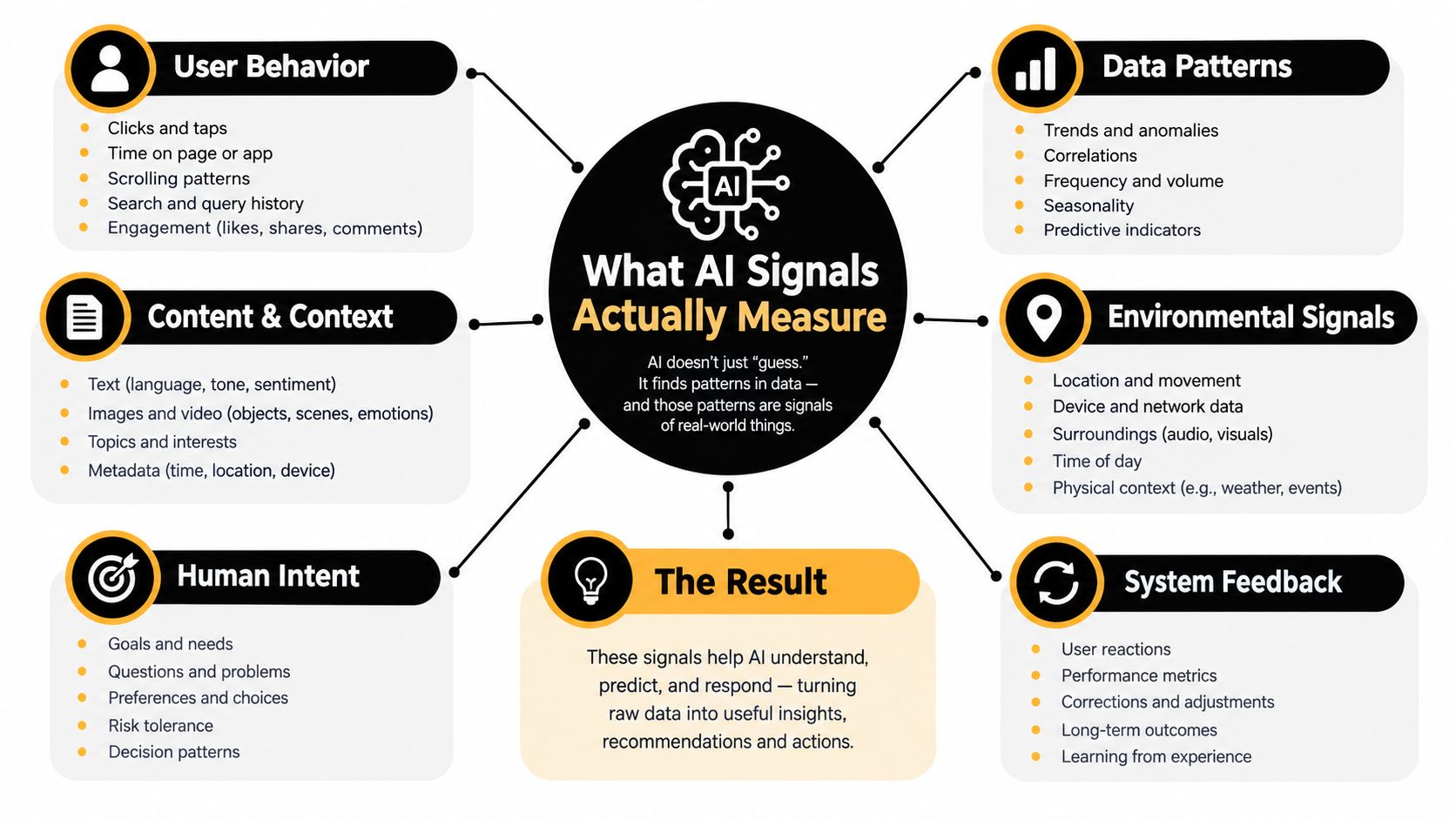
An AI signals platform collects structured observations from a defined prompt set. The basic record should include the prompt, provider, timestamp, response, detected entities, cited URLs, sentiment classification, relative position, and competitor presence. Without that underlying record, a chart may look precise while hiding changes in prompt wording or collection conditions.
The main measurements usually fall into five groups:
- Mention detection: Whether the brand appears, and whether the system has correctly distinguished it from a similarly named entity.
- Position and recommendation: Where the brand appears in a ranked list or comparative response.
- Citation attribution: Which URLs support the answer and how often those sources recur.
- Sentiment and description: Whether the response frames the brand positively, negatively, neutrally, or with caveats.
- Share of voice: The brand's observed presence relative to named competitors across a prompt set.
These aren't equivalent to classic SEO signals. Backlinks and SERP positions describe a search ecosystem with identifiable documents and result pages. AI signals describe generated outputs that may incorporate retrieval, model memory, citations, and probabilistic wording. A provider can produce a different answer even when the prompt appears unchanged, so the collection protocol becomes part of the metric.
Stable observations and noisy interpretations
Raw mention counts and citation URLs are generally easier to inspect than sentiment or share of voice. A reviewer can open the response, verify the entity, and check whether the URL was cited. Sentiment classification requires interpretation, especially when a response is balanced, conditional, or factually mixed.
Share of voice is more fragile because the denominator depends on the prompt set. Add comparison prompts, remove branded prompts, change market language, or switch provider, and the result can move without any change in the brand's underlying visibility. The number is useful only when the team preserves a consistent sampling frame and reports the frame alongside the result.
For teams building their first measurement process, AI visibility tracking for SMBs offers practical context on setting up prompts and reviewing outputs. A complementary guide on measuring AI search visibility is useful when turning those observations into a repeatable reporting workflow.
Collection method determines comparability
Vendors may use API polling, controlled prompt injection, browser automation, scraping, or human verification. Each approach affects latency, coverage, cost, and the amount of response context retained. A platform that reports a higher visibility figure may be sampling different providers, markets, prompt variants, or refresh intervals.
Ask vendors to document:
- The providers and model surfaces included.
- Whether prompts are fixed, randomized, or dynamically expanded.
- How often each prompt runs.
- How duplicate mentions and entity ambiguity are handled.
- Whether citations are captured from the response or inferred later.
- Whether raw responses can be exported for review.
The most important comparison isn't the size of the dashboard. It's whether two analysts can reproduce the same observation and explain why the metric changed.
Comparing Top AI Signals Platforms Side by Side
A platform comparison should begin with the measurement contract, not the feature list. Engine coverage matters, but so do prompt limits, refresh rules, historical access, alert controls, and the vendor's willingness to expose raw evidence. A polished chart doesn't compensate for an opaque sample.
The category includes products with different emphases. MyMentions is positioned around prompt-level visibility, position, sentiment, citation sources, alerts, and attribution-oriented reporting. Otterly is commonly considered by teams seeking focused AI visibility monitoring. Profound tends to attract organizations that need enterprise-oriented governance and reporting, while Peec AI is often evaluated for competitive and European-market workflows. Exact plan limits and availability can change, so buyers should verify current documentation before procurement.
| Platform | Engine Coverage | Prompt Volume | Alerts | Methodology Transparency |
|---|---|---|---|---|
| MyMentions | Broad provider coverage, including major conversational and answer engines | Configurable by plan | Threshold-based alerts and stakeholder reporting | Evaluate prompt records, citation capture, and export options during trial |
| Otterly | AI search monitoring across supported engines | Plan-dependent | Monitoring alerts | Confirm refresh cadence and raw-response access |
| Profound | Enterprise-focused AI visibility coverage | Plan-dependent and typically negotiated for larger programs | Enterprise reporting and alert workflows | Request sampling, retention, and governance documentation |
| Peec AI | AI visibility and competitive analysis with a strong European orientation | Plan-dependent | Configurable reporting workflows | Verify regional coverage, prompt methodology, and export depth |
The feature that separates a serious measurement product from a dashboard is raw prompt-response export. Aggregated charts answer “what changed?” Raw records help answer “did the prompt change, did the provider change, was the entity misclassified, or did the citation disappear?” That distinction is essential for quality assurance.
What to test before signing
Run the same controlled prompt set through each trial. Compare whether the platform records the complete response, preserves citations exactly, distinguishes direct recommendations from incidental mentions, and shows provider-specific results instead of collapsing them into a single blended score.
Then test the alert system with a known change. An alert should identify the prompt, provider, previous state, new state, and supporting response. “Visibility declined” is not actionable without the evidence needed to investigate it.
The broader market supports this caution. Research across more than 126 million U.S. AI search prompts demonstrates the scale at which prompt ecosystems are being measured (Semrush's 2026 AI Visibility Index announcement). Scale improves coverage, but it doesn't remove the need for a clear sampling methodology. A large dataset can still answer the wrong question.
For a wider shortlist, teams can use this review of the best AI visibility tools, then validate the candidates against their own prompts and reporting requirements.
Core Features of an AI Signals Platform
A credible platform should let an analyst move from an aggregate change to the exact response that caused it. That requires more than a mention counter. It requires entity resolution, source inspection, controlled prompt management, and an export path for independent analysis.
The practical feature surface
Prompt-level monitoring should cover the providers relevant to the buyer's audience, including ChatGPT, Claude, Gemini, and Perplexity where supported. The platform should preserve prompt categories, geography, language, and intent so a blended score doesn't conceal an important segment.
Entity disambiguation prevents a brand mention from being confused with a person, product, or unrelated organization. This is a small technical detail with a large reporting effect. False positives can inflate visibility, while missed variants can make a brand appear absent.
Citation and source attribution should identify the exact URL, not merely the publisher domain. A domain-level report won't tell a content team whether AI systems rely on a pricing page, an integration guide, a review, or an outdated help article.
Sentiment classification is useful for triage, but analysts should retain the original response. A model can describe a product positively while adding a qualification that changes the commercial meaning.
Share of voice and competitor comparison are useful for prioritization. They become defensible only when the prompt set, provider mix, and classification rules remain consistent.
| Feature | MyMentions | Otterly | Profound | Peec |
|---|---|---|---|---|
| Prompt-level tracking | Available as a core workflow | Available, confirm plan scope | Available, with enterprise workflow emphasis | Available, confirm plan scope |
| Citation source analysis | Included in the product description | Verify URL-level depth | Verify export and source granularity | Verify URL-level depth |
| Sentiment and position | Included in the product description | Verify by plan | Verify by plan and provider | Verify by plan |
| Competitor comparison | Supported | Supported, confirm limits | Supported | Supported |
| Alerts and reporting | Slack, Discord, email, and tailored reports are described | Verify channels | Verify enterprise integrations | Verify available channels |
| Raw response and API access | Confirm exact export and quota terms | Confirm availability | Confirm contract terms | Confirm availability |
The least mature measurements are usually cross-provider sentiment consistency and blended share of voice. Citation accuracy also requires inspection because a source may be listed without supporting the exact claim. Topic clustering and trend lines are valuable, but volatility flags should accompany them rather than presenting every movement as a strategic shift.
A useful product design includes Slack, email, or webhook alerts, prompt injection auditing, API access, and historical views. The purpose isn't to automate interpretation. It's to shorten the path from an observed change to a verified explanation.
Best Use Cases for AI Signals Tracking
The right investment depends on the decision the team needs to make. A founder checking whether a product appears in a handful of branded prompts doesn't need the same system as an agency producing recurring reports for many clients.
Match the tool to the decision
A Series A startup can begin with a small prompt set covering its category, alternatives, and core use cases. The minimum viable setup is mention detection, response storage, competitor comparison, and a simple way to rerun the prompts. A free or entry-level tracker is appropriate when the goal is validation rather than continuous attribution.
An in-house SEO team needs a broader prompt library and historical comparisons. Its minimum set includes category and comparison prompts, citation URLs, competitor share of voice, topic clusters, and exportable results. A mid-range subscription makes sense when the team uses AI visibility as part of recurring content audits and source-repair work.
A PR or product marketing team has a different trigger. After a launch, it may care more about how AI systems describe the product than whether the product appears in a generic category answer. Sentiment classification, prompt-specific alerts, response archives, and the ability to distinguish factual errors from opinion should be the baseline.
An enterprise brand operating across sensitive markets needs API access, language and regional controls, SSO, role permissions, retention policies, and documented sampling. The buying question is governance as much as coverage. If analysts can't explain how a result was collected, legal, communications, and regional teams may not trust the report.
An agency needs workspace separation, reusable prompt templates, bulk exports, white-labeled reporting, and client-level permissions. Without those controls, analysts spend time rebuilding the same report rather than interpreting changes.
The expensive mistake is buying a larger dashboard before defining the decision it must support.
The business outcome also changes the required instrumentation. If the team only wants visibility, response and citation tracking may be sufficient. If it wants attribution, it needs campaign conventions, referral analysis, landing-page measurement, and a process for connecting an AI observation with a qualified visit or conversion. No AI signal alone proves revenue impact.
AI Signals Pricing and Total Cost of Ownership
Pricing in this category varies by sampling volume, provider access, retention, seats, alerts, and API rights. Recent market coverage describes AI visibility tools ranging from free products to $399 or more per month, with an average cost of $337, although those figures describe a fast-changing market rather than a universal price list (Searchable's AI visibility tracking guide).
| Tier | Price Range | Prompts Tracked | Refresh Frequency | Historical Data |
|---|---|---|---|---|
| Free or entry-level | $0 or limited-cost plans | Limited, plan-dependent | Often scheduled rather than continuous | Limited or unavailable |
| Mid-range | Varies by vendor and plan | Larger controlled prompt sets | More frequent scheduled refreshes | Usually included for a defined retention period |
| Enterprise | Negotiated or custom | High-volume and multi-workspace requirements | Frequent refreshes with governance controls | Contract-dependent, often with export and retention options |
The table should be treated as a procurement framework, not a current price card. Vendors change quotas and packaging, and a low subscription price can exclude the capability that makes the data useful, such as raw-response exports, provider coverage, API access, or historical retention.
The costs outside the subscription
Implementation includes prompt design, entity rules, workspace setup, analytics integration, and stakeholder training. Maintenance follows because product names, competitors, features, documentation, and buyer language change. Someone must review whether prompts still represent real buying questions and whether a sudden result change reflects the market or the measurement process.
Analysts also need time to interpret volatility. A team that treats every movement as a content emergency can waste resources fixing noise. A team that reviews only a blended score can miss a critical citation loss on a high-value prompt.
Before purchase, calculate the value of one attributable inbound conversion from AI-referred traffic, then ask whether the platform can identify that path reliably. The relevant comparison isn't subscription price alone. It's the first-year cost of software, setup, maintenance, analysis, and integration against the decisions the data will improve.
A broader discussion of the commercial question appears in whether AI is profitable. The same discipline applies here: visibility is an intermediate signal until the organization demonstrates how it influences qualified demand.
Which AI Signals Tool Fits Your Team
Three variables usually determine fit: team maturity, monthly prompt volume, and whether the buyer needs visibility or attribution. A small team can use a narrow prompt set effectively, while a larger team may need governance and raw data before it needs more charts.
| Team Profile | Monthly Prompt Volume | Recommended Tier | Typical Cost | Reporting Depth |
|---|---|---|---|---|
| Founder validating positioning | Small, branded and category-focused set | Free or entry-level tracker | Low or no subscription cost | Manual review and simple comparisons |
| Mid-market SEO team | Moderate category, competitor, and use-case set | Mid-range subscription | Recurring subscription, plan-dependent | Historical trends, citations, competitor analysis |
| Agency with many client workspaces | High and distributed across accounts | Agency or enterprise platform | Custom or higher recurring cost | White-labeled reports, exports, permissions, alerts |
Three buying scenarios
A founder running five branded prompts should prioritize response storage, mention detection, and a repeatable review routine. More provider coverage is useful only if those providers reflect the founder's buyers. Attribution can wait until the organization has enough observed demand to connect AI referrals with site behavior.
A mid-market SEO lead tracking fifty category prompts needs stable prompt definitions, competitor comparisons, citation analysis, and historical reporting. The team should require exports because content recommendations need evidence at URL level. Alerts are helpful, but only after the team has established a baseline and knows which changes deserve attention.
An agency reporting across thirty clients needs workspace isolation, reusable prompt structures, role controls, CSV or API exports, and report customization. Manual screenshots won't scale, and a tool that can't preserve client-level methodology will create disputes over why one report differs from another.
A five-minute fit score
Give your team one point for each statement that applies:
- You need provider-specific reporting rather than one blended score.
- You need to inspect exact prompt-response pairs.
- You need citation URLs for content or PR action.
- You need recurring alerts for material changes.
- You need historical comparisons for stakeholder reporting.
- You need API or bulk export access.
- You need separate workspaces, permissions, or client reporting.
- You need traffic or conversion attribution, not only visibility.
A low score supports a lightweight tracker. A middle score points to a mid-range platform. A high score justifies enterprise evaluation, but only if the vendor can document collection, retention, and export behavior. Upgrade when the prompt set outgrows the available quota, when manual QA becomes a bottleneck, or when stakeholders ask questions the aggregated dashboard can't answer.
For teams comparing workflows rather than isolated features, this overview of an AI visibility tracking tool provides another evaluation point. The decision should still rest on your prompts, providers, and business question.
AI Signals FAQs for 2026 Buyers
How stable are AI signal metrics from week to week?
A marketing team can see the same prompt produce different answers across providers or collection times. Raw observations are easier to audit because analysts can review the stored mention or citation directly. Sentiment and share of voice are less stable, since they depend on classification rules, prompt composition, provider behavior, and timing.
Manual baselining, weekly reruns, and prompt-level change logs are practical safeguards while the category lacks fully standardized signals. Treat weekly movement as directional evidence, then inspect the underlying responses before changing a content roadmap, escalating a brand issue, or declaring a competitor advantage.
Can a platform tie an AI citation to a conversion?
A platform can identify a possible path from an AI citation to a visit, but citation presence alone does not prove conversion. Attribution needs referral data, landing-page tracking, analytics configuration, and a defensible method for connecting the AI observation with the visit and subsequent action.
Ask vendors what they mean by “attribution.” A report placing AI visibility beside traffic may show correlation or sequence, not proof that the citation caused the visit.
What does vendor lock-in look like?
Lock-in begins when a vendor stores your prompt library, response history, classification rules, or citation records in a proprietary format. Before signing, confirm that exports include raw responses, prompt definitions, timestamps, provider labels, citations, and historical aggregates.
A dashboard export is not a portable dataset. If changing tools would require your team to reconstruct its baseline from memory, migration cost is already part of the contract.
How often should prompt libraries be refreshed?
Refresh prompts when the product, category language, competitor set, or buyer journey changes. Preserve a stable core for comparison rather than replacing the entire baseline after every update. Add a controlled expansion set for new questions and emerging use cases.
That structure preserves historical meaning while allowing the program to reflect how buyers request recommendations.
Can alerts exclude hallucinated mentions?
Alerts can reduce noise when the platform exposes the complete response, supports entity rules, and allows confidence or source-verification thresholds. They cannot make generated text factual by default.
Set alerts around verifiable changes, such as a citation disappearing from a priority prompt or a product description changing materially. Send uncertain detections to human review instead of treating them as confirmed brand events.
MyMentions provides prompt-level AI visibility analytics, provider comparisons, position and sentiment tracking, citation source analysis, traffic attribution, alerts, and stakeholder reporting. Teams can use it to establish a baseline, inspect sources behind AI answers, and test whether visibility changes correspond with qualified visits through MyMentions.