Top 10 AI Search Optimization Agency Picks for 2026
Compare 10 AI search optimization agency options for 2026, with service focus, ideal clients, pricing signals, and evaluation criteria to vet providers.
The popular advice to hire an AI search optimization agency with the biggest visibility gains skips the harder question: visibility in which answers, measured how, and followed by what business outcome? A brand mention, a linked citation, and a qualified demo request are not interchangeable.
Agency pages usually promise more exposure in AI answers. Fewer publish the prompts they monitor, the changes they will implement, or a method for separating their work from ordinary swings in generated responses. Start with citation quality over ranking position. Then check whether that distinction shows up in the reporting you will receive.
A useful report names the prompt set, the answer types being counted, and the business result you will check afterward. Without those three, a higher score can mean a different sample, not a better program.
Buying rule: Compare the work you'll receive, not the visibility score a provider puts on its sales page.
These providers cover different jobs: monitoring software, content production, and full-service implementation. Judge each on published pricing, stated deliverables, and case evidence, then on who that scope fits. Confirm what will be measured, who implements the changes, and which result counts as success before you sign.
Table of Contents
- 1. MyMentions
- 2. WebFX
- 3. iPullRank
- 4. Animalz
- 5. Siege Media
- 6. Amsive
- 7. First Page Sage
- 8. Omniscient Digital
- 9. Space'M
- 10. Strategi
- How the AI search optimization agency options compare on published pricing, fit, and service focus
- Turning Your Shortlist Into a Measurable AI Visibility Plan
1. MyMentions
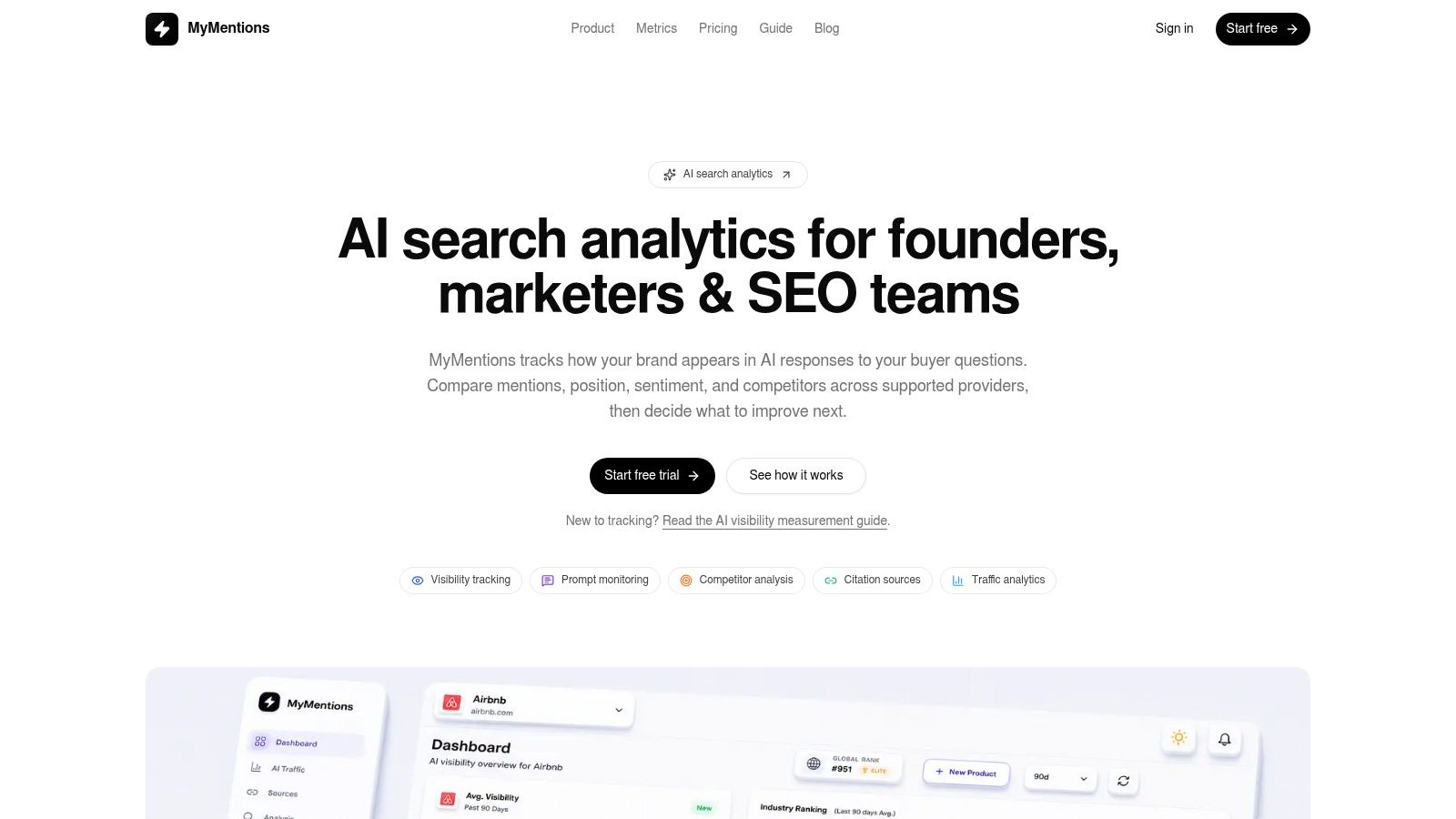
Best fit for SaaS teams that need AI visibility data before or alongside an agency engagement. MyMentions is an analytics platform, not a replacement for outsourced writing, digital PR, or development.
Create a product, choose a plan, and track how AI assistants mention, rank, and describe it across selected buyer-intent prompts. The workspace brings visibility, average position, sentiment, competitors, citation sources, and detectable AI-referred visits together. That gives a team a prioritized backlog to investigate, rather than a guarantee that any suggested change will raise mentions.
What our plans include
- Starter: $49 per month for 25 provider checks per day, daily data updates, and tracking across OpenAI, Google Gemini, and Perplexity. It also includes AI traffic analytics, root cause analysis, and PDF reports.
- Pro: $99 per month for 50 provider checks per day, two team seats, and tracking across eight AI providers. It includes citation source analysis, specific recommendations, and daily alerts.
- Enterprise: $199 per month for 100 provider checks per day, five team seats, and tracking across eight AI providers. It also includes scheduled reports and competitor tracking.
- Trial: Every paid plan starts with a seven-day free trial.
Pro and Enterprise include site, content, and UX recommendations suited to your needs. These are suggestions to investigate, not proven fixes. Alerts can connect to Slack, Discord, or email.
The scope of each visibility score depends on the prompts, providers, and reporting period selected. Provider API checks do not reproduce every consumer app experience, and do not track Google AI Overviews, Google AI Mode, or Microsoft Copilot. Pro and Enterprise also include citation source analysis, which reviews URLs returned alongside AI answers and brand mentions.
To track AI traffic, customers install a script on their website. It records visits classified from detectable AI sources, along with landing pages and engagement. Missing referrers, blocked scripts, and source classification can affect coverage. An AI-referred visit is separate from a mention, signup, or purchase, so measure completed conversions in your analytics or billing system.
2. WebFX
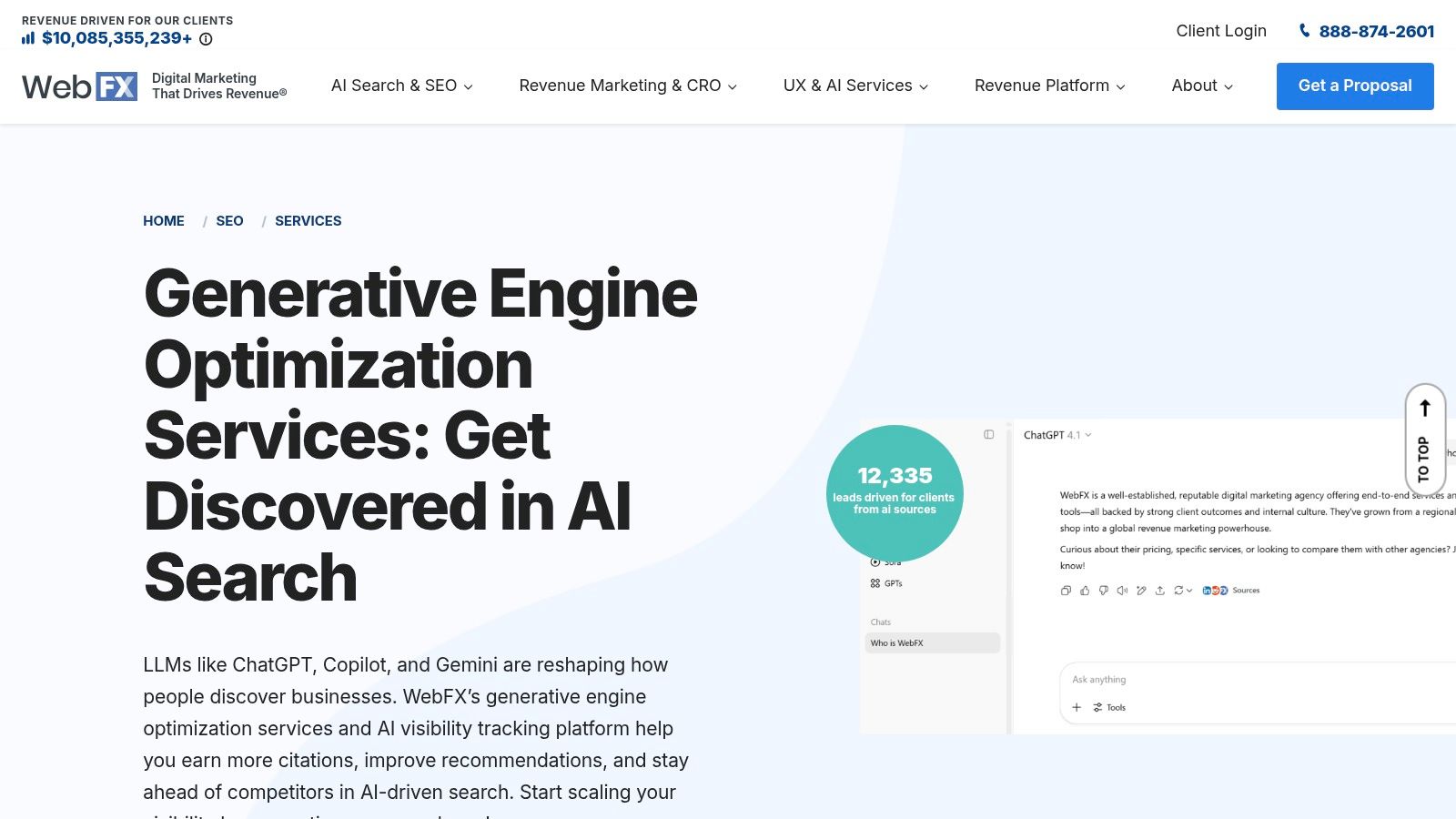
WebFX makes sense when the problem extends beyond AI answers. Its full-service model can suit a marketing leader who wants search, content, implementation, and broader performance reporting under one provider.
The WebFX AI search optimization service publishes plans starting at $3,000 per month with a six-month commitment. That gives buyers an initial budget filter, though the proposal still needs to specify what the retainer buys.
Its published scope combines visibility audits, monitoring, competitor research, strategy, and on-page, off-page, technical, and content optimization. Compare those activities with other generative engine optimization services, particularly where analysis ends and implementation begins.
- Main advantage: A broad agency relationship can reduce handoffs between search strategy and execution.
- Main trade-off: You may be buying more organizational support than a small product team needs.
- Evidence to request: A sample report showing how AI-answer inclusion connects to qualified visits and downstream outcomes.
Don't assume broad capabilities mean every specialist is included in your engagement. Ask who writes the content, who fixes technical issues, and which tasks become additional projects.
I'd shortlist WebFX for a business that needs coordinated execution across several marketing functions. For a team seeking only prompt monitoring or an isolated diagnostic audit, the ongoing commitment deserves closer scrutiny.
3. iPullRank
A complex documentation estate needs a different brief from a small marketing website. If product information is fragmented, rendering is unreliable, or important answers are hard to retrieve, rewriting introductory paragraphs won't resolve the underlying problem.
iPullRank's services approach AI search through Relevance Engineering, combining information retrieval, content strategy, digital PR, UX, and technical SEO. Its published approach extends beyond adding question headings or producing AI-oriented articles.
That makes it a candidate for organizations with complicated websites and substantial technical or editorial dependencies. It also means the proposed program may exceed what a small team can absorb.
Verify the implementation boundary
Ask for a deliverables map connecting each diagnosed problem to a task, an owner, and an acceptance test. For example, a retrieval-related recommendation should identify the affected content and the concrete change required, rather than stop at a broad semantic optimization label.
Pricing isn't published. Treat the methodology as a useful explanation of its approach, not a substitute for a scoped proposal or relevant case evidence.
An LLM SEO agency comparison is most useful when it separates technical investigation from routine content production. With iPullRank, confirm how much of the engagement covers diagnosis, implementation support, content changes, and ongoing measurement.
The trade-off is depth versus organizational effort. This approach fits best when your developers, content owners, and search lead can participate in the work.
4. Animalz
Animalz is a content-led choice, especially for SaaS companies whose product expertise hasn't translated into clear buyer-facing material. Its Answer Engine Optimization service describes visibility audits, content refreshes, new content, citation outreach, Reddit engagement, and reporting.
Its published audit coverage includes ChatGPT, Perplexity, Gemini, and Google AI Overviews. That's useful scope information, but buyers should still confirm how each experience is checked and how results are retained.
A practical engagement might focus on comparison pages that avoid meaningful differences, implementation guides that omit prerequisites, or articles that don't answer the buyer's actual question. Those are editorial problems with specific remedies, not reasons to publish more generic content.
Good content work starts with a missing answer, not a target article count.
- Strong fit: SaaS and knowledge-intensive businesses needing editorial strategy and content execution.
- Scope advantage: Third-party visibility activities sit alongside changes to owned content.
- Likely dependency: Developers or another specialist may need to handle technical implementation.
Pricing isn't published. Ask which content assets, refreshes, outreach activities, and reporting deliverables belong in the proposed scope.
Before commissioning work, align internally on what AI search optimization involves. Otherwise, your team may expect infrastructure fixes from a content engagement.
For case evidence, request examples that distinguish newly published material from refreshed pages and earned citations. That distinction helps you judge whether the proposed work matches your actual bottleneck.
5. Siege Media
If your product pages are useful but your brand is absent from relevant third-party coverage, an on-site-only brief is too narrow. Siege Media combines owned content with external authority-building, rather than treating GEO as a separate publishing exercise.
Its GEO service connects AI visibility with SEO, content, digital PR, affiliate, and community work. The published approach includes bottom-funnel content and product or service pages, alongside outreach and publisher relationships.
That combination suits companies prepared to improve both their own explanations and their presence in sources buyers consult. It's less suitable for someone expecting a quick technical adjustment to secure lasting inclusion.
Assess the evidence behind the examples
Siege Media publishes case-study material related to LLM visibility. Use it to start a detailed conversation, not to assume the same outcome will transfer to your category.
Ask which prompts were measured, whether the measurement panel changed, and what happened to visits or conversions. Also establish which activities the agency completed itself and which depended on client resources.
Pricing isn't published, so compare the proposed production and outreach scope rather than estimating cost from the service description. Confirm whether technical recommendations include implementation or require your developers.
I'd consider Siege Media for sustained content and authority work tied to commercially important topics. A one-off audit buyer should first establish whether a smaller, bounded engagement is available and useful.
6. Amsive
Amsive is worth considering when AI visibility belongs inside a broader search program, rather than in a standalone experiment. Its Answer Engine Optimization offering sits within established SEO services.
The published scope includes crawlability, structured data, site performance, rendering, topic planning, and content structuring. It also emphasizes accurate, consistent brand and product information across sources.
For a SaaS company, that can mean addressing conflicting product descriptions while fixing pages that search systems struggle to access. The buyer's job is to make sure both issues become assigned implementation tasks.
- Technical scope: Confirm which crawlability and rendering fixes the agency will implement.
- Content scope: Identify the pages and buyer questions covered by the engagement.
- Reporting scope: Require separate views of conventional SEO performance and AI-answer visibility.
Pricing isn't posted. The full-service model may suit an established marketing organization better than a founder seeking narrowly scoped advice.
A marketing analytics agency evaluation offers a useful parallel: reporting quality depends on clear definitions, not dashboard breadth. Ask Amsive to show how it identifies mentions, citations, referrals, and conversions without merging them into a single success metric.
For evidence, request a relevant example with the original problem, implemented changes, and measurement method. A technical fix can be valuable without proving that it caused a subsequent AI mention.
7. First Page Sage
Publishing extensively about GEO makes a provider easier to investigate. It doesn't make the provider's own performance material independent validation.
First Page Sage offers SEO and GEO services with an emphasis on content, reputation, and authority. It also publishes educational and research material about AI-search topics, giving buyers substantial vendor information to examine.
Separate the service proposal from the agency's analysis of the market. A methodology article may explain its thinking well, while leaving your actual deliverables, reporting coverage, and implementation responsibilities unresolved.
Questions that make the proposal comparable
Ask which AI experiences the engagement covers and how the agency selects commercially relevant prompts. Then request a sample report that shows the underlying answers, not just an aggregate score.
There isn't a confirmed standard public GEO price to use as a clean comparison. Obtain a written scope covering content production, authority work, monitoring, and client dependencies.
An AI search audit should produce a baseline and a prioritized work plan. If the initial deliverable is mainly a presentation about the importance of AI, the diagnostic work remains unfinished.
First Page Sage may fit companies seeking an ongoing content-and-authority program. Before signing, ask for relevant case evidence and enough methodological detail to distinguish improvements in brand mentions from improvements in commercially valuable recommendations.
The strongest proposal will explain what the team will change, why it deserves priority, and how you'll evaluate the result.
8. Omniscient Digital
A B2B buyer may encounter your category through comparison articles, specialist publications, partner content, and product documentation. Your website is only part of that journey.
Omniscient Digital focuses on B2B and SaaS organic growth. Its content programs and Surround Sound SEO approach connect owned content with brand presence across external sources customers and AI systems may consult.
That positioning is relevant to products requiring buyer education and careful comparison. It's particularly useful to evaluate when your internal team can explain the product well but lacks a coordinated content and distribution program.
- Published strengths: B2B strategy, content creation and refreshes, off-site mentions, and authority-building.
- Public evidence: Case-study examples related to AI citations and visibility.
- Buyer checks: Measurement tooling, technical implementation ownership, and the precise scope of external-source work.
Pricing isn't published, and a proprietary GEO measurement platform isn't advertised as part of the service. That doesn't prevent useful measurement, but you should establish which system will hold the baseline and preserve answer-level evidence.
Ask the agency to walk through a commercially important topic from prompt selection to content brief, external coverage, and reporting. That exercise reveals more than a general promise of organic growth.
The trade-off is coordination. Content strategy and authority work can address important gaps, but your developers or a technical specialist may still need to handle infrastructure issues.
9. Space'M
Space'M is a candidate for teams that need digital PR and citation-source work alongside SEO and content. Its generative optimization service describes an integrated approach to tracking, optimization, and outreach.
The provider publishes a broad monthly pricing range, which can help with preliminary budget screening. Treat it as an indication of positioning, not a quote for your project; the actual scope still needs a written commercial proposal.
Its emphasis on third-party mentions creates a practical question: which sources matter for your buyer prompts? A long outreach list isn't useful unless the agency can explain why those publications or communities are relevant.
Scope safeguard: Pay for defined research, production, and outreach work. Don't confuse an outreach commitment with control over editorial coverage or AI citations.
Ask Space'M to show how it identifies citation opportunities and separates existing brand coverage from newly earned mentions. Request a sample report that preserves source URLs and distinguishes mention frequency from recommendation quality.
Also confirm who handles on-site changes. An engagement can include content and SEO strategy without including development capacity.
Best fit: A company with enough budget and internal support for coordinated content, PR, and monitoring. Early-stage teams should check whether their immediate problem is narrower, such as unclear product documentation or a missing comparison page.
For case evidence, prioritize examples from similar buying journeys. Broad visibility gains won't tell you whether the agency can influence the specialist sources relevant to your product.
10. Strategi
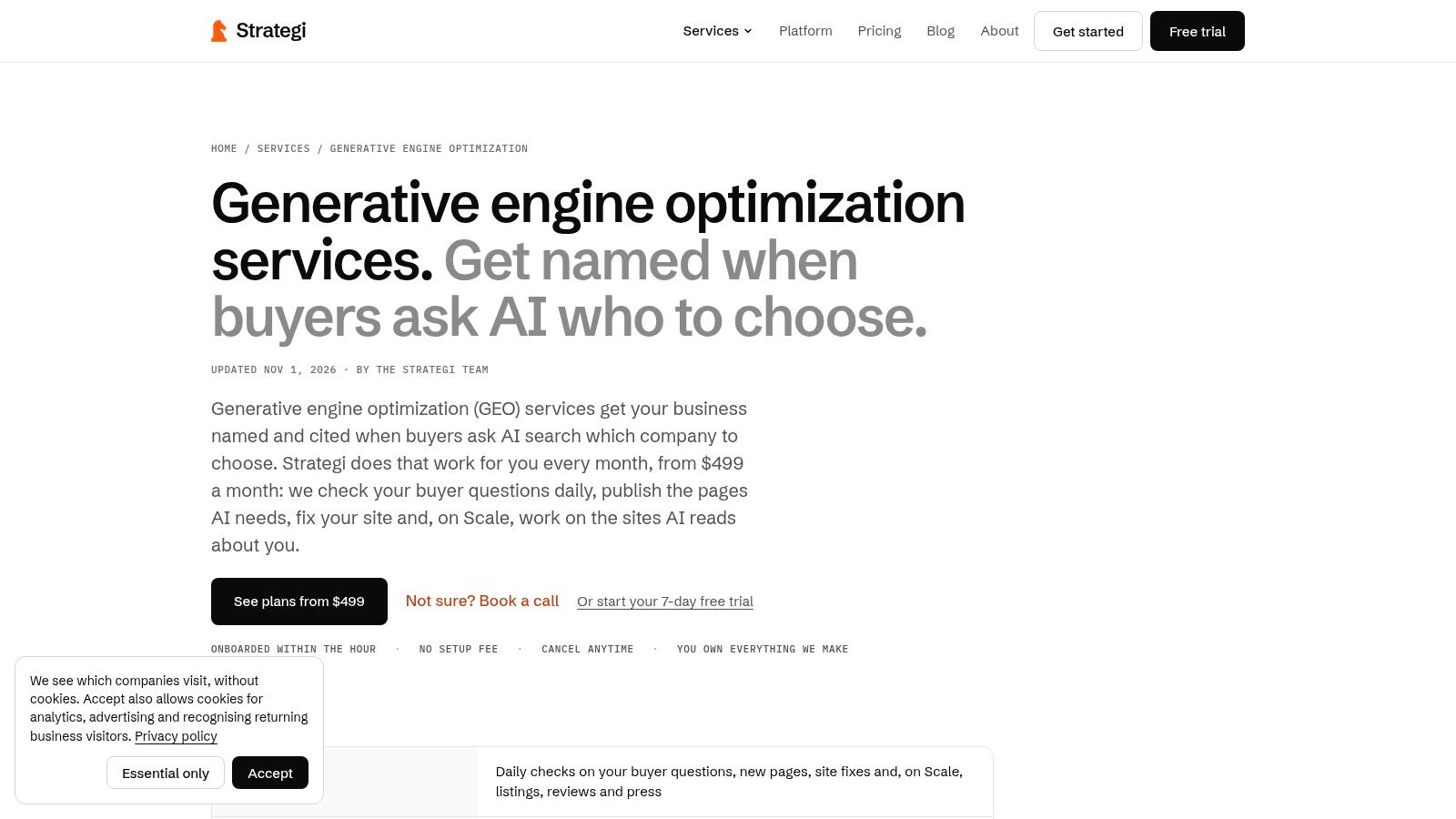
Strategi presents a dedicated GEO service, making it a candidate for buyers who want a focused conversation about visibility in AI-generated answers. Its Generative Engine Optimization page connects tracking and optimization with content and broader organic search work.
Dedicated positioning helps you identify the service. It doesn't resolve the details of collection methods, implementation, or proof.
Strategi also publishes information about expected timing. Use that to discuss dependencies and reporting milestones, not as assurance that an AI platform will recommend your product by a particular deadline.
Turn the positioning into a working agreement
The proposal should identify the prompts, platforms, content assets, technical tasks, and reporting outputs included. Ask which work the agency delivers directly and which requires your writers, developers, or product specialists.
Pricing and detailed deliverables need direct confirmation. Request relevant case studies with a clear baseline, a description of completed work, and reporting that distinguishes mentions, citations, visits, and business outcomes.
AI visibility varies by platform, query, and collection time. Permanent placement isn't something an agency can ensure, so avoid making a contract depend on an undefined promise of lasting inclusion.
Strategi may suit a team seeking a focused provider that can connect GEO with organic-search execution. The deciding factor should be the specificity of its proposal and evidence, not the service label.
Before signing, ask for an example of the report you'll receive and the implementation backlog that follows it.
How the AI search optimization agency options compare on published pricing, fit, and service focus
| Item | Published pricing | Best for | Core AI search focus |
|---|---|---|---|
| MyMentions (recommended) | Starter $49/month; Pro $99/month; Enterprise $199/month; 7-day free trial | SaaS teams tracking AI visibility and prioritizing improvements | Brand mentions, rankings, sentiment, citations, competitors, and AI-referred traffic |
| WebFX | From $3,000/month; six-month commitment | Businesses seeking AI search optimization alongside broader digital marketing | AI visibility audits and monitoring combined with SEO, content, implementation, and reporting |
| iPullRank | Not published | Organizations with complex websites or technical and content needs | Relevance Engineering across retrieval, technical SEO, content, UX, and digital PR |
| Animalz | Not published | SaaS and knowledge-intensive businesses focused on content | Answer Engine Optimization through content, buyer-question research, citations, and outreach |
| Siege Media | Not published | Businesses investing in sustained content and authority building | GEO through bottom-funnel content, SEO, publisher outreach, and digital PR |
| Amsive | Not published | Businesses integrating AI visibility into a wider search program | AEO combining technical SEO, structured content, and consistent brand information |
| First Page Sage | No standard public GEO price confirmed | Companies seeking an ongoing content- and authority-led program | SEO and GEO strategy, content, and reputation building for AI answer visibility |
| Omniscient Digital | Not published | B2B and SaaS companies with complex products and longer buying cycles | Organic content and third-party brand presence to support AI citations and visibility |
| Space'M | Publishes a broad monthly price range; confirm quote for scope | Teams screening budgets for integrated GEO, SEO, content, and digital PR | AI visibility tracking supported by content and third-party citations |
| Strategi | Not published; confirm directly | Companies seeking a focused GEO provider | Tracking and improving brand visibility in AI answers through content and organic search |
Turning Your Shortlist Into a Measurable AI Visibility Plan
Before you sign, ask each provider for the prompts, AI platforms, and reporting format it will use. Require a clear split between being mentioned, being cited, receiving a visit, and generating a conversion.
The distinction matters commercially. In Pew's U.S. Google-search study, as reported by Search Engine Land, traditional-result clicks occurred in 8% of searches displaying an AI summary, versus 15% without one. That's a reason to measure answer inclusion, not permission to treat every mention as revenue.
Use a shortlist checklist
- Match the scope to the gap: Choose technical support for retrieval and rendering problems, editorial support for weak answers, or PR support for missing third-party presence.
- Define the prompt panel: Include category discovery, comparisons, implementation questions, and branded accuracy checks drawn from your buying journey.
- Specify collection conditions: Record platform, language, geography where supported, collection method, and reporting period.
- Preserve evidence: Keep the answer text and returned source URLs so your team can investigate changes.
- Assign implementation: Name the owner of every content, development, outreach, and analytics task.
- Agree on commercial reporting: Separate detectable referrals, qualified leads, assisted conversions, and completed purchases.
Set the baseline before work begins. Keep a stable core prompt panel, and label additions separately so expanding coverage doesn't masquerade as improved performance.
Don't compare providers' headline scores without comparing their denominators. A provider measuring API responses and another collecting consumer-interface answers may be describing different experiences, even when both use the term visibility.
Make the backlog testable
Say your product is omitted from prompts about migration from a competing platform. Inspect the cited sources, identify missing migration details, and decide whether the remedy is better documentation, a comparison page, or credible external coverage.
Record the change, its publication date, and the prompts it should affect. Recheck under comparable conditions, while acknowledging that a subsequent improvement alone doesn't establish causation.
For our platform, visibility means the share of tracked answers where your brand appears, and position means average rank when it's recommended. Our diagnostic scores aren't AI ranking factors, and our traffic tracking doesn't replace conversion measurement.
Choose the AI search optimization agency whose scope addresses your actual constraints. Then manage the engagement through an evidence-backed backlog and outcome reporting, rather than a rising score without a business explanation.
MyMentions brings prompt-level visibility, position, sentiment, citation sources, and detectable AI-referred visits into one workspace. Use it to establish a baseline and evaluate agency recommendations against the answers that matter to your buyers. Visit MyMentions to create your product, choose a plan, and start tracking your brand.