
“Track conversions, not clicks” is useful advice until a team needs to explain why conversions changed. The opposite advice, optimizing engagement because it arrives sooner, creates another problem: people can keep interacting with a cue without getting value from what follows.
Sign tracking vs goal tracking is a measurement-design question, not a contest between good and bad metrics. Borrowing carefully from behavioral research, the useful distinction is between attention directed toward a signal and behavior directed toward an outcome. For product and marketing teams, the strongest approach is to connect those observations without pretending they measure the same thing.
Table of Contents
- Sign Tracking vs Goal Tracking at a Glance
- What Goal Tracking Captures and What It Costs
- What Sign Tracking Captures and Where It Misleads
- Choosing the Right Metric for Each Business Question
- When Each Approach Fits Product and Marketing Work
- How to Pair Signal Events With Goal Conversions
- Choose Your Primary Metric Before Adding More Events
Sign Tracking vs Goal Tracking at a Glance
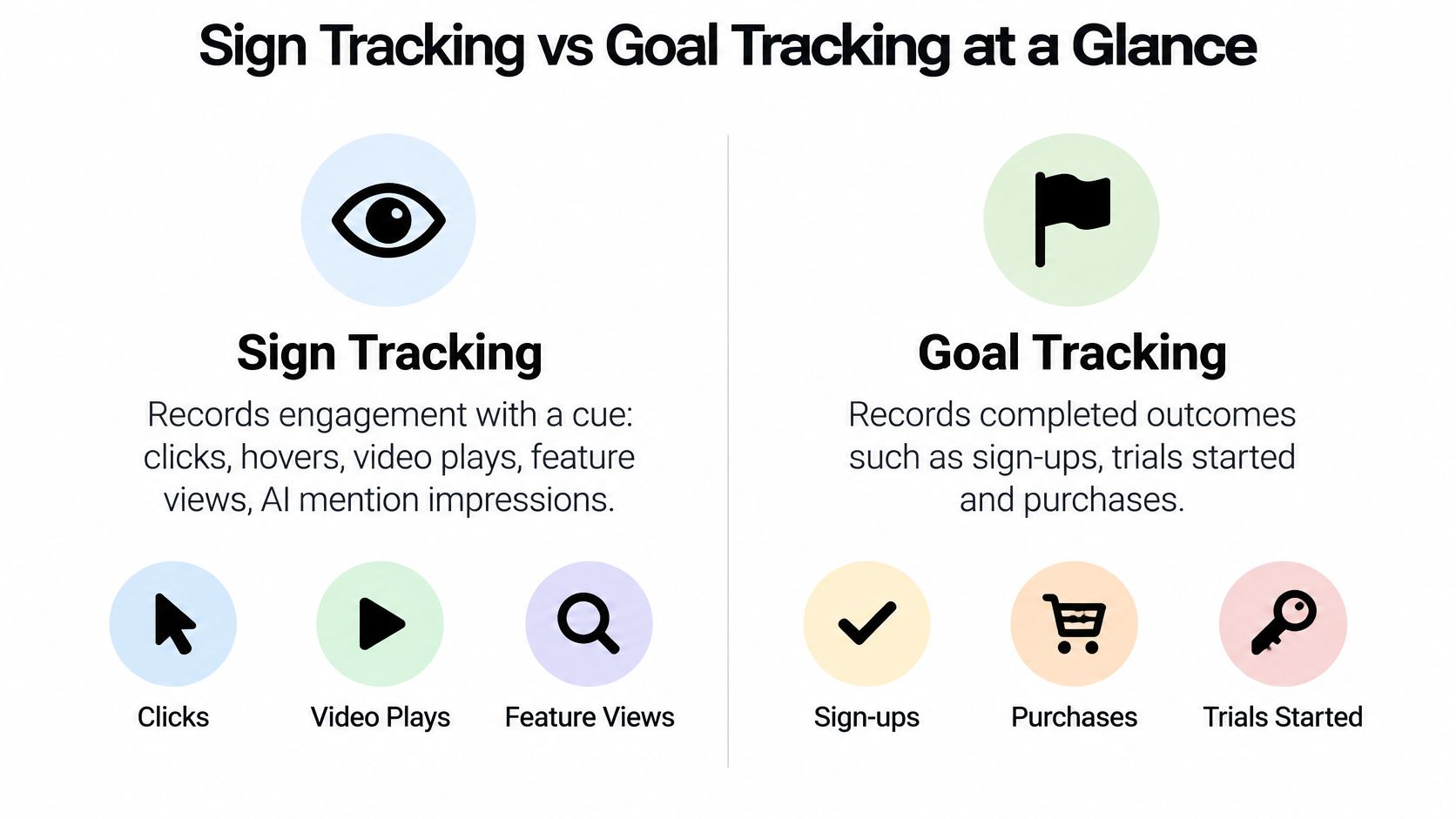
Sign tracking records engagement with a cue, such as clicks, hovers, video plays, feature views, or AI mention impressions. Goal tracking records completed outcomes tied to the business, such as sign-ups, purchases, booked demos, or activated accounts.
These are practical analytics definitions, not interchangeable names for laboratory measurements. A pricing-page click is an observable event, not evidence that the person belongs to a psychological category.
Sign tracking vs goal tracking by key criterion
| Criterion | Sign tracking | Goal tracking |
|---|---|---|
| What it records | Cue and engagement events: clicks, hovers, video plays, feature views, mention impressions | Completed outcomes: sign-ups, purchases, demo bookings, activated accounts |
| Question it answers | Is attention reaching the intended place? | Did the visitor complete the outcome we need? |
| Typical event volume | Potentially frequent, depending on exposure and instrumentation | Restricted to qualifying completions |
| Feedback speed | Available when the interaction occurs | Available after completion and any required observation period |
| Main weakness | Engagement can persist without current value | Doesn't explain why visitors abandoned the path |
| Setup effort | Event naming, taxonomy, exposure rules, and interaction validation | Goal definitions, funnel mapping, identity handling, and deduplication |
| Best role | Diagnosing friction and comparing cue variants | Judging completed outcomes, channel performance, and retention |
Compare effort across the whole path
Don't assume interaction tracking is automatically cheap. A button click may be straightforward to record, but meaningful hover behavior, video progress, and repeated feature use need definitions that distinguish intentional engagement from incidental activity.
Likewise, goal tracking isn't finished when someone creates a conversion event in an analytics interface. The team must agree on what constitutes completion, which system confirms it, and how repeated or reversed actions should count.
Neither column establishes causation. Someone who previews a template and later subscribes may already have intended to buy, so their sequence alone doesn't prove that the preview persuaded them.
Sign tracking shows where attention goes; goal tracking shows whether the outcome happened.
What Goal Tracking Captures and What It Costs
The most damaging goal-definition error is counting an attempt as a success. A checkout-button click records an intention to proceed; a server-confirmed payment records a completed purchase.
A useful goal specification names the qualifying event, authoritative system, eligible user, and attribution window. That window should reflect the decision you're measuring, rather than an unexplained default copied from another dashboard.
Common goal types, triggering events and pitfalls
| Goal | Event that counts | Typical attribution window | Common pitfall |
|---|---|---|---|
| Sign-up | Account created with a verified email | Session-based or an agreed return-visit window | Counting duplicate form submissions |
| Trial start | Workspace created and trial activated | The documented evaluation period | Treating trial starts as revenue |
| Purchase | Payment confirmed by the server | The agreed purchase-consideration window | Firing on checkout clicks rather than payment success |
| Demo booked | Calendar booking confirmed | The booking decision period | Counting reschedules as new demand or ignoring attendance |
| Activation | First core action completed, such as a report exported | The expected onboarding period | Choosing an action that doesn't represent useful progress |
These windows are design choices, not universal benchmarks. Write their boundaries into the event specification, including when observation begins and when a cohort becomes eligible for comparison.
The cost is maintaining agreement
Engineers need to preserve event meaning across interfaces, backend services, and product changes. If a workspace can be created through both an onboarding form and an invitation, the activation logic must handle both paths consistently.
Analysts also need to distinguish incomplete observation from failure. An account still evaluating a trial hasn't necessarily rejected the product, and comparing it with an account whose evaluation has finished creates a misleading denominator.
Sparse outcomes create a different constraint. When few eligible users complete a goal, individual completions can materially change the apparent result; the team should express uncertainty rather than declare a winner from an unstable comparison.
Attribution is a separate problem
Outcome certainty doesn't imply source certainty. A payment record can establish that someone purchased without establishing which earlier exposure influenced the decision.
For AI-mediated discovery, keep that distinction visible in your generative AI analytics measurement plan. Record known referral information separately from inferred influence, and leave unattributed outcomes unattributed when the evidence doesn't support a connection.
Measurement boundary: A conversion event can verify completion without explaining the path that produced it.
What Sign Tracking Captures and Where It Misleads
A pricing banner click, an integrations-page view, a template preview, a demo-video progress event, and a launch-announcement hover all describe interactions with something presented to the user. None, by itself, establishes that the user achieved the intended result.
The details matter. A template preview may represent serious evaluation or casual browsing; a video play may reflect interest or an accidental start. Instrument the behavior precisely before assigning it commercial meaning.
Why attention can outlast value
The terminology comes from Pavlovian conditioned-approach research. Sign-trackers approach and interact with a reward-predictive cue, while goal-trackers approach the location where the reward will arrive.
The distinction concerns more than where subjects look. Research described in the reward-value and neurocomputational evidence distinguishes the cue's predictive role from its incentive value: sign tracking resisted reward devaluation and could increase, while goal tracking declined. The same evidence includes 129 men, with sign-trackers showing detectable model-free reward-prediction-error signaling and goal-trackers showing stronger model-based state-prediction-error signaling.
That supports a caution about interpretation, not a direct claim about website visitors. A compelling cue and a valuable outcome are different things, and laboratory findings don't establish that a particular banner caused a particular purchase decision.
Consider a hypothetical expired-discount banner. Visitors might continue clicking because the offer looks attractive, then discover that the discount no longer applies. A team could observe sustained engagement alongside weaker purchasing without any contradiction between the measurements.
A cue can remain effective at attracting attention after it stops helping people reach a worthwhile outcome.
Audit the destination, not just the interaction
For product analytics, check cue activity against completed outcomes, destination behavior, retention, and post-exposure usefulness. For discovery through assistants, AI traffic analytics should similarly separate evidence of exposure from evidence of a productive visit.
Start with events whose interpretation currently depends on an assumption:
- Pricing banner: After clicking, does the visitor select a plan, or return immediately to browsing?
- Integrations page: Does the view precede a successfully connected integration within your chosen evaluation window?
- Demo video: Does meaningful viewing precede a confirmed demo booking, rather than merely another video interaction?
The actionable question isn't whether an event looks engaged. It's whether the team can name the useful behavior expected afterward and test whether that relationship holds.
Choosing the Right Metric for Each Business Question
Start with the decision, not the analytics tool. If you're deciding whether people notice a new interface element, begin with exposure and interaction; if you're deciding whether a campaign merits continued investment, begin with the outcome that justifies that investment.
Business questions and the tracking type that answers them
| Business question | Start with | Confirm with | Why this pairing |
|---|---|---|---|
| Does a new onboarding step get noticed? | Sign tracking: step views and clicks | Goal tracking: activation rate | Attention doesn't establish that the step helped |
| Why do pricing-page visitors leave? | Sign tracking: scroll depth and plan toggles | Goal tracking: trial starts | Interaction patterns suggest where to investigate |
| Did a campaign drive paid outcomes? | Goal tracking: purchases by source | Sign tracking: landing-page engagement | The purchase is the decision metric |
| Is an AI assistant surfacing our product? | Sign tracking: observed mentions and citations | Goal tracking: attributable visits and sign-ups | Visibility and downstream response answer different questions |
| Which feature supports retention? | Sign tracking: depth of feature use | Goal tracking: retained active accounts | Usage alone doesn't establish continued value |
Keep the components visible
Behavioral research offers a useful warning about composite scores. The Pavlovian conditioned approach index ranges from −1.0 to +1.0, with positive values indicating more cue-directed behavior, negative values indicating more reward-location behavior, and values near zero indicating intermediate responding, as described in the PCA measurement and classification research.
The practical lesson is to preserve the underlying components: approach probability, latency, vigor, and time allocation. A single summary can conceal whether subjects differ in destination, response speed, or engagement intensity.
Apply that principle to dashboards without pretending a commercial engagement score is a validated PCA index. Show click rate, time to first interaction, depth of use, and time spent on the cue separately before combining them.
For acquisition reporting, connect these components to a documented SEO tracking framework. Don't blend search exposure, landing-page interaction, and account creation into an opaque score that prevents the team from locating the change.
Avoid turning segments into identities
In a human conditioning study with intermediate responders, 36 participants were classified as intermediate, compared with 10 sign-trackers and 4 goal-trackers. That distribution doesn't establish how customers generally behave, but it does challenge an insistence on clean binary labels.
A user can attend strongly to cues and still pursue outcomes deliberately. Report both dimensions for the same segment, and describe observed behavior rather than diagnosing a fixed personality type.
When Each Approach Fits Product and Marketing Work
Consider a hypothetical feature launch in a SaaS reporting product. The product manager wants to know whether customers discover a new export workflow, while the growth lead wants evidence that it supports activation.

Feature launch
During initial rollout, track whether eligible users see the entry point, open the workflow, and attempt an export. Those observations help the team distinguish a discovery problem from a failure after first use.
Move the primary decision toward successful activation once users have had the intended opportunity to complete the workflow. Base that handoff on observation maturity, not an arbitrary launch anniversary. Lead initially with discovery, then with completed activation.
Low-volume business acquisition
A marketing team evaluating a business-to-business campaign shouldn't promote landing-page activity into proof of pipeline. Instead, use confirmed demo bookings, attendance, and qualified opportunities as distinct stages, with explicit definitions for each.
Interaction events remain useful when the campaign underperforms. They can help identify whether visitors examined the offer or reached the booking interface, but they shouldn't substitute for the commercial objective. Lead with qualified demo bookings when that is the campaign's agreed goal.
AI visibility
AI discovery makes the separation especially important. A summary of Pew Research Center's 2025 findings reports traditional Google-result clicks in 8% of visits with an AI summary, compared with 15% without one.
That comparison doesn't prove that any individual brand gained or lost customers. It does show why a team shouldn't use traditional-result clicks as a complete description of exposure in that search environment.
An AI visibility report should distinguish:
- Observed presence: Whether the product appears for the buyer-intent prompts being monitored.
- Presentation: Its position, description, sentiment, and supporting citations.
- Downstream response: Identifiable referred visits and qualifying account outcomes.
Treat monitored prompts as a defined sample, not a census of every buyer conversation. When the question is whether assistants surface the product, lead with visibility across that documented prompt set; use attributable outcomes to evaluate the business response.
How to Pair Signal Events With Goal Conversions
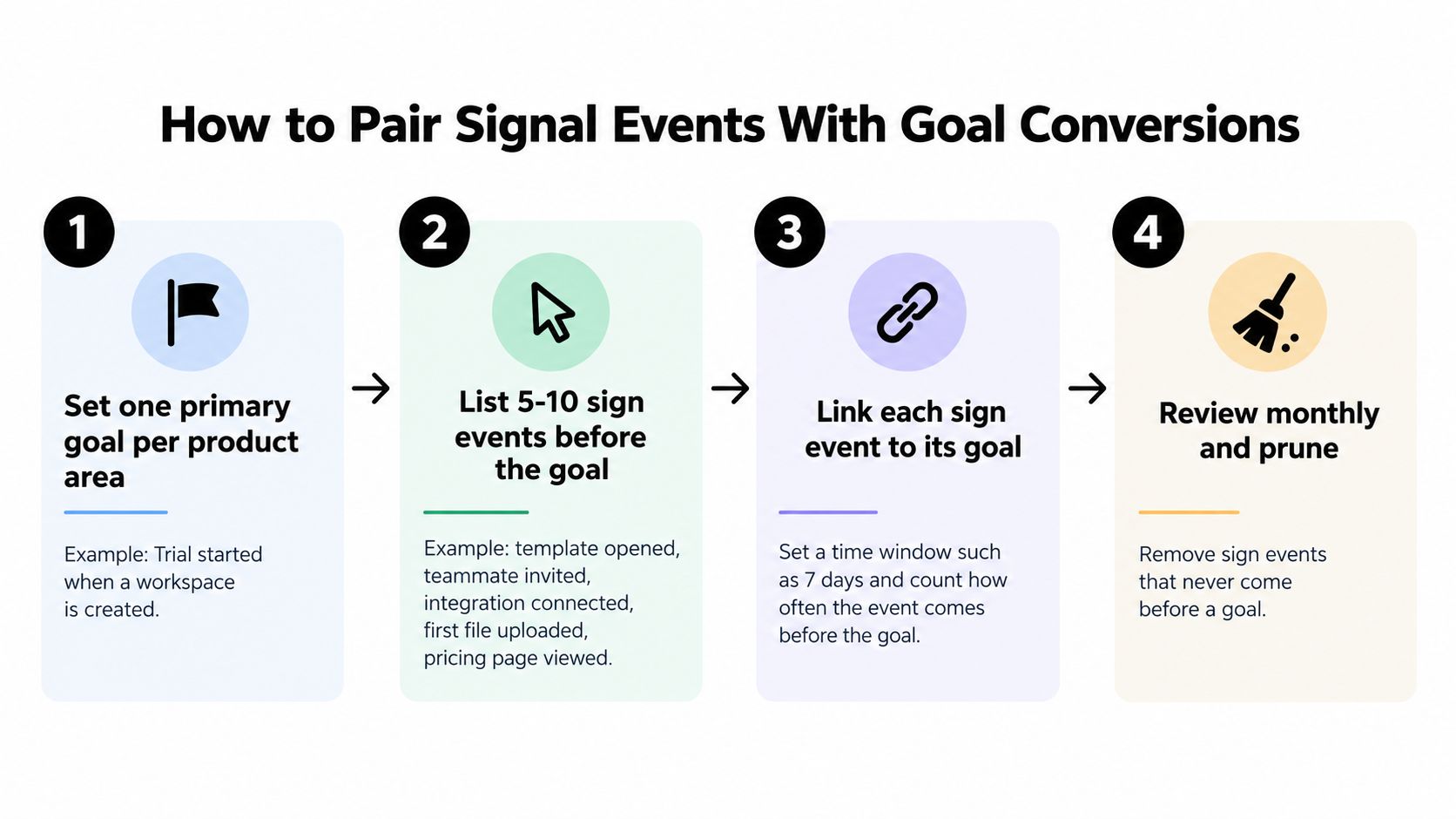
Build a measurement contract before adding more instrumentation. The contract should let a product manager, engineer, and analyst independently reach the same conclusion about whether an event qualifies.
Specify the relationship
Choose the primary goal for the product area. Write its exact trigger, such as a workspace entering an active trial state. Don't use a button label as a substitute for the confirmed state change.
List the preceding cue events you expect to help explain that goal. Pricing views, integration-detail clicks, and template previews are candidates, not automatically useful indicators.
Standardize event names and properties. Include the context needed to interpret the action, such as workspace, page, variant, and eligibility. Avoid recording the same action under different names across interfaces.
Define the path rule explicitly. Specify which signal must precede which goal, how identities connect, and what happens when users repeat the signal.
Choose an observation window using the goal table's categories. Match it to onboarding, evaluation, or purchase behavior. Keep immature cohorts separate from cohorts whose windows have closed.
Validate before interpreting
Deduplicate confirmed outcomes using stable identifiers. A purchase observed by both client and server should reconcile to the same transaction, while legitimate repeat purchases shouldn't disappear under an overly broad user-level rule.
Compare analytics records with authoritative records. Test successful actions, failed attempts, retries, cancellations, and cross-session returns. Investigate unexplained discrepancies rather than accepting a generic tolerance that may hide a consequential error.
Review retained signals on a scheduled cadence. Keep events that support a named diagnostic question; retire unused events after checking whether another team depends on them.
The same discipline applies when exposure occurs without a click. A view-through attribution framework needs a defensible exposure definition and observation rule, not an assumption that every later conversion resulted from the view.
Validation check: Every retained signal should have a named downstream goal or a documented diagnostic purpose.
A preceding event can be predictive without being causal. Use controlled testing when the decision requires evidence that changing the cue changes the outcome.
Choose Your Primary Metric Before Adding More Events
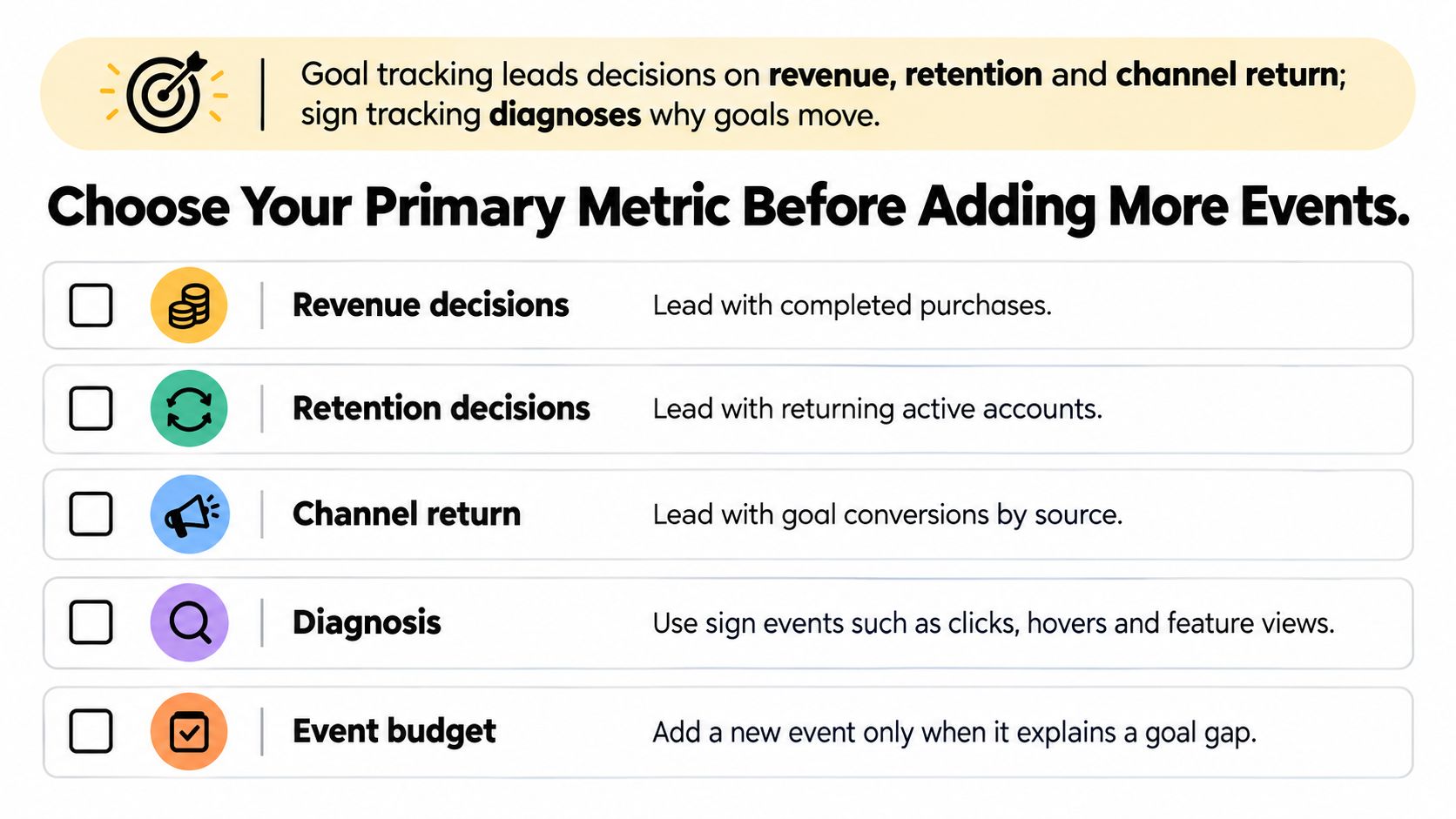
Use goal tracking to lead revenue, retention, and channel-return decisions; use sign tracking to diagnose the behavior surrounding those outcomes. When the decision is specifically about discoverability or attention, make the signal primary, but don't quietly redefine it as business success.
The important constraint is not the number of events available. It's whether the team has agreed on what evidence would change its decision.
Make the decision rule explicit
- Name the decision. “Continue this acquisition campaign” is actionable; “understand engagement” isn't specific enough to govern spending.
- Record the primary metric and trigger. State what qualifies, who is eligible, and which system confirms completion.
- Require a purpose for each added signal. Identify the goal or diagnostic question it supports before asking engineers to implement it.
- Set the review conditions. Agree on observation maturity, acceptable uncertainty, and the evidence that would justify a change.
Put those definitions beside the charts in your internet marketing dashboard. A stakeholder shouldn't need to reconstruct counting rules from an old implementation ticket.
Prefer an explainable result
A useful report lets the team distinguish observation from interpretation. It should say whether fewer eligible users encountered the cue, whether their responses changed, or whether completion changed after they entered the destination workflow.
If those observations disagree, preserve the disagreement. Don't average it away with a composite engagement score or choose whichever chart supports the preferred narrative.
Before approving another event request, ask its owner to name the decision it could change. If they can't, improve the existing measurement contract first.
MyMentions offers buyer-intent prompt tracking, visibility, position, and sentiment monitoring across supported assistants, alongside traffic attribution to help connect AI presence with identifiable visits. Visit MyMentions to organize your prompt set, compare visibility with downstream sign-ups in your analytics, and configure Slack, Discord, or Email alerts for changes your team should investigate.