Traditional keyword rankings don't answer the question product teams now face: will an AI assistant discover, describe, recommend, cite, or send traffic to our product? A page can perform well in conventional search while disappearing from a specific assistant's answer, or appearing without receiving a measurable visit.
That's why the best AI search visibility tools should be judged by the job they perform. The useful dimensions are provider coverage, prompt granularity, citation analysis, competitor benchmarking, traffic attribution, technical crawling data, reporting, pricing clarity, and implementation effort. These dimensions also expose an important distinction: a hands-on AI visibility workspace helps a team find and fix prompt-level gaps, while an enterprise SEO platform may be better for connecting AI data to rankings, logs, APIs, and executive reporting.
For a founder, start with prompt visibility, citations, and recommendations. For marketers, add competitor comparisons, sentiment, alerts, and attribution. SEO teams may prefer AI monitoring inside an established SEO suite. Analytics leaders should prioritize APIs, referral estimates, log data, and export controls. The list below moves from practical product-level monitoring to specialized and enterprise-scale capabilities. The broader shift is also covered in this guide to optimising for AI search.
Table of Contents
- 1. MyMentions
- 2. Semrush
- 3. SISTRIX
- 4. Similarweb
- 5. Ahrefs
- 6. Botify
- 7. seoClarity
- 8. BrightEdge
- 9. Nozzle
- 10. Conductor
- Top 10 AI Search Visibility Tools, Side-by-Side Comparison
- Build a Measurement Loop, Not a Tool Stack
1. MyMentions
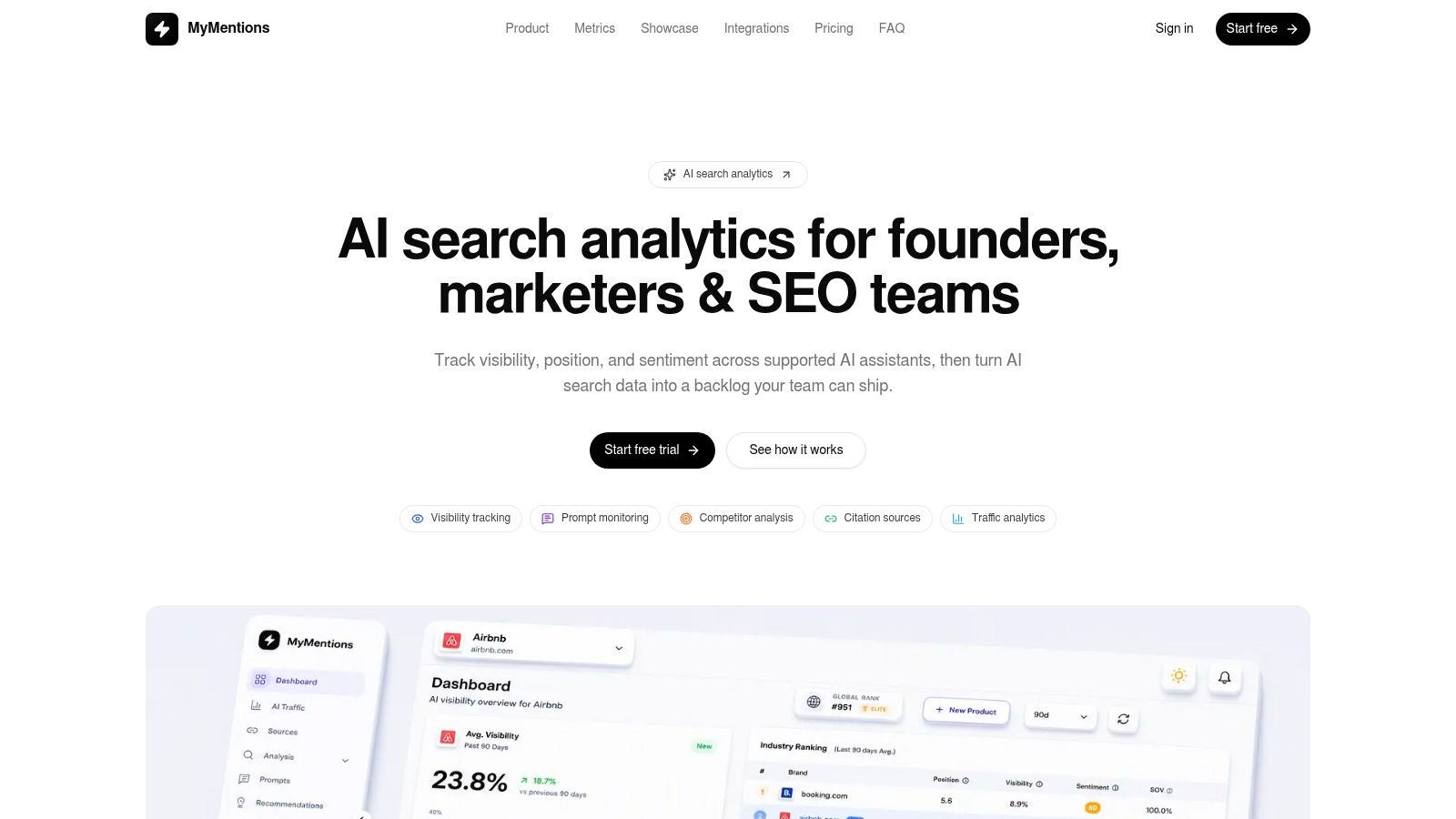
MyMentions is the most direct fit for teams that need to move from “Where are we mentioned?” to “What should we fix next?” Its workspace tracks prompt-level visibility, position, and sentiment across supported AI providers, including OpenAI, Google, Perplexity, Claude, Grok, Copilot, and DeepSeek. That cross-provider view matters because visibility can fragment sharply between assistants.
The product also surfaces the sources shaping answers, including product documentation, reviews, partner pages, and help content. This changes the workflow from generic mention tracking to source analysis. A marketer can see that a competitor is being supported by review coverage, while a product team can identify missing documentation or unclear positioning on its own site.
Best for turning visibility gaps into work
MyMentions combines share of voice, average rank, confidence signals, competitor benchmarking, citation-source analysis, and traffic attribution in one workspace. Its recommendation queue converts findings into prioritized actions across trust, content, UX, and technical signals. That's a meaningful distinction from a dashboard that reports a decline but leaves the team to diagnose it manually.
Teams can create buyer-intent prompts, compare outcomes across providers, and receive alerts through Slack, Discord, or email. Custom exports help product marketing, SEO, and leadership teams work from the same evidence.
Practical rule: Treat a visibility score as a starting signal. The citation source and the prompt where you disappear are usually more useful for deciding what to ship.
Paid plans include a 7-day free trial. Protocol Alpha costs $49 per month and includes 25 provider checks per day across 3 AI providers. Protocol Delta costs $99 per month, with 50 provider checks per day, 8 providers, 2 team seats, integrations, traffic analytics, and advanced recommendations. Protocol Omega costs $199 per month, with 100 provider checks per day, 5 seats, scheduled reports, competitor tracking, and deeper coverage. These details are listed in the supplied product brief, and teams should validate current coverage during the trial.
The main limitation is plan depth. The Starter tier may be enough for one product, but teams requiring broader coverage or higher analysis volume will need a higher plan. The site also lists no third-party awards, certifications, or public customer testimonials, so the trial is important. For a deeper explanation of the source workflow, see AI citation tracking with MyMentions.
2. Semrush
Semrush is the pragmatic choice for teams that don't want AI visibility separated from their existing SEO operation. Its AI Visibility toolkit tracks brand presence across Google AI Overviews, ChatGPT, Gemini, Perplexity, and other supported assistants, while the broader platform continues to handle keywords, domains, competitors, and SERP analysis.
The advantage isn't just feature breadth. It's the ability to place AI visibility beside familiar SEO metrics, so an SEO manager can compare traditional search performance with how the same brand appears in generated answers. Prompt tracking, sentiment, domain-level visibility, and competitor analysis support a shared reporting language across organic and AI discovery.
Where Semrush fits best
Semrush publishes plans that bundle SEO and AI visibility, which gives buyers more pricing clarity than a fully sales-led enterprise platform. Higher tiers add API and MCP support, making the product more relevant when teams need to move data into internal workflows.
The tradeoff is measurement interpretation. Third-party AI Overview monitoring is directional, and model or interface changes can affect coverage. Semrush also won't necessarily capture every model version or provider behavior in real time, so teams with highly specific assistant-level requirements should test their priority prompts before standardizing on it.
For a conventional SEO department, that may be an acceptable compromise. The team gets a single vendor, established SEO workflows, and an expanding AI layer. For a founder who needs citation-level explanations and a ship-ready backlog, a dedicated workspace may be more actionable.
A mainstream SEO suite reduces operational friction, but it doesn't remove the need to inspect the underlying prompts and cited sources.
Read the supplied comparison of the best AI visibility tools from MyMentions before deciding whether an integrated suite or a specialist platform better matches your workflow.
3. SISTRIX
SISTRIX suits SEO teams that value historical search intelligence and want AI monitoring inside the same environment. Its Visibility Index and rank-tracking workflows extend into AI Search, AI Check, Google AI Overviews, Google AI Mode, and ChatGPT analysis.
That combination creates a different kind of value from a dedicated assistant-monitoring workspace. SISTRIX is strongest when the question is comparative and historical: how has a domain's search visibility changed, which keywords trigger AI features, and how does AI presence relate to broader SERP performance?
A strong bridge from SERPs to AI answers
The AI Check and prompt-tracking modules provide monthly update quotas, with larger allocations on higher tiers. AI Overview detection and historical presence for domains and keywords are useful for teams that already maintain substantial SERP datasets and want to add generative surfaces without rebuilding their research process.
SISTRIX's integrated approach also reduces the temptation to treat AI visibility as a completely separate discipline. Traditional search data still helps teams understand the pages and entities assistants may consult, but AI answers remain less uniform than ordinary ranking reports. Coverage is growing, yet it isn't exhaustive across all assistants.
Euro pricing and unfamiliar feature names may require internal translation for teams outside Europe. That's a buying consideration, not a product defect, but it adds implementation effort when multiple departments need to understand the reporting.
For an SEO lead, SISTRIX is a sensible choice when historical benchmarking matters more than prescriptive recommendations. For a product marketer investigating why a specific answer excludes the brand, the team may need a complementary prompt and citation tool. See this practical guide on how to rank in AI Overviews for the optimization context.
4. Similarweb
Similarweb approaches AI visibility through the executive question: is assistant presence connected to traffic? Its GenAI Intelligence tracks brand mentions across AI chatbots, while its AI Traffic Overview estimates chatbot referrals by language-model source through an API.
That makes it more useful for analytics leaders and senior marketers than for a small content team looking for page-level fixes. Similarweb's strength is comparative business intelligence. A company can study AI visibility alongside broader traffic benchmarks and connect those signals to reporting systems used by marketing, finance, or leadership.
Useful for attribution, not perfect proof
Similarweb also surfaces AI Overview presence through Rank Tracker and offers modules for emerging AI advertising and share-of-voice analysis. The platform's enterprise data and API orientation can support business intelligence integrations, especially when the organization already uses Similarweb for market and traffic analysis.
The limitation is methodological. AI referral figures are modeled estimates, not a complete first-party record of every assistant-influenced visit. Conductor's 2026 benchmark places AI referral traffic at just over 1% of total web visits, based on U.S. monthly AI search traffic analysis from May through September 2025, and reports average growth of roughly 1% per month. That context suggests teams shouldn't judge AI visibility only by current traffic volume. Prompt and citation signals may reveal an emerging referral stream before it becomes a major channel.
Similarweb's full platform is sales-led, and feature bundles vary by contract. Buyers should ask exactly which assistants, referral sources, API fields, and historical windows are included. The product is strongest when the organization needs modeled traffic context and enterprise integration, not when a small team wants a low-friction action queue.
The supplied AI traffic analytics guide provides a useful framework for connecting assistant visibility with visits without treating estimates as deterministic attribution.
5. Ahrefs
Ahrefs gives established SEO users a familiar route into AI search monitoring. Its AI Overviews Tracker and SERP Feature filters help teams identify AIO presence for organic keywords, while Brand Radar extends monitoring toward mentions and citations inside Google AI Overviews and major assistants.
The important distinction is between search-result feature tracking and assistant prompt monitoring. Ahrefs is particularly comfortable on the first side. A team can study the keywords that trigger AI Overviews, relate them to existing organic performance, and use familiar link and keyword workflows to investigate the pages involved.
A practical add-on for Ahrefs users
Bot Analytics adds technical context by highlighting AI assistant crawler activity in server logs. That can answer a question ordinary mention reports can't: are AI-related bots reaching the content at all? Crawler activity doesn't prove that an assistant cited a page or sent a visitor, but it can help technical teams identify access patterns and investigate blocked or overlooked content.
Some AI features and add-ons depend on the plan. Measurements of AIO impact on clicks are also directional, because an observed AI Overview is not the same thing as a confirmed click attributable to that feature.
Ahrefs works best for SEO teams already invested in its interface and datasets. They gain continuity, documentation, and a familiar way to connect AI Overview observations with links, keywords, and crawl-related signals. They may still need a specialist platform for broad provider comparison, sentiment, citation-source diagnosis, and recommendation management.
The useful separation: crawler activity tells you that a bot accessed content. It doesn't tell you that a buyer saw, trusted, or clicked an AI recommendation.
For teams focused specifically on Google's generated result layer, the AI Overview tracker explanation is a useful companion to this distinction.
6. Botify
Botify is built for organizations where technical access and large-scale site behavior matter as much as answer visibility. Its enterprise platform combines AI Visibility monitoring across ChatGPT, Google AI Mode and Gemini, Perplexity, and AI Overviews with log-based detection of AI bots crawling the site.
That combination gives technical SEO teams a view many content-led tools can't provide. The visibility dashboard shows where the brand appears, while server logs reveal which AI bots reach which areas of the site. Those are related but separate observations, and keeping them separate prevents teams from mistaking crawling for citation.
Designed for technical governance
Botify supports exports, reporting, and API options for stakeholder updates and integrations. Enterprise onboarding and support can help organizations coordinate SEO, web operations, analytics, and content teams around one data environment.
The cost is complexity. Custom enterprise pricing makes Botify difficult to evaluate as a lightweight experiment, and the learning curve is higher than a focused visibility tracker. A small SaaS team probably won't benefit from adopting a log-analysis platform before it has a clear prompt set and a repeatable content process.
Large organizations, however, often need to answer technical questions such as whether AI bots are accessing documentation, whether important sections receive crawler attention, and whether visibility losses coincide with changes in site architecture or access rules. Botify's value increases when the organization has the people and permissions to act on those findings.
Use it when the primary problem is sitewide technical observability plus enterprise reporting. Pair it with a prompt-level workspace when editors and product marketers need direct evidence about assistant answers, citations, and competitive positioning.
7. seoClarity
seoClarity is an infrastructure choice for enterprises that want to feed AEO and AI visibility data into internal analytics rather than rely only on a vendor dashboard. Its AI Search Visibility API and MCP server connectors support workflows where organizations stream mentions, citations, and visibility signals into reporting systems or internal assistants.
The platform also offers large-scale rank and SERP intelligence, domain research APIs, enterprise dashboards, and data exports. That makes it less of a standalone monitoring product and more of a foundation for teams building an organization-wide search intelligence layer.
Best when data must travel
An API-first model is valuable when the company has data engineers, analysts, or platform teams who can standardize fields, combine AI visibility with CRM and traffic data, and create role-specific views. A marketing leader may need competitive share of voice, while an SEO engineer may need domain and SERP research. An internal system can support both without forcing every user into the same dashboard.
The limitation is buying and implementation effort. Public pricing isn't transparent, and the sales motion is enterprise-centric. The best return requires technical resources to configure integrations, establish governance, and turn raw or semi-structured outputs into decisions.
That makes seoClarity a poor fit for a founder who wants to start monitoring buyer-intent prompts this week. It can be a strong fit for a large organization already standardizing on seoClarity and looking to add AI search data to existing pipelines.
A useful evaluation question is not “How many AI features does it have?” Ask instead: who will own the API, who will maintain prompt and provider definitions, and which teams will act on the resulting data?
8. BrightEdge
BrightEdge targets large brands that need ongoing Google AI Overview monitoring alongside enterprise content and SEO workflows. Its Generative Parser and related reports identify keywords that trigger AI Overviews and show whether a domain is cited.
The product's center of gravity is Google's ecosystem. That focus can be an advantage for organizations with extensive Google keyword portfolios, established reporting routines, and leadership that wants a consistent view of AIO exposure across large topic sets.
Strong for executive-ready Google reporting
BrightEdge's Data Cube X filtering helps teams identify AIO-prone keywords and topics. Weekly AI search insights and executive-friendly reporting can support prioritization across content operations, regional teams, and brand portfolios.
The tradeoff is provider breadth. Teams that need to compare ChatGPT, Perplexity, Gemini, Claude, Copilot, Grok, and DeepSeek at the prompt level may find the coverage less suitable than a multi-assistant workspace. BrightEdge's enterprise pricing and onboarding also make it impractical for small teams that are still testing whether AI visibility belongs in their regular process.
BrightEdge is most defensible when the measurement problem is Google AIO at scale, not general assistant intelligence. It can help a large SEO organization quantify where generated result features appear and which domains receive citations. It won't, by itself, answer every question about how different assistants describe a product or which third-party sources shape those descriptions.
That distinction matters because a brand may look healthy in Google while losing visibility in a conversational assistant. A Google-centered platform should therefore be evaluated against the company's actual buyer journey, not treated as a universal AI visibility score.
9. Nozzle
Nozzle is for teams that want configurable SERP monitoring rather than a packaged, multi-assistant prompt workspace. It detects and trends AI Overviews, supports hourly, daily, weekly, and monthly pulls, and provides API and BigQuery access for custom reporting.
Its pricing model is tied to SERP pulls rather than a fixed keyword-count framework. An overage calculator and transparent pricing levers make it easier for technical buyers to estimate usage, especially when they need different monitoring cadences for different projects.
Flexible data for custom systems
Nozzle's main advantage is data portability. A team can export results, connect them to BigQuery, and build dashboards around its own definitions of visibility, competitors, and reporting periods. That's valuable for analytics groups that already maintain a warehouse and don't want another closed reporting layer.
The limitation is scope. Nozzle focuses primarily on AIO and SERP monitoring, with less emphasis on multi-assistant, prompt-level visibility. Teams must do more setup if they want to mirror the same buyer-intent prompt set across different assistants, because SERP pulls and conversational prompts are not interchangeable units of measurement.
Nozzle is therefore a specialist instrument. Choose it when the question is: How often does this search result environment show an AI Overview, and which domains appear within it? Don't choose it expecting a native recommendation queue that connects assistant citations to trust, content, UX, and technical fixes.
It can complement a prompt-level tool well. Nozzle supplies configurable Google SERP evidence, while a dedicated assistant-monitoring workspace handles conversational answers and source-level diagnosis.
10. Conductor
Conductor organizes AI search performance around prompts, topics, cohorts, and competitive share of voice. Its module tracks brand presence across ChatGPT, Perplexity, Google AI Overviews, and other supported assistants, then connects those findings to the wider Conductor SEO stack and Data API.
The cohorting model is useful for teams that don't want one blended score across every query. A brand manager can group prompts by product category, while an SEO team can compare topic clusters or intent groups over time. That structure makes trend reporting more meaningful than a single number that hides which prompts changed.
A fit for mature monitoring programs
Conductor also supports competitive comparisons, filters, custom instructions, and a data API for internal analytics. Its frequent release cadence reflects a category where assistants and interfaces continue to change, but that same change means buyers should confirm current engine coverage and measurement depth.
Packaging is sales-led, with usage-based elements that require discovery and scoping. Assistant coverage also varies by engine, and model changes can affect how comparable results remain over time. A weekly trend line can be useful, but it shouldn't be treated as a permanent measurement standard without checking the underlying prompt set, provider, response conditions, and cited sources.
Conductor is a strong option for organizations already using its SEO workflows and wanting AI search performance in the same operating environment. Smaller teams may prefer a more prescriptive tool with transparent plans and built-in recommendations. Analytics-heavy enterprises may value its API, while content teams should confirm whether the interface exposes enough cause analysis to support day-to-day execution.
Top 10 AI Search Visibility Tools, Side-by-Side Comparison
| Tool | Core features ✨ | UX & Quality ★ | Price & Value 💰 | Best for 👥 | Unique selling point ✨ |
|---|---|---|---|---|---|
| MyMentions 🏆 | Prompt‑level visibility across OpenAI/Google/Perplexity/Claude/Grok/etc., citation‑source analysis, recommendation queue, traffic attribution | ★★★★★ | 💰 Starter $49 / Pro $99 / Enterprise $199, 7‑day trial | 👥 Founders, product marketers, SEO teams | ✨ Cross‑provider prompt tracking + ship‑ready fixes + traffic validation |
| Semrush, AI Visibility toolkit | Domain & prompt tracking, AI Overview detection, blended SEO+AI dashboards | ★★★★☆ | 💰 Published plans, bundles SEO + AI tools | 👥 Marketing & SEO teams wanting single‑vendor | ✨ Integrated SEO + AI visibility workflows |
| SISTRIX, AI/Chatbot Analysis | AI Check, AI Overviews detection, historical SERP datasets, API access | ★★★★☆ | 💰 Euro‑priced plans, AI included across tiers | 👥 Teams needing long‑term SERP history & benchmarking | ✨ Deep historical SERP context for AI visibility |
| Similarweb, GenAI Intelligence | Brand mentions in chatbots, AI traffic estimates, enterprise APIs | ★★★★☆ | 💰 Enterprise/sales‑led, API integrations | 👥 Execs & BI teams tracking AI→traffic impact | ✨ Strong traffic attribution & enterprise data pipelines |
| Ahrefs, AI Overviews Tracker | AIO tracker, Brand Radar, bot analytics, organic keyword filters | ★★★★☆ | 💰 Some free tools; AI features gated by plan | 👥 SEO teams already on Ahrefs | ✨ Familiar UX + bot analytics surface AI crawler activity |
| Botify, AI Visibility (Enterprise) | AI visibility dashboards, log‑based AI bot detection, exports/APIs | ★★★★ | 💰 Enterprise/custom pricing | 👥 Large sites needing technical SEO & logs | ✨ Server‑log detection of specific AI bots |
| seoClarity, AEO / AI Search Visibility | AI Search Visibility API, MCP connectors, large‑scale domain APIs | ★★★★ | 💰 Enterprise pricing; API‑first contracts | 👥 Enterprises building internal AI/SEO analytics | ✨ API‑first AEO data for internal systems |
| BrightEdge, Generative Parser | AIO presence & citation tracking, weekly AI insights, Data Cube X | ★★★★ | 💰 Enterprise plans, onboarding required | 👥 Large brands & content orgs | ✨ Early, large‑scale SGE/AIO quantification |
| Nozzle, SERP & AIO Monitoring | AI Overview detection, flexible cadence (hourly→monthly), BigQuery export | ★★★★ | 💰 Usage‑based (SERP pulls), transparent levers | 👥 Teams needing data portability & custom BI | ✨ Granular cadence + BigQuery pipelines |
| Conductor, AI Search Performance | Prompt/topic cohorting, share‑of‑voice, Data API | ★★★★ | 💰 Sales‑led, usage/scoped packages | 👥 SEO + content teams integrating AI insights | ✨ Cohorting prompts & SOV across assistants |
Build a Measurement Loop, Not a Tool Stack
The right tool depends on the measurement problem, not on the length of a feature list. If the team needs concrete content and product fixes, start with prompt-level, citation-aware analytics. If AI visibility must sit beside keywords, rankings, and SERP features, an established SEO suite such as Semrush, SISTRIX, Ahrefs, BrightEdge, or Conductor may reduce friction. If leadership needs referral context, Similarweb is more relevant. If engineers need crawler behavior and server evidence, Botify belongs in the evaluation. If internal reporting is the priority, seoClarity or Nozzle may fit better because their API and export models support custom systems.
The market remains early despite its crowded appearance. One 2026 roundup estimates more than 27 platforms, with average pricing of about $337 per month and most subscriptions clustered between $49 and $499 per month. The same source describes a small group of vendors dominating agency conversations, which suggests that workflow integration may matter more than collecting every available dashboard. Review the 2026 GEO market overview for that market context.
Your measurement loop should separate at least four signals:
- Prompt visibility: Does the assistant mention or recommend the product for a defined buyer-intent prompt?
- Citation evidence: Which exact pages, publications, reviews, or partner sources support the answer?
- AI Overview monitoring: Does a Google search result show an AI-generated summary or citation?
- Traffic and technical data: Did an assistant referral appear in analytics, and are AI crawlers reaching relevant pages?
These signals answer different questions. A crawler log can show bot activity without proving an answer citation. An AI Overview tracker can show a Google SERP feature without measuring ChatGPT recommendations. A referral estimate can suggest a traffic trend without exposing the prompt or source that created it.
Start by defining the prompts real buyers use, not only the keywords already tracked in SEO software. Include category discovery, comparison, alternatives, use-case, integration, and problem-aware questions. Establish a baseline for your brand, direct competitors, providers, and citation sources. Then inspect where the brand vanishes, identify whether the gap comes from weak content, missing trust signals, poor technical access, or insufficient third-party coverage.
Measurement also needs repetition. A 2026 critical survey highlighted low source overlap, run-to-run variability, and fidelity gaps in commercial AI audits. It also found that generic heuristics can transfer poorly, while citation-oriented rewrites may sometimes impair retrieval. That means a single weekly report shouldn't trigger a major strategy change without repeated observations under a stable prompt and provider setup. Read the complete AI search visibility guide for the source-level and measurement issues behind that caution.
For teams that want this loop in one hands-on workspace, MyMentions provides a native path from cross-provider monitoring to citation analysis, competitor comparison, recommendations, alerts, exports, and traffic attribution. Its 7-day free trial is the sensible starting point. Test the providers your buyers use, confirm that the citation sources are visible, check whether the recommendations are specific enough to ship, and only then decide whether the coverage matches your operating model.
MyMentions helps founders, marketers, and SEO teams track how AI assistants discover, rank, describe, and cite their products across buyer-intent prompts. Visit MyMentions to test cross-provider visibility, source analysis, competitor benchmarking, recommendations, alerts, and traffic attribution in one workspace.